REVIEW 3 major objections 3 minor 67 references
A Full-Atmosphere Model of Jupiter
T0 review · 3 major / 3 minor · reviewed 2026-08-05 · deepseek-v4-flash
Pith's one-line read A 1D kinetics model spanning Jupiter's full atmosphere predicts a new stratospheric HCN layer peaking at 33 ppb at 2.94e-7 bar.
desk verdict Useful full-atmosphere Jupiter chemistry model with a testable HCN prediction, but the abstract's N2 value contradicts the body and undermines the HCN peak. read the letter →
The pith
A machine-rendered reading of the paper's core claim, the machinery that carries it, and where it could break.
The reading
What carries the argument
ARGO, a 1D photochemical-thermochemical kinetics solver, running the STAND gas-phase reaction network with the new NH4SH chemistry. At each level ARGO integrates coupled continuity equations dn_i/dt = P_i - L_i - dPhi_i/dz, with eddy and molecular diffusion supplying vertical transport; reverse reaction rates are set by Gibbs free energies, which lets the deep atmosphere relax to thermochemical equilibrium. HCN's stratospheric peak is carried by a radical chain: CH4 photolysis gives CH/CH3, N2 photolysis gives N, then N + CH3 -> H2CN and H2CN -> HCN, with net 2CH4 + N2 -> 2HCN + 3H2. The NH4SH cloud layer is anchored by fitted NASA-polynomial thermodynamics derived from the NH3+H2S equilibri
What would settle it
A limb or occultation retrieval resolving the 1e-6 to 6.76e-8 bar window that returns an HCN upper limit below a few ppb at ~3e-7 bar (well under the predicted 33 ppb peak) would falsify the gas-phase layer; detecting a localized rise toward tens of ppb at 2.94e-7 bar would confirm it.
Extended reading notes
Core claim
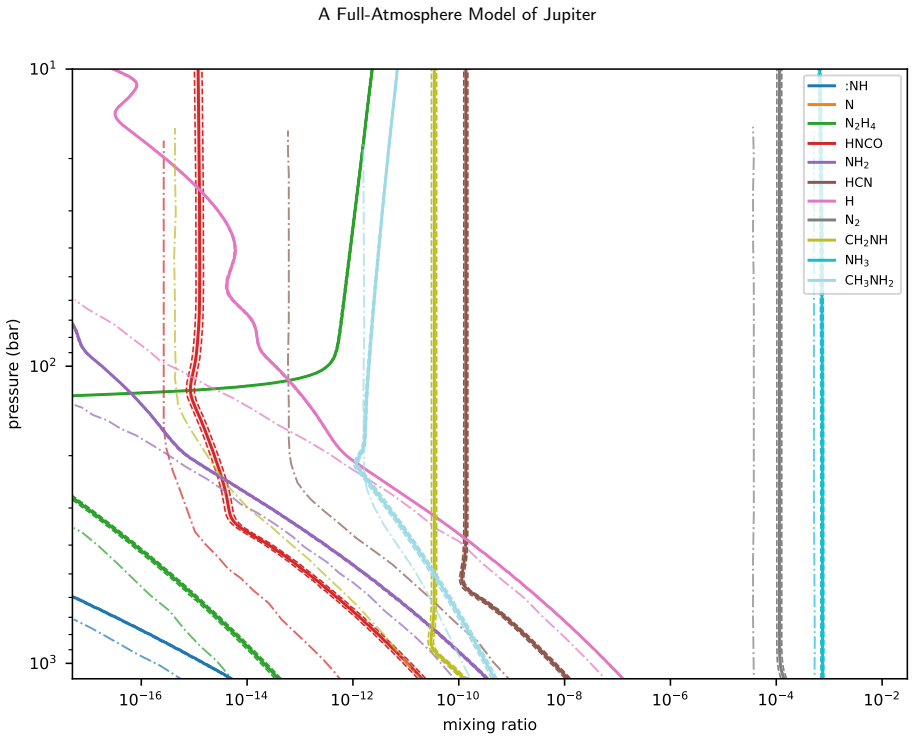
The paper's central object is a 1D photochemical-thermochemical kinetics model extending from 1.1e3 bar to 7.4e-11 bar, with sulfur chemistry included over this full span for the first time. After validation against regional models and spacecraft observations, it reproduces Jupiter's main chemistry, including a mixed NH3-NH4SH cloud layer between 0.1 and 1 bar. Its new claim is six vertically separated HCN regimes; in the fifth, between 1e-6 and 6.76e-8 bar, photolysis of CH4 and N2 feeds radicals that make HCN by net 2CH4 + N2 -> 2HCN + 3H2, peaking at 33 ppb at 2.94e-7 bar. The authors present this peak as observationally testable and additionally report CO frozen at 4.2 ppb near 318 bar.
Load-bearing premise
The predicted 33 ppb HCN peak assumes gas-phase radical chemistry alone sets HCN between 1e-6 and 6.76e-8 bar; the paper itself notes the model excludes aerosol chemistry, while observations have proposed that aerosols remove HCN.
Editorial extensions
If this is right
- A limb or occultation observation aimed at the 1e-6 to 6.76e-8 bar window can confirm or reject the 33 ppb HCN peak without an entry probe.
- The model's gas-phase destruction transition near 2 mbar offers a purely chemical explanation for the sharp HCN drop-off seen in recent ALMA data, independent of the proposed aerosol mechanism.
- NH4SH condensation between 0.1 and 1 bar sequesters most sulfur below the cloud, so deep sulfur abundance must be inferred from H2S below that layer, not from upper-atmosphere sulfur.
- A CO abundance frozen at 4.2 ppb near 318 bar provides an observable linkage from Jupiter's deep water and oxygen supply to the CO seen higher in the atmosphere.
- Having one code from 1,100 bar to 7.4e-11 bar means future retrievals can be compared with a single self-consistent chemical profile, rather than patched regional models.
Reading between the lines
- The authors do not say so, but a steady background HCN source implies post-Shoemaker-Levy 9 HCN maps need a modeled baseline before cometary material can be cleanly separated; the predicted layer could serve as that baseline.
- If the radical mechanism is real, any gas-rich world with overlapping CH4 and N2 photolysis regions should produce a similar HCN layer; locating where the two photolysis cutoffs cross would give a fast, transferable prediction.
- Because aerosol chemistry is absent, a non-detection of the 33 ppb peak would more likely mean HCN uptake on haze than failure of the gas-phase chain; fitting an aerosol uptake coefficient to the observed profile would separate the two effects.
- The peak's width and altitude encode stratospheric vertical mixing, so high-resolution spectra of the layer could constrain Kzz independently of temperature retrievals even if the absolute abundance remains uncertain.
Signed reviews
Editorial analysis
A structured set of objections, weighed in public.
Referee Report
Summary. The paper couples a thermochemical-kinetic 1D model (ARGO with the STAND network) over 1.1e3 bar to 7.4e-11 bar to describe Jupiter's deep atmosphere, troposphere, and stratosphere in a single code. New updates include NH4SH formation/destruction, Antoine equations for NH4SH and H2S condensation, and two updated reaction rates. The model is benchmarked against several regional models (Rimmer & Helling 2016; Hu 2021; Tsai et al. 2021; Visscher et al. 2010; Moses et al. 2010; Rensen et al. 2023) and against observations. It reproduces the main hydrocarbon profiles, CO quenching (4.2 ppb at ~318 bar), the NH3-NH4SH cloud near 0.1-1 bar, and a relatively constant N2 mixing ratio (11 ppm in §5) up to 1e-6 bar. The headline result is a newly identified HCN formation region at 1e-6 to 6.76e-8 bar driven by N2 photolysis (Eq. 36), with a predicted peak of 33 ppb at 2.94e-7 bar, presented as testable by JUICE/MAJIS. The abstract additionally claims a quenched N2 mixing ratio of 490 ppm, which is inconsistent with §5 and with the N inventory in Table 1.
Significance. If correct, the paper would provide the first full-pressure-range coupled kinetics model for Jupiter's sulfur and nitrogen chemistry and a falsifiable stratospheric HCN prediction. Strengths include use of a published, reusable code framework; comparisons to multiple state-of-the-art codes and observations; explicit incorporation of sulfur chemistry; and a clearly articulated reaction mechanism for HCN (Eq. 36). The HCN peak is a genuine model output rather than a fit to target observables, which lowers circularity concerns. However, the N2 abundance inconsistency directly affects the magnitude of this prediction, and the NH4SH thermodynamics rest on unvalidated extrapolations. These points prevent acceptance in the current form.
major comments (3)
- [Abstract vs. §5; Eq. (36)] The abstract states a quenched N2 mixing ratio of 490 ppm up to 10^-6 bar; §5 reports 'a relatively constant value of 11 ppm from the bottom of the atmosphere up to 10^-6 bar' — a factor-45 discrepancy. Table 1 gives N mole fraction 4.68×10^-4, so 490 ppm N2 would require 9.8×10^-4 N atoms, exceeding the total N inventory. This is load-bearing because the new HCN region (Eq. 36) begins with N2 photolysis; in the 1e-6–6.76e-8 bar window HCN production is approximately first-order in f_N2. With 11 ppm the 33 ppb peak would become ~0.7 ppb. No sensitivity analysis over f_N2 is given. Please reconcile the values, verify N conservation, and provide f_N2 sensitivity for the HCN peak.
- [§2.4.1, Eq. (11); Table 4] The NH4SH equilibrium constant from Lewis (1969), Eq. (11), is explicitly valid only for 180–300 K, yet it is extrapolated to the full atmospheric temperature range, and the resulting NASA polynomials are used up to 6500 K. Similarly, the NH4SH Antoine parameters (Table 4, valid 222.1–306.4 K) are extrapolated to 110 K. The claimed NH3–NH4SH cloud layer between 0.1 and 1 bar (§4, Fig. 8) depends on these saturation relations, and the paper presents sulfur chemistry as one of its main novelties. No uncertainty, error budget, or alternative treatment is offered. Because the cloud-layer claim is a stated validation, this extrapolation needs a targeted sensitivity test (e.g., varying the equilibrium constant within its stated validity or comparing with a current NH4SH thermodynamic dataset).
- [§6, Fig. 14] The 33 ppb HCN prediction is the central new result. The paper states 'Our model does not include aerosol chemistry and would therefore not catch this effect,' referring to Cavalié et al. (2023b), who propose heterogeneous/aerosol removal as the cause of depleted HCN. Since the new production region lies in the stratosphere (1e-6 to 6.76e-8 bar), where haze is present, the predicted peak could be an upper limit. The paper should quantify the heterogeneous-loss timescale or perform a simple sensitivity test with an adopted sticking coefficient. Without that, the 'testable by observations' claim is not yet supported. In addition, the model predicts 33 ppb while the earlier uniform-mixing upper limits of Weisstein & Serabyn (1996) (0.3 ppb) and Davis et al. (1997) (0.16 ppb) are cited; a column-density check against those limits would clarify whether the prediction is already observable.
minor comments (3)
- [§4] 'down to 320 mbar at 1.55 bar' — the unit appears to be a typo for ppm (mixing ratio vs pressure).
- [§2.4.1, Eqs. (22)–(23)] The units of k_f are not clearly defined; including NHTOT in Eq. (23) suggests a termolecular rate coefficient, but c1 is quoted in cm3 s-1. Define bimolecular vs termolecular coefficients to avoid dimensional confusion.
- [§2.2, Table 1] The 5% margin is described as applied to mixing ratios directly and then said not to correspond to a 5% change in metallicity; the interpretation is confusing.
Circularity Check
No significant circularity: predictions are forward model outputs, not fits or self-referential definitions.
full rationale
The paper's central claims—the stratospheric HCN peak at 33 ppb and the quenched N2 abundance—are produced by a forward 1D kinetics model (ARGO with the STAND network), not by fitting to the target observables. Initial elemental abundances are taken from external observational constraints (Rensen et al. 2023, based on Wong et al. 2004 and Li et al. 2020), and reaction rates are largely from published literature with updates from Hu (2021). No parameter is fitted to the HCN or N2 observations used for validation; comparisons to Cavalié et al. (2023b), Weisstein & Serabyn (1996), and Davis et al. (1997) are after-the-fact checks, not inverse constraints. The self-citations to Rimmer & Helling (2016) and Rimmer et al. (2021) describe the public ARGO code and STAND network, but the new results do not reduce to a self-citation: the HCN formation mechanism in Eq. (36) follows from explicit reaction tracing in the network, and the N2 quench value is an emergent disequilibrium output. The paper explicitly notes the missing aerosol chemistry as a limitation, which is a legitimate scope caveat rather than a circular step. An internal inconsistency exists between the abstract's 490 ppm N2 and Section 5's 11 ppm N2, but that is a correctness risk and does not constitute circular self-derivation. No equation in the paper reduces by construction to an input or to a cited authors' claim.
Assumptions & free parameters
free parameters (2)
- Eddy diffusion coefficient Kzz (deep atmosphere) =
1e8 cm^2/s (constant)
- Lower boundary temperature =
1400 K
assumptions (6)
- domain assumption The STAND reaction network is complete and accurate for Jupiter's full atmosphere.
- domain assumption Gas-phase chemistry alone determines stratospheric HCN; no heterogeneous or aerosol loss.
- ad hoc to paper Lewis (1969) NH4SH equilibrium constant, valid 180-300 K, can be extrapolated to the full atmospheric temperature range.
- ad hoc to paper Antoine equation parameters for NH4SH are valid when extrapolated from 222-306 K down to 110 K.
- domain assumption The actinic flux at Jupiter is the solar flux at Earth scaled by inverse-square distance to 5.2 AU.
- domain assumption Deep elemental abundances from Rensen et al. (2023), based on Wong et al. (2004) and Li et al. (2020), are representative of Jupiter's bulk composition.
Cite this review
Pith. "Pith review of A Full-Atmosphere Model of Jupiter." pith.science (2026). https://pith.science/paper/BUCIUHFR
@misc{pith2026250904034,
  author       = {Pith},
  title        = {Pith review of: A Full-Atmosphere Model of Jupiter},
  year         = {2026},
  howpublished = {\url{https://pith.science/paper/BUCIUHFR}},
  note         = {Machine review of arXiv:2509.04034}
}
abstract
This paper presents a combined 1D photochemical-thermochemical kinetics model of Jupiter's deeper atmosphere, troposphere and stratosphere. The model covers atmospheric pressure range from $1.1 \times 10^{3}$ bar to $7.4 \times 10^{-11}$ bar and is the first model that incorporates sulfur chemistry when spanning an atmospheric region of this extent. This model incorporates a new version of the STAND reaction network with updated NH4SH chemistry, and updated Antoine equation parameters for NH4SH and H2S. Validation against current models of Jupiter's atmosphere as well as recent observational data shows that our model successfully describes Jupiter's main observed chemical features. Since one of the focuses of the model is the chemistry on nitrogen, it correctly predicts the formation of a mixed NH3-NH4SH cloud layer between 0.1 and 1 bar. It also describes the chemistry of HCN throughout the atmosphere and discovers a region in the stratosphere between $1 \times 10^{-6}$ and $6.76 \times 10^{-8}$ bar, where HCN forms through radical chemistry with maximum mixing ratio 33 ppb at $2.94 \times 10^{-7}$ bar -- a prediction testable by observations. At the same time, our model predicts a quenched N2 mixing ratio 490 ppm up to 10$^{-6}$ bar. The model therefore successfully bridges the gap between existing models of separate regions of Jupiter's atmosphere and makes new testable predictions of several chemical species.
Figures


Figures from the paper (11 more)




Reference graph
Works this paper leans on
-
[1]
pp. 1–47. URL: https://onlinelibrary.wiley.com/doi/abs/10.1002/047002903X.ch1, doi:https: //doi.org/10.1002/047002903X.ch1. Matthews, C.N.,
-
[3]
Cambridge Planetary Science, pp
The interior of Jupiter. Cambridge Planetary Science, pp. 35–58. URL:https://books.google.co.uk/books?id= aMERHqj9ivcC. Gupta, P., Atreya, S.K., Steffes, P.G., Fletcher, L.N., Guillot, T., Allison, M.D., Bolton, S.J., Helled, R., Levin, S., Li, C., Lunine, J.I., Miguel, Y., Orton,G.S.,HunterWaite,J.,Withers,P.,2022. Jupiter’stemperaturestructure:Areassess...
work page 2022
-
[9]
Planetary and Space Science 45, 1203–1212. URL:https://www. sciencedirect.com/science/article/pii/S0032063397000433, doi:https://doi.org/10.1016/S0032-0633(97)00043-3. the SL9-Jupiter Collision. A Knížek et al.:Preprint submitted to Elsevier Page 23 of 25 A Full-Atmosphere Model of Jupiter Lellouch,E.,Paubert,G.,Moreno,R.,Festou,M.C.,Bézard,B.,Bockelée-Mo...
-
[15]
Moses, J.I., Visscher, C., Keane, T.C., Sperier, A.,
doi:10.1088/0004-637x/737/1/15. Moses, J.I., Visscher, C., Keane, T.C., Sperier, A.,
-
[17]
Are the giant planets fully convective? Icarus 112, 337–353. doi:10.1006/icar.1994
-
[21]
doi:10.3847/1538-4357/ ab55e8. Rimmer,P.B.,Helling,C.,2016.Achemicalkineticsnetworkforlightningandlifeinplanetaryatmospheres.TheAstrophysicalJournal:Supplement series
-
[25]
Geophysical Research Letters 44, 7676–7685
Implications of the ammonia distribution on jupiter from 1 to 100 bars as measured by the juno microwave radiometer. Geophysical Research Letters 44, 7676–7685. URL:https://agupubs.onlinelibrary. wiley.com/doi/abs/10.1002/2017GL074277, doi:https://doi.org/10.1002/2017GL074277. Ingersoll, A.P., Cuzzi, J.N.,
-
[27]
Huebner, W.F., Carpenter, C.W.,
URL: https://doi.org/10.3847/1538-4357/ac1789, doi:10.3847/1538-4357/ac1789. Huebner, W.F., Carpenter, C.W.,
Show all 67 references
- [33]
-
[35]
Nature Astronomy 4, 609+
The water abundance in jupiter’s equatorial zone. Nature Astronomy 4, 609+. doi:10.1038/s41550-020-1009-3. Li, C., Ingersoll, A., Janssen, M., Levin, S., Bolton, S., Adumitroaie, V., Allison, M., Arballo, J., Bellotti, A., Brown, S., Ewald, S., Jewell, L., Misra,S.,Orton,G.,Oy...
2017 doi
-
[36]
Icarus 302, 418–425
Coloring Jupiter’s clouds: Radiolysis of ammonium hydrosulfide (NH4SH). Icarus 302, 418–425. doi:10. 1016/j.icarus.2017.10.041. Matteucci, S., Yampolskii, Y., Freeman, B.D., Pinnau, I.,
2017
-
[40]
URL:https://www.sciencedirect.com/science/article/pii/S0032063303000722, doi:https://doi.org/10.1016/S0032-0633(03)00072-2
Planetary and Space Science 51, 591–611. URL:https://www.sciencedirect.com/science/article/pii/S0032063303000722, doi:https://doi.org/10.1016/S0032-0633(03)00072-2. Moses, J.I.,
-
[42]
Geophysical Research Letters 22, 1597–1600
Post-sl9 sulfur photochemistry on jupiter. Geophysical Research Letters 22, 1597–1600. doi:10.1029/95gl01200. Moses, J.I., Fouchet, T., Bézard, B., Lellouch, E., Gladstone, G.R.,
- [48]
-
[53]
A Knížek et al.:Preprint submitted to Elsevier Page 22 of 25 A Full-Atmosphere Model of Jupiter Fouchet, T., Lellouch, E., Bézard, B., Feuchtgruber, H., Drossart, P., Encrenaz, T.,
doi:10.1007/s11214-023-00996-6. A Knížek et al.:Preprint submitted to Elsevier Page 22 of 25 A Full-Atmosphere Model of Jupiter Fouchet, T., Lellouch, E., Bézard, B., Feuchtgruber, H., Drossart, P., Encrenaz, T.,
-
[56]
Icarus 292, 182–207
Jupiter’s auroral-related stratospheric heating and chemistry i: Analysis of voyager-iris and cassini-cirs spectra. Icarus 292, 182–207. doi:10.1016/j.icarus.2016.12.033. Stevenson, D.J.,
2016 doi
-
[62]
Icarus 209, 602–615
The deep water abundance on jupiter: New constraints from thermochemical kinetics and diffusion modeling. Icarus 209, 602–615. URL: https://www.sciencedirect.com/science/article/pii/S0019103510001387, doi:https: //doi.org/10.1016/j.icarus.2010.03.029. Visscher,C.,Sperier,A.D.,...
2010 doi
-
[64]
Icarus 250, 154–164
New insights on jupiter’s deep water abundance from disequilibrium species. Icarus 250, 154–164. doi:10.1016/j.icarus.2014.11.026. Wang, D., Lunine, J.I., Mousis, O.,
2014 doi
-
[65]
Icarus 276, 21–38
Modeling the disequilibrium species for jupiter and saturn: Implications for juno and saturn entry probe. Icarus 276, 21–38. doi:10.1016/j.icarus.2016.04.027. Weisstein, E.W., Serabyn, E.,
2016 doi
-
[67]
Icarus 10, 386–392
Organic synthesis in a simulated jovian atmosphere. Icarus 10, 386–392. URL: https://www. sciencedirect.com/science/article/pii/0019103569900931, doi:https://doi.org/10.1016/0019-1035(69)90093-1. Woitke, P., Helling, C., Hunter, G.H., Millard, J.D., Turner, G.E., Worters, M., ...
-
[68]
impactofsilicatesandphyllosilicatesonthecarbontooxygenratio.Astronomy&Astrophysics614,A1.doi: 10.1051/0004-6361/201732193
Equilibrium chemistry down to 100 k. impactofsilicatesandphyllosilicatesonthecarbontooxygenratio.Astronomy&Astrophysics614,A1.doi: 10.1051/0004-6361/201732193. Wong, M.H., Mahaffy, P.R., Atreya, S.K., Niemann, H.B., Owen, T.C.,
-
[72]
Visscher, C., Moses, J.I., Saslow, S.A.,
doi:10.1088/0004-637X/738/1/72. Visscher, C., Moses, J.I., Saslow, S.A.,
-
[73]
doi:10.1006/icar.1994.1038
Icarus 108, 1–17. doi:10.1006/icar.1994.1038. Zhang, Z., Adumitroaie, V., Allison, M., Arballo, J., Atreya, S., Bjoraker, G., Bolton, S., Brown, S., Fletcher, L.N., Guillot, T., Gulkis, S., Hodges, A., Ingersoll, A., Janssen, M., Levin, S., Li, C., Li, L., Lunine, J., Misra, S...
1994
-
[74]
Earth and Space Science 7, e01229
Residual study: Testing jupiter atmosphere models against juno mwr observations. Earth and Space Science 7, e01229. doi:10.1029/2020ea001229. A Knížek et al.:Preprint submitted to Elsevier Page 25 of 25
-
[101]
doi:10.3847/1538-3881/aad186. Bolton, S.J., Adriani, A., Adumitroaie, V., Allison, M., Anderson, J., Atreya, S., Bloxham, J., Brown, S., Connerney, J.E.P., DeJong, E., Folkner, W.,Gautier,D.,Grassi,D.,Gulkis,S.,Guillot,T.,Hansen,C.,Hubbard,W.B.,Iess,L.,Ingersoll,A.,Janssen,M.,...
-
[103]
Noll, K., Knacke, R., Tokunaga, A., Lacy, J., Beck, S., Serabyn, E.,
doi:10.1039/c003954c. Noll, K., Knacke, R., Tokunaga, A., Lacy, J., Beck, S., Serabyn, E.,
-
[110]
Moses, J.I., Visscher, C., Fortney, J.J., Showman, A.P., Lewis, N.K., Griffith, C.A., Klippenstein, S.J., Shabram, M., Friedson, A.J., Marley, M.S., Freedman, R.S.,
URL:https: //agupubs.onlinelibrary.wiley.com/doi/abs/10.1029/2005JE002411, doi:https://doi.org/10.1029/2005JE002411. Moses, J.I., Visscher, C., Fortney, J.J., Showman, A.P., Lewis, N.K., Griffith, C.A., Klippenstein, S.J., Shabram, M., Friedson, A.J., Marley, M.S., Freedman, R.S.,
-
[159]
Howard,S.,Guillot,T.,Markham,S.,Helled,R.,Müller,S.,Stevenson,D.J.,Lunine,J.I.,Miguel,Y.,Nettelmann,N.,2023.Exploringthehypothesis of an inverted z gradient inside jupiter
doi:10.3847/PSJ/ac6956. Howard,S.,Guillot,T.,Markham,S.,Helled,R.,Müller,S.,Stevenson,D.J.,Lunine,J.I.,Miguel,Y.,Nettelmann,N.,2023.Exploringthehypothesis of an inverted z gradient inside jupiter. Astronomy & Astrophysics 680, L2. doi:10.1051/0004-6361/202348129. Hu, R.,
2023 doi
-
[194]
doi:10.3847/1538-3881/ab46a8. Poulet, F., Piccioni, G., Langevin, Y., Dumesnil, C., Tommasi, L., Carlier, V., Filacchione, G., Amoroso, M., Arondel, A., D’Aversa, E., Barbis, A., Bini, A., Bolsée, D., Bousquet, P., Caprini, C., Carter, J., Dubois, J.P., Condamin, M., Couturier...
2024 doi
-
[224]
Rimmer, P.B., Jordan, S., Constantinou, T., Woitke, P., Shorttle, O., Hobbs, R., Paschodimas, A.,
doi:10.3847/0067-0049/224/1/9. Rimmer, P.B., Jordan, S., Constantinou, T., Woitke, P., Shorttle, O., Hobbs, R., Paschodimas, A.,
- [264]
-
[559]
Cavalié,T.,Lunine,J.,Mousis,O.,2023a
doi:10.1086/165751. Cavalié,T.,Lunine,J.,Mousis,O.,2023a. Asubsolaroxygenabundanceoraradiativeregiondeepinjupiterrevealedbythermochemicalmodelling. Nature Astronomy 7, 678–683. doi:10.1038/s41550-023-01928-8. Cavalié, T., Rezac, L., Moreno, R., Lellouch, E., Fouchet, T., Benma...
1994 doi
-
[841]
doi:10.3390/rs15030841. A Knížek et al.:Preprint submitted to Elsevier Page 24 of 25 A Full-Atmosphere Model of Jupiter Rimmer,P.B.,Ferus,M.,Waldmann,I.P.,Knížek,A.,Kalvaitis,D.,Ivanek,O.,Kubelík,P.,Yurchenko,S.N.,Burian,T.,Dostál,J.,Juha,L.,Dudžák, R.,Krůs,M.,Tennyson,J.,Civi...
2020 doi
-
[1188]
Storms and the depletion of ammonia in jupiter: Ii
Guillot, T., Li, C., Bolton, S.J., Brown, S.T., Ingersoll, A.P., Janssen, M.A., Levin, S.M., Lunine, J.I., Orton, G.S., Steffes, P.G., Stevenson, D.J., 2020a. Storms and the depletion of ammonia in jupiter: Ii. explaining the juno observations. Journal of Geophysical Research ...
-
[1947]
organic and inorganic compounds
Vapor pressure of pure substances. organic and inorganic compounds. Industrial & Engineering Chemistry 39, 517–540. URL: https://doi.org/10.1021/ie50448a022, doi:10.1021/ie50448a022. Sutherland, J.D.,
-
[1969]
Journal of Atmospheric Sciences 26, 981–985
Dynamics of jupiter’s cloud bands. Journal of Atmospheric Sciences 26, 981–985. URL: https: //journals.ametsoc.org/view/journals/atsc/26/5/1520-0469%5F1969%5F026%5F0981%5Fdojcb%5F2%5F0%5Fco%5F2.xml, doi:https://doi.org/10.1175/1520-0469(1969)026<0981:DOJCB>2.0.CO;2. Kaspi, Y.,...
1969 doi
-
[1977]
Science 198, 1031–1034
Carbon Monoxide on Jupiter and Implications for Atmospheric Convection. Science 198, 1031–1034. doi:10.1126/science.198.4321.1031. Prinn, R.G., Olaguer, E.P.,
-
[1981]
JournalofGeophysicalResearch86,5715–5725
Composition and Thermal Profiles of the JovianupperatmospheredeterminedbytheVoyagerultravioletstellaroccultationexperiment. JournalofGeophysicalResearch86,5715–5725. doi:10.1029/JA086iA07p05715. Fletcher, L.N., Cavalié, T., Grassi, D., Hueso, R., Lara, L.M., Kaspi, Y., Galanti...
-
[1983]
The Astrophysical journal 266, 415–424
An analysis of the reflection spectrum of Jupiter from 1500 A to 1740 A. The Astrophysical journal 266, 415–424. doi:10.1086/160789. Grassi,D.,Adriani,A.,Mura,A.,Atreya,S.K.,Fletcher,L.N.,Lunine,J.I.,Orton,G.S.,Bolton,S.,Plainaki,C.,Sindoni,G.,Altieri,F.,Cicchetti,A., Dinelli,...
2020 doi
-
[1985]
Astrophysical Journal 299, 1067–1078
Equilibrium and nonequilibrium chemistry of saturn’s atmosphere - implications for the observability of ph3, n2, co, and geh4. Astrophysical Journal 299, 1067–1078. doi:10.1086/163775. Fegley, Bruce, J., Lodders, K.,
-
[1989]
Infrared Physics 29, 199–204
Infrared studies of hydrocarbons on jupiter. Infrared Physics 29, 199–204. URL: https://www.sciencedirect.com/science/article/pii/0020089189900481, doi:https://doi.org/10.1016/ 0020-0891(89)90048-1. Lellouch, E., Bézard, B., Strobel, D.F., Bjoraker, G.L., Flasar, F.M., Romani, P.N.,
-
[1991]
Origins of Life and Evolution of the Biosphere 21, 421–434
Dark matter in the solar system: Hydrogen cyanide polymers. Origins of Life and Evolution of the Biosphere 21, 421–434. doi:10.1007/bf01808312. Miguel, Y., Bazot, M., Guillot, T., Howard, S., Galanti, E., Kaspi, Y., Hubbard, W.B., Militzer, B., Helled, R., Atreya, S.K., Conner...
-
[1992]
Astrophysics and Space Science 195, 1–294
Solar Photo Rates for Planetary Atmospheres and Atmospheric Pollutants. Astrophysics and Space Science 195, 1–294. doi:10.1007/BF00644558. Huebner, W.F., Mukherjee, J.,
-
[1994]
Icarus 110, 117–154
Chemical models of the deep atmospheres of jupiter and saturn. Icarus 110, 117–154. doi:10.1006/icar. 1994.1111. Ferus, M., Kubelík, P., Knížek, A., Pastorek, A., Sutherland, J., Civiš, S.,
1994
-
[1995]
mushballs
Cepam: a code for modeling the interiors of giant planets. Astronomy & Astrophysicss 109, 109–123. Guillot, T., Stevenson, D.J., Atreya, S.K., Bolton, S.J., Becker, H.N., 2020b. Storms and the depletion of ammonia in jupiter: I. microphysics of “mushballs”. Journal of Geophysi...
-
[1996]
Icarus 123, 23–36
Submillimeter line search in jupiter and saturn. Icarus 123, 23–36. doi:10.1006/icar.1996.0139. Woeller, F., Ponnamperuma, C.,
1996
-
[1997]
Icarus 130, 387–403
Broadband Submillimeter Spectroscopy of HCN, NH3, and PH3in the Troposphere of Jupiter. Icarus 130, 387–403. doi:10.1006/icar.1997.5836. Draine, B.T.,
1997
-
[1998]
JournalofGeophysicalResearch:Planets 103, 22857–22889
Thermalstructureofjupiter’satmosphereneartheedgeofa5- 𝜇mhotspotinthenorthequatorialbelt. JournalofGeophysicalResearch:Planets 103, 22857–22889. doi:https://doi.org/10.1029/98JE01766. Sinclair, J., Orton, G., Greathouse, T., Kasaba, Y., Sato, T., Giles, R., Melin, H., Fletcher,...
-
[1999]
Planetary and Space Science 47, 1243–1262
A comparison of the atmo- spheres of jupiter and saturn: deep atmospheric composition, cloud structure, vertical mixing, and origin. Planetary and Space Science 47, 1243–1262. URL: https://www.sciencedirect.com/science/article/pii/S0032063399000471, doi:https://doi.org/10. 101...
2002
-
[2000]
Astronomy & Astrophysics 355, L13–L17
Jupiter’s hydrocarbons observed with ISO-SWS: vertical profiles of C_2H_6 and C_2H_2, detection of CH_3C_2H. Astronomy & Astrophysics 355, L13–L17. doi:10.48550/arXiv.astro-ph/ 0002273, arXiv:astro-ph/0002273. Freedman,R.S.,Marley,M.S.,Lodders,K.,2008. LineandMeanOpacitiesforU...
-
[2001]
Icarus 152, 331–346
Structure of the Jovian Stratosphere at the Galileo Probe Entry Site. Icarus 152, 331–346. doi:10.1006/icar.2001.6640. Young, R.M.B., Read, P.L., Wang, Y.,
2001
-
[2004]
Icarus 171, 153–170
Updated galileo probe mass spectrometer measurements of carbon, oxygen, nitrogen, and sulfur on jupiter. Icarus 171, 153–170. URL:https://www.sciencedirect.com/science/article/pii/ S0019103504001393, doi:https://doi.org/10.1016/j.icarus.2004.04.010. Yelle, R.V., Griffith, C.A....
2004 doi
-
[2006]
Icarus 184, 478–497
On the HCN and CO2 abundance and distribution in Jupiter’s stratosphere. Icarus 184, 478–497. doi:10.1016/j.icarus.2006.05.018. Lellouch, E., Bézard, B., Moreno, R., Bockelée-Morvan, D., Colom, P., Crovisier, J., Festou, M., Gautier, D., Marten, A., Paubert, G.,
2006 doi
-
[2009]
Annual Review of Astronomy and Astrophysics 47, 481–522
The Chemical Composition of the Sun. Annual Review of Astronomy and Astrophysics 47, 481–522. doi:10.1146/annurev.astro.46.060407.145222. Atreya, S., Wong, M., Owen, T., Mahaffy, P., Niemann, H., de Pater, I., Drossart, P., Encrenaz, T.,
-
[2010]
Icarus 208, 837–849
High-resolution 3-𝜇m spectra of Jupiter: Latitudinal spectral variations influenced by molecules, clouds, and haze. Icarus 208, 837–849. doi:10.1016/j.icarus.2010.03.024. Kitzmann, D., Joachim, S.,
2010 doi
-
[2014]
Philosophical Transactions of the Royal Society of London Series A 372, 20130073– 20130073
Chemical kinetics on extrasolar planets. Philosophical Transactions of the Royal Society of London Series A 372, 20130073– 20130073. doi:10.1098/rsta.2013.0073. Moses, J.I., Allen, M., Gladstone, G.R.,
2013
-
[2015]
Planetary and Space Science 106, 11–45
Photoionization and photodissociation rates in solar and blackbody radiation fields. Planetary and Space Science 106, 11–45. doi:10.1016/j.pss.2014.11.022. Ingersoll, A.P., Adumitroaie, V., Allison, M.D., Atreya, S., Bellotti, A.A., Bolton, S.J., Brown, S.T., Gulkis, S., Janss...
2014 doi
-
[2016]
Angewandte Chemie International Edition 55, 104–121
The origin of life—out of the blue. Angewandte Chemie International Edition 55, 104–121. URL: https:// onlinelibrary.wiley.com/doi/abs/10.1002/anie.201506585, doi:https://doi.org/10.1002/anie.201506585. Tokunaga, A., Beck, S., Geballe, T., Lacy, J., Serabyn, E.,
-
[2017]
Science 356, 821–825
Jupiter’s interior and deep atmosphere: The initial pole-to-pole passes with the juno spacecraft. Science 356, 821–825. doi:10.1126/science.aal2108. Breck, D.W.,
-
[2018]
Nature 558, 87–90
Prevalent lightning sferics at 600 megahertz near jupiter’s poles. Nature 558, 87–90. doi:10.1038/s41586-018-0156-5. Burcat, A., Ruscic, B.,
-
[2019]
Part II: Passive ammonia and water cycles
Simulating Jupiter’s weather layer. Part II: Passive ammonia and water cycles. Icarus 326, 253–268. doi:10.1016/j.icarus.2018.12.002. Zahnle, K., Mac Low, M.M.,
2018 doi
-
[2020]
SpaceScienceReviews216,84
Comparison of the deep atmospheric dynamics of jupiterandsaturninlightofthejunoandcassinigravitymeasurements. SpaceScienceReviews216,84. doi: 10.1007/s11214-020-00705-7. Kim, S.J., Geballe, T.R., Kim, J.H., Jung, A., Seo, H.J., Minh, Y.C.,
-
[2021]
ThePlanetaryScienceJournal2,133
Hydroxide salts in the clouds of venus: TheireffectonthesulfurcycleandclouddropletpH. ThePlanetaryScienceJournal2,133. URL: https://doi.org/10.3847/psj/ac0156, doi:10.3847/psj/ac0156. Romani,P.N.,Jennings,D.E.,Bjoraker,G.L.,Sada,P.V.,McCabe,G.H.,Boyle,R.J.,2008. Temporallyvary...
2008 doi
-
[2022]
Astronomy & Astrophysics 662, A18
Jupiter’s inhomogeneous envelope. Astronomy & Astrophysics 662, A18. doi:10.1051/0004-6361/202243207. Moreno,R.,Marten,A.,Matthews,H.,Biraud,Y.,2003. Long-termevolutionofco,csandhcninjupiteraftertheimpactsofcometshoemaker-levy
2003 doi
-
[2023]
The Astrophysical Journal Letters 952, L27
Highly Depleted Alkali Metals in Jupiter’s Deep Atmosphere. The Astrophysical Journal Letters 952, L27. doi:10.3847/2041-8213/ace115. Bjoraker, G.L., Wong, M.H., de Pater, I., Hewagama, T., Ádámkovics, M., Orton, G.S.,
-
[6232]
Guillot,T.,1999.AcomparisonoftheinteriorsofJupiterandSaturn.PlanetaryandSpaceScience47,1183–1200.doi: 10.1016/S0032-0633(99) 00043-4, arXiv:astro-ph/9907402
doi:10.1038/s41467-023-41665-0. Guillot,T.,1999.AcomparisonoftheinteriorsofJupiterandSaturn.PlanetaryandSpaceScience47,1183–1200.doi: 10.1016/S0032-0633(99) 00043-4, arXiv:astro-ph/9907402. Guillot, T., Gautier, D., Chabrier, G., Mosser, B.,
1999 arXiv
-
[6275]
Festou, M.C., Atreya, S.K., Donahue, T.M., Sandel, B.R., Shemansky, D.E., Broadfoot, A.L.,
doi:10.1038/s41598-017-06489-1. Festou, M.C., Atreya, S.K., Donahue, T.M., Sandel, B.R., Shemansky, D.E., Broadfoot, A.L.,
Reviewed August 5, 2026 · model on record in the stance chip above.
Discussion (0). Continue with ORCID to comment.