REVIEW 3 major objections 4 minor 39 references
Duality between polyhedral approximation of value functions and optimal quantization of measures
T0 review · 3 major / 4 minor · reviewed 2026-08-05 · deepseek-v4-flash
Pith's one-line read Approximating a convex function by few affine pieces is equivalent, up to constants, to optimally quantizing the Monge–Ampère measure of its conjugate.
desk verdict A useful duality result tying polyhedral pruning to quantization of the Monge-Ampère measure; the load-bearing stability theorem needs a scope check for atomic targets. read the letter →
The pith
A machine-rendered reading of the paper's core claim, the machinery that carries it, and where it could break.
The reading
What carries the argument
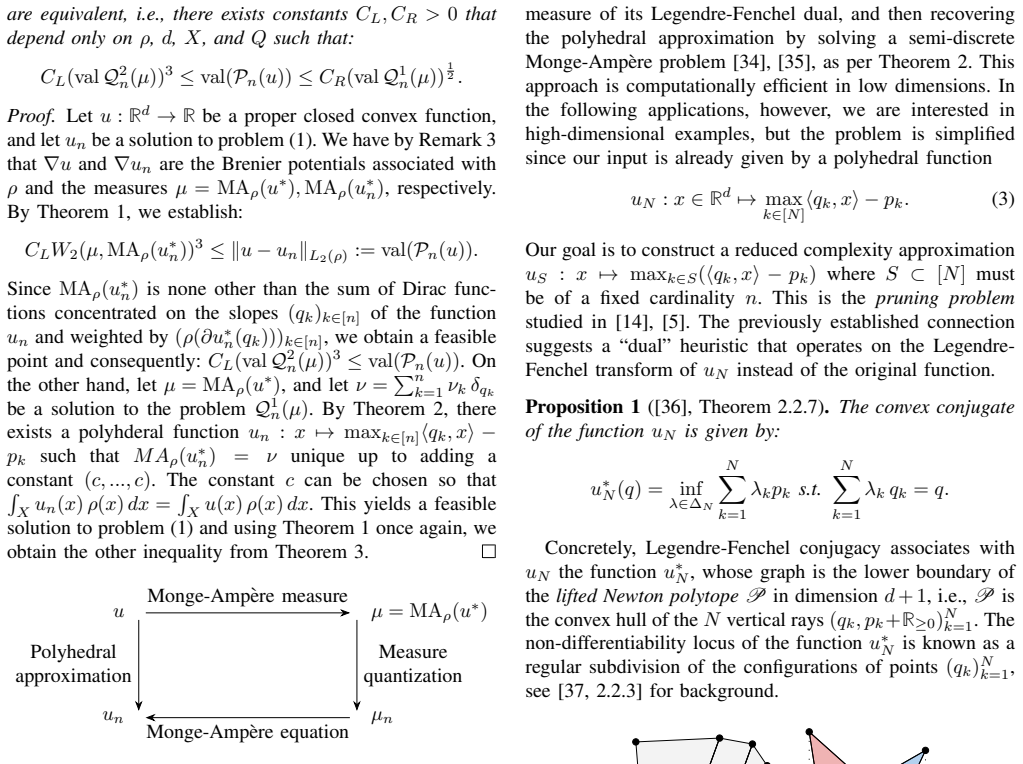
The carrying object is the ρ-Monge–Ampère measure, MA_ρ(u)(E) = ρ(∂u(E)). For a polyhedral function u_n = max_k (⟨q_k, x⟩ − p_k), this measure is a weighted sum of Dirac masses at the slopes q_k, so the quantization works on a finite point set. The identity (∇u)_#ρ = MA_ρ(u*) turns the subgradient of the convex function into an optimal transport map, and the stability estimates of [11] translate transport distances into L2 differences of potentials. On the algorithmic side, the lifted Newton polytope—the convex hull of the vertical rays (q_k, p_k + R_≥0)—encodes the conjugate function, and greedy k-center clustering of its vertices controls the pruning error by the k-center radius (Propositi
What would settle it
Compute, for ρ uniform on [0,1] and μ = ρ, the Brenier potential u from ρ to an atomic target ν_n made of n equally spaced Diracs. Check numerically whether CL W2(μ,ν_n)^3 ≤ ||u − v_n||_{L2(ρ)} ≤ CR W1(μ,ν_n)^{1/2} holds with constants CL, CR independent of n. If the ratio ||u − v_n||_{L2} / W2^3 is unbounded as n grows, or the right-hand ratio fails to stay bounded below, the stability bound for discrete targets is false and Theorem 3 collapses.
Extended reading notes
Core claim
The paper's central result, Theorem 3, states that for any proper closed convex function u and μ = MA_ρ(u*), the optimal L2(ρ) error of approximating u by a polyhedral function with at most n facets is sandwiched between a constant times the cube of the optimal quadratic Wasserstein quantization error of μ and a constant times the square root of the optimal first-order Wasserstein quantization error. The proof goes by identifying the subgradient ∇u as the Brenier potential pushing ρ to μ, and ∇u_n similarly for the polyhedral approximation u_n, then applying the quantitative stability bound quoted as Theorem 1 (from [11]). Conversely, any n-point quantization ν of μ yields, via the discrete
Load-bearing premise
The proof of the equivalence leans on a stability estimate for optimal transport that is applied to discrete target measures (sums of point masses); if that estimate actually requires the target measure to have a density, the two-sided inequalities do not follow as stated.
Editorial extensions
If this is right
- Any n-point quantization scheme for Monge–Ampère measures—Lloyd iterations, greedy, or geometric—directly yields polyhedral approximations with the same error order, and vice versa.
- The known O(n^{-2/d}) rates for smooth strictly convex functions and for optimal quantization are now linked by explicit inequalities, so bounds proved on one side transfer to the other.
- Pruning in max-plus optimal control can be performed in dual space by clustering slopes rather than by solving SDP-based importance metrics; the paper reports 5–20% cost improvements over the earlier metric-based pruning at small budgets.
- Menu reduction in nonlinear pricing can be viewed as quantizing the Monge–Ampère measure of the indirect utility, giving a principled geometric selection of offers.
- Numerical evidence indicates that the LP/SDP preprocessing removes redundant affine pieces and that the main computational cost is the preprocessing, not the clustering itself.
Reading between the lines
- The equivalence suggests a natural adaptive strategy the paper does not explore: run Lloyd-type quantization on the empirical slopes and compare against greedy k-center; if the stability constants are mild, iterative quantization should beat the single-pass greedy heuristic.
- Because the left-hand exponent is 3 and the right-hand exponent is 1/2, the equivalence is coarse; a systematic numerical mapping of the implied constants for low-dimensional cases could reveal whether one side is much tighter, which the paper leaves open.
- The dependence of the constants on the reference measure ρ means ρ can be used as a design parameter: choosing ρ concentrated near regions of interest would localize the L2 fidelity, a degree of freedom the paper does not discuss.
- The k-center bound of Proposition 2 is worst-case; average-case analyses under random slope distributions would connect the algorithm to classical vector quantization theory and could explain why it performs better than the worst-case bound.
Editorial analysis
A structured set of objections, weighed in public.
Referee Report
Summary. The paper establishes a duality between optimal polyhedral approximation of a convex function u in L^2(ρ) with n affine pieces and optimal quantization of the Monge-Ampère measure μ = MAρ(u*) in Wasserstein distance. The main result, Theorem 3, asserts that CL(val Q^2_n(μ))^3 ≤ val(P_n(u)) ≤ CR(val Q^1_n(μ))^{1/2}, based on a stability theorem of Delalande–Mérigot and a semi-discrete Monge-Ampère theorem of Gu–Luo–Sun–Yau. Motivated by this duality, the authors propose a pruning algorithm for polyhedral value functions: greedy k-center clustering applied to the vertices of the lifted Newton polytope of the Legendre–Fenchel dual, optionally with LP/SDP preprocessing to remove redundant affine terms. The algorithm is tested on a quantum gate synthesis optimal control problem and on a Rochet–Choné electricity pricing model, reporting improved cost and runtime relative to earlier importance-metric pruning methods.
Significance. If Theorem 3 is correct, the paper provides a conceptually appealing bridge between two classical approximation problems and gives a theoretical justification for importance-metric pruning: the relevant geometric object is the quantization of the Monge-Ampère measure. The proposed k-center algorithm is simple, scalable, and backed by a clean error bound in Proposition 2. The numerical experiments cover realistic high-dimensional applications and compare against existing heuristics. The paper ships no fitted parameters in the theoretical inequalities; the derivation is a direct consequence of external stability results. However, the central theorem depends on the exact validity of the cited stability result for atomic target measures, which is not verified in the manuscript, and the statement of Theorem 3 omits necessary support/integrability assumptions. These issues are load-bearing for the paper's main claim.
major comments (3)
- [Section III-A, Theorem 3 proof] The proof applies Theorem 1 to the pair (μ, MAρ(u_n^*)). For any polyhedral u_n, MAρ(u_n^*) is a sum of Diracs. The manuscript states Theorem 1 for 'any probability measures μ, ν on Q', but the cited Delalande–Mérigot result ([11], Thm 5.12/Remark 5.13) is not reproduced with its exact hypotheses. If that theorem requires the target measures to have densities bounded above and below, or any other condition excluding atomic measures, then neither inequality in Theorem 3 follows, since both applications involve an atomic target (and μ itself may be atomic if u is piecewise linear). Please quote the exact hypotheses from [11] and [12] and either confirm that they cover finitely supported measures or provide a separate stability argument for the semi-discrete case. This is the single most load-bearing external premise of the paper.
- [Theorem 3, statement] The statement 'let u be a proper closed convex function' is missing assumptions needed for the two problems to be comparable. Problem (1) restricts slopes to Q and problem (2) restricts quantization points to Q, and the proof invokes Theorem 1 for measures on Q. One therefore needs at least supp(MAρ(u*)) ⊂ Q and u ∈ L^2(ρ) (or another integrability condition making (1) well-posed). Without this, μ may not be a measure on Q, and the duality object in (2) is not the one relevant to (1). These hypotheses should be stated explicitly in Theorem 3.
- [Corollary 1] Corollary 1 is not a valid consequence as written. It allows p ∈ [1,2] and writes val(P_n(μ)) and val(Q^p_n(u)); Theorem 3 only proves bounds involving Q^2_n(μ) on the left and Q^1_n(μ) on the right. The expressions should presumably be val(P_n(u)) and val(Q^p_n(μ)), and for p ≠ 1,2 an additional argument (e.g., W_1 ≤ W_p ≤ W_2 on a bounded Q) would be needed. Also, 'ϵ_Q val(P_n(μ))^{1/3}-optimal solution' should be defined precisely (additive vs. multiplicative error). This corollary should be corrected or removed.
minor comments (4)
- [Theorem 1] The statement refers to 'Brenier potentials' without fixing the additive constant. The L^2 difference is only meaningful after a normalization, e.g., zero mean with respect to ρ. The mean-zero constraint in problem (1) suggests the intended normalization, but it should be stated.
- [Section III-B, Algorithm 1] The text says an affine term is redundant when the optimal value of (F^D_{k,S}) is non-positive, while the pseudocode removes the term only when val(F^D_{k,A}) < 0. The threshold should be made consistent, and the zero case discussed.
- [Theorem 2 usage in Theorem 3] If the optimal ν in Q^1_n(μ) has fewer than n support points, the proof writes it as ∑_{k=1}^n ν_k δ_{q_k}; Theorem 2 requires distinct points q_k. This can be fixed by adding arbitrary distinct points with zero weight, or by stating explicitly that zero weights are allowed in Theorem 2.
- [Notation] Problem (2) is introduced as Q^p_n(μ), but the 'p' is not defined in the displayed equation; in Theorem 3 only p=1 and p=2 are used. Also, several typos occur throughout, e.g., 'polyhderal', 'an M´erigot', and 'effeciency'.
Circularity Check
No circularity: Theorem 3 chains external stability and semi-discrete Monge–Ampère theorems; self-citations are only baselines.
full rationale
The central claim (Theorem 3) is derived by chaining two external results: Theorem 1 (Delalande–Mérigot quantitative stability, [11], [12]) and Theorem 2 (Gu–Luo–Sun–Yau semi-discrete Monge–Ampère, [33]). The lower bound takes an optimal polyhedral approximation u_n, observes that MA_ρ(u_n^*) is a feasible n-point quantizer of μ = MA_ρ(u^*), and applies the stability lower bound; no quantity fitted to the target data appears in the inequality. The upper bound takes an optimal quantizer ν, realizes it exactly as the Monge–Ampère measure of a polyhedral function via Theorem 2, adjusts the additive constant to satisfy the mean constraint, and applies the stability upper bound. Each mapping is explicit: MA_ρ(u_n^*) is the weighted sum of Diracs on the slopes, and Theorem 2 guarantees realizability of arbitrary weights with prescribed support points. The authors' own prior work ([5], [16], [17]) appears only as numerical baselines and in descriptions of existing pruning heuristics; it is not used to justify Theorem 3 or Corollary 1. The only substantial caveat is that Theorem 1's hypotheses, as stated in the paper ('any probability measures μ, ν on Q'), may not match the cited source's conditions when ν is a finite sum of Diracs; that is an external-assumption/correctness concern, not a circularity. No equation reduces to its own input, no fitted parameter is renamed a prediction, and no uniqueness claim is imported from the authors' prior work. Therefore the circularity score is 0.
Assumptions & free parameters
assumptions (4)
- standard math Delalande-Mérigot quantitative stability: for any probability measures μ,ν on Q, there exist constants C_L,C_R depending only on ρ,d,X,Q such that C_L W_2(μ,ν)^3 ≤ ∥u−v∥_{L^2(ρ)} ≤ C_R W_1(μ,ν)^{1/2}.
- standard math Gu-Luo-Sun-Yau discrete Monge-Ampère theorem: for any distinct points {q_k} and weights ν∈Δ_n, there exists p unique up to constant such that MA_ρ(u_n^*) = ν for u_n = max_k (⟨q_k,x⟩−p_k).
- domain assumption ρ is absolutely continuous with density bounded above and below by positive constants on compact X.
- domain assumption u is a proper closed convex function with subgradients in Q and integrable over X.
Cite this review
Pith. "Pith review of Duality between polyhedral approximation of value functions and optimal quantization of measures." pith.science (2026). https://pith.science/paper/DJTRQ7LH
@misc{pith2026250904101,
  author       = {Pith},
  title        = {Pith review of: Duality between polyhedral approximation of value functions and optimal quantization of measures},
  year         = {2026},
  howpublished = {\url{https://pith.science/paper/DJTRQ7LH}},
  note         = {Machine review of arXiv:2509.04101}
}
read the original abstract
Approximating a convex function by a polyhedral function that has a limited number of facets is a fundamental problem with applications in various fields, from mitigating the curse of dimensionality in optimal control to bi-level optimization. We establish a connection between this problem and the optimal quantization of a positive measure. Building on recent stability results in optimal transport, by Delalande and M\'erigot, we deduce that the polyhedral approximation of a convex function is equivalent to the quantization of the Monge-Amp\`ere measure of its Legendre-Fenchel dual. This duality motivates a simple greedy method for computing a parsimonious approximation of a polyhedral convex function, by clustering the vertices of a Newton polytope. We evaluate our algorithm on two applications: 1) A high-dimensional optimal control problem (quantum gate synthesis), leveraging McEneaney's max-plus-based curse-of-dimensionality attenuation method; 2) A bi-level optimization problem in electricity pricing. Numerical results demonstrate the efficiency of this approach.
Figures


Figures from the paper (2 more)


Reference graph
Works this paper leans on
-
[11]
Delalande, Quantitative Stability in Quadratic Optimal Transport
A. Delalande, Quantitative Stability in Quadratic Optimal Transport . Theses, Universit´e Paris-Saclay, Dec. 2022
work page 2022
-
[12]
Quantitative stability of optimal trans- port maps under variations of the target measure,
A. Delalande and Q. Merigot, “Quantitative stability of optimal trans- port maps under variations of the target measure,” Duke Mathematical Journal, vol. 172, no. 17, pp. 3321–3357, 2023
work page 2023
-
[1]
W. M. McEneaney, Max-plus methods for nonlinear control and estimation. Springer, 2006
work page 2006
-
[2]
A max-plus-based algorithm for a hamilton–jacobi–bellman equation of nonlinear filtering,
W. H. Fleming and W. M. McEneaney, “A max-plus-based algorithm for a hamilton–jacobi–bellman equation of nonlinear filtering,” SIAM J. Control Optim. , vol. 38, no. 3, p. 683–710, 2000
work page 2000
-
[3]
A curse-of-dimensionality-free numerical method for solution of certain HJB PDEs,
W. M. McEneaney, “A curse-of-dimensionality-free numerical method for solution of certain HJB PDEs,” SIAM Journal on Control and Optimization, vol. 46, jan 2007
work page 2007
-
[4]
M. Akian, S. Gaubert, and A. Lakhoua, “The max-plus finite element method for solving deterministic optimal control problems: Basic properties and convergence analysis,” SIAM Journal on Control and Optimization, vol. 47, pp. 817–848, jan 2008
work page 2008
-
[5]
S. Gaubert, W. McEneaney, and Z. Qu, “Curse of dimensionality reduction in max-plus based approximation methods: theoretical es- timates and improved pruning algorithms,” in Proceedings of the 50th IEEE Conference on Decision and Control and European Control Conference (CDC-ECC 11) , (Orlando, FL, USA), pp. 1054–1061, December 2011
work page 2011
-
[6]
Optimal stochastic operations scheduling of large hydro- electric systems,
M. Pereira, “Optimal stochastic operations scheduling of large hydro- electric systems,” International Journal of Electrical Power & Energy Systems, vol. 11, no. 3, pp. 161–169, 1989
work page 1989
Show all 39 references
-
[7]
Ironing, sweeping, and multidimensional screening,
J.-C. Rochet and P. Chon ´e, “Ironing, sweeping, and multidimensional screening,” Econometrica, vol. 66, no. 4, pp. 783–826, 1998
1998
-
[8]
A numerical approach to variational problems subject to convexity constraint,
G. Carlier, T. Lachand-Robert, and B. Maury, “A numerical approach to variational problems subject to convexity constraint,” Num. Math., vol. 88, pp. 299–318, 04 2001
2001
-
[9]
An algorithm for computing solutions of variational problems with global convexity constraints,
I. Ekeland and S. Moreno-Bromberg, “An algorithm for computing solutions of variational problems with global convexity constraints,” Num. Math., vol. 115, no. 1, p. 45–69, 2009
2009
-
[10]
Nonlinear pricing with finite information,
D. Bergemann, E. Yeh, and J. Zhang, “Nonlinear pricing with finite information,” Games and Econ. Behav. , vol. 130, pp. 62–84, 2021
2021
-
[13]
Clustering to minimize the maximum intercluster distance,
T. F. Gonzalez, “Clustering to minimize the maximum intercluster distance,” Theor. Comput. Sci., vol. 38, pp. 293–306, 1985
1985
-
[14]
Reduced- complexity numerical method for optimal gate synthesis,
S. Sridharan, M. Gu, M. R. James, and W. M. McEneaney, “Reduced- complexity numerical method for optimal gate synthesis,” Physical Review A, vol. 82, Oct. 2010
2010
-
[15]
A reduced complexity min-plus solution method to the optimal control of closed quantum systems,
S. Sridharan, W. M. Mceneaney, M. Gu, and M. R. James, “A reduced complexity min-plus solution method to the optimal control of closed quantum systems,” Appl. Math. Optim. , vol. 70, p. 469–510, Dec. 2014
2014
-
[16]
Bundle-based pruning in the max-plus curse of dimensionality free method,
S. Gaubert, Z. Qu, and S. Sridharan, “Bundle-based pruning in the max-plus curse of dimensionality free method,” in Proceedings of the MTNS, July 7-11, 2014. Groningen, The Netherland , pp. 166–172, 2014
2014
-
[17]
A quantiza- tion procedure for nonlinear pricing with an application to electricity markets,
Q. Jacquet, W. van Ackooij, C. Alasseur, and S. Gaubert, “A quantiza- tion procedure for nonlinear pricing with an application to electricity markets,” in 62nd IEEE Conference on Decision and Control (CDC) , pp. 2270–2277, 2023
2023
-
[18]
The principle of least action and fundamental solutions of mass-spring and n-body two-point boundary value problems,
W. M. McEneaney and P. M. Dower, “The principle of least action and fundamental solutions of mass-spring and n-body two-point boundary value problems,” SIAM Journal on Control and Optimization , vol. 53, no. 5, 2015
2015
-
[19]
On the convergence of stochastic dual dynamic programming and related methods,
A. Philpott and Z. Guan, “On the convergence of stochastic dual dynamic programming and related methods,” Operations Research Letters, vol. 36, pp. 450–455, 07 2008
2008
-
[20]
Exact converging bounds for stochastic dual dynamic programming via fenchel duality,
V . Lecl `ere, P. Carpentier, J.-P. Chancelier, A. Lenoir, and F. Pacaud, “Exact converging bounds for stochastic dual dynamic programming via fenchel duality,” SIAM Journal on Optimization , vol. 30, no. 2, pp. 1223–1250, 2020
2020
-
[21]
P. M. Gruber, Convex and discrete geometry, vol. 336. Springer, 2007
2007
-
[22]
Approximation of convex sets by polytopes,
E. M. Bronstein, “Approximation of convex sets by polytopes,” Jour- nal of Mathematical Sciences , vol. 153, no. 6, pp. 727–762, 2008
2008
-
[23]
Submodular function maximization.,
A. Krause and D. Golovin, “Submodular function maximization.,” Tractability, vol. 3, no. 71-104, p. 3, 2014
2014
-
[24]
Greedy minimization of weakly supermodular set functions,
C. Boutsidis, E. Liberty, and M. Sviridenko, “Greedy minimization of weakly supermodular set functions,” 2015
2015
-
[25]
Curse-of- complexity attenuation in the curse-of-dimensionality-free method for HJB PDEs,
W. M. McEneaney, A. Deshpande, and S. Gaubert, “Curse-of- complexity attenuation in the curse-of-dimensionality-free method for HJB PDEs,” in 2008 American Control Conference , pp. 4684–4690, 2008
2008
-
[26]
Pag `es, H
G. Pag `es, H. Pham, and J. Printems, Optimal Quantization Methods and Applications to Numerical Problems in Finance , p. 253–297. Birkh¨auser Boston, 2004
2004
-
[27]
Non-asymptotic convergence bounds for wasserstein approximation using point clouds,
Q. M ´erigot, F. Santambrogio, and C. Sarrazin, “Non-asymptotic convergence bounds for wasserstein approximation using point clouds,” Advances in Neural Information Processing Systems , vol. 34, pp. 12810–12821, 2021
2021
-
[28]
Villani, Optimal Transport
C. Villani, Optimal Transport. Springer Berlin Heidelberg, 2009
2009
-
[29]
Polar factorization and monotone rearrangement of vector- valued functions,
Y . Brenier, “Polar factorization and monotone rearrangement of vector- valued functions,” Comm. pure appl. math. , vol. 44, no. 4, pp. 375– 417, 1991
1991
-
[30]
The monge-amp `ere equation and its link to optimal transportation,
G. De Philippis and A. Figalli, “The monge-amp `ere equation and its link to optimal transportation,” 2014. arXiv:1310.6167
2014 arXiv
-
[31]
van Ackooij and W
W. van Ackooij and W. de Oliveira, Methods of Nonsmooth Opti- mization in Stochastic Programming . Int. Series in Oper. Res. & Management Sci., Springer, 2025
2025
-
[32]
R. T. Rockafellar, Convex Analysis. Princeton University Press, Dec. 1970
1970
-
[33]
Variational principles for minkowski type problems, discrete optimal transport, and discrete monge–amp`ere equations,
X. Gu, F. Luo, J. Sun, and S.-T. Yau, “Variational principles for minkowski type problems, discrete optimal transport, and discrete monge–amp`ere equations,” 2016
2016
-
[34]
An algorithm for optimal transport between a simplex soup and a point cloud,
Q. M ´erigot, J. Meyron, and B. Thibert, “An algorithm for optimal transport between a simplex soup and a point cloud,” SIAM Journal on Imaging Sciences , vol. 11, no. 2, pp. 1363–1389, 2018
2018
-
[35]
Initialization procedures for discrete and semi-discrete optimal transport,
J. Meyron, “Initialization procedures for discrete and semi-discrete optimal transport,” Computer-Aided Design, vol. 115, pp. 13–22, 2019
2019
-
[36]
H ¨ormander, Notions of convexity
L. H ¨ormander, Notions of convexity . Springer Science & Business Media, 2007
2007
-
[37]
J. A. De Loera, J. Rambau, and F. Santos, Triangulations. Springer Berlin Heidelberg, 2010
2010
-
[38]
A general solution to the quasi linear screening problem,
G. Carlier, X. Dupuis, J.-C. Rochet, and J. Thanassoulis, “A general solution to the quasi linear screening problem,” J. Math. Econ. , vol. 114, p. 103025, 2024
2024
-
[39]
Simulations multi- agents de l’activit ´e humaine: application dans le contexte ´energ´etique r´esidentiel franc ¸ais,
T. Huraux, N. Sabouret, Y . Haradji, and F. Semp´e, “Simulations multi- agents de l’activit ´e humaine: application dans le contexte ´energ´etique r´esidentiel franc ¸ais,” 01 2015
2015
Reviewed August 5, 2026 · model on record in the stance chip above.
Discussion (0). Sign in to comment.