REVIEW 3 major objections 6 minor 48 references
EHVC: Efficient Hierarchical Reference and Quality Structure for Neural Video Coding
T0 review · 3 major / 6 minor · reviewed 2026-08-05 · deepseek-v4-flash
Pith's one-line read EHVC aligns reference and quality structure in a neural video codec and reports average bitrate savings of about 17% over VTM-23.4 under low-delay settings.
desk verdict Solid engineering gains with a sensible reference-quality alignment idea, but the key ablation doesn't isolate the mechanism and the lookahead module has a real unexplained gap. read the letter →
The pith
A machine-rendered reading of the paper's core claim, the machinery that carries it, and where it could break.
The reading
What carries the argument
The hierarchical multi-reference context generation module, which takes the decoder-side feature of the previous frame and the decoder-side feature of the nearest high-quality key frame, warps the key-frame feature n times (where n is the frame distance) to align it with the current frame, and fuses both branches across three scales to produce temporal contexts. Supporting it are a lookahead module that merges the next frame into the encoder-side context, and layer-wise learnable quantization scales (one per hierarchical layer) with a random quality training scheme that randomly scales the first key frame's quantization by a factor in [0.8, 1.2].
What would settle it
Evaluate EHVC under intra-period -1 on a sequence where every key frame is replaced by a no-information frame (all pixels set to 128). If the bitrate advantage over DCVC-FM largely disappears, the gain attributed to the key-frame reference would be falsified. Alternatively, measure the alignment error between an n-times-warped key-frame feature and a directly warped feature using optical flow from the key frame to the current frame for n=2,3,4; a sharp increase with n would indicate the long-range warping assumption breaks.
Extended reading notes
Core claim
EHVC claims that the reference-quality mismatch is the main cause of error propagation and instability in neural video codecs, and that explicitly aligning the reference structure with the quality structure recovers both stability and efficiency. The paper's central evidence is a hierarchical multi-reference context generation module that fuses two branches: the adjacent frame branch, which processes the previous frame's feature, and the key frame branch, which warps the nearest high-quality key frame's feature n times to the current frame. Ablation shows hierarchical multi-reference alone gives 10.47% BD-rate savings; adding lookahead gives 12.74%; layer-wise quality scale gives 13.09%; and
Load-bearing premise
The key-frame branch assumes that repeatedly warping a key frame's feature up to four times keeps enough useful information to improve the current frame's coding; if iterative warping drifts, the 10.47% bitrate saving from hierarchical multi-reference would shrink.
Editorial extensions
If this is right
- EHVC reduces average bitrate by 17.14% over VTM-23.4 on 96 frames with intra-period 32, and by 17.04% when all frames are inter-coded (intra-period -1).
- Compared with the previous state-of-the-art DCVC-FM, EHVC saves 10.98% more bitrate under intra-period 32 and 12.88% more under intra-period -1, measured relative to VTM-23.4.
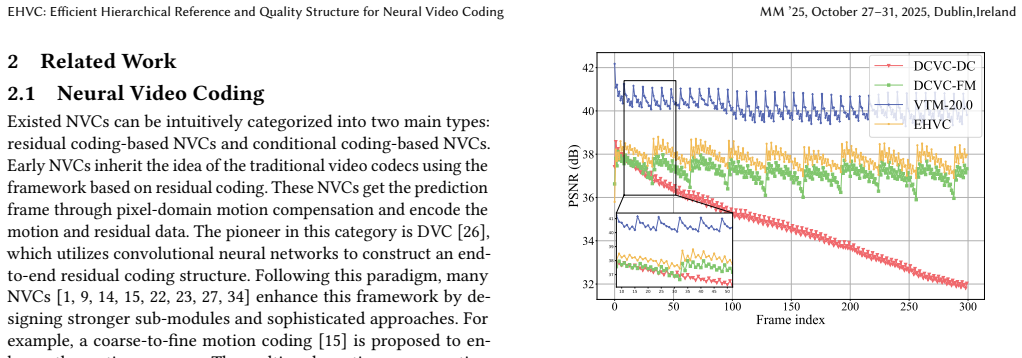
- The quality structure of EHVC is more stable per 32-frame refresh cycle: about 1 dB quality degradation versus about 1.5 dB for DCVC-FM, and EHVC's frame-level PSNR matches the designed hierarchical pattern more closely.
- After a deliberately corrupted no-information frame, EHVC's reconstructed quality recovers to its pre-corruption level within a few frames, whereas DCVC-FM stays degraded, showing the explicit reference structure is more robust.
- The computational cost is 1311 kMACs/pixel, only about 17% higher than DCVC-FM's 1125 kMACs/pixel, while delivering more than 10% bitrate savings, so the added complexity is modest relative to the gain.
Reading between the lines
- The hierarchical multi-reference design could naturally extend to random-access (B-frame) coding by treating future anchor frames as key frames; the paper only evaluates low-delay configurations, so this is an untested extension.
- The one-frame lookahead suggests a latency-quality trade-off: using more future frames could improve the quality structure further, but would increase delay; measuring this curve is a concrete next step.
- The key-frame branch's n-times warping likely degrades with larger GOP sizes; beyond the tested 4-frame key spacing, a periodic refresh of the key frame or a distance-based weight might be needed to sustain the 10.47% gain.
- Random quality training acts as a form of quantization-scale augmentation, which may transfer to other conditional neural codecs as a generic robustness technique even without the hierarchical reference structure.
Editorial analysis
A structured set of objections, weighed in public.
Referee Report
Summary. The paper proposes EHVC, a conditional neural video codec built on DCVC-FM, with three main contributions: (1) a hierarchical multi-reference scheme that adds a key-frame reference branch to align the reference structure with a hierarchical quality structure; (2) a lookahead strategy that uses one future frame to obtain an encoder-side context; and (3) a layer-wise quantization scale with random quality training to stabilize the quality structure. Experiments report average BD-rate savings of 17.14% (intra-period 32) and 17.04% (intra-period -1) over VTM-23.4 LDB, and 10.98% and 12.88% over DCVC-FM, respectively. The paper also analyzes frame-level quality and reference stability on corrupted frames.
Significance. If the reported results are reproducible, EHVC would be a new state-of-the-art low-delay neural video codec. The performance gains are large, consistently in the double digits, and the complexity increase over DCVC-FM is modest. The paper gives a useful analysis of quality and reference structures, and provides ablations for each proposed component. However, the central ablation for the hierarchical multi-reference does not isolate the claimed 'reference-quality alignment' property, and the lookahead scheme leaves an encoder/decoder context mismatch under-specified. These issues limit the current support for the paper's conceptual claims, though the empirical SOTA claim may still hold.
major comments (3)
- [Section 4.3, Fig. 4] The lookahead produces an encoder-side context c^enc_t from the future frame x_{t+1}, while the decoder uses c^dec_t. The paper does not state whether the entropy model for y_t conditions on c^enc_t. If it does, the decoder cannot compute probability estimates without the future frame, breaking decodability. If it does not, then the encoder's transform is conditioned on information unavailable to the decoder, and the paper should explain how this asymmetry is trained and why it does not cause a train/test mismatch. This is load-bearing for the lookahead contribution and must be clarified.
- [Section 5.4, Table 6] The M_b ablation adds both a second reference branch and the key-frame selection relative to the DCVC-FM baseline M_a. The 10.47% BD-rate gain is attributed to aligning reference and quality structures, but there is no control for (a) adding a second reference branch using a non-key past frame at a similar distance, (b) adding a branch with equal capacity, or (c) using the key-frame feature without repeated warping. The gain could therefore be due to multi-reference or increased model capacity rather than the quality-alignment property. Please add a controlled ablation to support the paper's central conceptual claim.
- [Section 4.2, Fig. 5] The key-frame branch warps the key-frame feature n times, where n is the distance to the current frame. The paper does not analyze accumulated warp error or compare against a non-key reference at the same distance. If repeated warping degrades the key-frame feature, the improvement cannot be attributed to the quality-alignment mechanism. At minimum, report a quantitative or qualitative evaluation of the warped key-frame feature, or an ablation with a single-step warp, to demonstrate that the key-frame information remains informative.
minor comments (6)
- [Abstract, Section 1, Table 4] The abstract and introduction state that EHVC outperforms VTM under intra-period -1, but Table 4 shows HEVC E is +2.32% BD-rate (worse than VTM). Please qualify these claims as average or per-dataset.
- [Tables 3, 4, 6] No error bars or multiple-seed results are reported. Since neural codec training has stochastic variation, please state whether these are single-run results and, if feasible, report variance.
- [Section 5.1] The qualitative analysis in Section 3 uses VTM-20.0 while the BD-rate tables use VTM-23.4. Please clarify whether this difference affects the conclusions.
- [Eq. (3), Section 4.4] The random quality training scales Q_enc by omega and Q_dec by 1/omega. Please explain the rationale for the inverse scaling and specify whether omega is sampled per frame or per GOP, and whether the range 0.8–1.2 is fixed or tuned.
- [General] The manuscript contains broken rendering artifacts (e.g., 'uni00000013' sequences in Section 2.2.1). Please fix the text encoding.
- [Section 1, Footnote 3 (reproducibility)] The code is promised to be released but is not yet available. Providing code at review time would strengthen reproducibility.
Circularity Check
No significant circularity: EHVC is an empirical architecture study whose claims rest on measured rate-distortion comparisons and ablations, not on fitted parameters presented as predictions or self-citation chains.
full rationale
The paper's central results are direct rate-distortion measurements on standard test sets, and its ablations compare incremental architectural additions against a DCVC-FM baseline. No equation defines an output in terms of its target; no fitted constant is renamed as a prediction; no uniqueness theorem is imported from the authors' prior work; and no ansatz is smuggled in via citation. The only self-citation ([21], EFVC) appears in a general list of modern NVCs and is not load-bearing. The ablation for the hierarchical multi-reference scheme (M_b) does not fully isolate the quality-alignment mechanism from added capacity, but that is a limitation in experimental control, not circularity: the measured 10.47% gain is not forced by construction, and the 'reference-quality mismatch' narrative is an interpretation of measured gains rather than an input to them. The design choice to define key frames by hierarchical weight is explicit and based on prior external work (DCVC-DC), not on the target result. Therefore, the derivation chain is self-contained in the relevant sense, and the appropriate circularity score is 0.
Assumptions & free parameters
free parameters (3)
- Random quality scale range (omega) =
[0.8, 1.2]
- Hierarchical lambda weights =
[0.5, 1.2, 0.5, 0.9]
- Layer-wise quantization scales Q_enc_layer and Q_dec_layer =
learned
assumptions (5)
- domain assumption The conditional coding framework and rate-distortion training objective of DCVC-FM remain valid when encoder-side and decoder-side contexts differ.
- domain assumption Frames assigned hierarchical weight 1.2 are reconstructed at sufficiently higher quality to act as reliable key references.
- domain assumption Iterative n-times feature warping from the key frame to the current frame remains accurate enough over a GOP of 4 frames.
- domain assumption The no-information-frame experiment is a valid probe of reference structure stability.
- domain assumption Baseline DCVC-FM is reproduced faithfully for the ablation.
Cite this review
Pith. "Pith review of EHVC: Efficient Hierarchical Reference and Quality Structure for Neural Video Coding." pith.science (2026). https://pith.science/paper/KENT6RJU
@misc{pith2026250904118,
  author       = {Pith},
  title        = {Pith review of: EHVC: Efficient Hierarchical Reference and Quality Structure for Neural Video Coding},
  year         = {2026},
  howpublished = {\url{https://pith.science/paper/KENT6RJU}},
  note         = {Machine review of arXiv:2509.04118}
}
read the original abstract
Neural video codecs (NVCs), leveraging the power of end-to-end learning, have demonstrated remarkable coding efficiency improvements over traditional video codecs. Recent research has begun to pay attention to the quality structures in NVCs, optimizing them by introducing explicit hierarchical designs. However, less attention has been paid to the reference structure design, which fundamentally should be aligned with the hierarchical quality structure. In addition, there is still significant room for further optimization of the hierarchical quality structure. To address these challenges in NVCs, we propose EHVC, an efficient hierarchical neural video codec featuring three key innovations: (1) a hierarchical multi-reference scheme that draws on traditional video codec design to align reference and quality structures, thereby addressing the reference-quality mismatch; (2) a lookahead strategy to utilize an encoder-side context from future frames to enhance the quality structure; (3) a layer-wise quality scale with random quality training strategy to stabilize quality structures during inference. With these improvements, EHVC achieves significantly superior performance to the state-of-the-art NVCs. Code will be released in: https://github.com/bytedance/NEVC.
Figures


Figures from the paper (5 more)


Reference graph
Works this paper leans on
-
[1]
Eirikur Agustsson, David Minnen, Nick Johnston, Johannes Balle, Sung Jin Hwang, and George Toderici. 2020. Scale-space flow for end-to-end optimized video compression. In Proceedings of the IEEE/CVF Conference on Computer Vision and Pattern Recognition. 8503–8512
work page 2020
-
[2]
David Alexandre, Hsueh-Ming Hang, and Wen-Hsiao Peng. 2023. Hierarchical B- frame video coding using two-layer CANF without motion coding. InProceedings of the IEEE/CVF Conference on Computer Vision and Pattern Recognition . 10249– 10258
work page 2023
-
[3]
Yifan Bian, Chuanbo Tang, Li Li, and Dong Liu. 2025. Augmented Deep Contexts for Spatially Embedded Video Coding. In Proceedings of the Computer Vision and Pattern Recognition Conference. 2094–2104
work page 2025
-
[4]
Gisle Bjontegaard. 2001. Calculation of average PSNR differences between RD- curves. ITU SG16 Doc. VCEG-M33 (2001)
work page 2001
-
[5]
Frank Bossen, Karsten Sühring, Adam Wieckowski, and Shan Liu. 2021. VVC complexity and software implementation analysis. IEEE Transactions on Circuits and Systems for Video Technology 31, 10 (2021), 3765–3778
work page 2021
-
[6]
Benjamin Bross, Jianle Chen, Jens-Rainer Ohm, Gary J Sullivan, and Ye-Kui Wang. 2021. Developments in international video coding standardization after AVC, with an overview of versatile video coding (VVC). Proc. IEEE 109, 9 (2021), 1463–1493
work page 2021
-
[7]
Benjamin Bross, Ye-Kui Wang, Yan Ye, Shan Liu, Jianle Chen, Gary J Sullivan, and Jens-Rainer Ohm. 2021. Overview of the versatile video coding (VVC) standard and its applications. IEEE Transactions on Circuits and Systems for Video Technology 31, 10 (2021), 3736–3764
work page 2021
-
[8]
Zhenghao Chen, Lucas Relic, Roberto Azevedo, Yang Zhang, Markus Gross, Dong Xu, Luping Zhou, and Christopher Schroers. 2023. Neural video compression with spatio-temporal cross-covariance transformers. In Proceedings of the 31st ACM International Conference on Multimedia . 8543–8551
work page 2023
Show all 48 references
-
[9]
Abdelaziz Djelouah, Joaquim Campos, Simone Schaub-Meyer, and Christopher Schroers. 2019. Neural inter-frame compression for video coding. In Proceedings of the IEEE/CVF international conference on computer vision . 6421–6429
2019
-
[10]
Bernd Girod, Eckehard G Steinbach, and Niko Faerber. 1995. Comparison of the H. 263 and H. 261 video compression standards. InStandards and Common Interfaces for Video Information Systems: A Critical Review , Vol. 10282. SPIE, 230–248
1995
-
[11]
Haifeng Guo, Sam Kwong, Dongjie Ye, and Shiqi Wang. 2023. Enhanced con- text mining and filtering for learned video compression. IEEE Transactions on Multimedia 26 (2023), 3814–3826
2023
-
[12]
Amirhossein Habibian, Ties van Rozendaal, Jakub M Tomczak, and Taco S Cohen
-
[13]
Yung-Han Ho, Chih-Peng Chang, Peng-Yu Chen, Alessandro Gnutti, and Wen- Hsiao Peng. 2022. Canf-vc: Conditional augmented normalizing flows for video compression. In European Conference on Computer Vision . Springer, 207–223
2022
-
[14]
Zhihao Hu, Zhenghao Chen, Dong Xu, Guo Lu, Wanli Ouyang, and Shuhang Gu
-
[15]
Zhihao Hu, Guo Lu, Jinyang Guo, Shan Liu, Wei Jiang, and Dong Xu. 2022. Coarse- to-fine deep video coding with hyperprior-guided mode prediction. InProceedings of the IEEE/CVF Conference on Computer Vision and Pattern Recognition . 5921– 5930
2022
-
[16]
Théo Ladune, Pierrick Philippe, Wassim Hamidouche, Lu Zhang, and Olivier Déforges. 2021. Conditional coding for flexible learned video compression. arXiv preprint arXiv:2104.07930 (2021)
2021 arXiv
-
[17]
Jiahao Li, Bin Li, and Yan Lu. 2021. Deep contextual video compression.Advances in Neural Information Processing Systems 34 (2021), 18114–18125
2021
-
[18]
Jiahao Li, Bin Li, and Yan Lu. 2022. Hybrid spatial-temporal entropy modelling for neural video compression. InProceedings of the 30th ACM International Conference on Multimedia. 1503–1511
2022
-
[19]
Jiahao Li, Bin Li, and Yan Lu. 2023. Neural video compression with diverse contexts. In Proceedings of the IEEE/CVF conference on computer vision and pattern recognition. 22616–22626
2023
-
[20]
Jiahao Li, Bin Li, and Yan Lu. 2024. Neural video compression with feature modulation. In Proceedings of the IEEE/CVF Conference on Computer Vision and Pattern Recognition. 26099–26108
2024
-
[21]
Junqi Liao, Li Li, Dong Liu, and Houqiang Li. 2025. EFVC: Error-Propagation- Free Neural Video Coding with Reversible Transform. In 2025 IEEE International Symposium on Circuits and Systems (ISCAS) . IEEE, 1–5
2025
-
[22]
Jianping Lin, Dong Liu, Houqiang Li, and Feng Wu. 2020. M-LVC: Multiple frames prediction for learned video compression. In Proceedings of the IEEE/CVF conference on computer vision and pattern recognition . 3546–3554
2020
-
[23]
Haojie Liu, Ming Lu, Zhan Ma, Fan Wang, Zhihuang Xie, Xun Cao, and Yao Wang. 2020. Neural video coding using multiscale motion compensation and spatiotemporal context model. IEEE Transactions on Circuits and Systems for Video Technology 31, 8 (2020), 3182–3196
2020
-
[24]
Jerry Liu, Shenlong Wang, Wei-Chiu Ma, Meet Shah, Rui Hu, Pranaab Dhawan, and Raquel Urtasun. 2020. Conditional entropy coding for efficient video com- pression. In European Conference on Computer Vision . Springer, 453–468
2020
-
[25]
Salvator Lombardo, Jun Han, Christopher Schroers, and Stephan Mandt. 2019. Deep generative video compression. Advances in Neural Information Processing Systems 32 (2019)
2019
-
[26]
Guo Lu, Wanli Ouyang, Dong Xu, Xiaoyun Zhang, Chunlei Cai, and Zhiyong Gao
-
[27]
Guo Lu, Xiaoyun Zhang, Wanli Ouyang, Li Chen, Zhiyong Gao, and Dong Xu
-
[28]
Fabian Mentzer, George Toderici, David Minnen, Sung-Jin Hwang, Sergi Caelles, Mario Lucic, and Eirikur Agustsson. 2022. VCT: A video compression transformer. arXiv preprint arXiv:2206.07307 (2022)
2022 arXiv
-
[29]
In Proceedings of the IEEE/CVF conference on computer vision and pattern recognition
Dvc: An end-to-end deep video compression framework. In Proceedings of the IEEE/CVF conference on computer vision and pattern recognition . 11006–11015
-
[30]
Alexandre Mercat, Marko Viitanen, and Jarno Vanne. 2020. UVG dataset: 50/120fps 4K sequences for video codec analysis and development. InProceedings of the 11th ACM multimedia systems conference . 297–302
2020
-
[31]
An end-to-end learning framework for video compression.IEEE transactions on pattern analysis and machine intelligence 43, 10 (2020), 3292–3308
2020
-
[32]
Woonsung Park and Munchurl Kim. 2020. Deep predictive video compression using mode-selective uni-and bi-directional predictions based on multi-frame hypothesis. IEEE Access 9 (2020), 72–85
2020
-
[33]
Alexandre Mercat, Arttu Mäkinen, Joose Sainio, Ari Lemmetti, Marko Viitanen, and Jarno Vanne. 2021. Comparative rate-distortion-complexity analysis of VVC and HEVC video codecs. IEEE Access 9 (2021), 67813–67828
2021
-
[34]
Oren Rippel, Alexander G Anderson, Kedar Tatwawadi, Sanjay Nair, Craig Lytle, and Lubomir Bourdev. 2021. Elf-vc: Efficient learned flexible-rate video coding. In Proceedings of the IEEE/CVF International Conference on Computer Vision . 14479– 14488
2021
-
[35]
Woonsung Park and Munchurl Kim. 2019. Deep predictive video compression with bi-directional prediction. arXiv preprint arXiv:1904.02909 (2019)
2019 arXiv
-
[36]
Xihua Sheng, Li Li, Dong Liu, and Shiqi Wang. 2025. Bi-Directional Deep Con- textual Video Compression. IEEE Transactions on Multimedia (2025)
2025
-
[37]
Linfeng Qi, Jiahao Li, Bin Li, Houqiang Li, and Yan Lu. 2023. Motion informa- tion propagation for neural video compression. In Proceedings of the IEEE/CVF Conference on Computer Vision and Pattern Recognition . 6111–6120
2023
-
[38]
Chuanbo Tang, Zhuoyuan Li, Yifan Bian, Li Li, and Dong Liu. 2025. Neural Video Compression with Context Modulation. In Proceedings of the Computer Vision and Pattern Recognition Conference . 12553–12563
2025
-
[39]
Xihua Sheng, Jiahao Li, Bin Li, Li Li, Dong Liu, and Yan Lu. 2022. Temporal context mining for learned video compression. IEEE Transactions on Multimedia 25 (2022), 7311–7322
2022
-
[40]
Ye-Kui Wang, Robert Skupin, Miska M Hannuksela, Sachin Deshpande, Virginie Drugeon, Rickard Sjöberg, Byeongdoo Choi, Vadim Seregin, Yago Sanchez, Jill M Boyce, et al. 2021. The high-level syntax of the versatile video coding (VVC) standard. IEEE Transactions on Circuits and Sy...
2021
-
[41]
Gary J Sullivan, Jens-Rainer Ohm, Woo-Jin Han, and Thomas Wiegand. 2012. Overview of the high efficiency video coding (HEVC) standard.IEEE Transactions on circuits and systems for video technology 22, 12 (2012), 1649–1668
2012
-
[42]
Ren Yang, Fabian Mentzer, Luc Van Gool, and Radu Timofte. 2020. Learning for video compression with hierarchical quality and recurrent enhancement. In Proceedings of the IEEE/CVF Conference on Computer Vision and Pattern Recognition. 6628–6637
2020
-
[43]
Haiqiang Wang, Weihao Gan, Sudeng Hu, Joe Yuchieh Lin, Lina Jin, Longguang Song, Ping Wang, Ioannis Katsavounidis, Anne Aaron, and C-C Jay Kuo. 2016. MCL-JCV: a JND-based H. 264/AVC video quality assessment dataset. In 2016 IEEE international conference on image processing (IC...
2016
-
[44]
Yiwei Zhang, Guo Lu, Yunuo Chen, Shen Wang, Yibo Shi, Jing Wang, and Li Song. 2023. Neural rate control for learned video compression. In The Twelfth International Conference on Learning Representations
2023
-
[45]
Jinxi Xiang, Kuan Tian, and Jun Zhang. 2022. Mimt: Masked image modeling transformer for video compression. In The Eleventh International Conference on Learning Representations
2022
-
[47]
M Akin Yilmaz and A Murat Tekalp. 2020. End-to-end rate-distortion optimization for bi-directional learned video compression. In2020 IEEE International Conference on Image Processing (ICIP) . IEEE, 1311–1315
2020
-
[2019]
In Proceedings of the IEEE/CVF international conference on computer vision
Video compression with rate-distortion autoencoders. In Proceedings of the IEEE/CVF international conference on computer vision . 7033–7042
-
[2020]
In Computer Vision–ECCV 2020: 16th European Conference, Glasgow, UK, August 23–28, 2020, Proceedings, Part II 16
Improving deep video compression by resolution-adaptive flow coding. In Computer Vision–ECCV 2020: 16th European Conference, Glasgow, UK, August 23–28, 2020, Proceedings, Part II 16 . Springer, 193–209
2020
Reviewed August 5, 2026 · model on record in the stance chip above.
Discussion (0). Continue with ORCID to comment.