REVIEW 5 major objections 6 minor 16 references
Analysis of Bluffing by DQN and CFR in Leduc Hold'em Poker
T0 review · 5 major / 6 minor · reviewed 2026-08-05 · deepseek-v4-flash
Pith's one-line read Both a game-theoretic and a reinforcement-learning poker agent learn to bluff, with near-equal success rates — suggesting deception belongs to the game, not the algorithm.
desk verdict A checkable but methodologically shaky comparison of DQN and CFR bluffing; the central interpretive claim outruns the evidence, and the epsilon question needs to be resolved before the counts mean what the authors say they mean. read the letter →
The pith
A machine-rendered reading of the paper's core claim, the machinery that carries it, and where it could break.
The reading
What carries the argument
Two operational bluff detectors carry the analysis. The threshold-based detector labels a raise as a bluff attempt when the private hand's score (rank times four plus suit value) is 32 or lower — roughly weaker than a ten with no pair — and counts a success when the opponent folds. The statistics-based detector formalizes a bluff as an action that both misrepresents hand strength (the played hand is weaker than the opponent's belief distribution over hands taking that action) and is EV-preferred over the passive alternative; its implementation approximates that definition using mean-minus-0.5-sigma thresholds and a 70%-pair rule. All comparative claims about bluff rates, success rates, and r
What would settle it
Run the trained agents' action logs through both detectors while varying the cutoff from HandScore ≤ 28 to ≤ 36 and the statistics detector's sigma-threshold from 0.3 to 0.7, then check whether the CFR-versus-DQN success-rate gap stays within a few percentage points; if the gap moves materially, the reported similarity is a detector artifact rather than a property of the agents.
Extended reading notes
Core claim
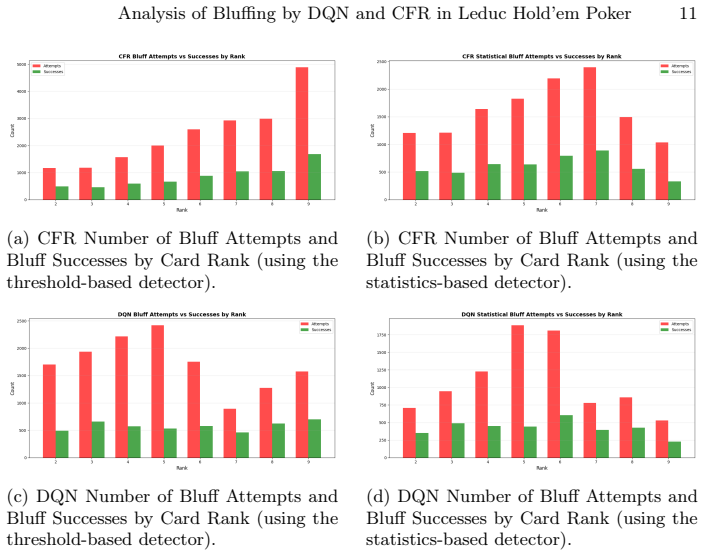
Neither DQN nor CFR was given any concept of deception, yet both developed bluffing behavior when trained against each other. CFR, being equilibrium-driven, bluffed more often and distributed attempts across ranks 2 through 9 to keep its strategy unpredictable; DQN bluffing clustered at weak-to-mid hands where its learned Q-values showed aggression occasionally paid. Despite the different attempt rates, bluff success rates were 36–37% for CFR and 34–39% for DQN depending on the detector. Both agents also reacted to bluffs the same way: calling pre-flop to gather information, folding post-flop once the public card resolved uncertainty. The paper reads the matched success rates as evidence tha
Load-bearing premise
The results stand or fall on whether the two hand-made bluff detectors correctly label real bluffs: if raises with weak hands are misread as bluffs, or bluffs with strong hands are missed, the measured rates and the game-versus-algorithm conclusion do not follow.
Editorial extensions
If this is right
- Bluffing becomes a measurable, first-class behavior: future poker-agent evaluations can report bluff attempt and success statistics alongside win rates and exploitability.
- Because agents co-trained against each other converged to near-equal bluff success rates, single-agent evaluations against fixed opponents may yield different numbers than mutually adapting ones.
- CFR's extra bluff attempts across additional card ranks did not produce extra folds, implying those marginal bluffs buy unpredictability rather than immediate profit.
- Both agents shifted from call-heavy, information-gathering responses pre-flop to fold-heavy responses post-flop, indicating information availability rather than algorithm family drives reactions to bluffs.
- The similarity of success rates across two methodologically opposite algorithms supports treating bluffing as a structural feature of imperfect-information games worth studying in its own right.
Reading between the lines
- A sharper test of the game-versus-algorithm conclusion would pit a third, structurally different learner (a policy-gradient agent, an actor-critic, or a human) in the same Leduc environment and check whether bluff-success rates again land in the mid-30s percent band.
- The near-equal success rates may be an artifact of mutual adaptation rather than a game constant: DQN and CFR co-tuned their calling and folding frequencies to each other, so a natural extension is freezing one agent's policy and measuring whether the other's success rate shifts.
- Both detectors classify bluffs by private-hand strength only, so a raise with a strong hand intended to look weak is invisible to the analysis; adding action-history or timing features could reveal deception styles the current framework cannot see.
- Sweeping the HandScore cutoff and the 0.5-sigma / 70% parameters would test whether the qualitative conclusion survives detector choice; the paper reports agreement between two detectors but does not perform such a sensitivity analysis.
Editorial analysis
A structured set of objections, weighed in public.
Referee Report
Summary. The paper trains a DQN agent and a CFR agent against each other in a 52-card variant of Leduc Hold'em, then evaluates them over 100,000 logged games. Two bluff detectors are proposed: a threshold-based detector that classifies a raise as a bluff when the private-hand score is at most 32, and a statistics-based detector that approximates a formal belief/EQ definition using mean/sigma thresholds and a pair-raise rule. The central claim is that both DQN and CFR exhibit bluffing, that CFR bluffs more often than DQN, that bluff success rates are similar (CFR 36%/37%, DQN 34%/39%), and that both agents react similarly to bluffs (call pre-flop, fold post-flop). The paper interprets this as evidence that bluffing is an essential aspect of the game rather than of a particular learning algorithm.
Significance. If the measurements are reliable, the paper would be a useful empirical contribution on emergent deceptive behavior in imperfect-information game agents, complementing the usual win-rate/exploitability evaluations. The code is released, and using two detection heuristics is a reasonable starting point. However, the central comparative claims rest on an unvalidated hand-chosen threshold and on an approximated version of the statistical detector, so the strength of the conclusions currently exceeds what the evidence supports.
major comments (5)
- [§3.3, Eq. (1)] The threshold-based detector is the load-bearing instrument for all bluff counts. The cutoff of 32 and the hand-score formula (rank x 4 + suit, plus 1000 for a pair) are chosen by hand, and no validation, sensitivity analysis, or comparison with expert-labeled bluffs is given. The suit term is particularly unmotivated: Spc is a tie-breaker, not a strength contributor, yet it changes the score and can move a hand across the cutoff. The paper should report how the counts and the qualitative conclusions change when the cutoff is varied over a plausible range, and should justify the score formula or replace it with a standard poker hand-strength measure.
- [§3.2 and Table 2] The manuscript never states that epsilon-greedy exploration is disabled during evaluation. Table 2 sets Epsilon End to 0.05, and §3.2 only says the agents use 'their learned policies' during the 100,000 evaluation games. If evaluation retains epsilon=0.05, then roughly 5% of DQN actions are uniformly random, and any random raise with a low private card will be classified as a bluff by Eq. (1). This would inflate DQN bluff counts and contaminate the CFR comparison, since CFR trains and evaluates against this DQN. The authors must state explicitly whether epsilon is set to zero at evaluation, and ideally report a random-policy baseline for the bluff detector.
- [§3.3, Eq. (2) and implementation] The statistics-based detector is presented as a second, independent validation, but the implementation does not compute the formal definition in Eq. (2). It replaces the belief distribution and expected-utility comparison with heuristic rules: mean minus 0.5 sigma for pairs, and a '>70% of raises are with pairs' rule for non-pairs. These parameters are arbitrary, and the approximation is acknowledged in the text. As a result, the two detectors are not truly independent; both are hand-tuned filters over the same hand-strength score. The paper should either implement the formal definition for this small game (which is computationally feasible) or clearly label the statistical detector as another heuristic and avoid claiming independent confirmation.
- [§4.1 and Fig. 2] The comparative claim that DQN and CFR have 'roughly the same' bluff success rate is based on point estimates of 34% vs. 36% (threshold) and 39% vs. 37% (statistical). No confidence intervals, standard errors, significance tests, or multiple seeds are reported. Given the large but single evaluation run and the detector classification noise, these differences are not interpretable. The paper should report variability across at least several training runs and provide a significance test or confidence intervals for the success-rate comparison.
- [§4.1 and §5] The interpretation that CFR bluffs more because it is 'equilibrium-driven' is not supported by the experimental setup. The authors themselves state in §4 that CFR has not converged after the training budget used. This does not invalidate the behavioral observations, but the equilibrium-based explanation should be softened or replaced with a description of what the finite-time CFR strategy actually does. Otherwise the central claim that bluffing differences arise from the two paradigms is speculative.
minor comments (6)
- [§3.3, Eq. (1)] The notation Rpc and Spc is used without defining the rank mapping (e.g., A=14, K=13, ...?) and without explaining why the suit value is added. The phrase 'less than 10s' is also ambiguous about whether 10 is included.
- [Fig. 3 caption] The main text claims CFR bluff attempts 'increase in size from 2 to 9' and 'peak at ranks 7–9', while the caption for panel (b) says attempts 'peak at ranks 5–7'. These descriptions should be reconciled with the actual plotted data.
- [Fig. 2 caption] Typo: 'succesful' should be 'successful'.
- [§2.1] The 52-card extension of Leduc is a substantive change from the standard 6-card game. The authors claim it 'creates richer opportunities for deception' but provide no comparison showing that the strategic properties relevant to bluffing are preserved. A short discussion or reference would help.
- [References] Reference [14] is cited as the source of 'further details of our methods' but is a university thesis that may not be readily accessible. The paper should be self-contained enough that the detectors and training details can be reproduced from the text and the released code alone.
- [Fig. 1] The win-rate plots appear to be smoothed or binned, but the text does not describe the aggregation window or whether the lines are averages over multiple runs. Clarify the figure construction.
Circularity Check
Minor definitional circularity in the bluff detector; comparative results are independent.
-
self definitional
[Section 3.3 (Bluff Detection, Eq. 1) and Section 4.1 (Do CFR and DQN bluff?)]
"If an agent performs a raise action while holding a hand with a strength score of 32 or lower (less than 10s and no pairs), then the action is classified as an attempted bluff. If the opponent folds immediately to the agents bluff attempt, then we classify that as a successful bluff. ... From Figure 2 we can see that both agents have a large number of both attempted and successful bluffs using two independent detectors. This shows us that indeed both DQN and CFR engage in bluffing."
The detector defines 'attempted bluff' as a raise with HandScore <= 32 (Eq. 1). The existence conclusion 'both DQN and CFR engage in bluffing' is a direct restatement of the counts generated by that definition: any nonzero count of raises with HandScore <= 32 is automatically classified as bluffing. The paper does not independently establish that these raises are deceptive or strategic; it stipulates it. Thus the existential part of the central claim is true by construction. The comparative claims (CFR bluffs more; success rates similar; rank distributions) are not circular because they compare the counts and opponent fold responses, but the 'bluffing exists' result is definitional. Since the threshold is a hand-set operationalization rather than a fitted parameter, this is a minor definit
full rationale
The paper's central comparison—that both DQN and CFR bluff at different rates with similar success—is an empirical measurement, not a derivation. The only load-bearing reduction is the operationalization in Eq. 1: an 'attempted bluff' is defined as a raise with HandScore <= 32, so the conclusion that both agents 'engage in bluffing' is a restatement of the nonzero counts produced by that definition. This is a transparent, hand-set definition rather than a fitted parameter disguised as a prediction, and it does not contaminate the rank-distribution or success-rate findings. No load-bearing self-citation or imported uniqueness theorem appears: references [13] and [14] are the authors' own code/thesis, but the detector and training details are in the paper. The evaluation-phase epsilon issue is a correctness/validity concern, not circularity. Overall, minor definitional circularity, partially acknowledged by the paper's 'we define and identify' language; score 2.
Assumptions & free parameters
free parameters (4)
- Bluff threshold hand score (32) =
32
- Rank multiplier (4) and pair bonus (1000) in HandScore =
4, 1000
- Statistical misrepresentation threshold =
0.5
- Pair-raise fraction rule =
70%
assumptions (4)
- domain assumption Leduc Hold'em with a 52-card deck preserves the strategic features relevant to bluffing of the original 6-card game
- domain assumption The HandScore function (Eq. 1) is an adequate measure of hand strength for bluff classification
- domain assumption CFR with 10 iterations per episode provides a meaningful approximation of equilibrium play for the comparative claim
- standard math Standard regret minimization and Q-learning convergence assumptions
Cite this review
Pith. "Pith review of Analysis of Bluffing by DQN and CFR in Leduc Hold'em Poker." pith.science (2026). https://pith.science/paper/X5FJC4PM
@misc{pith2026250904125,
  author       = {Pith},
  title        = {Pith review of: Analysis of Bluffing by DQN and CFR in Leduc Hold'em Poker},
  year         = {2026},
  howpublished = {\url{https://pith.science/paper/X5FJC4PM}},
  note         = {Machine review of arXiv:2509.04125}
}
read the original abstract
In the game of poker, being unpredictable, or bluffing, is an essential skill. When humans play poker, they bluff. However, most works on computer-poker focus on performance metrics such as win rates, while bluffing is overlooked. In this paper we study whether two popular algorithms, DQN (based on reinforcement learning) and CFR (based on game theory), exhibit bluffing behavior in Leduc Hold'em, a simplified version of poker. We designed an experiment where we let the DQN and CFR agent play against each other while we log their actions. We find that both DQN and CFR exhibit bluffing behavior, but they do so in different ways. Although both attempt to perform bluffs at different rates, the percentage of successful bluffs (where the opponent folds) is roughly the same. This suggests that bluffing is an essential aspect of the game, not of the algorithm. Future work should look at different bluffing styles and at the full game of poker. Code at https://github.com/TarikZ03/Bluffing-by-DQN-and-CFR-in-Leduc-Hold-em-Poker-Codebase.
Figures


Figures from the paper (2 more)


Reference graph
Works this paper leans on
-
[1]
Brown,N.,Sandholm,T.:Superhumanaiformultiplayerpoker.Science 365(6456), 885–890 (2019).https://doi.org/10.1126/science.aay2400, https://doi.org/ 10.1126/science.aay2400
-
[2]
ConJelCo LLC, Pittsburgh, PA (2006)
Chen, B., Ankenman, J.: The Mathematics of Poker. ConJelCo LLC, Pittsburgh, PA (2006)
work page 2006
-
[3]
Nature518(7540), 529–533 (2015)
Mnih, V., Kavukcuoglu, K., Silver, D., Rusu, A.A., Veness, J., Bellemare, M.G., Graves,A.,Riedmiller,M.,Fidjeland,A.K.,Ostrovski,G.,Petersen,S.,Beattie,C., Sadik, A., Antonoglou, I., King, H., Kumaran, D., Wierstra, D., Legg, S., Hassabis, D.: Human-level control through deep reinforcement learning. Nature518(7540), 529–533 (2015). https://doi.org/10.1038...
-
[4]
Science 356(6337), 508–513 (2017)
Moravčík, M., Schmid, M., Burch, N., Lisý, V., Morrill, D., Bard, N., Davis, T., Waugh, K., Johanson, M., Bowling, M.: Deepstack: Expert-level artificial intel- ligence in heads-up no-limit poker. Science 356(6337), 508–513 (2017). https: //doi.org/10.1126/science.aam6960
-
[5]
Princeton University Press, Princeton, NJ (1944) 16 Tarik Začiragić, Aske Plaat, and K
von Neumann, J., Morgenstern, O.: Theory of Games and Economic Behavior. Princeton University Press, Princeton, NJ (1944) 16 Tarik Začiragić, Aske Plaat, and K. Joost Batenburg
work page 1944
-
[6]
Plaat, A.: Learning to play: reinforcement learning and games. Springer (2020)
work page 2020
-
[7]
Two Plus Two Publishing, Las Vegas, NV (1987)
Sklansky, D.: The Theory of Poker. Two Plus Two Publishing, Las Vegas, NV (1987)
work page 1987
-
[8]
In: Proceedings of the 21st Conference on Uncertainty in Artificial Intelligence (UAI)
Southey, F., Bowling, M.P., Larson, B., Piccione, C., Burch, N., Billings, D., Rayner, C.: Bayes’ bluff: Opponent modelling in poker. In: Proceedings of the 21st Conference on Uncertainty in Artificial Intelligence (UAI). pp. 550–558 (2005)
work page 2005
Show all 16 references
-
[9]
MIT Press, Cambridge, MA, 2nd edn
Sutton, R.S., Barto, A.G.: Reinforcement Learning: An Introduction. MIT Press, Cambridge, MA, 2nd edn. (2018)
2018
-
[10]
In: Benelux Conference on Artificial Intelligence
Wang, H., Emmerich, M., Plaat, A.: Assessing the potential of classical q-learning in general game playing. In: Benelux Conference on Artificial Intelligence. pp. 138–
-
[11]
arXiv preprint arXiv:1903.08129 (2019)
Wang, H., Emmerich, M., Preuss, M., Plaat, A.: Hyper-parameter sweep on alp- hazero general. arXiv preprint arXiv:1903.08129 (2019)
1903 arXiv
-
[12]
In: Machine Learning
Watkins, C.J., Dayan, P.: Q-learning. In: Machine Learning. vol. 8, pp. 279–292. Springer (1992)
1992
-
[13]
https://github.com/TarikZ03/ Bluffing-by-DQN-and-CFR-in-Leduc-Hold-em-Poker-Codebase (2025), gitHub repository
Začiragić, T.: Bluffing by DQN and CFR in Leduc Hold-em Poker: Codebase. https://github.com/TarikZ03/ Bluffing-by-DQN-and-CFR-in-Leduc-Hold-em-Poker-Codebase (2025), gitHub repository
2025
-
[14]
Leiden University (2025)
Začiragić, T.: Bluffing tendencies in Leduc Hold’em. Leiden University (2025)
2025
-
[15]
CoRRabs/1910.04376 (2019), http: //arxiv.org/abs/1910.04376
Zha, D., Lai, K., Cao, Y., Huang, S., Wei, R., Guo, J., Hu, X.: Rlcard: A toolkit for reinforcement learning in card games. CoRRabs/1910.04376 (2019), http: //arxiv.org/abs/1910.04376
1910 arXiv
-
[16]
In: Proceedings of the 21st International Con- ference on Neural Information Processing Systems
Zinkevich, M., Johanson, M., Bowling, M., Piccione, C.: Regret minimization in games with incomplete information. In: Proceedings of the 21st International Con- ference on Neural Information Processing Systems. p. 1729–1736. NIPS’07, Curran Associates Inc., Red Hook, NY, USA (2007)
2007
Reviewed August 5, 2026 · model on record in the stance chip above.
Discussion (0). Continue with ORCID to comment.