REVIEW 3 major objections 4 minor 54 references
Lagrangian features of turbulent transport in tokamak plasmas
T0 review · 3 major / 4 minor · reviewed 2026-08-05 · deepseek-v4-flash
Pith's one-line read Tokamak turbulence keeps Lagrangian statistics nearly stationary despite inhomogeneous drifts
desk verdict A careful, honest numerical study of approximate Lagrangian stationarity in a synthetic-turbulence test-particle model, but the abstract's tokamak extrapolation outruns the evidence because the super-ensemble construction builds in much of the stationarity that is then reported. read the letter →
The pith
A machine-rendered reading of the paper's core claim, the machinery that carries it, and where it could break.
The reading
What carries the argument
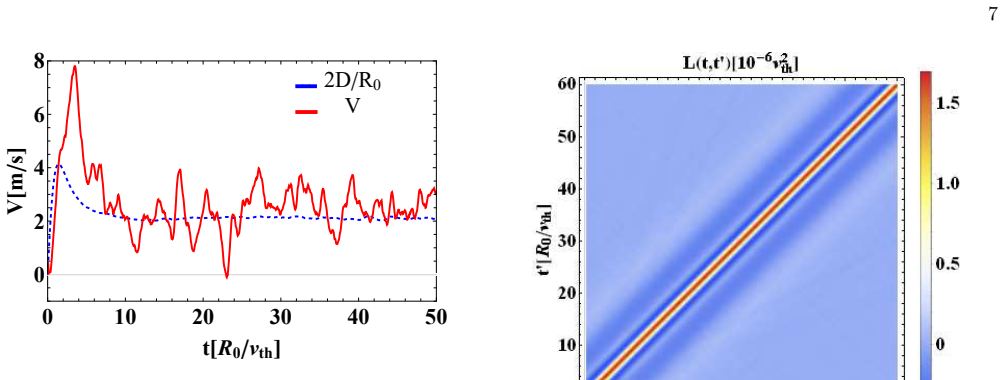
The central object is the Lagrangian velocity autocorrelation function L(t,t') for radial gyrocenter velocities, along with its two-time structure and its use in computing the diffusion coefficient via the Green-Kubo integral DL(t) = ∫₀ᵗ L(τ)dτ, compared against the mean-square-displacement definition Dd(t). The paper also uses the super-ensemble average over both initial phase-space coordinates and independent field realizations, and a linearized form of the E×B drift, B(x)⁻¹ ≈ B(0)⁻¹(1 - X·∇lnB(0)), to derive the turbulence equipartition pinch as V(t) ≈ (2D(t)/R₀) ∇lnB.
What would settle it
Run the same test-particle diagnostics in a global gyrokinetic simulation with a single shared, self-consistently saturated turbulent field (including zonal flows) and compare the two-time Lagrangian autocorrelation L(t0, t0+t) across different t0 values, along with the difference between MSD and Green-Kubo diffusion coefficients; if the deviations exceed the few-percent level in that setting, the paper's stationarity claim would not carry over to realistic turbulence.
Extended reading notes
Core claim
The central claim is that, despite the Eulerian gyrocenter drifts being compressible and inhomogeneous, the Lagrangian statistics of test-particle transport in tokamak-like turbulence are approximately stationary, ergodic, and time-symmetric. The paper supports this with simulations of 5×10^5 particles in the Cyclone Base Case, showing that the Lagrangian velocity autocorrelation is nearly independent of the initial time, that forward and backward time evolutions produce essentially identical transport coefficients and particle distributions, and that single-realization and ensemble-average diffusion agree to about 5%. It also shows that the long-time diffusion coefficient changes by only 5-
Load-bearing premise
The load-bearing premise is that the statistics of the synthetic turbulence ensemble—independent random-phase Fourier realizations that are by construction Eulerian-stationary, homogeneous, and Gaussian—represent a real tokamak's single self-consistent turbulent field, which includes zonal flows, collisions, and non-Gaussian structures that the model omits.
Editorial extensions
If this is right
- Reduced transport models that assume Lagrangian stationarity, such as Green-Kubo relations and the Decorrelation Trajectory Method, can be applied in tokamak-relevant geometries with expected errors of roughly a percent.
- The asymptotic diffusion coefficient is robust to changes in initial phase-space sampling, so test-particle codes can initialize particles from simpler distributions without materially altering predicted transport.
- A finite radial pinch, here identified as a turbulence equipartition pinch proportional to the local diffusion coefficient, should be included in local transport closures even when temperature gradients and rotation are absent.
- The time-integrated Green-Kubo estimator DL tends to underestimate the asymptotic diffusion relative to the MSD-based estimator, because the slight non-stationarity of the velocity amplitude is not captured by L(0,t); DL should be used with caution when stationarity is imperfect.
- The apparent ergodicity of gyrocenter transport arises from broad initial phase-space sampling, so simulations with narrow or non-representative initial distributions may produce spurious transport statistics even if the field model is accurate.
Reading between the lines
- The paper's mechanism suggests a testable extension for real tokamak turbulence: if a self-consistent, single-shared turbulent field (including zonal flows and non-Gaussian structures) is used instead of independent random-phase realizations, the measured Lagrangian stationarity may degrade because the ergodic mixing provided by initial conditions would have to compensate for a field that is no lo
- The 1%-level stationarity found here is likely tied to the Gaussianity and homogeneity of the synthetic field ensemble; introducing drift-wave packets, streamers, or intermittent bursts could push the deviations beyond the few-percent range, providing a direct stress test of the paper's claim.
- The TEP pinch expression V ∝ 2D/R₀ could be probed experimentally by comparing measured impurity or main-ion radial convection with independently inferred diffusion coefficients in discharges where turbulence is the dominant drive, isolating the geometric contribution.
- The distinction between DL and Dd suggests a practical estimator for diagnosing non-stationarity in any test-particle or tracer simulation: the persistent gap between correlation-based and MSD-based diffusion coefficients measures the violation of Lagrangian stationarity directly.
Signed reviews
Editorial analysis
A structured set of objections, weighed in public.
Referee Report
Summary. The paper uses the T3ST test-particle code to construct a random-phase ITG-like turbulent electrostatic field ensemble and asks whether Lagrangian velocity statistics are stationary, ergodic, and time-symmetric despite the inhomogeneous and compressible character of the Eulerian gyrocenter drifts. The central numerical finding is that, in the standard T3ST setup (broad Maxwellian initial distribution plus an independent field realization per particle), the radial velocity autocorrelation L(t0,t0+t) is nearly independent of t0, the velocity variance drifts by about 1%, and forward/backward time simulations agree. The paper additionally reports a turbulent equipartition pinch V≈2D/R0, a ~5%–20% sensitivity of the long-time diffusion coefficient to the initial phase-space sampling, a close but imperfect agreement between MSD- and correlation-based diffusion estimates, and a single-trajectory control showing that stationarity is lost when the initial phase-space sampling is narrow. The conclusion is that the statistical assumptions underlying reduced transport models (Green-Kubo relations, DTM, Fick closures) hold to good approximation in tokamak-relevant geometries.
Significance. If the result holds as stated, it provides valuable numerical support for the use of stationary, ergodic statistical descriptions of turbulent transport in fusion plasmas, and it sharpens the known limitations of such descriptions. The paper has genuine strengths: it includes a control experiment (Section III I), convergence tests (Fig. 20), and an unusually candid self-assessment of the DL estimator (Section III H). The claims are appropriately hedged with 'approximately' and '≈1%'. The main significance is therefore conditional: the evidence is strong for the super-ensemble used in T3ST, but the extrapolation to a single physical turbulent realization is not yet tested at the level of the autocorrelation function, which is the quantity that anchors the paper's central claim.
major comments (3)
- [III C and III F] The central stationarity result is obtained with the T3ST super-ensemble in which each of the Np particles evolves in its own random-phase field realization (Sec. II C, Eqs. 12–14). Because the field ensemble is stationary and homogeneous by construction, the near-independence of L(t0,t0+t) from t0 in Figs. 7b and 8b is largely an ensemble property. The only single-shared-field comparison, Fig. 14, tests the running D(t), not L(t0,t0+t); D(t) is a time integral of L and is therefore far less sensitive to a time-origin dependence, as the paper itself demonstrates in Sec. III H for DL vs Dd. To support the conclusion that Lagrangian stationarity holds in a tokamak-like single realization, the manuscript should compute L(t0,t0+t) for a broad initial distribution in a single shared field, or should explicitly restrict the claim to the super-ensemble.
- [III B, Eq. (5), Fig. 5] The identification of the radial pinch as a turbulent equipartition pinch is presented as confirmed by the agreement with V≈2D/R0. However, starting from the linearization B(x)^-1 ≈ B(0)^-1(1 - X·∇lnB(0)) and the assumption that X is E×B-dominated, Eqs. (3)–(5) make both V(t) and 2D(t)/R0 time integrals of the same velocity autocorrelation ⟨Vr(t)Vr(τ)⟩. The agreement in Fig. 5 is therefore largely a consistency check of the linearization rather than an independent confirmation of the TEP mechanism. Please state this explicitly, or provide a test that does not use the same L(t,τ) on both sides (e.g., a direct measurement of the compressibility contribution).
- [III I] The single-trajectory experiment compares one fixed initial phase-space point across independent field realizations with the standard super-ensemble. It demonstrates that narrowing the initial phase-space sampling changes the outcome, but it does not isolate the physical mechanism: in the standard case the initial distribution is broad and each particle also sees an independent field realization, whereas in the single-trajectory case both are collapsed. The claim that 'the extensiveness of the initial kinetic distribution' causes the apparent stationarity still needs a control in which a broad initial distribution is evolved in a single shared field realization. Without that control, the attribution to phase-space sampling rather than to ensemble averaging over fields remains ambiguous.
minor comments (4)
- [Eq. (11)] The displayed formula for V(t|x) contains typographical errors in the braces and superscript: it should be V(t|x) = d/dt {⟨X(t|x)⟩}, with one closing brace and no stray '⟩}^2'. Please correct.
- [III C and III D] The text contains repeated typos: 'ask weather' should be 'ask whether', and 'a more consistent approach would be to initialize particles in either a known equilibrium state ... or a steady-state—like the one reached asymptotically under pure magnetic motion' contains a long dash that should be an em dash. These are minor but should be fixed.
- [III B and Conclusions] The abbreviation TEP is introduced as 'Turbulence Equipartition Pinch' in Section III B but as 'Turbulent Equipartition' in the Conclusions. Please use one consistent name and define it at first use.
- [III H, Figs. 19–20] The statement that D∞_L provides 'a smaller average value' than D∞_d is made without a quantitative bias estimate. Since this is directly relevant to the '≈1% stationarity' claim, please report the mean bias and its uncertainty, or explain why the bias is not statistically significant.
Circularity Check
TEP confirmation in Sec. III B reduces to the Green-Kubo identity V = D·∇lnB by construction; the central stationarity result is otherwise self-contained.
-
self definitional
[Section III B (TEP derivation), using Eq. (5) and Fig. 5]
"V(t) = ∫ t 0 dτ ⟨Vr(t)Vr(τ)⟩ ·∂r lnB(0) ∝ 2D(t)/R0. In the final step we have identified the expression of diffusion as time-integral of the velocity auto-correlation. It turns out that the numerical results are very much in line with this approximate dependency (see Fig. 5) thus, the TEP is confirmed."
Eq. (5) defines D(t)=∫0^t L(τ)dτ, the time integral of the Lagrangian velocity autocorrelation. The TEP derivation expresses V(t) as the same integral multiplied by ∂r lnB(0). Hence V=2D/R0 is an algebraic consequence of the definitions once stationarity is assumed, not an independent numerical prediction. The Fig. 5 agreement therefore verifies the Green-Kubo relation/stationarity, not a distinct TEP mechanism. The paper's wording 'the TEP is confirmed' overstates what is a built-in consistency check.
full rationale
The paper's main quantitative results (e.g., L(t0,t0+t) in Sec. III C, Dd vs DL in Sec. III H, and single-vs-ensemble D in Sec. III F) are self-contained numerical experiments: they are measured from simulated trajectories rather than derived from the assumptions. The stationarity claim has independent support, including the single-trajectory experiment in Sec. III I showing that stationarity is not trivially forced by Eulerian stationarity alone. The super-ensemble/single-field equivalence is tested only for D(t), not for L(t0,t0+t); that is an external-validity limitation, not a circular reduction. The one genuinely circular step is the TEP 'confirmation': both V and D are expressed as time-integrals of the same velocity autocorrelation, so the agreement in Fig. 5 is a consistency check, not an independent confirmation of the TEP mechanism. This partial circularity affects a secondary claim, while the central stationarity result remains self-contained.
Assumptions & free parameters
free parameters (7)
- turbulence amplitude Φ = eAφ/Ti =
0.011
- radial correlation length λx =
7 (in scaled units, ρi)
- poloidal correlation length λy =
5
- characteristic wavenumber k0 =
0.05
- correlation time τc =
4
- safety factor coefficients c1, c2, c3 =
0.85, 0, 2.2
- mode count Nc and particle count Np =
Nc=100, Np=5×10^5
assumptions (6)
- domain assumption Gyrokinetic ordering and Lie-perturbation theory justify the gyrocenter equations (Eqs. 6-7), with FLR effects via J0(k⊥ρL).
- ad hoc to paper The synthetic turbulent potential is statistically Gaussian, zero-mean, stationary, homogeneous, and characterized by spectrum S(k,ω) of Eq. 14.
- domain assumption Slab-like ITG dispersion relation ω⋆(k) = k·V⋆s / (1 + ρs²|k⊥|²) (Eq. 9).
- ad hoc to paper TEP linearization: B(x)⁻¹ ≈ B(0)⁻¹(1 - X·∇lnB(0)), with displaced positions driven mainly by the E×B drift.
- domain assumption Neglect of collisions, plasma rotation, zonal flows, polarization drifts, and magnetic fluctuations.
- standard math The gyrocenter dynamics conserve phase-space volume, so the initially broad distribution remains broad.
invented entities (1)
-
super-ensemble (joint average over the initial phase-space distribution and over independent turbulent field realizations)
Cite this review
Pith. "Pith review of Lagrangian features of turbulent transport in tokamak plasmas." pith.science (2026). https://pith.science/paper/742VEMQ4
@misc{pith2026250904132,
  author       = {Pith},
  title        = {Pith review of: Lagrangian features of turbulent transport in tokamak plasmas},
  year         = {2026},
  howpublished = {\url{https://pith.science/paper/742VEMQ4}},
  note         = {Machine review of arXiv:2509.04132}
}
read the original abstract
This study investigates the Lagrangian properties of ion turbulent transport driven by drift-type turbulence in tokamak plasmas. Despite the compressible and inhomogeneous nature of Eulerian gyrocenter drifts, numerical simulations with the T3ST code reveal approximate ergodicity, stationarity, and time-symmetry. These characteristics are attributed to broad initial phase-space distributions that support ergodic mixing. Moreover, relatively minor constraints on the initial distributions are found to have negligible effects on transport levels.
Figures


Figures from the paper (17 more)


Reference graph
Works this paper leans on
-
[1]
Initial pitch angles are fixed at λ = 0.3
-
[2]
Initial energies are fixed at E =Ti
-
[3]
Particles are placed at a single radial point on the low-field side (LFS)
-
[4]
Turbulence is later, at t = 35R0/vth, after the par- ticles reach a quasi-steady quiescent state
-
[5]
thus, the TEP is confirmed. C. Lagrangian stationarity Previously, results shown in Figs. 4a-4b suggested that the distributions P [Vr] of radial Lagrangian velocities of particles are almost identical between the starting point of the simulation t = 0 and the final time t = tmax = 60R0/vth. A closer inspection into Fig. 5 has revealed that this is not enti...
-
[6]
Initial pitch angles are setted to λ = 0.3 and parti- cle placed at the low-field-side (LFS)
-
[7]
Initial pitch angles and energies are concurrently setted to λ = 0.3,E =Ti
-
[8]
D.I. Palade and L.M. Pomˆ arjanschi. T3st code: turbulent transport in tokamaks via stochastic trajectories. Nuclear Fusion, 65(8):086007, jul 2025
work page 2025
Show all 54 references
-
[9]
The first four scenarios constitute a mild degrada- tion (restriction) of the initial filling of the phase space
Initial energies are setted to E = Ti and particle placed at the low-field-side (LFS). The first four scenarios constitute a mild degrada- tion (restriction) of the initial filling of the phase space. Their associated radial diffusion coefficients are shown in Fig. 15a. Perhaps surp...
-
[10]
This is the reason for the consistent underestimation of diffusion. In Figs. 20a and 20b we have investigated the conver- gence of the statistics of asymptotic diffusion coefficients D∞ L andD∞ d with the number of test-particles used Np or partial modes Nc. The purpose was to rul...
-
[11]
D.I. Palade. Peaking and hollowness of low-z impurity profiles: an interplay between itg and tem induced turbu- lent transport. Nuclear Fusion, 63(4):046007, mar 2023
2023
-
[12]
R. Balescu. V-langevin equations, continuous time ran- dom walks and fractional diffusion. Chaos, Solitons & Fractals, 34(1):62 – 80, 2007. In Search of a Theory of Complexity
2007
-
[13]
Diffusion by continuous movements
Geoffrey I Taylor. Diffusion by continuous movements. Proceedings of the london mathematical society, 2(1):196– 212, 1922
1922
-
[14]
It is interesting to note that the latter seem to have similar amplitudes in both cases
Minor differences ∼ 5% can be observed across the entire time profile and stem from numerical fluctuations. It is interesting to note that the latter seem to have similar amplitudes in both cases. This suggests that the numerical noise is independent of single ensemble 0 10 20 30...
-
[15]
A. S. Monin. Statistical fluid mechanics : mechanics of turbulence. MIT Press, Cambridge, Mass, 1971
1971
-
[16]
Aspects of anomalous transport in plas- mas
Radu Balescu. Aspects of anomalous transport in plas- mas. CRC Press, 2005
2005
-
[17]
Statistical theory of turbulence
SA Orszag. Statistical theory of turbulence. Fluid dy- namics, pages 237–374, 1973
1973
-
[18]
Tokamaks, volume
John Wesson and David J Campbell. Tokamaks, volume
-
[19]
Progress and challenges in understanding core transport in tokamaks in support to iter operations
P Mantica, C Angioni, N Bonanomi, J Citrin, B A Grierson, F Koechl, A Mariani, G M Staebler, Eurofu- sion JET contributors, Eurofusion MST1 contributors, ASDEX Upgrade team, and ITPA transport & confine- ment group. Progress and challenges in understanding core transport in tok...
2019
-
[20]
D. I. Palade and M. Vlad. Fast generation of gaussian random fields for direct numerical simulations of stochas- tic transport. Statistics and Computing , 31(5):60, Aug 2021
2021
-
[21]
Neural networks for turbulent trans- port prediction in a simplified model of tokamak plasmas
LM Pomˆ arjanschi. Neural networks for turbulent trans- port prediction in a simplified model of tokamak plasmas. Plasma Physics and Controlled Fusion , 66(6):065007, 2024
2024
-
[22]
This broken stationarity is supported further by plots of the Lagrangian auto-correlation either in 2D such as Fig
which implies that stationarity is broken for the turbulent dy- namics of a single quiescent trajectory. This broken stationarity is supported further by plots of the Lagrangian auto-correlation either in 2D such as Fig. 23a-23b or in single-time Fig. 24a-24b. These results co...
2023
-
[23]
Scaling laws of two-dimensional incompressible turbulent trans- port
D I Palade, L M Pomˆ arjanschi, and M Ghit ¸˘ a. Scaling laws of two-dimensional incompressible turbulent trans- port. Physica Scripta , 99(1):015201, dec 2023
2023
-
[24]
Collisional transport in plasma
Fred L Hinton. Collisional transport in plasma. Handbook of Plasma Physics , 1(147):331, 1983
1983
-
[25]
Dif-Pradalier, P
G. Dif-Pradalier, P. H. Diamond, V. Grandgirard, Y. Sarazin, J. Abiteboul, X. Garbet, Ph. Ghendrih, A. Strugarek, S. Ku, and C. S. Chang. On the valid- ity of the local diffusive paradigm in turbulent plasma transport. Phys. Rev. E , 82:025401, Aug 2010
2010
-
[26]
Littlejohn
Robert G. Littlejohn. Hamiltonian perturbation theory in noncanonical coordinates. Journal of Mathematical Physics, 23(5):742–747, 05 1982
1982
-
[27]
A. J. Brizard and T. S. Hahm. Foundations of nonlinear gyrokinetic theory. Rev. Mod. Phys. , 79:421–468, Apr 2007
2007
-
[28]
Sauter and S.Yu
O. Sauter and S.Yu. Medvedev. Tokamak coordinate con- ventions: Cocos. Computer Physics Communications , 184(2):293–302, 2013
2013
-
[29]
neoclassical transport theory
Transport processes in plasmas. neoclassical transport theory. vol. 2
-
[30]
W. Horton. Drift waves and transport. Rev. Mod. Phys. , 71:735–778, Apr 1999
1999
-
[31]
Jenko, W
F. Jenko, W. Dorland, M. Kotschenreuther, and B. N. Rogers. Electron temperature gradient driven turbu- lence. Physics of Plasmas , 7(5):1904–1910, 05 2000
1904
-
[32]
Naulin, J
V. Naulin, J. Nycander, and J. Juul Rasmussen. Equipar- tition and transport in two-dimensional electrostatic tur - bulence. Phys. Rev. Lett. , 81:4148–4151, Nov 1998
1998
-
[33]
M. A. Beer, S. C. Cowley, and G. W. Hammett. Field- aligned coordinates for nonlinear simulations of tokamak turbulence. Physics of Plasmas , 2(7):2687–2700, 07 1995
1995
-
[34]
G. M. Staebler, J. Candy, N. T. Howard, and C. Holland. The role of zonal flows in the saturation of multi-scale gy- rokinetic turbulence. Physics of Plasmas , 23(6):062518, 06 2016
2016
-
[35]
Dudding, F.J
H.G. Dudding, F.J. Casson, D. Dickinson, B.S. Patel, C.M. Roach, E.A. Belli, and G.M. Staebler. A new quasi- linear saturation rule for tokamak turbulence with appli- cation to the isotope scaling of transport. Nuclear Fusion, 62(9):096005, jul 2022
2022
-
[36]
Dimits, B.I
A.M. Dimits, B.I. Cohen, N. Mattor, W.M. Nevins, D.E. Shumaker, S.E. Parker, and C. Kim. Simulation of ion temperature gradient turbulence in tokamaks. Nuclear Fusion, 40(3Y):661, mar 2000
2000
-
[37]
The european turbulence code bench- marking effort: turbulence driven by thermal gradients in magnetically confined plasmas
G L Falchetto, B D Scott, P Angelino, A Bottino, T Dan- nert, V Grandgirard, S Janhunen, F Jenko, S Jolliet, A Kendl, B F McMillan, V Naulin, A H Nielsen, M Otta- viani, A G Peeters, M J Pueschel, D Reiser, T T Ribeiro, and M Romanelli. The european turbulence code bench- mark...
2008
-
[38]
Lin and T
Z. Lin and T. S. Hahm. Turbulence spreading and trans- port scaling in global gyrokinetic particle simulations. Physics of Plasmas , 11(3):1099–1108, 03 2004
2004
-
[39]
Vernay, S
T. Vernay, S. Brunner, L. Villard, B. F. McMillan, S. Jol- liet, T. M. Tran, A. Bottino, and J. P. Graves. Neo- 18 classical equilibria as starting point for global gyroki- netic microturbulence simulations. Physics of Plasmas , 17(12):122301, 12 2010
2010
-
[40]
Garbet, G
X. Garbet, G. Dif-Pradalier, C. Nguyen, Y. Sarazin, V. Grandgirard, and Ph. Ghendrih. Neoclassical equi- librium in gyrokinetic simulations. Physics of Plasmas , 16(6):062503, 06 2009
2009
-
[41]
Angelino, A
P. Angelino, A. Bottino, R. Hatzky, S. Jolliet, O. Sauter, T. M. Tran, and L. Villard. On the definition of a kinetic equilibrium in global gyrokinetic simulations. Physics of Plasmas, 13(5):052304, 05 2006
2006
-
[42]
Camenen, A
Y. Camenen, A. G. Peeters, C. Angioni, F. J. Casson, W. A. Hornsby, A. P. Snodin, and D. Strintzi. Impact of the background toroidal rotation on particle and heat turbulent transport in tokamak plasmas. Physics of Plas- mas, 16(1):012503, 01 2009
2009
-
[43]
M. B. Isichenko, A. V. Gruzinov, and P. H. Diamond. In- variant measure and turbulent pinch in tokamaks. Phys. Rev. Lett., 74:4436–4439, May 1995
1995
-
[45]
M. Vlad, F. Spineanu, and S. Benkadda. Impurity pinch from a ratchet process. Phys. Rev. Lett. , 96:085001, Feb 2006
2006
-
[46]
M. Vlad, F. Spineanu, J. H. Misguich, and R. Balescu. Diffusion with intrinsic trapping in two-dimensional in- compressible stochastic velocity fields. Phys. Rev. E , 58:7359–7368, Dec 1998
1998
-
[47]
M. Vlad, F. Spineanu, J. H. Misguich, and R. Balescu. Diffusion in biased turbulence. Phys. Rev. E , 63:066304, May 2001
2001
-
[48]
M. Vlad, F. Spineanu, J. H. Misguich, and R. Balescu. Collisional effects on diffusion scaling laws in electrostat ic turbulence. Phys. Rev. E , 61:3023–3032, Mar 2000
2000
-
[49]
Turbulent transport of the w ions in toka- mak plasmas: properties derived from a test particle ap- proach
Dragos Iustin Palade, Madalina Vlad, and Florin Spineanu. Turbulent transport of the w ions in toka- mak plasmas: properties derived from a test particle ap- proach. Nuclear Fusion, 61(11):116031, oct 2021
2021
-
[50]
Effects of the parallel acceleration on heavy impurity transport in turbulent tokamak plasmas
Madalina Vlad, Dragos Iustin Palade, and Florin Spineanu. Effects of the parallel acceleration on heavy impurity transport in turbulent tokamak plasmas. Plasma Physics and Controlled Fusion , 63(3):035007, jan 2021
2021
-
[51]
Effects of the mean field gradients on magnetic field line random walk
Madalina Vlad. Effects of the mean field gradients on magnetic field line random walk. The Astrophysical Jour- nal, 867(2):104, 2018
2018
-
[52]
Stochastic field-line wandering in magnetic turbulence with shear
M Negrea, I Petrisor, and A Shalchi. Stochastic field-line wandering in magnetic turbulence with shear. ii. decor- relation trajectory method. Physics of Plasmas , 24(11), 2017
2017
-
[53]
The fluctuation-dissipation theorem
R Kubo. The fluctuation-dissipation theorem. Reports on Progress in Physics , 29(1):255, jan 1966
1966
-
[54]
Mixing, ergodicity and the fluctuation-dissipation theo- rem in complex systems
Mendeli H Vainstein, Ismael VL Costa, and F A Oliveira. Mixing, ergodicity and the fluctuation-dissipation theo- rem in complex systems. In Jamming, Yielding, and Ir- reversible Deformation in Condensed Matter , pages 159–
-
[149]
Oxford university press, 2011
2011
Reviewed August 5, 2026 · model on record in the stance chip above.
Discussion (0). Continue with ORCID to comment.