REVIEW 3 major objections 6 minor 22 references
An Automated, Scalable Machine Learning Model Inversion Assessment Pipeline
T0 review · 3 major / 6 minor · reviewed 2026-08-05 · deepseek-v4-flash
Pith's one-line read This paper proposes an automated, modular evaluation pipeline that quantifies how much private training data model inversion attacks can leak from image classifiers, scoring risk across four accuracy-based dimensions.
desk verdict Genuinely novel pipeline for MIA risk scoring, but the privacy-loss claim rests on unvalidated proxies and one experiment fine-tunes evaluators on the private data. read the letter →
The pith
A machine-rendered reading of the paper's core claim, the machinery that carries it, and where it could break.
The reading
What carries the argument
The load-bearing mechanism is a four-stage modular pipeline: (1) a target classifier; (2) a model inversion attack, here feature visualization with a GAN prior or generative model inversion (GMI), run repeatedly to produce reconstructed images per class; (3) a VLM (CLIP, BLIP2, or InstructBLIP) that captions each reconstruction and supports zero-shot text and image classification; and (4) an evaluation model trained on disjoint public data, optionally fine-tuned into a proxy model on the reconstructions. The four risk dimensions are computed from these components and combined through the weighted composite accuracy loss formula WCAL = sum(ω_k r_k), which is what turns raw reconstruction accu
What would settle it
Run the pipeline on a target model trained on class labels that have been shuffled relative to the images (so no real class-typical visual features exist). If the four loss values, especially quality and feature loss, stay high because reconstructions are saved only when the target model classifies them correctly, then the scores are tracking the selection criterion rather than private training-data leakage. A second check: split a single class's training images into two subgroups, one with a private visual attribute, and test whether reconstruction accuracy for the private subgroup exceeds ch
Extended reading notes
Core claim
The central claim is that privacy loss from model inversion can be quantified automatically by treating four accuracy-based measures as adversarial risk dimensions, then averaging them into a single score. The four dimensions are: quality loss, the classification accuracy of reconstructed images under an evaluation model trained on public data disjoint from the target's training set; feature loss, the accuracy with which a VLM's zero-shot text classification of image captions recovers possible class labels; label loss, the accuracy of zero-shot classification that assigns a high-confidence class label to each reconstructed group; and model stealing loss, the accuracy of a proxy model obtaine
Load-bearing premise
The whole risk score rests on the assumption that the classification accuracy of a reconstructed image under an external evaluation model or VLM faithfully measures how much private training data leaked; the paper itself notes the evaluation does not capture true visual semantics.
Editorial extensions
If this is right
- Model architecture materially changes inversion risk: in the paper's experiments VGG16 consistently falls into high risk while ResNet50 falls into low risk, so architecture choice should be part of pre-deployment privacy review.
- Increasing the number of reconstructed images per class beyond a small number (10) does not raise any of the four loss values, so assessments can be run with small reconstruction budgets at lower compute cost.
- Fine-tuning the GAN prior and the VLMs on domain-specific public data substantially increases all measured losses, meaning domain-adapted attacks reveal more leakage than generic ones.
- The WCAL score gives a single comparable risk number that can bin any image classifier into low/medium/high leakage risk without human interpretation of reconstructed images.
Reading between the lines
- If the accuracy-based metrics are accepted as leakage proxies, the same pipeline architecture could be applied to other data modalities (e.g., audio or tabular) by swapping the VLM and evaluation model, since the four loss definitions do not depend on image-specific details.
- A testable extension: use the pipeline to compare the four loss dimensions against a direct privacy ground truth, such as a dataset where one class contains private subgroups; if the pipeline's risk score tracks subgroup reconstruction accuracy, it would validate the metric; if not, it would isolate what the classifier accuracy is actually measuring.
- The paper's own caveat that the evaluation 'does not capture true visual semantics' suggests the quality and feature losses may partly reflect class-typical public features selected by the attack's save criterion; extending the pipeline with per-image semantic similarity (e.g., retrieval against training-like images) could separate genuine private-data leakage from generic class resemblance.
Editorial analysis
A structured set of objections, weighed in public.
Referee Report
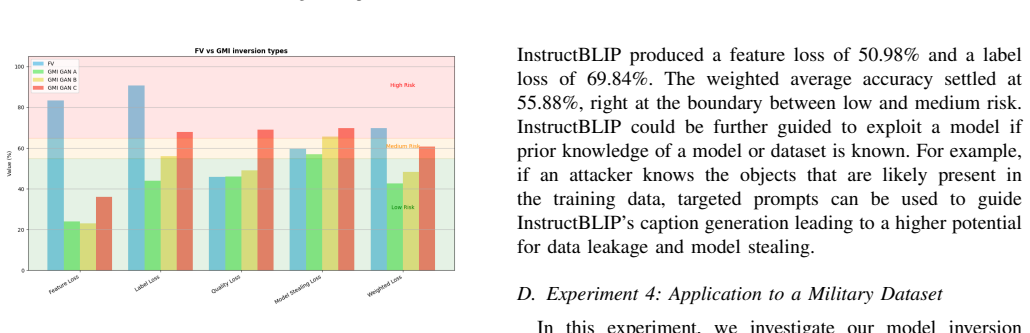
Summary. The paper presents an automated, modular pipeline for developmental test and evaluation (DT&E) of model inversion attack (MIA) risk in image classifiers. The pipeline applies an MIA (feature visualization with a GAN prior, or GMI) to a target model, produces reconstructed images, captions them with a vision-language model (VLM), and computes four risk metrics: quality loss (evaluation-model classification accuracy), feature loss (VLM zero-shot text classification on captions), label loss (VLM zero-shot image classification), and model stealing loss (proxy model accuracy). These are combined into a weighted composite accuracy loss (WCAL) using equal weights in the experiments, and models are binned into low/medium/high risk categories. Experiments vary target architectures (VGG16, MobileNetV2, ResNet50), number of reconstructions (10/50/100), MIA type (FV, GMI), VLM type (BLIP2, InstructBLIP), and dataset (STL-10 and a military vehicle dataset). The results show architecture-dependent risk, with VGG16 consistently rated high-risk and ResNet50 low-risk, and the military-vehicle experiments report increased losses after fine-tuning the GAN, BLIP, and CLIP on the target's training data.
Significance. If the proposed metrics are valid, the paper addresses a genuine gap: there are few automated, scalable MIA risk assessment frameworks, and none that integrate VLMs for interpretation. The modular design and the four-dimensional decomposition are useful engineering contributions, and the experimental breadth across architectures, attacks, VLMs, and datasets is commendable. However, the central claim that the four accuracy-based losses 'quantify privacy loss' is not yet established. The losses are classification accuracies relabeled as losses, none is validated against an accepted privacy-leakage benchmark, and the paper itself concedes in Section III-D that the evaluation 'does not capture true visual semantics.' Since WCAL is a weighted average of these unvalidated accuracies, the risk scores and low/medium/high classifications rest on a construct-validity assumption that is load-bearing and currently unsupported. The work shows promise as a tool prototype, but the privacy-loss interpretation requires stronger evidence before it can support operational DT&E decisions.
major comments (3)
- [Section II-B1 and Section III-D] The quality loss metric is defined as the classification accuracy of an external evaluation model on reconstructed images, and it is asserted that 'higher accuracy indicates a higher information loss.' This assertion is never validated against a ground-truth privacy metric. Section III-D explicitly states that 'this MIA evaluation does not capture true visual semantics' and that quality loss values are high partly because the pipeline saves reconstructed images only when they are correctly categorized against the target model. This selection criterion means the quality-loss numbers reflect the attack's alignment with the target's decision boundary, not necessarily the recovery of specific private training instances. As quality loss is one of the four components of WCAL (Eq. 1), the composite risk score is not established as a measure of privacy loss. The authors should validate quality l
- [Section I.C and Section III-D (Experiment 4)] The paper states in Section I.C that when an evaluation model is used to assess MIA accuracy, its training dataset is independent of the target model's training dataset. Yet in Section III-D, the second trial of Experiment 4 fine-tunes the GAN, BLIP, and CLIP on the very same military-vehicle dataset used to train the target model, explicitly 'to capture the highest-risk assessment.' This violates the stated independence assumption and introduces circularity: evaluators that have already seen the private data will score reconstructions highly regardless of what the target model actually leaked. The observed increase in losses after fine-tuning is therefore not evidence of increased leakage from the target. The paper should either use public-data-only priors and evaluators in the main results, or clearly relabel the second trial as an upper-bound adversary with private-data access and com
- [Section II-B (all four metrics) and Eq. (1)] All four loss dimensions are classification accuracies (of an InceptionV3 evaluation model, VLM zero-shot text classification, VLM zero-shot image classification, and a proxy model) that are relabeled as losses. The paper does not compare these scores to any existing MIA evaluation metric, such as the methodology discussed in reference [22], nor to a ground-truth measure of training-data exposure. Without such validation, the risk thresholds (55% and 65%) and the conclusions that VGG16 is 'high risk' and ResNet50 is 'low risk' are not supported as statements about privacy loss; they are statements about classifier agreement among the target, evaluation, and VLM models. A validation experiment correlating each dimension and WCAL with an established privacy metric on a common set of models/attacks is needed to support the central claim.
minor comments (6)
- [Section II (structure)] The subsection numbering is inconsistent: after Section II-B, the text jumps to subsections D, E, F, and G, and no Section II-C appears. Section II-A also uses A/B/C/D labels for pipeline stages, which conflicts with the main subsection numbering. Please renumber for clarity.
- [Eq. (1)] The equation for WCAL appears as 'WCAL = 4X k=1' in the submitted text, with the summation index and limits not properly typeset. Please ensure the equation is rendered in standard mathematical notation.
- [References] Reference [9] (He et al., ResNet) lists the arXiv identifier 1801.04381, which is the same as reference [8] for MobileNetV2. The ResNet paper's arXiv identifier is 1512.03385. Please correct this.
- [Section II-G] The risk thresholds for low (<55%), medium (55-65%), and high (>65%) risk are introduced without justification or sensitivity analysis. Since these thresholds directly determine the qualitative risk labels, a brief rationale or a robustness check varying the thresholds would strengthen the presentation.
- [Section III (experimental setup)] The paper promises 95% confidence intervals for all experiments, but several reported values in Experiment 3 (e.g., VGG feature loss 75.0%, label loss 90.0%) are given without intervals. Please report intervals consistently across all results.
- [General (reproducibility)] The paper does not provide a code repository, random seeds, or complete details of the GMI configurations beyond iteration counts and thresholds. Given that the pipeline is the main contribution, more implementation detail or a public release would aid independent verification.
Circularity Check
Partial circularity: Experiment 4 fine-tunes evaluators on the target's private training data, and quality loss is inflated by a target-correct selection rule.
-
fitted input called prediction
[Section III-D (Experiment 4: Application to a Military Dataset), paragraphs 3-5]
"To demonstrate how distilling and incorporating prior knowledge can improve MIA success, we fine-tuned the GAN used as the prior in the FV attack, as well as the BLIP and CLIP models used for feature loss and label loss evaluation. ... we utilize training data for the following experiments. ... These increases show that the fine-tuning of the GANs and VLMs allow more information to be leaked by the target model."
Feature loss and label loss are defined as VLM classification/captioning accuracy on reconstructed images. Fine-tuning BLIP and CLIP on the same military-vehicle dataset used to train the target model mechanically raises their accuracy on reconstructions resembling that dataset, independent of what the target model actually leaked. The reported increase in loss is therefore a direct consequence of fitting the evaluators to the private data, not an independent measurement of increased information leakage from the target. This also contradicts the paper's own independence requirement in Section I-C: 'we ensure that the training dataset for the evaluation model and the training dataset that was used to train the target model are independent.'
-
self definitional
[Section III-D (Experiment 4: Application to a Military Dataset), paragraph 3]
"The quality loss values are high because the process of creating the reconstructed images saves images that are correctly categorized against the target model. While this results in good accuracy against the evaluation model, the difference in loss scores reinforces the observation that this MIA evaluation does not capture true visual semantics [22]."
Quality loss is defined as evaluation-model accuracy on reconstructed images. The pipeline saves only reconstructions that the target model classifies correctly, and the evaluation model is trained on the same classification task, so target-correct reconstructions will often also be evaluation-correct. The high quality-loss value is thus partly an artifact of the selection rule built into the definition of the metric, rather than evidence of private-training-data leakage. The paper's own sentence exhibits this reduction: the saving rule 'results in good accuracy against the evaluation model,' so the metric measures alignment with the target's decision boundary more than recovery of specific private instances.
full rationale
The paper's derivation chain is not globally circular: Experiments 1-3 use stock VLMs and an evaluation model trained on data disjoint from the target's training set, so those architecture, attack, and VLM comparisons have independent content. The construct-validity assumption in Section II-B1 (higher evaluation accuracy = higher information loss) is a validity threat rather than a circularity per se. However, two concrete construction effects create partial circularity in the reported risk scores. First, the quality-loss metric is inflated by design because only reconstructions correctly categorized by the target model are saved, directly raising the evaluation-model accuracy that defines quality loss. Second, Experiment 4 fine-tunes the GAN, BLIP, and CLIP on the target's private training data and then attributes the resulting increases in loss to the target model leaking more information; because the evaluators themselves have now seen the private data, the increase reduces to the fine-tuning procedure rather than to measured target leakage. These two effects contaminate some of the evidence for the central claim that the pipeline quantifies privacy loss, but they do not make the entire framework reducible to its inputs. The paper's own admission in Section III-D that 'this MIA evaluation does not capture true visual semantics' supports this assessment. No load-bearing self-citation chain is present. Overall score: 6.
Assumptions & free parameters
free parameters (4)
- Risk weights omega_k =
0.25 each (equal weights)
- WCAL risk thresholds =
low <55%, medium 55-65%, high >65%
- GMI configuration parameters =
iterations 5000/7500/10000; selectivity thresholds 0.7/0.8
- NearMiss undersampling parameters =
version=1, neighbors=3, feature size=32x32
assumptions (6)
- domain assumption Higher classification accuracy of reconstructed images by an independent evaluation model indicates higher information loss from the target model's private training data.
- domain assumption Reconstructed images that strongly activate a target model's internal layer or class node are meaningful proxies for private training examples.
- domain assumption VLM captions and zero-shot labels of reconstructed images reveal the target model's class structure or task.
- domain assumption An adversary can approximate the target task by training on public data plus reconstructed images, and proxy model accuracy on the private training set is a valid measure of model stealing.
- domain assumption The target model's test dataset can be used to train an evaluation model that represents an adversary's capability without leaking target training data.
- domain assumption An equal-weight arithmetic combination of the four risk dimensions produces a meaningful composite privacy risk score.
invented entities (1)
-
Weighted Composite Accuracy Loss (WCAL)
Cite this review
Pith. "Pith review of An Automated, Scalable Machine Learning Model Inversion Assessment Pipeline." pith.science (2026). https://pith.science/paper/35HBZS7H
@misc{pith2026250904214,
  author       = {Pith},
  title        = {Pith review of: An Automated, Scalable Machine Learning Model Inversion Assessment Pipeline},
  year         = {2026},
  howpublished = {\url{https://pith.science/paper/35HBZS7H}},
  note         = {Machine review of arXiv:2509.04214}
}
read the original abstract
Machine learning (ML) models have the potential to transform military battlefields, presenting a large external pressure to rapidly incorporate them into operational settings. However, it is well-established that these ML models are vulnerable to a number of adversarial attacks throughout the model deployment pipeline that threaten to negate battlefield advantage. One broad category is privacy attacks (such as model inversion) where an adversary can reverse engineer information from the model, such as the sensitive data used in its training. The ability to quantify the risk of model inversion attacks (MIAs) is not well studied, and there is a lack of automated developmental test and evaluation (DT&E) tools and metrics to quantify the effectiveness of privacy loss of the MIA. The current DT&E process is difficult because ML model inversions can be hard for a human to interpret, subjective when they are interpretable, and difficult to quantify in terms of inversion quality. Additionally, scaling the DT&E process is challenging due to many ML model architectures and data modalities that need to be assessed. In this work, we present a novel DT&E tool that quantifies the risk of data privacy loss from MIAs and introduces four adversarial risk dimensions to quantify privacy loss. Our DT&E pipeline combines inversion with vision language models (VLMs) to improve effectiveness while enabling scalable analysis. We demonstrate effectiveness using multiple MIA techniques and VLMs configured for zero-shot classification and image captioning. We benchmark the pipeline using several state-of-the-art MIAs in the computer vision domain with an image classification task that is typical in military applications. In general, our innovative pipeline extends the current model inversion DT&E capabilities by improving the effectiveness and scalability of the privacy loss analysis in an automated fashion.
Figures


Figures from the paper (5 more)



Reference graph
Works this paper leans on
-
[22]
Revisiting Model Inversion Evaluation: From Misleading Standards to Reliable Privacy Assessment
S. S. Ho, H. Liu, A. Suri, Z. Fu, S. Jha, and K. Chaudhuri, “Revisiting Model Inversion Evaluation: From Misleading Standards to Reliable Privacy Assessment,” 2025. [Online]. Available: https://arxiv.org/abs/2505.03519
work page Pith review arXiv 2025
-
[1]
Model inversion attacks that exploit confidence information and basic countermeasures,
M. Fredrikson, S. Jha, and T. Ristenpart, “Model inversion attacks that exploit confidence information and basic countermeasures,” in Proceedings of the 22nd ACM SIGSAC Conference on Computer and Communications Security , ser. CCS ’15. Association for Computing Machinery, 2015, pp. 1322–1333. [Online]. Available: https://doi.org/10.1145/2810103.2813677
arXiv 2015
-
[2]
Response Wide Shut: Surprising Observations in Basic Vision Language Model Capabilities
S. Chandhok, O. Vantzos, E. Strack, and Y . Bitton, “Response Wide Shut: Surprising Observations in Basic Vision Language Model Capabilities,” 2024. [Online]. Available: https://arxiv.org/abs/2408.06721
work page Pith review arXiv 2024
-
[3]
C. Park, D. Hong, and C. Seo, “An Attack-Based Evaluation Method for Differentially Private Learning Against Model Inversion Attack,” in IEEE Access , 2019. [Online]. Available: https://doi.org/10.1109/ACCESS.2019.2938759
-
[4]
Checkpoint for bart-large after being trained on the MultiNLI (MNLI) dataset
Meta, “Checkpoint for bart-large after being trained on the MultiNLI (MNLI) dataset.” https://huggingface.co/facebook/bart-large-mnli, 2025
work page 2025
-
[5]
Z. He, C. Gui, A. Suri, C. Meehan, K. Chaudhuri, and S. Jha, “Be Careful What You Smooth For: Label Smoothing Can Be a Privacy Shield But Also a Catalyst for Model Inversion Attacks,” in The Twelfth International Conference on Learning Representations (ICLR) , 2024. [Online]. Available: https://openreview.net/forum?id=V2zk3y5d2e
work page 2024
-
[6]
Rethinking the inception architecture for computer vision,
C. Szegedy, V . Vanhoucke, S. Ioffe, J. Shlens, and Z. Wojna, “Rethinking the inception architecture for computer vision,” in IEEE Conference on Computer Vision and Pattern Recognition (CVPR) , 2016. [Online]. Available: doi: 10.1109/CVPR.2016.308
-
[7]
Very deep convolutional networks for large-scale image recognition,
K. Simonyan and A. Zisserman, “Very deep convolutional networks for large-scale image recognition,” arXiv preprint arXiv:1409.1556 , 2014
arXiv 2014
Show all 22 references
-
[9]
Deep residual learning for image recognition,
K. He, X. Zhang, S. Ren, and J. Sun, “Deep residual learning for image recognition,” arXiv preprint arXiv:1801.04381 , 2018
2018 arXiv
-
[10]
Visualizing and understanding convolu- tional networks,
M. D. Zeiler and R. Fergus, “Visualizing and understanding convolu- tional networks,” in European Conference on Computer Vision (ECCV) . Springer, 2014, pp. 818–833
2014
-
[11]
The Secret Revealer: Generative Model-Inversion Attacks Against Deep Neural Networks,
Y . Zhang, Z. Chen, Z.-Y . Kuo, and J. Z. Wang, “The Secret Revealer: Generative Model-Inversion Attacks Against Deep Neural Networks,” in Proceedings of the IEEE/CVF Conference on Computer Vision and Pattern Recognition (CVPR), 2020, pp. 2447–2456
2020
-
[12]
Learning transferable visual models from natural language supervision,
A. Radford, J. W. Kim, C. Hallacy, A. Ramesh, G. Goh, S. Agarwal, G. Sastry, A. Askell, P. Mishkin, J. Clark, G. Krueger, and I. Sutskever, “Learning transferable visual models from natural language supervision,” arXiv preprint arXiv:2103.00020 , 2021
2021 arXiv
-
[13]
BLIP-2: bootstrapping language-image pre-training with frozen image encoders and large language models,
J. Li, D. Li, S. Savarese, and S. Hoi, “BLIP-2: bootstrapping language-image pre-training with frozen image encoders and large language models,” in ICML’23: Proceedings of the 40th International Conference on Machine Learning , 2023. [Online]. Available: https://dl.acm.org/doi...
2023
-
[14]
InstructBLIP: towards general- purpose vision-language models with instruction tuning,
W. Dai, J. Li, D. Li, A. M. H. Tiong, J. Zhao, W. Wang, B. Li, P. Fung, and S. Hoi, “InstructBLIP: towards general- purpose vision-language models with instruction tuning,” in NIPS ’23: Proceedings of the 37th International Conference on Neural Information Processing System , ...
2023
-
[15]
An analysis of single-layer networks in unsupervised feature learning,
A. Coates, H. Lee, and A. Y . Ng, “An analysis of single-layer networks in unsupervised feature learning,” in Proceedings of the Fourteenth Inter- national Conference on Artificial Intelligence and Statistics (AISTATS) , vol. 15, 2011, pp. 215–223
2011
-
[16]
ImageNet: A Large-Scale Hierarchical Image Database,
J. Deng, W. Dong, R. Socher, L.-J. Li, K. Li, and L. Fei-Fei, “ImageNet: A Large-Scale Hierarchical Image Database,” in Proceedings of the IEEE/CVF Conference on Computer Vision and Pattern Recognition (CVPR), 2009, pp. 248–255
2009
-
[17]
Military Vehicles Dataset,
lab-v2, “Military Vehicles Dataset,” https://huggingface.co/datasets/lab- v2/military vehicles, 2023
2023
-
[18]
Lucid library adapted for PyTorch,
Lim Swee Kiat, “Lucid library adapted for PyTorch,” https://github.com/greentfrapp/lucent, 2021
2021
-
[19]
Error detection and constraint recovery in hierarchical multi-label classification without prior knowledge,
J. S. Kricheli, K. V o, A. Datta, S. Ozgur, and P. Shakarian, “Error detection and constraint recovery in hierarchical multi-label classification without prior knowledge,” in The 33rd ACM International Conference on Information and Knowledge Managemen (CIKM ’24) . Association ...
2024
-
[20]
kNN Approach to Unbalanced Data Distributions: A Case Study involving Information Extraction,
J. Zhang and I. Mani, “kNN Approach to Unbalanced Data Distributions: A Case Study involving Information Extraction,” in Proceedings of the ICML’2003 Workshop on Learning from Imbalanced Datasets , 2003. [Online]. Available: https://www.site.uottawa.ca/ nat/Workshop2003/jzhang.pdf
2003
-
[21]
An image is worth 16x16 words: Transformers for image recognition at scale,
A. Dosovitskiy, L. Beyer, A. Kolesnikov, D. Weissenborn, X. Zhai, T. Unterthiner, M. Dehghani, M. Minderer, G. Heigold, S. Gelly, J. Uszkoreit, and N. Houlsby, “An image is worth 16x16 words: Transformers for image recognition at scale,” ArXiv, vol. abs/2010.11929, 2020. [Onli...
2010 arXiv
-
[23]
BLIP: Bootstrapping Language-Image Pre-training for Unified Vision-Language Understanding and Generation,
Salesforce, “BLIP: Bootstrapping Language-Image Pre-training for Unified Vision-Language Understanding and Generation,” https://huggingface.co/Salesforce/blip-image-captioning-base, 2022
2022
Reviewed August 5, 2026 · model on record in the stance chip above.
Discussion (0). Continue with ORCID to comment.