REVIEW 3 major objections 4 minor 39 references
Reinforcement Learning for Robust Ageing-Aware Control of Li-ion Battery Systems with Data-Driven Formal Verification
T0 review · 3 major / 4 minor · reviewed 2026-08-05 · deepseek-v4-flash
Pith's one-line read A switched reinforcement-learning charging controller for Li-ion cells is certified—with probability at least 99.956% and confidence at least 99.9999%—to reach 90% SOC within 80 minutes while keeping voltage and temperature within safety li
desk verdict A genuine integration of RL and data-driven formal verification for battery control, but the headline probability guarantee depends on an under-specified SOC partition. read the letter →
The pith
A machine-rendered reading of the paper's core claim, the machinery that carries it, and where it could break.
The reading
What carries the argument
The load-bearing object is the data-driven Strongest Asynchronous ℓ-complete Abstraction (SAℓCA): a finite automaton whose states are length-ℓ sequences of output labels observed from sampled trajectories, with transitions given by the domino rule—a successor state's first ℓ−1 labels must equal the predecessor's last ℓ−1 labels. It over-approximates the concrete battery's output behaviors, and a PAC-style bound (Proposition 2) says a new initial condition's label sequence lies inside the abstraction with probability at least 1−ε at confidence at least 1−β. This abstraction acts as the verifier inside a counterexample-guided inductive synthesis loop: it certifies the Reach-While-Avoid propert
What would settle it
Take the final switched controller and simulate a large batch of initial conditions drawn from the boundaries of the 8 partition cells, or with a deliberately biased SOC measurement of a few percent; if any trajectory violates voltage or temperature limits or fails to reach 90% SOC within 80 minutes, then the abstraction's label alignment or its coverage of the switched regions is wrong and the 99.956% claim does not transfer to those cases.
Extended reading notes
Core claim
The paper establishes that a switched output-feedback charging controller for a Li-ion cell, synthesized by iterating RL training against a data-driven formal verifier, can be certified to satisfy a time-bounded Reach-While-Avoid specification—reach 90% SOC within 80 minutes while keeping voltage at most 4.2 V and temperature at most 45 °C—with probability at least 99.956% and confidence at least 99.9999%, over random initial conditions, manufacturing parameter variations, and state-of-health values between 85% and 100%. The guarantee is distribution-free: it holds for any underlying distribution of initial conditions, not just the Gaussian used in sampling. The same finite abstraction is re
Load-bearing premise
The probabilistic certificate transfers to a real cell only if the output labels used by the verifier match the true physical sets—goal label t means SOC in [0.9,1] and safe label a means voltage at most 4.2 V and temperature at most 45 °C—so any SOC-estimation error or label discretization mismatch breaks the chain.
Editorial extensions
If this is right
- If correct, deploying the synthesized controller on cells within the specified parameter and SOH ranges carries a distribution-free guarantee that a fresh cell will follow a safe, goal-reaching charge with probability at least 99.956% at confidence at least 99.9999%.
- The same data-driven abstraction can be reused to verify additional temporal properties without new sampling or training, e.g., time bounds to intermediate SOC levels such as 50% in at most 33.75 minutes and 70% in at most 49.25 minutes.
- The CEGIS architecture turns verification failures into region-specific retraining, so the formal guarantee scales from a single controller to a switched family of controllers without abandoning the abstraction-based certificate.
- The controller operates in output feedback using only measurable signals—SOC, voltage, temperature, past input current, and time—so the protocol is deployable in a battery management system without estimating internal electrochemical states.
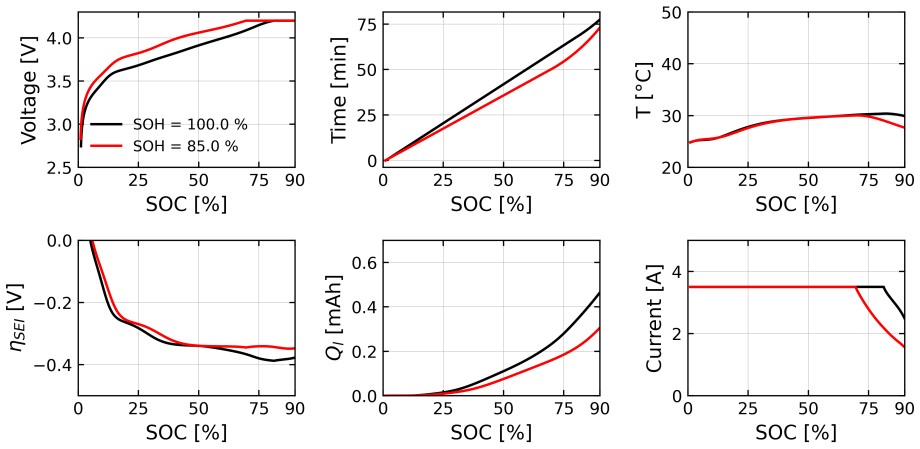
- Relative to the CC-CV benchmark at 3.5 A, the synthesized protocol saves up to 20 minutes of charging time in some initial-condition regions with comparable capacity loss, and improves the reward balance across all sampled initial conditions.
Reading between the lines
- Because training and verification share the same electrochemical simulator, a model bias common to both—for example in SEI kinetics—would not be detected by the abstraction; independent hardware experiments would be needed before relying on the numeric probability in practice.
- The switched controller selects a region from the initial measurements only, so initial measurement noise or sensor bias at the first step could place a cell in the wrong control region; the paper does not quantify sensitivity to that error.
- The reusable-abstraction pattern suggests a broader recipe: once a certified finite model of a closed-loop system is built, many control objectives can be checked offline against the same PAC bound, at the cost of re-verifying when the plant distribution changes.
Editorial analysis
A structured set of objections, weighed in public.
Referee Report
Summary. The paper proposes a CEGIS-based framework for synthesizing an output-feedback charging controller for a DFN-model Li-ion battery. RL (soft actor-critic) trains candidate controllers, and a data-driven Strongest Asynchronous ℓ-complete Abstraction (SAℓCA) built from 10^5 sampled H-long behaviors is used to verify a time-bounded Reach-While-Avoid (RWA) specification. If the finite abstraction satisfies the specification, Proposition 2 gives a distribution-free PAC guarantee. The headline result, Eq. (25), is that with confidence at least 99.9999%, the probability that a new initial condition (voltage, temperature, manufacturing parameters, SOH) yields a behavior in the abstraction is at least 99.956%; since all abstract behaviors are verified to satisfy the RWA specification, the concrete behavior is concluded to satisfy RWA. One refinement step partitions the initial set by voltage/temperature and retrains eight agents, yielding the switched controller K1.
Significance. If the guarantee chain is valid, the paper makes a valuable contribution: it couples RL with data-driven formal verification for a realistic physics-based battery model, treats manufacturing and SOH variability explicitly, and demonstrates reuse of the abstraction for secondary properties (50%/70% SOC time bounds). The approach is distribution-free and avoids Gaussian assumptions on the surrogate. The main caveat is that the transfer of the abstract verification to the concrete battery depends on a precise alignment between abstract labels and the concrete goal/safe sets; the current manuscript does not establish this alignment reproducibly, and the claimed ageing guarantee is broader than what the verified RWA specification supports.
major comments (3)
- [Sec. 4.2, Sec. 5.1, Eq. (25)] The SOC partition is ambiguous and inconsistent with the stated RWA goal. The text says the [0,1] interval is 'partitioned in 19 identical sections plus 1 for the Goal set' while Sec. 5.1 fixes X_G as SOC∈[0.9,1]. If the 19 sections are width-0.05 intervals ending at 0.95, then the goal label t is [0.95,1], a strict subset of X_G; if instead the 19 sections cover [0,0.9), the later claim that labels g–t denote SOC≥50% is false under either arithmetic. The exact target of the 99.956% guarantee is therefore not reproducible. Please specify the interval for every label, reconcile the reuse claim, and provide the implementation or a precise partition table. This is load-bearing because Eq. (25) transfers to the concrete RWA only if the abstract goal/safe labels are aligned with X_G and X_S.
- [Sec. 1, Sec. 6] The introduction claims 'We obtain a charging protocol with formal guarantees on the maximum rate of ageing of the battery'. This is not supported by the verification machinery: the RWA specification (Sec. 3.2, Sec. 5.1) involves only SOC, V, and T, and the abstraction labels contain no capacity-loss or ageing variable. The capacity loss Q_l appears only in the RL reward (Eq. (17)–(20)) and in benchmarking plots. The formal guarantee (Eq. (25)) is about the RWA specification, not about ageing. Please revise the claims to state exactly what is formally guaranteed, or extend the specification to include a verified ageing metric.
- [Sec. 2.1 Eq. (2), Sec. 3.1.3, Sec. 4.2 Step 1] The closed-loop system is presented as autonomous in Eq. (2), but the controller observes the time step k (Sec. 3.1.3: z_k includes 'time-step, ... k'; Sec. 4.1: policy π(z_k) with k in the observation). Therefore the closed-loop dynamics depend explicitly on k and are not of the form x_{k+1}=f(x_k). The application of Proposition 2, which is stated for a time-invariant TS, is not formally justified as written. Either remove k from the controller observation, or explicitly augment the state with the time index and discuss how the abstraction handles the resulting non-autonomous system. This is needed for the rigor of the guarantee chain.
minor comments (4)
- [Sec. 4.2] The phrase 'the Goal set, which consists of the region [SOC,1]' uses 'SOC' both as a variable name and as the state-of-charge; this makes the intended lower bound unclear. Use a distinct symbol, e.g., SOC_goal.
- [Fig. 11 caption] The caption reads 'Effect of the CC-CV protocol on pristine and aged cell...' but the text refers to the K1 controller. This appears to be a copy-paste error from Fig. 6 and should be corrected.
- [Sec. 5.2, reuse claim] The statement 'labels from g to t and from o to t indicate SOCs greater or equal to 50% and 70%' is likely a typo (probably 'k to t' for 50% if the width is 0.05). Please correct and verify against the actual partition.
- [General] No code or data are provided. Given that the reported guarantee hinges on the exact implementation of the partition and the SAℓCA construction, the authors should make the implementation available or at least list the exact label intervals and verification scripts.
Circularity Check
No significant circularity; the PAC/SAℓCA guarantee is used as an external theorem and the battery-level claim is a new application.
full rationale
The derivation chain is: train an RL controller, close the loop with the DFN model, sample N=10^5 behaviors, construct a data-driven SAℓCA, verify the finite abstraction against RWA via safety/reachability games, and then invoke Proposition 2 (quoted from [14]) plus the scenario-optimization bound of [21] to state the 99.956%/99.9999% PAC guarantee. The load-bearing probabilistic step is a general theorem about deterministic systems with finite output labels; its stated assumptions (i.i.d. sampling, Assumption 2) do not include the battery RWA property, and the bound on ε is computed from N, s*_N, and β, not fitted to make the conclusion true. The finite-abstraction verification is a model-checking step on the abstraction, not a renaming of the sampled outcomes. The use of prior work by the same group ([13]–[15], [20]) is real evidence rather than circular: Proposition 1 comes from Schmuck & Raisch [20] and Proposition 2 is an established PAC result; no uniqueness claim or ansatz is smuggled in by citation. The only notable concern in the text is Assumption 1: the abstraction-to-concrete transfer requires the output labels to be exactly aligned with X_G and X_S, and Section 4.2's description of the SOC partition is ambiguous relative to Section 5.1's X_G=[0.9,1] and to the later claim that labels g–t denote SOC≥50%. That ambiguity affects the reproducibility and the precise target of the guarantee, but it is an assumption/consistency issue, not a circular reduction: the RWA conclusion is not equivalent to the partition definition by construction. No fitted parameter is disguised as a prediction, and the controller comparison against CC-CV is external benchmarking. Therefore the circularity score is 0.
Assumptions & free parameters
free parameters (4)
- Reward weights lambda1, lambda2, lambda3 =
lambda1=10^2, lambda2=10^5, lambda3=2.5e-2 (Table 1)
- Abstraction memory length l =
6
- SOC partition granularity =
19 bins plus 1 goal bin
- Refinement clustering grid =
4 initial-voltage segments x 2 initial-temperature segments (8 agents)
assumptions (5)
- standard math SAℓCA over-approximation: B^H(S) subset of B^H(S_l) for l >= 1 (Proposition 1, ref [20]).
- standard math Data-driven PAC bound: P^N[ P[ B^H_x(S) in B^H(hat S_l) ] >= 1 - epsilon(s*, N, beta) ] >= 1 - beta (Proposition 2, refs [14,21]).
- domain assumption Assumption 1: X0, XS, XG are aligned with the output partition map h, i.e., label sets exactly represent initial, goal, and safe sets.
- domain assumption Assumption 2: initial conditions x0 are drawn i.i.d. from a probability distribution P.
- domain assumption The DFN/PyBaMM model with SEI-driven capacity loss is a faithful representation of the LG M50LT cell over the tested SOH range.
Cite this review
Pith. "Pith review of Reinforcement Learning for Robust Ageing-Aware Control of Li-ion Battery Systems with Data-Driven Formal Verification." pith.science (2026). https://pith.science/paper/L4IVSU3L
@misc{pith2026250904288,
  author       = {Pith},
  title        = {Pith review of: Reinforcement Learning for Robust Ageing-Aware Control of Li-ion Battery Systems with Data-Driven Formal Verification},
  year         = {2026},
  howpublished = {\url{https://pith.science/paper/L4IVSU3L}},
  note         = {Machine review of arXiv:2509.04288}
}
read the original abstract
Rechargeable lithium-ion (Li-ion) batteries are a ubiquitous element of modern technology. In the last decades, the production and design of such batteries and their adjacent embedded charging and safety protocols, denoted by Battery Management Systems (BMS), has taken central stage. A fundamental challenge to be addressed is the trade-off between the speed of charging and the ageing behavior, resulting in the loss of capacity in the battery cell. We rely on a high-fidelity physics-based battery model and propose an approach to data-driven charging and safety protocol design. Following a Counterexample-Guided Inductive Synthesis scheme, we combine Reinforcement Learning (RL) with recent developments in data-driven formal methods to obtain a hybrid control strategy: RL is used to synthesise the individual controllers, and a data-driven abstraction guides their partitioning into a switched structure, depending on the initial output measurements of the battery. The resulting discrete selection among RL-based controllers, coupled with the continuous battery dynamics, realises a hybrid system. When a design meets the desired criteria, the abstraction provides probabilistic guarantees on the closed-loop performance of the cell.
Figures


Figures from the paper (9 more)




Reference graph
Works this paper leans on
-
[1]
J. Weng, A. Jossen, A. Stefanopoulou, J. Li, X. Feng, G. Offer, Fast-charging lithium-ion batteries require a systems engineering approach, Nature Energy (2025) 1–2
work page 2025
-
[2]
K. A. Smith, C. D. Rahn, C.-Y. Wang, Control oriented 1d electrochemical model of lithium ion battery, Energy Conversion and management 48 (9) (2007) 2565–2578
work page 2007
- [3]
-
[4]
R. Darling, J. Newman, Modeling side reactions in composite liymn2 o 4 electrodes, Journal of The Electrochemical Society 145 (3) (1998) 990
work page 1998
- [5]
- [6]
-
[7]
Z. Khalik, Modeling and Optimal Control for Aging-Aware Charging of Batteries, PhD Thesis (research TU/e / graduation TU/e), Eindhoven University of Technology, Eindhoven (Nov. 2021)
work page 2021
-
[8]
S. Kolluri, S. V. Aduru, M. Pathak, R. D. Braatz, V. R. Subramanian, Real-time nonlinear model predictive control (nmpc) strategies using physics-based models for advanced lithium-ion battery man- agement system (bms), Journal of The Electrochemical Society 167 (6) (2020) 063505
work page 2020
Show all 39 references
-
[9]
S. Park, A. Pozzi, M. Whitmeyer, H. Perez, A. Kandel, G. Kim, Y. Choi, W. T. Joe, D. M. Raimondo, S. Moura, A Deep Reinforcement Learning Framework for Fast Charging of Li-ion Batteries, IEEE Transactions on Transportation Electrification 8 (2) (2022) 2770–2784. 27
2022
-
[10]
T. Gao, Y. Han, D. Fraggedakis, S. Das, T. Zhou, C.-N. Yeh, S. Xu, W. C. Chueh, J. Li, M. Z. Bazant, Interplay of lithium intercalation and plating on a single graphite particle, Joule 5 (2) (2021) 393–414
2021
-
[11]
X. Lu, M. Lagnoni, A. Bertei, S. Das, R. E. Owen, Q. Li, K. O’Regan, A. Wade, D. P. Finegan, E.Kendrick, etal., Multiscaledynamicsofchargingandplatingingraphiteelectrodescouplingoperando microscopy and phase-field modelling, Nature Communications 14 (1) (2023) 5127
2023
-
[12]
M. A. Chowdhury, S. S. Al-Wahaibi, Q. Lu, Adaptive safe reinforcement learning-enabled optimization of battery fast-charging protocols, AIChE Journal 71 (1) (2025) e18605
2025
-
[13]
R.Coppola, A.Peruffo, M.MazoJr, Data-drivenAbstractionsforVerificationofDeterministicSystems, arXiv preprint arXiv:2211.01793 (2022)
2022 arXiv
-
[14]
Coppola, A
R. Coppola, A. Peruffo, M. Mazo, Data-driven abstractions for verification of linear systems, IEEE Control Systems Letters 7 (2023) 2737–2742
2023
-
[15]
Coppola, A
R. Coppola, A. Peruffo, M. Mazo Jr, Data-driven abstractions for control systems via random explo- ration, arXiv preprint arXiv:2402.10668 (2024)
2024 arXiv
-
[16]
Abate, C
A. Abate, C. David, P. Kesseli, D. Kroening, E. Polgreen, Counterexample guided inductive synthesis modulo theories, in: International Conference on Computer Aided Verification, Springer, 2018, pp. 270–288
2018
-
[17]
Ravanbakhsh, S
H. Ravanbakhsh, S. Sankaranarayanan, Learning control lyapunov functions from counterexamples and demonstrations, Autonomous Robots 43 (2) (2019) 275–307
2019
-
[18]
Ahmed, A
D. Ahmed, A. Peruffo, A. Abate, Automated and sound synthesis of lyapunov functions with smt solvers, in: Tools and Algorithms for the Construction and Analysis of Systems: 26th International Conference, TACAS 2020, Held as Part of the European Joint Conferences on Theory and ...
2020
-
[19]
Tabuada, Verification and Control of Hybrid Systems: A Symbolic Approach, Springer Science & Business Media, 2009
P. Tabuada, Verification and Control of Hybrid Systems: A Symbolic Approach, Springer Science & Business Media, 2009
2009
-
[20]
Schmuck, J
A.-K. Schmuck, J. Raisch, Asynchronous l-complete approximations, Systems & Control Letters 73 (2014) 67–75
2014
-
[21]
Garatti, M
S. Garatti, M. C. Campi, The risk of making decisions from data through the lens of the scenario approach, IFAC-PapersOnLine 54 (7) (2021) 607–612. 28
2021
-
[22]
Doyle, T
M. Doyle, T. F. Fuller, J. Newman, Modeling of galvanostatic charge and discharge of the lithium/polymer/insertion cell, Journal of the Electrochemical society 140 (6) (1993) 1526
1993
-
[23]
Brosa Planella, W
F. Brosa Planella, W. Ai, A. M. Boyce, A. Ghosh, I. Korotkin, S. Sahu, V. Sulzer, R. Timms, T. G. Tranter, M. Zyskin, et al., A continuum of physics-based lithium-ion battery models reviewed, Progress in Energy 4 (4) (2022) 042003
2022
-
[24]
C.-H. Chen, F. B. Planella, K. O’regan, D. Gastol, W. D. Widanage, E. Kendrick, Development of experimental techniques for parameterization of multi-scale lithium-ion battery models, Journal of The Electrochemical Society 167 (8) (2020) 080534
2020
-
[25]
Nyman, M
A. Nyman, M. Behm, G. Lindbergh, Electrochemical characterisation and modelling of the mass trans- port phenomena in lipf6–ec–emc electrolyte, Electrochimica Acta 53 (22) (2008) 6356–6365
2008
-
[26]
O’Regan, F
K. O’Regan, F. B. Planella, W. D. Widanage, E. Kendrick, Thermal-electrochemical parameters of a high energy lithium-ion cylindrical battery, Electrochimica Acta 425 (2022) 140700
2022
-
[27]
Ramadass, B
P. Ramadass, B. Haran, P. M. Gomadam, R. White, B. N. Popov, Development of first principles capacity fade model for li-ion cells, Journal of the Electrochemical Society 151 (2) (2004) A196
2004
-
[28]
Sulzer, S
V. Sulzer, S. G. Marquis, R. Timms, M. Robinson, S. J. Chapman, Python battery mathematical modelling (pybamm), Journal of Open Research Software 9 (1) (2021)
2021
-
[29]
Haarnoja, A
T. Haarnoja, A. Zhou, P. Abbeel, S. Levine, Soft actor-critic: Off-policy maximum entropy deep reinforcement learning with a stochastic actor, in: International conference on machine learning, Pmlr, 2018, pp. 1861–1870
2018
-
[30]
D. Xu, Y. Tian, A comprehensive survey of clustering algorithms, Annals of data science 2 (2015) 165–193
2015
-
[31]
Delft High Performance Computing Centre (DHPC), DelftBlue Supercomputer (Phase 1),https:// www.tudelft.nl/dhpc/ark:/44463/DelftBluePhase1(2022)
2022
-
[32]
Reijsbergen, P.-T
D. Reijsbergen, P.-T. De Boer, W. Scheinhardt, B. Haverkort, On hypothesis testing for statistical model checking, International journal on software tools for technology transfer 17 (4) (2015) 377–395
2015
-
[33]
Karanth, M
P. Karanth, M. Weijers, P. Ombrini, D. Ripepi, F. Ooms, F. M. Mulder, A phase inversion strategy for low-tortuosity and ultrahigh-mass-loading nickel-rich layered oxide electrodes, Cell Reports Physical Science 5 (6) (2024)
2024
-
[34]
M. Z. Bazant, Unified quantum theory of electrochemical kinetics by coupled ion–electron transfer, Faraday Discussions 246 (2023) 60–124. 29
2023
-
[35]
P. Bai, D. A. Cogswell, M. Z. Bazant, Suppression of phase separation in lifepo4 nanoparticles during battery discharge, Nano letters 11 (11) (2011) 4890–4896
2011
-
[36]
Ombrini, Q
P. Ombrini, Q. Wang, A. Vasileiadis, F. Wu, Z. Gao, X. Hu, M. van Hulzen, B. Li, C. Zhao, M. Wage- maker, Kinetically induced memory effect in li-ion batteries, EES Batteries (2025)
2025
-
[37]
Ombrini, M
P. Ombrini, M. Z. Bazant, M. Wagemaker, A. Vasileiadis, Thermodynamics of multi-sublattice battery active materials: from an extended regular solution theory to a phase-field model of limnyfe1-ypo4, npj Computational Materials 9 (1) (2023) 148
2023
-
[38]
Karger, S
A. Karger, S. E. O’Kane, M. Rogge, C. Kirst, J. P. Singer, M. Marinescu, G. J. Offer, A. Jossen, Modeling particle versus sei cracking in lithium-ion battery degradation: Why calendar and cycle aging cannot simply be added, Journal of The Electrochemical Society 171 (9) (2024) 090512
2024
-
[39]
Sulzer, S
V. Sulzer, S. G. Marquis, R. Timms, M. Robinson, S. J. Chapman, Python Battery Mathematical Modelling (PyBaMM), Journal of Open Research Software 9 (1) (2021). 30
2021
Reviewed August 5, 2026 · model on record in the stance chip above.
Discussion (0). Continue with ORCID to comment.