REVIEW 5 major objections 5 minor 44 references
Plot'n Polish: Zero-shot Story Visualization and Disentangled Editing with Text-to-Image Diffusion Models
T0 review · 5 major / 5 minor · reviewed 2026-08-15 · deepseek-v4-flash
Pith's one-line read A training-free pipeline can generate a story template and then apply text-driven edits consistently across every frame while leaving the rest of the scene intact.
desk verdict Practical zero-shot multi-frame editing pipeline with real utility; the disentanglement claim is real but conditional on mask quality, and the paper needs code and a sensitivity analysis before acceptance. read the letter →
The pith
A machine-rendered reading of the paper's core claim, the machinery that carries it, and where it could break.
The reading
What carries the argument
The load-bearing mechanism is the grid prior: the story frames are arranged into a rectangular grid in latent space and denoised together, with the grid regrouped at every timestep so that every frame exchanges information with every other frame over the course of denoising. Around this grid, the method wraps per-frame masks produced by an open-vocabulary detector and a segmenter to localize the edited concept, a depth condition to preserve layout, and latent blending to keep unedited pixels identical to the original. The same machinery serves both tasks: generating a consistent story by editing a rough template, and editing an existing story.
What would settle it
Take a story series where the target object is partly occluded in one frame, run the pipeline, and inspect the mask: if the mask includes the occluder or misses part of the object, the edit will leak or be incomplete. For a quantitative check, measure pixel difference or an image-distance metric on the complement of the masks; a truly disentangled edit should leave the non-masked regions nearly unchanged, and the paper's own overlapping-reindeer failure already shows this can fail.
Extended reading notes
Core claim
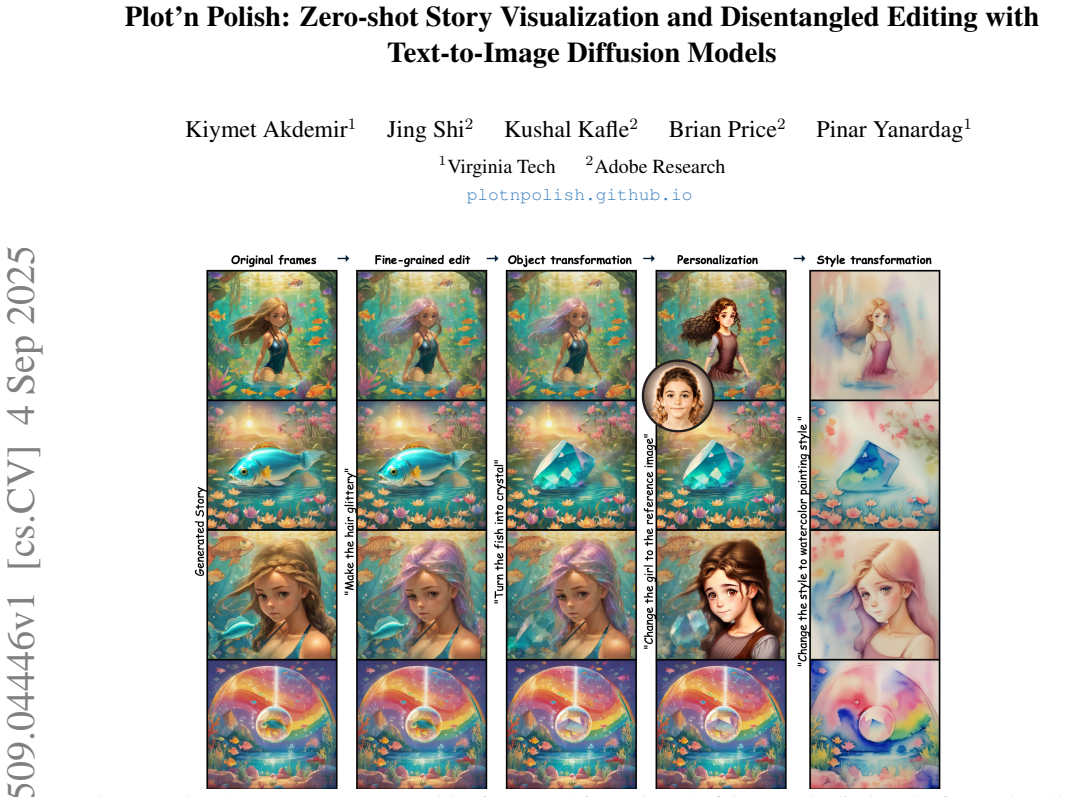
The central discovery is that multi-frame consistency in editing can be achieved without training by combining three ingredients: a grid prior that arranges frames side by side and reshuffles them at each denoising step so spatial features interact; a depth condition that preserves each frame's structure; and latent blending that confines edits to masked regions. The method first detects the target concept in every frame with an open-vocabulary object detector and a segmentation model, then denoises the whole grid against the edit prompt, and finally blends the edited latent back into the original at unmasked pixels. For global style edits the blending step is skipped, letting the change propagate across the full image. According to the paper, this combination yields consistent local edits, object replacement, style transfer, and personalization, and the authors report the method rated highest in their user studies for alignment, consistency, and disentanglement.
Load-bearing premise
The whole method assumes the automatic object finder isolates the target concept correctly in every frame; when it grabs the wrong region or two objects overlap, the edit hits the wrong subject, as the paper's two-reindeer case shows.
Editorial extensions
If this is right
- Story generation can be treated as a two-stage process: produce a cheap, inconsistent template, then polish it into a consistent sequence, so final quality inherits from the base model.
- A single text prompt can propagate a local edit across any number of frames, as long as the target concept can be masked in each frame.
- User-supplied frames, including illustrations from published books, can be edited consistently without retraining or per-story fine-tuning.
- The same pipeline covers both local edits, which use latent blending to protect the background, and global edits, which deliberately skip blending to restyle the whole scene.
- Personalization is a drop-in feature: loading a reference-image adapter or a low-rank adaptation lets a user's own character appear consistently across the edited story.
Reading between the lines
- A natural extension, already hinted at by the paper's attention-mask experiment, is to let users click the object they want to edit instead of naming it, avoiding the detector's vocabulary limits.
- The grid-reshuffling trick is a general mechanism for making any diffusion denoising run consistent across a set of images, so it could transfer to multi-view generation or consistent editing of related images beyond narratives.
- Because the pipeline depends on off-the-shelf detection and segmentation, edit quality should track those models' ability to handle small, rare, or overlapping objects; measuring that correlation would be a direct test of the method's real-world ceiling.
- If the disentanglement claim generalizes, the method could serve as a user-friendly storyboarding front end, letting an artist iterate on scene content and style before committing to final renders.
Signed reviews
Editorial analysis
A structured set of objections, weighed in public.
Referee Report
Summary. The paper introduces Plot'n Polish, a training-free pipeline for story visualization and consistent multi-frame editing. It first generates a story template with an off-the-shelf text-to-image model using prompts produced by GPT-4, then refines the frames with a grid-prior diffusion editing pass that combines depth-conditioned ControlNet and latent blending. The method supports local edits (e.g., changing a shirt color), global edits (e.g., applying a style), and personalization via LoRA or IP-Adapter, and it can also edit user-provided story frames. Quantitative experiments on GPT-4-generated stories and user studies report improvements over several story-generation and editing baselines in consistency, text alignment, and disentanglement.
Significance. If the results hold, the method is practically valuable: it is zero-shot, training-free, and leverages widely available components, while addressing a real gap in story visualization—post-generation multi-frame editing. The paper is honest about some limitations, and the combination of grid priors, depth control, and latent blending is a sensible and potentially reusable design. However, the evaluation currently rests on self-generated data, lacks public code, and does not quantify the acknowledged failure modes, so the significance is conditional on additional validation.
major comments (5)
- [Section 5, Fig. 11] The paper's central claim (contribution 1) is that the method 'ensures multi-frame consistency for both local and global edits,' but Section 5 concedes that overlapping objects cause edits of unintended subjects, as in the two-reindeer failure case. This directly contradicts the strength of the claim. Provide a quantitative analysis of this failure mode—for example, report the success rate on a set of overlapping-object cases—and temper the claim accordingly.
- [Section 4.3 and Appendix B] All quantitative experiments use stories and prompts generated by GPT-4, with no standard story-visualization benchmark (e.g., Pororo or Flintstones). This makes the comparison with prior methods less controlled and raises the risk of selection bias. Add experiments on at least one standard benchmark, or release the full set of 200 story prompts and editing instructions so the community can reproduce and extend the evaluation.
- [Section 4.1] The two key hyperparameters—depth condition strength (0.4 for local edits, 1.0 for global edits) and the 3×3 grid size—are hand-chosen without sensitivity analysis. Since these directly trade off edit fidelity, disentanglement, and cross-frame consistency, provide ablations over depth strength values and grid sizes (e.g., 1×1, 2×2, 3×3, 3×4) to justify the choices.
- [Table 1 and Section 4.2] Table 1 marks Plot'n Polish as 'Publicly Available,' but no code or implementation details are provided in the paper or linked from the project page. This is a factual inconsistency and a reproducibility concern. Either release the code and precise pipeline configuration or change the table to 'Not Available.'
- [Appendix B vs. Section 4.3] The reported dataset sizes are inconsistent: the main text says 200 stories × 9 frames = 1800 frames, while Appendix B says 'a total of 2000 images' and '100 edits per image, amounting to 180,000 total edits.' Clarify the correct numbers and reconcile the arithmetic (1800 × 100 = 180,000; 2000 × 100 = 200,000).
minor comments (5)
- [References] References [40] and [41] are the same paper (Zhang & Agrawala, 'Adding Conditional Control to Text-to-Image Diffusion Models'); please merge them to avoid duplicate citations.
- [Section 3.2, Eq. (5)] The latent blending equation uses both lowercase m and uppercase M_grid without a precise definition of how the mask is resized and normalized; please clarify the notation and specify the interpolation method.
- [Section 3.2] The term 'grid prior' is attributed to NeRFiller [36], but the description of randomly regrouping frames at each timestep is closer to the 'random grid' idea in RA VE [19]; please clarify which prior is being used and acknowledge the relation to RA VE more precisely.
- [Section 4.3] The user study description does not report the number of ratings per condition per participant, the total number of edit scenarios, or inter-annotator agreement; adding these details would strengthen the statistical claims.
- [Appendix B] The sentence 'we prompted GPT-4 to transform characters into 30 different animals and 30 objects while also performing 10 clothing color changes and 10 hair color changes per story' is grammatically ambiguous: it likely means 30 animal transformations, 30 object transformations, 10 clothing-color edits, and 10 hair-color edits total, but the phrasing could be misinterpreted.
Circularity Check
No significant circularity: Plot'n Polish is an empirical pipeline of off-the-shelf components evaluated against external baselines; no prediction reduces to a fitted input or a self-citation.
full rationale
The paper does not derive a result from its own assumptions in a circular way. Its editing mechanism is a constructive pipeline: an SDXL template, per-frame masks from YOLO-World and EfficientSAM, depth-conditioned ControlNet, grid-based latent denoising, and latent blending. The central update, z_{grid,t-1} <- z_{grid,t-1} * m + z'_{grid,t-1} * (1-m), is a standard masked latent blending operation borrowed from Blended Latent Diffusion and NeRFiller, not a quantity that is fitted and then re-reported as a prediction. The reported CLIP-I, CLIP-T, DINO, LPIPS, and user-study numbers are measured against independent baselines (StoryDiffusion, ConsiStory, AutoStudio, Intelligent Grimm, InstructPix2Pix, LEDITS++, Plug-and-Play), so the claims are externally falsifiable. The two self-citations, ORACLE and RA VE, overlap with the authors but are used only for related-work positioning and as comparison methods; the grid-prior component is attributed to NeRFiller, and the blending component to Blended Latent Diffusion, so no load-bearing argument rests on the authors' own prior work. The acknowledged limitation in Section 5 (overlapping objects such as two reindeer causing edits of unintended subjects) is a correctness and robustness concern about mask quality, not a circularity: the method's output is not equal to its input by construction. Overall, the derivation chain is self-contained and empirically evaluated, and no circular step meets the quoted-evidence bar.
Assumptions & free parameters
free parameters (2)
- depth_condition_strength =
0.4 (local), 1.0 (global)
- grid_size =
3x3
assumptions (4)
- domain assumption Grid prior from NeRFiller provides cross-frame interaction in latent space that yields consistent identity.
- domain assumption ControlNet depth-conditioning preserves structural integrity of the original image while allowing prompt-driven changes.
- domain assumption Blended latent diffusion preserves unmasked regions when combined with grid denoising.
- domain assumption Open-vocabulary segmentation (YOLO-World, EfficientSAM) reliably localizes the target concept in all frames.
Cite this review
Pith. "Pith review of Plot'n Polish: Zero-shot Story Visualization and Disentangled Editing with Text-to-Image Diffusion Models." pith.science (2026). https://pith.science/paper/NRKV4UXD
@misc{pith2026250904446,
  author       = {Pith},
  title        = {Pith review of: Plot'n Polish: Zero-shot Story Visualization and Disentangled Editing with Text-to-Image Diffusion Models},
  year         = {2026},
  howpublished = {\url{https://pith.science/paper/NRKV4UXD}},
  note         = {Machine review of arXiv:2509.04446}
}
read the original abstract
Text-to-image diffusion models have demonstrated significant capabilities to generate diverse and detailed visuals in various domains, and story visualization is emerging as a particularly promising application. However, as their use in real-world creative domains increases, the need for providing enhanced control, refinement, and the ability to modify images post-generation in a consistent manner becomes an important challenge. Existing methods often lack the flexibility to apply fine or coarse edits while maintaining visual and narrative consistency across multiple frames, preventing creators from seamlessly crafting and refining their visual stories. To address these challenges, we introduce Plot'n Polish, a zero-shot framework that enables consistent story generation and provides fine-grained control over story visualizations at various levels of detail.
Figures


Figures from the paper (14 more)


Reference graph
Works this paper leans on
-
[1]
Josh Achiam, Steven Adler, Sandhini Agarwal, Lama Ah- mad, Ilge Akkaya, Florencia Leoni Aleman, Diogo Almeida, Janko Altenschmidt, Sam Altman, Shyamal Anadkat, et al. Gpt-4 technical report. arXiv preprint arXiv:2303.08774 ,
-
[2]
Kiymet Akdemir and Pinar Yanardag. Oracle: Leveraging mutual information for consistent character generation with loras in diffusion models. arXiv preprint arXiv:2406.02820,
-
[3]
Omri Avrahami, Ohad Fried, and Dani Lischinski. Blended latent diffusion. arXiv preprint arXiv:2206.02779, 2022. 4
arXiv 2022
-
[4]
The chosen one: Consistent characters in text-to- image diffusion models
Omri Avrahami, Amir Hertz, Yael Vinker, Moab Arar, Shlomi Fruchter, Ohad Fried, Daniel Cohen-Or, and Dani Lischinski. The chosen one: Consistent characters in text-to- image diffusion models. arXiv preprint arXiv:2311.10093,
-
[5]
Sega: Instructing diffusion using semantic dimensions
Manuel Brack, Felix Friedrich, Dominik Hintersdorf, Lukas Struppek, Patrick Schramowski, and Kristian Kersting. Sega: Instructing diffusion using semantic dimensions. arXiv preprint arXiv:2301.12247, 2023. 3
arXiv 2023
-
[6]
Ledits++: Limitless image editing using text- to-image models
Manuel Brack, Felix Friedrich, Katharina Kornmeier, Linoy Tsaban, Patrick Schramowski, Kristian Kersting, and Apoli- naros Passos. Ledits++: Limitless image editing using text- to-image models. In Proceedings of the IEEE/CVF Confer- ence on Computer Vision and Pattern Recognition (CVPR) ,
-
[7]
In- structpix2pix: Learning to follow image editing instructions
Tim Brooks, Aleksander Holynski, and Alexei A Efros. In- structpix2pix: Learning to follow image editing instructions. arXiv preprint arXiv:2211.09800, 2022. 2, 4, 6, 7, 8
arXiv 2022
-
[8]
Emerg- ing properties in self-supervised vision transformers
Mathilde Caron, Hugo Touvron, Ishan Misra, Herv ´e J´egou, Julien Mairal, Piotr Bojanowski, and Armand Joulin. Emerg- ing properties in self-supervised vision transformers. In Pro- ceedings of the IEEE/CVF international conference on com- puter vision, pages 9650–9660, 2021. 8
2021
Show all 44 references
-
[9]
Au- tostudio: Crafting consistent subjects in multi-turn interac- tive image generation
Junhao Cheng, Xi Lu, Hanhui Li, Khun Loun Zai, Baiqiao Yin, Yuhao Cheng, Yiqiang Yan, and Xiaodan Liang. Au- tostudio: Crafting consistent subjects in multi-turn interac- tive image generation. arXiv preprint arXiv:2406.01388 ,
-
[10]
Theatergen: Character management with llm for consistent multi-turn image generation
Junhao Cheng, Baiqiao Yin, Kaixin Cai, Minbin Huang, Hanhui Li, Yuxin He, Xi Lu, Yue Li, Yifei Li, Yuhao Cheng, et al. Theatergen: Character management with llm for consistent multi-turn image generation. arXiv preprint arXiv:2404.18919, 2024. 2
2024 arXiv
-
[11]
Yolo-world: Real-time open- vocabulary object detection
Tianheng Cheng, Lin Song, Yixiao Ge, Wenyu Liu, Xing- gang Wang, and Ying Shan. Yolo-world: Real-time open- vocabulary object detection. In Proc. IEEE Conf. Computer Vision and Pattern Recognition (CVPR), 2024. 3
2024
-
[12]
Scaling recti- fied flow transformers for high-resolution image synthesis
Patrick Esser, Sumith Kulal, Andreas Blattmann, Rahim Entezari, Jonas M ¨uller, Harry Saini, Yam Levi, Dominik Lorenz, Axel Sauer, Frederic Boesel, et al. Scaling recti- fied flow transformers for high-resolution image synthesis. In Forty-first international conference on mach...
-
[13]
Tokenflow: Consistent diffusion features for consistent video editing
Michal Geyer, Omer Bar-Tal, Shai Bagon, and Tali Dekel. Tokenflow: Consistent diffusion features for consistent video editing. arXiv preprint arxiv:2307.10373, 2023. 15
2023 arXiv
-
[14]
Talecrafter: Interactive story visualization with multiple characters
Yuan Gong, Youxin Pang, Xiaodong Cun, Menghan Xia, Yingqing He, Haoxin Chen, Longyue Wang, Yong Zhang, Xintao Wang, Ying Shan, et al. Talecrafter: Interactive story visualization with multiple characters. arXiv preprint arXiv:2305.18247, 2023. 2, 6
2023 arXiv
-
[15]
Prompt-to-prompt image editing with cross attention control
Amir Hertz, Ron Mokady, Jay Tenenbaum, Kfir Aberman, Yael Pritch, and Daniel Cohen-Or. Prompt-to-prompt image editing with cross attention control. 2022. 3
2022
-
[16]
Denoising diffu- sion probabilistic models
Jonathan Ho, Ajay Jain, and Pieter Abbeel. Denoising diffu- sion probabilistic models. Advances in Neural Information Processing Systems, 33:6840–6851, 2020. 1
2020
-
[17]
Lora: Low-rank adaptation of large language models
Edward J Hu, Yelong Shen, Phillip Wallis, Zeyuan Allen- Zhu, Yuanzhi Li, Shean Wang, Lu Wang, and Weizhu Chen. Lora: Low-rank adaptation of large language models. arXiv preprint arXiv:2106.09685, 2021. 2, 3, 4
2021 arXiv
-
[18]
Zero-shot generation of coherent storybook from plain text story using diffusion models, 2023
Hyeonho Jeong, Gihyun Kwon, and Jong Chul Ye. Zero-shot generation of coherent storybook from plain text story using diffusion models, 2023. 2
2023
-
[19]
Rehg, and Pinar Yanardag
Ozgur Kara, Bariscan Kurtkaya, Hidir Yesiltepe, James M. Rehg, and Pinar Yanardag. Rave: Randomized noise shuf- fling for fast and consistent video editing with diffusion mod- els. In Proceedings of the IEEE/CVF Conference on Com- puter Vision and Pattern Recognition, 2024. 3, 15
2024
-
[20]
Black Forest Labs. Flux. https://github.com/ black-forest-labs/flux, 2024. 9, 14
2024
-
[21]
Intelligent grimm - open- ended visual storytelling via latent diffusion models
Chang Liu, Haoning Wu, Yujie Zhong, Xiaoyun Zhang, Yanfeng Wang, and Weidi Xie. Intelligent grimm - open- ended visual storytelling via latent diffusion models. In The IEEE/CVF Conference on Computer Vision and Pattern Recognition (CVPR), pages 6190–6200, 2024. 2, 4, 6, 7, 15
2024
-
[22]
Compositional visual genera- tion with composable diffusion models
Nan Liu, Shuang Li, Yilun Du, Antonio Torralba, and Joshua B Tenenbaum. Compositional visual genera- tion with composable diffusion models. arXiv preprint arXiv:2206.01714, 2022. 3
2022 arXiv
-
[23]
One-prompt-one-story: Free-lunch consistent text-to-image generation using a single prompt,
Tao Liu, Kai Wang, Senmao Li, Joost van de Weijer, Fa- had Shahbaz Khan, Shiqi Yang, Yaxing Wang, Jian Yang, and Ming-Ming Cheng. One-prompt-one-story: Free-lunch consistent text-to-image generation using a single prompt,
-
[24]
Storydall-e: Adapting pretrained text-to-image transformers for story continuation
Adyasha Maharana, Darryl Hannan, and Mohit Bansal. Storydall-e: Adapting pretrained text-to-image transformers for story continuation. InEuropean Conference on Computer Vision, pages 70–87. Springer, 2022. 2
2022
-
[25]
Synthesizing coherent story with auto-regressive la- tent diffusion models
Xichen Pan, Pengda Qin, Yuhong Li, Hui Xue, and Wenhu Chen. Synthesizing coherent story with auto-regressive la- tent diffusion models. In Proceedings of the IEEE/CVF Win- ter Conference on Applications of Computer Vision , pages 2920–2930, 2024. 2
2024
-
[26]
Sdxl: Improving latent diffusion models for high-resolution image synthesis, 2023
Dustin Podell, Zion English, Kyle Lacey, Andreas Blattmann, Tim Dockhorn, Jonas M ¨uller, Joe Penna, and Robin Rombach. Sdxl: Improving latent diffusion models for high-resolution image synthesis, 2023. 3, 9, 14
2023
-
[27]
Learning transferable visual models from natural language supervi- sion
Alec Radford, Jong Wook Kim, Chris Hallacy, Aditya Ramesh, Gabriel Goh, Sandhini Agarwal, Girish Sastry, Amanda Askell, Pamela Mishkin, Jack Clark, et al. Learning transferable visual models from natural language supervi- sion. In International conference on machine learning, ...
2021
-
[28]
Make-a-story: Visual memory conditioned consistent story generation
Tanzila Rahman, Hsin-Ying Lee, Jian Ren, Sergey Tulyakov, Shweta Mahajan, and Leonid Sigal. Make-a-story: Visual memory conditioned consistent story generation. In Pro- ceedings of the IEEE/CVF Conference on Computer Vision and Pattern Recognition, pages 2493–2502, 2023. 2
2023
-
[29]
High-resolution image synthesis with latent diffusion models
Robin Rombach, Andreas Blattmann, Dominik Lorenz, Patrick Esser, and Bj ¨orn Ommer. High-resolution image synthesis with latent diffusion models. In Proceedings of the IEEE/CVF conference on computer vision and pattern recognition, pages 10684–10695, 2022. 1
2022
-
[30]
U- net: Convolutional networks for biomedical image segmen- tation
Olaf Ronneberger, Philipp Fischer, and Thomas Brox. U- net: Convolutional networks for biomedical image segmen- tation. In Medical Image Computing and Computer-Assisted Intervention–MICCAI 2015: 18th International Conference, Munich, Germany, October 5-9, 2015, Proceedings, Pa...
2015
-
[31]
Storyimager: A unified and efficient frame- work for coherent story visualization and completion
Ming Tao, Bing-Kun Bao, Hao Tang, Yaowei Wang, and Changsheng Xu. Storyimager: A unified and efficient frame- work for coherent story visualization and completion. arXiv preprint arXiv:2404.05979, 2024. 2, 3, 6
2024 arXiv
-
[32]
Training-free con- sistent text-to-image generation, 2024
Yoad Tewel, Omri Kaduri, Rinon Gal, Yoni Kasten, Lior Wolf, Gal Chechik, and Yuval Atzmon. Training-free con- sistent text-to-image generation, 2024. 2, 4, 6, 7, 8, 15
2024
-
[33]
Plug-and-play diffusion features for text-driven image-to-image translation
Narek Tumanyan, Michal Geyer, Shai Bagon, and Tali Dekel. Plug-and-play diffusion features for text-driven image-to-image translation. InProceedings of the IEEE/CVF Conference on Computer Vision and Pattern Recognition (CVPR), pages 1921–1930, 2023. 3, 4, 6, 7, 8
1921
-
[34]
Unitune: Text-driven image editing by fine tuning a diffusion model on a single image
Dani Valevski, Matan Kalman, Eyal Molad, Eyal Segalis, Yossi Matias, and Yaniv Leviathan. Unitune: Text-driven image editing by fine tuning a diffusion model on a single image. ACM Transactions on Graphics (TOG) , 42:1 – 10,
-
[35]
Autostory: Generating di- verse storytelling images with minimal human effort
Wen Wang, Canyu Zhao, Hao Chen, Zhekai Chen, Kecheng Zheng, and Chunhua Shen. Autostory: Generating di- verse storytelling images with minimal human effort. arXiv preprint arXiv:2311.11243, 2023. 2
2023 arXiv
-
[36]
Nerfiller: Completing scenes via generative 3d inpainting, 2023
Ethan Weber, Aleksander Hoły ´nski, Varun Jampani, Saurabh Saxena, Noah Snavely, Abhishek Kar, and Angjoo Kanazawa. Nerfiller: Completing scenes via generative 3d inpainting, 2023. 3
2023
-
[37]
Efficientsam: Leveraged masked image pre- training for efficient segment anything, 2023
Yunyang Xiong, Bala Varadarajan, Lemeng Wu, Xiaoyu Xi- ang, Fanyi Xiao, Chenchen Zhu, Xiaoliang Dai, Dilin Wang, Fei Sun, Forrest Iandola, Raghuraman Krishnamoorthi, and Vikas Chandra. Efficientsam: Leveraged masked image pre- training for efficient segment anything, 2023. 3, 9
2023
-
[38]
Seed-story: Multimodal long story generation with large language model
Shuai Yang, Yuying Ge, Yang Li, Yukang Chen, Yixiao Ge, Ying Shan, and Yingcong Chen. Seed-story: Multimodal long story generation with large language model. arXiv preprint arXiv:2407.08683, 2024. 2
2024 arXiv
-
[39]
Ip- adapter: Text compatible image prompt adapter for text-to- image diffusion models
Hu Ye, Jun Zhang, Sibo Liu, Xiao Han, and Wei Yang. Ip- adapter: Text compatible image prompt adapter for text-to- image diffusion models. 2023. 4
2023
-
[40]
Adding conditional control to text-to-image diffusion models, 2023
Lvmin Zhang and Maneesh Agrawala. Adding conditional control to text-to-image diffusion models, 2023. 3
2023
-
[41]
Adding conditional control to text-to-image diffusion models
Lvmin Zhang, Anyi Rao, and Maneesh Agrawala. Adding conditional control to text-to-image diffusion models. In Proceedings of the IEEE/CVF International Conference on Computer Vision, pages 3836–3847, 2023. 3
2023
-
[42]
The unreasonable effectiveness of deep features as a perceptual metric
Richard Zhang, Phillip Isola, Alexei A Efros, Eli Shechtman, and Oliver Wang. The unreasonable effectiveness of deep features as a perceptual metric. In CVPR, 2018. 8
2018
-
[43]
Storydiffusion: Consistent self- attention for long-range image and video generation
Yupeng Zhou, Daquan Zhou, Ming-Ming Cheng, Jiashi Feng, and Qibin Hou. Storydiffusion: Consistent self- attention for long-range image and video generation. arXiv preprint arXiv:2405.01434, 2024. 2, 4, 6, 7, 15 Figure 12. Screenshot from user study evaluating consistency, alig...
2024 arXiv
-
[44]
Main Characters
Consistency: How consistent (similar) is the subject in each edited frame? For both user studies, we used a rating scale from 1 (Very Bad) to 5 (Very Good). Our method re- ceived the highest ratings across all aspects, demonstrating its ability to perform consistent and disent...
2000
Reviewed August 15, 2026 · model on record in the stance chip above.
Discussion (0). Continue with ORCID to comment.