REVIEW 4 major objections 5 minor 62 references
Memristor-Based Neural Network Accelerators for Space Applications: Enhancing Performance with Temporal Averaging and SIRENs
T0 review · 4 major / 5 minor · reviewed 2026-08-05 · deepseek-v4-flash
Pith's one-line read Combining SIREN activations, bit-slicing, and layerwise temporal averaging makes memristor-based neural networks competitive for on-board spacecraft AI, at least in simulation.
desk verdict Simulation feasibility study: SIREN + bit-slicing + temporal averaging closes much of the memristor gap on two space tasks; load-bearing assumption is simulator noise fidelity, openly acknowledged. read the letter →
The pith
A machine-rendered reading of the paper's core claim, the machinery that carries it, and where it could break.
The reading
What carries the argument
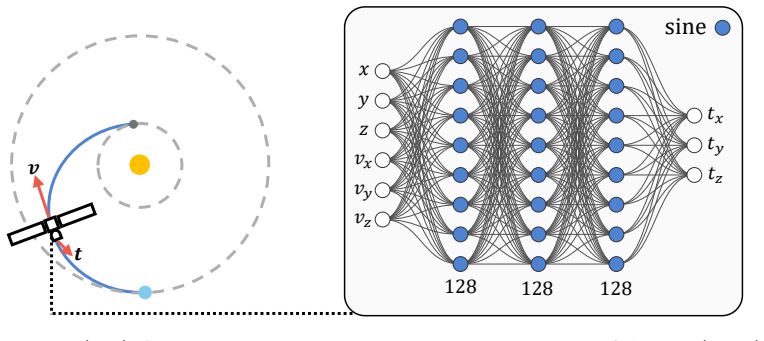
Three mechanisms carry the argument. (1) SIREN periodic activations, sin(ω0·x), give the networks smooth, high-capacity representations and are the reason both tasks work at all on analog hardware. (2) Linear bit-slicing splits each weight across several memristor devices; since device noise is roughly independent, representing a weight by more devices reduces effective variability at the cost of area. (3) Layerwise temporal averaging recomputes each layer's output N times and averages, reducing Gaussian noise by about 1/√N; the authors note it can be implemented with a shift-register and adder, and it stacks with bit-slicing. A fourth component, hardware-aware training, simulates inference
What would settle it
Program the same trained G&CNET and geodesyNet weights onto a fabricated RRAM crossbar whose per-device conductance variability, read noise, drift, and fault rates have been measured; run inference under the same conditions and compare test losses to the simulated 0.010 and 0.007. If measured losses are substantially higher (e.g., comparable to the uncompensated 0.07/0.3), the central feasibility claim would be falsified.
Extended reading notes
Core claim
The central discovery is that memristor non-idealities can be largely compensated by pairing periodic activations with two averaging schemes. G&CNETs (three-layer SIREN controllers, 128 neurons/layer) drop from about 0.07 to about 0.010 with sine activations and 64-fold layerwise temporal averaging, versus a digital baseline of 0.003–0.005. GeodesyNets (four-layer SIREN density networks, 300 neurons/layer) fail entirely on noisy devices (loss ~0.36) until 4 bit-slices per weight and 64 repeats bring them to about 0.007, close to the digital baseline of 0.003. The paper also finds an asymmetry: SIREN G&CNETs degrade sharply under drift and faults despite low initial loss, while geodesyNets to
Load-bearing premise
The load-bearing premise is that the simulated PCM/RRAM device models (conductance noise, drift, and fault statistics) faithfully represent real hardware, so the simulated losses predict what an actual memristor accelerator would deliver; the paper itself states the study is entirely simulation-based and omits effects such as non-ideal transistor matching.
Editorial extensions
If this is right
- If the simulation results transfer to real devices, a spacecraft could run G&CNET guidance and geodesy density-field learning on memristor crossbars with test losses only about 2–3 times the digital baselines, which the authors judge acceptable for the studied missions.
- SIRENs are not uniformly robust: the G&CNET's sharp degradation under drift and faults means memristive deployment should pair periodic activations with drift/fault mitigation or a lower activation frequency.
- GeodesyNets can learn an asteroid's density field from scratch on simulated RRAM when 4 slices and 64 repeats are used, supporting continuous on-board learning for inverse problems.
- Hardware-aware retraining can recover geodesyNet performance up to 10% stuck-at-fault devices, so device degradation need not be mission-ending if retraining capacity exists.
- Bit-slicing and temporal averaging are complementary and their optimal settings are task-dependent (1 slice for G&CNET, 4 for geodesyNet), meaning accelerator design should co-optimize with the application.
Reading between the lines
- Beyond the paper: the observed link between Lipschitz constant and drift sensitivity suggests a concrete design rule—when selecting or training networks for memristive accelerators, measure and bound the Lipschitz constant, not just training loss.
- Beyond the paper: because 64 temporal repeats multiply inference cost 64-fold, the energy advantage of memristors could shrink; quantifying energy and latency at 64 repeats versus conventional hardware is the natural next calculation and was left for future work.
- Beyond the paper: the same SIREN-plus-averaging recipe should transfer to other implicit neural representations the authors mention, such as lunar terrain models or SAR compression; that transfer is testable without new hardware.
Editorial analysis
A structured set of objections, weighed in public.
Referee Report
Summary. This paper investigates, entirely by simulation, whether memristor-based neural network accelerators can support two space on-board tasks: G&CNET guidance/control and geodesyNet asteroid geodesy. Using the IBM Analog Hardware Acceleration Kit with calibrated PCM and RRAM device models, the authors compare SIREN-based networks with earlier softplus baselines, quantify degradation from read/write noise, device faults, and conductance drift, and introduce layerwise temporal averaging and linear bit-slicing as mitigations. They report improvements from about 0.07 to about 0.01 for G&CNET and from about 0.3 to about 0.007 for geodesyNet with RRAM, approaching digital baselines of 0.003-0.005 and 0.003, respectively. The paper also analyzes the relation between the SIREN frequency omega0, the network Lipschitz constant, and robustness to drift. Section 4 explicitly acknowledges that the study is simulation-based and that non-ideal transistor matching is not modeled. The code is promised on GitHub.
Significance. If the reported numbers are robust, this is a useful contribution: it opens a new application domain for memristor accelerators, uses an established simulator, compares against digital baselines, and provides an open-source implementation. The proposed temporal-averaging technique and the systematic comparison of SIRENs against softplus networks are practically relevant. The paper is also honest about its limitations, which is a strength. However, the central quantitative claims currently rest on point estimates from a single experimental protocol: no error bars or repeated seeds are reported, hyperparameters are selected from the same sweeps that produce the headline numbers, and the noise-independence assumption behind temporal averaging and bit-slicing is not verified. The 'first demonstration of feasibility' claim is therefore stronger than the current evidence supports.
major comments (4)
- [Section 3, Figs. 5 and 9] The final configurations used for the headline losses (1 slice/64 repeats for G&CNET; 4 slices/64 repeats for geodesyNet) are chosen from the same sweeps shown in Figs. 5 and 9. Section 3 states that slice counts were 'chosen on the basis of the effectiveness of the slices during the experiments concerning linear bit-slicing.' No separate validation split is described. This selection can bias the reported losses downward and makes the comparison to the digital baselines (0.003-0.005 and 0.003) optimistic. Please define a train/validation/test protocol, select repeats/slices on validation data, and report the test loss of the final configuration once, ideally over multiple data splits. If the sweeps were already run on a held-out test set, state this explicitly.
- [Section 3, Figs. 5-10] All reported losses are point estimates from a single training run or a single device-noise realization; no error bars or repeated seeds are reported. Because both network initialization and device noise are stochastic, the central comparisons (e.g., RRAM loss 0.007 vs PCM loss 0.008 and digital baseline 0.003 in Fig. 9; the difference between 4 and 64 repeats) may lie within run-to-run variability. Please repeat each experiment at least five times with different seeds and report mean +/- std (or an equivalent), and add error bars to the sweep figures. This is necessary to support the quantitative 'close to SOTA' claim.
- [Section 2.4] The entire mitigation strategy rests on the assumption that noise samples are independent across temporal repeats and across bit-slices. The paper states that the standard deviation of the mean output decreases by 1/sqrt(N) for Gaussian weight noise, and that bit-slicing gives a 'similar reduction' because the devices have 'related read/write behavior.' No empirical verification is provided in the simulator. Correlated or common-mode noise, e.g., from shared DAC/ADC quantization, IR drop, or unmodeled transistor matching (acknowledged in Section 4), would reduce the averaging gains and make the reported improvements optimistic. Please add a diagnostic that measures the variance of layer outputs (and the final test loss) as a function of the number of repeats N and the number of slices in the simulator, and discuss the sensitivity to correlated noise.
- [Abstract, Section 1, Section 4] The abstract and Section 1 claim that this is 'the first work that demonstrates the feasibility of memristor-based accelerators for on-board space application tasks.' Section 4, however, states that the study is entirely simulation-based, inherently constrained by models and assumptions, and that 'the effect of non-ideal transistor matching is not included.' The unqualified term 'feasibility' exceeds what a simulation study can establish. Please either soften the claim to 'simulated feasibility' or add a sensitivity analysis that scales read/write noise (e.g., 0.5x-2x) and shows that the qualitative conclusions are robust.
minor comments (5)
- [Section 2.4] Typo: 'weight updates are calculated in digitally' should be 'calculated digitally.'
- [Section 2.1.2] Typo: 'geodesNetsy outperforms' should be 'geodesyNets outperforms.'
- [Figs. 5 and 9] The legends show 'RRAM (Rudge 2024)' and 'Sine (Origer 2024)' without defining these in the caption. Please clarify whether these are digital baselines, previously published memristive results, or other reference lines.
- [Fig. 7] The legend labels omit the omega0 symbol; 'sine ( =0.01)' etc. is unclear. Add the omega0 notation in the legend or caption.
- [Section 2.4, Reference [57]] The text states that the code and data to reproduce the paper are available on GitHub, but reference [57] is titled only 'Guidance and control neural network acceleration using memristors.' Please confirm that the geodesyNet code and data are included in that repository, or amend the reproducibility statement.
Circularity Check
No material circularity: the central results are simulation measurements against external digital baselines, and the few self-citations serve only as comparisons.
full rationale
The paper is an empirical simulation study, not a derivation from first principles. The central numbers (0.010 for G&CNET, 0.007 for geodesyNet) are measured losses from the IBM AI HW Kit simulator under chosen mitigation configurations; they are not derived from the definitions of those techniques. Temporal averaging is justified by the standard sqrt(N) reduction for independent zero-mean noise, which is stated explicitly as an assumption, not as an empirical finding. Bit-slicing similarly averages over devices; its benefit is measured, not asserted by construction. The paper's use of prior work [29, 35, 30] is as baselines/comparisons, not as evidence that the present result holds; for instance, the digital SOTA numbers come from external sources. The only self-citations are the authors' own earlier G&CNET/memristor paper [29] and original G&CNET paper [35], used for comparison of softplus vs. SIREN performance; this is not load-bearing. Section 4 openly flags simulation-to-reality gaps (e.g., missing transistor matching, entirely simulation-based), which are limitations on validity, not circularity. No fitted parameter is renamed as a prediction; hyperparameter choices (slice count, repeats) are reported as measurements. Therefore no circular step can be exhibited from the text.
Assumptions & free parameters
free parameters (5)
- omega0 for G&CNET SIREN =
1.0
- omega0 for geodesyNet SIREN =
30.0
- Number of bit slices =
4 slices per weight for geodesyNet, 1 for G&CNET
- Number of temporal averages (repeats) =
64
- Training epochs =
300 for G&CNET, 10,000 for geodesyNet
assumptions (4)
- domain assumption IBM AI HW Kit device models faithfully represent real RRAM/PCM non-idealities.
- domain assumption The selected G&CNET and geodesyNet architectures and baselines are representative of actual on-board space AI tasks.
- domain assumption Temporal averaging can be implemented in hardware with acceptable overhead.
- domain assumption The digital baselines (Origer 2024, Izzo 2021) are correct references for state-of-the-art performance.
Cite this review
Pith. "Pith review of Memristor-Based Neural Network Accelerators for Space Applications: Enhancing Performance with Temporal Averaging and SIRENs." pith.science (2026). https://pith.science/paper/TEWXLK7B
@misc{pith2026250904506,
  author       = {Pith},
  title        = {Pith review of: Memristor-Based Neural Network Accelerators for Space Applications: Enhancing Performance with Temporal Averaging and SIRENs},
  year         = {2026},
  howpublished = {\url{https://pith.science/paper/TEWXLK7B}},
  note         = {Machine review of arXiv:2509.04506}
}
abstract
Memristors are an emerging technology that enables artificial intelligence (AI) accelerators with high energy efficiency and radiation robustness -- properties that are vital for the deployment of AI on-board spacecraft. However, space applications require reliable and precise computations, while memristive devices suffer from non-idealities, such as device variability, conductance drifts, and device faults. Thus, porting neural networks (NNs) to memristive devices often faces the challenge of severe performance degradation. In this work, we show in simulations that memristor-based NNs achieve competitive performance levels on on-board tasks, such as navigation \& control and geodesy of asteroids. Through bit-slicing, temporal averaging of NN layers, and periodic activation functions, we improve initial results from around $0.07$ to $0.01$ and $0.3$ to $0.007$ for both tasks using RRAM devices, coming close to state-of-the-art levels ($0.003-0.005$ and $0.003$, respectively). Our results demonstrate the potential of memristors for on-board space applications, and we are convinced that future technology and NN improvements will further close the performance gap to fully unlock the benefits of memristors.
Figures


Figures from the paper (9 more)




Reference graph
Works this paper leans on
-
[1]
G. Furano, G. Meoni, A. Dunne, D. Moloney, V. Ferlet-Cavrois, A. Tavoularis, J. Byrne, L. Buckley, M. Psarakis, K.-O. Voss, L. Fanucci, Towards the Use of Artificial Intelligence on the Edge in Space Systems: Challenges and Opportunities, IEEE Aerospace and Electronic Systems Magazine 35 (12) (2020) 44–56. doi:10.1109/MAES.2020.3008468. URL https://ieeexp...
arXiv 2020
-
[2]
V. Kothari, E. Liberis, N. D. Lane, The Final Frontier: Deep Learn- ing in Space, in: Proceedings of the 21st International Workshop on Mobile Computing Systems and Applications, HotMobile ’20, Associa- tion for Computing Machinery, New York, NY, USA, 2020, pp. 45–49. doi:10.1145/3376897.3377864. URL https://doi.org/10.1145/3376897.3377864
arXiv 2020
-
[3]
D. Izzo, M. Märtens, B. Pan, A survey on artificial intelligence trends in spacecraft guidance dynamics and control, Astrodynamics 3 (4) (2019) 287–299. doi:10.1007/s42064-018-0053-6. URL https://doi.org/10.1007/s42064-018-0053-6
-
[4]
D. Izzo, G. Meoni, P. Gómez, D. Dold, A. Zoechbauer, Selected Trends in Artificial Intelligence for Space Applications, in: Artificial Intelligence for Space: AI4SPACE, CRC Press, 2023, pp. 1–32
work page 2023
-
[5]
D. Izzo, A. Hadjiivanov, D. Dold, G. Meoni, E. Blazquez, Neuromorphic computing and sensing in space, in: Artificial Intelligence for Space: AI4SPACE, CRC Press, 2022, pp. 107–159
work page 2022
-
[6]
L. Cheng, Z. Wang, Y. Song, F. Jiang, Real-time optimal control for irregular asteroid landings using deep neural networks, Acta Astronau- tica 170 (2020) 66–79. doi:10.1016/j.actaastro.2019.11.039. URL https://www.sciencedirect.com/science/article/pii/ S0094576520300151
-
[7]
Y. Ma, B. Pan, Q. Tan, Neural convex optimization for real-time trajectory generation of asteroid landings, Acta Astronautica 229 (2025) 606–615. doi:10.1016/j.actaastro.2025.01.009. URL https://www.sciencedirect.com/science/article/pii/ S0094576525000116
-
[8]
Y. Ni, B. Pan, P. G. Pérez, Accelerating Deep Neural Network training for autonomous landing guidance via homotopy, Acta Astronautica 212 (2023) 654–664. doi:10.1016/j.actaastro.2023.08.029. URL https://www.sciencedirect.com/science/article/pii/ S0094576523004368
Show all 62 references
-
[9]
Luccioni, Y
S. Luccioni, Y. Jernite, E. Strubell, Power Hungry Processing: Watts Driving the Cost of AI Deployment?, in: The 2024 ACM Conference 23 on Fairness, Accountability, and Transparency, ACM, Rio de Janeiro Brazil, 2024, pp. 85–99. doi:10.1145/3630106.3658542. URL https://dl.acm.o...
2024
-
[10]
Schumann, Radiation Tolerance and Mitigation for Neuromorphic Processors, Tech
J. Schumann, Radiation Tolerance and Mitigation for Neuromorphic Processors, Tech. rep., NASA Ames Research Center, nTRS Author Affiliations: KBR (United States) NTRS Document ID: 20220013182 NTRS Research Center: Ames Research Center (ARC) (Jan. 2022). URL https://ntrs.nasa.g...
2022
-
[11]
N. N. Editors, Beyond von Neumann, Nature Nanotechnology 15 (7) (2020) 507–507. doi:10.1038/s41565-020-0738-x. URL https://www.nature.com/articles/s41565-020-0738-x
2020 doi
-
[12]
Amrouch, N
H. Amrouch, N. Du, A. Gebregiorgis, S. Hamdioui, I. Polian, Towards Reliable In-Memory Computing:From Emerging Devices to Post-von- Neumann Architectures, in: 2021 IFIP/IEEE 29th International Con- ference on Very Large Scale Integration (VLSI-SoC), IEEE, Singapore, Singapore,...
2021
-
[13]
Chatzinotas, N
E.Lagunas, F.G.Ortiz, G.Eappen, S.Daoud, W.A.Martins, J.Querol, S. Chatzinotas, N. Skatchkovsky, B. Rajendran, O. Simeone, Perfor- mance evaluation of neuromorphic hardware for onboard satellite com- munication applications, IEEE Wireless Communications 31 (6) (2024) 78–84
2024
-
[14]
Lunghi, S
P. Lunghi, S. Silvestrini, G. Meoni, D. Dold, A. Hadjiivanov, D. Izzo, et al., Investigation of low-energy spiking neural networks based on tem- poral coding for scene classification, in: 75th International Astronautical Congress (IAC 2024), 2024, pp. 1–13
2024
-
[15]
Arnold, P
E. Arnold, P. Spilger, J. V. Straub, E. Müller, D. Dold, G. Meoni, J. Schemmel, Scalable network emulation on analog neuromorphic hard- ware, Frontiers in Neuroscience 18 (2025) 1523331
2025
-
[16]
A. S. Kucik, G. Meoni, Investigating Spiking Neural Networks for Energy-Efficient On-Board AI Applications. A Case Study in Land Cover and Land Use Classification, in: 2021 IEEE/CVF 24 Conference on Computer Vision and Pattern Recognition Work- shops (CVPRW), IEEE, Nashville, ...
2021
-
[17]
Frenkel, D
C. Frenkel, D. Bol, G. Indiveri, Bottom-up and top-down approaches for the design of neuromorphic processing systems: Tradeoffs and syner- gies between natural and artificial intelligence, Proceedings of the IEEE 111 (6) (2023) 623–652
2023
- [18]
-
[19]
Davies, N
M. Davies, N. Srinivasa, T.-H. Lin, G. Chinya, Y. Cao, S. H. Cho- day, G. Dimou, P. Joshi, N. Imam, S. Jain, Y. Liao, C.-K. Lin, A. Lines, R. Liu, D. Mathaikutty, S. McCoy, A. Paul, J. Tse, G. Venkataramanan, Y.-H. Weng, A. Wild, Y. Yang, H. Wang, Loihi: A Neuromorphic Many- c...
2018
-
[20]
Montealegre, D
N. Montealegre, D. Merodio, A. Fernández, P. Armbruster, In-flight reconfigurable FPGA-based space systems, in: 2015 NASA/ESA Conference on Adaptive Hardware and Systems (AHS), 2015, pp. 1–8. doi:10.1109/AHS.2015.7231177. URL https://ieeexplore.ieee.org/abstract/ document/7231...
2015
-
[21]
Singh, S
A. Singh, S. Diware, A. Gebregiorgis, R. Bishnoi, F. Catthoor, R. V. Joshi, S. Hamdioui, Low-Power Memristor-Based Computing for Edge-AI Applications, in: 2021 IEEE International Symposium on Circuits and Systems (ISCAS), 2021, pp. 1–5, iSSN: 2158-1525. doi:10.1109/ISCAS51556....
2021
-
[22]
Diware, A
S. Diware, A. Singh, A. Gebregiorgis, R. V. Joshi, S. Hamdioui, R. Bish- noi, Accurate and Energy-Efficient Bit-Slicing for RRAM-Based Neural Networks, IEEE Transactions on Emerging Topics in Computational In- telligence 7 (1) (2023) 164–177. doi:10.1109/TETCI.2022.3191397. UR...
2023
-
[23]
Khaddam-Aljameh, M
R. Khaddam-Aljameh, M. Stanisavljevic, J. Fornt Mas, G. Karunaratne, M. Braendli, F. Liu, A. Singh, S. M. Muller, U. Egger, A. Petropoulos, T. Antonakopoulos, K. Brew, S. Choi, I. Ok, F. L. Lie, N. Saulnier, V. Chan, I. Ahsan, V. Narayanan, S. R. Nandakumar, M. Le Gallo, P. A....
2021
-
[24]
W. Wan, R. Kubendran, C. Schaefer, S. B. Eryilmaz, W. Zhang, D. Wu, S. Deiss, P. Raina, H. Qian, B. Gao, S. Joshi, H. Wu, H.- S. P. Wong, G. Cauwenberghs, A compute-in-memory chip based on resistive random-access memory, Nature 608 (7923) (2022) 504–512. doi:10.1038/s41586-022...
2022 doi
-
[25]
Deaville, B
P. Deaville, B. Zhang, N. Verma, A 22nm 128-kb MRAM Row/Column-Parallel In-Memory Computing Macro with Memory- Resistance Boosting and Multi-Column ADC Readout, in: 2022 IEEE Symposium on VLSI Technology and Circuits (VLSI Technol- ogy and Circuits), IEEE, Honolulu, HI, USA, 2...
2022
-
[26]
Bonnet, T
D. Bonnet, T. Hirtzlin, A. Majumdar, T. Dalgaty, E. Esmanhotto, V. Meli, N. Castellani, S. Martin, J.-F. Nodin, G. Bourgeois, J.-M. Por- tal, D. Querlioz, E. Vianello, Bringing uncertainty quantification to the extreme-edge with memristor-based Bayesian neural networks, Nature...
2023 doi
-
[27]
D. R. Hughart, A. J. Lohn, P. R. Mickel, S. M. Dalton, P. E. Dodd, M. R. Shaneyfelt, A. I. Silva, E. Bielejec, G. Vizkelethy, M. T. Marshall, M. L. McLain, M. J. Marinella, A Comparison of the Radiation Response of \rm TaO_\rm x and \rm TiO_2 Memristors, IEEE Transactions on N...
2013
-
[28]
H. Lyu, H. Zhang, B. Mei, Q. Yu, R. Mo, Y. Sun, W. Gao, Re- search on single event effect test of a RRAM memory and space flight demonstration, Microelectronics Reliability 126 (2021) 114347. doi:10.1016/j.microrel.2021.114347. URL https://www.sciencedirect.com/science/article...
2021
-
[29]
Z. A. Rudge, D. Izzo, M. Fieback, A. Gebregiorgis, S. Hamdioui, D. Dold, Guidance and Control Neural Network Acceleration using Memristors, in: Proceedings of SPAICE2024: The First Joint Euro- pean Space Agency/IAA Conference on AI in and for Space, 2024, pp. 162–168. URL http...
2024
- [30]
-
[31]
D. Izzo, P. Gómez, Geodesy of irregular small bodies via neu- ral density fields, Communications Engineering 1 (1) (2022) 1–12. doi:10.1038/s44172-022-00050-3. URL https://www.nature.com/articles/s44172-022-00050-3
2022 doi
-
[32]
Le Gallo, C
M. Le Gallo, C. Lammie, J. Büchel, F. Carta, O. Fagbohungbe, C. Mackin, H. Tsai, V. Narayanan, A. Sebastian, K. El Maghraoui, M. J. Rasch, Using the IBM analog in-memory hardware acceleration 27 kit for neural network training and inference, APL Machine Learning 1 (4) (2023) 0...
2023 doi
-
[33]
Sitzmann, J
V. Sitzmann, J. Martel, A. Bergman, D. Lindell, G. Wetzstein, Im- plicit Neural Representations with Periodic Activation Functions, in: Advances in Neural Information Processing Systems, Vol. 33, Curran Associates, Inc., 2020, pp. 7462–7473. URL https://proceedings.neurips.cc/...
2020
-
[34]
L. S. Pontryagin, Mathematical Theory of Optimal Processes, CRC Press, 1987
1987
-
[35]
D. Izzo, E. Öztürk, M. Märtens, Interplanetary transfers via deep rep- resentations of the optimal policy and/or of the value function, in: Proceedings of the Genetic and Evolutionary Computation Confer- ence Companion, ACM, Prague Czech Republic, 2019, pp. 1971–1979. doi:10.1...
2019
-
[36]
Glassmeier, H
K.-H. Glassmeier, H. Boehnhardt, D. Koschny, E. Kührt, I. Richter, The Rosetta Mission: Flying Towards the Origin of the Solar System, Space Science Reviews 128 (1) (2007) 1–21. doi:10.1007/s11214-006-9140-8. URL https://doi.org/10.1007/s11214-006-9140-8
2007 doi
-
[37]
A. M. Hein, R. Matheson, D. Fries, A techno-economic analy- sis of asteroid mining, Acta Astronautica 168 (2020) 104–115. doi:10.1016/j.actaastro.2019.05.009. URL https://www.sciencedirect.com/science/article/pii/ S0094576518316357
2020 doi
-
[38]
S. M. A. Eslami, D. Jimenez Rezende, F. Besse, F. Viola, A. S. Morcos, M. Garnelo, A. Ruderman, A. A. Rusu, I. Danihelka, K. Gregor, D. P. Reichert, L. Buesing, T. Weber, O. Vinyals, D. Rosenbaum, N. Rabi- nowitz, H. King, C. Hillier, M. Botvinick, D. Wierstra, K. Kavukcuoglu,...
2018 doi
-
[39]
Mildenhall, P
B. Mildenhall, P. P. Srinivasan, M. Tancik, J. T. Barron, R. Ramamoor- thi, R. Ng, NeRF: representing scenes as neural radiance fields for view synthesis, Commun. ACM 65 (1) (2021) 99–106. doi:10.1145/3503250. URL https://dl.acm.org/doi/10.1145/3503250
2021 doi
-
[40]
Blazquez, D
E. Blazquez, D. Izzo, F. Biscani, R. Walker, F. Perez-Lissi, Small celestial body exploration with cubesat swarms, arXiv preprint arXiv:2308.13333 (2023)
2023 arXiv
-
[41]
Werner, D
R. Werner, D. Scheeres, Exterior gravitation of a polyhedron derived and compared with harmonic and mascon gravitation representations of asteroid 4769 Castalia, Celestial Mechanics and Dynamical Astronomy 65 (3) (1997). doi:10.1007/BF00053511. URL http://link.springer.com/10....
1997 doi
-
[42]
P. T. Wittick, R. P. Russell, Mixed-model gravity representations for small celestial bodies using mascons and spherical harmonics, Celestial Mechanics and Dynamical Astronomy 131 (7) (2019) 31. doi:10.1007/s10569-019-9904-6. URL http://link.springer.com/10.1007/s10569-019-9904-6
2019 doi
-
[43]
Sebera, A
J. Sebera, A. Bezděk, I. Pešek, T. Henych, Spheroidal models of the exterior gravitational field of Asteroids Bennu and Castalia, Icarus 272 (2016) 70–79. doi:10.1016/j.icarus.2016.02.038. URL https://linkinghub.elsevier.com/retrieve/pii/ S0019103516001160
2016 doi
-
[44]
Chua, Memristor-the missing circuit element, IEEE Transactions on circuit theory 18 (5) (1971) 507–519
L. Chua, Memristor-the missing circuit element, IEEE Transactions on circuit theory 18 (5) (1971) 507–519
1971
-
[45]
R. S. Williams, How we found the missing memristor, IEEE spectrum 45 (12) (2008) 28–35
2008
-
[46]
Zahoor, T
F. Zahoor, T. Z. Azni Zulkifli, F. A. Khanday, Resistive Random Ac- cess Memory (RRAM): an Overview of Materials, Switching Mechanism, Performance, Multilevel Cell (mlc) Storage, Modeling, and Applications, Nanoscale Research Letters 15 (1) (2020) 90. doi:10.1186/s11671-020- 0...
2020 doi
-
[47]
Ankit, I
A. Ankit, I. E. Hajj, S. R. Chalamalasetti, G. Ndu, M. Foltin, R. S. Williams, P. Faraboschi, W.-m. W. Hwu, J. P. Strachan, K. Roy, D. S. Milojicic, PUMA: A Programmable Ultra-efficient Memristor-based Ac- celerator for Machine Learning Inference, in: Proceedings of the Twenty...
2019
-
[48]
S. Yu, W. Shim, X. Peng, Y. Luo, RRAM for Compute-in- Memory: From Inference to Training, IEEE Transactions on Circuits and Systems I: Regular Papers 68 (7) (2021) 2753–2765. doi:10.1109/TCSI.2021.3072200. URL https://ieeexplore.ieee.org/abstract/ document/9406197?casa_token=d...
2021
-
[49]
H.-S. P. Wong, S. Raoux, S. Kim, J. Liang, J. P. Reifenberg, B. Rajendran, M. Asheghi, K. E. Goodson, Phase Change Memory, Proceedings of the IEEE 98 (12) (2010) 2201–2227. doi:10.1109/JPROC.2010.2070050. URL https://ieeexplore.ieee.org/abstract/document/ 5609179?casa_token=ZN...
2010
-
[50]
M. J. Rasch, D. Moreda, T. Gokmen, M. Le Gallo, F. Carta, C. Gold- berg, K. El Maghraoui, A. Sebastian, V. Narayanan, A Flexible and Fast PyTorch Toolkit for Simulating Training and Inference on Ana- log Crossbar Arrays, in: 2021 IEEE 3rd International Conference on Artificial...
2021
-
[51]
M. L. Gallo, S. R. Nandakumar, L. Ciric, I. Boybat, R. Khaddam- Aljameh, C. Mackin, A. Sebastian, Precision of bit slicing with in-memory computing based on analog phase-change memory cross- bars, Neuromorphic Computing and Engineering 2 (1) (2022) 014009. 30 doi:10.1088/2634-...
2022 doi
-
[52]
Baroni, C
A. Baroni, C. Zambelli, P. Olivo, E. Pérez, C. Wenger, D. Ielmini, Tackling the Low Conductance State Drift through Incremental Re- set and Verify in RRAM arrays, in: 2021 IEEE International Inte- grated Reliability Workshop (IIRW), 2021, pp. 1–5, iSSN: 2374-8036. doi:10.1109/...
2021
-
[53]
S. K. Esser, P. A. Merolla, J. V. Arthur, A. S. Cassidy, R. Appuswamy, A. Andreopoulos, D. J. Berg, J. L. McKinstry, T. Melano, D. R. Barch, C. di Nolfo, P. Datta, A. Amir, B. Taba, M. D. Flickner, D. S. Modha, Convolutional networks for fast, energy-efficient neuromorphic com...
2016 doi
-
[54]
ahn, G. Bellec, A. Gr
S. Schmitt, J. Kl"ahn, G. Bellec, A. Gr"ubl, M. Guettler, A. Har- tel, S. Hartmann, D. Husmann, K. Husmann, S. Jeltsch, et al., Neu- romorphic hardware in the loop: Training a deep spiking network on the brainscales wafer-scale system, in: Proceedings International Joint Confe...
2017
-
[55]
ahn, P. M
A. F. Kungl, S. Schmitt, J. Kl"ahn, P. M"uller, A. Baumbach, D. Dold, A. Kugele, E. M"uller, C. Koke, M. Kleider, et al., Accelerated physical emulation of bayesian inference in spiking neural networks, Frontiers in neuroscience 13 (2019) 1201. doi:10.3389/fnins.2019.01201
2019
-
[56]
M. J. Rasch, C. Mackin, M. Le Gallo, A. Chen, A. Fasoli, F. Oder- matt, N. Li, S. R. Nandakumar, P. Narayanan, H. Tsai, G. W. Burr, A. Sebastian, V. Narayanan, Hardware-aware training for large- scale and diverse deep learning inference workloads using in-memory computing-base...
2023
-
[57]
URL https://github.com/HeatPhoenix/memristor-gecnet 31
Guidance and control neural network acceleration using memristors github repo (accessed May 2024). URL https://github.com/HeatPhoenix/memristor-gecnet 31
2024
-
[58]
T.-H. Kim, S. Kim, J. Park, S. Youn, H. Kim, Memristor Crossbar Array with Enhanced Device Yield for In-Memory Vector–Matrix Mul- tiplication, ACS Applied Electronic Materials 6 (6) (2024) 4099–4107. doi:10.1021/acsaelm.4c00199. URL https://pubs.acs.org/doi/10.1021/acsaelm.4c00199
2024 doi
- [59]
-
[60]
E. V. Kints, A. Hammond, C. Adams, I. G. Lopez-Francos, Neural Ra- diance Methods for Lunar Terrain Modeling, in: 2025 IEEE Aerospace Conference, Big Sky, MT, 2025, pp. 1–17, nTRS Author Affiliations: KBR (United States), Ames Research Center NTRS Document ID: 20250001277 NTRS...
2025
-
[61]
R. M. Asiyabi, A. Anghel, P. Rizzoli, M. Martone, M. Datcu, Complex- Valued Autoencoder for Multi-Polarization SLC SAR Data Compression with Side Information, in: IGARSS 2023 - 2023 IEEE International Geoscience and Remote Sensing Symposium, 2023, pp. 1787–1790, iSSN: 2153-700...
2023
-
[5282]
URL https://www.nature.com/articles/s41467-023-40770-4
doi:10.1038/s41467-023-40770-4. URL https://www.nature.com/articles/s41467-023-40770-4
Reviewed August 5, 2026 · model on record in the stance chip above.
Discussion (0). Sign in to comment.