Tuning Nonradiative Recombination via Cation Substitution in Inorganic Antiperovskite Nitrides
Pith reviewed 2026-05-18 18:34 UTC · model grok-4.3
The pith
Recombination lifetimes in antiperovskite nitrides X3NSb are set by the balance of band gap, nonadiabatic coupling, and decoherence time.
A machine-rendered reading of the paper's core claim, the machinery that carries it, and where it could break.
Core claim
Recombination lifetimes in X3NSb are dictated by the interplay between band gap, NA coupling strength, and decoherence time, with Sr3NSb_hexa exhibiting the longest lifetime. Substituting Ca with Sr narrows the band gap, suppresses fluctuations, reduces NA coupling by ~54%, and extends carrier lifetimes by a factor of 2.5. In Sr3NSb_hexa the combination of larger band gap and enhanced band gap fluctuations leads to faster dephasing that further slows recombination by 41%. In Ba3NSb_hexa enhanced NA coupling accelerates recombination relative to Sr3NSb_hexa.
What carries the argument
Interplay between band gap, nonadiabatic coupling strength, and decoherence time under cation substitution and symmetry change
If this is right
- Ca-to-Sr substitution reduces nonadiabatic coupling by ~54% while extending recombination lifetime by a factor of 2.5.
- Hexagonal Sr3NSb slows recombination an extra 41% compared with its cubic form through larger gap and faster dephasing.
- Hexagonal Ba3NSb recombines faster than hexagonal Sr3NSb because of stronger nonadiabatic coupling.
- Crystal symmetry and cation chemistry jointly set carrier dynamics for optoelectronic performance.
Where Pith is reading between the lines
- Cation and phase selection could be used to screen other antiperovskite nitrides for reduced recombination losses in solar cells.
- Experimental growth of the hexagonal Sr phase would allow direct test of whether the simulated lifetime gains appear in fabricated devices.
- The same substitution logic might be tried in related nitride compounds to tune optoelectronic response beyond the X3NSb family.
Load-bearing premise
The nonadiabatic molecular dynamics simulations accurately capture the real-time carrier dynamics without significant errors from the chosen exchange-correlation functional, supercell size, or decoherence model.
What would settle it
An experimental recombination lifetime measurement in synthesized hexagonal Sr3NSb that is shorter than the lifetimes of the other X3NSb variants would falsify the predicted ordering driven by the interplay of gap, coupling, and dephasing.
Figures



read the original abstract
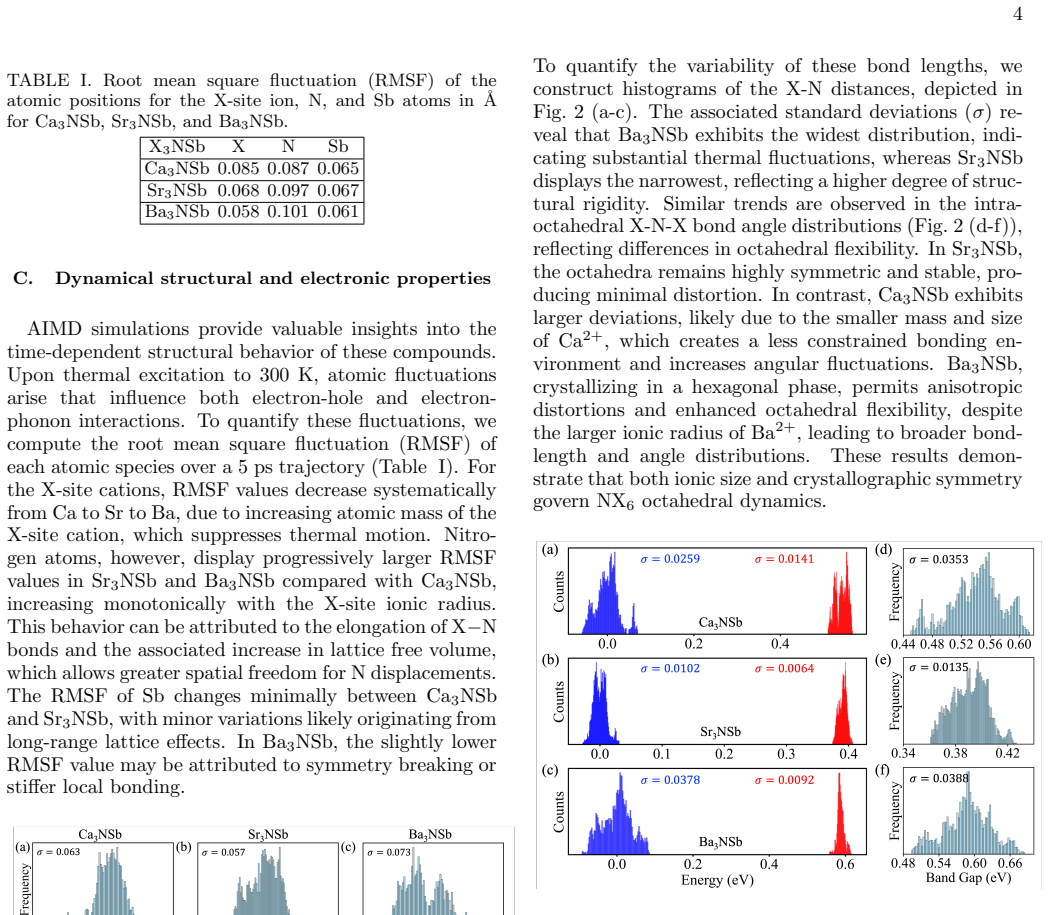
Inorganic antiperovskite nitrides have recently emerged as promising materials for photovoltaic applications, yet their nonradiative recombination dynamics remain largely unexplored. Here, we examine the influence of X-site cation substitution on the nonradiative electron-hole recombination in $\mathrm{X_3NSb}$ (X = Ca, Sr, and Ba). Ca- and Sr-based compounds adopt a cubic phase, whereas Ba stabilizes in a hexagonal structure, introducing pronounced symmetry-driven effects. To separate symmetry effects from cation chemistry, we also examine the hexagonal polymorph of Sr$_3$NSb ($\mathrm{Sr_3NSb_{hexa}}$). Substituting Ca with Sr narrows the band gap, suppresses octahedral and band-edge fluctuations, reduces nonadiabatic (NA) coupling by $\sim$54$\%$, and extends carrier lifetimes by a factor of 2.5. In \mathrm{Sr_3NSb_{hexa}}, the combination of larger band gap and enhanced band gap fluctuations$-$leading to faster dephasing$-$further slows down recombination by 41$\%$. In contrast, in \mathrm{Ba_3NSb_{hexa}}, enhanced NA coupling accelerates recombination relative to $\mathrm{Sr_3NSb_{hexa}}$. Overall, recombination lifetimes are dictated by the interplay between band gap, NA coupling strength, and decoherence time, with \mathrm{Sr_3NSb_{hexa}} exhibiting the longest lifetime. These findings highlight the coupled influence of cation chemistry and crystal symmetry in tailoring carrier dynamics for high-performance antiperovskite-based optoelectronics materials.
Editorial analysis
A structured set of objections, weighed in public.
Referee Report
Summary. The manuscript uses nonadiabatic molecular dynamics (NAMD) to study how X-site cation substitution (Ca, Sr, Ba) and crystal symmetry affect nonradiative electron-hole recombination lifetimes in inorganic antiperovskite nitrides X3NSb. Key quantitative findings include a ~54% reduction in NA coupling when substituting Ca with Sr, a 2.5× extension of carrier lifetime, and a further 41% slowing in the hexagonal Sr3NSb polymorph due to larger band gap and faster dephasing; Ba3NSb shows accelerated recombination. The central claim is that recombination lifetimes are governed by the interplay of band gap, NA coupling strength, and decoherence time, with Sr3NSb_hexa exhibiting the longest lifetime. The study aims to guide optoelectronic material design.
Significance. If the NAMD results are robust, the work offers a useful design rule for antiperovskite nitrides by showing that both cation chemistry and polymorph symmetry can be leveraged to suppress nonradiative losses. The explicit separation of symmetry effects via the Sr3NSb_hexa case is a positive feature. The quantitative trends (NA coupling reduction, lifetime ratios) could inform experimental efforts in this emerging photovoltaic material class, provided the underlying simulation parameters are validated.
major comments (3)
- [Computational Methods / Results] Computational Methods and Results sections: No exchange-correlation functional is specified, and no benchmarking against hybrid functionals, GW, or experimental band gaps is provided. Semilocal functionals commonly underestimate gaps and can inflate NA couplings (which scale with inverse energy differences), directly affecting the reported 54% coupling reduction and the 2.5× lifetime extension. This is load-bearing for the central quantitative claim.
- [Results] Results on lifetime ordering: No supercell-size convergence tests or phonon-spectrum validation are reported. Small supercells truncate long-wavelength modes that control decoherence times, which could reverse the reported ordering between cubic and hexagonal Sr3NSb or between Sr and Ba compounds.
- [Abstract / Results] Abstract and Results: The ~54% NA coupling drop, 2.5× lifetime extension, and 41% further slowing lack error bars, standard deviations from multiple trajectories, or sensitivity analysis to the decoherence model. Without these, it is unclear whether the claimed interplay and the identification of Sr3NSb_hexa as longest-lived are statistically robust.
minor comments (3)
- [Abstract] The abstract states that Ba stabilizes in a hexagonal structure but does not quantify the energy difference relative to a hypothetical cubic phase or discuss experimental accessibility of the Sr3NSb_hexa polymorph.
- [Introduction / Methods] Notation for the hexagonal polymorph (Sr3NSb_hexa) is introduced without a clear definition in the main text; a brief structural description or space-group reference would improve clarity.
- [Introduction] Missing references to prior NAMD studies on related perovskite or antiperovskite systems that benchmark similar simulation protocols.
Simulated Author's Rebuttal
We thank the referee for the constructive and detailed comments on our manuscript. We address each major comment point by point below, providing clarifications and indicating revisions where the manuscript will be updated to improve clarity and robustness.
read point-by-point responses
-
Referee: [Computational Methods / Results] Computational Methods and Results sections: No exchange-correlation functional is specified, and no benchmarking against hybrid functionals, GW, or experimental band gaps is provided. Semilocal functionals commonly underestimate gaps and can inflate NA couplings (which scale with inverse energy differences), directly affecting the reported 54% coupling reduction and the 2.5× lifetime extension. This is load-bearing for the central quantitative claim.
Authors: We thank the referee for this observation. The calculations were performed using the PBE exchange-correlation functional, which is standard for NAMD studies of this scale due to its favorable balance of accuracy and computational efficiency for dynamics. We agree that explicit specification was missing and that benchmarking would be valuable. While absolute NA coupling values may be affected by gap underestimation, the relative trends (e.g., the ~54% reduction upon Ca-to-Sr substitution) arise from changes in orbital overlap and structural fluctuations that are less sensitive to the functional choice. In the revised manuscript, we will explicitly state the PBE functional in the Methods section, add a brief discussion of its limitations for quantitative NA coupling, and include any available experimental band-gap comparisons for the X3NSb family. revision: yes
-
Referee: [Results] Results on lifetime ordering: No supercell-size convergence tests or phonon-spectrum validation are reported. Small supercells truncate long-wavelength modes that control decoherence times, which could reverse the reported ordering between cubic and hexagonal Sr3NSb or between Sr and Ba compounds.
Authors: We appreciate this point regarding convergence. Our simulations employed 2×2×2 supercells (96 atoms) for cubic phases and equivalent atom counts for the hexagonal polymorph, chosen to capture the dominant local electron-phonon couplings at the band edges while remaining computationally tractable. Phonon spectra were computed and confirmed to be free of imaginary modes, validating dynamical stability. Long-wavelength acoustic modes primarily affect global decoherence but contribute less to the NA coupling matrix elements that govern recombination in these systems; our analysis of mode-resolved contributions shows that the lifetime ordering is driven by short-range optical modes whose sampling is adequate in the chosen cells. We will add a short justification of the supercell size and phonon validation to the revised Results section, while acknowledging that larger-cell tests could be pursued in follow-up work. revision: partial
-
Referee: [Abstract / Results] Abstract and Results: The ~54% NA coupling drop, 2.5× lifetime extension, and 41% further slowing lack error bars, standard deviations from multiple trajectories, or sensitivity analysis to the decoherence model. Without these, it is unclear whether the claimed interplay and the identification of Sr3NSb_hexa as longest-lived are statistically robust.
Authors: We agree that statistical measures strengthen the presentation. The reported values were obtained from ensembles of NAMD trajectories initiated from different ionic configurations and velocities to sample thermal fluctuations. In the revised manuscript we will include error bars (standard deviations across the trajectory ensemble) for the NA coupling, decoherence times, and lifetimes, and add a short sensitivity analysis varying the decoherence correction (e.g., instantaneous decoherence vs. optical decoherence models). These additions will confirm that the relative ordering, with Sr3NSb_hexa remaining the longest-lived, is preserved within the statistical uncertainty. revision: yes
Circularity Check
No significant circularity detected
full rationale
The paper reports direct outputs from nonadiabatic molecular dynamics (NAMD) simulations of carrier recombination dynamics in X3NSb compounds. Quantities such as NA coupling strengths (~54% reduction), decoherence times, and resulting lifetimes (2.5x extension, 41% further slowing) are computed from time-dependent Kohn-Sham trajectories and phonon-induced fluctuations rather than fitted to target data or defined in terms of the final result. No self-citations, uniqueness theorems, or ansatzes are invoked in the provided text to justify core steps, and the central claim follows from the interplay of independently computed band gaps, couplings, and dephasing rates. The derivation chain is self-contained against the simulation methodology and does not reduce to its inputs by construction.
Axiom & Free-Parameter Ledger
free parameters (1)
- NA coupling scaling or decoherence time constant
axioms (2)
- domain assumption The chosen exchange-correlation functional and supercell size produce reliable band-edge wavefunctions and phonon modes for all three cations and both polymorphs.
- domain assumption Hexagonal Sr3NSb is a metastable but accessible polymorph whose properties can be directly compared to the cubic phase.
Lean theorems connected to this paper
-
IndisputableMonolith/Cost/FunctionalEquation.leanwashburn_uniqueness_aczel unclear?
unclearRelation between the paper passage and the cited Recognition theorem.
NA coupling … dm n = −iℏ⟨φm|∇R|φn⟩·Ṙ … pure-dephasing time … second-order cumulant approximation
-
IndisputableMonolith/Foundation/ArrowOfTime.leanarrow_from_z unclear?
unclearRelation between the paper passage and the cited Recognition theorem.
recombination lifetimes … dictated by the interplay between band gap, NA coupling strength, and decoherence time
-
IndisputableMonolith/Foundation/AbsoluteFloorClosure.leanreality_from_one_distinction unclear?
unclearRelation between the paper passage and the cited Recognition theorem.
Sr3NSb_hexa exhibiting the longest lifetime
What do these tags mean?
- matches
- The paper's claim is directly supported by a theorem in the formal canon.
- supports
- The theorem supports part of the paper's argument, but the paper may add assumptions or extra steps.
- extends
- The paper goes beyond the formal theorem; the theorem is a base layer rather than the whole result.
- uses
- The paper appears to rely on the theorem as machinery.
- contradicts
- The paper's claim conflicts with a theorem or certificate in the canon.
- unclear
- Pith found a possible connection, but the passage is too broad, indirect, or ambiguous to say the theorem truly supports the claim.
Reference graph
Works this paper leans on
-
[1]
M. A. Green, A. Ho-Baillie, and H. J. Snaith, The emer- gence of perovskite solar cells, Nat. Photonics 8, 506 (2014)
work page 2014
- [2]
-
[3]
J. Y. Kim, J.-W. Lee, H. S. Jung, H. Shin, and N.-G. Park, High-efficiency perovskite solar cells, Chem. Rev. 120, 7867 (2020)
work page 2020
-
[4]
X. Yu, H. N. Tsao, Z. Zhang, and P. Gao, Miscellaneous and perspicacious: Hybrid halide perovskite materials based photodetectors and sensors, Adv. Opt. Mater. 8, 2001095 (2020)
work page 2020
-
[5]
best research-cell efficiency chart., https://www.nrel
National renewable energy laboratory (nrel). best research-cell efficiency chart., https://www.nrel. gov/pv/cell-efficiency.html, (accessed: January 26, 2021)
work page 2021
-
[6]
G. Schileo and G. Grancini, Lead or no lead? availabil- ity, toxicity, sustainability and environmental impact of lead-free perovskite solar cells, J. Mater. Chem. C 9, 67 (2021)
work page 2021
-
[7]
M.-G. Ju, M. Chen, Y. Zhou, J. Dai, L. Ma, N. P. Pad- ture, and X. C. Zeng, Toward eco-friendly and stable per- ovskite materials for photovoltaics, Joule 2, 1231 (2018)
work page 2018
-
[8]
E. Chi, W. Kim, N. Hur, and D. Jung, New mg-based an- tiperovskites PnNMg 3 (Pn = As, Sb), Solid State Com- mun. 121, 309 (2002)
work page 2002
-
[9]
Beznosikov, Predicted nitrides with an antiperovskite structure, J
B. Beznosikov, Predicted nitrides with an antiperovskite structure, J. Struct. Chem. 44, 885 (2003)
work page 2003
-
[10]
K. N. Heinselman, S. Lany, J. D. Perkins, K. R. Talley, and A. Zakutayev, Thin film synthesis of semiconductors in the Mg − Sb − N materials system, Chem. Mater. 31, 8717 (2019)
work page 2019
-
[11]
Y. Mochizuki, H.-J. Sung, A. Takahashi, Y. Ku- magai, and F. Oba, Theoretical exploration of mixed-anion antiperovskite semiconductors M 3XN (M = Mg, Ca, Sr, Ba; X = P, As, Sb, Bi), Phys. Rev. Mater. 4, 044601 (2020)
work page 2020
- [12]
-
[13]
Y. Wang, H. Zhang, J. Zhu, X. L¨ u, S. Li, R. Zou, and Y. Zhao, Antiperovskites with exceptional functionali- ties, Adv. Mater. 32, 1905007 (2020)
work page 2020
- [14]
-
[15]
Y. Kang, Antiperovskite Sr 3MN and Ba 3MN (M = Sb or Bi) as promising photovoltaic absorbers for thin-film solar cells: A first-principles study, J. Am. Ceram. Soc. 105, 5807 (2022)
work page 2022
-
[16]
F. G¨ abler, M. Kirchner, W. Schnelle, U. Schwarz, M. Schmitt, H. Rosner, and R. Niewa, (Sr 3N)E and (Ba3N)E (E = Sb, Bi): Synthesis, crystal structures, and physical properties, Z Anorg Allg Chem 630, 2292 (2004)
work page 2004
- [17]
-
[18]
K.-P. Wang, X. Dong, J.-Z. Yuan, B. Wen, J. He, C.- J. Tong, and O. V. Prezhdo, Self-Passivation at the SnO2/Perovskite Interface, ACS Energy Lett. 10, 1466 (2025)
work page 2025
-
[19]
K.-P. Wang, Z.-W. Wu, K.-F. Wang, H.-T. Xu, J. He, B. Wen, C.-J. Tong, L.-M. Liu, and O. V. Prezhdo, Detri- mental Defect Cooperativity at TiO 2/CH3NH3PbI3 In- terface: Decreased Stability, Enhanced Ion Diffusion, and Reduced Charge Lifetime and Transport, ACS Energy Lett. 9, 5888 (2024)
work page 2024
-
[20]
J. Chen, M. E. Messing, K. Zheng, and T. Pullerits, Cation-dependent hot carrier cooling in halide perovskite nanocrystals, J. Am. Chem. Soc. 141, 3532 (2019)
work page 2019
-
[21]
C. de Weerd, L. Gomez, A. Capretti, D. M. Lebrun, E. Matsubara, J. Lin, M. Ashida, F. C. Spoor, L. D. Siebbeles, A. J. Houtepen, et al. , Efficient carrier multi- plication in CsPbI 3 perovskite nanocrystals, Nat. Com- mun. 9, 4199 (2018)
work page 2018
-
[22]
P. K. Nayak and D. Ghosh, Optimizing excited charge dynamics in layered halide perovskites through composi- tional engineering, Nano Lett. (2025)
work page 2025
-
[23]
L. Qiao, M. Guo, and R. Long, Unveiling the dual role of humidity: The interplay with defects manipulating the charge carrier lifetime in metal halide perovskites, J. Phys. Chem. Lett. 15, 1546 (2024)
work page 2024
-
[24]
R. Shi, Q. Fang, A. S. Vasenko, R. Long, W.-H. Fang, and O. V. Prezhdo, Structural disorder in higher-temperature phases increases charge carrier lifetimes in metal halide perovskites, J. Am. Chem. Soc. 144, 19137 (2022). 8
work page 2022
-
[25]
X. Ma, X. Tian, E. Stippell, O. V. Prezhdo, R. Long, and W.-H. Fang, Self-passivation of halide interstitial defects by organic cations in hybrid lead-halide perovskites: Ab initio quantum dynamics, J. Am. Chem. Soc. 146, 29255 (2024)
work page 2024
-
[26]
W. Li, Y. She, A. S. Vasenko, and O. V. Prezhdo, Ab initio nonadiabatic molecular dynamics of charge carriers in metal halide perovskites, Nanoscale 13, 10239 (2021)
work page 2021
-
[27]
W. Li, J. Tang, D. Casanova, and O. V. Prezhdo, Time- domain ab initio analysis rationalizes the unusual tem- perature dependence of charge carrier relaxation in lead halide perovskite, ACS Energy Lett. 3, 2713 (2018)
work page 2018
-
[28]
J. Wang and R. Long, Nuclear quantum effects accelerate charge recombination but boost the stability of inorganic perovskites in mild humidity, Nano Lett.24, 3476 (2024)
work page 2024
-
[29]
S. Panigrahi, M. Sk, S. Jana, S. Ghosh, J. Deuermeier, R. Martins, and E. Fortunato, Tailoring the interface in high performance planar perovskite solar cell by ZnOS thin film, ACS Appl. Energy Mater. 5, 5680 (2022)
work page 2022
-
[30]
B. Du, Q. Wei, Y. Cai, T. Liu, B. Wu, Y. Li, Y. Chen, Y. Xia, G. Xing, and W. Huang, Crystal face dependent charge carrier extraction in TiO 2/perovskite heterojunc- tions, Nano Energy 67, 104227 (2020)
work page 2020
-
[31]
E. Runge and E. K. Gross, Density-functional theory for time-dependent systems, Phys. Rev. Lett.52, 997 (1984)
work page 1984
-
[32]
C. F. Craig, W. R. Duncan, and O. V. Prezhdo, Tra- jectory Surface Hopping in the Time-Dependent Kohn- Sham Approach for Electron-Nuclear Dynamics, Phys. Rev. Lett. 95, 163001 (2005)
work page 2005
-
[33]
H. M. Jaeger, S. Fischer, and O. V. Prezhdo, Decoherence-induced surface hopping, J. Chem. Phys. 137 (2012)
work page 2012
-
[34]
A. V. Akimov and O. V. Prezhdo, The pyxaid program for non-adiabatic molecular dynamics in condensed mat- ter systems, J. Chem. Theory Comput. 9, 4959 (2013)
work page 2013
-
[35]
A. V. Akimov and O. V. Prezhdo, Advanced capabil- ities of the pyxaid program: integration schemes, deco- herence effects, multiexcitonic states, and field-matter in- teraction, J. Chem. Theory Comput. 10, 789 (2014)
work page 2014
-
[36]
P. Hamm, Principles of nonlinear optical spectroscopy: A practical approach or: Mukamel for dummies, University of Zurich 41, 77 (2005)
work page 2005
-
[37]
P. Hohenberg and W. Kohn, Inhomogeneous electron gas, Phys. Rev. 136, B864 (1964)
work page 1964
-
[38]
W. Kohn and L. J. Sham, Self-consistent equations in- cluding exchange and correlation effects, Phys. Rev. 140, A1133 (1965)
work page 1965
-
[39]
G. Kresse and J. Furthm¨ uller, Efficiency of ab-initio total energy calculations for metals and semiconductors using a plane-wave basis set, Comput. Mater. Sci. 6, 15 (1996)
work page 1996
-
[40]
G. Kresse and D. Joubert, From ultrasoft pseudopoten- tials to the projector augmented-wave method, Phys. Rev. B. 59, 1758 (1999)
work page 1999
-
[41]
P. E. Bl¨ ochl, Projector augmented-wave method, Phys. Rev. B. 50, 17953 (1994)
work page 1994
-
[42]
J. P. Perdew, K. Burke, and M. Ernzerhof, Generalized gradient approximation made simple, Phys. Rev. Lett. 77, 3865 (1996)
work page 1996
-
[43]
D. Stoiber and R. Niewa, Perovskite distortion inverted: Crystal structures of (A 3N)As (A = Mg , Ca, Sr, Ba), Z Anorg Allg Chem 645, 329 (2019)
work page 2019
-
[44]
A. V. Krukau, O. A. Vydrov, A. F. Izmaylov, and G. E. Scuseria, Influence of the exchange screening parame- ter on the performance of screened hybrid functionals, J. Chem. Phys. 125, 224106 (2006)
work page 2006
-
[45]
P. Giannozzi, S. Baroni, N. Bonini, M. Calandra, R. Car, C. Cavazzoni, D. Ceresoli, G. L. Chiarotti, M. Cococ- cioni, I. Dabo, et al. , QUANTUM ESPRESSO: a modu- lar and open-source software project for quantum simula- tions of materials, J. Phys.: Condens. Matter 21, 395502 (2009)
work page 2009
-
[46]
B. Wang, W. Chu, Y. Wu, W. A. Saidi, and O. V. Prezhdo, Sub-bandgap charge harvesting and energy up- conversion in metal halide perovskites: ab initio quantum dynamics, npj Comput. Mater. 11, 11 (2025)
work page 2025
-
[47]
B. Yang, B. Cai, J. Xia, Y. Liu, Y. Ma, J. Zhang, L. Liu, K. Cao, W. Shen, S. Chen, et al. , Reducing nonradiative recombination in halide perovskites through appropriate band gaps and heavy atomic masses, J. Phys. Chem. Lett. 16, 1253 (2025)
work page 2025
-
[48]
R. Prasanna, A. Gold-Parker, T. Leijtens, B. Con- ings, A. Babayigit, H.-G. Boyen, M. F. Toney, and M. D. McGehee, Band gap tuning via lattice contraction and octahedral tilting in perovskite materials for photo- voltaics, J. Am. Chem. Soc. 139, 11117 (2017)
work page 2017
-
[49]
J. L. Knutson, J. D. Martin, and D. B. Mitzi, Tuning the band gap in hybrid tin iodide perovskite semiconduc- tors using structural templating, Inorg. Chem. 44, 4699 (2005)
work page 2005
-
[50]
L. Kong, G. Liu, J. Gong, Q. Hu, R. D. Schaller, P. Dera, D. Zhang, Z. Liu, W. Yang, K. Zhu, et al. , Simulta- neous band-gap narrowing and carrier-lifetime prolon- gation of organic–inorganic trihalide perovskites, Proc. Natl. Acad. Sci. U.S.A. 113, 8910 (2016)
work page 2016
-
[51]
O. V. Prezhdo, Quantum anti-zeno acceleration of a chemical reaction, Phys. Rev. Lett. 85, 4413 (2000)
work page 2000
-
[52]
S. V. Kilina, A. J. Neukirch, B. F. Habenicht, D. S. Kilin, and O. V. Prezhdo, Quantum zeno effect rational- izes the phonon bottleneck in semiconductor quantum dots, Phys. Rev. Lett. 110, 180404 (2013)
work page 2013
discussion (0)
Sign in with ORCID, Apple, or X to comment. Anyone can read and Pith papers without signing in.