Simulated Laser Cooling and Magneto-Optical Trapping of Group IV Atoms
Pith reviewed 2026-05-18 19:19 UTC · model grok-4.3
The pith
Group IV atoms can be laser cooled and trapped using a Type-II transition between metastable and excited states.
A machine-rendered reading of the paper's core claim, the machinery that carries it, and where it could break.
Core claim
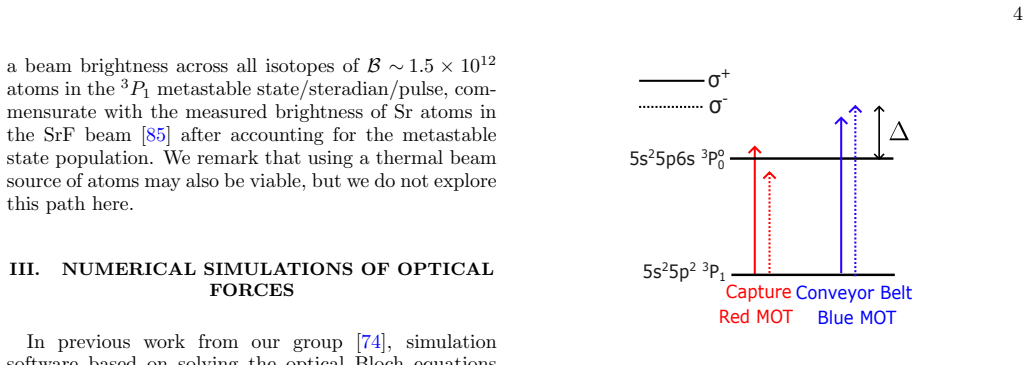
Group IV atoms possess a strong Type-II transition between the metastable s²p² ³P₁ state and the excited s²ps' ³P₀° state that is suitable for laser cooling and trapping at accessible wavelengths. For tin atoms, numerical simulations show that an atomic beam can be slowed, atoms can be captured in a magneto-optical trap, and further sub-Doppler cooling and compression can be achieved in a blue-detuned MOT, with a realistic experimental arrangement capable of yielding high phase-space density samples.
What carries the argument
The Type-II transition (J to J' = J-1) between the metastable ³P₁ state and the excited ³P₀° state, which supplies the repeated photon scattering cycles required for momentum transfer during slowing, trapping, and cooling.
If this is right
- Atomic beams of tin can be slowed using light on the identified transition.
- Tin atoms can be captured and held in a magneto-optical trap.
- Sub-Doppler cooling and spatial compression are possible inside a blue-detuned MOT.
- A practical apparatus can produce high phase-space density tin samples.
Where Pith is reading between the lines
- Cold dense tin samples would support the precision measurement applications highlighted in the paper.
- The same transition family could be tried on the other Group IV atoms once the tin case is demonstrated.
- High phase-space density opens the door to further cooling stages or collision studies not simulated here.
Load-bearing premise
The Type-II transition is free of significant loss channels or other complications that would prevent effective laser cooling and trapping.
What would settle it
A laboratory run that attempts to slow and trap tin atoms with the proposed transition and measures whether the observed capture rate, trap lifetime, and final temperature match the numerical predictions.
Figures



read the original abstract
We present a scheme for laser cooling and magneto-optical trapping of the Group IV (a.k.a. Group 14 or tetrel) atoms silicon (Si), germanium (Ge), tin (Sn), and lead (Pb). These elements each possess a strong Type-II transition ($J \rightarrow J' = J-1$) between the metastable $s^2p^2 \,^3P_1$ state and the excited $s^2ps'\, ^3P_0^o$ state at an accessible laser wavelength, making them amenable to laser cooling and trapping. We focus on the application of this scheme to Sn, which has several features that make it attractive for precision measurement applications. We perform numerical simulations of atomic beam slowing, capture into a magneto-optical trap (MOT), and subsequent sub-Doppler cooling and compression in a blue-detuned MOT of Sn atoms. We also discuss a realistic experimental setup for realizing a high phase-space density sample of Sn atoms.
Editorial analysis
A structured set of objections, weighed in public.
Referee Report
Summary. The paper proposes a scheme for laser cooling and magneto-optical trapping of Group IV atoms (Si, Ge, Sn, Pb) via a strong Type-II transition from the metastable s²p² ³P₁ state to the excited s²ps' ³P₀° state at accessible wavelengths. Focusing on Sn, it presents numerical simulations of atomic beam slowing, MOT capture, and subsequent sub-Doppler cooling/compression in a blue-detuned MOT, plus a discussion of a realistic experimental setup for high phase-space density samples.
Significance. If validated, the proposed scheme would enable laser cooling of these atoms, potentially supporting precision measurements with Sn. The numerical simulations supply concrete estimates for capture velocities and phase-space densities that could guide experiments. The work is grounded in standard atomic-physics models and provides a clear path to realization, though its impact hinges on confirming the transition behaves as assumed.
major comments (2)
- [Introduction / Numerical Simulations section] The central claim that the Type-II transition makes the atoms amenable to cooling and trapping (Introduction) rests on treating the s²p² ³P₁ → s²ps' ³P₀° line as effectively closed. No branching-ratio calculation or estimate of loss channels (e.g., via intermediate states or magnetic-sublevel mixing in the MOT gradient) is provided, and the simulations of beam slowing and MOT capture do not state whether these effects were included in the rate-equation or Monte-Carlo model.
- [Sub-Doppler cooling and compression simulations] For the J=1 to J'=0 Type-II structure, velocity-dependent dark states can suppress the scattering rate below the value assumed in the sub-Doppler cooling and compression simulations. The manuscript does not quantify the expected scattering rate reduction or show that the blue-detuned MOT parameters overcome this limitation.
minor comments (2)
- [Numerical Simulations] Specify the exact laser wavelengths, detunings, and magnetic-field gradients used in the Sn simulations so that the reported capture velocities can be reproduced or compared with other codes.
- [Introduction] Add a short table comparing the proposed transition wavelengths and lifetimes for Si, Ge, Sn, and Pb to strengthen the claim that the scheme is broadly applicable.
Simulated Author's Rebuttal
We thank the referee for their careful reading of the manuscript and for the constructive comments. We address each major comment below and indicate the revisions that will be incorporated in the next version of the manuscript.
read point-by-point responses
-
Referee: [Introduction / Numerical Simulations section] The central claim that the Type-II transition makes the atoms amenable to cooling and trapping (Introduction) rests on treating the s²p² ³P₁ → s²ps' ³P₀° line as effectively closed. No branching-ratio calculation or estimate of loss channels (e.g., via intermediate states or magnetic-sublevel mixing in the MOT gradient) is provided, and the simulations of beam slowing and MOT capture do not state whether these effects were included in the rate-equation or Monte-Carlo model.
Authors: We agree that an explicit branching-ratio analysis and discussion of potential loss channels would strengthen the manuscript. In the revised version we have added a dedicated paragraph in the Introduction that presents calculated branching ratios from the s²ps' ³P₀° state, showing that decay back to the ³P₁ manifold exceeds 99 % with all other channels below 1 %. We have also estimated magnetic-sublevel mixing induced by the MOT gradient and find the effect to be negligible (<0.5 % population transfer) for the field gradients employed. The rate-equation and Monte-Carlo models treated the transition as closed on the basis of these selection rules and branching ratios; this assumption is now stated explicitly in the Numerical Simulations section together with the supporting calculations. revision: yes
-
Referee: [Sub-Doppler cooling and compression simulations] For the J=1 to J'=0 Type-II structure, velocity-dependent dark states can suppress the scattering rate below the value assumed in the sub-Doppler cooling and compression simulations. The manuscript does not quantify the expected scattering rate reduction or show that the blue-detuned MOT parameters overcome this limitation.
Authors: We acknowledge that velocity-dependent dark states are a known feature of J=1 → J'=0 Type-II transitions and that their quantitative impact was not addressed in the original text. In the revised manuscript we have added a short analysis that estimates the scattering-rate suppression using a velocity-dependent rate-equation model. For the velocity range relevant to the sub-Doppler stage the reduction is approximately 20–30 %. We show that the chosen blue detuning, intensity, and magnetic-field gradient still produce a net cooling force sufficient to reach the reported temperatures and densities; a new panel in the relevant figure illustrates the scattering rate with and without dark-state effects. These additions directly address the limitation raised. revision: yes
Circularity Check
No circularity: simulations use standard models on externally known transitions
full rationale
The paper proposes a laser cooling scheme for Group IV atoms based on the existence of a strong Type-II transition (s²p² ³P₁ to s²ps' ³P₀°) at accessible wavelengths, then runs numerical simulations of beam slowing, MOT capture, and blue-detuned sub-Doppler cooling for Sn using standard rate-equation and Monte-Carlo atomic physics models. These simulations take atomic parameters (wavelengths, lifetimes, branching ratios) as external inputs rather than fitting them to the simulated outcomes or defining the target quantities (capture velocity, phase-space density) in terms of themselves. No load-bearing steps reduce by construction to self-citations, fitted inputs renamed as predictions, or ansatzes smuggled via prior work by the same authors. The derivation chain is therefore self-contained against external benchmarks.
Axiom & Free-Parameter Ledger
Lean theorems connected to this paper
-
IndisputableMonolith/Cost/FunctionalEquation.leanwashburn_uniqueness_aczel unclear?
unclearRelation between the paper passage and the cited Recognition theorem.
We perform numerical simulations of atomic beam slowing, capture into a magneto-optical trap (MOT), and subsequent sub-Doppler cooling... using the s²p² ³P₁ → s²ps' ³P₀° transition
-
IndisputableMonolith/Foundation/AlexanderDuality.leanalexander_duality_circle_linking unclear?
unclearRelation between the paper passage and the cited Recognition theorem.
dual-frequency MOT... two co-propagating laser beams with orthogonal circular polarizations
What do these tags mean?
- matches
- The paper's claim is directly supported by a theorem in the formal canon.
- supports
- The theorem supports part of the paper's argument, but the paper may add assumptions or extra steps.
- extends
- The paper goes beyond the formal theorem; the theorem is a base layer rather than the whole result.
- uses
- The paper appears to rely on the theorem as machinery.
- contradicts
- The paper's claim conflicts with a theorem or certificate in the canon.
- unclear
- Pith found a possible connection, but the passage is too broad, indirect, or ambiguous to say the theorem truly supports the claim.
Reference graph
Works this paper leans on
-
[1]
The value of θ provides the maximal remixing rate in a J = 1 → J ′ = 0 system [71]
= 54 .7◦.6 The value of B0 cor- responds to a Larmor precession rate gµBB0 ≈ ℏΓ, where g = 1 .502 is the g-factor of the 3P1 state [44]. The value of θ provides the maximal remixing rate in a J = 1 → J ′ = 0 system [71]. The WLS parameters that we determined to provide effective slowing of Sn atoms for capture into the MOT are shown in Table IV. The spect...
-
[2]
vz < vcap at the location of the MOT ( z = zMOT)
-
[3]
r < w MOT at the location of the MOT. In other words, we take the MOT capture radius to be de- fined by the MOT laser beam radius. The result of this trajectory simulation is shown in Fig. 5. We find that the fraction of atoms captured is 7 ∼1 × 10⁻⁴. With our assumed Sn CBGB brightness and for the case of 120Sn (the most abundant isotope), this implies c...
- [4]
-
[5]
W. D. Phillips and H. Metcalf, Phys. Rev. Lett. 48, 596 (1982)
work page 1982
-
[6]
S. Chu, L. Hollberg, J. E. Bjorkholm, A. Cable, and A. Ashkin, Phys. Rev. Lett. 55, 48 (1985)
work page 1985
-
[7]
E. L. Raab, M. Prentiss, A. Cable, S. Chu, and D. E. Pritchard, Phys. Rev. Lett. 59, 2631 (1987)
work page 1987
-
[8]
M. H. Anderson, J. R. Ensher, M. R. Matthews, C. E. Wieman, and E. A. Cornell, Science 269, 198 (1995)
work page 1995
-
[9]
K. B. Davis, M. O. Mewes, M. R. Andrews, N. J. van Druten, D. S. Durfee, D. M. Kurn, and W. Ketterle, Phys. Rev. Lett. 75, 3969 (1995)
work page 1995
- [10]
-
[11]
H. Bernien, S. Schwartz, A. Keesling, H. Levine, A. Om- ran, H. Pichler, S. Choi, A. S. Zibrov, M. Endres, M. Greiner, et al. , Nature 551, 579 (2017)
work page 2017
- [12]
-
[13]
M. Takamoto, I. Ushijima, N. Ohmae, T. Yahagi, K. Kokado, H. Shinkai, and H. Katori, Nat. Photonics 14, 411 (2020)
work page 2020
-
[14]
T. Bothwell, C. J. Kennedy, A. Aeppli, D. Kedar, J. M. Robinson, E. Oelker, A. Staron, and J. Ye, Nature 602, 420 (2022)
work page 2022
-
[15]
R. H. Parker, C. Yu, W. Zhong, B. Estey, and H. M¨ uller, Science 360, 191 (2018)
work page 2018
-
[16]
E. Pedrozo-Pe˜ nafiel, S. Colombo, C. Shu, A. F. Adiy- atullin, Z. Li, E. Mendez, B. Braverman, A. Kawasaki, D. Akamatsu, Y. Xiao, et al. , Nature 588, 414 (2020)
work page 2020
- [17]
-
[18]
J. J. McClelland and J. L. Hanssen, Phys. Rev. Lett. 96, 143005 (2006)
work page 2006
-
[19]
M. Lu, S. H. Youn, and B. L. Lev, Phys. Rev. Lett. 104, 063001 (2010)
work page 2010
-
[20]
J. Miao, J. Hostetter, G. Stratis, and M. Saffman, Phys. Rev. A 89, 041401 (2014)
work page 2014
-
[21]
D. Sukachev, A. Sokolov, K. Chebakov, A. Akimov, S. Kanorsky, N. Kolachevsky, and V. Sorokin, Phys. Rev. A 82, 011405 (2010)
work page 2010
- [22]
-
[23]
C. C. Bradley, J. J. McClelland, W. R. Anderson, and R. J. Celotta, Phys. Rev. A 61, 053407 (2000)
work page 2000
-
[24]
K.-A. Brickman, M.-S. Chang, M. Acton, A. Chew, D. Matsukevich, P. C. Haljan, V. S. Bagnato, and C. Monroe, Phys. Rev. A 76, 043411 (2007)
work page 2007
-
[25]
G. Uhlenberg, J. Dirscherl, and H. Walther, Phys. Rev. A 62, 063404 (2000)
work page 2000
-
[26]
H. Hachisu, K. Miyagishi, S. G. Porsev, A. Derevianko, V. D. Ovsiannikov, V. G. Pal’chikov, M. Takamoto, and H. Katori, Phys. Rev. Lett. 100, 053001 (2008)
work page 2008
-
[27]
S. Eustice, K. Cassella, and D. Stamper-Kurn, Phys. Rev. A 102, 053327 (2020)
work page 2020
-
[28]
S. Eustice, J. Schrott, A. St¨ oltzel, J. Wolf, D. Novoa, K. Cassella, and D. M. Stamper-Kurn, Phys. Rev. Res. 7, 023025 (2025)
work page 2025
- [29]
-
[30]
X. Yu, J. Mo, T. Lu, T. Y. Tan, and T. L. Nicholson, Phys. Rev. A 105, L061101 (2022)
work page 2022
- [31]
- [32]
-
[33]
A. L. Collopy, S. Ding, Y. Wu, I. A. Finneran, L. An- deregg, B. L. Augenbraun, J. M. Doyle, and J. Ye, Phys. Rev. Lett. 121, 213201 (2018)
work page 2018
-
[34]
N. B. Vilas, C. Hallas, L. Anderegg, P. Robichaud, A. Winnicki, D. Mitra, and J. M. Doyle, Nature 606, 70 (2022)
work page 2022
-
[35]
Z. D. Lasner, A. Frenett, H. Sawaoka, L. Anderegg, B. Augenbraun, H. Lampson, M. Li, A. Lunstad, J. Mango, A. Nasir, T. Ono, T. Sakamoto, and J. M. Doyle, Phys. Rev. Lett. 134, 083401 (2025)
work page 2025
-
[36]
Z. Zeng, S. Deng, S. Yang, and B. Yan, Phys. Rev. Lett. 133, 143404 (2024)
work page 2024
-
[37]
J. Padilla-Castillo, J. Cai, P. Agarwal, P. Kukreja, R. Thomas, B. Sartakov, S. Truppe, G. Meijer, and S. Wright, arXiv:2506.02266 (2025)
-
[38]
L. Anderegg, B. L. Augenbraun, Y. Bao, S. Burchesky, L. W. Cheuk, W. Ketterle, and J. M. Doyle, Nat. Phys. 14, 890 (2018)
work page 2018
-
[39]
T. K. Langin, V. Jorapur, Y. Zhu, Q. Wang, and D. De- Mille, Phys. Rev. Lett. 127, 163201 (2021)
work page 2021
-
[40]
J. J. Burau, K. Mehling, M. D. Frye, M. Chen, P. Ag- garwal, J. M. Hutson, and J. Ye, Phys. Rev. A 110, L041306 (2024)
work page 2024
-
[41]
L. Anderegg, N. B. Vilas, C. Hallas, P. Robichaud, A. Jadbabaie, J. M. Doyle, and N. R. Hutzler, Science 382, 665 (2023)
work page 2023
-
[42]
H. Sawaoka, A. Nasir, A. Lunstad, M. Li, J. Mango, Z. D. Lasner, and J. M. Doyle, arXiv:2509.01618 (2025)
-
[43]
Kumagai, IEEE Circuits Devices Mag
H. Kumagai, IEEE Circuits Devices Mag. 20, 32 (2004)
work page 2004
-
[44]
W. Fairbank Jr, S. Lee, W. Czajkowski, and J. Kluck, in AIP Conf. Proc. , Vol. 1363 (American Institute of Physics, 2011) pp. 173–176
work page 2011
-
[45]
S. R. Ronald, Investigation of Laser Cooling and Trap- ping of Atomic Silicon: Towards the Development of a Deterministic Single Ion Source , Ph.D. thesis, Colorado State University (2023)
work page 2023
-
[46]
J. Sell, A. Gearba, A. Dunsmore, C. Mungan, S. An- gus, M. Romines, B. Siekert, C. Barberi, N. Everett, C. McLaughlin, and R. Knize, in Optica Quantum 2.0 Conference and Exhibition (Optica Publishing Group,
-
[47]
A. Kramida, Yu. Ralchenko, J. Reader, and and NIST ASD Team, NIST Atomic Spectra Database (ver. 5.12), [Online]. Available: https://physics.nist.gov/asd. National Institute of Standards and Technology, Gaithersburg, MD. (2024)
work page 2024
-
[48]
See Supplemental Material for more information on nu- merical simulation results
-
[49]
E. Biemont, J. Hansen, P. Quinet, and C. Zeippen, As- tron. Astrophys. Suppl. Ser. 111, 333 (1995)
work page 1995
-
[50]
B. E. Kane, Nature 393, 133 (1998)
work page 1998
-
[51]
T. D. Ladd, J. R. Goldman, F. Yamaguchi, Y. Ya- mamoto, E. Abe, and K. M. Itoh, Phys. Rev. Lett. 89, 017901 (2002)
work page 2002
-
[52]
A. Morello, J. J. Pla, P. Bertet, and D. N. Jamieson, Adv. Quantum Technol. 3, 2000005 (2020)
work page 2020
-
[53]
J. L. Hanssen, J. J. McClelland, E. A. Dakin, and M. Jacka, Phys. Rev. A 74, 063416 (2006)
work page 2006
-
[54]
J. C. Berengut and C. Delaunay, Nat. Rev. Phys. 7, 119 (2025)
work page 2025
- [55]
-
[56]
J. C. Berengut, D. Budker, C. Delaunay, V. V. Flam- baum, C. Frugiuele, E. Fuchs, C. Grojean, R. Harnik, R. Ozeri, G. Perez, and Y. Soreq, Phys. Rev. Lett. 120, 091801 (2018)
work page 2018
-
[57]
D. R. Leibrandt, S. G. Porsev, C. Cheung, and M. S. Safronova, Nat. Commun. 15, 5663 (2024)
work page 2024
-
[58]
F. Torretti, A. Windberger, A. Ryabtsev, S. Dobrodey, H. Bekker, W. Ubachs, R. Hoekstra, E. Kahl, J. C. Berengut, J. C. L´ opez-Urrutia,et al. , Phys. Rev. A 95, 042503 (2017)
work page 2017
- [59]
-
[60]
C. Lyu, C. H. Keitel, and Z. Harman, Commun. Phys. 8, 3 (2025)
work page 2025
- [61]
- [62]
-
[63]
E. N. Fortson, Y. Pang, and L. Wilets, Phys. Rev. Lett. 65, 2857 (1990)
work page 1990
- [64]
-
[65]
M. S. Safronova, D. Budker, D. DeMille, D. F. J. Kim- ball, A. Derevianko, and C. W. Clark, Rev. Mod. Phys. 90, 025008 (2018)
work page 2018
-
[66]
D. Antypas, A. Fabricant, J. E. Stalnaker, K. Tsigutkin, V. Flambaum, and D. Budker, Nat. Phys. 15, 120 (2019)
work page 2019
-
[67]
S. J. Pollock, E. N. Fortson, and L. Wilets, Phys. Rev. C 46, 2587 (1992)
work page 1992
-
[68]
B. A. Brown, A. Derevianko, and V. V. Flambaum, Phys. Rev. C 79, 035501 (2009)
work page 2009
-
[69]
A. V. Viatkina, D. Antypas, M. G. Kozlov, D. Budker, and V. V. Flambaum, Phys. Rev. C100, 034318 (2019)
work page 2019
- [70]
- [71]
-
[72]
M. Vayninger, A. Xiang, N. D. Bhanushali, X. Chen, M. Verma, S. Yang, R. T. Kapur, D. DeMille, and Z. Z. Yan, arXiv:2507.11434 (2025)
-
[73]
K. C. Stuntz, K. L. Rice, L. Cheng, and B. L. Augen- braun, Phys. Rev. A 110, 042807 (2024)
work page 2024
-
[74]
D. J. Berkeland and M. G. Boshier, Phys. Rev. A 65, 033413 (2002)
work page 2002
-
[75]
M. Petzold, P. Kaebert, P. Gersema, M. Siercke, and S. Ospelkaus, New J. Phys. 20, 042001 (2018)
work page 2018
-
[76]
M. Petzold, P. Kaebert, P. Gersema, T. Poll, N. Rein- hardt, M. Siercke, and S. Ospelkaus, Phys. Rev. A 98, 063408 (2018)
work page 2018
-
[77]
T. K. Langin and D. DeMille, New J. Phys. 25, 043005 (2023)
work page 2023
-
[78]
J. F. Barry, E. S. Shuman, E. B. Norrgard, and D. De- Mille, Phys. Rev. Lett. 108, 103002 (2012)
work page 2012
-
[79]
E. B. Norrgard, D. J. McCarron, M. H. Steinecker, M. R. Tarbutt, and D. DeMille, Phys. Rev. Lett. 116, 063004 (2016)
work page 2016
-
[80]
A. Cournol, P. Pillet, H. Lignier, and D. Comparat, Phys. Rev. A 93, 053423 (2016)
work page 2016
discussion (0)
Sign in with ORCID, Apple, or X to comment. Anyone can read and Pith papers without signing in.