REVIEW 4 major objections 4 minor 51 references
Inferring Piece Value in Chess and Chess Variants
T0 review · 4 major / 4 minor · reviewed 2026-08-05 · deepseek-v4-flash
Pith's one-line read Piece values can be inferred from millions of chess games, and the data put a knight at 2.9 pawns, a bishop at 3.2, a rook at 4.6, and a queen at 9.6 pawns.
desk verdict Useful and honest empirical study of chess-variant piece values, but the headline numbers sit on an outcome-dependent filter that shifts them 25–30% — treat them as provisional. read the letter →
The pith
A machine-rendered reading of the paper's core claim, the machinery that carries it, and where it could break.
The reading
What carries the argument
The engine is ordinary logistic regression of game outcome on material differences plus a Glicko-2 rating-term, where the coefficients are converted to Elo-like units. Because published ratings are noisy proxies for skill, the paper applies SIMEX (simulation-extrapolation): it adds controlled Gaussian noise to rating differences, re-fits the regression, and extrapolates back to zero noise. A no-capture filter on snapshots serves as a crude quiescence filter, and the final piece values are reported as ratios of the fitted piece coefficient to the fitted pawn coefficient.
What would settle it
Re-run the full regression pipeline on a fresh Lichess sample filtered by an explicit quiescence check, such as requiring that the position evaluation is stable across a one-ply engine search. If the bishop-over-knight gap disappears, reverses sign, or moves by more than a few percent, the reported piece values are artifacts of the crude quiescence filter rather than true material worth.
Extended reading notes
Core claim
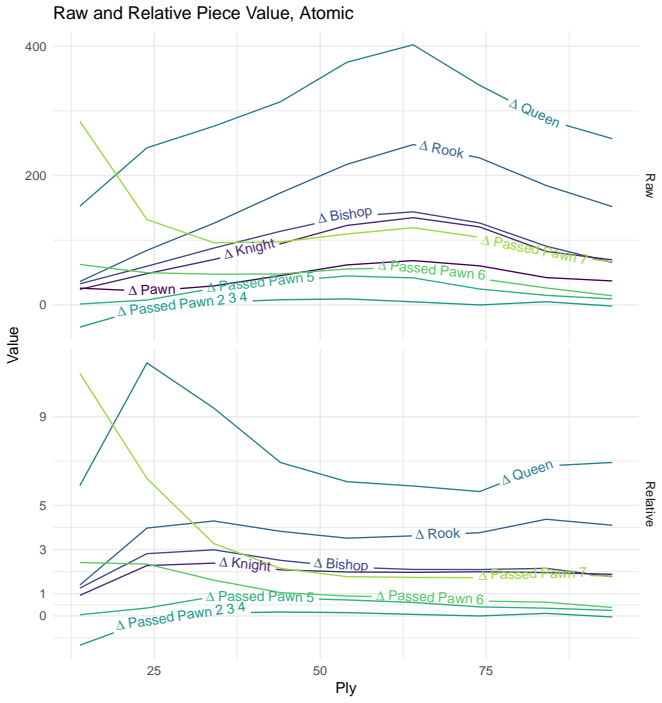
The central claim is that a simple logistic regression on material imbalance, with Glicko-2 rating differences as a covariate and SIMEX-based correction for rating noise, recovers meaningful piece values. For standard chess, after filtering out positions with an immediate capture, the estimated values are knight 2.9 pawns, bishop 3.2, rook 4.6, and queen 9.6. These are close to classical systems, except that bishops edge out knights, and the values lie on the low end of historical estimates, implying a relatively high pawn value. In Chess 960 the same values come out slightly depressed (2.7, 3.0, 4.2, 8.7), in Atomic chess they are much smaller in absolute terms but similar relative to a paw
Load-bearing premise
The whole analysis hinges on the assumption that a single noise level for Glicko-2 ratings, chosen by trial and error, plus a filter for positions with no immediate capture, removes the confounding effects of player skill and non-quiescent positions.
Editorial extensions
If this is right
- Standard chess material evaluation can be checked and updated from observed play, giving baseline values of roughly 3, 3, 5, 10 pawns for knight, bishop, rook, queen, with bishop slightly above knight.
- In Chess 960, piece values track standard chess but run slightly lower for each piece, suggesting the same hand-evaluation system transfers to random openings.
- In Atomic and Horde chess, major pieces are worth fewer pawns, meaning positional factors dominate material the way players often assume.
- In Antichess, most pieces carry negative value, and a king is worth nearly zero on average, so equalizing odds by removing pieces from the stronger player is a quantitative, not merely intuitive, exercise.
- The reported equalizer values convert material directly into rating points, giving a concrete way to set up fair games between mismatched opponents.
Reading between the lines
- The method could be extended to non-material positional features, like knight outposts, king safety, or castling status, by adding them as regression terms, potentially yielding a fully data-driven static evaluation function.
- The discrepancy between human-play estimates and Stockfish self-play values suggests piece values may depend on the skill of the players; a natural test is to run the same regression on games filtered by rating band to see if the piece coefficients shift with playing strength.
- The sigma_0 noise estimate for Glicko-2 ratings, which varies across variants, could itself be estimated jointly with the piece values using a measurement-error model, rather than fixed by trial and error.
- A cleaner falsifiable prediction is that the ratio of bishop-to-knight value should remain above 1 across time controls; running the regression on bullet or blitz games would test whether the effect is an artifact of longer time controls.
Editorial analysis
A structured set of objections, weighed in public.
Referee Report
Summary. The paper estimates chess piece values by fitting logistic regressions to large samples of Lichess games, using Glicko-2 rating differences as a skill control and a SIMEX/regression-calibration procedure to correct attenuation from rating noise. Standard chess, Chess 960, Atomic, Antichess, and Horde are analyzed. The headline standard-chess results, based on the 'no capture next 1' sample, are relative values of approximately knight 2.9, bishop 3.2, rook 4.6, and queen 9.6 pawns, with bishops rated slightly above knights. The paper also reports Stockfish self-play ablations that yield more compressed values and explicitly notes this discrepancy. The paper is candid about limitations: the no-capture filter is called a crude quiescence proxy, sigma_0 is fitted by trial and error, and confidence intervals are described as misleading because filter changes move estimates more than the intervals.
Significance. If the results hold, the paper would provide large-sample, publicly grounded evidence on classical piece-value questions and on how piece values change across chess variants. Strengths include the use of millions of games, a transparent measurement-error-correction exercise with Monte Carlo validation, and honest discussion of confounding and selection issues. The variant comparisons and the equalizer-value side results are potentially useful. However, the central quantitative claims are heavily dependent on a filter whose endogeneity the paper itself concedes, and the paper's own sensitivity analyses show that the estimates move by more than the reported bootstrap uncertainty. The significance is therefore conditional on resolving the selection-bias and residual-confounder concerns.
major comments (4)
- [§4.1, Table 3] The headline values are taken from the 'No Capture Next 1' column, but this filter conditions on the realized next move rather than on a static property of the position. A position with a winning capture is excluded if the player captures and included if the player overlooks the capture, so the sample is enriched for mistakes and for positions where material is not tactically contested. This is a collider-style selection rule, not a quiescence filter. The magnitude of the concern is visible in the table: moving from 'No Filtering' to 'No Capture Next 1' changes the material coefficients by 25–36% (e.g., knight 147 to 195, queen 479 to 650). The paper concedes the filter is crude and calls for a better one, but still publishes the filtered numbers as the central result. The identifying assumption is not merely 'positions are quiescent' but that the next-move capture choice is ignorable af
- [§3.1, Figure 2; §4.1] The measurement-error correction relies on sigma_0 = 58 for standard chess, selected 'via trial and error' to make Monte Carlo and SIMEX curves coincide. No uncertainty is attached to this tuning parameter, and the rating coefficient after correction remains 0.94 rather than the calibrated 1.0. The paper attributes the residual to lopsided positions, but that is the same unmodeled confounding that could bias material coefficients. The Monte Carlo validation in §3.2 covers only a single piece coefficient in a synthetic setting where the mechanism is known; it does not validate the full specification or the no-capture filter. The authors should provide a sensitivity analysis over sigma_0 and should address why the post-correction rating coefficient near 0.94 does not indicate remaining skill confounding.
- [§4.1.1] The paper reports bootstrap confidence intervals for the no-capture-filter model but then states that many alternative filtering choices fall far outside those intervals and concludes that 'confidence intervals are somewhat misleading in this study.' Since the no-filter versus one-filter change is 25–30% for several material coefficients, the central estimates have a large model-selection uncertainty that is never quantified. The claim that bishops are slightly more valuable than knights is supported by a 19-point difference in Table 4 with narrow marginal intervals, but the paper itself notes that non-overlap of marginal intervals is not a significance test and does not report the covariance. Without an assessment of the filter-selection uncertainty, the precision of the headline ratios is overstated.
- [§5, Tables 15–16] The Stockfish self-play experiments give piece values that are strongly compressed relative to the Lichess-based estimates: roughly knight 2.7–2.9, bishop 2.9–3.1, rook 3.5–3.6, and queen 4.9–5.6 pawns, versus 2.9, 3.2, 4.6, and 9.6 from the main analysis. The paper presents this as a 'contrasting view' and lists possible explanations, but the discrepancy is large enough to undermine the general framing that these are 'piece values' rather than estimates specific to a particular population and selection rule. The discussion should either substantially temper the causal interpretation or provide a test that distinguishes the competing explanations, for example by running the same Lichess filter on Stockfish self-play positions.
minor comments (4)
- [Appendix A] Typo: 'frist player' should be 'first player' in the sentence 'Both these differences are with respect to the frist player.'
- [§4.1 / Table 4] The table title says 'under filtering for immediate capture,' which is ambiguous: the filter actually removes positions where the next move is a capture. Rephrase to 'excluding positions with an immediate capture.'
- [§4.2] The estimated sigma_0 for Chess 960 (34) is nearly half the standard-chess value (58), and the paper says it is 'not clear why.' Since the SIMEX correction is central, this unexplained variation across datasets deserves more than a parenthetical remark; even a brief discussion of possible causes (rating volatility, time window, player pool) would help.
- [Tables 3–14] The tables report 'num observations' for what are often multiple snapshots per game, and the text sometimes says 'games' and sometimes 'positions.' Clarify whether the unit is games, positions, or snapshots, and whether the standard errors (when reported) account for repeated snapshots from the same game.
Circularity Check
No circular derivation: piece values are estimated from observed game outcomes, and the acknowledged limitations are validity threats, not definitional loops.
full rationale
The paper's central estimates are obtained by logistic regression of game outcomes on material imbalances, with Glicko-2 ratings used as a skill control. The piece-value coefficients are not assumed or fitted from prior piece-value tables; they are estimated directly from Lichess game data. The SIMEX/Monte Carlo procedure is a validation of the attenuation-correction method on synthetic data with known coefficients, and it does not set the final estimates. Moreover, the paper itself reports (Table 4) that the SIMEX calibration has little impact on the non-rating coefficients, so the headline piece values are essentially the raw logistic coefficients, not the output of a fitted parameter that encodes the answer. The author's self-citations (refs 30, 31) are background blog posts about atomic piece values; they are not invoked as authority for the method or as evidence for the results. The no-capture filter is a sample-selection rule, not a definitional equivalence: the paper explicitly calls it a 'crude way to approximately select only quiescent positions,' notes that the estimates change by 25-30% under it, and calls for a better filter (Section 4.1; Section 6 item 1). This is an endogeneity/validity concern, not a circular derivation. Similarly, the residual rating coefficient of 0.94 instead of 1.0 is acknowledged as possible confounding from lopsided positions, and the Stockfish self-play results are presented as a contrasting view with the paper itself noting that engines with internal piece values may bias such inferences (Section 1 item 4; Section 5). These are honest limitations that do not reduce the derivation to its inputs. No circular step can be exhibited with a specific equation or self-citation chain that forces the result.
Assumptions & free parameters
free parameters (6)
- sigma_0 (standard chess) =
58
- sigma_0 (Chess 960) =
34
- sigma_0 (Atomic) =
33
- sigma_0 (Antichess) =
67
- sigma_0 (Horde) =
34
- Piece imbalance exclusion thresholds =
|K|,|B|,|R| <= 3; |Q| <= 2
assumptions (7)
- domain assumption Glicko-2 ratings are an unbiased, noisy proxy for true skill
- standard math Elo logistic model (Eq 1) links rating difference to win probability
- domain assumption Material imbalance has a linear effect on log-odds (Eq 3)
- ad hoc to paper Measurement error in rating differences is additive Gaussian with variance sigma_0^2
- ad hoc to paper The no-capture filter selects approximately quiescent positions
- domain assumption Ratings below 1200 and short/unfinished games can be excluded without biasing piece values
- domain assumption Stockfish self-play from modified starting positions measures piece value independent of human heuristics
Cite this review
Pith. "Pith review of Inferring Piece Value in Chess and Chess Variants." pith.science (2026). https://pith.science/paper/ZQS3DSFN
@misc{pith2026250904691,
  author       = {Pith},
  title        = {Pith review of: Inferring Piece Value in Chess and Chess Variants},
  year         = {2026},
  howpublished = {\url{https://pith.science/paper/ZQS3DSFN}},
  note         = {Machine review of arXiv:2509.04691}
}
read the original abstract
We use logistic regression to estimate the value of the pieces in standard chess and several chess variants, namely Chess 960, Atomic chess, Antichess, and Horde chess. We perform our regressions on several years of data from Lichess, the free and open-source internet chess server. We use the published player ratings to control for the confounding effect of differential player skill. We adjust for the attenuation bias in regressions due to the noise in observed ratings. We find that major piece values, relative to the value of a pawn, are fairly consistent with historical valuation systems. However we find slightly higher value to bishops than knights. We find that piece values are smaller, in absolute value, in Atomic and Antichess than standard chess. We also present approximate values of the pieces to equalize odds when players of varying skill face off. We briefly consider self-play experiments using the Stockfish engine, which give a contrasting view of piece value.
Figures


Figures from the paper (13 more)




Reference graph
Works this paper leans on
- [1]
- [2]
-
[3]
Vladica Andreji´ c.The Ultimate Guide to Antichess. ˇSahovski informator,
-
[4]
Princeton university press, 2009
Joshua D Angrist and J¨ orn-Steffen Pischke.Mostly harmless econometrics: An empiricist’s companion. Princeton university press, 2009
work page 2009
-
[5]
Fragility of Chess positions: measure, universality and tipping points
Marc Barthelemy. Fragility of chess positions: measure, universality and tipping points, 2024. URLhttps://arxiv.org/abs/2410.02333
work page Pith review arXiv 2024
-
[6]
About the values of chess pieces, 1996
Ralph Betza. About the values of chess pieces, 1996. URLhttps://www. chessvariants.com/d.betza/pieceval/index.html
work page 1996
-
[7]
Tree-searching and tree-pruning tech- niques
John Birmingham and Peter Kent. Tree-searching and tree-pruning tech- niques. InComputer Chess Compendium, pages 123–128. Springer New York, New York, NY, 1988. ISBN 978-1-4757-1968-0. doi:10.1007/978- 1-4757-1968-0 13. URLhttps://doi.org/10.1007/978-1-4757-1968- 0_13
doi:10.1007/978- 1988
-
[8]
Carroll, David Ruppert, and Leonard A
Raymond J. Carroll, David Ruppert, and Leonard A. Stefanski.Measure- ment error in nonlinear models, volume 105. CRC press, 1995
work page 1995
Show all 51 references
-
[9]
Chess Variants Theory Books
Enigma Chess.The Definitive Guide to Horde Chess: Openings, Strategies and Tactics for White and Black. Chess Variants Theory Books. Amazon Digital Services LLC - KDP Print US, 2021. ISBN 9798737259457. URL https://books.google.com/books?id=9npyzgEACAAJ
2021
-
[10]
Implementing the chess engine using NNUE with nega- max algorithm
Angad Makarand Chitale, Aaron Mano Cherian, Amitoz Singh, and P Prakasam. Implementing the chess engine using NNUE with nega- max algorithm. In2024 IEEE International Conference on Electronics, Computing and Communication Technologies (CONECCT), pages 1–6. 49 IEEE, 2024. doi:1...
2024
-
[11]
Dobson and Adrian Barnett.An Introduction to Generalized Linear Models
Annette J. Dobson and Adrian Barnett.An Introduction to Generalized Linear Models. CRC Press, May 2008. ISBN 978-1-58488-951-9. Google- Books-ID: ZzncBQAAQBAJ
2008
-
[12]
Bradley Efron and R. J. Tibshirani.An Introduction to the Bootstrap. Chapman and Hall/CRC, 1994. doi:10.1201/9780429246593. URLhttps: //doi.org/10.1201/9780429246593
1994 doi
-
[13]
Arpad E. Elo. The proposed USCF rating system, its development, theory, and applications.Chess Life, XXII(8), August 1967
1967
-
[14]
Elo.The Rating of Chessplayers: Past and Present
Arpad E. Elo.The Rating of Chessplayers: Past and Present. Ishi Press International, 1978. ISBN 9780923891275
1978
-
[15]
Cornerstone Library books
Reuben Fine.Chess the Easy Way. Cornerstone Library books. David McKay Company, 1942
1942
-
[16]
Extended Kalman filter.Refernce Manual, 14:41,
Keisuke Fujii. Extended Kalman filter.Refernce Manual, 14:41,
-
[17]
The glicko system.Boston University, 16(8):9, 1995
Mark E Glickman. The glicko system.Boston University, 16(8):9, 1995. URLhttp://www.fngo.it/public/pdf/glicko.pdf
1995
-
[18]
Determining chess piece values using machine learning.Journal of Student Research, 12(1), 2023
Aditya Gupta, Arnav Gupta, and Christopher Grattoni. Determining chess piece values using machine learning.Journal of Student Research, 12(1), 2023. doi:10.47611/jsrhs.v12i1.4356. URLhttps://www.jsr.org/ hs/index.php/path/article/view/4356/1910
2023 doi
-
[19]
Hardin, Henrik Schmiediche, and Raymond J
James W. Hardin, Henrik Schmiediche, and Raymond J. Carroll. The simulation extrapolation method for fitting generalized linear models with additive measurement error.The Stata Journal, 3(4):373–385,
-
[20]
James W Hardin, Henrik Schmiediche, and Raymond J. Carroll. The regression-calibration method for fitting generalized linear models with ad- ditive measurement error.The Stata Journal, 3(4):361–372, 2003. URL https://www.stata.com/merror/rcal.pdf
2003
-
[21]
Causal inference: What if, 2020
MA Hern´ an and JM Robins. Causal inference: What if, 2020. URLhttps: //miguelhernan.org/whatifbook
2020
-
[22]
The evaluation of material imbalances.Chess Life, 1999
Larry Kaufman. The evaluation of material imbalances.Chess Life, 1999. URLhttps://archive.ph/20120714204040/http: //mywebpages.comcast.net/danheisman/Articles/evaluation_of_ material_imbalance.htm
1999
-
[23]
Mit Press
Peter Kennedy.A Guide to Econometrics. Mit Press. MIT Press, 2003. ISBN 9780262611831. 50
2003
-
[24]
Neural networks for chess, 2022
Dominik Klein. Neural networks for chess, 2022. URLhttps://arxiv. org/abs/2209.01506
2022 arXiv
-
[25]
Emanuel Lasker.Lasker’s manual of chess. 1926. URLhttp:// simardartizanfarm.ca/pdf/-_Lasker_s_Manual_of_Chess.pdf
1926
-
[26]
Springer New York, New York, NY, 1988
David Levy, editor.Computer Chess Compendium. Springer New York, New York, NY, 1988. ISBN 978-1-4757-1968-0. doi:10.1007/978-1-4757- 1968-0. URLhttps://link.springer.com/book/10.1007/978-1-4757- 1968-0
1988 doi
-
[27]
Chess classics
Ilya Lvovich Maizelis.The Soviet Chess Primer. Chess classics. Quality Chess, 2014. ISBN 978-1-907982-99-6
2014
-
[28]
Peter McCullagh and J. A. Nelder.Generalized linear models. Rout- ledge, 1989. doi:10.1201/9780203753736. URLhttps://doi.org/10. 1201/9780203753736
1989 doi
-
[29]
Simon and Schuster, 1997
Bruce Pandolfini.Kasparov and Deep Blue: The historic chess match be- tween man and machine. Simon and Schuster, 1997
1997
-
[30]
Atomic piece values, again, 2021
Steven Pav. Atomic piece values, again, 2021. URLhttps://www. gilgamath.com/atomic-three
2021
-
[31]
Atomic piece values, 2021
Steven Pav. Atomic piece values, 2021. URLhttps://www.gilgamath. com/atomic-two
2021
-
[32]
Basic books, 2018
Judea Pearl and Dana Mackenzie.The book of why: the new science of cause and effect. Basic books, 2018
2018
-
[33]
D. B. Pritchard.Popular Chess Variants. Batsford Chess Books. B.T. Batsford, 2000. ISBN 0-7134-8578-7
2000
-
[34]
D. B. Pritchard.The Classified Encyclopedia of Chess Variants. John Beasley, 2007. ISBN 978-0-9555168-0-1. URLhttps://www.jsbeasley. co.uk/encyc/encyc.pdf. The second edition of The Encyclopedia of Chess Variants
2007
-
[35]
Mastering reconnaissance blind chess with reinforcement learning
Sergey Savelyev. Mastering reconnaissance blind chess with reinforcement learning. Bachelor’s thesis, Georgia Institute of Technology, May 2020. URLhttp://hdl.handle.net/1853/63890
2020
-
[36]
Computerschach)
Reinhard Scharnagl.Fischer-Random-Schach: (FRC/Chess 960) ; die rev- olution¨ are Zukunft des Schachspiels (incl. Computerschach). Books on De- mand, 2004. ISBN 978-3-8334-1322-3
2004
-
[38]
Mastering chess and shogi by self-play with a general rein- forcement learning algorithm, 2017
David Silver, Thomas Hubert, Julian Schrittwieser, Ioannis Antonoglou, Matthew Lai, Arthur Guez, Marc Lanctot, Laurent Sifre, Dharshan Ku- maran, Thore Graepel, Timothy Lillicrap, Karen Simonyan, and Demis 51 Hassabis. Mastering chess and shogi by self-play with a general rein...
2017
-
[39]
Herbert Simon and William Chase.Skill in Chess, pages 175–
-
[40]
Walker & Company, 2002
Tom Standage.The Turk: The life and times of the famous eighteenth- century chess-playing machine. Walker & Company, 2002. ISBN 978-0- 8027-1391-9
2002
-
[41]
Simplified Kalman filter for online rating: one-fits-all approach, 2021
Leszek Szczecinski and Rapha¨ elle Tihon. Simplified Kalman filter for online rating: one-fits-all approach, 2021. URLhttps://arxiv.org/abs/2104. 14012
2021
-
[42]
Assessing game balance with AlphaZero: Exploring alternative rule sets in chess.CoRR, abs/2009.04374, 2020
Nenad Tomasev, Ulrich Paquet, Demis Hassabis, and Vladimir Kramnik. Assessing game balance with AlphaZero: Exploring alternative rule sets in chess.CoRR, abs/2009.04374, 2020. URLhttps://arxiv.org/abs/2009. 04374
2009 arXiv
-
[43]
Alan M. Turing. Chess. In David Levy, editor,Computer Chess Com- pendium, pages 14–17. Springer New York, New York, NY, 1988. ISBN 978-1-4757-1968-0. doi:10.1007/978-1-4757-1968-0 2. URLhttps://doi. org/10.1007/978-1-4757-1968-0_2
1988 doi
-
[44]
Wiley-Interscience, 1 edition, 2002
Gerald van Belle.Statistical Rules of Thumb (Wiley Series in Probability and Statistics). Wiley-Interscience, 1 edition, 2002. ISBN 0471402273. URLhttp://www.vanbelle.org/
2002
-
[45]
Losing chess: 1
Mark Watkins. Losing chess: 1. e3 wins for white.J. Int. Comput. Games Assoc., 39(2):123–125, 2017. URLhttps://magma.maths.usyd.edu.au/ ~watkins/LOSING_CHESS/LCsolved.pdf
2017
-
[46]
Deep Blue versus Garry Kasparov — Wikipedia, the free encyclopedia, 2024
Wikipedia contributors. Deep Blue versus Garry Kasparov — Wikipedia, the free encyclopedia, 2024. URLhttps://en.wikipedia.org/w/index. php?title=Deep_Blue_versus_Garry_Kasparov&oldid=1261068408. [Online; accessed 23-January-2025]
2024
-
[47]
Chess piece relative value — Wikipedia, the free encyclopedia, 2024
Wikipedia contributors. Chess piece relative value — Wikipedia, the free encyclopedia, 2024. URLhttps://en.wikipedia.org/w/index.php? title=Chess_piece_relative_value&oldid=1265673175. [Online; ac- cessed 28-December-2024]
2024
-
[48]
Mechanical turk — Wikipedia, the free ency- clopedia, 2025
Wikipedia contributors. Mechanical turk — Wikipedia, the free ency- clopedia, 2025. URLhttps://en.wikipedia.org/w/index.php?title= Mechanical_Turk&oldid=1270044935. [Online; accessed 23-January- 2025]
2025
-
[49]
Mobility
Edward Winter. The value of the chess pieces, 2012. URLhttps://www. chesshistory.com/winter/extra/value.html. 52 A Standard Error of Rating Scores Suppose two players repeatedly play a chess-like game, and we observe the outcome, as a win, loss or draw, and update a skill rati...
2012
-
[2003]
URLhttps://doi.org/10
doi:10.1177/1536867X0400300407. URLhttps://doi.org/10. 1177/1536867X0400300407
-
[2013]
URLhttps://www-jlc.kek.jp/2004sep/subg/offl/kaltest/ doc/ReferenceManual.pdf
-
[2018]
URLhttps://www.sahovski.com
ISBN 978-8-7297-09-8. URLhttps://www.sahovski.com
Reviewed August 5, 2026 · model on record in the stance chip above.
Discussion (0). Continue with ORCID to comment.