REVIEW 5 major objections 4 minor 31 references
WatchHAR: Real-time On-device Human Activity Recognition System for Smartwatches
T0 review · 5 major / 4 minor · reviewed 2026-08-05 · deepseek-v4-flash
Pith's one-line read A smartwatch can run a full audio-and-IMU activity recognition pipeline on-device, detecting events in 9.3 ms and classifying activities in 11.8 ms while keeping over 90% accuracy across more than 25 activity classes.
desk verdict Genuine on-device engineering contribution, but the 0.27s onset latency looks inconsistent with the stated 2-second moving average and needs to be explained before the real-time claims can be taken at face value. read the letter →
The pith
A machine-rendered reading of the paper's core claim, the machinery that carries it, and where it could break.
The reading
What carries the argument
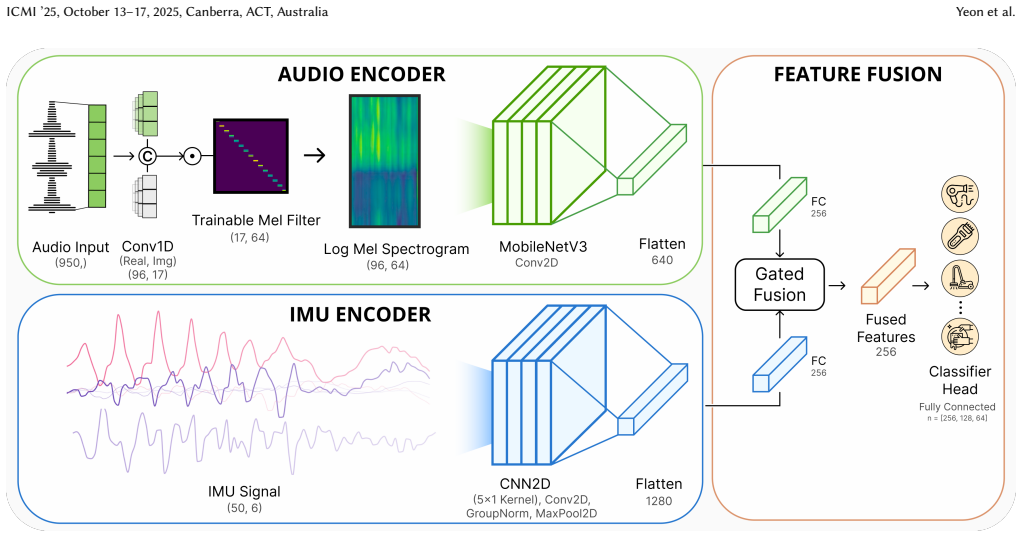
The load-bearing object is the end-to-end trainable audio preprocessing module: a Short-Time Fourier Transform represented as two 1D convolutional layers (real and imaginary), a trainable mel-filter bank initialized from triangular speech filters but left free to adapt, and a log amplitude-to-DB activation. This replaces a fixed external spectrogram pipeline, so feature extraction is co-optimized with the classifier and runs on the watch's GPU. It is paired with a two-stage gating design: a lightweight depthwise 1D CNN continuously monitors 6-axis IMU data and only triggers the heavier multimodal classifier, keeping the microphone off during idle periods. Fusion is handled by a gated mechani
What would settle it
Run the released models on a newly recruited participant with no personalized data and compare their accuracy to the reported P-LOPO numbers; also measure continuous on-watch battery drain over a full day of real use. A large accuracy drop in the first case, or a battery life too short for daily wear in the second, would undercut the deployment claim.
Extended reading notes
Core claim
The central claim is that a fully on-device, two-stage multimodal HAR system is not only possible but faster and cheaper than existing offload-based systems. WatchHAR uses a depthwise 1D CNN on 3-second IMU windows as a continuously running event detector; only when it fires does the system wake the microphone and run a multimodal classifier over 1-second windows of IMU and audio. The audio front end is a differentiable STFT plus trainable mel-filter bank implemented as 1D convolutions and a log activation, so preprocessing and inference form one trained module. Classification uses a MobileNetV3 audio encoder pretrained on AudioSet, a ConvBoost-based IMU encoder, and a gated fusion layer tha
Load-bearing premise
The headline personalized accuracy figures assume that part of the new user's own labeled data is already available at training time; a first-time user without that data—and with no on-device fine-tuning—would not see the same numbers.
Editorial extensions
If this is right
- Continuous HAR can run without network connectivity, so privacy-sensitive audio and motion data never need to leave the watch and notifications can be immediate in remote or disconnected settings.
- The reported processing times of 9.3 ms for event detection and 11.8 ms for multimodal classification make interactive, always-on activity tracking feasible on commodity smartwatch hardware.
- Keeping the microphone off until an IMU-detected event means the power cost of audio sensing is paid only during actual activity, not during idle periods.
- Because the audio preprocessing is trainable, the system can learn feature representations suited to human activities rather than relying on filters designed for speech recognition.
- The accuracy gains on semi-controlled data do not fully transfer to in-the-wild conditions, but WatchHAR still matches or slightly beats prior work there while using an order of magnitude fewer FLOPs.
Reading between the lines
- The gap between LOPO and P-LOPO numbers suggests that fresh-user accuracy—without any personalized data—will be materially lower than the headline P-LOPO figures; the paper leaves on-device fine-tuning as future work, but does not build or measure it.
- Because the mel filter bank is trainable and initialized from speech-oriented filters, the same architecture could be repurposed for other on-device audio tasks such as cough detection or appliance recognition, where learned filters may transfer better than fixed speech filters.
- The gating design implies a power-accuracy trade-off the paper does not quantify: the energy saved by keeping the microphone off depends on how often events occur, so users with frequent activities will approach the cost of always-on audio.
- With both modalities available on the watch, the gated fusion could also be used to identify which activities are primarily audible, primarily inertial, or genuinely multimodal—an interpretability extension the paper does not explore.
Editorial analysis
A structured set of objections, weighed in public.
Referee Report
Summary. The paper presents WatchHAR, a two-stage on-device HAR system for smartwatches: a lightweight IMU-only 1D CNN event detector (3-second windows, 20 ms hop, 2-second moving average) gates a multimodal classifier that fuses IMU and audio via a trainable STFT/mel preprocessing module, a MobileNetV3 audio encoder, a ConvBoost-based IMU encoder, and gated fusion. The authors report 9.3 ms event-detection and 11.8 ms classification processing time on an Apple Watch Series 7, with 5x faster inference and 47x lower FLOPs than SAMoSA, alongside 93.5% event-detection F1 and 92.34% SAMoSA classification accuracy. Additional evaluations on the Semi-Naturalistic and In-the-Wild datasets use LOPO and P-LOPO protocols, and ablations cover audio encoders, IMU encoders, and fusion methods. The paper also includes application scenarios and a limitations section acknowledging the absence of longitudinal studies and platform constraints on microphone sampling and battery metering.
Significance. If the reported numbers hold, this is a meaningful systems contribution: it demonstrates that multimodal audio-plus-IMU HAR can run entirely on commodity watch hardware without offloading, which addresses real privacy and latency concerns. The direct on-watch benchmarks with named tools (PyTorch 2.1.2, coremltools 7.1, Apple Watch Series 7) and the open-source release are concrete strengths, as is the trainable STFT/mel front-end that moves audio preprocessing into the network. However, the evaluation as written has significant caveats: the P-LOPO protocol uses test-participant data during training, the reported onset/offset latencies appear inconsistent with the described 2-second moving-average smoothing, and the accuracy differences against prior work are small and unreplicated. These issues do not invalidate the engineering contribution but they materially weaken the 'outperforms state-of-the-art' and 'real-time' claims as stated.
major comments (5)
- [Section 3.1 and Table 1] The reported onset latency of 0.27 s and offset latency of 0.07 s appear physically inconsistent with the described detection protocol. Section 3.1 states that the event detector uses a 3-second rolling window with 20 ms hop and applies a 2-second moving average to output probabilities. At t=0.27 s after event onset, the moving average is computed over predictions from windows ending in approximately [-1.73 s, +0.27 s]; the vast majority of those windows contain no event data, so the smoothed probability cannot plausibly cross a detection threshold that quickly. Similarly, a 0.07 s offset latency is impossible with a 2-second moving average, because after the event ends the smoothed output should remain high for roughly another 2 seconds. Please clarify the exact definition of onset/offset latency, the threshold used, and whether the smoothing is applied to input IMU data rather than out
- [Section 5.2 and Table 2] The P-LOPO evaluation incorporates a subset of the test participant's own data during training ('we use personalized data from public datasets'). Because WatchHAR does not perform on-device fine-tuning, a new user in deployment would have no such personalization data. The P-LOPO results (93.8% Semi-Naturalistic, 56.7% In-the-Wild) therefore overstate the out-of-box performance that a fresh user would obtain. The claimed 'outperforms state-of-the-art' on the Bhattacharya datasets rests on these P-LOPO numbers. Please report LOPO (no personalization) as the primary protocol or clearly separate the non-personalized and personalized conditions and explain how the personalization data would be obtained in a real deployment.
- [Table 2 and Section 5.2] The headline accuracy comparisons are small and are presented without any measure of uncertainty. On the SAMoSA dataset, WatchHAR's 92.34% is only 0.14 percentage points higher than SAMoSA's 92.2%; on Semi-Naturalistic P-LOPO, WatchHAR is actually lower (93.8% vs 94.3%); and on In-the-Wild the difference is 56.7% vs 55.8%. No error bars, confidence intervals, repeated runs, or statistical tests are reported. Given that the P-LOPO protocol also includes test-user data in training, these results do not support the unqualified 'outperforms' language in the Introduction and Section 5.2. Please provide variance estimates or significance tests, or soften the claims accordingly.
- [Section 5.1, Table 1] The event-detection F1 comparison (93.5% vs 88.0%) lacks essential evaluation details: it is not stated which dataset this comparison uses, what train/test split is applied, how the detection threshold is chosen for each model, or whether SAMoSA's detector is also smoothed with a 2-second moving average. Since F1 is threshold-dependent and the smoothing directly affects both F1 and latency, the comparison is under-specified. Please report the exact evaluation protocol, threshold, and any post-processing applied to both methods.
- [Abstract and Table 2] The abstract claims 'over 90% accuracy across more than 25 activity classes,' but Table 2 reports a weighted F1 of only 56.7% on the In-the-Wild dataset. The claim appears to be true only for specific datasets/protocols (e.g., SAMoSA and Semi-Naturalistic LOPO/P-LOPO), not for the unconstrained in-the-wild setting that motivates the 'unconstrained environments' framing. This overgeneralized claim should be qualified to the datasets and protocols where it actually holds.
minor comments (4)
- [Section 5.2 and Appendix] The text refers to 'the Appendix' for per-activity confusion matrices, but no appendix is present in the arXiv v1 manuscript. Please include the appendix or remove the reference.
- [Table 4] The 'CNN1D' IMU backbone is reported as having 246.80 M parameters, which is far larger than the other IMU encoders and seems suspiciously high. Please verify this number or clarify if it includes the audio encoder or other components.
- [Section 3.1] The sentence 'Our system uses a two-stage detection process to balance performance and power consumption' repeats information already given in the preceding paragraph. Consider tightening the text.
- [Table 2] The use of 'N/A' in the P-LOPO and LOPO columns is ambiguous. Please specify which values were not reported, which are not applicable, and which were not measured.
Circularity Check
No circular derivation found; the central claims rest on external datasets and on-device measurements, and the flagged concerns are validity/reporting issues rather than definitional circularity.
full rationale
WatchHAR's derivation chain is self-contained with respect to its inputs. The event-detection and classification architectures are evaluated against publicly available datasets (SAMoSA, Semi-Naturalistic, In-the-Wild) using external baselines, with processing time and latency measured on physical Apple Watch hardware. The P-LOPO protocol is explicitly disclosed as incorporating a subset of the test participant's data in training, and the same protocol is applied to the Bhattacharya et al. baseline, so the comparison is symmetric rather than a fitted-input-called-prediction collapse. The 0.27s onset latency concern is a potential internal inconsistency with the 2-second moving-average smoothing described in Section 3.1, but inconsistency is a correctness/reporting issue, not a circular definitional step. The overlap of one author with the SAMoSA work is a provenance consideration, but SAMoSA is an independently published dataset/model, and WatchHAR's improvements are measured rather than derived from SAMoSA's outputs. No equation is defined in terms of the quantity it purports to predict, and no load-bearing argument reduces to a self-citation.
Assumptions & free parameters
free parameters (6)
- IMU Event Detector window length =
3 s
- IMU Event Detector hop length =
20 ms
- Event detector smoothing window =
2 s
- Multimodal classifier window length =
1 s
- Multimodal classifier hop length =
20 ms
- Mel filterbank size =
64 bins (inferred from 690x64 spectrogram)
assumptions (5)
- domain assumption AudioSet-pretrained MobileNetV3 audio features transfer to smartwatch activity sounds
- domain assumption 1 kHz subsampled audio preserves activity-discriminative information
- domain assumption LOPO and P-LOPO protocols simulate realistic deployment
- domain assumption CoreML float16 conversion preserves accuracy
- domain assumption The IMU event detector keeps the microphone off most of the time in practice
Cite this review
Pith. "Pith review of WatchHAR: Real-time On-device Human Activity Recognition System for Smartwatches." pith.science (2026). https://pith.science/paper/NKA34BED
@misc{pith2026250904736,
  author       = {Pith},
  title        = {Pith review of: WatchHAR: Real-time On-device Human Activity Recognition System for Smartwatches},
  year         = {2026},
  howpublished = {\url{https://pith.science/paper/NKA34BED}},
  note         = {Machine review of arXiv:2509.04736}
}
read the original abstract
Despite advances in practical and multimodal fine-grained Human Activity Recognition (HAR), a system that runs entirely on smartwatches in unconstrained environments remains elusive. We present WatchHAR, an audio and inertial-based HAR system that operates fully on smartwatches, addressing privacy and latency issues associated with external data processing. By optimizing each component of the pipeline, WatchHAR achieves compounding performance gains. We introduce a novel architecture that unifies sensor data preprocessing and inference into an end-to-end trainable module, achieving 5x faster processing while maintaining over 90% accuracy across more than 25 activity classes. WatchHAR outperforms state-of-the-art models for event detection and activity classification while running directly on the smartwatch, achieving 9.3 ms processing time for activity event detection and 11.8 ms for multimodal activity classification. This research advances on-device activity recognition, realizing smartwatches' potential as standalone, privacy-aware, and minimally-invasive continuous activity tracking devices.
Figures


Figures from the paper (1 more)

Reference graph
Works this paper leans on
-
[1]
Alireza Abedin, Mahsa Ehsanpour, Qinfeng Shi, Hamid Rezatofighi, and Damith C. Ranasinghe. 2021. Attend and Discriminate: Beyond the State-of-the-Art for Human Activity Recognition Using Wearable Sensors.Proc. ACM Interact. Mob. Wearable Ubiquitous Technol.5, 1, Article 1 (mar 2021), 22 pages. https://doi.org/ 10.1145/3448083
doi:10.1145/3448083 2021
-
[2]
Karan Ahuja. 2024. Practical and Rich User Digitization.arXiv preprint arXiv:2403.00153(2024)
work page Pith review arXiv 2024
-
[3]
Karan Ahuja, Eric Whitmire, Joseph Greer, and Wolf Kienzle. 2022. ActivityPoser: Activity driven Full-Body Pose Estimation from Sparse IMU Configurations. InProceedings of the 2022 ACM Symposium on Spatial User Interaction(Online, CA, USA)(SUI ’22). Association for Computing Machinery, New York, NY, USA, Article 19, 2 pages. https://doi.org/10.1145/356597...
-
[4]
Sayma Akther, Nazir Saleheen, Mithun Saha, Vivek Shetty, and Santosh Kumar
-
[5]
Apple Inc. 2024. CoreML. https://developer.apple.com/documentation/coreml/. [Software library]
work page 2024
-
[6]
Riku Arakawa, Hiromu Yakura, Vimal Mollyn, Suzanne Nie, Emma Russell, Dustin P. DeMeo, Haarika A. Reddy, Alexander K. Maytin, Bryan T. Carroll, Jill Fain Lehman, and Mayank Goel. 2023. PrISM-Tracker: A Framework for Multimodal Procedure Tracking Using Wearable Sensors and State Transition Information with User-Driven Handling of Errors and Uncertainty.Pro...
doi:10.1145/3569504 2023
- [7]
-
[8]
Sarnab Bhattacharya, Rebecca Adaimi, and Edison Thomaz. 2022. Leveraging Sound and Wrist Motion to Detect Activities of Daily Living with Commodity Smartwatches.Proc. ACM Interact. Mob. Wearable Ubiquitous Technol.6, 2, Article 42 (jul 2022), 28 pages. https://doi.org/10.1145/3534582
doi:10.1145/3534582 2022
Show all 31 references
-
[9]
Gino Brunner, Darya Melnyk, Birkir Sigfússon, and Roger Wattenhofer. 2019. Swimming style recognition and lap counting using a smartwatch and deep learning. InProceedings of the 2019 ACM International Symposium on Wearable Computers(London, United Kingdom)(ISWC ’19). Associati...
2019
-
[10]
Burke, Jing Wang, and Mary Ann Sevick
Lora E. Burke, Jing Wang, and Mary Ann Sevick. 2011. Self-Monitoring in Weight Loss: A Systematic Review of the Literature.Journal of the American Dietetic Association111, 1 (2011), 92–102. https://doi.org/10.1016/j.jada.2010.10.008
2011 doi
-
[11]
K. W. Cheuk, H. Anderson, K. Agres, and D. Herremans. 2020. nnAudio: An on- the-Fly GPU Audio to Spectrogram Conversion Toolbox Using 1D Convolutional Neural Networks.IEEE Access8 (2020), 161981–162003. https://doi.org/10.1109/ ACCESS.2020.3019084
2020
-
[12]
François Chollet. 2017. Xception: Deep learning with depthwise separable con- volutions. InProceedings of the IEEE conference on computer vision and pattern recognition. 1251–1258
2017
-
[13]
Gemmeke, Daniel P
Jort F. Gemmeke, Daniel P. W. Ellis, Dylan Freedman, Aren Jansen, Wade Lawrence, R. Channing Moore, Manoj Plakal, and Marvin Ritter. 2017. Audio Set: An ontology and human-labeled dataset for audio events. In2017 IEEE Interna- tional Conference on Acoustics, Speech and Signal ...
2017
-
[14]
Andrew Howard, Mark Sandler, Grace Chu, Liang-Chieh Chen, Bo Chen, Mingx- ing Tan, Weijun Wang, Yukun Zhu, Ruoming Pang, Vijay Vasudevan, et al. 2019. Searching for mobilenetv3. InProceedings of the IEEE/CVF international conference on computer vision. 1314–1324
2019
-
[15]
Jiha Kim, Younho Nam, Jungeun Lee, Young-Joo Suh, and Inseok Hwang. 2023. ProxiFit: Proximity Magnetic Sensing Using a Single Commodity Mobile toward Holistic Weight Exercise Monitoring.Proceedings of the ACM on Interactive, Mobile, Wearable and Ubiquitous Technologies7, 3 (20...
2023
-
[16]
Plumbley
Qiuqiang Kong, Yin Cao, Turab Iqbal, Yuxuan Wang, Wenwu Wang, and Mark D. Plumbley. 2020. PANNs: Large-Scale Pretrained Audio Neural Networks for Audio Pattern Recognition. arXiv:1912.10211 [cs.SD] https://arxiv.org/abs/1912.10211
2020 arXiv
-
[17]
Utkarsh Kunwar, Sheetal Borar, Moritz Berghofer, Julia Kylmälä, Ilhan Aslan, Luis A Leiva, and Antti Oulasvirta. 2022. Robust and deployable gesture recog- nition for smartwatches. InProceedings of the 27th International Conference on Intelligent User Interfaces. 277–291
2022
-
[18]
Abowd, Thad Starner, Cheng Zhang, and Thomas Plötz
Hong Li, Shishir Chawla, Richard Li, Sumeet Jain, Gregory D. Abowd, Thad Starner, Cheng Zhang, and Thomas Plötz. 2018. Wristwash: towards automatic handwashing assessment using a wrist-worn device. InProceedings of the 2018 ACM International Symposium on Wearable Computers(Sin...
2018
-
[19]
Vimal Mollyn, Karan Ahuja, Dhruv Verma, Chris Harrison, and Mayank Goel
-
[20]
Dan Morris, T Scott Saponas, Andrew Guillory, and Ilya Kelner. 2014. RecoFit: using a wearable sensor to find, recognize, and count repetitive exercises. In Proceedings of the SIGCHI Conference on Human Factors in Computing Systems. 3225–3234
2014
-
[21]
Shuai Shao, Yu Guan, Bing Zhai, Paolo Missier, and Thomas Plötz. 2023. Con- vBoost: Boosting ConvNets for Sensor-based Activity Recognition.Proc. ACM Interact. Mob. Wearable Ubiquitous Technol.7, 2 (2023), 75. https://doi.org/10. 1145/3596234
2023
-
[22]
Muhammad Shoaib, Stephan Bosch, Hans Scholten, Paul JM Havinga, and Ozlem Durmaz Incel. 2015. Towards detection of bad habits by fusing smart- phone and smartwatch sensors. In2015 IEEE international conference on pervasive computing and communication workshops (PerCom Workshop...
2015
-
[23]
Yonatan Vaizman, Katherine Ellis, and Gert Lanckriet. 2017. Recognizing Detailed Human Context in the Wild from Smartphones and Smartwatches.IEEE Pervasive Computing16, 4 (2017), 62–74. https://doi.org/10.1109/MPRV.2017.3971131
2017
-
[24]
Jamie A Ward, Paul Lukowicz, Gerhard Troster, and Thad E Starner. 2006. Activity recognition of assembly tasks using body-worn microphones and accelerometers. IEEE transactions on pattern analysis and machine intelligence28, 10 (2006), 1553– 1567
2006
-
[25]
Vasco Xu, Chenfeng Gao, Henry Hoffmann, and Karan Ahuja. 2024. Mobileposer: Real-time full-body pose estimation and 3d human translation from imus in mobile consumer devices. InProceedings of the 37th Annual ACM Symposium on User Interface Software and Technology. 1–11
2024
-
[26]
Weitao Xu, Huanqi Yang, Jiongzhang Chen, Chengwen Luo, Jia Zhang, Yuliang Zhao, and Wen Jung Li. 2024. WashRing: An Energy-Efficient and Highly Accurate Handwashing Monitoring System via Smart Ring.IEEE Transactions on Mobile Computing23, 1 (2024), 971–984. https://doi.org/10....
2024
-
[27]
Inan, Thad E
Cheng Zhang, AbdelKareem Bedri, Gabriel Reyes, Bailey Bercik, Omer T. Inan, Thad E. Starner, and Gregory D. Abowd. 2016. TapSkin: Recognizing On- Skin Input for Smartwatches. InProceedings of the 2016 ACM International Conference on Interactive Surfaces and Spaces(Niagara Fall...
2016
-
[28]
Shibo Zhang, Ebrahim Nemati, Minh Dinh, Nathan Folkman, Tousif Ahmed, Mah- bubur Rahman, Jilong Kuang, Nabil Alshurafa, and Alex Gao. 2022. Coughtrig- ger: Earbuds IMU Based Cough Detection Activator Using An Energy-Efficient Sensitivity-Prioritized Time Series Classifier. InI...
2022
-
[2017]
arXiv:1702.01992 [stat.ML] https://arxiv.org/abs/1702.01992
Gated Multimodal Units for Information Fusion. arXiv:1702.01992 [stat.ML] https://arxiv.org/abs/1702.01992
-
[2021]
mteeth: Identifying brushing teeth surfaces using wrist-worn inertial sensors.Proceedings of the ACM on interactive, mobile, wearable and ubiquitous technologies5, 2 (2021), 1–25
2021
-
[2022]
ACM Interact
SAMoSA: Sensing Activities with Motion and Subsampled Audio.Proc. ACM Interact. Mob. Wearable Ubiquitous Technol.6, 3, Article 132 (sep 2022), 19 pages. https://doi.org/10.1145/3550284
2022 doi
Reviewed August 5, 2026 · model on record in the stance chip above.
Discussion (0). Sign in to comment.