CONCERTO: forward modeling of interferograms for calibration
Pith reviewed 2026-05-18 19:12 UTC · model grok-4.3
The pith
A forward model of interferograms enables absolute brightness calibration of CONCERTO spectra from raw APEX data.
A machine-rendered reading of the paper's core claim, the machinery that carries it, and where it could break.
Core claim
We present the modeling approach that enables us to reproduce the expected instrument outputs under controlled input conditions and provides a framework for the different calibration steps, including the absolute brightness calibration of the spectra. We constructed a dedicated analysis pipeline to characterize the raw interferometric data obtained under a broad range of atmospheric conditions at APEX. Using the forward model, we measured the interferogram alignment with the optical path difference and the relative response of each detector. Together, these elements enable a robust characterization of the instrument's spectral brightness calibration.
What carries the argument
Forward model that simulates both the spectral response and the corresponding interferograms for each observation scan, incorporating instrument response, optical path difference, and atmospheric transmission and emission.
Load-bearing premise
The forward model correctly captures the combined effects of instrument response, optical path difference, and actual atmospheric transmission and emission at the APEX site.
What would settle it
If simulated interferograms still differ systematically from observed ones after all calibration parameters have been adjusted, or if the derived brightness calibration changes inconsistently between scans taken under similar but not identical weather, the model would be shown to miss essential effects.
Figures




read the original abstract
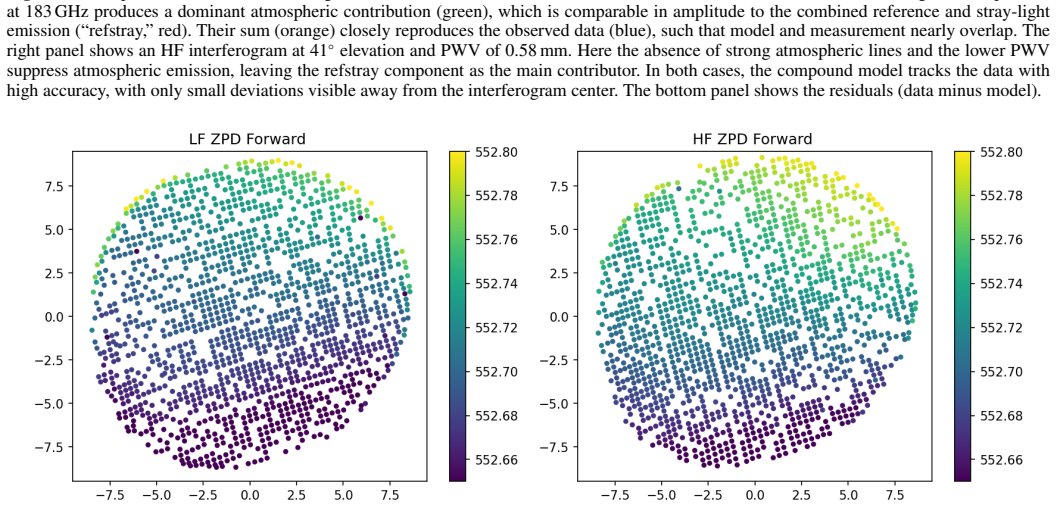
The CarbON [CII] line in post-rEionisation and ReionisaTiOn epoch (CONCERTO) instrument is a low-resolution mapping Fourier-transform spectrometer, based on lumped-element kinetic inductance detector (LEKID) technology, operating at 130- 310 GHz. It was installed on the 12-meter APEX telescope in Chile in April 2021 and operated until December 2022. CONCERTO's main science goal is to constrain the [CII] line fluctuations at high redshift. To reach that goal CONCERTO observed 1.4 deg2 in the COSMOS field. To ensure accurate calibration of the data, we have developed a forward model capable of simulating both the spectral response and the corresponding interferograms for each scan of observation in the COSMOS field. We present the modeling approach that enables us to reproduce the expected instrument outputs under controlled input conditions and provides a framework for the different calibration steps, including the absolute brightness calibration of the spectra. We constructed a dedicated analysis pipeline to characterize the raw interferometric data (interferograms) obtained under a broad range of atmospheric conditions at APEX. Using the forward model, we measured the interferogram alignment with the optical path difference (zero path difference, ZPD) and the relative response of each KID (flatfield). Together, these elements enable a robust characterization of the instrument's spectral brightness calibration.
Editorial analysis
A structured set of objections, weighed in public.
Referee Report
Summary. The manuscript describes the CONCERTO instrument, a low-resolution mapping Fourier-transform spectrometer operating at 130-310 GHz on the APEX telescope, and presents a forward model to simulate its spectral response and interferograms. The model is applied to raw interferometric data from COSMOS field observations to measure ZPD alignment and KID flatfield responses, providing a framework for absolute brightness calibration.
Significance. This work could be significant for ensuring accurate calibration of CONCERTO data, which is essential for its primary science goal of constraining high-redshift [CII] line fluctuations. By reproducing expected instrument outputs under controlled conditions, the forward model offers a systematic way to handle calibration steps amid varying atmospheric conditions at APEX. However, its impact depends on demonstrating that the model faithfully captures the relevant physics without introducing unaccounted systematics.
major comments (1)
- [Abstract] The abstract asserts that the forward model enables measurement of interferogram alignment with the optical path difference (ZPD) and relative KID response (flatfield), yet supplies no quantitative residuals, error budgets, or comparisons to independent calibrators to verify that model inaccuracies do not dominate the extracted calibration parameters.
minor comments (1)
- Consider adding a table summarizing the key input parameters to the forward model and their sources (e.g., atmospheric transmission models used).
Simulated Author's Rebuttal
We thank the referee for their constructive review and for identifying an opportunity to strengthen the abstract. We address the major comment below and have revised the manuscript accordingly.
read point-by-point responses
-
Referee: [Abstract] The abstract asserts that the forward model enables measurement of interferogram alignment with the optical path difference (ZPD) and relative KID response (flatfield), yet supplies no quantitative residuals, error budgets, or comparisons to independent calibrators to verify that model inaccuracies do not dominate the extracted calibration parameters.
Authors: We thank the referee for this observation. The abstract is intentionally concise, while the full manuscript presents quantitative validation in the results section, including direct comparisons of modeled versus observed interferograms with residuals typically below 5% near zero path difference and rising to ~12% at the scan edges due to atmospheric contributions. The ZPD alignment uncertainty is derived from the model fit as 0.12 mm rms, and the flatfield responses show a 3.8% rms variation across the array after correction. To address the comment, we have revised the abstract to incorporate these key metrics. Comparisons against independent external calibrators are not performed in this work, which focuses on developing and applying the internal forward model for ZPD and flatfield determination from the COSMOS scans themselves; such cross-checks are planned for future analyses but are not necessary to demonstrate the model's utility for the calibration steps described. revision: yes
Circularity Check
Forward model is an independent simulator; no reduction of calibration outputs to fitted inputs by construction
full rationale
The paper describes constructing a forward model that takes as inputs the expected sky signal, instrument response, optical path difference, and site-specific atmospheric transmission/emission at APEX, then generates simulated interferograms. These simulations are compared to observed data to extract calibration parameters (ZPD alignment, relative KID response). The model itself is not defined using the calibration quantities it helps measure, nor does any equation reduce the derived calibration factors to quantities fitted from the same interferograms. No self-citations, uniqueness theorems, or ansatzes are invoked to justify the model form. The derivation chain remains self-contained as a physics-based simulation framework rather than a tautological fit.
Axiom & Free-Parameter Ledger
Reference graph
Works this paper leans on
-
[1]
Adam, R., Adane, A., Ade, P. A. R., et al. 2018, A&A, 609, A115 Astropy Collaboration et al. 2013, A&A, 558, A33 Astropy Collaboration et al. 2018, AJ, 156, 123
work page 2018
-
[2]
2022, Journal of Instrumenta- tion, 17, P08037
Bounmy, J., Hoarau, C., Macías-Pérez, J.-F., et al. 2022, Journal of Instrumenta- tion, 17, P08037
work page 2022
-
[3]
2022, Journal of Instrumentation, 17, P10047
Bourrion, O., Hoarau, C., Bounmy, J., et al. 2022, Journal of Instrumentation, 17, P10047
work page 2022
-
[4]
2020, A&A, 641, A179 Concerto Collaboration, Ade, P., & Aravena, M
Catalano, A., Bideaud, A., Bourrion, O., et al. 2020, A&A, 641, A179 Concerto Collaboration, Ade, P., & Aravena, M. o. 2020, A&A, 642, A60 Désert, F. X., Macías-Pérez, J. F., Beelen, A., et al. 2025, arXiv e-prints, arXiv:2504.20487
-
[5]
2010, in Society of Photo-Optical Instru- mentation Engineers (SPIE) Conference Series, V ol
Doyle, S., Mauskopf, P., Zhang, J., et al. 2010, in Society of Photo-Optical Instru- mentation Engineers (SPIE) Conference Series, V ol. 7741, Millimeter, Sub- millimeter, and Far-Infrared Detectors and Instrumentation for Astronomy V , ed. W. S. Holland & J. Zmuidzinas, 77410M
work page 2010
- [6]
-
[7]
2020, Journal of Low Temperature Physics, 199, 529
Fasano, A., Aguiar, M., Benoit, A., et al. 2020, Journal of Low Temperature Physics, 199, 529
work page 2020
-
[8]
2022, in Society of Photo-Optical In- strumentation Engineers (SPIE) Conference Series, V ol
Fasano, A., Beelen, A., Benoît, A., et al. 2022, in Society of Photo-Optical In- strumentation Engineers (SPIE) Conference Series, V ol. 12190, Millimeter, Submillimeter, and Far-Infrared Detectors and Instrumentation for Astron- omy XI, ed. J. Zmuidzinas & J.-R. Gao, 121900Q
work page 2022
-
[9]
Fasano, A., Macías-Pérez, J. F., Benoit, et al. 2021, A&A, 656, A116
work page 2021
-
[10]
J., Abergel, A., Abreu, A., Ade, P
Griffin, M. J., Abergel, A., Abreu, A., Ade, P. A. R., et al. 2010, A&A, 518, L3 Güsten, R., Nyman, L. Å., Schilke, P., et al. 2006, A&A, 454, L13
work page 2010
-
[11]
Harris, C. R., Millman, K. J., van der Walt, S. J., et al. 2020, Nature, 585, 357
work page 2020
- [12]
-
[13]
Hunter, J. D. 2007, Computing in Science & Engineering, 9, 90
work page 2007
-
[14]
Kogut, A., Aghanim, N., Chluba, J., et al. 2025, J. Cosmology Astropart. Phys., 2025, 020
work page 2025
- [15]
-
[16]
2024, in Society of Photo-Optical Instrumentation Engineers (SPIE) Conference Series, V ol
Maffei, B., Aghanim, N., Aumont, J., et al. 2024, in Society of Photo-Optical Instrumentation Engineers (SPIE) Conference Series, V ol. 13102, Society of Photo-Optical Instrumentation Engineers (SPIE) Conference Series, ed. J. Zmuidzinas & J.-R. Gao, 131020N
work page 2024
-
[17]
Martin, D. H. & Puplett, E. 1970, Infrared Physics, 10, 105
work page 1970
- [18]
-
[19]
Mather, J. C., Fixsen, D. J., Shafer, R. A., Mosier, C., & Wilkinson, D. T. 1999, ApJ, 512, 511
work page 1999
- [20]
-
[21]
Monfardini, A., Swenson, L. J., Bideaud, A., et al. 2010, A&A, 521, A29
work page 2010
-
[22]
R., De Breuck, C., Muders, D., et al
Pardo, J. R., De Breuck, C., Muders, D., et al. 2025, A&A, 693, A148
work page 2025
-
[23]
R., Serabyn, E., & Cernicharo, J
Pardo, J. R., Serabyn, E., & Cernicharo, J. 2001, J. Quant. Spectr. Rad. Transf., 68, 419
work page 2001
- [24]
- [25]
discussion (0)
Sign in with ORCID, Apple, or X to comment. Anyone can read and Pith papers without signing in.