REVIEW 3 major objections 5 minor 83 references
Stochastic processes with multiple temporal scales: timescale separation and information
T0 review · 3 major / 5 minor · reviewed 2026-08-05 · deepseek-v4-flash
Pith's one-line read Slow-to-fast feedback is the only source of mutual information in strongly separated stochastic systems; fast-to-slow couplings add none.
desk verdict A useful but overbroad generalization of the authors' earlier timescale-separation results; the factorization and MIMMO principles are right when the fast dynamics are ergodic, but the paper never says so. read the letter →
The pith
A machine-rendered reading of the paper's core claim, the machinery that carries it, and where it could break.
The reading
What carries the argument
The machine is a hierarchy of effective Fokker-Planck operators: the operator for layer μ is obtained by integrating the original operator over all faster variables using their stationary conditional densities. Repeating this from fastest to slowest produces the factorization and also manufactures a self-interaction in the slow layer when two timescales are reciprocally coupled. The accompanying combinatorial device is the minimal propagation path (mPP), a directed path from a slower layer to a faster layer that remains a propagation path after all layers slower than the endpoint are removed; the set of conditional dependencies for layer μ is exactly the set of slower layers connected to μ b
What would settle it
Observe a two-layer stochastic system with only a fast-to-slow coupling and set the timescale ratio small enough that the fast layer is effectively stationary; estimate the mutual information between layers from long trajectories. The paper predicts zero mutual information in the leading-order limit, so a systematic nonzero value that does not shrink as the ratio decreases would falsify the no-generation principle.
Extended reading notes
Core claim
The central discovery is an explicit leading-order solution to the coupled Fokker-Planck equation when timescales are infinitely separated: the joint probability factorizes as the slowest layer's distribution times a product of stationary conditional distributions for every faster layer. The solution is obtained by solving each fast layer's operator at stationarity while slower layers are frozen, then averaging each next operator over all faster variables. For pairwise interactions between layers, the surviving conditional dependencies are exactly the layers reachable by a feedback edge or a minimal propagation path in the coarse-grained directed graph. The authors then define a matrix of pa
Load-bearing premise
Every fast layer has a unique stationary conditional distribution that it reaches before slower layers move at all, so the timescale ratios can be treated as infinite; if a fast layer is bistable, absorbing, or only moderately faster, the factorization and its zero-information predictions can fail.
Editorial extensions
If this is right
- In strongly separated multiscale networks, the pattern of nonzero mutual information becomes a topological fingerprint: entries vanish wherever only fast-to-slow couplings exist.
- Regulatory, slow-to-fast couplings are the only structural motifs that create functional information; purely feed-forward chains are information-neutral.
- Information can be routed: adding one feedback link creates mutual information not only with its direct target but with every layer connected through minimal propagation paths.
- A two-timescale reciprocal loop collapses to an effective self-interaction in the slow variable, explaining how fast fluctuations shape slow statistics without explicit fast variables.
- Nonlinear dynamics do not break these principles; they only change the magnitudes of the mutual information, so the predicted structure is testable across model classes.
Reading between the lines
- Beyond the paper, at finite (not infinite) timescale separation direct interactions should generate small but nonzero mutual information of order the timescale ratio; the paper's leading-order structure predicts where these corrections appear.
- The minimal-propagation-path rule gives a design recipe: to create a functional coupling between a slow regulator and a target, place a feedback edge to any faster layer that path-reaches the target, not necessarily a direct edge to the target itself.
- The effective self-interaction loop suggests a minimal stochastic model of slow-timescale memory: fast fluctuations leave a nonlinear trace in the slow equation, a feature that could be fitted in gene-regulatory or neural circuits.
- A natural stress test is to break uniqueness of the fast stationary density, for example by bistability, and check whether residual information appears even as the timescale ratio goes to zero; the paper's assumptions exclude this case, so a positive result would define the boundary of the regime.
Editorial analysis
A structured set of objections, weighed in public.
Referee Report
Summary. This paper develops a timescale-separation expansion for systems of coupled stochastic differential equations with N separated timescales. The main claim is that, in the limit of infinite timescale separation, the joint probability density factorizes as p_eff_N(x_N,t) times a product of stationary conditional densities for the faster clusters (Eq. (33)), with effective Fokker-Planck operators defined by averaging over faster variables. For pairwise multilayer interactions, the paper defines feedback and direct interactions, introduces minimal propagation paths (mPPs), and derives structural principles for the zero/nonzero pattern of the Mutual Information Matrix for Multiscale Observables (MIMMO). The formalism is tested on linear, neural, ecological, and contact-process dynamics, and a two-timescale feedback loop is shown to produce an effective self-interaction in the slow layer. A connection with previous discrete-state triadic-interaction results is also discussed.
Significance. The three-timescale derivation in Sec. II.B is explicit and formally clean, and the general factorization offers a compact way to understand multiscale stochastic systems beyond the Gaussian and discrete frameworks treated earlier by the authors. The MIMMO principles are falsifiable structural predictions and are tested on four different dynamical models, which is a genuine strength. If the result is properly qualified, this is a useful contribution to the statistical-mechanics understanding of information flow in multiscale networks. However, the paper overstates its generality: the derivation silently assumes unique, globally attracting stationary conditional densities, and the arbitrary-N expansion is not rigorously justified. These are load-bearing issues for Eq. (33) and the information principles.
major comments (3)
- [Sec. II.B; Eqs. (18), (22), (29), (33)] The derivation assumes that each effective stationary equation L_eff_mu p=0 has a unique, globally attracting, normalizable solution. No such hypothesis is stated. Non-confining drifts admit no stationary density; bistable potentials can have multiple stationary distributions selected by initial conditions; and multiplicative noise with absorbing boundaries, as in the contact-process example with g=x(1-x), requires explicit boundary-condition analysis. The assumption that timescales are 'infinitely different' does not control relaxation across metastable barriers: a fast variable with a Kramers time comparable to the next-slower timescale is not stationary on the slow variables' time even if tau_1/tau_2 -> 0. The stated claims 'any set of SDEs' and Eq. (33) therefore need an explicit ergodicity/mixing condition on each L_eff_mu and a relaxation-time bound.
- [Sec. II.C, Eqs. (25)-(31)] The general N-timescale expansion is not rigorously justified. Eq. (25) expands in all small parameters epsilon_mu, but Eq. (26) retains terms (epsilon_nu/epsilon_mu) L_mu p^(1_nu) with nu>mu, which are large rather than small. The three-timescale calculation uses a nested expansion (first in epsilon_1, then in epsilon_2), but the general argument does not show that these cross-ratio terms are subdominant or cancel, nor does it provide the solvability conditions that determine the leading-order factor. Without a reformulation in terms of the ratios epsilon_mu/epsilon_{mu+1}, or a matched-asymptotics proof of the order-by-order closure, the arbitrary-N factorization Eq. (33) is not established.
- [Sec. IV.B.2, Eq. (57)] The sentence that in the feedback motif 'the elements of MIMMO are always non-zero' is stronger than the derivation supports. The factorization p=p_{1|2}p_{2|3}p_3 shows that I_13 can be nonzero, but proving positivity requires non-degeneracy of the conditional dependencies; special coupling functions or parameter choices can make a particular MI vanish. The qualitative theorem is about which entries have nonzero leading-order structure, not literally 'always non-zero'. Please rephrase with the required generic conditions.
minor comments (5)
- [Eq. (48)] The denominator contains a typo: p_eff_mu(x_nu,t) p_eff_nu(x_nu,t) should read p_eff_mu(x_mu,t) p_eff_nu(x_nu,t).
- [Eq. (3)] The definition of i_mu uses M_mu inside the sum; this should be M_nu.
- [Sec. IV.B.3] The text says 'see Fig. 2a' when referring to the propagation-path case; this should be Fig. 4a.
- [Eqs. (35)-(36)] The noise amplitude g_mu(x_mu) appears in the Langevin equation, but the Fokker-Planck operator in Eq. (36) is written with diffusion coefficient D_i only. Please clarify whether g_mu has been absorbed into D_i or explain the notation.
- [Sec. V] There is an incomplete sentence: 'following. Crucially, each layer...' at the start of the discrete-state connection. A reference or explanatory phrase appears to be missing.
Circularity Check
No significant circularity: the factorization and information-propagation principles are derived from the Fokker-Planck expansion and checked against simulations; self-citations are background only.
full rationale
The central derivation (Sections II.B, II.C, III.B) is a standard adiabatic/iterative elimination. Each factorization step follows from the general fact that if an effective Fokker-Planck operator acts only on x_mu with the slower variables as parameters, its stationary solution can be written as a conditional density times a marginal; no target conclusion is inserted as an ansatz. The information principles (i)-(iii) are deduced from the explicit form of p^eff in Eq. (47), not assumed. The mPP/feedback characterization of rho(mu) is a combinatorial reformulation of the recursion in Eqs. (43)-(46), and the paper verifies the resulting MIMMO structure against Langevin simulations for four different dynamics, with no fitted parameters. The self-citations ([30], [40]) are used for background, analogy, and previous discrete-state/Gaussian results, not as inputs to the derivation of Eq. (33). One caveat is worth noting but is not circular: the paper assumes 'the dynamical timescales are infinitely different from one another' (Sec. II.B) and solves L_eff_mu p^{st,eff}=0 without stating ergodicity or uniqueness conditions on each effective operator; this is a domain-of-validity gap that could affect metastable or absorbing fast dynamics, but it does not make the derivation borrow its own conclusion. Hence the paper is self-contained against external benchmarks and exhibits no circular reduction.
Assumptions & free parameters
assumptions (4)
- domain assumption Timescale ratios ε_μ are sufficiently small and ordered so that each faster layer reaches stationarity conditioned on slower variables before slower variables change appreciably.
- domain assumption For each effective Fokker-Planck operator L_μ^{eff}, a unique stationary conditional density p^{st,eff}_{μ|...} exists and is the relevant attractor for the fast dynamics.
- domain assumption The force and noise amplitudes are rescaled as f_μ/τ_μ and σ_μ/√τ_μ so that each cluster has a well-defined Fokker-Planck operator on its own timescale.
- standard math Multiplicative noise is interpreted in the Itô convention with no spurious drift, as encoded by a Fokker-Planck operator of the form ∂_x^2(D p).
Cite this review
Pith. "Pith review of Stochastic processes with multiple temporal scales: timescale separation and information." pith.science (2026). https://pith.science/paper/O6DOD675
@misc{pith2026250904946,
  author       = {Pith},
  title        = {Pith review of: Stochastic processes with multiple temporal scales: timescale separation and information},
  year         = {2026},
  howpublished = {\url{https://pith.science/paper/O6DOD675}},
  note         = {Machine review of arXiv:2509.04946}
}
read the original abstract
Complex systems are often characterized by the interplay of multiple interconnected dynamical processes operating across a range of temporal scales. This phenomenon is widespread in both biological and artificial scenarios, making it crucial to understand how such multiscale dynamics influence the overall functioning and behavior of these systems. Here, we present a general timescale separation approach that is valid for any set of stochastic differential equations coupled across multiple timescales. We show two alternative derivations, one based on an iterative procedure, and the other grounded on an a priori expansion in relevant small parameters associated with faster timescales. We provide an explicit expression for the conditional structure of the joint probability distribution of the whole set of processes that is solely determined by the multiscale interactions. This result has important consequences in determining how information is generated in the system and how it propagates across different timescales. To demonstrate that our findings are valid independently of the specific dynamical model, we test them against four different (linear and non-linear) dynamics. Then, we focus on the scenario in which two degrees of freedom are reciprocally coupled across their timescales. In this case, we show that the statistics of the fastest dynamics is captured by an effective self-interaction term in the slowest one, creating a regulatory loop. Finally, a connection with analogous previous results obtained for discrete-state systems with higher-order interactions is drawn, elucidating similarities and differences in the physical interpretation of the system. The presented framework might open the avenue for a clearer understanding of the interplay between the underlying multiscale structure and emergent functional behavior of biological and artificial systems.
Figures
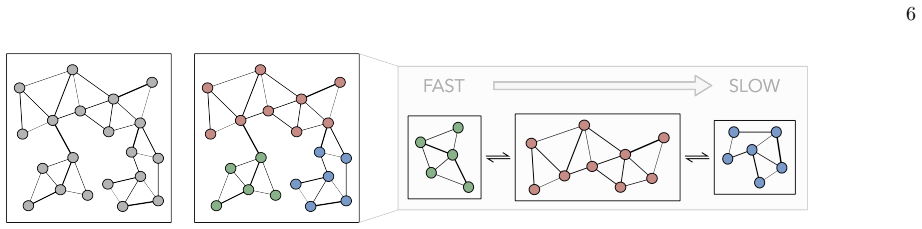


Figures from the paper (2 more)


Reference graph
Works this paper leans on
-
[1]
direct interactions
(14) which is a first-order expansion in the smallest parameterϵ 1 up to the first order [30, 46, 47]. By inserting Eq. (14) into Eq. (13), and splitting the equations order by order, we obtain the following relationships governing the evolution of the leading contribution to the joint distribution: orderϵ −1 1 0 = 1 ϵ1 L1 p(0) 1,2,3 ,(15) orderϵ 0 1 ∂ ∂τ...
-
[2]
In this case, all interactions are direct
Direct interactions path We begin with a simple multilayer network where the first layer influences the second, and the second influences the third (Figure 3a). In this case, all interactions are direct. Hence, ˆA= ˆA11 0 0 ˆA21 ˆA22 0 0 ˆA32 ˆA33 (51) so that it does not exist any block such that ˆAµν ̸= 0 forµ < ν. Similarly, there is no directe...
-
[3]
effective
Feedback interactions path We now consider the opposite case, where all layers are connected by feedback interactions only (Figure 3b): ˆA= ˆA11 ˆA12 0 0 ˆA22 ˆA23 0 0 ˆA33 (54) and, since no direct interactions are present, there is no PP inGonce more. However, from eq. (46), we have ρ(1) ={2}, ρ(2) ={3}, ρ(3) ={}.(55) Thus, eq. (47) tells us tha...
-
[4]
Propagation path A propagation path inGcan be found with the structure of interactions shown in Fig. 4a, i.e., ˆA= ˆA11 0 ˆA13 0 ˆA22 0 0 ˆA32 ˆA33 (58) so that ˆA13 describes a feedback interaction from 3 to 1, whereas ˆA32 describes a direct interaction from 2 to 3. Therefore,x 2 →x 3 →x 1 is a PP from 2 to 1, but not a mPP. Indeed, when conside...
-
[5]
Minimal propagation path Finally, we now study the case of a minimal propagation path (see Figure 4b). The adjacency tensor is given by ˆA= ˆA11 0 ˆA13 ˆA21 ˆA22 0 0 0 ˆA33 ,(61) so that ˆA13 describes a feedback interaction from 3 to 1, as before, but now ˆA21 is a direct interaction from 1 to 2. In this example,x 3 →x 1 →x 2 is a PP from 3 to 2....
-
[6]
Our results depend only on the general structure of the probability in eq
Information propagation across timescales The previous examples show that the topological structure of interactions between different timescales fully determines the propagation of information. Our results depend only on the general structure of the probability in eq. (47), not on the dynamics of the layer nor the form of the interactions, which rather de...
-
[7]
D. G. Clark and L. Abbott, Theory of coupled neuronal-synaptic dynamics, Physical Review X14, 021001 (2024)
work page 2024
- [8]
Show all 83 references
-
[9]
W.-H. Cho, E. Barcelon, and S. J. Lee, Optogenetic glia manipulation: possibilities and future prospects, Experimental neurobiology25, 197 (2016)
2016
-
[10]
Faskowitz, R
J. Faskowitz, R. F. Betzel, and O. Sporns, Edges in brain networks: Contributions to models of structure and function, Network Neuroscience6, 1 (2022)
2022
-
[11]
Wolff, N
A. Wolff, N. Berberian, M. Golesorkhi, J. Gomez-Pilar, F. Zilio, and G. Northoff, Intrinsic neural timescales: temporal integration and segregation, Trends in cognitive sciences26, 159 (2022)
2022
-
[12]
Hastings, Timescales, dynamics, and ecological understanding, Ecology91, 3471 (2010)
A. Hastings, Timescales, dynamics, and ecological understanding, Ecology91, 3471 (2010)
2010
-
[13]
Bairey, E
E. Bairey, E. D. Kelsic, and R. Kishony, High-order species interactions shape ecosystem diversity, Nature communications 7, 12285 (2016)
2016
-
[14]
Nicoletti, P
G. Nicoletti, P. Padmanabha, S. Azaele, S. Suweis, A. Rinaldo, and A. Maritan, Emergent encoding of dispersal network topologies in spatial metapopulation models, Proceedings of the National Academy of Sciences120, e2311548120 (2023)
2023
-
[15]
Sireci and M
M. Sireci and M. A. Mu˜ noz, Statistical mechanics of phenotypic eco-evolution: From adaptive dynamics to complex diversification, Physical Review Research6, 023070 (2024)
2024
-
[16]
Celani, T
A. Celani, T. S. Shimizu, and M. Vergassola, Molecular and functional aspects of bacterial chemotaxis, Journal of Statistical Physics144, 219 (2011)
2011
-
[17]
W. Ma, A. Trusina, H. El-Samad, W. A. Lim, and C. Tang, Defining network topologies that can achieve biochemical adaptation, Cell138, 760 (2009)
2009
-
[18]
S. J. Rahi, J. Larsch, K. Pecani, A. Y. Katsov, N. Mansouri, K. Tsaneva-Atanasova, E. D. Sontag, and F. R. Cross, Oscillatory stimuli differentiate adapting circuit topologies, Nature methods14, 1010 (2017)
2017
-
[19]
Y. Tu, T. S. Shimizu, and H. C. Berg, Modeling the chemotactic response of escherichia coli to time-varying stimuli, Proceedings of the National Academy of Sciences105, 14855 (2008)
2008
-
[20]
Jeong, B
H. Jeong, B. Tombor, R. Albert, Z. N. Oltvai, and A.-L. Barab´ asi, The large-scale organization of metabolic networks, Nature407, 651 (2000)
2000
-
[21]
Avanzini, N
F. Avanzini, N. Freitas, and M. Esposito, Circuit theory for chemical reaction networks, Physical Review X13, 021041 (2023)
2023
-
[22]
Liang, D
S. Liang, D. M. Busiello, and P. De Los Rios, Emergent thermophoretic behavior in chemical reaction systems, New Journal of Physics24, 123006 (2022)
2022
-
[23]
Tu and W.-J
Y. Tu and W.-J. Rappel, Adaptation of living systems, Annual review of condensed matter physics9, 183 (2018)
2018
-
[24]
Nicoletti, M
G. Nicoletti, M. Bruzzone, S. Suweis, M. Dal Maschio, and D. M. Busiello, Information gain at the onset of habituation to repeated stimuli, eLife 99767 (2025)
2025
-
[25]
Kollmann, L
M. Kollmann, L. Løvdok, K. Bartholom´ e, J. Timmer, and V. Sourjik, Design principles of a bacterial signalling network, Nature438, 504 (2005)
2005
-
[26]
Villa Mart ´ ın, M
P. Villa Mart ´ ın, M. A. Mu˜ noz, and S. Pigolotti, Bet-hedging strategies in expanding populations, PLoS computational biology15, e1006529 (2019)
2019
-
[27]
Barzon, D
G. Barzon, D. M. Busiello, and G. Nicoletti, Excitation-inhibition balance controls information encoding in neural popu- lations, Physical Review Letters134, 068403 (2025)
2025
-
[28]
Miconi and K
T. Miconi and K. Kay, Neural mechanisms of relational learning and fast knowledge reassembly in plastic neural networks, Nature Neuroscience28, 406 (2025)
2025
-
[29]
Mariani, G
B. Mariani, G. Nicoletti, M. Bisio, M. Maschietto, S. Vassanelli, and S. Suweis, Disentangling the critical signatures of neural activity, Scientific reports12, 10770 (2022)
2022
-
[30]
Cheong, A
R. Cheong, A. Rhee, C. J. Wang, I. Nemenman, and A. Levchenko, Information transduction capacity of noisy biochemical signaling networks, science334, 354 (2011)
2011
-
[31]
Nicoletti and D
G. Nicoletti and D. M. Busiello, Tuning transduction from hidden observables to optimize information harvesting, Physical review letters133, 158401 (2024)
2024
-
[32]
Tkaˇ cik and A
G. Tkaˇ cik and A. M. Walczak, Information transmission in genetic regulatory networks: a review, Journal of Physics: Condensed Matter23, 153102 (2011)
2011
-
[33]
T. M. Pham and K. Kaneko, Dynamical theory for adaptive systems, Journal of Statistical Mechanics: Theory and Experiment2024, 113501 (2024)
2024
-
[34]
Matsushita and K
Y. Matsushita and K. Kaneko, Generic optimization by fast chaotic exploration and slow feedback fixation, Physical Review Research5, 023017 (2023)
2023
-
[35]
Bauer and W
M. Bauer and W. Bialek, Information bottleneck in molecular sensing, PRX Life1, 023005 (2023). 17
2023
-
[36]
Nicoletti and D
G. Nicoletti and D. M. Busiello, Information propagation in multilayer systems with higher-order interactions across timescales, Physical Review X14, 021007 (2024)
2024
-
[37]
Tkaˇ cik and W
G. Tkaˇ cik and W. Bialek, Information processing in living systems, Annual Review of Condensed Matter Physics7, 89 (2016)
2016
-
[38]
Tostevin and P
F. Tostevin and P. R. Ten Wolde, Mutual information between input and output trajectories of biochemical networks, Physical review letters102, 218101 (2009)
2009
-
[39]
Nicoletti and D
G. Nicoletti and D. M. Busiello, Mutual information disentangles interactions from changing environments, Physical Review Letters127, 228301 (2021)
2021
-
[40]
Tostevin and P
F. Tostevin and P. R. Ten Wolde, Mutual information in time-varying biochemical systems, Physical Review E—Statistical, Nonlinear, and Soft Matter Physics81, 061917 (2010)
2010
-
[41]
Nicoletti and D
G. Nicoletti and D. M. Busiello, Mutual information in changing environments: non-linear interactions, out-of-equilibrium systems, and continuously-varying diffusivities, Physical Review E106, 014153 (2022)
2022
-
[42]
Sachdeva, T
V. Sachdeva, T. Mora, A. M. Walczak, and S. E. Palmer, Optimal prediction with resource constraints using the information bottleneck, PLoS computational biology17, e1008743 (2021)
2021
-
[43]
Flatt, D
S. Flatt, D. M. Busiello, S. Zamuner, and P. De Los Rios, Abc transporters are billion-year-old maxwell demons, Commu- nications Physics6, 205 (2023)
2023
-
[44]
Amano, M
S. Amano, M. Esposito, E. Kreidt, D. A. Leigh, E. Penocchio, and B. M. Roberts, Insights from an information thermo- dynamics analysis of a synthetic molecular motor, Nature Chemistry14, 530 (2022)
2022
-
[45]
Nicoletti and D
G. Nicoletti and D. M. Busiello, Multiscale nonlinear integration drives accurate encoding of input information, arXiv preprint arXiv:2411.11710 (2024)
2024 arXiv
-
[46]
Nicoletti and D
G. Nicoletti and D. M. Busiello, Information propagation in gaussian processes on multilayer networks, Journal of Physics: Complexity5, 045004 (2024)
2024
-
[47]
De Domenico, A
M. De Domenico, A. Sol´ e-Ribalta, E. Cozzo, M. Kivel¨ a, Y. Moreno, M. A. Porter, S. G´ omez, and A. Arenas, Mathematical formulation of multilayer networks, Physical Review X3, 041022 (2013)
2013
-
[48]
Bianconi,Multilayer networks: structure and function(Oxford university press, 2018)
G. Bianconi,Multilayer networks: structure and function(Oxford university press, 2018)
2018
-
[49]
Grilli, G
J. Grilli, G. Barab´ as, M. J. Michalska-Smith, and S. Allesina, Higher-order interactions stabilize dynamics in competitive network models, Nature548, 210 (2017)
2017
-
[50]
Battiston, E
F. Battiston, E. Amico, A. Barrat, G. Bianconi, G. Ferraz de Arruda, B. Franceschiello, I. Iacopini, S. K´ efi, V. Latora, Y. Moreno,et al., The physics of higher-order interactions in complex systems, Nature Physics17, 1093 (2021)
2021
-
[51]
St-Onge, H
G. St-Onge, H. Sun, A. Allard, L. H´ ebert-Dufresne, and G. Bianconi, Universal nonlinear infection kernel from heteroge- neous exposure on higher-order networks, Physical review letters127, 158301 (2021)
2021
-
[52]
D. M. Busiello, D. Gupta, and A. Maritan, Coarse-grained entropy production with multiple reservoirs: Unraveling the role of time scales and detailed balance in biology-inspired systems, Physical Review Research2, 043257 (2020)
2020
-
[53]
Bo and A
S. Bo and A. Celani, Multiple-scale stochastic processes: decimation, averaging and beyond, Physics reports670, 1 (2017)
2017
-
[54]
Harush and B
U. Harush and B. Barzel, Dynamic patterns of information flow in complex networks, Nature communications8, 2181 (2017)
2017
-
[55]
Meena, C
C. Meena, C. Hens, S. Acharyya, S. Haber, S. Boccaletti, and B. Barzel, Emergent stability in complex network dynamics, Nature Physics19, 1033 (2023)
2023
-
[56]
Barzon, O
G. Barzon, O. Artime, S. Suweis, and M. D. Domenico, Unraveling the mesoscale organization induced by network-driven processes, Proceedings of the National Academy of Sciences121, e2317608121 (2024)
2024
-
[57]
Kraskov, H
A. Kraskov, H. St¨ ogbauer, and P. Grassberger, Estimating mutual information, Physical Review E—Statistical, Nonlinear, and Soft Matter Physics69, 066138 (2004)
2004
-
[58]
H. Sun, F. Radicchi, J. Kurths, and G. Bianconi, The dynamic nature of percolation on networks with triadic interactions, Nature Communications14, 1308 (2023)
2023
-
[59]
Niedostatek, A
M. Niedostatek, A. Baptista, J. Yamamoto, J. Kurths, R. S. Garcia, B. MacArthur, and G. Bianconi, Mining higher-order triadic interactions, arXiv preprint arXiv:2404.14997 (2024)
2024
-
[60]
D. M. Busiello, J. Hidalgo, and A. Maritan, Entropy production for coarse-grained dynamics, New Journal of Physics21, 073004 (2019)
2019
-
[61]
Cocconi, G
L. Cocconi, G. Salbreux, and G. Pruessner, Scaling of entropy production under coarse graining in active disordered media, Physical Review E105, L042601 (2022)
2022
-
[62]
Q. Yu, D. Zhang, and Y. Tu, Inverse power law scaling of energy dissipation rate in nonequilibrium reaction networks, Physical review letters126, 080601 (2021)
2021
-
[63]
Hastings, K
A. Hastings, K. C. Abbott, K. Cuddington, T. Francis, G. Gellner, Y.-C. Lai, A. Morozov, S. Petrovskii, K. Scranton, and M. L. Zeeman, Transient phenomena in ecology, Science361, eaat6412 (2018)
2018
-
[64]
T. B. Francis, K. C. Abbott, K. Cuddington, G. Gellner, A. Hastings, Y.-C. Lai, A. Morozov, S. Petrovskii, and M. L. Zeeman, Management implications of long transients in ecological systems, Nature Ecology & Evolution5, 285 (2021)
2021
-
[65]
Arnoulx de Pirey and G
T. Arnoulx de Pirey and G. Bunin, Many-species ecological fluctuations as a jump process from the brink of extinction, Physical Review X14, 011037 (2024)
2024
-
[66]
Pichon, S
B. Pichon, S. K´ efi, N. Loeuille, I. Lajaaiti, and I. Gounand, Integrating ecological feedbacks across scales and levels of organization, Ecography , e07167 (2024)
2024
-
[67]
Nicoletti, L
G. Nicoletti, L. Saravia, F. Momo, A. Maritan, and S. Suweis, The emergence of scale-free fires in australia, Iscience26 (2023)
2023
-
[68]
Doimo, G
A. Doimo, G. Nicoletti, D. Bernardi, and P. Padmanabha, Finite-size scaling of survival statistics in metapopulation models, Physical Review E111, 064415 (2025). 18
2025
-
[69]
S. E. Cavanagh, L. T. Hunt, and S. W. Kennerley, A diversity of intrinsic timescales underlie neural computations, Frontiers in Neural Circuits14, 615626 (2020)
2020
-
[70]
R. Gao, R. L. Van den Brink, T. Pfeffer, and B. Voytek, Neuronal timescales are functionally dynamic and shaped by cortical microarchitecture, elife9, e61277 (2020)
2020
-
[71]
Zeraati, Y.-L
R. Zeraati, Y.-L. Shi, N. A. Steinmetz, M. A. Gieselmann, A. Thiele, T. Moore, A. Levina, and T. A. Engel, Intrinsic timescales in the visual cortex change with selective attention and reflect spatial connectivity, Nature communications14, 1858 (2023)
2023
-
[72]
Zeraati, A
R. Zeraati, A. Levina, J. H. Macke, and R. Gao, Neural timescales from a computational perspective, arXiv preprint arXiv:2409.02684 (2024)
2024
-
[73]
Senkowski and A
D. Senkowski and A. K. Engel, Multi-timescale neural dynamics for multisensory integration, Nature Reviews Neuroscience 25, 625 (2024)
2024
-
[74]
stabilitaxis
J. Agudo-Canalejo, P. Illien, and R. Golestanian, Cooperatively enhanced reactivity and “stabilitaxis” of dissociating oligomeric proteins, Proceedings of the National Academy of Sciences117, 11894 (2020)
2020
-
[75]
R. D. Astumian, Enhanced diffusion, chemotaxis, and pumping by active enzymes: progress toward an organizing principle of molecular machines, ACS nano8, 11917 (2014)
2014
-
[76]
N. S. Mandal, A. Sen, and R. D. Astumian, Kinetic asymmetry versus dissipation in the evolution of chemical systems as exemplified by single enzyme chemotaxis, Journal of the American Chemical Society145, 5730 (2023)
2023
-
[77]
Piazza and A
R. Piazza and A. Parola, Thermophoresis in colloidal suspensions, Journal of Physics: Condensed Matter20, 153102 (2008)
2008
-
[78]
Duhr and D
S. Duhr and D. Braun, Optothermal molecule trapping by opposing fluid flow with thermophoretic drift, Physical review letters97, 038103 (2006)
2006
-
[79]
Braun and A
D. Braun and A. Libchaber, Trapping of dna by thermophoretic depletion and convection, Physical review letters89, 188103 (2002)
2002
-
[80]
Liang, P
S. Liang, P. De Los Rios, and D. M. Busiello, Thermodynamic bounds on symmetry breaking in linear and catalytic biochemical systems, Physical Review Letters132, 228402 (2024)
2024
-
[81]
W¨ urthner, F
L. W¨ urthner, F. Brauns, G. Pawlik, J. Halatek, J. Kerssemakers, C. Dekker, and E. Frey, Bridging scales in a multiscale pattern-forming system, Proceedings of the National Academy of Sciences119, e2206888119 (2022)
2022
-
[82]
J. Denk, S. Kretschmer, J. Halatek, C. Hartl, P. Schwille, and E. Frey, Mine conformational switching confers robustness on self-organized min protein patterns, Proceedings of the National Academy of Sciences115, 4553 (2018)
2018
-
[83]
Brauns, J
F. Brauns, J. Halatek, and E. Frey, Phase-space geometry of mass-conserving reaction-diffusion dynamics, Physical Review X10, 041036 (2020)
2020
Reviewed August 5, 2026 · model on record in the stance chip above.
Discussion (0). Continue with ORCID to comment.