REVIEW 2 major objections 4 minor 65 references
Stalled dust-poor gas hides early black holes from X-rays
Reviewed by Pith at T0; open to challenge. T0 means a machine referee read the full paper against a public rubric. the ladder, T0–T4 →
Low-metallicity, dust-poor gas stalls under weak radiation pressure and blocks X-rays, explaining the X-ray weakness of early JWST-detected AGN.
T0 review reviewed 2026-08-05 challenge →
load-bearing objection A credible, mostly hypothesis-generating application of the dusty Eddington framework to JWST X-ray weak AGN; the central claim hinges on one empirical scaling that may not hold in these environments. the 2 major comments →
Another view into JWST-discovered X-ray weak AGNs via radiative dusty feedback
The pith
A machine-rendered reading of the paper's core claim, the machinery that carries it, and where it could break.
The reading
Core claim
Within the radiative dusty feedback scenario, the effective Eddington limit for dust sets a critical curve in the column-density–Eddington-ratio (N_H–lambda) plane. To the left of this curve radiation pressure cannot expel the dusty gas, producing long-lived obscuration; to the right lies a 'forbidden' region where gas should be blown away. The paper's central claim is that the location of this curve depends sensitively on the dusty gas parameters, especially metallicity: because the dust-to-gas ratio scales with metallicity, low-metallicity gas has much weaker UV and IR dust opacities, shifting the boundary to the right. Consequently, dust-poor gas in the low-metallicity nuclear environment
What carries the argument
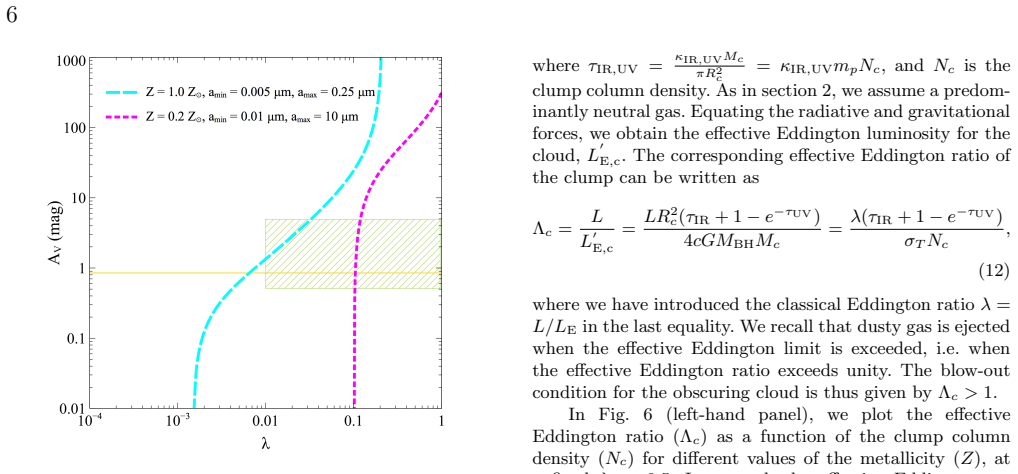
The central object is the effective Eddington ratio for dusty gas, Lambda = L(tau_IR + 1 - exp(-tau_UV))/(4 pi G c m_p M_BH N), balancing radiation pressure on dust against the black hole's gravity. Setting Lambda = 1 gives the critical column N_E = (tau_IR + 1 - exp(-tau_UV)) sigma_T / lambda, the boundary of the N_H–lambda plane that separates gas which is ejected (the forbidden region) from gas which survives as long-lived obscuration. The UV and IR dust opacities entering tau_UV and tau_IR depend on dust-to-gas ratio, grain size, grain density, and radiation temperature, and through the empirical dust-to-gas–metallicity relation they make the boundary a function of metallicity. For clump
Load-bearing premise
The argument depends on the empirical scaling between dust-to-gas ratio and metallicity, log f_dg = 1.30 [12+log(O/H)] - 13.72, holding in the high-redshift nuclear environments of JWST-AGN; if dust there is set by shock destruction, grain growth, or coagulation rather than by galaxy-wide metallicity, the boundary shifts and the stalling conclusion no longer follows.
What would settle it
If deep X-ray stacking of low-metallicity JWST-AGN at Eddington ratios above 0.1 shows transmitted 2–10 keV emission with column densities below 10^23 cm^-2, the stalled-gas explanation is contradicted; observing an Fe K-alpha fluorescence line consistent with cold, Compton-thick neutral gas at N_H greater than or equal to 10^24 cm^-2 would support the scenario.
If this is right
- X-ray-weak JWST-AGN need not be powered by exotic super-Eddington accretion: long-lived dust-poor gas offers a physical absorption explanation consistent with the observed non-detections, even in stacked X-ray data.
- Low metallicity makes radiative feedback self-limiting: the less dust there is, the harder it is for radiation pressure to clear the gas, so absorbing material accumulates and high covering fractions of Compton-thick clouds arise naturally.
- Heavy gas columns stall preferentially in metal-poor environments, implying that the most heavily obscured early AGN should be found among the lowest-metallicity hosts.
- The same stalled clouds can account for the co-occurrence of X-ray weakness, Balmer absorption (high-density gas), radio weakness (free-free absorption), and weak ionised outflows, tying several apparently unrelated JWST-AGN properties to one mechanism.
- Locally, metal-poor dwarf galaxies hosting AGN may be useful analogs of early JWST-AGN, because low metallicity reproduces the same combination of X-ray and radio weakness and Balmer absorption.
Where Pith is reading between the lines
- Inference: the scenario predicts a metallicity dependence of X-ray detection rates—if correct, the fraction of X-ray-detected JWST-AGN should rise with measured gas-phase metallicity, a testable trend in existing samples.
- Inference: because the dust-to-gas–metallicity relation may break down locally, the model could be sharpened by measuring extinction-curve slopes and dust masses directly in these nuclei; a grey extinction curve with little small-grain content would support the large-grain assumption.
- Inference: the same stalled gas reservoir would act as a persistent screen, perhaps suppressing optical/UV variability, and could keep feeding the black hole, connecting X-ray silence to a growth phase of early black holes.
Editorial analysis
A structured set of objections, weighed in public.
Referee Report
Summary. The paper interprets the X-ray weakness of JWST-discovered AGN within the dusty radiative feedback scenario. It derives the effective Eddington limit for dusty gas and maps the critical boundary in the N_H−λ plane as a function of metallicity, grain size, grain composition, and radiation temperature (Sec. 2). It applies this to low-metallicity, large-grain circumnuclear gas, arguing that such dust-poor gas is hard to clear, accumulates, and produces long-lived heavy obscuration (Sec. 3). It analyzes the blowout/stalling condition for individual clouds (Sec. 4.1) and presents Monte-Carlo X-ray spectral simulations for Compton-thick, low-metallicity absorbers (Sec. 4.2). The discussion links the picture to Balmer absorption, radio weakness, and the absence of ionized outflows.
Significance. If the proposed scenario holds, it offers a single, physically motivated explanation for several peculiar JWST-AGN properties (X-ray weakness, Balmer absorption, radio weakness, weak [O III] outflows) in terms of low metallicity suppressing dust-radiation coupling. The analytical derivation is transparent and, apart from the adopted dust opacity model and the f_dg−Z calibration, contains no free parameters. The X-ray spectral simulations usefully show that even at Z=0.1−0.2 Z_sun, columns of 10^24−10^25 cm^-2 absorb most 2−20 keV flux. The authors are appropriately cautious in framing the proposal as suggestive rather than definitive. The main risk, which the paper itself partially acknowledges, is that the central conclusion is tied to the extrapolation of the local, galaxy-wide dust-to-gas vs metallicity relation to high-redshift nuclear gas.
major comments (2)
- [Section 2.1, Eq. (7)] Equation (7) as printed is inverted. Substituting λ = L/L_E into Eq. (3) gives N_E = λ(τ_IR + 1 − e^{−τ_UV})/σ_T, not σ_T(τ_IR + 1 − e^{−τ_UV})/λ. The text in §2.2 and all subsequent figures use the correct form, so this appears to be a typographical error, but it is a serious one: the printed formula would place the boundary on the wrong side of the N_H−λ plane. Please correct Eq. (7) and verify the derivation statement.
- [Section 3.1/Eq. (10)] The central claim that low-metallicity gas is dust-poor and therefore stalls follows directly from the assumed f_dg−Z power law calibrated on local, galaxy-wide samples. The paper lists processes (reverse-shock destruction, grain growth, coagulation) that can decouple f_dg from Z in high-z nuclear gas, but it does not quantify how the boundary in Figs. 1−6 changes under plausible local variations of f_dg at fixed Z. Because the direction of uncertainty matters (grain growth would shrink the long-lived-obscuration region, destruction would enlarge it), please add a robustness test varying f_dg by ±0.5−1 dex at fixed Z, or adopt an alternative high-z scaling, and show the resulting N_H−λ boundaries. If the stalling conclusion is not robust to such variations, the abstract and Sec. 5.1 should be correspondingly softened.
minor comments (4)
- [Section 2.1, Eqs. (8)−(9)] Please specify the units of κ_UV, κ_IR, and T_r. The coefficients in Eq. (9) appear to assume cgs units (K for T_r), but this is never stated.
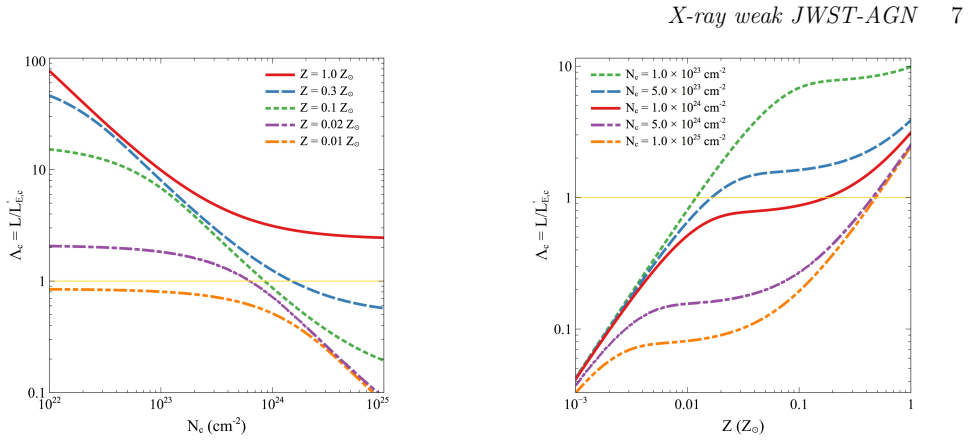
- [Section 4.1/Fig. 6] The sentence 'the effective Eddington ratio decreases with increasing clump column density' is not generally true: in the IR-dominated limit Eq. (12) gives Λ_c → λ κ_IR m_p/σ_T, independent of N_c. The curves in Fig. 6 indeed flatten at high column density. Please qualify this statement.
- [Section 4.2/Table 1] The Monte-Carlo spectral simulations are the only new numerical result, but there is no comparison with a solar-metallicity case or a description of code validation. A sentence on the code and its earlier use would help.
- [Data availability] Although no observational data were generated, the Monte-Carlo simulations in §4.2 are new; please state whether the code is publicly available or provide a reference.
Circularity Check
No significant circularity: the central derivation is self-contained and uses an external empirical dust-to-gas ratio relation as input, not fitted to the target JWST X-ray data.
full rationale
The paper's derivation chain is: (i) adopt the standard radiation-pressure-on-dust force balance (Eqs. 1–6), (ii) introduce analytic dust opacities (Eqs. 8–9) with fixed fiducial parameters, (iii) set the dust-to-gas ratio via the empirical relation log f_dg = 1.30 [12+log(O/H)] − 13.72 (Eq. 10) taken from external local-universe galaxy samples (De Vis et al. 2019; Popping & Péroux 2022), and (iv) compute the effective Eddington boundary in the NH–λ plane (Eq. 7). The conclusion that low metallicity shifts the boundary rightward and expands the region where Λ < 1 is a direct algebraic consequence of κ ∝ f_dg ∝ Z. This is a logical implication, not a circularity: the input scaling is independent of the JWST X-ray weakness phenomenon, and no model parameter is fitted to the target observations. The blowout/stalling analysis (Sec 4.1) uses the same opacity inputs and likewise derives, rather than assumes, the result that higher metallicities are needed to eject heavier columns. The paper explicitly acknowledges uncertainties in applying Eq. 10 to high-redshift nuclear environments (Sec 3.1), but that is a robustness limitation, not a circular step. Self-citations to previous work (e.g., Ishibashi & Fabian 2016; Ishibashi et al. 2018) serve to reference the framework, whose assumptions are stated explicitly and are also supported by external references (e.g., Thompson & Heckman 2024; Mathis et al. 1977). No fitted parameter is renamed as a prediction, and no uniqueness theorem from the authors is invoked to forbid alternatives. Therefore the analysis is self-contained given its stated inputs, and no circular step can be exhibited.
Axiom & Free-Parameter Ledger
free parameters (6)
- Metallicity Z =
fiducial 1 Z_sun; varied 0.01-1 Z_sun
- Minimum grain size a_min =
0.005 micron fiducial; varied 0.001-0.01 micron
- Maximum grain size a_max =
0.25 micron fiducial; varied 0.1-10 micron
- Grain density rho_d =
3 g/cm3 fiducial; graphite 2.26, silicate 3.3
- Radiation temperature T_r =
200 K fiducial; varied 100-300 K
- Dust-to-gas ratio normalization (slope and intercept in Eq 10) =
slope 1.30, intercept -13.72
axioms (8)
- domain assumption Cold neutral dusty gas; electron scattering is negligible relative to dust absorption
- domain assumption Dust opacity parameterization from Thompson and Heckman 2024: kappa_UV = (3/4) f_dg / (rho_d sqrt(a_min a_max)) and kappa_IR = 0.0125 f_dg T_r^2
- domain assumption Dust-to-gas ratio scales linearly with metallicity via log f_dg = 1.30 [12+log(O/H)] - 13.72
- domain assumption Radiation pressure on dust is the only force opposing gravity; winds, magnetic fields, and X-ray heating are ignored
- domain assumption The central black hole mass dominates the gravitational potential (F_grav = 4 pi G m_p M_BH N)
- domain assumption The absorbing gas is a uniform, cold, neutral spherical cloud with solar abundance ratios scaled by metallicity Z
- domain assumption The cloud blowout condition is instantaneous force balance Lambda_c > 1; no time-dependent dynamics or cloud survival physics is modeled
- domain assumption MRN grain size distribution dn/da proportional to a^-3.5 with the adopted limits
Cite this review
Pith. "Pith review of Another view into JWST-discovered X-ray weak AGNs via radiative dusty feedback." pith.science (2026). https://pith.science/paper/DETNZHSH
@misc{pith2026250905423,
  author       = {Pith},
  title        = {Pith review of: Another view into JWST-discovered X-ray weak AGNs via radiative dusty feedback},
  year         = {2026},
  howpublished = {\url{https://pith.science/paper/DETNZHSH}},
  note         = {Machine review of arXiv:2509.05423}
}
abstract
JWST has revealed a previously unknown population of low-luminosity active galactic nuclei (AGN) in the early Universe. These JWST-AGN at high redshifts are characterised by a set of peculiar properties, including unusually weak X-ray emission. Here we investigate the apparent lack of X-ray emission in the framework of the ``AGN radiative dusty feedback'' scenario based on the effective Eddington limit for dust. We analyse how the boundary in the $N_\mathrm{H} - \lambda$ plane, defined by the column density versus the Eddington ratio, is modified as a function of the dusty gas parameters (metallicity, dust grain size and composition). Low metallicity gas with little dust content tends to survive against radiation pressure, and likely accumulates in the nuclear region. We suggest that such dust-poor gas can provide long-lived absorption and may lead to heavy X-ray obscuration, as observed in early JWST-AGN. The blowout vs. stalling condition of the obscuring clouds indicates that higher metallicities are required to eject heavier column densities, while large columns of gas can stall in low metallicity environments. Therefore the metallicity may play a key role in the AGN radiative dusty feedback scenario. We discuss how other peculiar properties of JWST-AGN -- such as Balmer absorption features and weak radio emission -- may be naturally interpreted within the same physical framework.
Figures



Reference graph
Works this paper leans on
-
[1]
write newline
" write newline "" before.all 'output.state := FUNCTION fin.entry write newline FUNCTION new.block output.state before.all = 'skip after.block 'output.state := if FUNCTION new.sentence output.state after.block = 'skip output.state before.all = 'skip after.sentence 'output.state := if if FUNCTION not #0 #1 if FUNCTION and 'skip pop #0 if FUNCTION or pop #1...
-
[2]
\@ifclassloaded agu2001 natbib The agu2001 class already includes natbib coding, so you should not add it explicitly Type <Return> for now, but then later remove the command natbib from the document \@ifclassloaded aguplus natbib The aguplus class already includes natbib coding, so you should not add it explicitly Type <Return> for now, but then later rem...
-
[3]
@stdbsttrue NAT@ctr \@lbibitem[ NAT@ctr ] \@lbibitem[#1]#2 \@extra@b@citeb \@ifundefined br@#2\@extra@b@citeb \@namedef br@#2 \@nameuse br@#2\@extra@b@citeb \@ifundefined b@#2\@extra@b@citeb @num @parse #2 [ @natanchorstart #2\@extra@b@citeb \@biblabel @num @natanchorend] @ifcmd#1(@)(@)\@nil #2 @lbibitem\@undefined @lbibitem\@lbibitem \@lbibitem[#1]#2 @lb...
-
[4]
@open @close @open @close and [1] URL: #1 \@ifundefined chapter * \@mkboth \@ifundefined NAT@sectionbib * \@mkboth * \@mkboth\@gobbletwo \@ifclassloaded amsart * \@ifclassloaded amsbook * \@ifundefined bib@heading @heading NAT@ctr thebibliography [1] @ \@biblabel NAT@ctr \@bibsetup #1 NAT@ctr 0 @openbib .11em \@plus.33em \@minus.07em 4000 4000 `\.=1000 \@...
-
[5]
T., Bogd \'a n \'A ., Kov \'a cs O
Ananna T. T., Bogd \'a n \'A ., Kov \'a cs O. E., Natarajan P., Hickox R. C., 2024, , 969, L18
work page 2024
-
[6]
Arakawa N., Fabian A. C., Ferland G. J., Ishibashi W., 2022, , 517, 5069
work page 2022
-
[7]
J., Scott P., 2009, , 47, 481
Asplund M., Grevesse N., Sauval A. J., Scott P., 2009, , 47, 481
2009
- [8]
-
[9]
J., Liu X., Chen Y.-C., Shen Y., Guo H., 2021, , 504, 543
Burke C. J., Liu X., Chen Y.-C., Shen Y., Guo H., 2021, , 504, 543
work page 2021
-
[10]
I., Graci \'a -Carpio J., Koss M
Burtscher L., Davies R. I., Graci \'a -Carpio J., Koss M. J., Lin M. Y., Lutz D., Nandra P., Netzer H., Orban de Xivry G., et al. 2016, , 586, A28
work page 2016
-
[11]
Casey C. M., Akins H. B., Kokorev V., McKinney J., Cooper O. R., Long A. S., Franco M., Manning S. M., 2024, , 975, L4
work page 2024
-
[12]
P., Labbe I., Wang B., Leja J., Matthee J., Katz H., Greene J
de Graaff A., Rix H.-W., Naidu R. P., Labbe I., Wang B., Leja J., Matthee J., Katz H., Greene J. E. e. a., 2025, arXiv e-prints, p. arXiv:2503.16600
Pith/arXiv arXiv 2025
- [13]
-
[14]
D'Eugenio F., Maiolino R., Perna M., et al. 2025, arXiv e-prints, p. arXiv:2503.11752
Pith/arXiv arXiv 2025
- [15]
-
[16]
Fabian A. C., Vasudevan R. V., Mushotzky R. F., Winter L. M., Reynolds C. S., 2009, , 394, L89
work page 2009
- [17]
- [18]
-
[19]
Gaskell C. M., Goosmann R. W., Antonucci R. R. J., Whysong D. H., 2004, , 616, 147
work page 2004
-
[20]
Glikman E., LaMassa S., Piconcelli E., Zappacosta L., Lacy M., 2024, , 528, 711
work page 2024
-
[21]
Gloudemans A. J., Duncan K. J., Eilers A.-C., Farina E. P., Harikane Y., Inayoshi K., Lambrides E., Vardoulaki E., 2025, arXiv e-prints, p. arXiv:2501.04912
Pith/arXiv arXiv 2025
-
[22]
Greene J. E., Labbe I., Goulding A. D., Furtak L. J., Chemerynska I., Kokorev V., Dayal P., Volonteri M., et al. 2024, , 964, 39
work page 2024
-
[23]
N., Maiolino R., Juod z balis I., et al
Hainline K. N., Maiolino R., Juod z balis I., et al. 2025, , 979, 138
work page 2025
-
[24]
Harikane Y., Zhang Y., Nakajima K., Ouchi M., Isobe Y., Ono Y., Hatano S., Xu Y., Umeda H., 2023, , 959, 39
work page 2023
-
[25]
Inayoshi K., Maiolino R., 2025, , 980, L27
work page 2025
-
[26]
Inayoshi K., Visbal E., Haiman Z., 2020, , 58, 27
work page 2020
- [27]
- [28]
-
[29]
C., Maiolino R., 2018, , 476, 512
Ishibashi W., Fabian A. C., Maiolino R., 2018, , 476, 512
work page 2018
-
[30]
C., Ricci C., Celotti A., 2018, , 479, 3335
Ishibashi W., Fabian A. C., Ricci C., Celotti A., 2018, , 479, 3335
work page 2018
-
[31]
Ji X., Maiolino R., \"U bler H., Scholtz J., D'Eugenio F., Sun F., Perna M., Turner H., Arribas S., et al. 2025, arXiv e-prints, p. arXiv:2501.13082
arXiv 2025
-
[32]
Jiang D., Onoue M., Jiang L., Lai S., Ba \ n ados E., Becker G. D., Bischetti M., et al. 2024, , 975, 214
work page 2024
-
[33]
Jun H. D., Assef R. J., Carroll C. M., Hickox R. C., Kim Y., Lee J., Ricci C., Stern D., 2021, , 906, 21
work page 2021
- [34]
- [35]
-
[36]
King A., 2025, , 536, L1
work page 2025
-
[37]
Kocevski D. D., Finkelstein S. L., Barro G., Taylor A. J., Calabr \`o A., Laloux B., Buchner J., et al. 2024, arXiv e-prints, p. arXiv:2404.03576
Pith/arXiv arXiv 2024
-
[38]
D., Onoue M., Inayoshi K., et al
Kocevski D. D., Onoue M., Inayoshi K., et al. 2023, , 954, L4
work page 2023
-
[39]
E., Bezanson R., Fujimoto S., Furtak L
Labbe I., Greene J. E., Bezanson R., Fujimoto S., Furtak L. J., Goulding A. D., Matthee J., Naidu R. P., et al. 2025, , 978, 92
work page 2025
-
[40]
Li Z., Inayoshi K., Chen K., Ichikawa K., Ho L. C., 2025, , 980, 36
work page 2025
-
[41]
B., Sun F., Volonteri M., Yang J., et al
Lin X., Wang F., Fan X., Cai Z., Champagne J. B., Sun F., Volonteri M., Yang J., et al. 2024, , 974, 147
work page 2024
-
[42]
Liu T., Merloni A., Wang J.-X., Tozzi P., Shen Y., Brusa M., et al. 2018, , 479, 5022
work page 2018
-
[43]
Madau P., Haardt F., 2024, , 976, L24
work page 2024
-
[44]
Maiolino R., Marconi A., Oliva E., 2001, , 365, 37
work page 2001
-
[45]
Maiolino R., Risaliti G., Signorini M., Trefoloni B., Juod z balis I., et al. 2025,
work page 2025
-
[46]
Maiolino R., Scholtz J., Curtis-Lake E., Carniani S., Baker W., de Graaff A., et al. 2024, , 691, A145
work page 2024
-
[47]
D., Sommovigo L., Kohandel M., 2025, Nature Astronomy, 9, 458
Markov V., Gallerani S., Ferrara A., Pallottini A., Parlanti E., Mascia F. D., Sommovigo L., Kohandel M., 2025, Nature Astronomy, 9, 458
work page 2025
-
[48]
S., Rumpl W., Nordsieck K
Mathis J. S., Rumpl W., Nordsieck K. H., 1977, , 217, 425
1977
-
[49]
P., Brammer G., Chisholm J., Eilers A.-C., Goulding A., Greene J., et al
Matthee J., Naidu R. P., Brammer G., Chisholm J., Eilers A.-C., Goulding A., Greene J., et al. 2024, , 963, 129
work page 2024
-
[50]
F., Belladitta S., Vito F., et al
Mazzolari G., Gilli R., Maiolino R., Prandoni I., Delvecchio I., Norman C., Jimenez-Andrade E. F., Belladitta S., Vito F., et al. 2024, arXiv e-prints, p. arXiv:2412.04224
arXiv 2024
-
[51]
Modeling Galaxies in the Early Universe with Supernova Dust Attenuation
McKinney J., Cooper O., Casey C. M., Munoz J. B., Akins H., Lambrides E., Long A. S., 2025, arXiv e-prints, p. arXiv:2502.14031
work page internal anchor Pith review Pith/arXiv arXiv 2025
-
[52]
Mizukoshi S., Minezaki T., Sameshima H., Kokubo M., Noda H., Kawamuro T., Yamada S., Horiuchi T., 2024, , 532, 666
work page 2024
-
[53]
P., Matthee J., Katz H., de Graaff A., Oesch P., Smith A., Greene J
Naidu R. P., Matthee J., Katz H., de Graaff A., Oesch P., Smith A., Greene J. E., et al. 2025, arXiv e-prints, p. arXiv:2503.16596
Pith/arXiv arXiv 2025
-
[54]
Pacucci F., Narayan R., 2024, , 976, 96
work page 2024
-
[55]
Perger K., Fogasy J., Frey S., Gab \'a nyi K. \'E ., 2025, , 693, L2
work page 2025
-
[56]
Popping G., P \'e roux C., 2022, , 513, 1531
work page 2022
-
[57]
P., Brammer G., Gottumukkala R., Harvey T., Heintz K
Rusakov V., Watson D., Nikopoulos G. P., Brammer G., Gottumukkala R., Harvey T., Heintz K. E., et al. 2025, arXiv e-prints, p. arXiv:2503.16595
arXiv 2025
-
[58]
Schneider R., Maiolino R., 2024, , 32, 2
2024
-
[59]
Shimizu T. T., Davies R. I., Koss M., Ricci C., Lamperti I., Oh K., Schawinski K., et al. 2018, , 856, 154
work page 2018
-
[60]
Tazaki R., Ichikawa K., 2020, , 892, 149
work page 2020
- [61]
-
[62]
Trefoloni B., Ji X., Maiolino R., D'Eugenio F., \"U bler H., Scholtz J., Marconi A., Marconcini C., Mazzolari G., 2024, arXiv e-prints, p. arXiv:2410.21867
Pith/arXiv arXiv 2024
-
[63]
Tripodi R., Martis N., Markov V., et al. 2024, arXiv e-prints, p. arXiv:2412.04983
Pith/arXiv arXiv 2024
- [64]
-
[65]
T., Panagiotou C., Kara E., Miyaji T., 2024, , 974, L26
Yue M., Eilers A.-C., Ananna T. T., Panagiotou C., Kara E., Miyaji T., 2024, , 974, L26
work page 2024
This paper was first reviewed by deepseek-v4-flash on August 5, 2026.
discussion (0)
Sign in with ORCID, Apple, or X to comment. Anyone can read and Pith papers without signing in.