REVIEW 4 major objections 5 minor 1 cited by
A folded string dual for the Sachdev-Ye-Kitaev model
T0 review · 4 major / 5 minor · reviewed 2026-08-05 · deepseek-v4-flash
Pith's one-line read The paper proposes that the SYK conformal-point spectrum is exactly the mass spectrum of a folded string in AdS2 with imaginary radius squared, obtained by quantizing a string Casimir in momentum-fraction variables.
desk verdict Genuinely new proposal—folded string in imaginary-radius AdS2 as an SYK dual—but the spectral match is assembled from SYK inputs, so it's a consistency check rather than a derivation. read the letter →
The pith
A machine-rendered reading of the paper's core claim, the machinery that carries it, and where it could break.
The reading
What carries the argument
The central object is the string mass-squared written as a quadratic Casimir of an SL(2)×SL(2) phase-space algebra built from the lightcone boundary-time variables (t_i, t̃_i). In momentum-fraction variables (z,s) this Casimir becomes M² = s z(1−z)s + (1/2−Δ)² z(1−z). It reduces a two-particle string problem to a one-dimensional quantum-mechanics problem on the interval z∈(0,1), solved by Pöschl–Teller-type associated Legendre functions, with a self-adjoint boundary condition selecting the discrete conformal dimensions.
What would settle it
Solve the quantized Casimir with the same Pöschl–Teller equation but with the right-hand side of the boundary condition (29) replaced by another constant: the paper itself notes this generates other CFT spectra, so if (29) cannot be derived from an independent bulk requirement such as worldsheet consistency or absence of tachyons, the SYK match is an input rather than a prediction. A direct spectral check would be to compute the first 1/N correction to the SYK dimensions h and see whether worldsheet one-loop corrections on the folded string reproduce it.
Extended reading notes
Core claim
For a two-particle folded string in rigid AdS2, setting the coupling to g0 = i/4(1−2Δ) with Δ = 1/p makes the quadratic Casimir take the real form M² = s z(1−z)s + (1/2−Δ)² z(1−z), where z is a momentum fraction and s its conjugate. Quantizing this Casimir on positive-momentum wavefunctions leads to the Pöschl–Teller equation (27) in z. Near z=0 and z=1 the solutions are power laws with exponents Δ−1/2 and 1/2−Δ; imposing the symmetric boundary condition c_A/c_B = Δ/(1−Δ) makes the operator self-adjoint and yields a discrete spectrum of conformal dimensions h. The antisymmetric wavefunctions reproduce the SYK ladder spectrum k(h)=1, and the symmetric ones reproduce the bosonic SYK spectrum.
Load-bearing premise
The load-bearing premise is that the string coupling may be set to the imaginary value g0 = i/4(1−2Δ) and the boundary-condition ratio c_A/c_B = Δ/(1−Δ) may be chosen by hand; these two choices are exactly what make the string spectrum equal the SYK spectrum.
Editorial extensions
If this is right
- The entire SYK bilinear conformal spectrum k(h)=1 is encoded in a single one-dimensional mass-squared equation, so the full ladder spectrum is a single bulk mass spectrum.
- Symmetric wavefunctions reproduce the bosonic SYK spectrum, so the same folded-string construction covers both fermionic and bosonic sectors of the model.
- Varying the constant in the boundary condition (29) reproduces the spectrum of the line of CFTs between generalized free fields and SYK, so the construction is a one-parameter family rather than a single tuned model.
- At Δ=1/2 the string tension vanishes, the particles decouple, and the spectrum follows from tensor products of discrete-series representations—giving a free-particle limit where Wigner's classification applies.
- For a complex AdS radius, the particles never collide, so the discrete time steps needed in the standard AdS2 folded string are absent and quantization can proceed directly.
Reading between the lines
- The only places SYK data enter are the imaginary coupling g0 and the boundary-condition ratio Δ/(1−Δ); deriving either from an independent bulk consistency condition would turn the spectral match into a genuine duality rather than an input.
- Because the boundary-condition constant is free, the construction suggests a family of bulk duals; checking which constants correspond to well-defined string configurations could select SYK without first putting in its spectrum.
- A sharper test than the spectrum would be correlation data: comparing the OPE coefficients c_m from the string side with SYK four-point functions would show whether the match extends beyond conformal dimensions.
- The author's remark that d>1 brings level-matching constraints suggests the momentum-fraction reduction is special to AdS2; higher-dimensional analogues would need a different mechanism.
Editorial analysis
A structured set of objections, weighed in public.
Referee Report
Summary. The paper proposes a folded string in AdS2 with imaginary radius squared as a bulk dual of the SYK model at its conformal fixed point. The classical part develops a phase-space description of folded strings in flat space and AdS2, using Peierls brackets to obtain the Poisson structure of the lightcone time variables and then computing the string mass-squared. The quantum part sets the AdS radius/coupling to g0 = i/4(1-2Delta) (Eq. 23), chooses symmetric coordinates, quantizes the SL(2) generators, projects to positive momenta, and obtains a Pöschl-Teller-like equation for the mass eigenfunctions. Imposing the boundary condition (29) with c_A/c_B = Delta/(1-Delta) and selecting antisymmetric wavefunctions is claimed to reproduce the SYK bilinear operator spectrum k(h)=1, Eq. (5). Sections 2-6 provide the classical and quantization machinery; Section 7 is where the SYK match is made.
Significance. If the derivation were first-principles, this would be a notable step: it would give a concrete worldsheet realization of the SYK conformal-point spectrum and a bulk interpretation of the discrete bilinear dimensions. The paper contains useful technical material, including an explicit Peierls-bracket computation for the lattice time variables, a clean reduction of the mass-squared to a one-dimensional momentum-fraction problem, and interesting connections to integrable fishnet diagrams. However, the central spectral claim currently rests on inputs imported from SYK rather than derived from the string: the value of g0 in Eq. (23) and the boundary condition ratio in Eq. (29) are both chosen to match SYK data. The analytic continuation to imaginary AdS radius is also assumed without justification. As it stands, the result is a plausible mapping or consistency check; its significance depends on whether the imported inputs can be derived from the string dynamics or from a precise holographic dictionary.
major comments (4)
- [§7, Eq. (23)] The value g0 = i/4(1-2Delta) is fixed by the SYK fermion conformal dimension Delta. The only motivation is the statement that the path integral (24) with g=-g0 takes the form of the SYK ladder diagrams 'up to signs and constant factors.' This is too weak: without an exact matching of the measure, phases, and normalization, Eq. (23) is an ad hoc input. Since the mass spectrum in Eq. (27) depends directly on g0, the claimed reproduction of the SYK spectrum is partly an input rather than a prediction. The author should either derive g0 from the folded-string action and boundary conditions or explicitly frame the calculation as a consistency check.
- [§7, Eq. (29)] The self-adjoint extension ratio c_A/c_B = Delta/(1-Delta) is imposed by hand. The paper itself notes that varying the constant on the RHS reproduces the entire line of CFTs of [21], so self-adjointness alone does not select the SYK value. The chosen ratio is exactly the SYK near-boundary exponent ratio, making the match an input. To make the central claim load-bearing, the boundary condition must be derived from the string dynamics, from the path integral (24), or from the holographic dictionary. This is the most serious issue because it directly affects the uniqueness of the claimed spectrum.
- [§7, Eqs. (25)-(27)] The analytic continuation to imaginary g (complex AdS radius) is assumed to preserve the quantization, the positive-momentum projection, and the self-adjointness of the resulting Casimir. This is not a trivial step: the phase-space variables become complex, the classical picture changes (particles no longer collide), and the differential operators (26) were constructed for real p_n. The paper should either prove that the continuation is a legitimate deformation of the spectral problem or define the complex-radius model as an independent model and prove its spectrum is real and bounded below. Without this, the Pöschl-Teller equation (27) is not established as a consequence of the original string theory.
- [§7, final paragraph] The assertion that antisymmetric eigenfunctions match the SYK operator spectrum k(h)=1 is stated but not demonstrated. The matching depends on the boundary condition (29), on the parity selection, and on a change of variables that is delegated to the author's previous work [19]. The paper should display the resulting quantization condition and show explicitly that it is equivalent to Eq. (5). As written, the central spectral match is not reproducible from the information in this manuscript.
minor comments (5)
- [§6, Eq. (21)] The two expressions for M^2 corresponding to (y1,y2) = (t1,tilde t2) and (y1,y2) = (tilde t1,t2) are not labeled clearly. Please clarify the notation and the relation to the discrete time step.
- [§7, Eq. (25)] The second term on the RHS of Eq. (25) is typeset in a way that is easy to misread; please ensure it is displayed unambiguously as a fraction (the intended form appears to be (1/2-Delta)^2 / [z(1-z)]).
- [§7, Eq. (24)] The path integral (24) is written in a condensed form. It would help to specify the range of j, the meaning of L for L=2, and the precise SL(2)-invariant measure, especially because the matching to SYK is claimed only 'up to signs and constant factors.'
- [General] The paper relies heavily on reference [19] for the Pöschl-Teller mapping, boundary conditions, and spectrum. Since the SYK match is the main result, consider including the relevant equations in an appendix to make the manuscript more self-contained.
- [§8] The discussion of tachyonic bound states for Delta = 1/2 + is is important but appears only at the end. Consider presenting it earlier as a limitation, since it affects the regime where the AdS radius would be large and where a classical gravity description would be most reliable.
Circularity Check
SYK spectrum is an input: Eq. (23) fixes the coupling with SYK's Δ and Eq. (29) fixes the self-adjoint boundary condition to Δ/(1−Δ), while the Pöschl-Teller mapping is imported from the author's own [19].
-
fitted input called prediction
[Section 7, Eq. (23)]
"For applications to SYK, we will set g to the value g0 = i/4 (1−2∆), where ∆ = 1/p is the IR conformal dimension in the theory with p-fermion interactions, see (1)."
The bulk coupling g is the only parameter appearing in the mass-squared/Casimir, and here it is fixed by the SYK conformal dimension ∆. The path-integral motivation in (24) is only said to match 'up to signs and constant factors in the fermion propagators', so it does not independently fix g from the string theory. The subsequent spectrum therefore already contains the SYK value of ∆ as an input.
-
fitted input called prediction
[Section 7, Eq. (29)]
"Imposing a simple symmetric boundary condition cA/cB = ˜cB/˜cA = ∆/(1−∆) makes the Casimir self-adjoint and yields a discrete spectrum for h [19]. Eigenvalues corresponding to antisymmetric wavefunctions match the SYK operator spectrum k(h)=1, where k(h) is given in (5). Finally, varying the constant on the RHS of (29) reproduces the spectrum of the line of CFTs described in [21]."
The boundary-condition ratio is set to exactly ∆/(1−∆), which is built from the SYK fermion dimension. The paper itself states that changing the constant on the RHS of (29) produces a different line of CFTs, so self-adjointness alone does not select this value. Choosing the ratio to be ∆/(1−∆) and then reporting that antisymmetric eigenfunctions match k(h)=1 is fitting the free parameter to the known SYK answer, not deriving it.
1 more flagged steps
-
self citation load bearing
[Section 7, Eqs. (27)-(29)]
"With an appropriate change of variables [19], this equation is transformed into the P¨oschl-Teller equation [20], whose solutions are associated Legendre polynomials. ... Imposing a simple symmetric boundary condition ... makes the Casimir self-adjoint and yields a discrete spectrum for h [19]."
The essential spectral technology—the change of variables to the Pöschl-Teller equation, the self-adjoint extension, and the discrete spectrum—is imported from the author's own previous paper [19]. The present paper does not re-derive these steps, so the central claim that the string mass spectrum matches SYK rests on a load-bearing self-citation rather than on an independent derivation in this work.
full rationale
The paper's central claim—that the folded string in complex AdS2 reproduces the SYK operator spectrum—depends on two inputs explicitly imported from SYK rather than derived from the string dynamics. First, Eq. (23) fixes the coupling g0 using the SYK conformal dimension ∆. Second, Eq. (29) fixes the self-adjoint boundary condition to cA/cB = ∆/(1−∆), a value that the paper itself acknowledges is one point in a continuous family (varying it reproduces other CFT spectra). Because the boundary-condition constant is not selected by self-adjointness, the match of antisymmetric eigenvalues to k(h)=1 is effectively an input, not a prediction. The transformation to the Pöschl-Teller equation and the self-adjoint spectral result are also taken from the author's own [19], making the derivation chain dependent on a self-citation. There is substantial independent technical content in the construction of the string action, the Peierls bracket, and the Casimir, so the paper is not merely a renaming; however, the advertised spectral reproduction reduces by construction to the chosen coupling and boundary condition. This warrants a score of 8.
Assumptions & free parameters
free parameters (2)
- g0 (complex AdS radius/coupling) =
g0 = i/4 (1 - 2Δ), Δ = 1/p
- Boundary condition ratio cA/cB =
Δ/(1-Δ)
assumptions (5)
- domain assumption The folded string worldsheet is equivalent to a lattice of boundary time variables t_i,j with action (6).
- domain assumption Peierls brackets apply to the discretized string system and give (9).
- domain assumption Wavefunctions can be projected onto positive momenta p_i > 0, so z ∈ [0,1].
- ad hoc to paper Analytic continuation to imaginary g (complex AdS radius) preserves quantization and the spectral problem.
- ad hoc to paper Boundary condition (29) with cA/cB = Δ/(1-Δ) defines the self-adjoint extension.
invented entities (1)
-
AdS2 with imaginary radius squared (complex AdS2)
Cite this review
Pith. "Pith review of A folded string dual for the Sachdev-Ye-Kitaev model." pith.science (2026). https://pith.science/paper/GQLHH3PI
@misc{pith2026250905435,
  author       = {Pith},
  title        = {Pith review of: A folded string dual for the Sachdev-Ye-Kitaev model},
  year         = {2026},
  howpublished = {\url{https://pith.science/paper/GQLHH3PI}},
  note         = {Machine review of arXiv:2509.05435}
}
abstract
We propose a folded string moving in rigid AdS$_2$ with imaginary radius squared as a dual of the Sachdev-Ye-Kitaev (SYK) model at its conformal fixed point. In standard AdS$_2$, the string is represented by two massless particles connected by straight string segments. The particles move at the speed of light, abruptly reversing direction at turning points. We describe the system using the lightcone coordinates of these points, with the Poisson structure obtained from the Peierls bracket. In AdS$_2$ with imaginary radius squared, quantization of the string's mass-squared in momentum-fraction space yields a P\"oschl-Teller equation, reproducing the SYK operator spectrum.
Figures


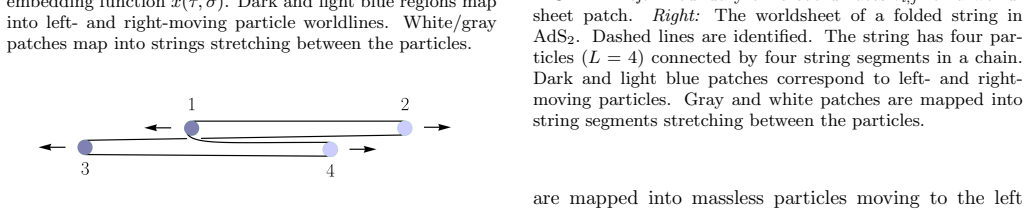
Figures from the paper (3 more)


Forward citations
Cited by 1 Pith paper
-
Quantum mechanical bootstrap without inequalities: SYK bilinear spectrum
Fractional operator powers generate non-positivity constraints that determine the SYK bilinear spectrum and converge to exact eigenvalues under truncation.
Reference graph
Works this paper leans on
-
[21]
R. E. Peierls, The Commutation laws of relativistic field theory, Proc. Roy. Soc. Lond. A214, 143 (1952)
work page 1952
-
[19]
Vegh, Segmented strings from a different angle, (2016), arXiv:1601.07571 [hep-th]
D. Vegh, Segmented strings from a different angle, (2016), arXiv:1601.07571 [hep-th]
arXiv 2016
-
[1]
Introduction.The SYK model has emerged as a prominent example of a strongly interacting quan- tum system that is both solvable in the large-Nlimit and closely connected to quantum gravity in AdS 2 [1– 4]. Originally introduced by Sachdev and Ye as a spin model [1], it was later reformulated by Kitaev [2] in terms ofNMajorana fermions with random all-to-al...
arXiv 2025
-
[2]
In temporal conformal gauge,t(τ, σ) =τ, and the string embedding is given byx=x(τ, σ)
F olded strings inR 1,1.We parametrize the string worldsheet by (τ, σ) and the target space by (t, x). In temporal conformal gauge,t(τ, σ) =τ, and the string embedding is given byx=x(τ, σ). The equation of mo- tion is the free wave equation ∂2 τ x−∂ 2 σx= 0, supplemented by the constraints∂ τ x ∂σx= 0 and (∂τ x)2 + (∂σx)2 = 1. Open string solutions can be...
-
[3]
F olded strings in AdS 2.The setup has been dis- cussed in [8, 9] (along with generalizations to arbitrary target space metrics). The worldsheet is depicted in Fig- ure 4 (right) and is structurally analogous to the flat- space case of Figure 2 (right). Dark (light) blue regions FIG. 4.Left:Boundary time coordinatest i,j for a world- sheet patch.Right:The...
-
[4]
The Peierls bracket.We now turn to the Hamilto- nian formalism, parametrizing phase space byt i,j. Their 3 FIG. 5.Left:Folded string with two particles (L= 2) in AdS2. Global timeτruns to the right; horizontal lines at θ= 0, πdenote the boundaries.Right:Phase space consists of two rows of time variables:t i ≡t i,j, ˜ti ≡t i,j+1 for a fixed j(i= 1,2). Whet...
-
[5]
The Hamiltonian in flat space.To gain some familiarity, we first discuss the case of a flat target space. In lightcone frame, the system of two massive particles connected by a linear potential has the Hamiltonian [14] H −(x− i , p+ i ) = m2 1 2p+ 1 (x+) + m2 2 2p+ 2 (x+) +κ|x− 1 (x+)−x− 2 (x+)|, (11) wherex − i = ti−xi√ 2 are the lightcone positions of t...
-
[6]
The Hamiltonian in AdS 2.Appendix B derives the string’s mass-squared in AdS 2 using the center-of- mass Hamiltonian in a similar way. In terms of the time variablest i,j introduced in Section 3, the result is M 2 ≡(mR) 2 = 16g2 (˜t1 −t 2)(˜t2 −t 1) (t1 − ˜t1)(˜t2 −t 2) ,(15) whereg≡ R2 2πα′ and we used the notation (10). The formula gives the mass-square...
Show all 43 references
-
[7]
complex AdS 2
F olded strings in “complex AdS 2” and SYK. For applications to SYK, we will setgto the value g0 = i 4 (1−2∆),(23) where ∆ = 1/pis the IR conformal dimension in the theory withp-fermion interactions, see (1). We moti- vate this value by the following observation. The fields ti...
-
[8]
string dual
Discussion.In this Letter, we have presented the “string dual” of the SYK model at the conformal fixed point. The string mass is quantized and reproduces the operator spectrum of fermion bilinears, in accordance with the AdS/CFT dictionary. The target space is AdS 2 of “comple...
-
[9]
Bars, Folded strings in curved space-time, (1994), arXiv:hep-th/9411078
I. Bars, Folded strings in curved space-time, (1994), arXiv:hep-th/9411078
1994 arXiv
-
[10]
Sachdev and J
S. Sachdev and J. Ye, Gapless spin-fluid ground state in a random quantum heisenberg magnet, Phys. Rev. Lett. 70, 3339 (1993), arXiv:cond-mat/9212030 [cond-mat]
1993 arXiv
-
[11]
Kitaev, A Simple Model of Quantum Holography, Talks at KITP, April 7, 2015 and May 27, 2015, http://online.kitp.ucsb.edu/online/entangled15/kitaev,
A. Kitaev, A Simple Model of Quantum Holography, Talks at KITP, April 7, 2015 and May 27, 2015, http://online.kitp.ucsb.edu/online/entangled15/kitaev,
2015
-
[12]
Polchinski and V
J. Polchinski and V. Rosenhaus, The Spectrum in the Sachdev-Ye-Kitaev Model, JHEP04, 001, arXiv:1601.06768 [hep-th]
-
[13]
Maldacena and D
J. Maldacena and D. Stanford, Remarks on the Sachdev- Ye-Kitaev model, Phys. Rev. D94, 106002 (2016), arXiv:1604.07818 [hep-th]
2016 arXiv
-
[14]
Jensen, Chaos in AdS 2 Holography, Phys
K. Jensen, Chaos in AdS 2 Holography, Phys. Rev. Lett. 117, 111601 (2016), arXiv:1605.06098 [hep-th]
2016 arXiv
-
[15]
Maldacena, D
J. Maldacena, D. Stanford, and Z. Yang, Confor- mal symmetry and its breaking in two dimensional Nearly Anti-de-Sitter space, PTEP2016, 12C104 (2016), arXiv:1606.01857 [hep-th]
2016 arXiv
-
[16]
Soederberg, B
B. Soederberg, B. Andersson, and G. Gustafson, Action- angle variables for the massless relativistic string in 1+1 dimensions, J Math Phys (NY)26(1), 112 (1985)
1985
-
[17]
Bars and J
I. Bars and J. Schulze, Folded strings falling into a black hole, Phys. Rev. D51, 1854 (1995), arXiv:hep- th/9405156
1995
-
[18]
Stanford and E
D. Stanford and E. Witten, Fermionic Localization of the Schwarzian Theory, JHEP10, 008, arXiv:1703.04612 [hep-th]
-
[20]
Vegh, Segmented strings coupled to a B-field, JHEP 04, 088, arXiv:1603.04504 [hep-th]
D. Vegh, Segmented strings coupled to a B-field, JHEP 04, 088, arXiv:1603.04504 [hep-th]
-
[22]
Gekhtman, M
M. Gekhtman, M. Shapiro, S. Tabachnikov, and A. Vain- shtein, Integrable cluster dynamics of directed networks and pentagram maps, Advances in Mathematics300, 390 (2016), special volume honoring Andrei Zelevinsky
2016
-
[23]
Lenz and B
S. Lenz and B. Schreiber, Example of a Poincare anomaly in relativistic quantum mechanics, Phys. Rev. D53, 960 (1996), arXiv:hep-th/9503219
1996 arXiv
-
[24]
’t Hooft, A Two-Dimensional Model for Mesons, Nucl
G. ’t Hooft, A Two-Dimensional Model for Mesons, Nucl. Phys. B75, 461 (1974)
1974
-
[25]
Y. B. Suris,The Problem of Integrable Discretization: Hamiltonian Approach(Birkh¨ auser Verlag, Basel, 2003)
2003
-
[26]
Vegh, The ’t Hooft equation as a quantum spectral curve, (2023), arXiv:2301.07154 [hep-th]
D. Vegh, The ’t Hooft equation as a quantum spectral curve, (2023), arXiv:2301.07154 [hep-th]
2023 arXiv
-
[27]
Kazakov, F
V. Kazakov, F. Levkovich-Maslyuk, and V. Mishnyakov, Integrable Feynman graphs and Yangian symmetry on the loom, JHEP06, 104, arXiv:2304.04654 [hep-th]
-
[28]
Vegh, Quantizing the folded string in AdS 2, (2024), arXiv:2409.06663 [hep-th]
D. Vegh, Quantizing the folded string in AdS 2, (2024), arXiv:2409.06663 [hep-th]
2024 arXiv
-
[29]
Poschl and E
G. Poschl and E. Teller, Bemerkungen zur Quanten- mechanik des anharmonischen Oszillators, Z. Phys.83, 143 (1933)
1933
-
[30]
D. J. Gross and V. Rosenhaus, A line of CFTs: from generalized free fields to SYK, JHEP07, 086, arXiv:1706.07015 [hep-th]
-
[31]
Amplitudes, strings & duality
or supersymmetric [32] versions of SYK, also merit further study. Another promising direction is general- ization to higher dimensions. However, we note that in d >1 the Poisson structure becomes more complicated due to the presence of level-matching-type constraints. The bulk...
-
[32]
Anninos, T
D. Anninos, T. Anous, B. Pethybridge, and G. S ¸eng¨ or, The discreet charm of the discrete series in dS 2, J. Phys. A57, 025401 (2024), arXiv:2307.15832 [hep-th]
2024 arXiv
-
[33]
B. J. Pethybridge, Notes on complexq= 2 SYK, (2024), arXiv:2403.04673 [hep-th]
2024 arXiv
-
[34]
A. B. Zamolodchikov, ’Fishnet’ diagrams as a completely integrable system, Phys. Lett. B97, 63 (1980)
1980
-
[35]
Kazakov and E
V. Kazakov and E. Olivucci, Biscalar Integrable Confor- mal Field Theories in Any Dimension, Phys. Rev. Lett. 121, 131601 (2018), arXiv:1801.09844 [hep-th]
2018 arXiv
-
[36]
Kazakov and E
V. Kazakov and E. Olivucci, The loom for general fishnet CFTs, JHEP06, 041, arXiv:2212.09732 [hep-th]
-
[37]
Gromov and A
N. Gromov and A. Sever, Derivation of the Holographic Dual of a Planar Conformal Field Theory in 4D, Phys. Rev. Lett.123, 081602 (2019), arXiv:1903.10508 [hep- th]
2019 arXiv
-
[38]
Gromov and A
N. Gromov and A. Sever, Quantum fishchain in AdS 5, JHEP10, 085, arXiv:1907.01001 [hep-th]
1907 arXiv
-
[39]
Gromov and A
N. Gromov and A. Sever, The holographic dual of stronglyγ-deformedN= 4 SYM theory: derivation, gen- eralization, integrability and discrete reparametrization symmetry, JHEP02, 035, arXiv:1908.10379 [hep-th]
1908 arXiv
-
[40]
Y. Gu, A. Kitaev, S. Sachdev, and G. Tarnopolsky, Notes on the complex Sachdev-Ye-Kitaev model, JHEP02, 157, arXiv:1910.14099 [hep-th]
1910 arXiv
-
[41]
W. Fu, D. Gaiotto, J. Maldacena, and S. Sachdev, Su- persymmetric Sachdev-Ye-Kitaev models, Phys. Rev. D 95, 026009 (2017), [Addendum: Phys.Rev.D 95, 069904 (2017)], arXiv:1610.08917 [hep-th]
2017 arXiv
-
[42]
Ficnar and S
A. Ficnar and S. S. Gubser, Finite momentum at string endpoints, Phys. Rev.D89, 026002 (2014), arXiv:1306.6648 [hep-th]
2014 arXiv
-
[43]
Callebaut, S
N. Callebaut, S. S. Gubser, A. Samberg, and C. Toldo, Segmented strings in AdS 3, JHEP11, 110, arXiv:1508.07311 [hep-th]
Reviewed August 5, 2026 · model on record in the stance chip above.
Discussion (0). Sign in to comment.