REVIEW 4 major objections 4 minor 78 references
Orchestrator: Active Inference for Multi-Agent Systems in Long-Horizon Tasks
T0 review · 4 major / 4 minor · reviewed 2026-08-15 · deepseek-v4-flash
Pith's one-line read Orchestrator claims that a lightweight multi-agent LLM system coordinated by an active-inference free-energy signal solves long-horizon mazes at up to 100% success on medium 18x18 mazes and 76.67% on hard 25x25 mazes, outperforming solo…
desk verdict The active-inference engine in this paper cannot run as written—the epistemic term is always negative—but the engineering scaffolding and honest negative result make it worth a referee's time. read the letter →
The pith
A machine-rendered reading of the paper's core claim, the machinery that carries it, and where it could break.
The reading
What carries the argument
The load-bearing object is the operational variational free energy $F_n(t,k) = U_{\text{epistemic}}(n,t,k) - C_{\text{accuracy}}(n,t,k)$, where $U_{\text{epistemic}} = -H[S_{n,t,k} \mid S_{n-1,t-1,k-1}]$ is the negative Shannon entropy of the agent's message tokens (interpreted as realized information gain) and $C_{\text{accuracy}}$ is an equally weighted sum of five risk components: movement efficiency, exploration efficiency, backtracking patterns, dead-end recognition, and oscillation avoidance. Thresholds $\vartheta_1 = 0.6$ and $\vartheta_2 = 0.4$ divide agents into four performance categories, and each category triggers updates to exploration, exploitation, coordination, and backtracking weights; an orchestrator node additionally injects corrective prompts. This machinery is what converts active inference from a principle into a control signal.
What would settle it
Run the same maze set with the free-energy signal replaced by random or constant weights, keeping everything else identical; if success rates stay at 100% and 76.67%, the free-energy computation is not doing the work. Alternatively, generate a very-hard 30x30 maze set (the paper defines one but does not test it) and apply the same thresholds; if success collapses, the thresholds were overfit to the tested difficulties.
Extended reading notes
Core claim
The central discovery is that a multi-agent system's global task performance can be optimized by giving each LLM agent a scalar variational free energy score at every step, computed as the negative Shannon entropy of its token outputs minus a weighted penalty for inefficient behaviors, and then using thresholds on that score to adjust exploration, exploitation, coordination, and backtracking weights. With two small LLMs as execution agents and one orchestrator node acting as shared memory and prompt injector, the system solves 18x18 mazes of medium difficulty at 100% success (25 runs) and 25x25 hard mazes at up to 76.67% success, outperforming solo-agent baselines by an average factor of 3.03 on medium mazes. The paper interprets these results as evidence that active-inference benchmarking mitigates partial observability and helps agents escape local minima.
Load-bearing premise
The entire result depends on the paper's formula for a free-energy score (how surprising the agent's outputs are minus how wasteful its moves are) actually measuring good exploration; if that formula is wrong or the thresholds were picked on the test mazes, the gains are just tuned heuristics.
Editorial extensions
If this is right
- Free-energy benchmarking alone lifts medium-maze success from about 30% (or 0%) for solo small models to 72–80%, so cheap introspection can substitute for a larger model.
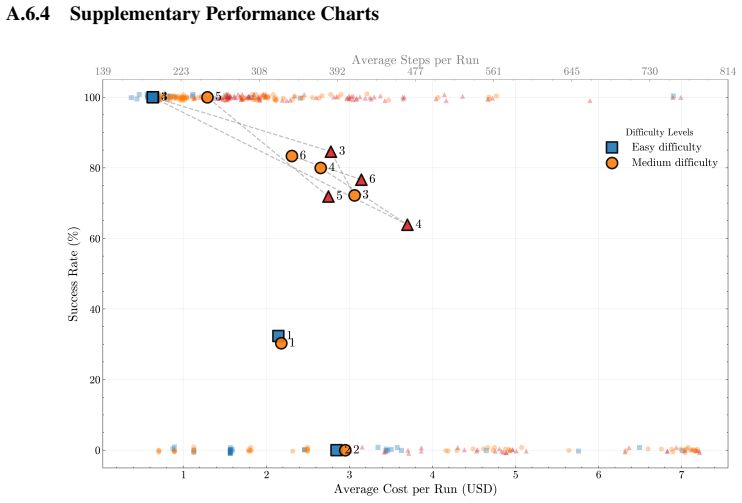
- Adding an orchestrator node pushes medium-maze success to 100% for one small model and 83% for another, but on hard mazes it can reduce success (e.g., from 84.6% to 71.9% for one model), implying orchestration overhead has a cost at the edge of the model's planning horizon.
- The framework achieves these results with small, fast-inference LLMs, suggesting production deployments on strict API budgets are feasible.
- The reported factor of 3.03 improvement over solo ensembles on medium mazes is the headline quantitative claim of the paper.
Reading between the lines
- If the free-energy proxy generalizes beyond mazes, the same two-signal control loop (information gain minus behavioral cost) could be dropped into other partially observable long-horizon domains, such as warehouse navigation or multi-agent search, without retraining the LLMs.
- The paper tunes its two thresholds on medium and hard mazes by grid search; a held-out difficulty or a randomized threshold sweep would reveal how much of the gain is active inference versus tuning.
- Only two execution agents are reported as a balanced trade-off; testing one or three to four agents would clarify whether the orchestrator's benefit scales with team size or saturates.
- Because the epistemic term is token entropy, not map-based information gain, one could test whether replacing it with a direct measure of newly discovered maze cells changes performance; if not, the LLM's token uncertainty is an unnecessary middleman.
Signed reviews
Editorial analysis
A structured set of objections, weighed in public.
Referee Report
Summary. The manuscript introduces Orchestrator, a multi-agent framework for LLM-based maze solving that combines an orchestrator node, reflective benchmarking, and an active-inference-inspired variational free energy (VFE) score. The VFE score is defined as epistemic uncertainty minus an accuracy cost, and threshold-based performance categories trigger dynamic weight adjustments. Experiments on procedurally generated mazes compare solo agents, FE-benchmark-only agents, and FE-plus-orchestration agents using GPT-4.1-nano and GPT-5-nano, reporting success rates, cost, and step counts. The paper claims that active-inference-driven orchestration substantially improves reliability and scalability, with up to 100% success on medium 18x18 mazes and up to 76.67% on hard 25x25 mazes.
Significance. If the mechanism worked as described, Orchestrator would offer a practical coordination method for lightweight LLMs in long-horizon tasks. The paper includes detailed appendices with prompts, algorithms, maze-generation code, and confidence-interval convergence analysis, and it candidly reports settings where orchestration hurts performance. However, because the core VFE equations as written cannot activate the high-epistemic-drive branches, the active-inference loop is inert; the reported gains are therefore not evidence for the paper's central claim. The threshold grid-search on the same difficulty levels further undermines the independent-evaluation claim. The framework may still work as a prompted multi-agent heuristic, but the paper does not establish that active inference is the operative mechanism.
major comments (4)
- [Section 3.2, Eqs. (2)-(3)] Uepistemic is defined as the negative Shannon entropy of token probabilities, so it is non-positive at every step, while the policy thresholds require U > 0.6 to activate the High Epistemic Drive categories. Consequently no agent can ever enter those categories, F = U - C in Eq. (5) is non-positive, and the dynamic weight modulation in Eq. (7) can respond only to the accuracy proxy. The active-inference feedback loop is inert as written, so the reported improvements cannot be attributed to the VFE mechanism without a corrected formulation and rerun experiments.
- [Section 3.2 and Appendix A.5] The thresholds ϑ1=0.6 and ϑ2=0.4 were selected by grid search on medium- and hard-difficulty mazes, the same difficulties used in Table 1. This makes the reported success rates on medium and hard mazes partly a result of fitting rather than an independent evaluation. Moreover, Appendix A.5 reports different optimal thresholds for hard mazes (ϑ1=0.9, ϑ2=0.01), so the adopted setting is not even the best for the hard condition.
- [Table 1] The orchestration component does not consistently improve over FE-benchmarking alone. For GPT-4.1-nano on hard mazes, success drops from 84.62% (95% CI 66.47-93.85) to 71.88% (95% CI 54.63-84.44); for GPT-5-nano on medium mazes, the difference between 80.0% and 83.33% is within sampling error, and on hard mazes the confidence intervals overlap substantially. The claim of significant reliability improvement is therefore not supported by the reported point estimates and intervals.
- [Section 4 and Table 1] The baseline comparison is not well controlled. Section 4 states that experiments use n=2 execution agents, but the 'Solo' rows in Table 1 appear to be single-agent runs; if so, the reported factor-of-3 improvement conflates adding an agent with adding orchestration. In addition, the random-walk floor baseline is omitted on hard mazes, and no comparison is made to a standard multi-agent ensemble without FE feedback or to classical planners (e.g., A*, BFS) that solve these mazes optimally, so the absolute improvement claim is not anchored.
minor comments (4)
- [Algorithm 1, line 27] The increment statement t←t−1 should be t←t+1, since the loop counter increases with each iteration.
- [Abstract and Section 1] Decimal commas and decimal points are used inconsistently (e.g., '3,03', '76,67' versus '72.22'); unify to a single convention.
- [Section 3.1] The sentence 'define define interaction pathways' contains a duplicated word; also, the reference to 'Figure 8' in Section 3.1 appears to point to the wrong appendix figure, since Figure 8 in Appendix A.6.5 is the confidence-interval convergence plot, not the update sequence.
- [Section 2 and Section 4] The term 'solo agent ensembles' is confusing: if 'solo' means a single agent, the phrase 'ensembles' is misleading; if it means multiple agents without orchestration, the baseline description should state that clearly.
Circularity Check
The epistemic-drive branch of the active-inference loop is empty by construction (U = -H ≤ 0 while high drive requires U > 0.6), and the policy thresholds were grid-searched on the same difficulty levels used to report success.
-
self definitional
[Section 3.2, Eqs. (2)-(3) and Performance Policies]
"Uepistemic(n,t,k) =−H[S n,t,k|S n−1,t−1,k−1] (2) ... Htokens(n,t,k) =− X j∈Kmessage pj(k) log pj(k) (3) ... High Epistemic Drive, Low Accuracy Cost (Uepistemic >0.6 ,Caccuracy <0.4)"
Equation (3) defines H as Shannon entropy, which is nonnegative for any probability distribution. Equation (2) therefore makes Uepistemic non-positive at every step. The Performance Policies section then assigns the two 'High Epistemic Drive' categories only when Uepistemic > 0.6, a condition no agent can satisfy by construction. Consequently, the claimed active-inference benchmarking reduces to the accuracy-cost term alone; the 'maximize information gain' branch of the framework is empty, so any reported benefit cannot be attributed to the epistemic-drive mechanism as written.
-
fitted input called prediction
[Appendix A.5 and Section 5 / Table 1]
"we conducted a brief grid search over a set of threshold parameters ϑ1 (epistemic drive) and ϑ2 (accuracy cost) and assess performance in terms of total number of steps required to solve the maze, given the respective parameter setup across both difficulties (medium and hard) ... For consistency and comparability across all experiments in this paper, we adopt the higher-performance setting of ϑ1 = 0.6 and ϑ2 = 0.4 throughout."
The category thresholds are selected by maximizing performance on the same medium and hard difficulty levels on which Section 5 reports the framework's success rates. No held-out difficulty or separate validation set is described, so the reported 'validation' of the orchestration policy is not independent of the hyperparameter fit. The leakage is partially muted because the unreachable U > 0.6 condition makes the ϑ1 grid search vacuous, but the ϑ2 accuracy-cost threshold is still tuned on the test difficulties before being carried into the headline results.
full rationale
The main circularity is structural: the epistemic uncertainty term in Eq. (2) is defined as the negative of a Shannon entropy, so it can never exceed zero, while Section 3.2's high-epistemic-drive performance categories require a value above 0.6. The active-inference 'benchmark' that the paper credits for its gains therefore has no operational high-drive branch; the only live signal is the hand-coded accuracy proxy of Eq. (4). That is a self-definitional failure of the claimed mechanism, not merely a weak approximation. In addition, Appendix A.5 discloses that the thresholds were grid-searched on the same medium/hard difficulties that later appear in the headline success-rate table, making the evaluation partially dependent on the fitted hyperparameters. There is no load-bearing self-citation chain: references to the authors' own supply-chain work [7,8] are contextual, and the active-inference citations [29,33,26] are external. The empirical maze results are real experimental outcomes and are not themselves arithmetic consequences of the equations, so the paper is not wholly circular; however, the central claim that active inference benchmarks drive the reported improvement is substantially undermined by the empty epistemic category and the tuned thresholds.
Assumptions & free parameters
free parameters (5)
- Epistemic drive threshold ϑ1 =
0.6
- Accuracy cost threshold ϑ2 =
0.4
- Risk component weights w_j =
0.20 each, sum 1.0
- Normalization cap for U and C =
±2.0
- Initial behavioral weights w_base =
not specified
assumptions (4)
- ad hoc to paper LLM output token probabilities provide a valid estimate of epistemic uncertainty between agent states
- ad hoc to paper Jaynes maximum entropy justifies approximating the LLM's posterior as uniform
- ad hoc to paper Five hand-defined behavioral risk components constitute the accuracy cost
- ad hoc to paper A well-defined weight update f_Δ exists
invented entities (1)
-
Operational variational free energy score F_n(t,k)
Cite this review
Pith. "Pith review of Orchestrator: Active Inference for Multi-Agent Systems in Long-Horizon Tasks." pith.science (2026). https://pith.science/paper/DJHGFEJN
@misc{pith2026250905651,
  author       = {Pith},
  title        = {Pith review of: Orchestrator: Active Inference for Multi-Agent Systems in Long-Horizon Tasks},
  year         = {2026},
  howpublished = {\url{https://pith.science/paper/DJHGFEJN}},
  note         = {Machine review of arXiv:2509.05651}
}
read the original abstract
Complex, non-linear tasks challenge LLM-enhanced multi-agent systems (MAS) due to partial observability and suboptimal coordination. We propose Orchestrator, a novel MAS framework that leverages attention-inspired self-emergent coordination and reflective benchmarking to optimize global task performance. Orchestrator introduces a monitoring mechanism to track agent-environment dynamics, using active inference benchmarks to optimize system behavior. By tracking agent-to-agent and agent-to-environment interaction, Orchestrator mitigates the effects of partial observability and enables agents to approximate global task solutions more efficiently. We evaluate the framework on a series of maze puzzles of increasing complexity, demonstrating its effectiveness in enhancing coordination and performance in dynamic, non-linear environments with long-horizon objectives.
Figures


Figures from the paper (5 more)




Reference graph
Works this paper leans on
-
[1]
AgentVerse: Facilitating Multi-Agent Collaboration and Exploring Emergent Behaviors in Agents
Weize Chen, Yusheng Su, Jingwei Zuo, Cheng Yang, Chenfei Yuan, Chi-Min Chan, Heyang Yu, Yaxi Lu, Yi-Hsin Hung, Chen Qian, Yujia Qin, Xin Cong, Ruobing Xie, Zhiyuan Liu, Maosong Sun, and Jie Zhou. AgentVerse: Facilitating Multi-Agent Collaboration and Exploring Emergent Behaviors in Agents. 2024
work page 2024
-
[2]
More Agents Is All You Need, October 2024
Junyou Li, Qin Zhang, Yangbin Yu, Qiang Fu, and Deheng Ye. More Agents Is All You Need, October 2024. arXiv:2402.05120 [cs]
arXiv 2024
-
[3]
Ex- ploring Collaboration Mechanisms for LLM Agents: A Social Psychology View, May 2024
Jintian Zhang, Xin Xu, Ningyu Zhang, Ruibo Liu, Bryan Hooi, and Shumin Deng. Ex- ploring Collaboration Mechanisms for LLM Agents: A Social Psychology View, May 2024. arXiv:2310.02124 [cs]
arXiv 2024
-
[4]
Leiserson, Yao Ma, and Jie Chen
Yuanzhe Liu, Ryan Deng, Tim Kaler, Xuhao Chen, Charles E. Leiserson, Yao Ma, and Jie Chen. Lessons Learned: A Multi-Agent Framework for Code LLMs to Learn and Improve, 2025. Version Number: 1
work page 2025
-
[5]
Junda He, Christoph Treude, and David Lo. LLM-Based Multi-Agent Systems for Software Engineering: Literature Review, Vision and the Road Ahead, July 2025. arXiv:2404.04834 [cs]
arXiv 2025
-
[6]
Visual analysis of time series data for multi-agent systems driven by large language models
Chao Xu, Qi Zhang, Baiyan Li, Anmin Wang, and Jingsong Bao. Visual analysis of time series data for multi-agent systems driven by large language models. In Proceedings of the 3rd International Conference on Signal Processing, Computer Networks and Communications, SPCNC ’24, page 427–431, New York, NY , USA, 2025. Association for Computing Machinery
work page 2025
-
[7]
Liming Xu, Sara Almahri, Stephen Mak, and Alexandra Brintrup. Multi-Agent Systems and Foundation Models Enable Autonomous Supply Chains: Opportunities and Challenges. IFAC-PapersOnLine, 58(19):795–800, 2024. Publisher: Elsevier BV
work page 2024
-
[8]
On Implementing Autonomous Supply Chains: a Multi-Agent System Approach
Liming Xu, Stephen Mak, Maria Minaricova, and Alexandra Brintrup. On Implementing Autonomous Supply Chains: a Multi-Agent System Approach, June 2024. arXiv:2310.09435 [cs]
work page Pith review arXiv 2024
Show all 78 references
-
[9]
Multiagent Evaluation Mechanisms
Tal Alon, Magdalen Dobson, Ariel Procaccia, Inbal Talgam-Cohen, and Jamie Tucker-Foltz. Multiagent Evaluation Mechanisms. Proceedings of the AAAI Conference on Artificial Intelligence, 34(02):1774–1781, April 2020
2020
-
[10]
Optima: Optimizing Effectiveness and Efficiency for LLM-Based Multi-Agent System, February 2025
Weize Chen, Jiarui Yuan, Chen Qian, Cheng Yang, Zhiyuan Liu, and Maosong Sun. Optima: Optimizing Effectiveness and Efficiency for LLM-Based Multi-Agent System, February 2025. arXiv:2410.08115 [cs]
2025 arXiv
-
[11]
HDFlow: Enhancing LLM Complex Problem-Solving with Hybrid Thinking and Dynamic Workflows, September 2024
Wenlin Yao, Haitao Mi, and Dong Yu. HDFlow: Enhancing LLM Complex Problem-Solving with Hybrid Thinking and Dynamic Workflows, September 2024. arXiv:2409.17433 [cs]
2024 arXiv
-
[12]
Active Inference for Self-Organizing Multi-LLM Systems: A Bayesian Ther- modynamic Approach to Adaptation, January 2025
Rithvik Prakki. Active Inference for Self-Organizing Multi-LLM Systems: A Bayesian Ther- modynamic Approach to Adaptation, January 2025. arXiv:2412.10425 [cs]
2025 arXiv
-
[13]
Actor-Attention-Critic for Multi-Agent Reinforcement Learning
Shariq Iqbal and Fei Sha. Actor-Attention-Critic for Multi-Agent Reinforcement Learning. 2018
2018
-
[14]
Grounded Answers for Multi-agent Decision- making Problem through Generative World Model
Zeyang Liu, Xinrui Yang, and Shiguang Sun. Grounded Answers for Multi-agent Decision- making Problem through Generative World Model. 2024
2024
-
[15]
Multi-Agent Coordination via Multi-Level Communication
Ziluo Ding, Zeyuan Liu, Zhirui Fang, Kefan Su, Liwen Zhu, and Zongqing Lu. Multi-Agent Coordination via Multi-Level Communication. 2024
2024
-
[16]
Plan-and-Act: Improving Planning of Agents for Long-Horizon Tasks, April 2025
Lutfi Eren Erdogan, Nicholas Lee, Sehoon Kim, Suhong Moon, Hiroki Furuta, Gopala Anu- manchipalli, Kurt Keutzer, and Amir Gholami. Plan-and-Act: Improving Planning of Agents for Long-Horizon Tasks, April 2025. arXiv:2503.09572 [cs]
2025 arXiv
-
[17]
Language Agents as Optimizable Graphs, August 2024
Mingchen Zhuge, Wenyi Wang, Louis Kirsch, Francesco Faccio, Dmitrii Khizbullin, and Jürgen Schmidhuber. Language Agents as Optimizable Graphs, August 2024. arXiv:2402.16823 [cs]. 9
2024 arXiv
-
[18]
Long-Horizon Planning for Multi-Agent Robots in Partially Observable Environments
Siddharth Nayak, Adelmo Morrison Orozco, Jackson Zhang, Darren Chen, Aditya Kapoor, Eric Robinson, Karthik Gopalakrishnan, James Harrison, Brian Ichter, Anuj Mahajan, and Hamsa Balakrishnan. Long-Horizon Planning for Multi-Agent Robots in Partially Observable Environments. 2024
2024
-
[19]
Chang and Longling Geng
Edward Y . Chang and Longling Geng. SagaLLM: Context Management, Validation, and Transaction Guarantees for Multi-Agent LLM Planning, July 2025. arXiv:2503.11951 [cs]
2025 arXiv
-
[20]
Adaptive Graph Pruning for Multi-Agent Communication, June 2025
Boyi Li, Zhonghan Zhao, Der-Horng Lee, and Gaoang Wang. Adaptive Graph Pruning for Multi-Agent Communication, June 2025. arXiv:2506.02951 [cs]
2025 arXiv
-
[21]
GPQA: A Graduate-Level Google-Proof Q&A Benchmark
David Rein, Betty Li Hou, Asa Cooper Stickland, Jackson Petty, Richard Yuanzhe Pang, Julien Dirani, Julian Michael, and Samuel R Bowman. GPQA: A Graduate-Level Google-Proof Q&A Benchmark. In First Conference on Language Modeling, 2024
2024
-
[22]
Siegel, Nitya Nadgir, and Arvind Narayanan
Sayash Kapoor, Benedikt Stroebl, Zachary S. Siegel, Nitya Nadgir, and Arvind Narayanan. AI Agents That Matter. Transactions on Machine Learning Research, June 2025
2025
-
[23]
Multi-Agent Collaboration via Evolving Orchestration, May 2025
Yufan Dang, Chen Qian, Xueheng Luo, Jingru Fan, Zihao Xie, Ruijie Shi, Weize Chen, Cheng Yang, Xiaoyin Che, Ye Tian, Xuantang Xiong, Lei Han, Zhiyuan Liu, and Maosong Sun. Multi-Agent Collaboration via Evolving Orchestration, May 2025. arXiv:2505.19591 [cs]
2025
-
[24]
Optimizing Sequential Multi-Step Tasks with Parallel LLM Agents, July 2025
Enhao Zhang, Erkang Zhu, Gagan Bansal, Adam Fourney, Hussein Mozannar, and Jack Gerrits. Optimizing Sequential Multi-Step Tasks with Parallel LLM Agents, July 2025. arXiv:2507.08944 [cs]
2025 arXiv
-
[25]
TradingAgents: Multi-Agents LLM Financial Trading Framework, June 2025
Yijia Xiao, Edward Sun, Di Luo, and Wei Wang. TradingAgents: Multi-Agents LLM Financial Trading Framework, June 2025. arXiv:2412.20138 [q-fin]
2025 arXiv
-
[26]
Free energy risk metrics for systemically safe ai: Gatekeeping multi-agent study, 2025
Michael Walters, Rafael Kaufmann, Justice Sefas, and Thomas Kopinski. Free energy risk metrics for systemically safe ai: Gatekeeping multi-agent study, 2025. arXiv:2502.04249 [cs.AI]
2025 arXiv
-
[27]
The Illusion of Thinking: Understanding the Strengths and Limitations of Reasoning Models via the Lens of Problem Complexity, July 2025
Parshin Shojaee, Iman Mirzadeh, Keivan Alizadeh, Maxwell Horton, Samy Bengio, and Mehrdad Farajtabar. The Illusion of Thinking: Understanding the Strengths and Limitations of Reasoning Models via the Lens of Problem Complexity, July 2025. arXiv:2506.06941 [cs]
2025 arXiv
-
[28]
AlphaMaze: Enhancing Large Language Models’ Spatial Intelligence via GRPO
Alan Dao and Dinh Bach Vu. AlphaMaze: Enhancing Large Language Models’ Spatial Intelligence via GRPO. arXiv preprint arXiv:2502.14669, 2025
2025 arXiv
-
[29]
Thomas Parr, Giovanni Pezzulo, and Karl J. Friston. Active Inference: The Free Energy Principle in Mind, Brain, and Behavior. The MIT Press, 03 2022
2022
-
[30]
Reflective Multi-Agent Collaboration based on Large Language Models
Xiaohe Bo, Zeyu Zhang, Quanyu Dai, Xueyang Feng, Lei Wang, Rui Li, Xu Chen, and Ji-Rong Wen. Reflective Multi-Agent Collaboration based on Large Language Models. 2025
2025
-
[31]
Jaime Ruiz-Serra, Patrick Sweeney, and Michael S. Harré. Factorised Active Inference for Strategic Multi-Agent Interactions, May 2025. arXiv:2411.07362 [cs]
2025 arXiv
-
[32]
Surprise Minimizing Multi-Agent Learning with Energy-based Models
Karush Suri, Xiao Qi Shi, Konstantinos Plataniotis, and Yuri Lawryshyn. Surprise Minimizing Multi-Agent Learning with Energy-based Models. 2022
2022
-
[33]
Deep Active Inference Agents for Delayed and Long-Horizon Environments, May 2025
Yavar Taheri Yeganeh, Mohsen Jafari, and Andrea Matta. Deep Active Inference Agents for Delayed and Long-Horizon Environments, May 2025. arXiv:2505.19867 [cs]
2025 arXiv
-
[34]
How, and John Vian
Shayegan Omidshafiei, Jason Pazis, Christopher Amato, Jonathan P. How, and John Vian. Deep Decentralized Multi-task Multi-Agent Reinforcement Learning under Partial Observability, July
-
[35]
Papadopoulos
Manousos Linardakis, Iraklis Varlamis, and Georgios Th. Papadopoulos. Distributed Maze Exploration Using Multiple Agents and Optimal Goal Assignment. IEEE Access, 12:101407– 101418, 2024. 10
2024
-
[36]
AMaze: An Intuitive Benchmark Generator for Fast Prototyping of Generalizable Agents
Kevin Godin-Dubois, Karine Miras, and Anna V Kononova. AMaze: An Intuitive Benchmark Generator for Fast Prototyping of Generalizable Agents. Frontiers in Artificial Intelligence, 8:1511712, 2025
2025
-
[37]
Multi-Agent Pathfinding: Definitions, Variants, and Benchmarks
Roni Stern, Nathan Sturtevant, Ariel Felner, Sven Koenig, Hang Ma, Thayne Walker, Jiaoyang Li, Dor Atzmon, Liron Cohen, TK Kumar, et al. Multi-Agent Pathfinding: Definitions, Variants, and Benchmarks. In Proceedings of the International Symposium on Combinatorial Search, volum...
2019
-
[38]
A Systematic Literature Review of A* Pathfinding
Daniel Foead, Alifio Ghifari, Marchel Budi Kusuma, Novita Hanafiah, and Eric Gunawan. A Systematic Literature Review of A* Pathfinding. Procedia Computer Science, 179:507–514, 2021
2021
-
[39]
A Systematic Literature Review of Multi-agent Pathfinding for Maze Research
Semuil Tjiharjadi, Sazalinsyah Razali, and Hamzah Asyrani Sulaiman. A Systematic Literature Review of Multi-agent Pathfinding for Maze Research. Journal of Advances in Information Technology, 13(4), 2022
2022
-
[40]
Cooperative Hybrid Multi-Agent Pathfinding Based on Shared Exploration Maps, March 2025
Ning Liu, Sen Shen, Xiangrui Kong, Hongtao Zhang, and Thomas Bräunl. Cooperative Hybrid Multi-Agent Pathfinding Based on Shared Exploration Maps, March 2025. arXiv:2503.22162 [cs]
2025 arXiv
-
[41]
Memory Gym: Towards Endless Tasks to Benchmark Memory Capabilities of Agents
Marco Pleines, Matthias Pallasch, Frank Zimmer, and Mike Preuss. Memory Gym: Towards Endless Tasks to Benchmark Memory Capabilities of Agents. Journal of Machine Learning Research, 26(6):1–40, 2025
2025
-
[42]
MazeEval: A Benchmark for Testing Sequential Decision-Making in Language Models
Hafsteinn Einarsson. MazeEval: A Benchmark for Testing Sequential Decision-Making in Language Models. arXiv preprint arXiv:2507.20395, 2025
2025 arXiv
-
[43]
Solving multi-agent path finding as an LLM benchmark: How, how good and why
Weizhe Chen, Sven Koenig, and Bistra Dilkina. Solving multi-agent path finding as an LLM benchmark: How, how good and why. Transactions on Machine Learning Research, 2025
2025
-
[44]
Reflexion: Language Agents with Verbal Reinforcement Learning, October 2023
Noah Shinn, Federico Cassano, Edward Berman, Ashwin Gopinath, Karthik Narasimhan, and Shunyu Yao. Reflexion: Language Agents with Verbal Reinforcement Learning, October 2023. arXiv:2303.11366 [cs]
2023 arXiv
-
[45]
HotpotQA: A Dataset for Diverse, Explainable Multi-Hop Question Answering
Zhilin Yang, Peng Qi, Saizheng Zhang, Yoshua Bengio, William W Cohen, Ruslan Salakhutdi- nov, and Christopher D Manning. HotpotQA: A Dataset for Diverse, Explainable Multi-Hop Question Answering. arXiv preprint arXiv:1809.09600, 2018
2018 arXiv
-
[46]
Training Verifiers to Solve Math Word Problems
Karl Cobbe, Vineet Kosaraju, Mohammad Bavarian, Mark Chen, Heewoo Jun, Lukasz Kaiser, Matthias Plappert, Jerry Tworek, Jacob Hilton, Reiichiro Nakano, et al. Training Verifiers to Solve Math Word Problems. arXiv preprint arXiv:2110.14168, 2021
-
[47]
Checkmate in One Move
Nitish Shirish Keskar. Checkmate in One Move. https://github.com/google/ BIG-bench/blob/main/bigbench/benchmark_tasks/checkmate_in_one/README.md,
-
[48]
Teaching Language Models to Critique via Reinforcement Learning, February 2025
Zhihui Xie, Jie Chen, Liyu Chen, Weichao Mao, Jingjing Xu, and Lingpeng Kong. Teaching Language Models to Critique via Reinforcement Learning, February 2025. arXiv:2502.03492 [cs]
2025
-
[49]
Self- Refine: Iterative Refinement with Self-Feedback, May 2023
Aman Madaan, Niket Tandon, Prakhar Gupta, Skyler Hallinan, Luyu Gao, Sarah Wiegreffe, Uri Alon, Nouha Dziri, Shrimai Prabhumoye, Yiming Yang, Shashank Gupta, Bodhisattwa Prasad Majumder, Katherine Hermann, Sean Welleck, Amir Yazdanbakhsh, and Peter Clark. Self- Refine: Iterati...
2023 arXiv
-
[50]
MAS- ZERO: Designing Multi-Agent Systems with Zero Supervision, May 2025
Zixuan Ke, Austin Xu, Yifei Ming, Xuan-Phi Nguyen, Caiming Xiong, and Shafiq Joty. MAS- ZERO: Designing Multi-Agent Systems with Zero Supervision, May 2025. arXiv:2505.14996 [cs]
2025
-
[51]
AdaSociety: An Adaptive Environment with Social Structures for Multi-Agent Decision-Making
Yizhe Huang, Xingbo Wang, Hao Liu, Fanqi Kong, Aoyang Qin, Min Tang, Song-Chun Zhu, Mingjie Bi, Siyuan Qi, and Xue Feng. AdaSociety: An Adaptive Environment with Social Structures for Multi-Agent Decision-Making. 2024. 11
2024
-
[52]
Multi-Agent Graph-Attention Communication and Teaming
Yaru Niu, Rohan Paleja, and Matthew Gombolay. Multi-Agent Graph-Attention Communication and Teaming. 2021
2021
-
[53]
Edward Y . Chang. EVINCE: Optimizing Multi-LLM Dialogues Using Conditional Statistics and Information Theory, January 2025. arXiv:2408.14575 [cs]
2025 arXiv
-
[54]
Maximizing utility in multi-agent environments by anticipating the behavior of other learners, July 2024
Angelos Assos, Yuval Dagan, and Constantinos Daskalakis. Maximizing utility in multi-agent environments by anticipating the behavior of other learners, July 2024. arXiv:2407.04889 [cs]
2024 arXiv
-
[55]
Adaptive and Optimal Second-order Optimistic Methods for Minimax Optimization
Ruichen Jiang, Ali Kavis, Qiujiang Jin, Sujay Sanghavi, and Aryan Mokhtari. Adaptive and Optimal Second-order Optimistic Methods for Minimax Optimization. 2024
2024
-
[56]
Small language models are the future of agentic ai, 2025
Peter Belcak, Greg Heinrich, Shizhe Diao, Yonggan Fu, Xin Dong, Saurav Muralidharan, Yingyan Celine Lin, and Pavlo Molchanov. Small language models are the future of agentic ai, 2025
2025
-
[57]
LookAround
E. T. Jaynes. Information theory and statistical mechanics. Phys. Rev., 106:620–630, May 1957. 12 A Technical Appendices and Supplementary Material A.1 Orchestrator Update Algorithm Algorithm 1Multi-Agent Active Inference Maze Solver Require:MazeM, starts 0, targetτ, number of...
1957
-
[60]
GPT-5-nano (Solo); 3) GPT-4.1-nano + FE Benchmark only 4) GPT-5-nano + FE Benchmark only
-
[61]
row 3, column 5
GPT-4.1-nano + FE + Orchestration Node; 6) GPT-5-nano + FE + Orchestration Node Figure 7: Distribution of steps taken to solve mazes, grouped by configuration and difficulty for medium- and hard-difficulty mazes using the orchestrator framework (successful runs only). Nu- meri...
-
[62]
BACKTRACKING LOCK MODE ACTIVE
Backtracking Lock Mode (override): If "BACKTRACKING LOCK MODE ACTIVE", immediately execute the required move. Ignore all other rules until cleared
-
[63]
Apply weight×{teammate_avoidance}
Coordinate with Teammates: Avoid teammate-explored areas unless no alternatives. Apply weight×{teammate_avoidance}
-
[64]
Current weights: exploration={exploration_weight}, efficiency={efficiency_weight}
Orchestrator & Optimization Guidance: Apply orchestrator corrections and optimization hints. Current weights: exploration={exploration_weight}, efficiency={efficiency_weight}
-
[65]
BACKTRACKING ACTIVE
Standard Backtracking Mode: If "BACKTRACKING ACTIVE", execute required move and skip other checks
-
[66]
Oscillation Detection: If stuck looping (same 2-3 positions), call start_backtracking()
-
[67]
If blocked everywhere, call start_backtracking()
Safety Check: Never move into walls. If blocked everywhere, call start_backtracking()
-
[68]
Avoid dead ends unless necessary for backtracking
Exploration Priority: Use weighted movement scores. Avoid dead ends unless necessary for backtracking. AVAILABLE ACTIONS - get_current_view()→Observe 3x3 surroundings - move_north/south/east/west()→Advance one step - mark_dead_end()→Optional, no args - start_backtracking()→Ret...
-
[69]
Maze Exit
Optionally: mark_dead_end() VICTORY CONDITION - If "Maze Exit" found→return FINISH immediately. FORBIDDEN - Multiple tool calls per step - Moving in loops - Explaining reasoning - Calling start_backtracking() when already backtracking 20 B. Execution-Context Message (runtime) ...
-
[70]
Real-time decision contexts per agent (positions, scores, weights, unexplored dirs)
-
[71]
Movement conflicts (local penalties vs global exploration value)
-
[72]
Coordination opportunities (overlap/duplication)
-
[73]
STRATEGIC RESPONSIBILITIES
Global optimization patterns (bottlenecks, gaps). STRATEGIC RESPONSIBILITIES
-
[74]
Validate dead ends: flag incorrect markings against discovered cells
-
[75]
Resolve movement conflicts: where efficiency penalties block global exploration
-
[76]
Coordinate agents: divide unexplored areas to maximize coverage
-
[77]
Break local minima: recommend overrides or temporary weight relaxations
-
[78]
analysis
Keep guidance decision-aware: amplify agents’ local context, do not blindly overwrite. RESPONSE CONTRACT (STRICT) - Output a SINGLE JSON object (no prose, no code fences). - Keys: "analysis", "corrections", "guidance_for_agents". - corrections.remove_dead_ends: list of [row, c...
-
[2017]
arXiv:1703.06182 [cs]
-
[2021]
Accessed: 2025-08-21
2025
Reviewed August 15, 2026 · model on record in the stance chip above.
Discussion (0). Continue with ORCID to comment.