REVIEW 3 major objections 5 minor 2 cited by
Strain-control of electronic superlattice domains in CsV$_{3}$Sb$_{5}$
T0 review · 3 major / 5 minor · reviewed 2026-08-05 · deepseek-v4-flash
Pith's one-line read Applying uniaxial strain of about -0.12% along a detwins the 2x2x4 electronic superlattice in CsV3Sb5, revealing the modulation as an intrinsic double-q state.
desk verdict Solid experimental advance: strain-detwinning of the 2x2x4 superlattice is real and the q1+q2 sum reflection supports intrinsic double-q, but quantitative domain-population and error-bar issues keep it conditional. read the letter →
The pith
A machine-rendered reading of the paper's core claim, the machinery that carries it, and where it could break.
The reading
What carries the argument
The load-bearing object is strain-controlled detwinning of the electronic superlattice, monitored by high-resolution x-ray diffraction. Compressive strain along a makes the three hexagonal directions inequivalent, shifting the populations of twin domains without changing peak positions, widths, or correlation lengths. In the detwinned 2x2x4 state, the observation of the q1+q2 reflection at l=-0.5 is the key identity: it can only arise from two modulations coherently occupying the same volume, establishing the double-q nature of the phase. A secondary piece of machinery is the isotropy-subgroup analysis that identifies candidate space groups, links the 2x2x4 and 2x2x2 orders to U-point and L-
What would settle it
Take the detwinned 2x2x4 crystal and rotate it around the scattering vector of the (3,-3.5,-0.5) reflection: a true double-q superlattice reflection from coherent q1 and q2 in the same volume will persist at all azimuths, while a multiple-scattering artifact or a mere overlap of two single-q domains will change or disappear. If a single-domain structural refinement without the q1+q2 term fits the full detwinned dataset as well as a double-q model, the intrinsic double-q claim would be falsified.
Extended reading notes
Core claim
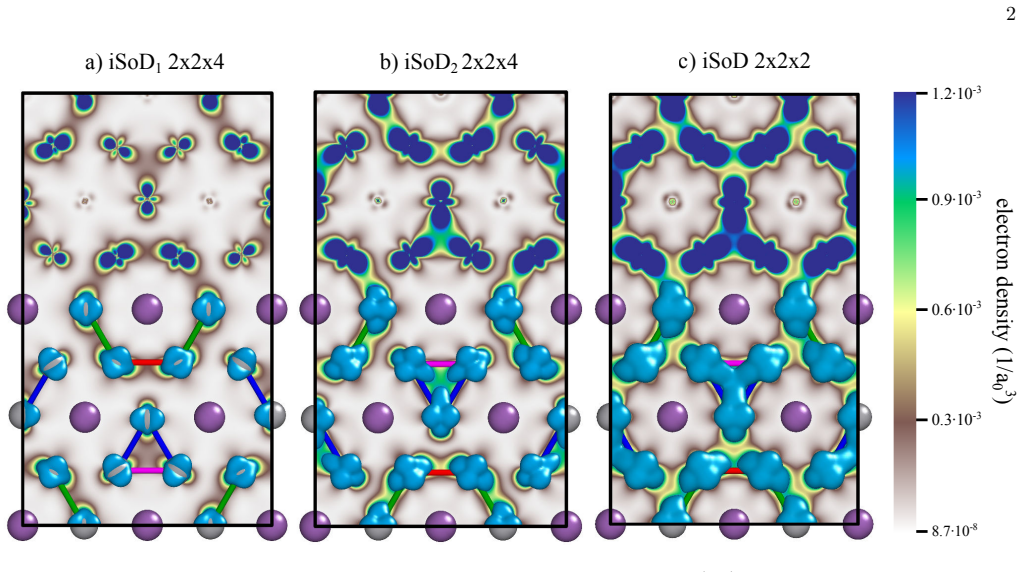
The paper's central claim is that uniaxial strain along a stabilizes a single superlattice domain in the 2x2x4 phase of CsV3Sb5, and the resulting monodomain diffraction pattern proves the phase is intrinsically a double-q modulation. With q1=(0.5,0,-0.25) and q2=(0.5,-0.5,-0.25), a superlattice reflection at q1+q2=(0,0.5,-0.5) appears at (3,-3.5,-0.5), which requires coherent coupling of the two modulations within the same volume. The companion claim is that the low-temperature 2x2x2 phase is remarkably insensitive to the same uniaxial strains: its superlattice intensities, positions, and widths barely change, and it shows no memory of a detwinned 2x2x4 state when cooled into it. Using dens
Load-bearing premise
The central load-bearing assumption is that the strain changes the populations of twin domains rather than the internal superlattice structure; if the modulation inside each domain changed instead, the conclusions about intrinsic double-q order and mobile domain walls would need to be revised.
Editorial extensions
If this is right
- Detwinned 2x2x4 crystals make a full single-domain structural refinement possible, allowing the space group and atomic-scale structure to be established uniquely and settling whether the bulk electronic order is chiral.
- The appearance of a q1+q2 superlattice reflection at l=-0.5 rules out describing the 2x2x4 phase as independent single-q twin domains; any structural model must include coherent coupling of the two modulations.
- The 2x2x2 phase's lack of strain response, even when entered from a detwinned 2x2x4 state, implies that its symmetry breaking and stabilization mechanism differ fundamentally from the 2x2x4 phase.
- The much larger V-V bond disproportionation and the DFT-derived orbital textures in the 2x2x4 phase show that V 3d orbital degrees of freedom and electron-lattice coupling are active in that phase.
- Isotropy-subgroup analysis links the 2x2x4 and 2x2x2 orders to U-point and L-point instabilities, respectively, and excludes chiral space groups for a bulk 2x2x2 order.
Reading between the lines
- If the large strain response comes from mobile domain walls, strain-cycling experiments should show reversible, history-independent intensity changes; a hysteretic response would instead suggest strain-induced pinning or an altered modulation.
- Because the isotropy analysis excludes a chiral bulk 2x2x2 order, previously reported chirality signatures may arise at surfaces, under applied fields, or from another phase; surface-sensitive or field-resolved measurements on detwinned crystals could test this.
- If V 3d orbital textures drive the 2x2x4 order, detwinned crystals should show anisotropic optical or photoemission responses along a versus b; measuring such anisotropy would provide a non-diffraction check of the orbital-coupling picture.
Editorial analysis
A structured set of objections, weighed in public.
Referee Report
Summary. The paper reports a high-resolution x-ray diffraction study of CsV3Sb5 under in-situ uniaxial compressive strain applied along the a-axis. In the 2x2x4 charge-density-wave phase at 80 K, the intensities of superlattice reflections redistribute strongly with strain while their positions and widths remain unchanged. At δϵa ≈ -0.12%, the pattern is consistent with a single domain, and the observation of a reflection at q1+q2 = (1, 0.5, -0.5) is interpreted as evidence that the 2x2x4 phase is intrinsically a double-q modulation with strong mode coupling. The same strain range applied in the low-temperature 2x2x2 phase produces no comparable change in the superlattice pattern. DFT on published structural models is used to suggest distinct orbital-stabilization mechanisms for the two phases. The authors conclude that strain detwins the electronic superlattice and that the domain walls are highly mobile.
Significance. If the detwinning interpretation is correct, this work provides a valuable experimental tool for resolving the long-standing structural ambiguity of the 2x2x4 CDW in AV3Sb5 compounds. The in-situ strain measurement from the (4,2,0) Bragg reflection with 0.01% precision is a methodological strength. The contrasting response of the 2x2x4 and 2x2x2 phases is a clear, falsifiable observation. The DFT orbital textures are illustrative but rest on previously published structural models. The main risk is that the central claim of an intrinsic double-q state and mobile domain walls depends on identifying the intensity redistribution as pure domain-volume change, a point that is plausible but not conclusively established by the present analysis.
major comments (3)
- [Results, Fig. 2(f) and Fig. 3] The assertion that strain only changes domain populations, and not the intra-domain superlattice modulation, is not established by the data. A strain-induced change of the relative amplitudes or phases of the q1 and q2 components inside a single domain would also leave peak positions and widths unchanged and need not shift T1. The cited refs. 22 and 24 constrain the unstrained electronic structure and transition temperature; they do not measure the intra-domain structure under strain. Please provide a quantitative domain-volume analysis: for each candidate domain, the integrated intensities of all reflections belonging to that domain should scale by a common factor as δϵa varies. Without such a test, the 'detwinning' and 'highly mobile domain walls' conclusions are not uniquely supported. This is load-bearing because the q1+q2 observation proves a coherent two-modulation state in the str
- [Results, Fig. 3, q1+q2 argument] The logical step from the appearance of q1+q2 reflections at l=-0.5 to an 'intrinsic double-q modulation' is valid only if the strained state is truly a single domain. Since the paper explicitly leaves open the possibility that strain alters the modulation within a domain (and argues only indirectly against it), the term 'intrinsic' is premature. At minimum, the manuscript should report the integrated intensities of all six (l=-0.5) and all four (l=-0.25) reflections at every strain step and demonstrate that the relative intensities of q1 and q2 and of q1+q2 are strain-independent (within error). If this cannot be demonstrated, the conclusion should be softened to a strain-stabilized double-q state.
- [Methods/Strain determination] The strain-determination section states that the zero-strain offset εa(0) cannot be measured directly and is estimated as -0.02% by comparison with previous work (ref. 21). While the precision of δϵa is excellent, the claim that detwinning occurs at 'δϵa ≃ -0.12%' depends on this offset. Please clarify whether the reported 'gigantic strain response' would be affected if the offset were, e.g., -0.05% instead of -0.02%. The qualitative conclusion is likely robust, but the quantitative comparison with DFT-derived energy scales should be rephrased to emphasize that only relative strain variations are measured directly.
minor comments (5)
- [Fig. 5 caption] The caption states 'δϵa = -0.08%' while the main text says 'a poling strain of δϵa = -0.11% was applied well above T1'. Please correct the inconsistency.
- [Results and Conclusions] The bond-length disproportionation is described as 'up to about 20 times larger' in the Results (2.7% vs. 0.13%) but 'about ten times larger' in the Conclusions. Please use a consistent factor.
- [References] References 23 and 29 do not appear to be cited in the text. Reference 23 is listed as 'Supplementary material'; it should either be cited where the supplement is referenced or removed. Reference 29 (Fecher et al.) also appears unused.
- [DFT, Fig. 6] The energy window for the charge-density plots (50 meV below EF) is not justified. A short sensitivity test (e.g., 25 meV or 100 meV) would strengthen the orbital-texture claim. The current plots are visually suggestive but not quantitative.
- [ISODISTORT analysis] The statement that 'all candidate space groups retain mirror symmetries, thereby excluding a chiral electronic 2x2x2 order in the bulk' is not supported by any tabulated subgroup data. Please provide the isotropy-subgroup output or a citation to a full analysis; this is a strong claim that should be verifiable.
Circularity Check
No significant circularity: the paper's central claims are read directly from new strain-resolved XRD data, not from fitted inputs or self-citation chains.
full rationale
The derivation chain in this manuscript is self-contained with respect to the new experimental results. The core claims—detwinning of the 2x2x4 superlattice, the intrinsic double-q nature of the modulation, and the contrasting strain insensitivity of the 2x2x2 phase—are inferred from strain-dependent XRD intensity maps (Figs. 2 and 3) that are presented as raw measurements. No predicted quantity is defined in terms of the target conclusion, no fitted parameter is renamed as a prediction, and no uniqueness theorem from the authors' prior work is invoked to force a choice. The paper explicitly considers the alternative that strain could alter the intra-domain modulation without changing symmetry or supercell, and excludes it using a combination of observed constant T1, unchanged peak positions/widths, and the tiny change in the a lattice parameter; the cited DFT (ref. 22, with overlapping authors) is used as supporting evidence, but it is a published calculation based on external structural models, not a self-fulfilling input to the present conclusion. Self-citations to earlier work by the same group appear mainly as background agreement (refs. 21, 22), sample provenance, and structural models for DFT; none of these is the load-bearing equivalent of the result being derived. The inference that q1+q2 reflections require coherent coupling within the same volume is a physical argument from the new data, not a definitional tautology. Therefore no step qualifies as circular under the specified criteria.
Assumptions & free parameters
free parameters (2)
- Absolute strain offset ϵa(0) =
-0.02 % (estimated)
- DFT energy window for charge-density plots =
50 meV below E_F to E_F
assumptions (5)
- domain assumption Published structural models of the 2x2x4 and 2x2x2 phases (refs 18, 19, 22, including the mixed iSOD/SoD model of ref 19) are accurate enough for the bond-length and DFT analyses.
- domain assumption Small uniaxial strain changes domain populations but not the modulation within a domain.
- standard math Kinematic diffraction theory applies to the superlattice reflections, so intensities are proportional to domain volumes and a q1+q2 reflection cannot arise from two spatially separated single-q domains.
- standard math ISODISTORT isotropy-subgroup analysis correctly identifies candidate space groups and their mirror symmetries.
- domain assumption LDA-DFT gives reliable energy-resolved electron densities for the orbital-texture analysis.
Cite this review
Pith. "Pith review of Strain-control of electronic superlattice domains in CsV$_{3}$Sb$_{5}$." pith.science (2026). https://pith.science/paper/NBAQZZVU
@misc{pith2026250905680,
  author       = {Pith},
  title        = {Pith review of: Strain-control of electronic superlattice domains in CsV$_3$Sb$_5$},
  year         = {2026},
  howpublished = {\url{https://pith.science/paper/NBAQZZVU}},
  note         = {Machine review of arXiv:2509.05680}
}
abstract
The kagome metals AV$_{3}$Sb$_{5}$ (A = K, Rb, Cs) provide a unique platform to investigate the physics of interacting electrons, a central challenge in condensed matter physics. A key obstacle in unraveling their correlated behavior is to determine which structural and electronic degrees of freedom are involved and how they couple. Here we address this important issue with a novel approach, namely by exploring the strain dependence of electronic superlattices in CsV$_{3}$Sb$_{5}$. Using high-resolution x-ray diffraction, we track the detwinning of the $2\times 2\times 4$ electronic crystal and uncover a gigantic strain response of its domains. We further show that the detwinned $2\times 2\times 4$ phase exhibits an intrinsic 2$\textbf{q}$-modulation and strong mode coupling. Density functional theory reveals that the structural $2\times 2\times 4$ modulation couples strongly to the V $3d$-orbitals, naturally explaining its pronounced strain response. In contrast, the $2\times 2\times 2$ phase at lower temperatures remains essentially unaffected by small uniaxial strain. This dichotomy points to fundamental differences in the symmetry breaking and stabilization mechanisms of the two electronic orders. More specifically, our results provide evidence for the active role of orbital degrees of freedom, which can realize distinct, complex ordering patterns driven by competing interactions.
Figures

Forward citations
Cited by 2 Pith papers
-
Symmetry-Selective Stabilization of Charge-Density Wave in ScV$_6$Sn$_6$
Uniaxial compression along specific in-plane directions stabilizes the CDW state in ScV6Sn6 by lifting domain degeneracy and enhancing T_CDW primarily via ordering of Sn-Sc rattling chains rather than phonon softening.
-
Four-layer charge density waves and chirality in CsV$_3$Sb$_5$
A Ginzburg-Landau stacking analysis of the 2x2x4 CDW in CsV3Sb5 identifies chiral inversion-breaking phases when layer rigidity is relaxed, yet these phases remain rare in the phase diagram.
Reference graph
Works this paper leans on
-
[1]
R. Cava, N. de Leon, and W. Xie, Chemical Reviews 121, 2777 (2021)
work page 2021
- [2]
-
[3]
S. D. Sarma, M. Freedman, and C. Nayak, npj Quantum Information 1, 15001 (2015)
work page 2015
-
[4]
A. R. P. Montblanch, M. Barbone, I. Aharonovich, M. Atat¨ ure, and A. C. Ferrari, Nature Nanotechnology 18, 555 (2023)
work page 2023
-
[5]
R. K. Goyal, S. Maharaj, P. Kumar, and M. Chan- drasekhar, Journal of Materials Science: Materials in En- gineering 20, 4 (2025)
work page 2025
-
[6]
J. Wang, C. Farhang, B. R. Ortiz, S. D. Wilson, and J. Xia, Phys. Rev. Mater. 8, 014202 (2024)
work page 2024
-
[7]
B. R. Ortiz, S. M. L. Teicher, Y. Hu, J. L. Zuo, P. M. Sarte, E. C. Schueller, A. M. M. Abeykoon, M. J. Krogstad, S. Rosenkranz, R. Osborn, R. Seshadri, L. Ba- lents, J. He, and S. D. Wilson, Phys. Rev. Lett. 125, 247002 (2020)
work page 2020
-
[8]
S. D. Wilson and B. R. Ortiz, Nature Reviews Materials 9, 420 (2024)
2024
Show all 36 references
-
[9]
Jiang, J.-X
Y.-X. Jiang, J.-X. Yin, M. M. Denner, N. Shumiya, B. R. Ortiz, G. Xu, Z. Guguchia, J. He, M. S. Hossain, X. Liu, J. Ruff, L. Kautzsch, S. S. Zhang, G. Chang, I. Belopol- ski, Q. Zhang, T. A. Cochran, D. Multer, M. Litskevich, Z.-J. Cheng, X. P. Yang, Z. Wang, R. Thomale, T. Ne-...
2021
-
[10]
Mielke, D
C. Mielke, D. Das, J. X. Yin, H. Liu, R. Gupta, Y. X. Jiang, M. Medarde, X. Wu, H. C. Lei, J. Chang, P. Dai, Q. Si, H. Miao, R. Thomale, T. Neupert, Y. Shi, R. Khasanov, M. Z. Hasan, H. Luetkens, and Z. Guguchia, Nature 602, 245 (2022)
2022
-
[11]
M. L. Kiesel, C. Platt, and R. Thomale, Phys. Rev. Lett. 110, 126405 (2013)
2013
-
[12]
H. Deng, H. Qin, G. Liu, T. Yang, R. Fu, Z. Zhang, X. Wu, Z. Wang, Y. Shi, J. Liu, H. Liu, X.-Y. Yan, W. Song, X. Xu, Y. Zhao, M. Yi, G. Xu, H. Hohmann, S. C. Holbæk, M. D¨ urrnagel, S. Zhou, G. Chang, Y. Yao, Q. Wang, Z. Guguchia, T. Neupert, R. Thomale, M. H. Fischer, and J....
2024
-
[13]
F. H. Yu, T. Wu, Z. Y. Wang, B. Lei, W. Z. Zhuo, J. J. Ying, and X. H. Chen, Phys. Rev. B 104, L041103 (2021)
2021
-
[14]
Y. Xu, Z. Ni, Y. Liu, B. R. Ortiz, Q. Deng, S. D. Wilson, B. Yan, L. Balents, and L. Wu, Nature Physics 18, 1470 (2022)
2022
-
[15]
Farhang, J
C. Farhang, J. Wang, B. R. Ortiz, S. D. Wilson, and J. Xia, Nature Communications 14, 5326 (2023)
2023
-
[16]
H. Li, S. Wan, H. Li, Q. Li, Q. Gu, H. Yang, Y. Li, Z. Wang, Y. Yao, and H.-H. Wen, Phys. Rev. B 105, 045102 (2022)
2022
-
[17]
H. J. Elmers, O. Tkach, Y. Lytvynenko, P. Yogi, M. Schmitt, D. Biswas, J. Liu, S. V. Chernov, Q. Nguyen, M. Hoesch, D. Kutnyakhov, N. Wind, L. Wenthaus, M. Scholz, K. Rossnagel, A. Gloskovskii, C. Schlueter, A. Winkelmann, A.-A. Haghighirad, T.-L. Lee, M. Sing, R. Claessen, M....
2025
-
[18]
Stahl, D
Q. Stahl, D. Chen, T. Ritschel, C. Shekhar, E. Sadrollahi, M. C. Rahn, O. Ivashko, M. v. Zimmermann, C. Felser, and J. Geck, Phys. Rev. B 105, 195136 (2022)
2022
-
[19]
Kautzsch, B
L. Kautzsch, B. R. Ortiz, K. Mallayya, J. Plumb, G. Pokharel, J. P. C. Ruff, Z. Islam, E.-A. Kim, R. Se- shadri, and S. D. Wilson, Phys. Rev. Mater. 7, 024806 (2023)
2023
-
[20]
Q. Xiao, Y. Lin, Q. Li, X. Zheng, S. Francoual, C. Plueck- thun, W. Xia, Q. Qiu, S. Zhang, Y. Guo, J. Feng, and Y. Peng, Phys. Rev. Res. 5, L012032 (2023)
2023
-
[21]
Stahl, M
Q. Stahl, M. Kusch, F. Heinsch, G. Garbarino, N. Kretzschmar, K. Hanff, K. Rossnagel, J. Geck, and T. Ritschel, Nature Commun. 11, 1247 (2020)
2020
-
[22]
Stier, A
F. Stier, A. A. Haghighirad, G. Garbarino, S. Mishra, N. Stilkerich, D. Chen, C. Shekhar, T. Lacmann, C. Felser, T. Ritschel, J. Geck, and M. L. Tacon, Phys. Rev. Lett. 133, 236503 (2024)
2024
-
[23]
Supplementary material
-
[24]
T. Qian, M. H. Christensen, C. Hu, A. Saha, B. M. An- dersen, R. M. Fernandes, T. Birol, and N. Ni, Phys. Rev. B 104, 144506 (2021)
2021
-
[25]
Fujimoto, The Physics of Structural Phase Transi- tions, 2nd ed., Solid-State Sciences, Vol
M. Fujimoto, The Physics of Structural Phase Transi- tions, 2nd ed., Solid-State Sciences, Vol. 91 (Springer, 2015)
2015
-
[26]
G. He, L. Peis, E. F. Cuddy, Z. Zhao, D. Li, Y. Zhang, R. Stumberger, B. Moritz, H. Yang, H. Gao, T. P. Dev- ereaux, and R. Hackl, Nature Communications 15, 1895 (2024)
2024
-
[27]
B. J. Campbell, H. T. Stokes, D. E. Tanner, and D. M. Hatch, Journal of Applied Crystallography 39, 607 (2006)
2006
-
[28]
H. T. Stokes, D. M. Hatch, and B. J. Campbell, ISODIS- TORT, ISOTROPY Software Suite, https://iso.byu. edu
-
[29]
G. H. Fecher, J. K¨ ubler, and C. Felser, Materials (Basel) 15, 10.3390/ma15175812 (2022)
2022 doi
-
[30]
Ikhlas, K
M. Ikhlas, K. R. Shirer, P.-Y. Yang, A. P. Mackenzie, S. Nakatsuji, and C. W. Hicks, Applied Physics Letters 117, 233502 (2020)
2020
-
[31]
E. B. Knudsen, H. O. Sørensen, J. P. Wright, G. Goret, and J. Kieffer, J. Appl. Cryst. 46, 537–539 (2013)
2013
-
[32]
Agilent, CrysAlis PRO (Agilent Technologies Ltd, Yarn- ton, Oxfordshire, England, 2014). 9
2014
-
[33]
Kieffer, J
J. Kieffer, J. Orlans, N. Coquelle, S. Debionne, S. Basu, A. Homs, G. Santonia, and D. De Sanctis, J. Appl. Cryst. 58 (2025)
2025
-
[34]
Full-potential nonorthogonal local-orbital minimum-basis band- structure scheme,
Klaus Koepernik and Helmut Eschrig, “Full-potential nonorthogonal local-orbital minimum-basis band- structure scheme,” Phys. Rev. B 59, 1743–1757 (1999)
1999
-
[35]
Accurate and simple analytic representation of the electron-gas correlation en- ergy,
John P. Perdew and Yue Wang, “Accurate and simple analytic representation of the electron-gas correlation en- ergy,” Phys. Rev. B 45, 13244–13249 (1992)
1992
-
[36]
High-precision sam- pling for Brillouin-zone integration in metals,
M. Methfessel and A. T. Paxton, “High-precision sam- pling for Brillouin-zone integration in metals,” Phys. Rev. B 40, 3616–3621 (1989) . Acknowledgments This research has been supported by the Deutsche Forschungsgemeinschaft through SFB 1143 (project-id 247310070), the W¨ urz...
1989
Reviewed August 5, 2026 · model on record in the stance chip above.
Discussion (0). Sign in to comment.