Deterministic nuclear spin squeezing and squeezing by continuous measurement using vector and tensor light shifts
Pith reviewed 2026-05-18 17:50 UTC · model grok-4.3
The pith
Joint vector and tensor light shifts create short-time measurement squeezing and longer-time deterministic squeezing of nuclear spins.
A machine-rendered reading of the paper's core claim, the machinery that carries it, and where it could break.
Core claim
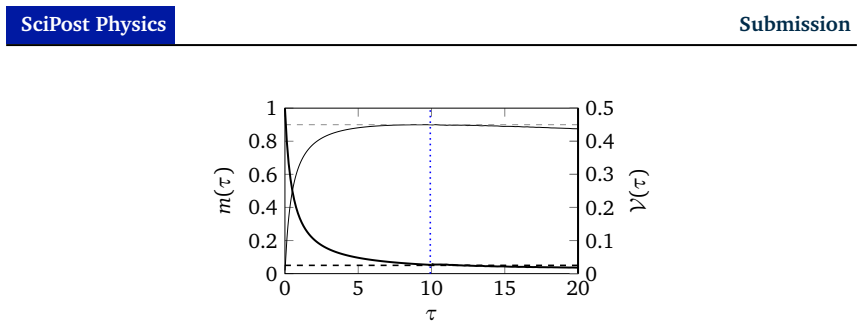
Depending on the ratio ε between tensor and vector coupling and the measurement rate Γ, the joint light shifts produce quantum non-demolition measurement squeezing for times shorter than (√ε Γ)^{-1} and deterministic squeezing for times longer than (ε Γ)^{-1}.
What carries the argument
The ratio ε of tensor to vector light-shift couplings, which governs the crossover between continuous-measurement squeezing and deterministic squeezing in polarized nuclear spins.
If this is right
- Nuclear-spin variance reduction becomes available without continuous measurement once the deterministic regime is reached.
- Fermionic isotopes with purely nuclear ground states gain a practical route to squeezing because of their intrinsically low decoherence.
- Cavity parameters already realized in existing experiments suffice to reach variance reductions of order 0.03.
Where Pith is reading between the lines
- The same light-shift combination could be tested in optical lattices or free-space ensembles to check whether the predicted time scales hold outside cavities.
- If the deterministic regime works as described, it may relax the need for high-finesse cavities in future spin-squeezing metrology.
Load-bearing premise
The atoms remain polarized and the combined vector and tensor light shifts dominate all other decoherence channels over the time scales set by ε and Γ.
What would settle it
Direct measurement of the nuclear spin variance in ytterbium-173 atoms inside a cavity showing no reduction below the initial value once the interaction time exceeds (ε Γ)^{-1}.
Figures




read the original abstract
We study the joint effects of vector and tensor light shifts in a set of large spin atoms, prepared in a polarized state and interacting with light. Depending on the ratio $\epsilon$ between tensor and vector coupling and a measurement rate $\Gamma$, we identify a regime of quantum non-demolition measurement squeezing for times shorter than $(\sqrt{\epsilon}\Gamma)^{-1}$, and a deterministic squeezing regime for times longer than $(\epsilon \Gamma)^{-1}$. We apply our results to fermionic isotopes of strontium, ytterbium, and helium, which are atoms with purely nuclear spin in their ground state, benefiting from very low decoherence. For ytterbium 173, with a cavity such as that of \cite{Thompson2021}, it would be possible to achieve an atomic spin variance reduction of $0.03$ in $\simeq 50 \rm ms$.
Editorial analysis
A structured set of objections, weighed in public.
Referee Report
Summary. The manuscript analyzes the joint action of vector and tensor light shifts on large-spin atoms held in a polarized state. It derives two distinct squeezing regimes controlled by the tensor-to-vector ratio ε and the measurement rate Γ: a QND measurement squeezing regime active for times shorter than (√ε Γ)^{-1} and a deterministic squeezing regime for times longer than (ε Γ)^{-1}. The framework is applied to fermionic isotopes of strontium, ytterbium and helium; for 173Yb in a cavity comparable to that of Thompson et al. (2021) the authors predict an atomic spin variance of 0.03 after roughly 50 ms.
Significance. If the regime separation and numerical forecast survive detailed scrutiny, the work supplies a concrete, low-decoherence route to deterministic nuclear-spin squeezing that could benefit quantum metrology and sensing protocols. The explicit time-scale hierarchy in terms of measurable parameters ε and Γ offers a useful experimental design tool. The absence of step-by-step derivations, error budgets or direct comparison with the full master equation nevertheless keeps the immediate impact modest.
major comments (2)
- [deterministic regime derivation] The deterministic-squeezing regime (abstract and the section deriving the long-time dynamics) rests on the assumption that the collective spin remains inside the polarized manifold for t ≫ (ε Γ)^{-1}. The tensor term proportional to ε can generate differential phases across m_F sublevels; no quantitative bound is given showing that these phases remain negligible compared with the squeezing timescale, which directly affects whether the reported variance reduction of 0.03 is attainable.
- [application to Yb-173] The numerical prediction of 0.03 variance reduction for 173Yb in ≃50 ms (abstract) is stated without an accompanying error analysis or explicit dependence on the cavity parameters taken from Thompson2021. Because the result is presented as a concrete experimental target, the missing propagation of uncertainties in Γ, ε and residual decoherence rates weakens the claim.
minor comments (2)
- Notation for the vector and tensor coupling strengths is introduced without a compact table relating them to the physical parameters of the cited cavity; adding such a table would improve readability.
- The abstract states clear regime boundaries yet the main text does not include a short appendix or figure that plots the crossover times versus ε for fixed Γ; such a plot would help experimentalists.
Simulated Author's Rebuttal
We thank the referee for the careful reading and constructive comments on our manuscript. We address each major comment below and indicate the revisions planned for the next version.
read point-by-point responses
-
Referee: The deterministic-squeezing regime (abstract and the section deriving the long-time dynamics) rests on the assumption that the collective spin remains inside the polarized manifold for t ≫ (ε Γ)^{-1}. The tensor term proportional to ε can generate differential phases across m_F sublevels; no quantitative bound is given showing that these phases remain negligible compared with the squeezing timescale, which directly affects whether the reported variance reduction of 0.03 is attainable.
Authors: We agree that an explicit quantitative bound on the differential phases induced by the tensor light shift would strengthen the justification for remaining in the polarized manifold. Our derivation of the long-time deterministic regime assumes that tensor-induced dephasing across sublevels remains perturbative on the squeezing timescale set by εΓ. In the revised manuscript we will insert a short subsection that estimates the accumulated phase spread δφ ≈ ε Γ t for t ∼ (ε Γ)^{-1} and shows that, for the 173Yb parameters used, δφ remains ≪ 1 radian while the squeezing variance reaches 0.03. This bound directly supports the validity of the reported result. revision: yes
-
Referee: The numerical prediction of 0.03 variance reduction for 173Yb in ≃50 ms (abstract) is stated without an accompanying error analysis or explicit dependence on the cavity parameters taken from Thompson2021. Because the result is presented as a concrete experimental target, the missing propagation of uncertainties in Γ, ε and residual decoherence rates weakens the claim.
Authors: We concur that an explicit dependence on cavity parameters and a brief error budget would make the numerical target more useful. The quoted variance of 0.03 is obtained by inserting the measured cavity linewidth and atom-cavity coupling strength from Thompson et al. (2021) into our expression for the long-time squeezing variance, together with the calculated tensor-to-vector ratio ε for 173Yb. In the revised manuscript we will add a short paragraph (and accompanying figure or table) that (i) writes the variance explicitly in terms of Γ and ε, (ii) propagates the reported uncertainties in those quantities, and (iii) estimates the effect of residual decoherence rates consistent with the same cavity. This will clarify the robustness of the 50 ms prediction. revision: yes
Circularity Check
Derivation of squeezing regimes is self-contained
full rationale
The paper derives the identified QND measurement squeezing regime for t ≪ (√ε Γ)^{-1} and deterministic squeezing regime for t ≫ (ε Γ)^{-1} directly from the joint vector and tensor light-shift Hamiltonian acting on a polarized collective spin, with the time-scale hierarchy following from the relative strength ε of the tensor term and the measurement rate Γ in the master equation. The numerical projection for Yb-173 uses external cavity parameters quoted from Thompson2021 and does not reduce any central claim to a tautological fit or self-definition. No load-bearing step collapses to a prior self-citation, ansatz smuggling, or renaming of an input; the polarized-state assumption is stated explicitly as a modeling choice rather than derived from the result itself.
Axiom & Free-Parameter Ledger
free parameters (2)
- ε
- Γ
axioms (1)
- domain assumption Atoms are prepared in a polarized state and interact with light primarily through vector and tensor shifts without dominant competing decoherence channels in the identified time windows.
Lean theorems connected to this paper
-
IndisputableMonolith/Cost/FunctionalEquation.leanwashburn_uniqueness_aczel unclear?
unclearRelation between the paper passage and the cited Recognition theorem.
We identify a regime of quantum non-demolition measurement squeezing for times shorter than (√ε Γ)^{-1}, and a deterministic squeezing regime for times longer than (ε Γ)^{-1}. ... asymptotic noise reduction equal to ε
-
IndisputableMonolith/Foundation/BranchSelection.leanbranch_selection unclear?
unclearRelation between the paper passage and the cited Recognition theorem.
H=ħhΩ_V P P_c + ħhΩ_T X X_c
What do these tags mean?
- matches
- The paper's claim is directly supported by a theorem in the formal canon.
- supports
- The theorem supports part of the paper's argument, but the paper may add assumptions or extra steps.
- extends
- The paper goes beyond the formal theorem; the theorem is a base layer rather than the whole result.
- uses
- The paper appears to rely on the theorem as machinery.
- contradicts
- The paper's claim conflicts with a theorem or certificate in the canon.
- unclear
- Pith found a possible connection, but the passage is too broad, indirect, or ambiguous to say the theorem truly supports the claim.
Reference graph
Works this paper leans on
-
[1]
J. A. Muniz, D. J. Young, J. R. K. Cline and J. K. Thompson, Cavity-qed measurements of the ^ 87 Sr millihertz optical clock transition and determination of its natural linewidth , Phys. Rev. Res. 3, 023152 (2021), doi:10.1103/PhysRevResearch.3.023152
-
[2]
G. Santarelli, P. Laurent, P. Lemonde, A. Clairon, A. G. Mann, S. Chang, A. N. Luiten and C. Salomon, Quantum projection noise in an atomic fountain: A high stability cesium frequency standard, Phys. Rev. Lett. 82, 4619 (1999), doi:10.1103/PhysRevLett.82.4619
-
[3]
V. Shah, G. Vasilakis and M. V. Romalis, High bandwidth atomic magnetometery with continuous quantum nondemolition measurements, Phys. Rev. Lett. 104, 013601 (2010), doi:10.1103/PhysRevLett.104.013601
-
[4]
W. Wasilewski, K. Jensen, H. Krauter, J. J. Renema, M. V. Balabas and E. S. Polzik, Quantum noise limited and entanglement-assisted magnetometry, Phys. Rev. Lett. 104, 133601 (2010), doi:10.1103/PhysRevLett.104.133601
-
[5]
A. Gauguet, B. Canuel, T. L\'ev\`eque, W. Chaibi and A. Landragin, Characterization and limits of a cold-atom sagnac interferometer, Phys. Rev. A 80, 063604 (2009), doi:10.1103/PhysRevA.80.063604
-
[6]
F. Sorrentino, Q. Bodart, L. Cacciapuoti, Y.-H. Lien, M. Prevedelli, G. Rosi, L. Salvi and G. M. Tino, Sensitivity limits of a raman atom interferometer as a gravity gradiometer, Phys. Rev. A 89, 023607 (2014), doi:10.1103/PhysRevA.89.023607
-
[7]
C. Janvier, V. M\'enoret, B. Desruelle, S. Merlet, A. Landragin and F. Pereira dos Santos, Compact differential gravimeter at the quantum projection-noise limit, Phys. Rev. A 105, 022801 (2022), doi:10.1103/PhysRevA.105.022801
-
[8]
D. J. Wineland, J. J. Bollinger, W. M. Itano, F. L. Moore and D. J. Heinzen, Spin squeezing and reduced quantum noise in spectroscopy, Phys. Rev. A 46, R6797 (1992), doi:10.1103/PhysRevA.46.R6797
-
[9]
M. Kitagawa and M. Ueda, Squeezed spin states, Phys. Rev. A 47, 5138 (1993), doi:10.1103/PhysRevA.47.5138
-
[10]
T. Takano, M. Fuyama, R. Namiki and Y. Takahashi, Spin squeezing of a cold atomic ensemble with the nuclear spin of one-half, Phys. Rev. Lett. 102, 033601 (2009), doi:10.1103/PhysRevLett.102.033601
-
[11]
C. Gross, T. Zibold, E. Nicklas, J. Est \`e ve and M. K. Oberthaler, Nonlinear atom interferometer surpasses classical precision limit, Nature 464(7292), 1165 (2010), doi:10.1038/nature08919
-
[12]
M. F. Riedel, P. B \"o hi, Y. Li, T. W. H \"a nsch, A. Sinatra and P. Treutlein, Atom-chip-based generation of entanglement for quantum metrology, Nature 464(7292), 1170 (2010), doi:10.1038/nature08988
-
[13]
W. Muessel, H. Strobel, D. Linnemann, D. B. Hume and M. K. Oberthaler, Scalable spin squeezing for quantum-enhanced magnetometry with bose-einstein condensates, Phys. Rev. Lett. 113, 103004 (2014), doi:10.1103/PhysRevLett.113.103004
-
[14]
O. Hosten, N. J. Engelsen, R. Krishnakumar and M. A. Kasevich, Measurement noise 100 times lower than the quantum-projection limit using entangled atoms, Nature 529(7587), 505 (2016), doi:10.1038/nature16176
-
[15]
L. Pezz\`e, A. Smerzi, M. K. Oberthaler, R. Schmied and P. Treutlein, Quantum metrology with nonclassical states of atomic ensembles, Rev. Mod. Phys. 90, 035005 (2018), doi:10.1103/RevModPhys.90.035005
-
[16]
J. M. Robinson, M. Miklos, Y. M. Tso, C. J. Kennedy, T. Bothwell, D. Kedar, J. K. Thompson and J. Ye, Direct comparison of two spin-squeezed optical clock ensembles at the 10-17 level, Nature Physics 20(2), 208 (2024), doi:10.1038/s41567-023-02310-1
-
[17]
S. Blatt, A. D. Ludlow, G. K. Campbell, J. W. Thomsen, T. Zelevinsky, M. M. Boyd, J. Ye, X. Baillard, M. Fouch\'e, R. Le Targat, A. Brusch, P. Lemonde et al., New limits on coupling of fundamental constants to gravity using ^ 87 Sr optical lattice clocks , Phys. Rev. Lett. 100, 140801 (2008), doi:10.1103/PhysRevLett.100.140801
-
[18]
Y. A. Yang, W.-T. Luo, J.-L. Zhang, S.-Z. Wang, C.-L. Zou, T. Xia and Z.-T. Lu, Minute-scale schr \"o dinger-cat state of spin-5/2 atoms , Nature Photonics 19(1), 89 (2025), doi:10.1038/s41566-024-01555-3
-
[19]
D. Burba, H. Dunikowski, M. Robert-de Saint-Vincent, E. Witkowska and G. Juzeli u \= u nas, Effective light-induced hamiltonian for atoms with large nuclear spin, Phys. Rev. Res. 6, 033293 (2024), doi:10.1103/PhysRevResearch.6.033293
- [20]
-
[21]
A. Serafin, Y. Castin, M. Fadel, P. Treutlein and A. Sinatra, \'etude th\'eorique de la compression de spin nucl\'eaire par mesure quantique non destructive en continu, Comptes Rendus. Physique 22(1), 1 (2021), doi:10.5802/crphys.71
-
[22]
A. Serafin, M. Fadel, P. Treutlein and A. Sinatra, Nuclear spin squeezing in helium-3 by continuous quantum nondemolition measurement, Phys. Rev. Lett. 127, 013601 (2021), doi:10.1103/PhysRevLett.127.013601
-
[23]
M. Fadel, P. Treutlein and A. Sinatra, Effective faraday interaction between light and nuclear spins of helium-3 in its ground state: a semiclassical study, New Journal of Physics 26(10), 103037 (2024), doi:10.1088/1367-2630/ad8953
-
[24]
C. Gemmel, W. Heil, S. Karpuk, K. Lenz, C. Ludwig, Y. Sobolev, K. Tullney, M. Burghoff, W. Kilian, S. Knappe-Gr \"u neberg, W. M \"u ller, A. Schnabel et al., Ultra-sensitive magnetometry based on free precession of nuclear spins, The European Physical Journal D 57(3), 303 (2010), doi:10.1140/epjd/e2010-00044-5
-
[25]
N. Aggarwal, A. Schnabel, J. Voigt, A. Brown, J. C. Long, S. Knappe-Grueneberg, W. Kilian, A. Fang, A. A. Geraci, A. Kapitulnik, D. Kim, Y. Kim et al., Characterization of magnetic field noise in the ariadne source mass rotor, Phys. Rev. Res. 4, 013090 (2022), doi:10.1103/PhysRevResearch.4.013090
-
[26]
E. Boyers, G. Goldstein and A. O. Sushkov, Spin squeezing of macroscopic nuclear spin ensembles, Phys. Rev. D 111, 052004 (2025), doi:10.1103/PhysRevD.111.052004
-
[27]
G. Vasilakis, H. Shen, K. Jensen, M. Balabas, D. Salart, B. Chen and E. S. Polzik, Generation of a squeezed state of an oscillator by stroboscopic back-action-evading measurement, Nature Physics 11(5), 389 (2015), doi:10.1038/nphys3280
-
[28]
H. Bao, J. Duan, S. Jin, X. Lu, P. Li, W. Qu, M. Wang, I. Novikova, E. Mikhailov, K. Zhao, K. Mølmer, H. Shen et al., Spin squeezing of 1011 atoms by prediction and retrodiction measurements, Nature 581, 159 (2020), doi:10.1038/s41586-020-2243-7
-
[29]
I. H. Deutsch and P. S. Jessen, Quantum control and measurement of atomic spins in polarization spectroscopy, Optics Communications 283(5), 681 (2010), doi:https://doi.org/10.1016/j.optcom.2009.10.059, Quo vadis Quantum Optics?
-
[30]
J. M. Geremia, J. K. Stockton and H. Mabuchi, Tensor polarizability and dispersive quantum measurement of multilevel atoms, Phys. Rev. A 73, 042112 (2006), doi:10.1103/PhysRevA.73.042112
-
[31]
Z. Kurucz and K. M lmer, Multilevel holstein-primakoff approximation and its application to atomic spin squeezing and ensemble quantum memories, Phys. Rev. A 81, 032314 (2010), doi:10.1103/PhysRevA.81.032314
-
[32]
J. Cviklinski, A. Dantan, J. Ortalo and M. Pinard, Conditional squeezing of an atomic alignment, Phys. Rev. A 76, 033830 (2007), doi:10.1103/PhysRevA.76.033830
-
[33]
C. A. Muschik, K. Hammerer, E. S. Polzik and J. I. Cirac, Efficient quantum memory and entanglement between light and an atomic ensemble using magnetic fields, Phys. Rev. A 73, 062329 (2006), doi:10.1103/PhysRevA.73.062329
-
[34]
K. Hammerer, A. S. S rensen and E. S. Polzik, Quantum interface between light and atomic ensembles, Rev. Mod. Phys. 82, 1041 (2010), doi:10.1103/RevModPhys.82.1041
-
[35]
M. Koschorreck, M. Napolitano, B. Dubost and M. W. Mitchell, Quantum nondemolition measurement of large-spin ensembles by dynamical decoupling, Phys. Rev. Lett. 105, 093602 (2010), doi:10.1103/PhysRevLett.105.093602
-
[36]
E. Pedrozo-Pe \ n afiel, S. Colombo, C. Shu, A. F. Adiyatullin, Z. Li, E. Mendez, B. Braverman, A. Kawasaki, D. Akamatsu, Y. Xiao and V. Vuleti \' c , Entanglement on an optical atomic-clock transition, Nature 588(7838), 414 (2020), doi:10.1038/s41586-020-3006-1
-
[37]
C. B rentsen, S. A. Fedorov, C. stfeldt, M. V. Balabas, E. Zeuthen and E. S. Polzik, Squeezed light from an oscillator measured at the rate of oscillation, Nature Communications 15(1), 4146 (2024), doi:10.1038/s41467-024-47906-0
-
[38]
P. E. Atkinson, J. S. Schelfhout and J. J. McFerran, Hyperfine constants and line separations for the ^ 1 s_ 0 - ^ 3 p_ 1 intercombination line in neutral ytterbium with sub-doppler resolution , Phys. Rev. A 100, 042505 (2019), doi:10.1103/PhysRevA.100.042505
-
[39]
T. P \"o pplau, Towards strong coupling of strontium to a miniature ring cavity , Theses, Sorbonne Universit \'e (2019)
work page 2019
-
[40]
K. M lmer, Y. Castin and J. Dalibard, Monte carlo wave-function method in quantum optics, J. Opt. Soc. Am. B 10(3), 524 (1993), doi:10.1364/JOSAB.10.000524
-
[41]
Gisin, Quantum measurements and stochastic processes, Phys
N. Gisin, Quantum measurements and stochastic processes, Phys. Rev. Lett. 52, 1657 (1984), doi:10.1103/PhysRevLett.52.1657
-
[42]
L. B. Madsen and K. M lmer, Spin squeezing and precision probing with light and samples of atoms in the gaussian description, Phys. Rev. A 70, 052324 (2004), doi:10.1103/PhysRevA.70.052324
-
[43]
H. Tanji-Suzuki, I. D. Leroux, M. H. Schleier-Smith, M. Cetina, A. T. Grier, J. Simon and V. Vuleti \' c , Chapter 4 - interaction between atomic ensembles and optical resonators: Classical description, In E. Arimondo, P. Berman and C. Lin, eds., Advances in Atomic, Molecular, and Optical Physics, vol. 60 of Advances In Atomic, Molecular, and Optical Phys...
-
[44]
T. R. Gentile, P. J. Nacher, B. Saam and T. G. Walker, Optically polarized ^ 3 He , Rev. Mod. Phys. 89, 045004 (2017), doi:10.1103/RevModPhys.89.045004
-
[45]
H. A. Bethe, Zur Theorie der Metalle. i. Eigenwerte und Eigenfunktionen der linearen Atomkette , Zeit. f \"u r Phys. 71 , 205 (1931), 10.1007\
work page 1931
-
[46]
It was twenty years ago today ...
P. Ginsparg, It was twenty years ago today... , http://arxiv.org/abs/1108.2700
work page internal anchor Pith review Pith/arXiv arXiv
-
[47]
, " * write output.state after.block =
ENTRY address archive author booktitle chapter doi edition editor eid eprint howpublished institution isbn journal key month note number organization pages publisher school series title type url volume year label INTEGERS output.state before.all mid.sentence after.sentence after.block FUNCTION init.state.consts #0 'before.all := #1 'mid.sentence := #2 'af...
-
[48]
" write newline "" before.all 'output.state := FUNCTION n.dashify 't := "" t empty not t #1 #1 substring "-" = t #1 #2 substring "--" = not "--" * t #2 global.max substring 't := t #1 #1 substring "-" = "-" * t #2 global.max substring 't := while if t #1 #1 substring * t #2 global.max substring 't := if while FUNCTION word.in bbl.in capitalize " " * FUNCT...
discussion (0)
Sign in with ORCID, Apple, or X to comment. Anyone can read and Pith papers without signing in.