REVIEW 3 major objections 4 minor 54 references
Improving the runtime of quantum phase estimation for chemistry through basis set optimization
T0 review · 3 major / 4 minor · reviewed 2026-08-05 · deepseek-v4-flash
Pith's one-line read The paper argues that the cost of quantum phase estimation for molecular ground states can be cut by up to 80%—and the required orbital count by 55%—by computing frozen natural orbitals in a large basis set and then truncating the virtual s
desk verdict Large-basis FNOs are a plausible and genuinely useful resource win for QPE planning, but the accuracy claim rests on a correlation-energy proxy that does not control total-energy error. read the letter →
The pith
A machine-rendered reading of the paper's core claim, the machinery that carries it, and where it could break.
The reading
What carries the argument
Frozen natural orbitals (FNOs): eigenvectors of the MP2 one-electron density matrix, ranked by occupation number, used to truncate the virtual space. Eq. 24 anchors the comparison: correlation energy is CCSD(T) in the chosen orbital basis minus Hartree–Fock, and the gate requires the truncated-space value within 1 mHa of the canonical small-basis result. Cost is measured by the double-factorization 1-norm λ_DF = Σ_k|f∅_k| + (1/4)Σ_t(Σ_k|W^t_k|)². Invariant under orbital rotations and growing roughly quadratically with orbital count, λ_DF turns orbital reduction directly into runtime reduction via qubitization cost (λ/ε_QPE)·C_W.
What would settle it
Compare total CCSD(T) energies (Hartree–Fock plus correlation) between the truncated large-basis FNO space and the canonical small-basis reference: if the Eq. 24 gate passes (ΔE_corr < 1 mHa) while total energies deviate by more than chemical accuracy (~1.6 mHa), the accuracy-preservation claim fails. A second check: apply the large-basis FNO recipe to a strongly correlated molecule where MP2 natural occupations are known to mis-rank virtual orbitals, and test whether the reported 80% and 55% savings survive at fixed total-energy accuracy.
Extended reading notes
Core claim
The load-bearing result, stated in Section 1: for fixed target accuracy, compute frozen natural orbitals in a large, over-performing basis set and then truncate, rather than start from a smaller basis. FNOs from cc-pVTZ truncated to reproduce cc-pVDZ CCSD(T) correlation energy give 30–60% reductions in the double-factorization 1-norm; FNOs from cc-pVQZ to reproduce cc-pVTZ accuracy reach nearly 80% norm and 55% orbital reduction. The N2 dissociation study shows the same ordering even where MP2 fails qualitatively. The paper reads this as evidence that the quality of the orbital basis—its capacity to capture correlation—determines QPE efficiency, not the raw size of the starting basis.
Load-bearing premise
The paper's accuracy gate (Eq. 24) requires the CCSD(T) correlation energy in the truncated large-basis FNO space to match the small-basis canonical CCSD(T) correlation energy to within 1 mHa, and assumes this correlation-energy match guarantees the total ground-state energy accuracy that chemistry requires, with thresholds tuned on 58 small closed-shell molecules carried over to systems like stretched N2.
Editorial extensions
If this is right
- At a fixed 1 mHa correlation-energy accuracy, the large-basis FNO route dominates: triple-zeta-derived spaces beat double-zeta-derived ones by 30–60% in 1-norm, and quadruple-zeta-derived spaces beat triple-zeta-derived ones by up to 80%.
- The two savings compound directly in the QPE cost estimate: fewer orbitals lowers the block-encoding cost C_W, and the lower λ lowers the number of walk-operator applications, since qubitization cost scales as (λ/ε_QPE)·C_W.
- Direct optimization of Gaussian exponents and contraction coefficients is not a viable scaling route: 1-norm gains stay below about 10%, shrink with molecular size, and carry small energy penalties.
- For N2 dissociation, the triple-zeta-derived FNO space is cheaper and at least as accurate as the double-zeta-derived one at every bond length, including stretched geometries where MP2 correlation energies are unreliable.
- The double-factorization 1-norm converges at NDF = 7N along the N2 curve, so block-encoding cost is governed essentially by the retained orbital count; orbital reduction is therefore the primary lever among the ones studied.
Reading between the lines
- The two headline numbers look like two views of one effect: since λ grows roughly quadratically with orbital count (Appendix A), a 55% orbital reduction predicts about an 80% norm reduction (0.45² ≈ 0.20)—the ratio the paper reports.
- Eq. 24 gates accuracy on CCSD(T) correlation energy only, not total energy; because Hartree–Fock energies differ between basis sets, the natural stress test is whether truncated large-basis FNO total energies keep within chemical accuracy of the canonical small-basis totals.
- The paper's accuracy metric is total energy alone; convergence of other observables, such as nuclear forces and dipole moments, is untested, so the method's reach beyond ground-state energetics is open.
- Truncation thresholds tuned on 58 small closed-shell molecules are carried over to stretched N2; for genuinely multireference systems where MP2 natural-occupation rankings mis-order the virtual space, the same compression story would need re-validation with other orbital generators before the savings could be trusted.
Editorial analysis
A structured set of objections, weighed in public.
Referee Report
Summary. The paper investigates two basis-set strategies for reducing the cost of quantum phase estimation (QPE) for molecular ground-state energies. The first strategy optimizes Gaussian exponents and contraction coefficients to minimize the double-factorized 1-norm while preserving CISD energy accuracy; it reports up to about 10% norm reduction but with system-dependent and diminishing gains. The second and central strategy uses frozen natural orbitals (FNOs) derived from a large basis set, truncating the virtual space so that the CCSD(T) correlation energy matches a smaller-basis canonical reference to within 1 mHa. On a dataset of 58 small molecules and the N2 dissociation curve, the authors report up to 80% reduction in the 1-norm and up to 55% reduction in the number of orbitals, and conclude that large-basis FNOs reduce QPE resource requirements without compromising accuracy.
Significance. If the central FNO claim is validated, the work is practically significant: it offers a simple, physically motivated preprocessing step that can be combined with tensor factorization and other resource-reduction methods to lower QPE costs for systems with dynamic correlation. The study has concrete strengths: the DF 1-norm is evaluated explicitly, the accuracy of the FNO truncation is checked against independent CCSD(T) benchmarks, the numerical protocol (PySCF, Dice) is described in enough detail to be reproduced, and the inclusion of an N2 dissociation curve addresses static correlation. However, the accuracy metric used throughout is the correlation energy, Eq. (24), while QPE returns total energies. The paper does not yet establish that the reported resource reductions are achieved at fixed total-energy accuracy, so the central 'without compromising accuracy' claim needs additional validation.
major comments (3)
- [Section 3.2, Eq. (24), Figs. 2-3] The accuracy gate for the FNO strategy is a correlation-energy difference: E_NO,TZ_corr - E_MO,DZ_corr < 1 mHa (and similarly for TZ/QZ). QPE, however, estimates total energies. For a TZ-derived FNO space the total energy is E_TZ_HF + E_corr(FNO,TZ), while the DZ reference total energy is E_DZ_HF + E_corr(DZ). The criterion does not control the Hartree-Fock basis-set gap E_TZ_HF - E_DZ_HF, which is typically tens of mHa for these molecules. Thus the reported improvements in lambda and orbital count at 'fixed target accuracy' are not yet tied to the quantity QPE actually computes. Please add total-energy comparisons against a high-level/CBS reference (or at least report E_TZ_HF + E_corr(FNO,TZ) and E_DZ_HF + E_corr(DZ) separately), and state explicitly whether the QPE target is total energy or correlation energy.
- [Section 3.2, N2 dissociation (Fig. 4)] The N2 demonstration compares SCI(DZ, sigma_NO=1e-4) with SCI(TZ, sigma_NO=1e-3), with thresholds selected from mean occupation numbers rather than from a fixed-accuracy criterion. The conclusion that TZ FNOs are 'always better' in both cost and correlation energy is based on a low-order SCI without perturbative correction and an approximate CASSCF+NEVPT2 reference. To support the fixed-accuracy claim for a strongly correlated system, please provide a quantitative error metric (e.g., deviation from FCI or a large-basis reference along the dissociation curve) and show convergence with respect to both the SCI threshold and the FNO truncation threshold. Without this, the comparison is between two arbitrary truncation choices rather than two methods at equal accuracy.
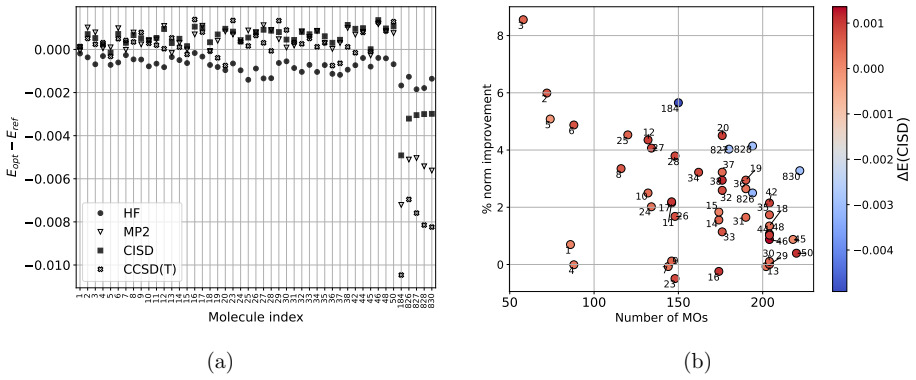
- [Section 3.1, Tables 2-3] The basis-optimization strategy is not the central FNO claim, but the reporting in Section 3.1 contains a selection issue: for each atom the 'optimal basis' is chosen as the gamma value yielding the best performance, and gamma is varied per atom. The improvements in Fig. 1b are therefore best-case over a small set of gamma values, and Fig. 1a shows that correlation energies often worsen in the optimized basis. This should be clearly presented as a negative or limited result, and the dependence of the reported percentages on the chosen gamma values should be stated. This does not block the FNO claim but affects the interpretation of the first half of the paper.
minor comments (4)
- [Section 3.2 (N2 paragraph)] The text says 'selected based on previous observations of the mean occupation numbers found in Section 3.1'; this should be Section 3.2, since the occupation numbers are reported there.
- [Eq. (24)] The notation E^ORB,BS_corr is visually confusing because the superscript contains two labels. Please define E_corr^{ORB,BS} explicitly and use it consistently in the text and figures.
- [Figs. 2 and 3] The color scale indicating the correlation-energy difference is not visible/legible in the provided figures. Please add a colorbar and, if needed, a table of numerical values for the molecules with the largest deviations.
- [Abstract and Section 3.2] The abstract and the figure captions report 'up to 80% norm improvement' and '55% orbital reduction' without always specifying the reference basis (cc-pVTZ) and the accuracy metric (correlation-energy difference relative to cc-pVTZ or cc-pVDZ). Please state these conditions explicitly wherever the percentages appear.
Circularity Check
No significant circularity: FNO resource reductions are measured outputs of a fixed-accuracy truncation procedure; the basis-set optimization objectively minimizes the norm and is tested on held-out molecules.
full rationale
The paper's central claim (Sec. 1, Sec. 3.2) is that FNOs from larger basis sets reduce the DF 1-norm and orbital count at fixed target accuracy. The accuracy gate (Eq. 24) is used as a truncation constraint, not as the quantity whose reduction is reported: after fixing ENO,TZ_corr − EMO,DZ_corr < 1 mHa, the reported reductions in λ and N are independently measured outputs. This is a trade-off curve, not a fitted input called a prediction. The basis-set optimization (Sec. 3.1) minimizes g(θ) = (1−γ)ECISD(θ)+γλ(θ); reporting the resulting λ reduction is an optimization result, not a prediction, and the optimized basis is then tested on 58 molecules not used in the fit, so the transferability claim is independently benchmarked. Self-citations are present (refs 19, 20) but not load-bearing: ref 19 supports the NDF=5N norm-convergence choice, and the paper independently verifies λ convergence with NDF for N2 (Sec. 3.2); no uniqueness theorem or ansatz is imported from the authors' prior work. The concern that the correlation-energy gate does not control total-energy error (HF basis-set gaps of 10–30 mHa) is a correctness/validation issue, not a circularity: the derivation chain is not equivalent to its inputs. Therefore no circular step can be exhibited, and the paper is self-contained against its chosen benchmarks.
Assumptions & free parameters
free parameters (4)
- gamma (weight in basis optimization cost function) =
e.g., 1.0/lambda_cc-pVDZ, 0.5/lambda_cc-pVDZ, 0.1/lambda_cc-pVDZ, 0.05/lambda_cc-pVTZ
- MP2 NO truncation thresholds for N2 dissociation =
sigma_NO = 1e-4 (cc-pVDZ), 1e-3 (cc-pVTZ)
- accuracy tolerance for FNO truncation =
1 mHa in correlation energy
- DF norm truncation rank =
NDF = 5N (verified at 7N for N2)
assumptions (4)
- domain assumption QPE cost scales as O(lambda/epsilon_QPE * C_W) under qubitization
- domain assumption The double-factorized 1-norm (Eq. 16) is a faithful proxy for QPE cost across basis sets
- domain assumption MP2 natural orbitals provide a good truncation basis for correlated energies
- ad hoc to paper Correlation energy difference below 1 mHa is sufficient to guarantee QPE-relevant accuracy
Cite this review
Pith. "Pith review of Improving the runtime of quantum phase estimation for chemistry through basis set optimization." pith.science (2026). https://pith.science/paper/3RHWL5SH
@misc{pith2026250905733,
  author       = {Pith},
  title        = {Pith review of: Improving the runtime of quantum phase estimation for chemistry through basis set optimization},
  year         = {2026},
  howpublished = {\url{https://pith.science/paper/3RHWL5SH}},
  note         = {Machine review of arXiv:2509.05733}
}
abstract
Quantum phase estimation (QPE) is a promising quantum algorithm for obtaining molecular ground-state energies with chemical accuracy. However, its computational cost, dominated by the Hamiltonian 1-norm $\lambda$ and the cost of the block encoding, scales at least quadratically with the number of molecular orbitals, making it challenging to incorporate dynamic correlation by enlarging the active space. In this work, we investigate two strategies to mitigate this cost through the optimization of the basis set. First, we investigate whether adjusting the coefficients of Gaussian basis functions can minimize the 1-norm while preserving the accuracy of the ground state energy. Although this method leads to a reduction in the 1-norm up to 10%, this reduction is system-dependent and diminishes with increasing molecular size. Second, we demonstrate that employing a large-basis-set frozen natural orbital (FNO) strategy results in a substantial reduction in QPE resources without compromising accuracy. We study a dataset of 58 small organic molecules and the dissociation curve of N2, and demonstrate that an active space constructed from orbitals derived from larger basis sets captures correlation effects more effectively. This approach yields up to an 80% reduction in the 1-norm $\lambda$ and also leads to a 55% reduction in the number of orbitals. Our results highlight that improving the quality, not just the size, of the orbital basis is a viable strategy for extending QPE to include dynamical correlation, making progress toward scalable and chemically accurate quantum simulations with tractable resource requirements.
Figures


Figures from the paper (4 more)


Reference graph
Works this paper leans on
-
[1]
Reiher, M.; Wiebe, N.; Svore, K. M.; Wecker, D.; Troyer, M. Elucidating reaction mechanisms on quantum computers. Proceedings of the national academy of sciences 2017, 114, 7555--7560
work page 2017
-
[2]
Cao, Y.; Romero, J.; Olson, J. P.; Degroote, M.; Johnson, P. D.; Kieferov \'a , M.; Kivlichan, I. D.; Menke, T.; Peropadre, B.; Sawaya, N. P.; others Quantum chemistry in the age of quantum computing. Chemical Reviews 2019, 119, 10856--10915
work page 2019
-
[3]
Bauer, B.; Bravyi, S.; Motta, M.; Chan, G. K.-L. Quantum algorithms for quantum chemistry and quantum materials science. Chemical Reviews 2020, 120, 12685--12717
work page 2020
-
[4]
Abrams, D. S.; Lloyd, S. Simulation of many-body Fermi systems on a universal quantum computer. Physical Review Letters 1997, 79, 2586
work page 1997
-
[5]
Abrams, D. S.; Lloyd, S. Quantum algorithm providing exponential speed increase for finding eigenvalues and eigenvectors. Physical Review Letters 1999, 83, 5162
work page 1999
-
[6]
D.; Love, P
Aspuru-Guzik, A.; Dutoi, A. D.; Love, P. J.; Head-Gordon, M. Simulated quantum computation of molecular energies. Science 2005, 309, 1704--1707
2005
-
[7]
H.; Chuang, I
Low, G. H.; Chuang, I. L. Hamiltonian simulation by qubitization. Quantum 2019, 3, 163
2019
-
[8]
W.; Wiebe, N.; McClean, J.; Paler, A.; Fowler, A.; Neven, H
Babbush, R.; Gidney, C.; Berry, D. W.; Wiebe, N.; McClean, J.; Paler, A.; Fowler, A.; Neven, H. Encoding electronic spectra in quantum circuits with linear T complexity. Physical Review X 2018, 8, 041015
work page 2018
Show all 54 references
-
[9]
H.; Kliuchnikov, V.; Schaeffer, L
Low, G. H.; Kliuchnikov, V.; Schaeffer, L. Trading T gates for dirty qubits in state preparation and unitary synthesis. Quantum 2024, 8, 1375
2024
-
[10]
W.; Gidney, C.; Motta, M.; McClean, J
Berry, D. W.; Gidney, C.; Motta, M.; McClean, J. R.; Babbush, R. Qubitization of arbitrary basis quantum chemistry leveraging sparsity and low rank factorization. Quantum 2019, 3, 208
2019
-
[11]
H.; H \"a ner, T.; Steiger, D
von Burg, V.; Low, G. H.; H \"a ner, T.; Steiger, D. S.; Reiher, M.; Roetteler, M.; Troyer, M. Quantum computing enhanced computational catalysis. Physical Review Research 2021, 3, 033055
2021
-
[12]
R.; Li, Z.; Minnich, A
Motta, M.; Ye, E.; McClean, J. R.; Li, Z.; Minnich, A. J.; Babbush, R.; Chan, G. K.-L. Low rank representations for quantum simulation of electronic structure. npj Quantum Information 2021, 7, 83
2021
-
[13]
Cohn, J.; Motta, M.; Parrish, R. M. Quantum filter diagonalization with compressed double-factorized hamiltonians. PRX Quantum 2021, 2, 040352
2021
-
[14]
M.; Hohenstein, E
Oumarou, O.; Scheurer, M.; Parrish, R. M.; Hohenstein, E. G.; Gogolin, C. Accelerating quantum computations of chemistry through regularized compressed double factorization. Quantum 2024, 8, 1371
2024
-
[15]
W.; Gidney, C.; Huggins, W
Lee, J.; Berry, D. W.; Gidney, C.; Huggins, W. J.; McClean, J. R.; Wiebe, N.; Babbush, R. Even more efficient quantum computations of chemistry through tensor hypercontraction. PRX quantum 2021, 2, 030305
2021
-
[16]
J.; White, A.; Lee, J.; Tautermann, C
Goings, J. J.; White, A.; Lee, J.; Tautermann, C. S.; Degroote, M.; Gidney, C.; Shiozaki, T.; Babbush, R.; Rubin, N. C. Reliably assessing the electronic structure of cytochrome P450 on today’s classical computers and tomorrow’s quantum computers. Proceedings of the National A...
2022
-
[17]
M.; Wiebe, N.; Izmaylov, A
Loaiza, I.; Khah, A. M.; Wiebe, N.; Izmaylov, A. F. Reducing molecular electronic Hamiltonian simulation cost for linear combination of unitaries approaches. Quantum Science and Technology 2023, 8, 035019
2023
-
[18]
Loaiza, I.; Izmaylov, A. F. Block-invariant symmetry shift: Preprocessing technique for second-quantized hamiltonians to improve their decompositions to linear combination of unitaries. Journal of Chemical Theory and Computation 2023, 19, 8201--8209
2023
-
[19]
L.; Gonthier, J
Rocca, D.; Cortes, C. L.; Gonthier, J. F.; Ollitrault, P. J.; Parrish, R. M.; Anselmetti, G.-L.; Degroote, M.; Moll, N.; Santagati, R.; Streif, M. Reducing the runtime of fault-tolerant quantum simulations in chemistry through symmetry-compressed double factorization. Journal ...
2024
-
[20]
L.; Pol, W.; Sim, S.; Steudtner, M.; Anselmetti, G.-L
Caesura, A.; Cortes, C. L.; Pol, W.; Sim, S.; Steudtner, M.; Anselmetti, G.-L. R.; Degroote, M.; Moll, N.; Santagati, R.; Streif, M.; others Faster quantum chemistry simulations on a quantum computer with improved tensor factorization and active volume compilation. arXiv prepr...
2025 arXiv
-
[21]
H.; King, R.; Berry, D
Low, G. H.; King, R.; Berry, D. W.; Han, Q.; DePrince III, A. E.; White, A.; Babbush, R.; Somma, R. D.; Rubin, N. C. Fast quantum simulation of electronic structure by spectrum amplification. arXiv preprint arXiv:2502.15882 2025,
2025
-
[22]
R.; Romero, J.; Babbush, R.; Aspuru-Guzik, A
McClean, J. R.; Romero, J.; Babbush, R.; Aspuru-Guzik, A. The theory of variational hybrid quantum-classical algorithms. New Journal of Physics 2016, 18, 023023
2016
-
[23]
E.; Rice, J
Tammaro, A.; Galli, D. E.; Rice, J. E.; Motta, M. N-Electron valence perturbation theory with reference wave functions from quantum computing: Application to the relative stability of hydroxide anion and hydroxyl radical. The Journal of Physical Chemistry A 2023, 127, 817--827
2023
-
[24]
Krompiec, M.; Ramo, D. M. Strongly contracted N-electron valence state perturbation theory using reduced density matrices from a quantum computer. arXiv preprint arXiv:2210.05702 2022,
2022 arXiv
-
[25]
C.; Jiang, Z.; Lee, E.; Babbush, R.; McClean, J
Takeshita, T.; Rubin, N. C.; Jiang, Z.; Lee, E.; Babbush, R.; McClean, J. R. Increasing the representation accuracy of quantum simulations of chemistry without extra quantum resources. Physical Review X 2020, 10, 011004
2020
-
[26]
J.; Stetina, T
Baek, U.; Hait, D.; Shee, J.; Leimkuhler, O.; Huggins, W. J.; Stetina, T. F.; Head-Gordon, M.; Whaley, K. B. Say no to optimization: A nonorthogonal quantum eigensolver. PRX Quantum 2023, 4, 030307
2023
-
[27]
K.; Ollitrault, P
Rossmannek, M.; Barkoutsos, P. K.; Ollitrault, P. J.; Tavernelli, I. Quantum HF/DFT-embedding algorithms for electronic structure calculations: Scaling up to complex molecular systems. The Journal of Chemical Physics 2021, 154
2021
-
[28]
Quantum embedding theory for strongly correlated states in materials
Ma, H.; Sheng, N.; Govoni, M.; Galli, G. Quantum embedding theory for strongly correlated states in materials. Journal of Chemical Theory and Computation 2021, 17, 2116--2125
2021
-
[29]
Toward practical quantum embedding simulation of realistic chemical systems on near-term quantum computers
Li, W.; Huang, Z.; Cao, C.; Huang, Y.; Shuai, Z.; Sun, X.; Sun, J.; Yuan, X.; Lv, D. Toward practical quantum embedding simulation of realistic chemical systems on near-term quantum computers. Chemical Science 2022, 13, 8953--8962
2022
-
[30]
R.; Chin, Z
Liu, Y.; Meitei, O. R.; Chin, Z. E.; Dutt, A.; Tao, M.; Chuang, I. L.; Van Voorhis, T. Bootstrap embedding on a quantum computer. Journal of Chemical Theory and Computation 2023, 19, 2230--2247
2023
-
[31]
He, N.; Evangelista, F. A. A zeroth-order active-space frozen-orbital embedding scheme for multireference calculations. The Journal of Chemical Physics 2020, 152
2020
-
[32]
He, N.; Li, C.; Evangelista, F. A. Second-order active-space embedding theory. Journal of Chemical Theory and Computation 2022, 18, 1527--1541
2022
-
[33]
Evangelista, F. A. Perspective: Multireference coupled cluster theories of dynamical electron correlation. The Journal of Chemical Physics 2018, 149
2018
-
[34]
Huang, R.; Li, C.; Evangelista, F. A. Leveraging small-scale quantum computers with unitarily downfolded hamiltonians. PRX Quantum 2023, 4, 020313
2023
-
[35]
R.; Oumarou, O.; Gogolin, C.; Rubin, N
Scheurer, M.; Anselmetti, G.-L. R.; Oumarou, O.; Gogolin, C.; Rubin, N. C. Tailored and externally corrected coupled cluster with quantum inputs. Journal of Chemical Theory and Computation 2024, 20, 5068--5093
2024
-
[36]
L.; Davidson, E
Barr, T. L.; Davidson, E. R. Nature of the configuration-interaction method in ab initio calculations. I. Ne ground state. Physical Review A 1970, 1, 644
1970
-
[37]
E.; Visscher, L
Koridon, E.; Yalouz, S.; Senjean, B.; Buda, F.; O'Brien, T. E.; Visscher, L. Orbital transformations to reduce the 1-norm of the electronic structure Hamiltonian for quantum computing applications. Physical Review Research 2021, 3, 033127
2021
-
[38]
Quantum theory of many-particle systems
L \"o wdin, P.-O. Quantum theory of many-particle systems. I. Physical interpretations by means of density matrices, natural spin-orbitals, and convergence problems in the method of configurational interaction. Physical Review 1955, 97, 1474
1955
-
[39]
W.; Bartlett, R
Sosa, C.; Geertsen, J.; Trucks, G. W.; Bartlett, R. J.; Franz, J. A. Selection of the reduced virtual space for correlated calculations. An application to the energy and dipole moment of H2O. Chemical Physics Letters 1989, 159, 148--154
1989
-
[40]
G.; Bartlett, R
Taube, A. G.; Bartlett, R. J. Frozen Natural Orbitals: Systematic Basis Set Truncation for Coupled-Cluster Theory. Collection of Czechoslovak Chemical Communications 2005, 70, 837--850
2005
-
[41]
G.; Bartlett, R
Taube, A. G.; Bartlett, R. J. Frozen natural orbital coupled-cluster theory: Forces and application to decomposition of nitroethane. The Journal of Chemical Physics 2008, 128, 164101
2008
-
[42]
E.; Sherrill, C
DePrince III, A. E.; Sherrill, C. D. Accuracy and Efficiency of Coupled-Cluster Theory Using Density Fitting/Cholesky Decomposition, Frozen Natural Orbitals, and a t_1 -Transformed Hamiltonian. Journal of Chemical Theory and Computation 2013, 9, 2687--2696
2013
-
[43]
E.; Sherrill, C
DePrince III, A. E.; Sherrill, C. D. Accurate Noncovalent Interaction Energies Using Truncated Basis Sets Based on Frozen Natural Orbitals. Journal of Chemical Theory and Computation 2013, 9, 293--299
2013
-
[44]
Gyevi-Nagy, L.; Kállay, M.; Nagy, P. R. Accurate Reduced-Cost CCSD(T) Energies: Parallel Implementation, Benchmarks, and Large-Scale Applications. Journal of Chemical Theory and Computation 2021, 17, 860--878
2021
-
[45]
R.; Gyevi-Nagy, L.; Kállay, M
Nagy, P. R.; Gyevi-Nagy, L.; Kállay, M. Basis Set Truncation Corrections for Improved Frozen Natural Orbital CCSD(T) Energies. Molecular Physics 2021, 119, e1963495
2021
-
[46]
M.; Scuseria, G
Verma, P.; Henderson, T. M.; Scuseria, G. E. Scaling up Electronic Structure Calculations on Quantum Computers: The Frozen Natural Orbital Based Method of Increments. The Journal of Chemical Physics 2021, 155, 034103
2021
-
[47]
Reduction of Orbital Space for Molecular Orbital Calculations with Quantum Computation Simulator for Educations
Mochizuki, Y.; Okuwaki, K.; Kato, T.; Minato, Y. Reduction of Orbital Space for Molecular Orbital Calculations with Quantum Computation Simulator for Educations. ChemRxiv Preprint 2019, This content is a preprint and has not been peer-reviewed
2019
-
[48]
C.; Blunt, N
Sun, Q.; Berkelbach, T. C.; Blunt, N. S.; Booth, G. H.; Guo, S.; Li, Z.; Liu, J.; McClain, J. D.; Sayfutyarova, E. R.; Sharma, S.; others PySCF: the Python-based simulations of chemistry framework. Wiley Interdisciplinary Reviews: Computational Molecular Science 2018, 8, e1340
2018
-
[49]
S.; Bogdanov, N
Sun, Q.; Zhang, X.; Banerjee, S.; Bao, P.; Barbry, M.; Blunt, N. S.; Bogdanov, N. A.; Booth, G. H.; Chen, J.; Cui, Z.-H.; others Recent developments in the PySCF program package. The Journal of chemical physics 2020, 153
2020
-
[50]
O.; Rupp, M.; Von Lilienfeld, O
Ramakrishnan, R.; Dral, P. O.; Rupp, M.; Von Lilienfeld, O. A. Quantum chemistry structures and properties of 134 kilo molecules. Scientific data 2014, 1, 1--7
2014
-
[51]
A.; Jeanmairet, G.; Alavi, A.; Umrigar, C
Sharma, S.; Holmes, A. A.; Jeanmairet, G.; Alavi, A.; Umrigar, C. J. Semistochastic heat-bath configuration interaction method: Selected configuration interaction with semistochastic perturbation theory. Journal of chemical theory and computation 2017, 13, 1595--1604
2017
-
[52]
A.; Tubman, N
Holmes, A. A.; Tubman, N. M.; Umrigar, C. Heat-bath configuration interaction: An efficient selected configuration interaction algorithm inspired by heat-bath sampling. Journal of chemical theory and computation 2016, 12, 3674--3680
2016
-
[53]
J.; Reiher, M
Stein, C. J.; Reiher, M. autoCAS: A program for fully automated multiconfigurational calculations. Journal of computational chemistry 2019, 40, 2216--2226
2019
-
[54]
@ A BH ! D@
Landau, A.; Khistyaev, K.; Dolgikh, S.; Krylov, A. I. Frozen natural orbitals for ionized states within equation-of-motion coupled-cluster formalism. The Journal of Chemical Physics 2010, 132 mcitethebibliography Norm scaling and Gaussian width dependence appendix:norm In this...
2010
Reviewed August 5, 2026 · model on record in the stance chip above.
Discussion (0). Sign in to comment.