REVIEW 3 major objections 4 minor 48 references
Simple Optimizers for Convex Aligned Multi-Objective Optimization
T0 review · 3 major / 4 minor · reviewed 2026-08-05 · deepseek-v4-flash
Pith's one-line read The paper proves that for convex aligned multi-objective problems, two simple gradient methods—PAMOO and the meta-algorithm MG-AMOO—make the maximum gap across objectives shrink at rates independent of the number of objectives, while the na
desk verdict Solid reduction and m-free upper bounds for convex AMOO, but the equal-weights lower bound is false as stated. read the letter →
The pith
A machine-rendered reading of the paper's core claim, the machinery that carries it, and where it could break.
The reading
What carries the argument
The Maximum Gap metric, MG(x) = max_i (f_i(x) - f_i^*), replaces point-wise convergence since convex aligned objectives may have many shared optima. PAMOO selects a weight vector that maximizes the one-step decrease bound derived from convexity. MG-AMOO is the load-bearing reduction: at each iteration it selects the objective with the largest current gap and applies any single-objective optimizer to it; Lemma 2 then bounds the maximum gap of the averaged iterate by the average regret of the selected sequence. This reduction carries the m-independence of the rates.
What would settle it
Run PAMOO and MG-AMOO on a convex aligned family with known shared minima (for example f_i(x)=|x_i| with all functions minimized at zero), with the number of objectives exceeding the number of iterations K. If the equal-weight baseline's maximum gap falls substantially below the Omega(sqrt(m)/sqrt(K)) lower bound, Theorem 1 is false; if MG-AMOO's gap grows with m, the claimed m-independence is false. Alternatively, perturbing the supplied f_i^* values by a small epsilon and observing non-convergence would show the exact-optimal-values premise is load-bearing.
Extended reading notes
Core claim
The central claim is that for G-Lipschitz convex AMOO, both PAMOO and MG-AMOO instantiated with Polyak steps or gradient descent achieve MG(bar x) bounded by roughly G times the initial distance to a shared optimum divided by sqrt(K), and for beta-smooth objectives the bound is proportional to beta times the squared initial distance divided by K, with no factor depending on the number of objectives m. The counterpoint is a lower bound: the equal-weight baseline with the Polyak step size has worst-case MG in Omega(sqrt(m) G ||x1 - x*_EW|| / sqrt(K)) for K <= m, so its convergence degrades as objectives are added. The paper's contribution is a new analysis of PAMOO without strong convexity, pl
Load-bearing premise
Every proposed algorithm must know the exact minimum value of each objective in advance; if those values are only estimated, both the step-size choice and the selection of the worst objective can go wrong, and the paper does not analyze that situation.
Editorial extensions
If this is right
- Equal-weight baselines are provably worse as the number of objectives grows, while the proposed methods keep a single-objective-like rate.
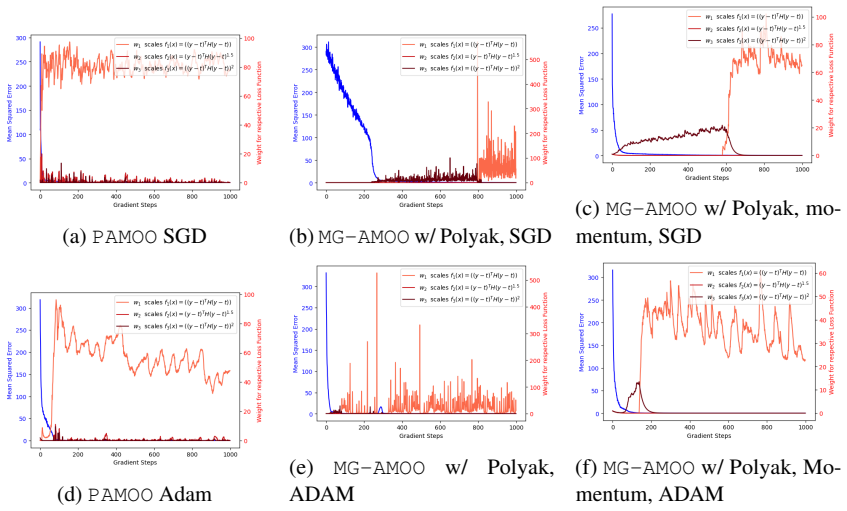
- MG-AMOO costs only O(m) per iteration to pick the worst objective and can use standard optimizers such as GD or Adam, making the theory accessible to deep learning practice.
- Both Lipschitz and smooth convex objectives converge at rates matching single-objective optimization up to constants, so aligned multi-task problems are not inherently harder than single-task ones.
- The epsilon-approximate AMOO extension shows that small misalignment costs only an additive epsilon, keeping the algorithms usable when objectives are nearly aligned.
- The online-to-AMOO reduction means any online learner with sublinear regret yields a converging optimizer without knowing smoothness or Lipschitz constants in advance.
Reading between the lines
- The requirement to know every optimal value f_i^* exactly is likely the main practical hurdle; in deep learning these minima are unknown, and misestimates would break both the Polyak step-size rule and the max-gap selection rule, a case the paper leaves unanalyzed.
- The lower bound suggests equal-weight averaging may be a poor default in many-task regimes with large m; a direct test would measure MG on synthetic convex AMOO instances with known shared minima across different m.
- The reduction is built on choosing the worst objective adversarially, so replacing the online learner with a stochastic or bandit variant should yield corresponding stochastic regret guarantees, a testable extension.
- For non-convex deep learning losses the convex theory does not apply directly, but the worst-objective selection rule is a natural heuristic; the experiments hint it transfers, which could be tested more broadly.
Editorial analysis
A structured set of objections, weighed in public.
Referee Report
Summary. The paper studies convex aligned multi-objective optimization (AMOO), where all objectives share a common minimizer. It introduces the Maximum Gap metric MG(x)=max_i(f_i(x)-f_i^*) and proposes two optimizer families: a new analysis of PAMOO and a reduction-based method MG-AMOO that wraps any single-objective optimizer. For G-Lipschitz objectives the claimed rates are O(G R / sqrt(K)), and for beta-smooth objectives O(beta R^2 / K), both independent of the number of objectives m. The paper also claims a lower bound showing that the equal-weights (EW) baseline with the Polyak step size has worst-case MG rate Omega(sqrt(m) G R / sqrt(K)) for K <= m, and extends the algorithms to an epsilon-approximate alignment setting.
Significance. The upper-bound part of the paper is a useful contribution: the MG-AMOO reduction in Lemma 2 is simple and elegant, and the PAMOO proof in Appendix E is self-contained and plausibly correct under the stated oracle assumptions. If the upper bounds are accepted, they genuinely extend AMOO from the strongly convex setting to convex Lipschitz/smooth settings and give an online-to-batch style conversion. However, the paper's advertised separation between the proposed methods and the EW baseline rests entirely on Theorem 1, and that theorem is false as stated. Since the abstract, Table 1, and the introduction all present the EW lower bound as a central novelty, the main claim of the paper is not supported. The requirement of exact knowledge of all f_i^* is also a substantial caveat that is not discussed in the limitations section.
major comments (3)
- [Section 4, Theorem 1 proof] Theorem 1 is false as stated. The proof asserts ma/(m+2K) >= sqrt(m) a/(3 sqrt(K)) for every K <= m. This is equivalent to 3 sqrt(mK) >= m+2K, which fails for example when m=10, K=1. The failure is not a small constant: for K=1 the Polyak update returns x1, and the construction gives MG(x_bar)=a, while the claimed lower bound is sqrt(10) a/3 about 1.054a, which is larger than the true value. More generally, EW with the Polyak step is distance-nonincreasing with respect to x*_EW, and every f_i is G-Lipschitz, so MG(x_bar) <= G ||x1 - x*_EW||. Therefore a lower bound with factor sqrt(m/K) cannot hold when K << m, and the range K <= m includes this regime. The claimed polynomial-in-m separation is unsupported.
- [Section 4, construction after Eq. (8)] Even if one restricted K to a range where the disputed inequality holds, the construction does not deliver the advertised dependence on m. The exact lower bound obtained in the proof is ma/(m+2K) = a/(1+2K/m), while R = ||x1 - x*_EW|| = a sqrt(m/(m-1)). Thus for a fixed ratio K/m the normalized lower bound is O(1) in m; at K=m it is exactly a/3. The factor sqrt(m/K) in Theorem 1 comes solely from the invalid inequality. Hence the abstract's claim that EW 'may converge with polynomial dependence on the number of functions' is not established by this example.
- [Algorithms 1 and 2; Theorems 2 and 3] All proposed methods require exact knowledge of the optimal values f_i^*. Algorithm 1 uses {f_i^*} in Delta_k, Algorithm 2 uses {f_i^*} in the gap-selection step, and the Polyak step-size variants use f_i^* directly. The paper motivates the setting by deep-learning practice, where minimal losses are typically unknown, yet it does not discuss how f_i^* could be estimated or how errors in f_i^* affect the rates. The experiments, especially P2 and P3 with offset losses, do not state how f_i^* is obtained. As stated, the contribution is an oracle result, and the practical claims in the abstract are overstated without this caveat.
minor comments (4)
- [Section 5.2, Theorem 3(1) and Appendix F.3, Theorem 8] The displayed bound in Theorem 3(1) is missing the division by sqrt(K): it should be (3/2) G ||x1 - x*|| / sqrt(K). Appendix Theorem 8 writes (3/2) G ||x1 - x*|| / K, which would give an O(1/K) rate for nonsmooth functions and is inconsistent with the O(G/sqrt(K)) claim in Table 1.
- [Corollary 1 and Algorithm 2] The online-gradient-descent regret bound in Theorem 7 requires a bounded convex domain and a projection step. Algorithm 2 does not include a projection or specify the domain for the online learner. Please state the domain explicitly and add the projection step to the algorithm.
- [Section 4 and Appendix C] The paper uses gradients throughout, but the lower-bound construction uses the nonsmooth functions f_i(x)=|x_i| and subgradients. A sentence clarifying the subgradient convention for the G-Lipschitz case would avoid ambiguity.
- [Proof of Theorem 1, final display] The displayed chain contains a typo, 'sqrt(m)/sqrt(K) a / 3K', which should read 'sqrt(m) a / (3 sqrt(K))'.
Circularity Check
No significant circularity: the convergence proofs are self-contained, and self-citations to the prior AMOO paper are attribution/reuse rather than load-bearing.
full rationale
The paper's central claims are derived in-line rather than imported. Theorem 2 (PAMOO) is proved from Lemma 6, which uses only convexity and the standard inequality f_w(x_k) - f_w(x*) <= grad f_w(x_k)^T (x_k - x*), and Lemma 5, which telescopes the squared-distance recursion and applies either Lipschitz or smoothness (Lemma 1, a standard Boyd-Vandenberghe result). No fitted constant or measured MG value enters the bound. Theorem 3 / MG-AMOO is established through Lemma 2, a Jensen/convexity inequality that upper-bounds MG of the averaged iterate by the average of the selected gaps, and then applies either the explicit Polyak/GD lemmas (Appendix F) or standard online regret bounds cited from Hazan et al.; the online learner is treated as a black box with its published regret guarantee, not as an author-specific theorem. Theorem 1 is a constructive example, not a reduction of the lower bound to its own statement. The only self-referential elements are attribution of the AMOO framework and the PAMOO algorithm to Efroni et al. (2025) and reuse of that implementation in experiments; the new convergence proofs do not rely on the earlier paper's convergence theorems, so this self-citation is not load-bearing. The reliance on exact f_i^* values is a genuine practical assumption/limitation, but it is not circular because f_i^* are inputs to the algorithms rather than outputs the proofs presuppose. The skeptical concern that Theorem 1's lower bound may fail for small K is a potential mathematical correctness issue, not a circularity issue, and is therefore not reflected in this score.
Assumptions & free parameters
free parameters (2)
- GD step size eta=1/(2 beta) =
1/(2 beta)
- Online GD step size eta_k = ||x1-x*||/(G sqrt(k)) =
R/(G sqrt(k))
assumptions (6)
- domain assumption Each objective f_i is convex and differentiable on R^n
- domain assumption The objectives are aligned: C* = {x : f_i(x)=f_i^* for all i} is nonempty
- domain assumption Each f_i is either G-Lipschitz or beta-smooth
- ad hoc to paper Exact optimal values f_i^* are known to the algorithms
- domain assumption For the online-learner instantiation, C* and the convex hull of the iterates are bounded
- standard math Standard convex analysis results: Lemma 1, Jensen's inequality, and gradient descent inequalities
Cite this review
Pith. "Pith review of Simple Optimizers for Convex Aligned Multi-Objective Optimization." pith.science (2026). https://pith.science/paper/6MXB3QFU
@misc{pith2026250905811,
  author       = {Pith},
  title        = {Pith review of: Simple Optimizers for Convex Aligned Multi-Objective Optimization},
  year         = {2026},
  howpublished = {\url{https://pith.science/paper/6MXB3QFU}},
  note         = {Machine review of arXiv:2509.05811}
}
read the original abstract
It is widely recognized in modern machine learning practice that access to a diverse set of tasks can enhance performance across those tasks. This observation suggests that, unlike in general multi-objective optimization, the objectives in many real-world settings may not be inherently conflicting. To address this, prior work introduced the Aligned Multi-Objective Optimization (AMOO) framework and proposed gradient-based algorithms with provable convergence guarantees. However, existing analysis relies on strong assumptions, particularly strong convexity, which implies the existence of a unique optimal solution. In this work, we relax this assumption and study gradient-descent algorithms for convex AMOO under standard smoothness or Lipschitz continuity conditions-assumptions more consistent with those used in deep learning practice. This generalization requires new analytical tools and metrics to characterize convergence in the convex AMOO setting. We develop such tools, propose scalable algorithms for convex AMOO, and establish their convergence guarantees. Additionally, we prove a novel lower bound that demonstrates the suboptimality of naive equal-weight approaches compared to our methods.
Figures

Reference graph
Works this paper leans on
-
[1]
@esa (Ref
\@ifxundefined[1] #1\@undefined \@firstoftwo \@secondoftwo \@ifnum[1] #1 \@firstoftwo \@secondoftwo \@ifx[1] #1 \@firstoftwo \@secondoftwo [2] @ #1 \@temptokena #2 #1 @ \@temptokena \@ifclassloaded agu2001 natbib The agu2001 class already includes natbib coding, so you should not add it explicitly Type <Return> for now, but then later remove the command n...
-
[2]
\@lbibitem[] @bibitem@first@sw\@secondoftwo \@lbibitem[#1]#2 \@extra@b@citeb \@ifundefined br@#2\@extra@b@citeb \@namedef br@#2 \@nameuse br@#2\@extra@b@citeb \@ifundefined b@#2\@extra@b@citeb @num @parse #2 @tmp #1 NAT@b@open@#2 NAT@b@shut@#2 \@ifnum @merge>\@ne @bibitem@first@sw \@firstoftwo \@ifundefined NAT@b*@#2 \@firstoftwo @num @NAT@ctr \@secondoft...
-
[3]
@open @close @open @close and [1] URL: #1 \@ifundefined chapter * \@mkboth \@ifxundefined @sectionbib * \@mkboth * \@mkboth\@gobbletwo \@ifclassloaded amsart * \@ifclassloaded amsbook * \@ifxundefined @heading @heading NAT@ctr thebibliography [1] @ \@biblabel @NAT@ctr \@bibsetup #1 @NAT@ctr @ @openbib .11em \@plus.33em \@minus.07em 4000 4000 `\.\@m @bibit...
-
[4]
Bayesian uncertainty for gradient aggregation in multi-task learning
Idan Achituve, Idit Diamant, Arnon Netzer, Gal Chechik, and Ethan Fetaya. Bayesian uncertainty for gradient aggregation in multi-task learning. arXiv preprint arXiv:2402.04005, 2024
arXiv 2024
-
[5]
Predicting with proxies: Transfer learning in high dimension
Hamsa Bastani. Predicting with proxies: Transfer learning in high dimension. Management Science, 67 0 (5): 0 2964--2984, 2021
work page 2021
-
[6]
Robust optimization--methodology and applications
Aharon Ben-Tal and Arkadi Nemirovski. Robust optimization--methodology and applications. Mathematical programming, 92: 0 453--480, 2002
work page 2002
-
[7]
Robust optimization
Aharon Ben-Tal, Arkadi Nemirovski, and Laurent El Ghaoui. Robust optimization. 2009
2009
-
[8]
Convex optimization
Stephen Boyd and Lieven Vandenberghe. Convex optimization. Cambridge university press, 2004
2004
Show all 48 references
-
[9]
Multitask learning
Rich Caruana. Multitask learning. Machine learning, 28: 0 41--75, 1997
1997
-
[10]
Prediction, learning, and games
Nicolo Cesa-Bianchi and G \'a bor Lugosi. Prediction, learning, and games. Cambridge university press, 2006
2006
-
[11]
Entropy-sgd: Biasing gradient descent into wide valleys
Pratik Chaudhari, Anna Choromanska, Stefano Soatto, Yann LeCun, Carlo Baldassi, Christian Borgs, Jennifer Chayes, Levent Sagun, and Riccardo Zecchina. Entropy-sgd: Biasing gradient descent into wide valleys. Journal of Statistical Mechanics: Theory and Experiment, 2019 0 (12):...
2019
-
[12]
Robust optimization for non-convex objectives
Robert S Chen, Brendan Lucier, Yaron Singer, and Vasilis Syrgkanis. Robust optimization for non-convex objectives. Advances in Neural Information Processing Systems, 30, 2017
2017
-
[13]
Reinforcement learning can be more efficient with multiple rewards
Christoph Dann, Yishay Mansour, and Mehryar Mohri. Reinforcement learning can be more efficient with multiple rewards. In International Conference on Machine Learning, pages 6948--6967. PMLR, 2023
2023
-
[14]
The road less scheduled
Aaron Defazio, Xingyu Yang, Ahmed Khaled, Konstantin Mishchenko, Harsh Mehta, and Ashok Cutkosky. The road less scheduled. Advances in Neural Information Processing Systems, 37: 0 9974--10007, 2024
2024
-
[15]
Sharing knowledge in multi-task deep reinforcement learning
Carlo D'Eramo, Davide Tateo, Andrea Bonarini, Marcello Restelli, and Jan Peters. Sharing knowledge in multi-task deep reinforcement learning. arXiv preprint arXiv:2401.09561, 2024
2024 arXiv
-
[16]
Adaptive subgradient methods for online learning and stochastic optimization
John Duchi, Elad Hazan, and Yoram Singer. Adaptive subgradient methods for online learning and stochastic optimization. Journal of machine learning research, 12 0 (7), 2011
2011
-
[17]
Aligned multi objective optimization
Yonathan Efroni, Ben Kretzu, Daniel Jiang, Jalaj Bhandari, Karen Ullrich, et al. Aligned multi objective optimization. arXiv preprint arXiv:2502.14096, 2025
2025 arXiv
-
[18]
Sharpness-aware minimization for efficiently improving generalization
Pierre Foret, Ariel Kleiner, Hossein Mobahi, and Behnam Neyshabur. Sharpness-aware minimization for efficiently improving generalization. arXiv preprint arXiv:2010.01412, 2020
2010 arXiv
-
[19]
A review of multi-objective optimization: Methods and its applications
Nyoman Gunantara. A review of multi-objective optimization: Methods and its applications. Cogent Engineering, 5 0 (1): 0 1502242, 2018
2018
-
[20]
Deepseek-r1: Incentivizing reasoning capability in llms via reinforcement learning
Daya Guo, Dejian Yang, Haowei Zhang, Junxiao Song, Ruoyu Zhang, Runxin Xu, Qihao Zhu, Shirong Ma, Peiyi Wang, Xiao Bi, et al. Deepseek-r1: Incentivizing reasoning capability in llms via reinforcement learning. arXiv preprint arXiv:2501.12948, 2025
2025 arXiv
-
[21]
Revisiting the polyak step size
Elad Hazan and Sham Kakade. Revisiting the polyak step size. arXiv preprint arXiv:1905.00313, 2019
1905 arXiv
-
[22]
Introduction to online convex optimization
Elad Hazan et al. Introduction to online convex optimization. Foundations and Trends in Optimization , 2 0 (3-4): 0 157--325, 2016
2016
-
[23]
Reinforcement learning with unsupervised auxiliary tasks
Max Jaderberg, Volodymyr Mnih, Wojciech Marian Czarnecki, Tom Schaul, Joel Z Leibo, David Silver, and Koray Kavukcuoglu. Reinforcement learning with unsupervised auxiliary tasks. arXiv preprint arXiv:1611.05397, 2016
2016 arXiv
-
[24]
Adam: A method for stochastic optimization
Diederik P Kingma and Jimmy Ba. Adam: A method for stochastic optimization. arXiv preprint arXiv:1412.6980, 2014
2014 arXiv
-
[25]
Visualizing the loss landscape of neural nets
Hao Li, Zheng Xu, Gavin Taylor, Christoph Studer, and Tom Goldstein. Visualizing the loss landscape of neural nets. Advances in neural information processing systems, 31, 2018
2018
-
[26]
Let's verify step by step
Hunter Lightman, Vineet Kosaraju, Yura Burda, Harri Edwards, Bowen Baker, Teddy Lee, Jan Leike, John Schulman, Ilya Sutskever, and Karl Cobbe. Let's verify step by step. arXiv preprint arXiv:2305.20050, 2023
2023 arXiv
-
[27]
Conflict-averse gradient descent for multi-task learning
Bo Liu, Xingchao Liu, Xiaojie Jin, Peter Stone, and Qiang Liu. Conflict-averse gradient descent for multi-task learning. Advances in Neural Information Processing Systems, 34: 0 18878--18890, 2021
2021
-
[28]
End-to-end multi-task learning with attention
Shikun Liu, Edward Johns, and Andrew J Davison. End-to-end multi-task learning with attention. In Proceedings of the IEEE/CVF conference on computer vision and pattern recognition, pages 1871--1880, 2019
2019
-
[29]
Multi-task learning as a bargaining game
Aviv Navon, Aviv Shamsian, Idan Achituve, Haggai Maron, Kenji Kawaguchi, Gal Chechik, and Ethan Fetaya. Multi-task learning as a bargaining game. arXiv preprint arXiv:2202.01017, 2022
2022 arXiv
-
[30]
A modern introduction to online learning
Francesco Orabona. A modern introduction to online learning. arXiv preprint arXiv:1912.13213, 2019
1912 arXiv
-
[31]
Relative flatness and generalization
Henning Petzka, Michael Kamp, Linara Adilova, Cristian Sminchisescu, and Mario Boley. Relative flatness and generalization. Advances in neural information processing systems, 34: 0 18420--18432, 2021
2021
-
[32]
Introduction to optimization
Boris T Polyak. Introduction to optimization. 1987
1987
-
[33]
Deepobs: A deep learning optimizer benchmark suite
Frank Schneider, Lukas Balles, and Philipp Hennig. Deepobs: A deep learning optimizer benchmark suite. arXiv preprint arXiv:1903.05499, 2019
1903 arXiv
-
[34]
Multi-task learning as multi-objective optimization
Ozan Sener and Vladlen Koltun. Multi-task learning as multi-objective optimization. Advances in neural information processing systems, 31, 2018
2018
-
[35]
Proxybo: Accelerating neural architecture search via bayesian optimization with zero-cost proxies
Yu Shen, Yang Li, Jian Zheng, Wentao Zhang, Peng Yao, Jixiang Li, Sen Yang, Ji Liu, and Bin Cui. Proxybo: Accelerating neural architecture search via bayesian optimization with zero-cost proxies. In Proceedings of the AAAI conference on artificial intelligence, volume 37, page...
2023
-
[36]
Kimi Team, Angang Du, Bofei Gao, Bowei Xing, Changjiu Jiang, Cheng Chen, Cheng Li, Chenjun Xiao, Chenzhuang Du, Chonghua Liao, et al. Kimi k1. 5: Scaling reinforcement learning with llms. arXiv preprint arXiv:2501.12599, 2025
2025 arXiv
-
[37]
Distral: Robust multitask reinforcement learning
Yee Teh, Victor Bapst, Wojciech M Czarnecki, John Quan, James Kirkpatrick, Raia Hadsell, Nicolas Heess, and Razvan Pascanu. Distral: Robust multitask reinforcement learning. Advances in neural information processing systems, 30, 2017
2017
-
[38]
Solving math word problems with process-and outcome-based feedback
Jonathan Uesato, Nate Kushman, Ramana Kumar, Francis Song, Noah Siegel, Lisa Wang, Antonia Creswell, Geoffrey Irving, and Irina Higgins. Solving math word problems with process-and outcome-based feedback. arXiv preprint arXiv:2211.14275, 2022
2022 arXiv
-
[39]
Discovery of useful questions as auxiliary tasks
Vivek Veeriah, Matteo Hessel, Zhongwen Xu, Janarthanan Rajendran, Richard L Lewis, Junhyuk Oh, Hado P van Hasselt, David Silver, and Satinder Singh. Discovery of useful questions as auxiliary tasks. Advances in Neural Information Processing Systems, 32, 2019
2019
-
[40]
Conditional language policy: A general framework for steerable multi-objective finetuning
Kaiwen Wang, Rahul Kidambi, Ryan Sullivan, Alekh Agarwal, Christoph Dann, Andrea Michi, Marco Gelmi, Yunxuan Li, Raghav Gupta, Avinava Dubey, et al. Conditional language policy: A general framework for steerable multi-objective finetuning. arXiv preprint arXiv:2407.15762, 2024
2024 arXiv
-
[41]
Robust markov decision processes
Wolfram Wiesemann, Daniel Kuhn, and Ber c Rustem. Robust markov decision processes. Mathematics of Operations Research, 38 0 (1): 0 153--183, 2013
2013
-
[42]
Two losses are better than one: Faster optimization using a cheaper proxy
Blake Woodworth, Konstantin Mishchenko, and Francis Bach. Two losses are better than one: Faster optimization using a cheaper proxy. In International Conference on Machine Learning, pages 37273--37292. PMLR, 2023
2023
-
[43]
Metaaligner: Towards generalizable multi-objective alignment of language models
Kailai Yang, Zhiwei Liu, Qianqian Xie, Jimin Huang, Tianlin Zhang, and Sophia Ananiadou. Metaaligner: Towards generalizable multi-objective alignment of language models. arXiv preprint arXiv:2403.17141, 2024
2024 arXiv
-
[44]
Gradient surgery for multi-task learning
Tianhe Yu, Saurabh Kumar, Abhishek Gupta, Sergey Levine, Karol Hausman, and Chelsea Finn. Gradient surgery for multi-task learning. Advances in Neural Information Processing Systems, 33: 0 5824--5836, 2020 a
2020
-
[45]
Meta-world: A benchmark and evaluation for multi-task and meta reinforcement learning
Tianhe Yu, Deirdre Quillen, Zhanpeng He, Ryan Julian, Karol Hausman, Chelsea Finn, and Sergey Levine. Meta-world: A benchmark and evaluation for multi-task and meta reinforcement learning. In Conference on robot learning, pages 1094--1100. PMLR, 2020 b
2020
-
[46]
Visual classification with multitask joint sparse representation
Xiao-Tong Yuan, Xiaobai Liu, and Shuicheng Yan. Visual classification with multitask joint sparse representation. IEEE Transactions on Image Processing, 21 0 (10): 0 4349--4360, 2012
2012
-
[47]
Facial landmark detection by deep multi-task learning
Zhanpeng Zhang, Ping Luo, Chen Change Loy, and Xiaoou Tang. Facial landmark detection by deep multi-task learning. In Computer Vision--ECCV 2014: 13th European Conference, Zurich, Switzerland, September 6-12, 2014, Proceedings, Part VI 13, pages 94--108. Springer, 2014
2014
-
[48]
Online convex programming and generalized infinitesimal gradient ascent
Martin Zinkevich. Online convex programming and generalized infinitesimal gradient ascent. In Proceedings of the 20th international conference on machine learning (icml-03), pages 928--936, 2003
2003
Reviewed August 5, 2026 · model on record in the stance chip above.
Discussion (0). Sign in to comment.