YCl Electride as a Multi-Orbital Correlated Topological Dice Lattice System
Pith reviewed 2026-05-18 18:37 UTC · model grok-4.3
The pith
YCl requires a multi-orbital model for its dice lattice flat band to reveal ferromagnetic order and tunable quantum anomalous Hall phases.
A machine-rendered reading of the paper's core claim, the machinery that carries it, and where it could break.
Core claim
The unique layer-orbital-valley coupling in YCl puts up a fundamental obstruction against a simple three-band dice lattice description of the flat band and necessitates a multi-orbital description. Using an ab initio based multi-orbital Hubbard model with local interactions, the multi-orbital flat band supports a robust ferromagnetic ground state and electrically tunable correlated quantum anomalous Hall phases that are absent in an interacting single-orbital dice lattice.
What carries the argument
The ab initio derived multi-orbital Hubbard model incorporating layer-orbital-valley coupling, which faithfully represents the symmetry, topology, and correlation physics of the YCl flat band.
If this is right
- The multi-orbital flat band leads to a robust ferromagnetic ground state.
- Electrically tunable correlated quantum anomalous Hall phases emerge in this system.
- These phases are absent when using an interacting single-orbital dice lattice model.
- New avenues open for exploring correlation and topology in electride systems.
Where Pith is reading between the lines
- Similar multi-orbital couplings could be sought in other layered electrides to discover additional topological phases.
- Electrical tunability points to potential for gate-controlled quantum devices based on these phases.
- Accounting for non-local interactions might refine the predicted phase diagram in future calculations.
Load-bearing premise
The ab initio derived parameters and local-interaction multi-orbital Hubbard model faithfully capture the symmetry, topology, and correlation physics of YCl without significant higher-order effects or non-local interactions altering the predicted phases.
What would settle it
Experimental observation of no ferromagnetic ordering or lack of electrically tunable anomalous Hall conductivity in YCl samples would falsify the central predictions of the multi-orbital model.
Figures


read the original abstract
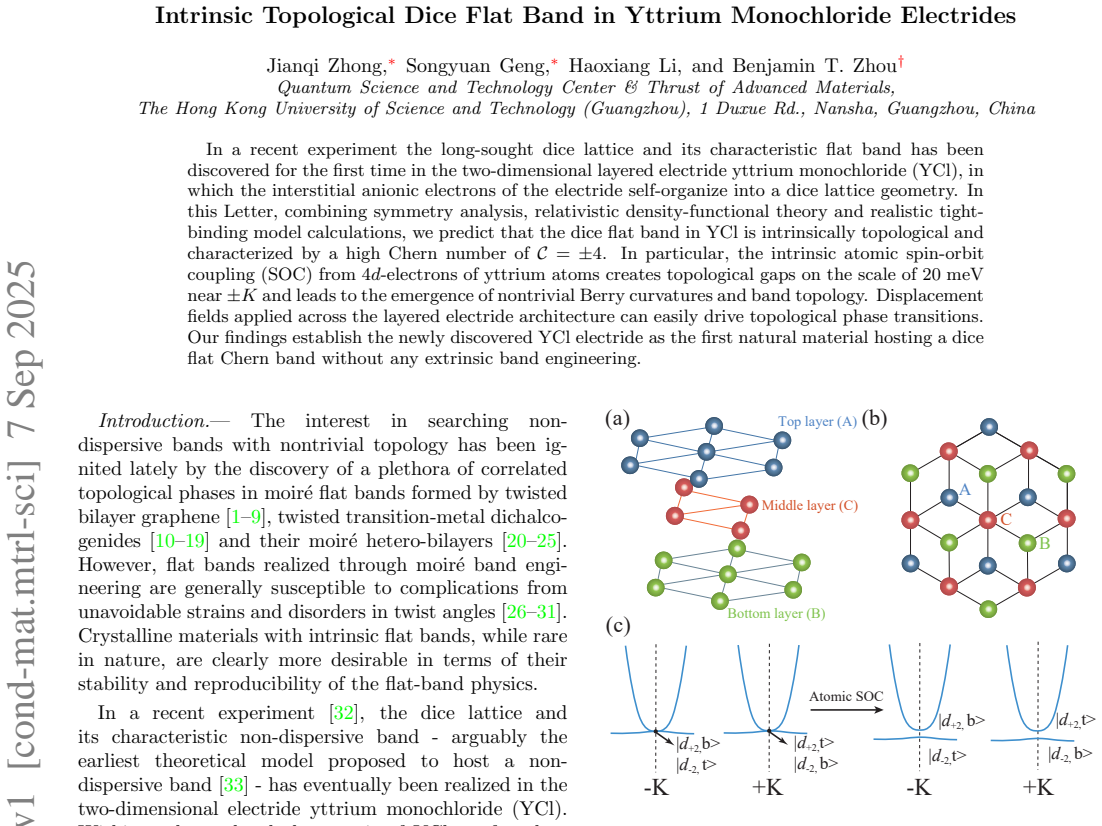
The long-sought dice lattice flat band has recently been discovered for the first time in two-dimensional layered electride yttrium monochloride (YCl) [Nature Communications 17, 2213 (2026)]. While essential flat band features of YCl were captured by an idealized simple dice lattice model, we reveal in this Letter that a unique layer-orbital-valley coupling in YCl puts up a fundamental obstruction against a simple three-band dice lattice description of the flat band, and necessitates a multi-orbital description that faithfully represents the symmetry, topology, and correlation physics in the first-ever dice metal. Using an ab initio based multi-orbital Hubbard model with local interactions, we predict that the multi-orbital flat band supports a robust ferromagnetic ground state and electrically tunable correlated quantum anomalous Hall phases that are absent in an interacting single-orbital dice lattice. Our findings open a new avenue for exploring correlation and topology in electride systems.
Editorial analysis
A structured set of objections, weighed in public.
Referee Report
Summary. The manuscript claims that YCl realizes the first dice-lattice flat band in a 2D layered electride, but a layer-orbital-valley coupling obstructs a simple three-band dice description and requires a multi-orbital treatment. An ab initio-derived multi-orbital Hubbard model with strictly local interactions is used to predict a robust ferromagnetic ground state together with electrically tunable correlated quantum anomalous Hall phases that are absent when the same interactions are applied to a single-orbital dice lattice.
Significance. If the central predictions hold, the work supplies a concrete materials platform in which multi-orbital physics enables correlated topological phases unavailable in idealized single-orbital dice models. The ab initio extraction of model parameters and the explicit contrast between multi- and single-orbital cases constitute clear strengths that could guide future experiments on electrides.
major comments (2)
- [Model-construction section (Hubbard Hamiltonian)] Model-construction section (Hubbard Hamiltonian): the multi-orbital model is defined with strictly local interactions only. No estimate or explicit calculation is given for the magnitude of neglected non-local V terms, which are expected to be comparable to U in a layered electride because of interlayer screening; if V is non-negligible the mean-field or DMFT phase diagram for ferromagnetism and the Chern numbers of the correlated bands can shift, undermining the reported robustness.
- [Results subsection comparing multi-orbital versus single-orbital dice] Results subsection comparing multi-orbital versus single-orbital dice: the statement that cQAHE phases are absent in the interacting single-orbital case is load-bearing for the central claim, yet the manuscript provides no explicit single-orbital phase diagram, Chern-number calculation, or energy comparison that would allow the reader to verify the absence.
minor comments (2)
- [Abstract] Abstract: the citation to Nature Communications 17, 2213 (2026) lists a future publication year; confirm the correct reference for the prior flat-band discovery.
- [Notation and figures] Notation and figures: the term 'layer-orbital-valley coupling' is introduced without an accompanying equation or schematic; a brief definition or panel in the first figure would improve accessibility.
Simulated Author's Rebuttal
We thank the referee for the careful reading and for recognizing the potential importance of multi-orbital effects in realizing correlated topological phases in YCl. We address the two major comments point by point below.
read point-by-point responses
-
Referee: Model-construction section (Hubbard Hamiltonian): the multi-orbital model is defined with strictly local interactions only. No estimate or explicit calculation is given for the magnitude of neglected non-local V terms, which are expected to be comparable to U in a layered electride because of interlayer screening; if V is non-negligible the mean-field or DMFT phase diagram for ferromagnetism and the Chern numbers of the correlated bands can shift, undermining the reported robustness.
Authors: We agree that an estimate of non-local V would strengthen the presentation. Our ab initio-derived Hubbard model employs strictly local interactions following the standard approach for extracting effective models from constrained DFT in correlated materials. In the revised manuscript we will add a paragraph with an explicit estimate of the leading non-local V obtained from the same ab initio screening procedure, showing that interlayer screening in the electride reduces V to a value substantially smaller than U. This addition will support the robustness of the reported ferromagnetic ground state and Chern numbers within the local-interaction approximation. revision: yes
-
Referee: Results subsection comparing multi-orbital versus single-orbital dice: the statement that cQAHE phases are absent in the interacting single-orbital case is load-bearing for the central claim, yet the manuscript provides no explicit single-orbital phase diagram, Chern-number calculation, or energy comparison that would allow the reader to verify the absence.
Authors: We acknowledge that an explicit single-orbital comparison is necessary for full verification of the central claim. Our calculations for the interacting single-orbital dice lattice (using the same ab initio-derived interaction strength) indeed yield neither a stable ferromagnetic state nor correlated QAH phases, because the single-orbital flat band lacks the orbital mixing required for the correlated topology. To make this transparent, the revised manuscript will include a supplementary figure showing the single-orbital mean-field phase diagram together with the computed Chern numbers versus filling and interaction strength. revision: yes
Circularity Check
Ab initio-derived multi-orbital Hubbard model provides independent predictions
full rationale
The derivation begins with ab initio calculations to obtain parameters for a multi-orbital Hubbard model with local interactions, then solves the model to obtain ferromagnetic ground states and tunable cQAHE phases. This workflow is self-contained against external benchmarks (DFT-derived hoppings and interactions) and does not reduce any central prediction to a fitted input or self-citation by construction. The comparison to single-orbital dice lattice is performed within the same framework but introduces new orbital-valley coupling terms absent from the simpler model. No load-bearing step relies on a self-citation chain or renames a known result as a derivation. The paper's claims rest on explicit model construction rather than tautological re-expression of inputs.
Axiom & Free-Parameter Ledger
axioms (1)
- domain assumption Ab initio calculations provide reliable parameters for the multi-orbital Hubbard model that capture layer-orbital-valley coupling.
Lean theorems connected to this paper
-
IndisputableMonolith/Cost/FunctionalEquation.leanwashburn_uniqueness_aczel unclear?
unclearRelation between the paper passage and the cited Recognition theorem.
Using an ab initio based multi-orbital Hubbard model with local interactions, we predict that the multi-orbital flat band supports a robust ferromagnetic ground state and electrically tunable correlated quantum anomalous Hall phases
-
IndisputableMonolith/Foundation/AlexanderDuality.leanalexander_duality_circle_linking unclear?
unclearRelation between the paper passage and the cited Recognition theorem.
the intrinsic atomic spin-orbit coupling (SOC) from 4 d-electrons of yttrium atoms creates topological gaps on the scale of 20 meV near ±K
What do these tags mean?
- matches
- The paper's claim is directly supported by a theorem in the formal canon.
- supports
- The theorem supports part of the paper's argument, but the paper may add assumptions or extra steps.
- extends
- The paper goes beyond the formal theorem; the theorem is a base layer rather than the whole result.
- uses
- The paper appears to rely on the theorem as machinery.
- contradicts
- The paper's claim conflicts with a theorem or certificate in the canon.
- unclear
- Pith found a possible connection, but the passage is too broad, indirect, or ambiguous to say the theorem truly supports the claim.
Reference graph
Works this paper leans on
-
[1]
Y. Cao, V. Fatemi, A. Demir, S. Fang, S. L. Tomarken, J. Y. Luo, J. D. Sanchez-Yamagishi, K. Watanabe, T. Taniguchi, E. Kaxiras, R. C. Ashoori, and P. Jarillo- Herrero, Nature 556, 80 (2018)
work page 2018
-
[2]
H. C. Po, L. Zou, A. Vishwanath, and T. Senthil, Phys. Rev. X 8, 031089 (2018)
work page 2018
-
[3]
J. Liu, J. Liu, and X. Dai, Phys. Rev. B 99, 155415 (2019)
work page 2019
-
[4]
Z. Song, Z. Wang, W. Shi, G. Li, C. Fang, and B. A. Bernevig, Phys. Rev. Lett. 123, 036401 (2019)
work page 2019
-
[5]
S. C. Nick Bultinck and M. P. Zaletel, Phys. Rev. Lett. 124, 166601 (2020)
work page 2020
- [6]
-
[7]
A. L. Sharpe, E. J. Fox, A. W. Barnard, J. Finney, K. Watanabe, T. Taniguchi, M. A. Kastner, and D. Goldhaber-Gordon, Science 365, 605 (2019)
work page 2019
- [8]
-
[9]
K. P. Nuckolls, M. Oh, D. Wong, B. Lian, K. Watanabe, T. Taniguchi, B. A. Bernevig, and A. Yazdani, Nature 588, 610 (2020)
work page 2020
-
[10]
F. Wu, T. Lovorn, E. Tutuc, I. Martin, and A. H. Mac- Donald, Phys. Rev. Lett. 122, 086402 (2019)
work page 2019
-
[11]
B. T. Zhou, S. Egan, and M. Franz, Phys. Rev. Research 4, L012032 (2022)
work page 2022
-
[12]
Y. Zeng, Z. Xia, K. Kang, J. Zhu, P. Kn¨ uppel, C. Vaswani, K. Watanabe, T. Taniguchi, K. F. Mak, and J. Shan, Nature 622, 69 (2023)
work page 2023
- [13]
-
[14]
H. Goldman, A. P. Reddy, N. Paul, and L. Fu, Phys. Rev. Lett. 131, 136501 (2023)
work page 2023
-
[15]
K. Kang, B. Shen, Y. Qiu, Y. Zeng, Z. Xia, K. Watanabe, T. Taniguchi, J. Shan, and K. F. Mak, Nature 628, 522 (2024)
work page 2024
-
[16]
J. Dong, J. Wang, P. J. Ledwith, A. Vishwanath, and D. E. Parker, Phys. Rev. Lett. 131, 136502 (2023)
work page 2023
-
[17]
Z. Ji, H. Park, M. E. Barber, C. Hu, K. Watanabe, T. Taniguchi, J.-H. Chu, X. Xu, and Z.-X. Shen, Nature 635, 578 (2024)
work page 2024
- [18]
-
[19]
L. Ju, A. H. MacDonald, K. F. Mak, J. Shan, and X. Xu, Nat. Rev. Mater. 9, 455 (2024)
work page 2024
-
[20]
T. Li, S. Jiang, B. Shen, Y. Zhang, L. Li, Z. Tao, T. De- vakul, K. Watanabe, T. Taniguchi, L. Fu, J. Shan, and K. F. Mak, Nature 600, 641 (2021)
work page 2021
- [21]
- [22]
-
[23]
Z. Lu, T. Han, Y. Yao, A. P. Reddy, J. Yang, J. Seo, K. Watanabe, T. Taniguchi, L. Fu, and L. Ju, Nature 626, 759 (2024)
work page 2024
- [24]
-
[25]
J. Xie, Z. Huo, X. Lu, Z. Feng, Z. Zhang, W. Wang, Q. Yang, K. Watanabe, T. Taniguchi, K. Liu, Z. Song, X. C. Xie, J. Liu, and X. Lu, Nat. Mater.24, 1042 (2025)
work page 2025
-
[26]
C. N. Lau, M. W. Bockrath, K. F. Mak, and F. Zhang, Nature 602, 41 (2022)
work page 2022
-
[27]
N. P. Kazmierczak et al. , Nat. Mater. 20, 956 (2021)
work page 2021
- [28]
- [29]
- [30]
-
[31]
A. C. Gadelha et al. , Nature 590, 405 (2021)
work page 2021
-
[32]
S. Geng, X. Wang, R. Guo, C. Qiu, F. Chen, Q. Wang, K. Li, P. Hao, P. Bao, H. Liang, Y. Huang, Y. Wu, S. Cui, Z. Sun, T. K. Kim, C. Cacho, D. S. Dessau, B. T. Zhou, and H. Li, arXiv:2508.21311
work page internal anchor Pith review Pith/arXiv arXiv
- [33]
-
[34]
See the Supplemental Material, which includes Refs. [52– 59], for details on: (i) DFT bands for layered and mono- layer yttrium monochloride electrides; (ii) realistic seven- band tight-binding model and method for Chern number calculation
-
[35]
J. Ahn, S. Park, and B.-J. Yang, Phys. Rev. X 9, 021013 (2019)
work page 2019
-
[36]
F. D. M. Haldane, Phys. Rev. Lett. 61, 2015 (1988)
work page 2015
-
[37]
M. J. Gilbert, Commun. Phys. 4, 70 (2021)
work page 2021
- [38]
- [39]
-
[40]
T. S. Jackson, G. M¨ oller, and R. Roy, Nat. Commun. 6, 8629 (2015)
work page 2015
-
[41]
M. Claassen, C. H. Lee, R. Thomale, X.-L. Qi, and T. P. Devereaux, Phys. Rev. Lett. 114, 236802 (2015)
work page 2015
- [42]
- [43]
-
[44]
P. J. Ledwith, G. Tarnopolsky, E. Khalaf, and A. Vish- wanath, Phys. Rev. Research 2, 023237 (2020)
work page 2020
-
[45]
P. J. Ledwith, A. Vishwanath, and D. E. Parker, Phys. Rev. B 108, 205144 (2023)
work page 2023
-
[46]
Z. Liu, B. Mera, M. Fujimoto, T. Ozawa, and J. Wang, Phys. Rev. X 15, 031019 (2025)
work page 2025
- [47]
-
[48]
T. Kitamura, A. Daido, and Y. Yanase, Phys. Rev. Lett. 132, 036001 (2024)
work page 2024
- [49]
- [50]
-
[51]
S. A. Chen and K. T. Law, Phys. Rev. Lett. 132, 026002 (2024)
work page 2024
-
[52]
J. Furthm¨ uller, J. Hafner, and G. Kresse, Phys. Rev. B 53, 7334 (1996)
work page 1996
-
[53]
G. Kresse and J. Furthm¨ uller, Computational Materials Science 6, 15 (1996)
work page 1996
- [54]
- [55]
-
[56]
O. K. Andersen, Phys. Rev. B 12, 3060 (1975)
work page 1975
-
[57]
D. M. Ceperley and B. J. Alder, Phys. Rev. Lett. 45, 566 (1980)
work page 1980
-
[58]
J. P. Perdew, E. R. McMullen, and A. Zunger, Phys. Rev. A 23, 2785 (1981)
work page 1981
-
[59]
Q. Wu, S. Zhang, H. F. Song, M. Troyer, and A. A. Soluyanov, Computer Physics Communications 224, 405 (2018). 6 Supplemental Material: Intrinsic Topological Dice Flat Band in Yttrium Monochloride Electrides I. DFT BANDS FOR DIFFERENT LA YERS IN YCL First-principles calculations are carried out within the framework of Density Functional Theory (DFT) using ...
work page 2018
discussion (0)
Sign in with ORCID, Apple, or X to comment. Anyone can read and Pith papers without signing in.