REVIEW 2 major objections 5 minor 1 cited by
This paper claims that generalized tensor completion can be made consistent under missing-not-at-random mechanisms by jointly modeling observed entries and the missingness mask, with error bounds that hold even when observation probabilitie
Reviewed by Pith at T0; open to challenge. T0 means a machine referee read the full paper against a public rubric. the ladder, T0–T4 →
T0 review · deepseek-v4-flash
2026-08-04 23:52 UTC pith:WCDXTYBE
load-bearing objection A promising MNAR tensor-completion framework, but Condition 2's b0 scaling makes the missingness mask nearly uninformative, so the main convergence theorem and the b1 test are unsupported as written. the 2 major comments →
Generalized Tensor Completion with Non-Random Missingness
The pith
A machine-rendered reading of the paper's core claim, the machinery that carries it, and where it could break.
Core claim
The central claim is that tensor completion with missing-not-at-random (MNAR) mechanisms can be solved by joint estimation rather than inverse-propensity reweighting, and that the joint estimator has rigorously controlled error. Under a CP low-rank model X = sum_r λ_r u_r ∘ v_r ∘ w_r and a logistic observation model g_θ(x)=logit^{-1}(b0+b1 x), the alternating maximization of the joint log-likelihood converges geometrically to a neighborhood of the truth whose radius is the statistical error. Theorem 1 (rank-one) and Theorem 2 (general rank R) state that after t iterations, D(Θ^(t),Θ*) ≤ ρ_R^t D(Θ^(0),Θ*) + C_4 ((ψ′_max+1)λ_max √(log d · d))/((ψ″_min √pbar + √qbar) λ_min^2), with probability
What carries the argument
The machinery is the joint log-likelihood ℓ_d(Θ) of the observed entries and the missingness mask, maximized by alternating coordinate ascent over each unit-norm factor u_r, v_r, w_r, the weight λ_r, and the logistic missingness parameters (b0, b1) (Algorithm 1). Because both the data model and the missingness model are generalized linear models, updates have no closed form; the analysis controls the gradient and Hessian coordinate-wise rather than at the vector level, with covering-number concentration bounds. The relaxations are encoded in the slice-average quantities pbar and qbar, which replace the uniform lower/upper bounds on observation probabilities used in prior work. The split-samp
Load-bearing premise
The convergence theorems assume the algorithm starts close enough to the true parameters—within a ball of radius 1/2 under the paper's own error metric—and the initialization designed to achieve this is deferred to the supplement.
What would settle it
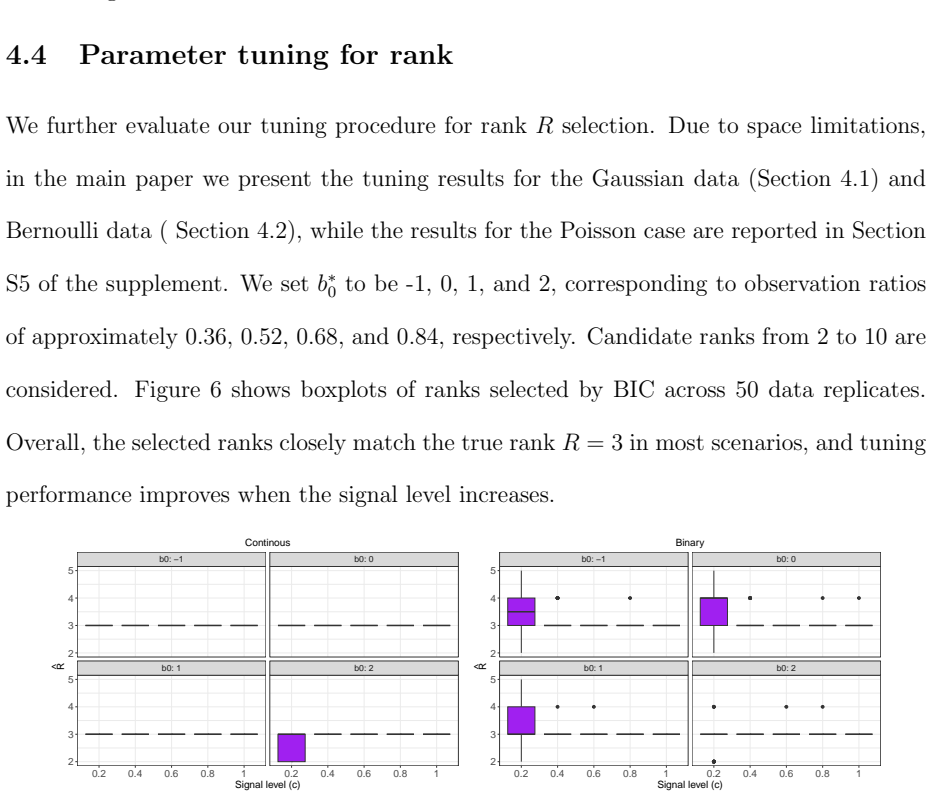
Run the proposed method on a 50×50×50 rank-3 Gaussian tensor with logit missingness b1=2 at an observation ratio near 0.36, over 50 replicates. If the missing-entry RMSE does not consistently beat inverse-propensity and MCAR baselines and shrink as signal strength c grows, the central practical claim fails. Alternatively, simulate b1=0 with d3=150 and |A2|=500: the split-sample test should reject about 5% of the time; a rejection rate far from nominal would falsify Theorem 3.
If this is right
- Tensor completion under MNAR no longer requires inverse-propensity reweighting, so estimates do not blow up when some observation probabilities are near zero.
- The same algorithm covers continuous, binary, and count data through exponential-family links, extending the result beyond squared-loss tensor completion.
- Practitioners can formally test whether missingness is MCAR or MNAR and build confidence intervals for b1 using the split-sample logistic regression.
- The non-asymptotic bound separates computational error (geometrically decaying) from statistical error, giving an explicit iteration count needed to reach the noise floor.
- Under uniform missingness, the conditions reduce to the existing tensor-completion condition p ≥ C0 log^4(d)/d^{3/2}, so the theory contains prior results as a special case.
Where Pith is reading between the lines
- The sample-splitting principle—tiny test set for a low-dimensional logistic regression, large set for the high-dimensional tensor—could be reused in other problems where a high-dimensional nuisance tensor must be estimated before low-dimensional inference.
- Because the missingness model is parametric, the same testing procedure can likely be extended to include covariates or polynomial terms in Xijk, turning the MCAR-versus-MNAR test into a test of a richer missingness mechanism.
- The coordinate-wise concentration proof suggests that similar slice-average conditions may transfer to other non-convex problems with heterogeneous weights, such as weighted low-rank approximation with unknown weights.
Editorial analysis
A structured set of objections, weighed in public.
Referee Report
Summary. The paper proposes a joint-likelihood framework for tensor completion when the missingness indicator D_ijk follows Bernoulli(logit^{-1}(b0+b1 X*_ijk)) and the observed entries follow an exponential-family model with mean depending on X*. The underlying tensor is assumed to have a rank-R CP decomposition. The proposed estimator maximizes the joint likelihood by alternating maximization (Algorithm 1). The main theoretical contributions are non-asymptotic per-iteration error bounds (Theorems 1 and 2) under conditions on slice averages of observation probabilities, and a sample-splitting test for H0: b1*=0 (Theorem 3). The paper reports simulations for Gaussian, Bernoulli and Poisson data and two real-data applications.
Significance. If the results hold, the paper would be a meaningful advance: it relaxes the uniform bounded-probability assumptions used in prior MNAR matrix/tensor completion work, provides a computational-statistical trade-off for the alternating algorithm, and supplies a formal MCAR-versus-MNAR test. The simulation study is reasonably extensive and the proposed method performs well relative to several baselines. However, the theoretical core is not fully verifiable from the submitted text (proofs and the initialization algorithm are deferred to a supplement), and Condition 2 as written appears to make b1 unidentified. These issues must be resolved before the main claims can be accepted.
major comments (2)
- [Section 3.1, Condition 2; Theorems 2-3] Condition 2 states b0*=Θ(Rλmin/√d3) when b1*≠0. With Condition 1(c), |X*_ijk|≤C R λmax/d^{3/2}; with λmin=Θ(λmax) and Condition 3, |b0*| ≥ c R d^{1/4} while |b1*X*_ijk| ≤ C R λmax/d^{3/2}. Hence b0* dominates b1*X* by at least a factor c d, and logit(P_ijk)=b0*(1+o(1)). For b0*>0, 1-P_ijk≤C e^{-c R d^{1/4}}; for b0*<0, P_ijk≤C e^{-c R d^{1/4}}. Thus qbar≤e^{-Ω(R d^{1/4})} and the Fisher information for b1 from the mask is I=Σ P(1-P)X²≤d³ e^{-Ω(R d^{1/4})}(Rλmax/d^{3/2})²=o(1). So b1 is asymptotically unidentified, contradicting the finite-sample error bound on |b1-b1*| in Theorem 2 and the asymptotic normality in Theorem 3. It also contradicts the paragraph after Condition 2 that says probabilities are not dominated by b0* or b1*X*. The simulations in §4.1 use b0∈{-1,...,2} whereas Rλmin/√d3≈150 at d=50, so they do not satisfy Condition 2 as written.
- [Theorems 1-2, Algorithm 1 and Algorithm S1] Theorems 1 and 2 assume Θ^(0)∈B_{1/2}(Θ*) and u^(0)_ri, v^(0)_rj, w^(0)_rk = O(1/√d). Algorithm S1, which is supposed to produce such an initialization, is only referenced as being in the supplement and is not part of the reviewed text. The theoretical guarantee of Algorithm 1 is therefore conditional on an unverified initialization property. The authors should either provide a proof that S1 attains the required ball or explicitly state the initialization as an assumption and discuss when it can be met. As written, the convergence claim for the implemented algorithm is not established.
minor comments (5)
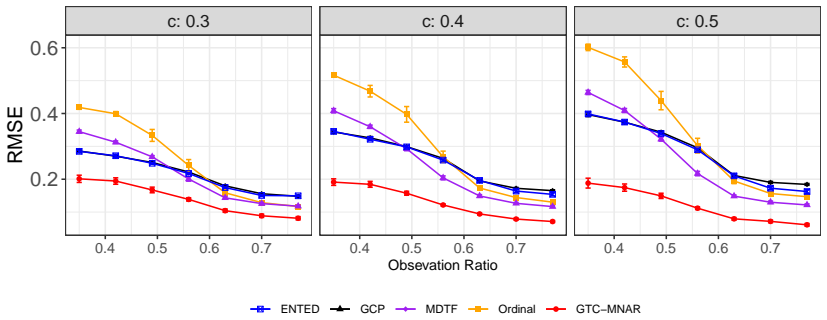
- [Section 4.1; Figures 4-5] Typos: 'suprior performance' should be 'superior performance'; 'Obsevation Ratio' should be 'Observation Ratio'.
- [Section 4.3 / Figure 5] The text refers to the method as 'MTDF' but the Figure 5 legend uses 'MDTF'. Please standardize.
- [Theorem 3] The displayed Hessian has an unmatched parenthesis/bracket: 'exp(-bb_A2_0 - bb_A2_1 bX_A1_ijk ))' contains an extra closing parenthesis.
- [Section 3.2] The phrase 'we exploit employ covering number arguments' should be corrected (e.g., 'we employ covering number arguments').
- [Condition 2] The disjunctive condition on qbar (qbar ≤ C0' pbar (ψ''min)^2 or qbar ≥ C0 ...) is not explained. A short intuition or example would help readers understand which regime each disjunct covers.
Circularity Check
No circular derivation: the error bounds and test are derived from stated conditions, not fitted or defined into existence.
full rationale
The paper's main theoretical results (Theorems 1-3) are non-asymptotic error bounds for an alternating maximization estimator and an asymptotic normality result for a sample-split logistic regression. These are derived from Conditions 1-4 and explicit initialization assumptions; they are not obtained by fitting the target quantity or by renaming an input as an output. The statistical error terms in Theorems 1-2 depend on model primitives and slice-level averages of the true missingness probabilities, but the constants are not calibrated to the reported error, and the bounds are not equivalent to the assumptions by construction. The hypothesis test in Section 3.3 uses sample splitting: the tensor is estimated only on A1 and the logistic regression for b1 is fit only on A2, so the predictor bX_A1 is independent of the testing mask by design; Theorem 3 is a standard MLE expansion rather than a restatement of an assumed conclusion. The paper's self-citations (e.g., Cai et al. 2025; Sun and Li 2019; Zhou et al. 2023) support standard incoherence or dynamic-tensor conditions but are not load-bearing in the sense of importing an unverified uniqueness theorem or smuggling in the paper's own conclusion. The initialization is deferred to Algorithm S1 in the supplement, which is an omitted implementation detail rather than a circular step. A separate concern--whether Condition 2's b0* scaling makes P_ijk near-constant and b1 weakly identifiable--is a validity-of-assumptions issue, not a circularity: if valid, it would mean the theorem's conditions are inappropriate, not that the proof assumes the conclusion. No circular step is exhibited.
Axiom & Free-Parameter Ledger
axioms (6)
- domain assumption Entries of Y are independent exponential family with known dispersion phi0 and cumulant psi (eq 1)
- domain assumption Mask entries are independent Bernoulli with logit P_ijk = b0 + b1 X_ijk (eq 2)
- domain assumption The true tensor X is exactly CP rank R with unit-norm factors, identified up to permutation (eq 4, Condition 1(b))
- ad hoc to paper Factor incoherence conditions on u*, v*, w* and small cross-rank correlations (Conditions 1(c) and 4)
- ad hoc to paper Scalings and slice-average bounds in Conditions 2 and 3, including b0* = Theta(R lambda_min / sqrt(d3)) and b1* = Theta(1)
- ad hoc to paper The initialization lies in a 1/2-ball of the truth with coordinate magnitudes O(1/sqrt(d)) (Theorems 1-2)
Cite this review
Pith. "Pith review of Generalized Tensor Completion with Non-Random Missingness." pith.science (2026). https://pith.science/paper/WCDXTYBE
@misc{pith2026250906225,
  author       = {Pith},
  title        = {Pith review of: Generalized Tensor Completion with Non-Random Missingness},
  year         = {2026},
  howpublished = {\url{https://pith.science/paper/WCDXTYBE}},
  note         = {Machine review of arXiv:2509.06225}
}
read the original abstract
Tensor completion plays a crucial role in applications such as recommender systems and medical imaging, where data are often highly incomplete. While extensive prior work has addressed tensor completion with data missingness, most assume that each entry of the tensor is available independently with probability $p$. However, real-world tensor data often exhibit missing-not-at-random (MNAR) patterns, where the probability of missingness depends on the underlying tensor values. This paper introduces a generalized tensor completion framework for noisy data with MNAR, where the observation probability is modeled as a function of underlying tensor values. Our flexible framework accommodates various tensor data types, such as continuous, binary and count data. For model estimation, we develop an alternating maximization algorithm and derive non-asymptotic error bounds for the estimator at each iteration, under considerably relaxed conditions on the observation probabilities. Additionally, we propose a statistical inference procedure to test whether observation probabilities depend on underlying tensor values, offering a formal assessment of the missingness assumption within our modeling framework. The utility and efficacy of our approach are demonstrated through comparative simulation studies and analyses of two real-world datasets.
Figures



Forward citations
Cited by 1 Pith paper
-
LLM Evaluation as Tensor Completion: Low Rank Structure and Semiparametric Efficiency
LLM pairwise evaluation is recast as low-rank tensor completion, yielding semiparametric efficient estimators and asymptotic normality for ability functionals via a score-whitening correction for anisotropic operators.
Reference graph
Works this paper leans on
- [1]
-
[2]
Anandkumar, A., R. Ge, D. J. Hsu, S. M. Kakade, and M. Telgarsky (2014). Tensor decompositions for learning latent variable models. Journal of Machine Learning Re- search\/ 15\/ (1), 2773--2832
work page 2014
- [3]
-
[4]
Bai, J. and S. Ng (2021). Matrix completion, counterfactuals, and factor analysis of missing data. Journal of the American Statistical Association\/ 116\/ (536), 1746--1763
work page 2021
-
[5]
Bhattacharya, S. and S. Chatterjee (2022). Matrix completion with data-dependent missingness probabilities. IEEE Transactions on Information Theory\/ 68\/ (10), 6762--6773
work page 2022
- [6]
-
[7]
Cai, B., J. Zhang, and W. W. Sun (2025). Jointly modeling and clustering tensors in high dimensions. Operations Research\/ 73\/ (3), 1320--1335
work page 2025
-
[8]
Cai, C., G. Li, H. V. Poor, and Y. Chen (2022). Nonconvex low-rank tensor completion from noisy data. Operations Research\/ 30\/ (2), 1219--1237
work page 2022
-
[9]
Cai, J.-F., J. Li, and D. Xia (2023). Online tensor learning: Computational and statistical trade-offs, adaptivity and optimal regret. arXiv preprint arXiv:2306.03372\/
Pith/arXiv arXiv 2023
-
[10]
Chao, Z., L. Huang, and D. Needell (2021). Hosvd-based algorithm for weighted tensor completion. Journal of Imaging\/ 7\/ (7), 110
work page 2021
-
[11]
Chen, E., X. Chen, W. Jing, and Y. Zhang (2025). Distributed tensor principal component analysis with data heterogeneity. Journal of the American Statistical Association\/ , 1--13
work page 2025
- [12]
-
[13]
Choi, J. and M. Yuan (2024). Matrix completion when missing is not at random and its applications in causal panel data models. Journal of the American Statistical Association\/ , 1--15
work page 2024
-
[14]
Deng, Y., X. Tang, and A. Qu (2023). Correlation tensor decomposition and its application in spatial imaging data. Journal of the American Statistical Association\/ 118\/ (541), 440--456
work page 2023
-
[15]
Fan, J. (2021). Multi-mode deep matrix and tensor factorization. In international conference on learning representations
work page 2021
-
[16]
Hong, D., T. G. Kolda, and J. A. Duersch (2020). Generalized canonical polyadic tensor decomposition. SIAM Review\/ 62\/ (1), 133--163
work page 2020
-
[17]
Hu, J., C. Lee, and M. Wang (2022). Generalized tensor decomposition with features on multiple modes. Journal of Computational and Graphical Statistics\/ 31\/ (1), 204--218
work page 2022
-
[18]
Ibriga, H. S. and W. W. Sun (2023). Covariate-assisted sparse tensor completion. Journal of the American Statistical Association\/ 118\/ (544), 2605--2619
work page 2023
-
[19]
Kolda, T. G. and B. W. Bader (2009). Tensor decompositions and applications. SIAM review\/ 51\/ (3), 455--500
work page 2009
-
[20]
Krishnamurthy, A. and A. Singh (2013). Low-rank matrix and tensor completion via adaptive sampling. Advances in Neural Information Processing Systems\/ 26
work page 2013
-
[21]
Lee, C. and M. Wang (2020). Tensor denoising and completion based on ordinal observations. In International conference on machine learning , pp.\ 5778--5788. PMLR
work page 2020
-
[22]
Lee, C. and M. Wang (2021). Beyond the signs: Nonparametric tensor completion via sign series. Advances in Neural Information Processing Systems\/ 34 , 21782--21794
work page 2021
-
[23]
Li, J., J. Wang, R. K. Wong, and K. C. G. Chan (2024). A pairwise pseudo-likelihood approach for matrix completion with informative missingness. Advances in Neural Information Processing Systems\/ 37 , 10735--10769
work page 2024
-
[24]
Liu, J., P. Musialski, P. Wonka, and J. Ye (2012). Tensor completion for estimating missing values in visual data. IEEE transactions on pattern analysis and machine intelligence\/ 35\/ (1), 208--220
work page 2012
-
[25]
Ma, W. and G. H. Chen (2019). Missing not at random in matrix completion: The effectiveness of estimating missingness probabilities under a low nuclear norm assumption. Advances in Neural Information Processing Systems\/ 32
work page 2019
-
[26]
Ma, W. and D. Xia (2024). Statistical inference in tensor completion: Optimal uncertainty quantification and statistical-to-computational gaps. arXiv preprint arXiv:2410.11225\/
Pith/arXiv arXiv 2024
-
[27]
Mao, X., S. X. Chen, and R. K. Wong (2019). Matrix completion with covariate information. Journal of the American Statistical Association\/ 114\/ (525), 198--210
work page 2019
-
[28]
Mao, X., H. Wang, Z. Wang, and S. Yang (2024). Mixed matrix completion in complex survey sampling under heterogeneous missingness. Journal of Computational and Graphical Statistics\/ 33\/ (4), 1320--1328
work page 2024
-
[29]
Mao, X., R. K. Wong, and S. X. Chen (2021). Matrix completion under low-rank missing mechanism. Statistica Sinica\/ 31\/ (4), 2005--2030
work page 2021
- [30]
-
[31]
Roffo, G. (2016). Personality in computational advertising: A benchmark. In Proceedings of the 4th Workshop on Emotions and Personality in Personalized Systems co-located with ACM Conference on Recommender Systems (RecSys 2016) , Volume 1680, pp.\ 18--25. USA
work page 2016
-
[32]
Schwarz, G. (1978). Estimating the dimension of a model. The Annals of Statistics\/ 6\/ (2), 461--464
1978
-
[33]
Sun, W. W. and L. Li (2019). Dynamic tensor clustering. Journal of the American Statistical Association\/ 114\/ (528), 1894--1907
work page 2019
-
[34]
Sun, W. W., J. Lu, H. Liu, and G. Cheng (2017). Provable sparse tensor decomposition. Journal of the Royal Statistical Society Series B: Statistical Methodology\/ 79\/ (3), 899--916
work page 2017
-
[35]
Tao, Z., T. Tanaka, and Q. Zhao (2024). Efficient nonparametric tensor decomposition for binary and count data. In Proceedings of the AAAI Conference on Artificial Intelligence , Volume 38, pp.\ 15319--15327
work page 2024
-
[36]
Wang, M. and L. Li (2020). Learning from binary multiway data: Probabilistic tensor decomposition and its statistical optimality. Journal of Machine Learning Research\/ 21\/ (154), 1--38
work page 2020
- [37]
-
[38]
Xia, D., M. Yuan, and C.-H. Zhang (2021). Statistically optimal and computationally efficient low rank tensor completion from noisy entries. The Annals of Statistics\/ 49\/ (1)
work page 2021
-
[39]
Xia, D., A. R. Zhang, and Y. Zhou (2022). Inference for low-rank tensors—no need to debias. The Annals of Statistics\/ 50\/ (2), 1220--1245
work page 2022
-
[40]
Xu, K., E. Chen, and Y. Han (2025). Statistical inference for low-rank tensor models. arXiv preprint arXiv:2501.16223\/
Pith/arXiv arXiv 2025
-
[41]
Yang, C., L. Ding, Z. Wu, and M. Udell (2021). Tenips: Inverse propensity sampling for tensor completion. In International Conference on Artificial Intelligence and Statistics , pp.\ 3160--3168. PMLR
work page 2021
- [42]
-
[43]
Zhang, A. and D. Xia (2018). Tensor svd: Statistical and computational limits. IEEE Transactions on Information Theory\/ 64\/ (11), 7311--7338
work page 2018
-
[44]
Zhang, M., B. Cai, W. Dai, D. Kong, H. Zhao, and J. Zhang (2024). Learning brain connectivity in social cognition with dynamic network regression. The Annals of Applied Statistics\/ 18\/ (4), 3405--3424
work page 2024
-
[45]
Zhou, J., B. Hao, Z. Wen, J. Zhang, and W. W. Sun (2025). Stochastic low-rank tensor bandits for multi-dimensional online decision making. Journal of the American Statistical Association\/ 120\/ (549), 198--211
work page 2025
-
[46]
Zhou, J., W. W. Sun, J. Zhang, and L. Li (2023). Partially observed dynamic tensor response regression. Journal of the American Statistical Association\/ 118\/ (541), 424--439
work page 2023
discussion (0)
Sign in with ORCID, Apple, or X to comment. Anyone can read and Pith papers without signing in.