Beyond Stellar Rank: Control Parameters for Scalable Optical Non-Gaussian State Generation
Pith reviewed 2026-05-18 18:47 UTC · model grok-4.3
The pith
New non-Gaussian control parameters let optical states be generated with far fewer photons and success rates increased by up to 100 million.
A machine-rendered reading of the paper's core claim, the machinery that carries it, and where it could break.
Core claim
The authors introduce non-Gaussian control parameters (s0, δ0) that serve as a continuous and operational measure of useful non-Gaussianity beyond the stellar rank benchmark. They then construct a universal optimization method based on these parameters that reduces photon-number requirements and greatly enhances success probabilities while preserving state quality. For GKP state generation this yields a threefold reduction in required photon detections and a success-probability increase of nearly 10^8, with comparable improvements demonstrated for cat states, cubic phase states, and random states.
What carries the argument
The non-Gaussian control parameters (s0, δ0), a pair of continuous values that quantify how effectively photon detections yield useful non-Gaussianity and that direct the optimization of optical state generators.
If this is right
- Multi-mode optical generators for non-Gaussian states require substantially fewer photon resources.
- GKP states for fault-tolerant quantum error correction become experimentally accessible at higher rates.
- Cat states and cubic phase states can be prepared with improved efficiency across different target fidelities.
- Random non-Gaussian states become feasible for quantum sensing tasks with reduced overhead.
- A single optimization principle applies uniformly to many classes of non-Gaussian optical states.
Where Pith is reading between the lines
- The parameters could simplify the design of larger-scale optical circuits by providing a low-dimensional figure of merit instead of full multi-mode simulations.
- Similar control parameters might be derived for non-optical platforms such as trapped ions or superconducting circuits that use analogous non-Gaussian resources.
- Long-term scaling limits could be tested by applying the optimization to systems with ten or more modes to see where computational cost or state quality begins to degrade.
- The method might combine with existing error-correction protocols to reduce the total overhead for fault-tolerant optical quantum computers.
Load-bearing premise
The new parameters s0 and δ0 give a faithful operational measure of useful non-Gaussianity that is strictly better than stellar rank for choosing experimental settings.
What would settle it
An experiment that prepares a GKP state with the optimized parameters, counts the actual photon detections required, and measures the achieved success probability to check whether it reaches the reported factor-of-three reduction and 10^8-fold increase.
Figures




read the original abstract
Advanced quantum technologies rely on non-Gaussian states of light, essential for universal quantum computation, fault-tolerant error correction, and quantum sensing. Their practical realization, however, faces hurdles: simulating large multi-mode generators is computationally demanding, and benchmarks such as the \emph{stellar rank} do not capture how effectively photon detections yield useful non-Gaussianity. We address these challenges by introducing the \emph{non-Gaussian control parameters} $(s_0,\delta_0)$, a continuous and operational measure that goes beyond stellar rank. Leveraging these parameters, we develop a universal optimization method that reduces photon-number requirements and greatly enhances success probabilities while preserving state quality. Applied to the Gottesman--Kitaev--Preskill (GKP) state generation, for example, our method cuts the required photon detections by a factor of three and raises the preparation probability by nearly $10^8$. Demonstrations across cat states, cubic phase states, GKP states, and even random states confirm broad gains in experimental feasibility. Our results provide a unifying principle for resource-efficient non-Gaussian state generation, charting a practical route toward scalable optical quantum technologies and fault-tolerant quantum computation.
Editorial analysis
A structured set of objections, weighed in public.
Referee Report
Summary. The paper introduces continuous non-Gaussian control parameters (s0, δ0) as an operational measure that extends beyond the discrete stellar rank for optimizing optical non-Gaussian state generation. It develops a universal optimization procedure based on these parameters to minimize photon-number requirements while increasing success probabilities and preserving state fidelity. Concrete demonstrations are given for cat states, cubic-phase states, GKP states, and random states, with the GKP example reporting a factor-of-three reduction in required photon detections and a nearly 10^8 gain in preparation probability.
Significance. If the reported gains hold under the stated conditions, the work supplies a practical, continuous optimization handle that directly addresses the computational cost of simulating large photonic circuits and the experimental difficulty of achieving high-probability non-Gaussian resources. The explicit resource reductions for GKP states, together with the broad applicability across state families, would constitute a useful engineering principle for scalable optical quantum information processing.
major comments (2)
- [§4.3] §4.3 (GKP optimization): the factor-of-three reduction in photon detections and the 10^8 probability gain are stated without an accompanying sensitivity analysis or explicit comparison table against the stellar-rank baseline under identical loss and detection-efficiency assumptions; this comparison is load-bearing for the central claim of superiority.
- [§3.1] §3.1 (definition of s0, δ0): the operational interpretation of these parameters as strictly superior guides is asserted, yet the manuscript does not provide a quantitative metric (e.g., correlation with fidelity or success probability across an ensemble) showing that stellar rank is systematically outperformed rather than merely supplemented.
minor comments (3)
- [Abstract] Abstract: the phrase 'preserving state quality' should be replaced by a concrete figure of merit (e.g., 'fidelity above 0.99' or 'Wigner negativity preserved within 1 %') to avoid ambiguity.
- [Figure 3] Figure 3 caption: the color scale for success probability should include the numerical range and the precise definition of the plotted quantity (raw vs. post-selected).
- [§2.2] Notation: the symbol δ0 is used both for the control parameter and for a small detuning in the cubic-phase section; a brief disambiguation sentence would prevent reader confusion.
Simulated Author's Rebuttal
We thank the referee for the constructive review and the recommendation for minor revision. The comments help clarify how to better present the advantages of the non-Gaussian control parameters. We address each major comment below and will incorporate the suggested improvements in the revised manuscript.
read point-by-point responses
-
Referee: [§4.3] §4.3 (GKP optimization): the factor-of-three reduction in photon detections and the 10^8 probability gain are stated without an accompanying sensitivity analysis or explicit comparison table against the stellar-rank baseline under identical loss and detection-efficiency assumptions; this comparison is load-bearing for the central claim of superiority.
Authors: We agree that an explicit side-by-side comparison and sensitivity analysis would strengthen the central claim. In the revised manuscript we will add a new table in §4.3 that directly compares the optimized (s0, δ0) results against the stellar-rank baseline under identical loss and detection-efficiency parameters. We will also include a brief sensitivity analysis showing how the reported gains respond to small variations in these assumptions, thereby confirming robustness of the factor-of-three reduction and the probability improvement. revision: yes
-
Referee: [§3.1] §3.1 (definition of s0, δ0): the operational interpretation of these parameters as strictly superior guides is asserted, yet the manuscript does not provide a quantitative metric (e.g., correlation with fidelity or success probability across an ensemble) showing that stellar rank is systematically outperformed rather than merely supplemented.
Authors: We acknowledge that a quantitative correlation metric across an ensemble would provide stronger evidence that (s0, δ0) systematically improve upon stellar rank. While the manuscript already demonstrates concrete gains across four distinct state families, we will add a new subsection (or supplementary figure) that reports the correlation of both measures with fidelity and success probability over a representative ensemble of states. This will clarify the extent to which the continuous parameters outperform the discrete stellar-rank baseline. revision: yes
Circularity Check
No significant circularity; derivation self-contained
full rationale
The paper introduces non-Gaussian control parameters (s0, δ0) as a new continuous operational measure explicitly positioned beyond stellar rank, then applies them in a universal optimization procedure demonstrated on GKP, cat, cubic-phase, and random states. No load-bearing step reduces by construction to fitted inputs from the same data, self-citation chains, or ansatz smuggling; the definitions, optimization protocol, and reported resource gains (e.g., factor-of-three reduction in photon detections) are presented as independent numerical outcomes that remain falsifiable against external benchmarks such as stellar rank. The argument is internally consistent and does not rely on renaming or re-deriving its own premises.
Axiom & Free-Parameter Ledger
invented entities (1)
-
non-Gaussian control parameters (s0, δ0)
no independent evidence
Lean theorems connected to this paper
-
IndisputableMonolith/Cost/FunctionalEquation.leanwashburn_uniqueness_aczel unclear?
unclearRelation between the paper passage and the cited Recognition theorem.
We address these challenges by introducing the non-Gaussian control parameters (s0, δ0), a continuous and operational measure that goes beyond stellar rank... output state ... ∝G (a† + s0 a + δ0)^n |0⟩
-
IndisputableMonolith/Foundation/RealityFromDistinction.leanreality_from_one_distinction unclear?
unclearRelation between the paper passage and the cited Recognition theorem.
Theorem 1 (Canonical form). Any pure two-mode Gaussian state |G⟩ can be expressed ... |TMSS(a)⟩ ... control moments (C,β)
What do these tags mean?
- matches
- The paper's claim is directly supported by a theorem in the formal canon.
- supports
- The theorem supports part of the paper's argument, but the paper may add assumptions or extra steps.
- extends
- The paper goes beyond the formal theorem; the theorem is a base layer rather than the whole result.
- uses
- The paper appears to rely on the theorem as machinery.
- contradicts
- The paper's claim conflicts with a theorem or certificate in the canon.
- unclear
- Pith found a possible connection, but the passage is too broad, indirect, or ambiguous to say the theorem truly supports the claim.
Forward citations
Cited by 1 Pith paper
-
Heralding probability optimization for nonclassical light generated by photon counting measurements on multimode Gaussian states
Maximization of heralding probability in photon-counting schemes on multimode Gaussian states reduces to solving a system of polynomial equations.
Reference graph
Works this paper leans on
-
[1]
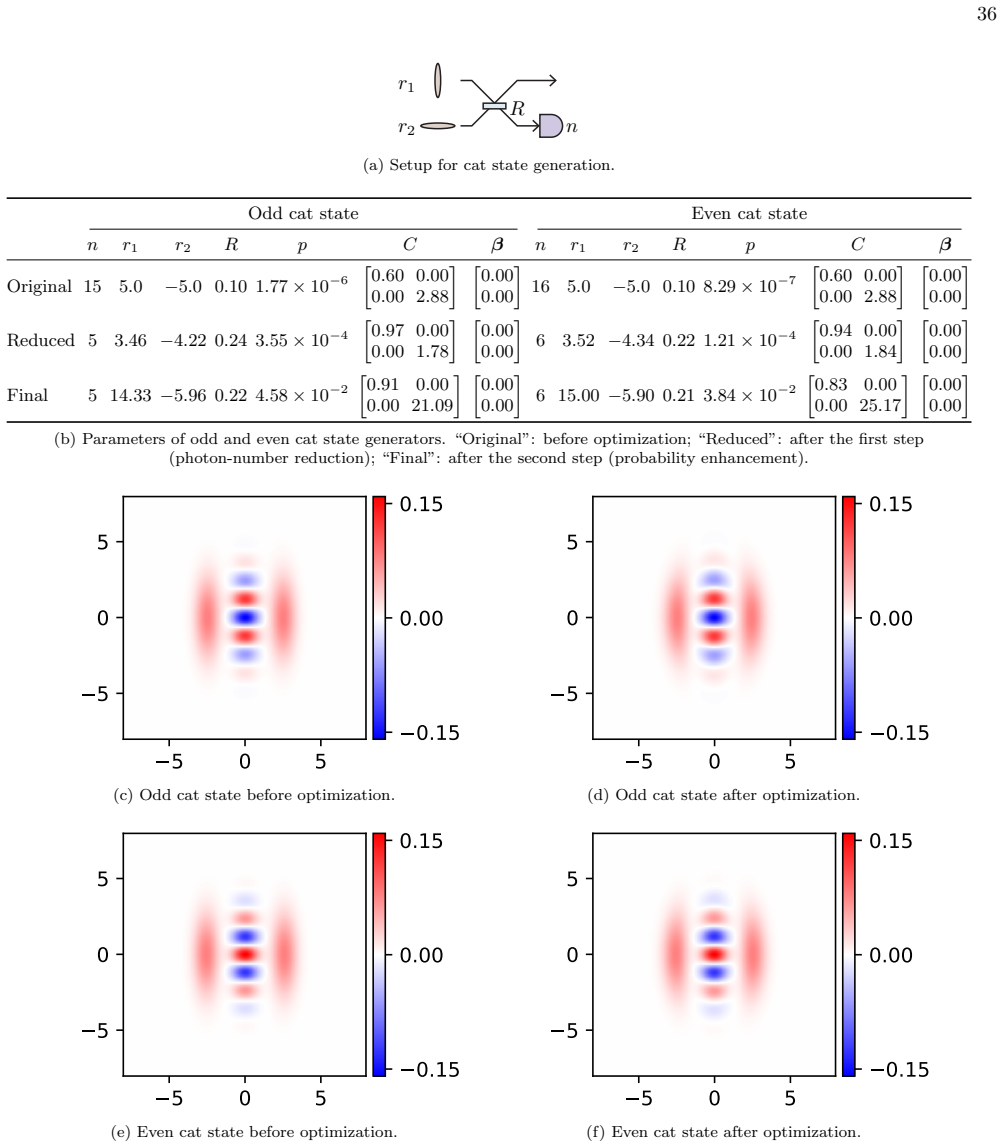
Cat State Cat states, defined in Eq. (2), are widely used in quantum metrology and quantum error correction ow- ing to their non-classical features. Experimentally, they are commonly generated either by photon sub- traction from squeezed vacuum states [30, 32] or, more recently, through the generalized photon subtraction (GPS) scheme using two-mode squeez...
-
[2]
Bef.” = before optimization; “Aft
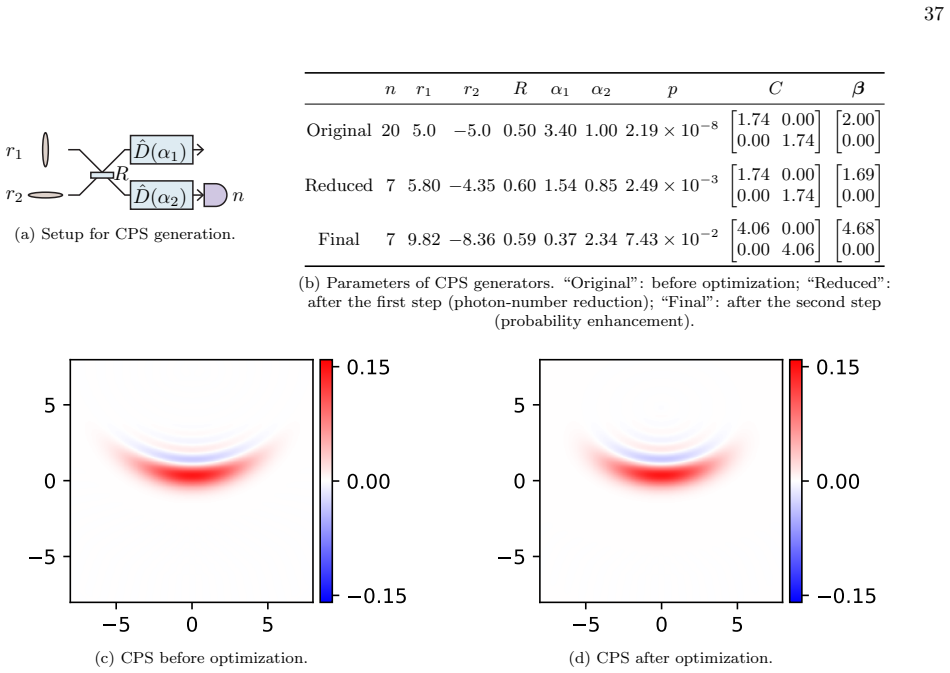
Cubic Phase State CPS, defined in Eq. (5), is a crucial resource for univer- sal continuous-variable quantum computation. We start from the CPS generation protocol proposed by Gottes- man et al. [10], which uses a displaced two-mode squeezed state. With our algorithm, the photon number is reduced from 20 to 7, as well as enhancing the probability by 106, ...
-
[3]
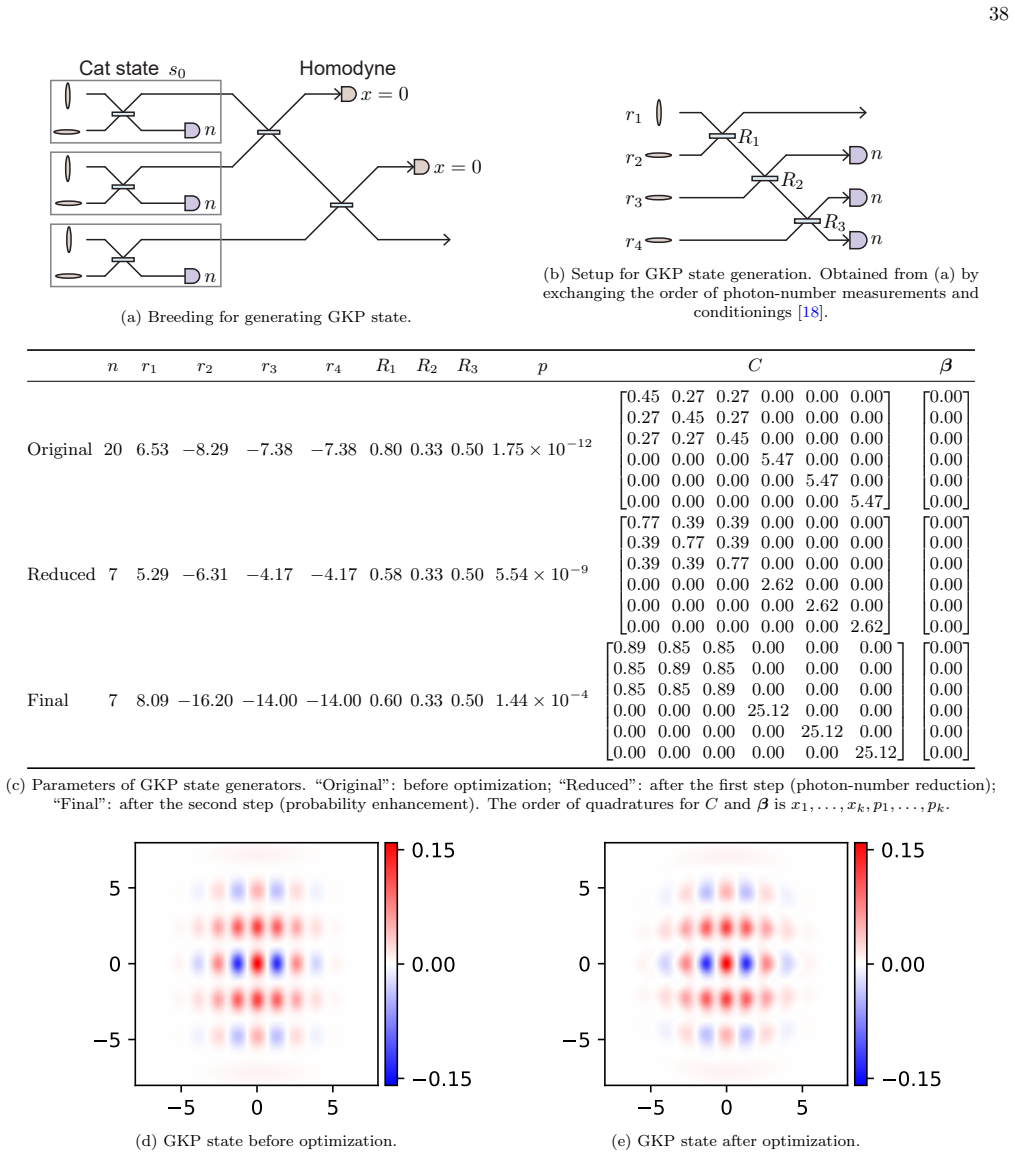
GKP State The Gottesman-Kitaev-Preskill (GKP) state [10], es- sential for bosonic quantum error correction, is defined as a superposition of displaced squeezed states: |GKP⟩= X k ˆD(k∆) ˆS(r)|0⟩.(102) It can be generated via the cat breeding protocol [52, 60], which combines multiple cat states using beamsplitters and homodyne conditioning. We start from ...
-
[4]
The details of the construction are pro- vided in Appendix M
Random state To illustrate the general applicability of our method, we also optimize a randomly constructed non-Gaussian state generator. The details of the construction are pro- vided in Appendix M. In this case as well, we observe a significant reduction in the required photon numbers together with an enhancement in the success probability, while mainta...
-
[5]
W. Asavanant, Y. Shiozawa, S. Yokoyama, B. Charoen- sombutamon, H. Emura, R. N. Alexander, S. Takeda, J. Yoshikawa, N. C. Menicucci, H. Yonezawa, and A. Fu- 18 rusawa, Generation of time-domain-multiplexed two- dimensional cluster state, Science366, 373 (2019)
work page 2019
-
[7]
W. Asavanant, B. Charoensombutamon, S. Yokoyama, T. Ebihara, T. Nakamura, R. N. Alexander, M. Endo, J. Yoshikawa, N. C. Menicucci, H. Yonezawa, and A. Furusawa, Time-domain-multiplexed measurement- based quantum operations with 25-MHz clock frequency, Phys. Rev. Appl.16, 034005 (2021)
work page 2021
-
[8]
M. V. Larsen, X. Guo, C. R. Breum, J. S. Neergaard- Nielsen, and U. L. Andersen, Deterministic multi-mode gates on a scalable photonic quantum computing plat- form, Nature Physics17, 1018 (2021)
work page 2021
-
[9]
S. D. Bartlett, B. C. Sanders, S. L. Braunstein, and K. Nemoto, Efficient classical simulation of continuous variable quantum information processes, Phys. Rev. Lett. 88, 097904 (2002)
work page 2002
-
[10]
N. C. Menicucci, P. van Loock, M. Gu, C. Weedbrook, T. C. Ralph, and M. A. Nielsen, Universal Quantum Computation with Continuous-Variable Cluster States, Physical Review Letters97, 110501 (2006)
work page 2006
-
[11]
S. Lloyd and S. L. Braunstein, Quantum Computation over Continuous Variables, Physical Review Letters82, 1784 (1999)
work page 1999
-
[12]
A. Mari and J. Eisert, Positive Wigner Functions Render Classical Simulation of Quantum Computation Efficient, Physical Review Letters109, 230503 (2012)
work page 2012
- [13]
-
[14]
D. Gottesman, A. Kitaev, and J. Preskill, Encoding a qubit in an oscillator, Phys. Rev. A64, 012310 (2001)
work page 2001
-
[15]
P. T. Cochrane, G. J. Milburn, and W. J. Munro, Macro- scopically distinct quantum-superposition states as a bosonic code for amplitude damping, Physical Review A59, 2631 (1999)
work page 1999
-
[16]
M. H. Michael, M. Silveri, R. T. Brierley, V. V. Albert, J. Salmilehto, L. Jiang, and S. M. Girvin, New Class of Quantum Error-Correcting Codes for a Bosonic Mode, Physical Review X6, 031006 (2016)
work page 2016
-
[17]
K. Duivenvoorden, B. M. Terhal, and D. Weigand, Single- mode displacement sensor, Physical Review A95, 012305 (2017)
work page 2017
-
[18]
M. Gessner, A. Smerzi, and L. Pezz` e, Metrological Non- linear Squeezing Parameter, Physical Review Letters 122, 090503 (2019)
work page 2019
-
[19]
F. Hanamura, W. Asavanant, K. Fukui, S. Konno, and A. Furusawa, Estimation of Gaussian random displace- ment using non-Gaussian states, Physical Review A104, 062601 (2021)
work page 2021
-
[20]
D. Su, C. R. Myers, and K. K. Sabapathy, Conversion of gaussian states to non-gaussian states using photon- number-resolving detectors, Phys. Rev. A100, 052301 (2019)
work page 2019
- [21]
-
[22]
H. Aghaee Rad, T. Ainsworth, R. N. Alexander, B. Al- tieri, M. F. Askarani, R. Baby, L. Banchi, B. Q. Bara- giola, J. E. Bourassa, R. S. Chadwick, I. Charania, H. Chen, M. J. Collins, P. Contu, N. D’Arcy, G. Dauphi- nais, R. De Prins, D. Deschenes, I. Di Luch, S. Duque, P. Edke, S. E. Fayer, S. Ferracin, H. Ferretti, J. Gefaell, S. Glancy, C. Gonz´ alez-A...
work page 2025
-
[23]
M. V. Larsen, J. E. Bourassa, S. Kocsis, J. F. Tasker, R. S. Chadwick, C. Gonz´ alez-Arciniegas, J. Hastrup, C. E. Lopetegui-Gonz´ alez, F. M. Miatto, A. Mo- tamedi, R. Noro, G. Roeland, R. Baby, H. Chen, P. Contu, I. Di Luch, C. Drago, M. Giesbrecht, T. Grainge, I. Krasnokutska, M. Menotti, B. Morri- son, C. Puviraj, K. Rezaei Shad, B. Hussain, J. McMa- ...
-
[24]
C. S. Hamilton, R. Kruse, L. Sansoni, S. Barkhofen, C. Silberhorn, and I. Jex, Gaussian boson sampling, Phys. Rev. Lett.119, 170501 (2017)
work page 2017
-
[25]
H.-S. Zhong, H. Wang, Y.-H. Deng, M.-C. Chen, L.-C. Peng, Y.-H. Luo, J. Qin, D. Wu, X. Ding, Y. Hu, P. Hu, X.-Y. Yang, W.-J. Zhang, H. Li, Y. Li, X. Jiang, L. Gan, G. Yang, L. You, Z. Wang, L. Li, N.-L. Liu, C.-Y. Lu, and J.-W. Pan, Quantum computational advantage using photons, Science370, 1460 (2020)
work page 2020
-
[26]
U. Chabaud, D. Markham, and F. Grosshans, Stellar rep- resentation of non-gaussian quantum states, Phys. Rev. Lett.124, 063605 (2020)
work page 2020
-
[27]
L. Lachman, I. Straka, J. Hlouˇ sek, M. Jeˇ zek, and R. Filip, Faithful Hierarchy of Genuine$n$-Photon Quantum Non-Gaussian Light, Physical Review Letters 123, 043601 (2019)
work page 2019
-
[28]
D. Menzies and R. Filip, Gaussian-optimized prepara- tion of non-Gaussian pure states, Physical Review A79, 012313 (2009)
work page 2009
-
[29]
U. Chabaud, G. Roeland, M. Walschaers, F. Grosshans, V. Parigi, D. Markham, and N. Treps, Certification of Non-Gaussian States with Operational Measurements, PRX Quantum2, 020333 (2021)
work page 2021
-
[30]
L. Podhora, L. Lachman, T. Pham, A. Leˇ sund´ ak, O.ˇC´ ıp, L. Slodiˇ cka, and R. Filip, Quantum Non-Gaussianity of Multiphonon States of a Single Atom, Physical Review Letters129, 013602 (2022)
work page 2022
- [31]
-
[32]
V. Kuchaˇ r and P. Marek, Nonlinear squeezing of superpositions of quadrature eigenstates (2025), arXiv:2506.17437 [quant-ph]
-
[33]
Marek, Ground state nature and nonlinear squeezing of gottesman-kitaev-preskill states, Phys
P. Marek, Ground state nature and nonlinear squeezing of gottesman-kitaev-preskill states, Phys. Rev. Lett.132, 210601 (2024)
work page 2024
-
[34]
M. Endo, T. Nomura, T. Sonoyama, K. Takahashi, S. Takasu, D. Fukuda, T. Kashiwazaki, A. Inoue, T. Umeki, R. Nehra, P. Marek, R. Filip, K. Takase, W. Asavanant, and A. Furusawa, High-rate four pho- ton subtraction from squeezed vacuum: Preparing cat state for optical quantum computation (2025), arXiv:2502.08952 [quant-ph]
-
[35]
S. Konno, W. Asavanant, F. Hanamura, H. Na- gayoshi, K. Fukui, A. Sakaguchi, R. Ide, F. China, M. Yabuno, S. Miki, H. Terai, K. Takase, M. Endo, P. Marek, R. Filip, P. van Loock, and A. Furusawa, Logical states for fault-tolerant quantum computa- tion with propagating light, Science383, 289 (2024), https://www.science.org/doi/pdf/10.1126/science.adk7560
-
[36]
T. Gerrits, S. Glancy, T. S. Clement, B. Calkins, A. E. Lita, A. J. Miller, A. L. Migdall, S. W. Nam, R. P. Mirin, and E. Knill, Generation of optical coherent-state super- positions by number-resolved photon subtraction from the squeezed vacuum, Phys. Rev. A82, 031802 (2010)
work page 2010
-
[37]
M. Endo, R. He, T. Sonoyama, K. Takahashi, T. Kashi- wazaki, T. Umeki, S. Takasu, K. Hattori, D. Fukuda, K. Fukui, K. Takase, W. Asavanant, P. Marek, R. Filip, and A. Furusawa, Non-gaussian quantum state genera- tion by multi-photon subtraction at the telecommunica- tion wavelength, Opt. Express31, 12865 (2023)
work page 2023
- [38]
- [39]
-
[40]
A. Zavatta, S. Viciani, and M. Bellini, Quantum-to- Classical Transition with Single-Photon-Added Coherent States of Light, Science306, 660 (2004)
work page 2004
-
[41]
J. Fiur´ aˇ sek, Engineering quantum operations on travel- ing light beams by multiple photon addition and subtrac- tion, Physical Review A80, 053822 (2009)
work page 2009
- [42]
-
[43]
K. Park, P. Marek, and R. Filip, Nonlinear potential of a quantum oscillator induced by single photons, Physical Review A90, 013804 (2014)
work page 2014
-
[44]
A. I. Lvovsky, H. Hansen, T. Aichele, O. Benson, J. Mlynek, and S. Schiller, Quantum State Reconstruc- tion of the Single-Photon Fock State, Physical Review Letters87, 050402 (2001)
work page 2001
-
[45]
T. Sonoyama, K. Takahashi, T. Sano, T. Suzuki, T. No- mura, M. Yabuno, S. Miki, H. Terai, K. Takase, W. Asa- vanant, M. Endo, and A. Furusawa, Generation of multi- photon Fock states at telecommunication wavelength us- ing picosecond pulsed light, Optics Express32, 32387 (2024)
work page 2024
- [46]
- [47]
-
[48]
V. V. Dodonov, I. A. Malkin, and V. I. Man’ko, Even and odd coherent states and excitations of a singular os- cillator, Physica72, 597 (1974)
work page 1974
-
[49]
A. Sakaguchi, S. Konno, F. Hanamura, W. Asavanant, K. Takase, H. Ogawa, P. Marek, R. Filip, J. Yoshikawa, and E. Huntington, Nonlinear feedforward enabling quantum computation, Nature Communications14, 3817 (2023)
work page 2023
-
[50]
C. Weedbrook, S. Pirandola, R. Garc´ ıa-Patr´ on, N. J. Cerf, T. C. Ralph, J. H. Shapiro, and S. Lloyd, Gaussian quantum information, Rev. Mod. Phys.84, 621 (2012)
work page 2012
-
[51]
M. A. Nielsen and I. L. Chuang,Quantum computation and quantum information(Cambridge university press, 2010)
work page 2010
-
[52]
L.-M. Duan, G. Giedke, J. I. Cirac, and P. Zoller, Insep- arability criterion for continuous variable systems, Phys. Rev. Lett.84, 2722 (2000)
work page 2000
-
[53]
Simon, Peres-horodecki separability criterion for con- tinuous variable systems, Phys
R. Simon, Peres-horodecki separability criterion for con- tinuous variable systems, Phys. Rev. Lett.84, 2726 (2000)
work page 2000
-
[54]
W. Asavanant, K. Takase, K. Fukui, M. Endo, J. Yoshikawa, and A. Furusawa, Wave-function engineer- ing via conditional quantum teleportation with a non- Gaussian entanglement resource, Physical Review A103, 043701 (2021)
work page 2021
-
[55]
A. Ourjoumtsev, H. Jeong, R. Tualle-Brouri, and P. Grangier, Generation of optical ‘Schr¨ odinger cats’ from photon number states, Nature448, 784 (2007)
work page 2007
-
[56]
A. P. Lund, H. Jeong, T. C. Ralph, and M. S. Kim, Conditional production of superpositions of coherent states with inefficient photon detection, Phys. Rev. A 70, 020101 (2004)
work page 2004
-
[57]
encoding a qubit in an oscilla- tor
H. M. Vasconcelos, L. Sanz, and S. Glancy, All-optical generation of states for “encoding a qubit in an oscilla- tor”, Opt. Lett.35, 3261 (2010)
work page 2010
- [58]
-
[59]
Szeg,Orthogonal polynomials, Vol
G. Szeg,Orthogonal polynomials, Vol. 23 (American Mathematical Soc., 1939)
work page 1939
-
[60]
R. Takagi and Q. Zhuang, Convex resource theory of non- gaussianity, Phys. Rev. A97, 062337 (2018)
work page 2018
-
[61]
W. P. Schleich,Quantum optics in phase space(John Wiley & Sons, 2015)
work page 2015
-
[62]
J. Williamson, On the algebraic problem concerning the normal forms of linear dynamical systems, American Journal of Mathematics58, 141 (1936)
work page 1936
-
[63]
XanaduAI, Mrmustard,https://github.com/ XanaduAI/MrMustard(2021)
work page 2021
-
[64]
D. V. Sychev, A. E. Ulanov, A. A. Pushkina, M. W. Richards, I. A. Fedorov, and A. I. Lvovsky, Enlargement of optical schr¨ odinger’s cat states, Nature Photonics11, 379 (2017)
work page 2017
-
[65]
A. P. Lund, M. J. Bremner, and T. C. Ralph, Quan- tum sampling problems, BosonSampling and quantum 20 supremacy, npj Quantum Information3, 15 (2017)
work page 2017
-
[66]
S. Aaronson and A. Arkhipov, The Computational Com- plexity of Linear Optics, Theory of Computing9, 143 (2013)
work page 2013
-
[67]
J. S. Ivan, K. K. Sabapathy, and R. Simon, Operator-sum representation for bosonic Gaussian channels, Physical Review A84, 042311 (2011)
work page 2011
- [68]
-
[69]
A. Jadczyk, Asymptotic formula for quantum harmonic oscillator tunneling probabilities, Reports on Mathemat- ical Physics76, 149 (2015)
work page 2015
-
[70]
J. Fiur´ aˇ sek, Efficient representation of purity-preserving Gaussian quantum filters, Physical Review A87, 052301 (2013). 21 Appendix A: Mixed state generators In real-world experiments, non-Gaussian state gener- ators inevitably suffer from imperfections such as loss, leading to mixed output states. The dominant errors in optical experiments, includin...
work page 2013
-
[71]
Whenx 0 = 0andn≡n ′(mod 2) First, we consider the simplest case with no displace- ment (x0 = 0) and withnandn ′ of the same parity. In this case, we may setd= 0. Let the wavefunction of the Fock state|n⟩beϕ n(x). This satisfies the Schr¨ odinger equation ϕ′′ n(x) =−(4n+ 2−x 2)ϕn(x).(K3) Using the “local momentum” p(x) = p 4n+ 2−x 2,(K4) this can be rewrit...
-
[72]
(K18) and (K19) simul- taneously, the values of (k, d) can be narrowed down to a finite set
Case ofx 0 ̸= 0 In the case with displacement (x 0 ̸= 0), the Schr¨ odinger equation for the squeezed and displaced Fock state wavefunction ˜ϕn′(x) :=ϕ n′(kx−d) (K14) is ˜ϕ′′ n′(x) =−[˜p(x)]2 ˜ϕn′(x),(K15) ˜p(x) =k2 (kx−d) 2 −(4n ′ + 2) .(K16) Thus, the approximation ϕn(x) ∝∼ ˜ϕn′(x) (K17) holds nearx=x 0, if the local momentum matches: p(x0) = ˜p(x0),(K1...
-
[73]
Representation by a Gaussian filter So far, we have shown that the output state of a two- mode non-Gaussian state generator can be approximated up to Gaussian unitary degrees of freedom. We now de- rive the explicit form of the transformation of the state generators, in the form of a Gaussian filter acting on the control mode. The approximation Eq. (71) c...
-
[74]
Final”), together with the intermediate result after the first step (“Reduced
is not unique, and has the degree of freedom of applying a damping operation. One possible choice is theC ′ that has the same symplectic eigenvalues asC, which we em- ploy for the algorithm implemented in Sec. VI. Appendix L: Invariant non-Gaussian control parameters In Sec. V, we defined the non-Gaussian control param- eterss 0,δ 0 for multi-mode non-Gau...
-
[75]
Cat state We consider the GPS scheme [34] for generating cat states, illustrated in Fig. 10(a). The initial squeezing is set tor 1 =−r 2 = 5 dB, and the beamsplitter reflectance to 0.1, both of which are reasonable experimental as- sumptions. We begin withn= 15,16 photon detections for odd and even cat states, respectively, and set the tar- get photon num...
-
[76]
[10] for generating CPS states using a displaced two-mode squeezed state, illustrated in Fig
CPS state We consider the scheme of Ref. [10] for generating CPS states using a displaced two-mode squeezed state, illustrated in Fig. 11(a). The initial squeezing is set to r1 =−r 2 = 5 dB, with a displacementα 2 = 1 applied to the control mode. A displacement is also applied to the signal mode, although not essential, so as to center the output state in...
-
[77]
GKP state We consider the cat-breeding protocol [53] withx= 0 conditioning, shown in Fig. 12(a). Since homodyne de- tection is Gaussian, exchanging the order of photon- number measurement and conditioning maps this pro- tocol to the Gaussian breeding circuit [17] in Fig. 12(b). A detailed derivation of this equivalence can be found in the Supplemental Mat...
-
[78]
Random state Finally, we apply the algorithm to random Gaus- sian states. A random Gaussian unitaryUis sam- pled using therandom symplecticfunction in MrMus- tard [59], constructed asU=W S(r)Vfrom two Haar- random symplectic orthogonal matricesW, Vand a ran- dom squeezing vectorr∈[0, r max]. With a displacement d∈[0, d max]⊗2(k+1), the state is |G⟩=D(d)U|...
discussion (0)
Sign in with ORCID, Apple, or X to comment. Anyone can read and Pith papers without signing in.