REVIEW 4 major objections 4 minor 51 references
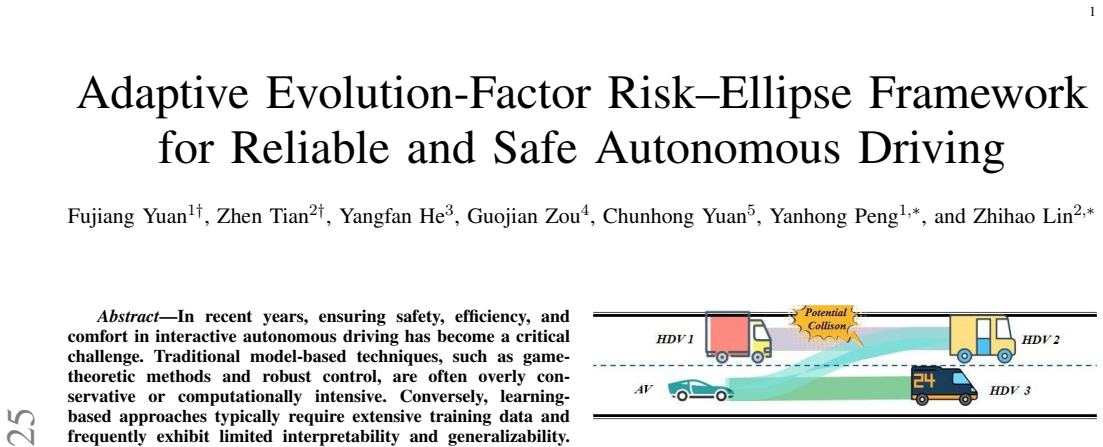
An adaptive risk ellipse, whose size is set by time-to-collision and time-window-of-hazard, lets an MPC planner keep autonomous vehicles collision-free in simulated lane changes and overtakes while maintaining near-reference speed.
Reviewed by Pith at T0; open to challenge. T0 means a machine referee read the full paper against a public rubric. the ladder, T0–T4 →
2026-08-04 23:42 UTC pith:HGBVR4DW
load-bearing objection The risk ellipse is defined but never used in the solved MPC cost, so the paper's central claim doesn't follow from its own equations. the 4 major comments →
Adaptive Evolution Factor Risk Ellipse Framework for Reliable and Safe Autonomous Driving
The pith
A machine-rendered reading of the paper's core claim, the machinery that carries it, and where it could break.
Core claim
The paper's central claim is that collision risk in interactive driving can be represented by an evolutionary potential field whose repulsion strength is modulated by a history-based factor η, and whose spatial extent is encoded by a risk ellipse with semi-major axis set by time-to-collision and semi-minor axis set by the time window of hazard, both clipped by physical actuation limits. The evolution factor, η_i(k) = 1 + λ·sigmoid((d̄_i(k) − d_i(k))/d_safe), amplifies the repulsion of an obstacle when the current distance is smaller than its recent average, and attenuates it when the obstacle is moving away. The ellipse risk factor ERF = √((x/a)² + (y/b)²) converts the ego position into a no
What carries the argument
The central object is the Evolutionary Risk Potential Field (ERPF), formed by multiplying a standard repulsive field by a history-dependent evolution factor η_i(k) = 1 + λ·σ((d̄_i(k) − d_i(k))/d_safe). The factor exceeds 1 when the current distance to an obstacle is smaller than its recent historical average, so risk grows as an obstacle approaches and decays once it recedes. Its spatial shape is set by a risk ellipse whose semi-major axis is governed by TTC and semi-minor axis by TWH, normalized by ERF = √((x/a)² + (y/b)²); the exponential R = e^{−α(ERF−1)} is added, weighted by γ, into the MPC cost, giving the optimizer a differentiable, bounded, time-varying hazard gradient.
Load-bearing premise
The load-bearing assumption is that surrounding vehicles keep moving along straight lines at constant known speeds while the plan is computed, and that the approximate routine used to solve the risk-ridden optimization always returns a trajectory close to the one reported.
What would settle it
Run ERPF-MPC in a scenario where an obstacle decelerates at half its assumed speed starting two seconds into the horizon, or performs a cut-in lane change; if any of 100 such runs ends in collision, the TTC/TWH ellipse is not covering prediction error. A cheaper check is an ablation with the evolution factor fixed to η = 1 while keeping the risk ellipse and all tuned parameters: if collision counts stay zero, the history-based adaptation is not what makes the method safe.
If this is right
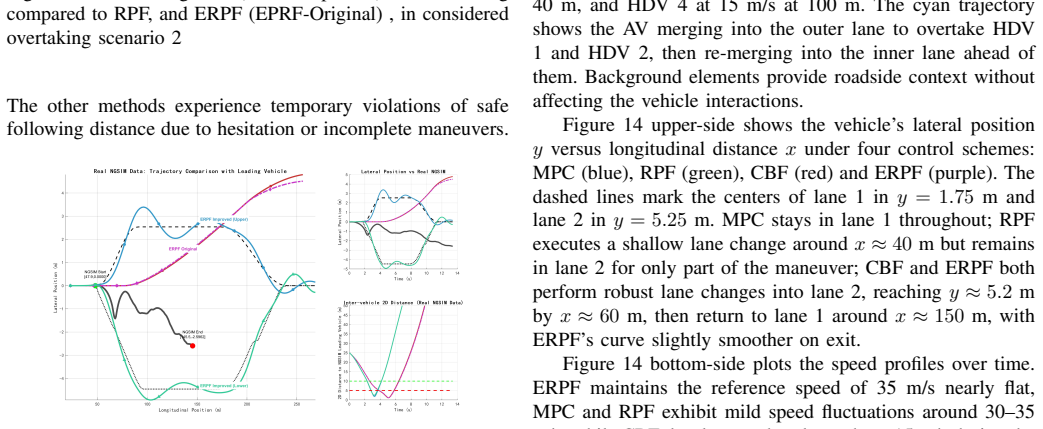
- Across 20 randomized runs in a multi-vehicle overtaking scenario, ERPF-MPC reports zero collisions, compared with 3 for CBF, about 8.5 for RPF, and 9 for plain MPC.
- ERPF keeps average speed near the reference of 35 m/s, while the CBF baseline slows to about 29 m/s during the maneuver.
- Risk ellipses inflate before the gap to an obstacle crosses the safety threshold, so the vehicle starts an avoidance maneuver earlier than a static field would trigger.
- Because the evolution factor uses a sigmoid, the MPC cost stays continuously differentiable, avoiding the jumps a binary risk switch would introduce.
- The per-timestep computation (roughly 5,000 FLOPs on the reported hardware) is small enough for real-time replanning, in the paper's estimate.
Where Pith is reading between the lines
- The benchmarks assume every obstacle moves on a straight line at constant velocity, so the result should be read as validation of the ellipse shape under exactly the motion model it assumes, not under genuine prediction error; a natural stress test would replace obstacle trajectories with a car that brakes hard or cuts in mid-horizon.
- The risk ellipse metric ERF could be reused outside the MPC cost, for example as a constraint in a control-barrier-function safety filter; that would give the adaptive geometry a formal safety guarantee rather than a tuned penalty.
- The history average d̄_i(k) is a simple moving average; using an exponential moving average or a prediction-error-weighted average would be a direct way to tune how fast the field forgets stale proximity, a parameter the paper leaves implicit.
- Because the nonconvex risk term is 'linearized or approximated iteratively' without specifying the solver, the cleanest way to separate ERPF's contribution from tuning is an ablation that keeps all parameters fixed and toggles only the evolution factor.
Editorial analysis
A structured set of objections, weighed in public.
Referee Report
Summary. The paper proposes an Evolutionary Risk Potential Field (ERPF) framework for MPC-based autonomous driving. The main ingredients are a history-based evolution factor η_i(k) that amplifies a standard radial RPF, and a separate risk-ellipse model whose semi-axes are computed from Time-to-Collision (TTC) and Time-Window-of-Hazard (TWH). The abstract and conclusions claim that the adaptive risk ellipse is integrated seamlessly into the MPC cost and is responsible for smoother, faster, and collision-free driving. The manuscript derives the RPF cost in Eqs. (13) and (21), then introduces the ellipse in Section V (Eqs. (23)–(26)), and reports simulations for lane-change and overtaking scenarios, comparisons against MPC, RPF, and CBF baselines, and FLOPs-based runtime estimates.
Significance. If the central claim were valid, a lightweight, interpretable, and adaptive risk field would be a useful contribution to interactive motion planning. The paper has some strengths: the evolution factor is smooth and differentiable, the notation is mostly clear, and the overall structure is easy to follow. However, the load-bearing connection between the risk ellipse and the MPC optimization is absent from the equations. The reported zero-collision trajectories are therefore not evidence for the proposed ellipse mechanism, and the prediction model used in the experiments removes the uncertainty that the framework aims to handle. As written, the paper does not demonstrate its main contribution.
major comments (4)
- [Section V / Eqs. (13), (21), Algorithm 1] The ellipse is never inserted into the optimization. The cost J(U) in Eq. (13) and Eq. (21) contains only V_ERPF = Σ η_i α_i φ(||Cs_k − p_i(k)||), with η_i from Eq. (10). No term involving the semi-axes a,b from Eqs. (23)–(24), the ellipse risk factor ERF from Eq. (25), or the exponential risk R from Eq. (26) appears in the objective. Algorithm 1 also never computes TTC, TWH, or ellipse axes. The appended note 'BENEFIT OF SIGMOID-BASED EVOLUTION FACTOR' explicitly separates η(k) from the ERF, which confirms that the implemented risk is a sigmoid-weighted radial field. Therefore, even a perfect solution of Eq. (21) would not exercise the risk-ellipse model, and the abstract's claim that the ellipse is 'integrated seamlessly' into MPC is unsupported.
- [Section IV-A, Eq. (19)] Obstacle motion is assumed to be deterministic straight-line motion: p_i(k) = p_i(0) + v_i k Δt with constant v_i. This removes the prediction uncertainty that motivates the TTC/TWH ellipse. No experiment in Section VI perturbs obstacle velocities or uses stochastic predictions. The abstract and introduction promise handling of 'uncertain driving of surrounding vehicles,' but the simulated obstacles are exactly known. To support the central claim, the authors need experiments with accelerating, decelerating, or lane-changing HDVs and must quantify how the ellipse contributes to safety under such uncertainty.
- [Eq. (21), Fig. 22] The solver is underspecified. The text says 'the risk term V_ERPF(s_k) is nonconvex and may be linearized or approximated iteratively,' but no linearization scheme, convergence criterion, or implementation details are given. Algorithm 1 simply says 'Solve the optimization problem.' The FLOP measurements in Fig. 22 are therefore not meaningful without a precise solver definition. The reported trajectories and collision counts may depend on an undocumented numerical approximation rather than on the ERPF formulation. A reproducible version must specify the iterative solver, tolerances, and discretization.
- [Section VI, Figs. 15 and 19] The empirical evidence is internally inconsistent. Figure 15 reports CBF with zero collisions, while Fig. 19 reports CBF averaging 3 collisions per 20 runs. These may be different scenarios, but the text does not reconcile them. Moreover, the 'uncertain driving environment' in Fig. 19 is never described: what randomness is applied over the 20 runs, what seeds and distributions are used, and how are obstacle trajectories generated? Without this information, the collision statistics are not reproducible. The hand-set parameters (λ, α, a_max, b_max, d_lat_max, and MPC weights) also lack any sensitivity analysis, which is essential for a paper whose title claims 'Reliable and Safe.'
minor comments (4)
- [Section VI, Figs. 10–13] Several figure references seem inconsistent. For example, Fig. 10 is described as an 'ERPF simulation of overtaking' but its caption says 'Initial positions' while Fig. 11 also shows overtaking; Fig. 13 is again 'Overtaking scenario 2.' The numbering and captions should be cleaned up to avoid confusion.
- [Fig. 22] The FLOP units are suspicious: '60.7 FLOPs per interaction' and '5,058 average FLOPs per timestep' are orders of magnitude apart, and typical MPC operations require more than a few hundred FLOPs. Clarify whether the intended units are KFLOPs, MFLOPs, or other prefixes.
- [Eq. (22)] The TTC formula TTC = (x_obs − x_ego)/(v_ego − v_obs) is undefined when v_ego = v_obs and does not address negative or infinite TTC. The paper should define how such cases are handled, especially since the ellipse semi-major axis depends on TTC.
- [Fig. 19] The acronym 'ERPF' is spelled 'EPRF' in Fig. 19 and in some surrounding text. Please use one consistent abbreviation.
Circularity Check
Minor self-definitional reduction in the risk-ellipse model; the main ERPF-MPC derivation is not circular, but the ellipse is never wired into the optimizer.
specific steps
-
self definitional
[Section V-B, Eqs. (22)-(23) and Eq. (25); Section VI, Fig. 17 discussion]
"TTC= (x_obs − x_ego)/(v_ego − v_obs) [Eq. 22] ... a= min((v_ego − v_obs)·TTC, v_rel·t_horizon + 1/2 a_max t_horizon^2) [Eq. 23] ... ERF= sqrt((x/a)^2 + (y/b)^2) [Eq. 25] ... 'the corresponding ellipse expands forward or laterally to account for the worst-case trajectories' [Fig. 17]"
When the first term of the min in Eq. (23) is active, substituting Eq. (22) yields (v_ego − v_obs)·TTC = x_obs − x_ego, the current longitudinal gap. Thus the ellipse's semi-major axis is, by construction, the present distance to the obstacle, and the ERF in Eq. (25) becomes a rescaled current-distance measure. The paper presents this as a TTC-based predictive 'expands forward' risk envelope, but the longitudinal reach is defined from instantaneous distance, not from a predicted future position. Any 'early warning' attributed to the ellipse is therefore the same current-proximity information already contained in the RPF of Eq. (6), just repackaged. This is a definitional reduction of the ellipse's claimed temporal prediction to its input distance.
full rationale
The core ERPF-MPC chain is internally self-contained: Eq. (6) defines the RPF, Eq. (10) the sigmoid evolution factor, Eq. (11) the ERPF, and Eq. (13)/Algorithm 1 place V_ERPF directly in the MPC cost. The controller actually implemented and simulated is a sigmoid-weighted radial RPF, and no load-bearing self-citation or imported uniqueness theorem is used. The one genuine definitional reduction is in the separately presented collision-ellipse model: because Eq. (23) together with Eq. (22) collapses to the current longitudinal gap when the min is inactive, the ellipse's longitudinal risk factor is a rescaled instantaneous distance rather than an independent temporal prediction. Separately, and more important for correctness though not for circularity, the ellipse equations (23)-(26) never appear in J(U) of Eq. (13)/(21) or in Algorithm 1; the abstract's claim that the risk ellipse is 'integrated seamlessly into MPC' is unsupported by the paper's own equations. That omission means the reported zero-collision trajectories cannot validate the ellipse mechanism, but it is a derivation gap, not a circular derivation. Because the main result is not forced by definition or by a self-citation chain, the circularity score remains low.
Axiom & Free-Parameter Ledger
free parameters (10)
- lambda (evolution factor gain) =
not reported
- d_safe (safety distance) =
not reported; a 2 m threshold appears in figures
- alpha_i (per-obstacle RPF gain) =
not reported
- gamma (risk weight in MPC) =
not reported
- Q, R, Q_N (MPC weighting matrices) =
not reported
- N_H (history window) =
not reported
- a_max, b_max, d_lat_max (ellipse geometric caps) =
a_max = 50 m, b_max = 10 m; d_lat_max not reported
- alpha (ellipse risk decay coefficient) =
not reported
- TWH (time-window-of-hazard) =
not reported
- N (prediction horizon) =
not reported
axioms (5)
- domain assumption Obstacle future positions follow p_i(k) = p_i(0) + v_i k dt with known constant velocities v_i.
- domain assumption The host vehicle is a point mass with linear kinematics s_{k+1} = A s_k + B u_k.
- ad hoc to paper The nonconvex risk term in the MPC objective can be linearized or approximated iteratively without changing the reported performance.
- domain assumption Risk from multiple obstacles adds linearly and is commensurate with tracking and control cost through a single scalar gamma.
- ad hoc to paper A two-layer risk representation (sigmoid evolution factor and TTC/TWH ellipse) can both be active in the same controller.
invented entities (4)
-
Risk-Ellipse (collision ellipse)
no independent evidence
-
Evolution factor eta
no independent evidence
-
Time-Window-of-Hazard (TWH)
no independent evidence
-
Ellipse risk factor ERF and risk metric R
no independent evidence
Cite this review
Pith. "Pith review of Adaptive Evolution Factor Risk Ellipse Framework for Reliable and Safe Autonomous Driving." pith.science (2026). https://pith.science/paper/HGBVR4DW
@misc{pith2026250906375,
  author       = {Pith},
  title        = {Pith review of: Adaptive Evolution Factor Risk Ellipse Framework for Reliable and Safe Autonomous Driving},
  year         = {2026},
  howpublished = {\url{https://pith.science/paper/HGBVR4DW}},
  note         = {Machine review of arXiv:2509.06375}
}
read the original abstract
In recent years, ensuring safety, efficiency, and comfort in interactive autonomous driving has become a critical challenge. Traditional model-based techniques, such as game-theoretic methods and robust control, are often overly conservative or computationally intensive. Conversely, learning-based approaches typically require extensive training data and frequently exhibit limited interpretability and generalizability. Simpler strategies, such as Risk Potential Fields (RPF), provide lightweight alternatives with minimal data demands but are inherently static and struggle to adapt effectively to dynamic traffic conditions. To overcome these limitations, we propose the Evolutionary Risk Potential Field (ERPF), a novel approach that dynamically updates risk assessments in dynamical scenarios based on historical obstacle proximity data. We introduce a Risk-Ellipse construct that combines longitudinal reach and lateral uncertainty into a unified spatial temporal collision envelope. Additionally, we define an adaptive Evolution Factor metric, computed through sigmoid normalization of Time to Collision (TTC) and Time-Window-of-Hazard (TWH), which dynamically adjusts the dimensions of the ellipse axes in real time. This adaptive risk metric is integrated seamlessly into a Model Predictive Control (MPC) framework, enabling autonomous vehicles to proactively address complex interactive driving scenarios in terms of uncertain driving of surrounding vehicles. Comprehensive comparative experiments demonstrate that our ERPF-MPC approach consistently achieves smoother trajectories, higher average speeds, and collision-free navigation, offering a robust and adaptive solution suitable for complex interactive driving environments.
Figures




Reference graph
Works this paper leans on
-
[1]
Enhanced visual slam for collision-free driving with lightweight autonomous cars,
Z. Linet al., “Enhanced visual slam for collision-free driving with lightweight autonomous cars,”Sensors, vol. 24, no. 19, p. 6258, 2024
work page 2024
-
[2]
Dpl-slam: enhancing dy- namic point-line slam through dense semantic methods,
Z. Lin, Q. Zhang, Z. Tian, P. Yu, and J. Lan, “Dpl-slam: enhancing dy- namic point-line slam through dense semantic methods,”IEEE Sensors Journal, vol. 24, no. 9, pp. 14 596–14 607, 2024
work page 2024
-
[3]
Slam2: Simultaneous localization and multimode mapping for indoor dynamic environments,
Z. Linet al., “Slam2: Simultaneous localization and multimode mapping for indoor dynamic environments,”Pattern Recognition, vol. 158, p. 111054, 2025
work page 2025
-
[4]
Path planning algorithms in the autonomous driving system: A comprehensive review,
M. Redaet al., “Path planning algorithms in the autonomous driving system: A comprehensive review,”Robotics and Autonomous Systems, vol. 174, p. 104630, 2024
work page 2024
-
[5]
Bio-inspired hybrid path planning for efficient and smooth robotic navigation,
F. Yuanet al., “Bio-inspired hybrid path planning for efficient and smooth robotic navigation,”International Journal of Intelligent Robotics and Applications, pp. 1–31, 2025
work page 2025
-
[6]
Industrial internet robot collaboration system and edge computing optimization,
Q. Zuoet al., “Industrial internet robot collaboration system and edge computing optimization,”arXiv preprint arXiv:2504.02492, 2025
-
[7]
Advanced multi-modal sensor fusion architectures for robust autonomous driving systems,
Q. Zuo, C. Liet al., “Advanced multi-modal sensor fusion architectures for robust autonomous driving systems,” in2025 IEEE 5th International Conference on Electronic Technology, Communication and Information (ICETCI). IEEE, 2025, pp. 1556–1560
work page 2025
-
[8]
End-to-end autonomous driving: Challenges and fron- tiers,
L. Chenet al., “End-to-end autonomous driving: Challenges and fron- tiers,”IEEE Transactions on Pattern Analysis and Machine Intelligence, 2024
work page 2024
-
[9]
Motion planning for autonomous driving: The state of the art and future perspectives,
S. Tenget al., “Motion planning for autonomous driving: The state of the art and future perspectives,”IEEE Trans. Intell. V eh., vol. 8, no. 6, pp. 3692–3711, 2023
work page 2023
-
[10]
A-OctoMap: An Adaptive OctoMap for Online Path Planning
Y . Mao and S. Liu, “A-octomap: An adaptive octomap for online path planning,”arXiv preprint arXiv:2406.13910, 2024
work page internal anchor Pith review Pith/arXiv arXiv 2024
-
[11]
Efficient and safe planner for automated driving on ramps considering unsatisfication,
Q. Li, Z. Tian, X. Wang, J. Yang, and Z. Lin, “Efficient and safe planner for automated driving on ramps considering unsatisfication,” arXiv preprint arXiv:2504.15320, 2025
Pith/arXiv arXiv 2025
-
[12]
J. Tsaiet al., “Autonomous driving control for passing unsignalized intersections using the semantic segmentation technique,”Electronics, vol. 13, no. 3, p. 484, 2024
work page 2024
-
[13]
L. Barruffoet al., “A goa4 control architecture for the autonomous driv- ing of high-speed trains over etcs: Design and experimental validation,” IEEE Trans. Intell. Transp. Syst., 2024
work page 2024
-
[14]
Ensuring safe and smooth control in safety-critical systems via filtered control barrier functions,
S. Liu, W. Xiao, and C. A. Belta, “Ensuring safe and smooth control in safety-critical systems via filtered control barrier functions,”arXiv preprint arXiv:2503.23267, 2025
-
[15]
Control Barrier Functions via Minkowski Operations for Safe Navigation among Polytopic Sets
Y .-H. Chen, S. Liu, W. Xiao, C. Belta, and M. Otte, “Control barrier functions via minkowski operations for safe navigation among polytopic sets,”arXiv preprint arXiv:2504.00364, 2025
work page internal anchor Pith review Pith/arXiv arXiv 2025
-
[16]
Game theoretic application to intersection management: A literature review,
Z. Qinet al., “Game theoretic application to intersection management: A literature review,”IEEE Trans. Intell. V eh., 2024
work page 2024
-
[17]
J. Zhanget al., “Non-cooperative game theory based driver-automation shared steering control considering driver steering behavior characteris- tics,”IEEE Internet of Things Journal, 2024
work page 2024
-
[18]
Enhanced mean field game for interactive decision-making with varied stylish multi-vehicles,
L. Zheng, Z. Tianet al., “Enhanced mean field game for interactive decision-making with varied stylish multi-vehicles,”arXiv preprint arXiv:2509.00981, 2025
Pith/arXiv arXiv 2025
-
[19]
A mean-field-game-integrated mpc-qp framework for collision-free multi-vehicle control,
L. Zheng, X. Wang, F. Li, Z. Mao, Z. Tian, Y . Peng, F. Yuan, and C. Yuan, “A mean-field-game-integrated mpc-qp framework for collision-free multi-vehicle control,”Drones, vol. 9, no. 5, p. 375, 2025. 13
work page 2025
-
[20]
Y . Liu, Z. Tian, Q. Zhou, Z. Huang, and H. Sun, “An aco-mpc framework for energy-efficient and collision-free path planning in autonomous maritime navigation,” in2025 8th International Conference on Advanced Algorithms and Control Engineering (ICAACE). IEEE, 2025, pp. 344– 354
work page 2025
-
[21]
J. Wanget al., “Robust cooperative control strategy for a platoon of connected and autonomous vehicles against sensor errors and control errors simultaneously in a real-world driving environment,”Transporta- tion research part B: methodological, vol. 184, p. 102946, 2024
work page 2024
-
[22]
Z. Linet al., “A conflicts-free, speed-lossless kan-based reinforcement learning decision system for interactive driving in roundabouts,”IEEE Trans. Intell. Transp. Syst., pp. 1–14, 2025
work page 2025
-
[23]
Z. Tianet al., “Efficient and balanced exploration-driven decision making for autonomous racing using local information,”IEEE Trans. Intell. V eh., pp. 1–17, 2024
work page 2024
-
[24]
Z. Tian, Z. Lin, D. Zhao, W. Zhao, D. Flynn, S. Ansari, and C. Wei, “Evaluating scenario-based decision-making for interactive autonomous driving using rational criteria: A survey,”arXiv preprint arXiv:2501.01886, 2025
work page internal anchor Pith review Pith/arXiv arXiv 2025
-
[25]
Balanced exploration and attention-inspired decision making for autonomous driving,
T. Zhenet al., “Balanced exploration and attention-inspired decision making for autonomous driving,”IEEE Transactions on V ehicular Tech- nology, 2025
work page 2025
-
[26]
Interpreting black-box models: a review on explainable artificial intelligence,
V . Hassijaet al., “Interpreting black-box models: a review on explainable artificial intelligence,”Cognitive Computation, vol. 16, no. 1, pp. 45–74, 2024
work page 2024
-
[27]
Risk field model of driving and its application in modeling car-following behavior,
H. Tanet al., “Risk field model of driving and its application in modeling car-following behavior,”IEEE Trans. Intell. Transp. Syst., vol. 23, no. 8, pp. 11 605–11 620, 2021
work page 2021
-
[28]
Y . Liuet al., “Designing external displays for safe av-hdv interactions: Conveying scenarios decisions of intelligent cockpit,” inProceeding of the CAA International Conference on V ehicular Control and Intelligence. IEEE, 2023, pp. 1–8
work page 2023
-
[29]
J. Lianget al., “Interaction-aware trajectory prediction for safe mo- tion planning in autonomous driving: A transformer-transfer learning approach,”arXiv preprint arXiv:2411.01475, 2024
work page internal anchor Pith review Pith/arXiv arXiv 2024
-
[30]
B. Gonget al., “Modeling hdv and cav mixed traffic flow on a foggy two-lane highway with cellular automata and game theory model,” Sustainability, vol. 14, no. 10, p. 5899, 2022
work page 2022
-
[31]
Safety-critical multi-agent mcts for mixed traffic coor- dination at unsignalized roundabout,
Z. Linet al., “Safety-critical multi-agent mcts for mixed traffic coor- dination at unsignalized roundabout,”arXiv preprint arXiv:2509.01856, 2025
arXiv 2025
-
[32]
Safety- critical multi-agent mcts for mixed traffic coordination at unsignalized intersections,
Z. Lin, J. Lan, C. Anagnostopoulos, Z. Tian, and D. Flynn, “Safety- critical multi-agent mcts for mixed traffic coordination at unsignalized intersections,”IEEE Transactions on Intelligent Transportation Systems, 2025
work page 2025
-
[33]
Multi-agent monte carlo tree search for safe decision making at unsignalized intersections,
——, “Multi-agent monte carlo tree search for safe decision making at unsignalized intersections,” 2025
work page 2025
-
[34]
Optimal lane-changing trajectory planning for au- tonomous vehicles considering energy consumption,
Z. Yaoet al., “Optimal lane-changing trajectory planning for au- tonomous vehicles considering energy consumption,”Expert Systems with Applications, vol. 225, p. 120133, 2023
work page 2023
-
[35]
R. Chaiet al., “Multiphase overtaking maneuver planning for au- tonomous ground vehicles via a desensitized trajectory optimization approach,”IEEE Transactions on Industrial Informatics, vol. 19, no. 1, pp. 74–87, 2022
work page 2022
-
[36]
Planning for safe abortable overtaking maneuvers in autonomous driving,
J. Palatti, A. Aksjonov, G. Alcan, and V . Kyrki, “Planning for safe abortable overtaking maneuvers in autonomous driving,” inProceeding of the IEEE International Intelligent Transportation Systems Conference. IEEE, 2021, pp. 508–514
work page 2021
-
[37]
Mpc-based haptic shared steering system: A driver modeling approach for symbiotic driving,
A. M. R. Lazcanoet al., “Mpc-based haptic shared steering system: A driver modeling approach for symbiotic driving,”IEEE/ASME Transac- tions on Mechatronics, vol. 26, no. 3, pp. 1201–1211, 2021
work page 2021
-
[38]
L. Zhaiet al., “Mpc-based integrated control of trajectory tracking and handling stability for intelligent driving vehicle driven by four hub motor,”IEEE Trans. V eh. Technol., vol. 71, no. 3, pp. 2668–2680, 2022
work page 2022
-
[39]
Y . Liu and other, “Data-driven evolutionary game-based model predictive control for hybrid renewable energy dispatch in autonomous ships,” in 2025 4th International Conference on New Energy System and Power Engineering (NESP), 2025, pp. 482–490
work page 2025
-
[40]
Z. Tian, Z. Lin, D. Zhao, C. Anagnostopoulos, Q. Wang, W. Zhao, X. Wang, and C. Wei, “A risk-aware spatial-temporal trajectory planning framework for autonomous vehicles using qp-mpc and dynamic hazard fields,”arXiv preprint arXiv:2509.00643, 2025
Pith/arXiv arXiv 2025
-
[41]
Nmpc-based path tracking control strategy for autonomous vehicles with stable limit handling,
T. Fuet al., “Nmpc-based path tracking control strategy for autonomous vehicles with stable limit handling,”IEEE Trans. V eh. Technol., vol. 71, no. 12, pp. 12 499–12 510, 2022
work page 2022
-
[42]
Control barrier functions: Theory and applications,
A. D. Ames, S. Coogan, M. Egerstedt, G. Notomista, K. Sreenath, and P. Tabuada, “Control barrier functions: Theory and applications,” in2019 18th European control conference (ECC). IEEE, 2019, pp. 3420–3431
2019
-
[43]
Auxiliary-variable adaptive control barrier functions for safety critical systems,
S. Liu, W. Xiao, and C. A. Belta, “Auxiliary-variable adaptive control barrier functions for safety critical systems,” in2023 62nd IEEE Conference on Decision and Control (CDC). IEEE, 2023, pp. 8602– 8607
work page 2023
-
[44]
S. Liu, J. Zeng, K. Sreenath, and C. A. Belta, “Iterative convex optimization for model predictive control with discrete-time high-order control barrier functions,” in2023 American Control Conference (ACC). IEEE, 2023, pp. 3368–3375
work page 2023
-
[45]
Learning-Enabled Iterative Convex Optimization for Safety-Critical Model Predictive Control
S. Liu, Z. Huang, J. Zeng, K. Sreenath, and C. A. Belta, “Learning- enabled iterative convex optimization for safety-critical model predictive control,”arXiv preprint arXiv:2409.08300, 2024
work page internal anchor Pith review Pith/arXiv arXiv 2024
-
[46]
Auxiliary-variable adaptive control barrier functions,
S. Liu, W. Xiao, and C. A. Belta, “Auxiliary-variable adaptive control barrier functions,”arXiv preprint arXiv:2502.15026, 2025
Pith/arXiv arXiv 2025
-
[47]
S. Liu and C. A. Belta, “Risk-aware adaptive control barrier functions for safe control of nonlinear systems under stochastic uncertainty,”arXiv preprint arXiv:2503.19205, 2025
-
[48]
Safety-critical model predictive control with discrete- time control barrier function,
J. Zenget al., “Safety-critical model predictive control with discrete- time control barrier function,” in2021 American Control Conference (ACC), 2021, pp. 3882–3889
work page 2021
-
[49]
A novel of repulsive function on artificial potential field for robot path planning,
H. H. Triharminto, O. Wahyunggoro, T. Adji, A. Cahyadi, and I. Ardiyanto, “A novel of repulsive function on artificial potential field for robot path planning,”International Journal of Electrical and Computer Engineering, vol. 6, no. 6, p. 3262, 2016
2016
-
[50]
Adaptive field effect planner for safe interactive autonomous driving on curved roads,
Q. Li, Z. Tian, X. Wang, J. Yang, and Z. Lin, “Adaptive field effect planner for safe interactive autonomous driving on curved roads,”arXiv preprint arXiv:2504.14747, 2025
Pith/arXiv arXiv 2025
-
[51]
Path planning method with improved artificial potential field—a reinforcement learning perspective,
Q. Yao, Z. Zheng, L. Qi, H. Yuan, X. Guo, M. Zhao, Z. Liu, and T. Yang, “Path planning method with improved artificial potential field—a reinforcement learning perspective,”IEEE access, vol. 8, pp. 135 513–135 523, 2020
2020
This paper was first reviewed by deepseek-v4-flash on August 4, 2026.
discussion (0)
Sign in with ORCID, Apple, or X to comment. Anyone can read and Pith papers without signing in.