REVIEW 4 minor 11 references
The MADMAX prototyping phase validated the dielectric haloscope by setting the first competitive axion and dark photon dark matter limits with tabletop boosters.
Reviewed by Pith at T0; open to challenge. T0 means a machine referee read the full paper against a public rubric. the ladder, T0–T4 →
T0 review · deepseek-v4-flash
2026-08-04 23:39 UTC pith:BLBIZVE5
load-bearing objection Honest status report from MADMAX; the new physics is in the cited PRLs, and the dark-photon boost-factor extraction is the one spot worth probing.
First searches for axion and dark photon dark matter with MADMAX
The pith
A machine-rendered reading of the paper's core claim, the machinery that carries it, and where it could break.
Core claim
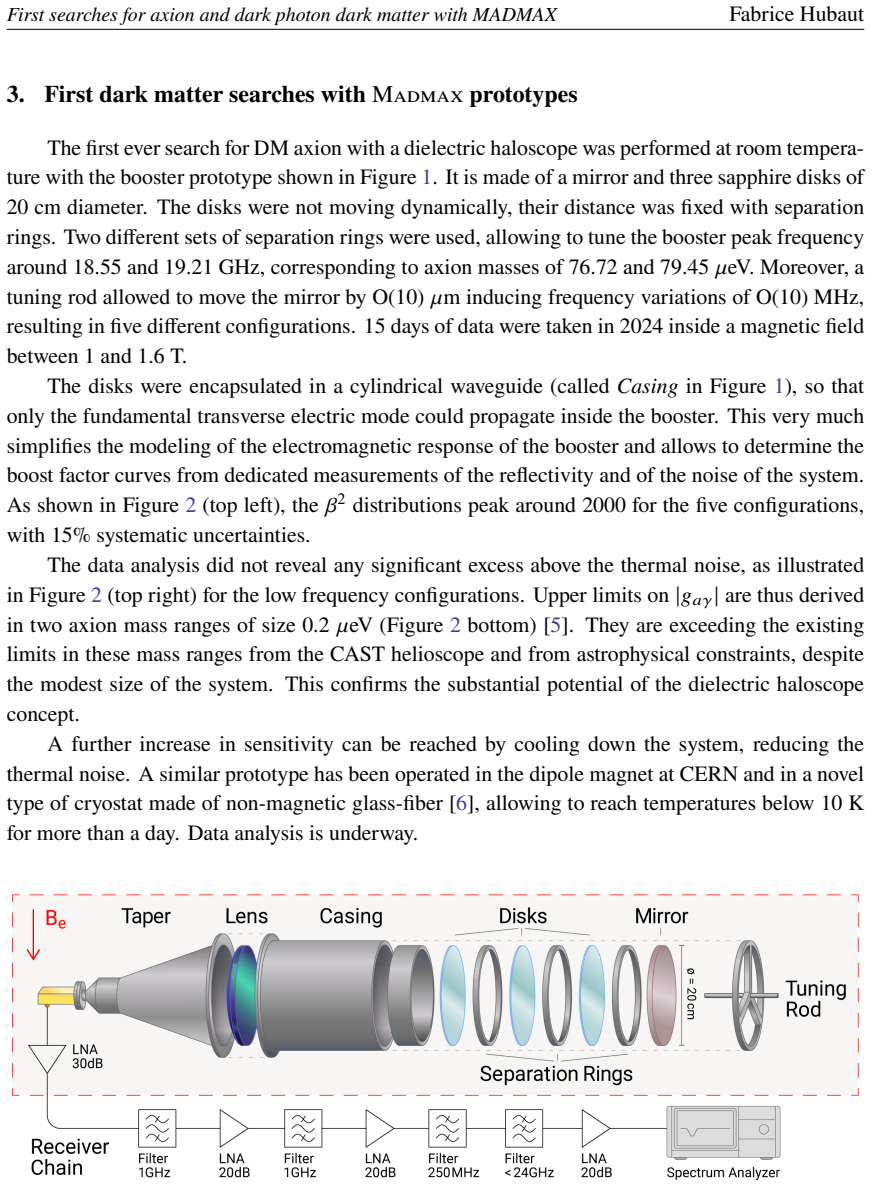
On the paper's own terms, the central discovery is that a dielectric haloscope—a mirror plus a stack of dielectric disks in a magnetic field—can act as a resonant converter of dark-matter axions and dark photons into measurable microwave power, and that even a small prototype can reach unexplored parameter space. The axion search used a three-sapphire-disk booster inside a cylindrical waveguide, with the boost factor β² extracted from reflectivity and noise measurements; no excess above thermal noise was seen, yielding the strongest limits to date in two 0.2 μeV windows near m_a = 76.7 and 79.5 μeV. The dark-photon search used a larger open three-disk booster whose boost factor was measured
What carries the argument
The load-bearing object is the dielectric-haloscope booster: a mirror with a stack of dielectric disks spaced so that axion- or dark-photon-induced electromagnetic waves emitted at each dielectric interface interfere constructively, resonantly enhancing the signal by a factor β² (the boost factor) over a mirror alone. The signal power scales as β² times the square of the axion–photon coupling, so the measured β² curve converts the absence of a spectral excess into an upper limit on the coupling. For the closed waveguide prototype, β² is obtained from reflectivity and noise measurements; for the open prototype, it is obtained from the change in the booster's reflection coefficient caused by a
Load-bearing premise
The limits assume the measured boost factor—the factor by which the dielectric stack amplifies a hypothetical dark-matter signal—equals the true amplification within the quoted 15% uncertainty, even though the open prototype's calibration is contaminated by higher-order transverse modes; if the calibration is biased, every exclusion limit shifts by the square root of the bias.
What would settle it
Measure the same booster's boost factor by two independent methods—reflectivity/noise in the waveguide prototype and the reciprocity perturbation in the open prototype, ideally with mode filtering—and compare the resulting β² curves; if they disagree by more than the 15% systematic uncertainty, the exclusion limits are not reliable. Re-analyzing the existing data after explicitly removing higher-order transverse modes from the reciprocity measurement would settle whether the dark-photon limits survive.
If this is right
- The axion limits in the two 0.2 μeV windows near 76.7 and 79.5 μeV are stronger than CAST and astrophysical bounds in those ranges, despite the small size of the prototype.
- The dark-photon limits in 78.6–84 μeV are up to three orders of magnitude stronger than previous bounds, and the search required no magnetic field.
- A cryogenic booster with 3–20 movable 30 cm disks is projected to gain up to two orders of magnitude in sensitivity and scan a sizable mass range, based on the demonstrated mechanics.
- The measured boost factors (peaking around 2,000 for the waveguide prototype, and above 1 over 1.3 GHz for the open prototype) confirm the resonant enhancement needed for a full-scale booster to reach benchmark QCD axion couplings near 100 μeV.
Where Pith is reading between the lines
- My inference: because the same β² calibration feeds both the axion and dark-photon interpretations, improving the mode purity of the open booster would sharpen both searches at once; the paper notes the mode contamination but does not draw this cross-channel leverage.
- My inference: since the dark-photon channel needs no magnet, the same booster hardware could be operated in magnet-off and magnet-on runs to separate dark-photon from axion signals with a single detector.
- My inference: the oscillation pattern in the open booster's β², attributed to higher-order transverse modes, suggests a concrete upgrade—adding mode filtering or a second antenna to recover a cleaner fundamental-mode calibration and reduce the 15% systematic uncertainty.
Editorial analysis
A structured set of objections, weighed in public.
Referee Report
Summary. This EPS-HEP 2025 proceedings contribution summarizes the MADMAX prototyping phase and its first dark-matter searches. The paper describes the dielectric-haloscope concept and reports, based on refs. [5] and [9]: (i) a room-temperature axion dark-matter search with a 20-cm three-sapphire-disk booster in a cylindrical waveguide, using five tuning configurations near 18.55 and 19.21 GHz; measured boost factors peak near 2000 with 15% systematic uncertainties, and 95% CL upper limits on |g_aγ| are set in two 0.2 μeV windows around m_a = 76.7 and 79.5 μeV, exceeding CAST and astrophysical constraints. (ii) a room-temperature dark-photon search with a 30-cm open prototype without a waveguide, using a reciprocity-based boost-factor measurement peaking at about 640 with 15% uncertainty; limits on the kinetic-mixing parameter are placed in the mass range 78.6–84 μeV, improving on previous bounds by up to three orders of magnitude. The paper also summarizes progress on cryogenic operation, piezoelectric positioning, and the future OB300 booster.
Significance. The results, if correct, are significant: a tabletop dielectric haloscope has produced the first competitive axion and dark-photon dark-matter limits in the ~80 μeV window, validating the booster concept for the full MADMAX experiment. Strengths of this manuscript are its explicit benchmark numbers (β² ≈ 2000 and 640, 15% uncertainties), its external benchmarks (CAST, globular clusters, SN1987a, previous dark-photon results), and its transparency about work in progress (cryogenic data still under analysis). Full details are delegated to the two published PRLs [5,9]; for a proceedings contribution this delegation is appropriate and makes the claims traceable. The paper does not introduce ad-hoc parameters.
minor comments (4)
- [Section 3, Fig. 3 (left)] The dark-photon limits scale inversely with the measured boost factor, so the treatment of β² is load-bearing. The text acknowledges oscillations from higher-order transverse modes in the reciprocity-based measurement, but does not state whether the quoted 15% uncertainty includes their effect, nor where in ref. [9] this is quantified. Please add one sentence (or a specific reference to the systematic section of [9]) to remove this ambiguity. This is a clarity issue in the proceedings text, not a challenge to the published result.
- [Section 2, Eq. (1)] Equation (1) is unnumbered and its variables (β², B_e, A, ρ_a, |g_aγ|, m_a) are not all defined immediately after the display. Number the equation and add a defining sentence, or move the existing definitions closer.
- [Figure 2 captions / axes] The lower-left axis label is rendered as "|ga | [GeV 1]" in the arXiv version; the superscript is missing. Also, the vertical axis of the top-right panel, "Normalized power excess", has no units; specify whether it is in units of the noise standard deviation.
- [General] Minor language: "to cool down the system down to 4 K" should be "to cool the system down to 4 K"; "these last three years" is awkward; and the collaboration name is rendered both "MADMAX" and "Madmax" — please use one convention.
Circularity Check
No significant circularity: the boost factors are measured independently of the search data, and the limits are benchmarked against external constraints.
full rationale
The paper's central quantitative claims are the exclusion limits on axion-photon coupling and dark-photon kinetic mixing set with MADMAX prototypes. In both searches, the boost factor beta^2 is obtained from dedicated measurements that are logically prior to and independent of the search data: for the CB200 axion search, 'the boost factor curves from dedicated measurements of the reflectivity and of the noise of the system'; for the 30-cm dark-photon search, 'a small-sized perturbing dielectric object can easily be inserted between the disks, allowing to measure in situ the boost factor from the induced change in the booster reflection coefficient [7,8]'. The search data then consist of power spectra inspected for excesses above thermal noise. No parameter is fitted to the search data and then renamed a prediction: the coupling |g_a_gamma| is scanned, and the resulting limits are compared with external bounds from CAST, globular clusters, SN1987a, and prior dark-photon limits. The citations to the collaboration's own PRL papers [5,9] are normal reports of the underlying measurements, not load-bearing justifications of an unverified premise. The reciprocity-based boost-factor extraction [7,8] is an externally published theoretical/experimental method rather than an assertion unique to this paper whose validity is assumed only by self-citation. The skeptic's concern about higher-order transverse modes and the adequacy of the 15% systematic uncertainty is a legitimate experimental systematic/correctness issue, but it is not a circularity: a biased boost factor would shift the limits, but the limits would still be derived from independent measurements rather than from a fit to the claimed output. No equation in the paper reduces a prediction to an input by construction. Therefore the circularity score is 0.
Axiom & Free-Parameter Ledger
free parameters (3)
- Boost factor β² (measured, peak ≈ 2000 for CB200; ≈ 640 for 30 cm prototype) =
peak ≈ 2000 and ≈ 640, with 15% systematic uncertainty
- Local dark matter density ρ_a =
0.3 GeV/cm³
- System noise temperature of receiver chain =
a few K (quoted from [3])
axioms (5)
- domain assumption Standard axion-photon conversion in a magnetic field (Primakoff effect) converts halo axions to photons at frequency f = m_a c²/h.
- domain assumption The full local dark matter density (ρ_a = 0.3 GeV/cm³) is made of axions (or dark photons) in the scanned mass windows.
- domain assumption Reciprocity: the reflection-coefficient perturbation induced by a small dielectric object (and, for CB200, the reflectivity and noise response) determines the on-resonance axion signal power of the booster.
- domain assumption For CB200 only the fundamental transverse electric mode propagates in the cylindrical casing, so a 1D booster model suffices.
- domain assumption Benchmark QCD axion coupling |g_aγ| ≈ 2×10^-14 GeV^-1 at m_a ≈ 100 micro-eV for the projected signal power.
Cite this review
Pith. "Pith review of First searches for axion and dark photon dark matter with MADMAX." pith.science (2026). https://pith.science/paper/BLBIZVE5
@misc{pith2026250906398,
  author       = {Pith},
  title        = {Pith review of: First searches for axion and dark photon dark matter with MADMAX},
  year         = {2026},
  howpublished = {\url{https://pith.science/paper/BLBIZVE5}},
  note         = {Machine review of arXiv:2509.06398}
}
read the original abstract
The MAgnetized Disk and Mirror Axion eXperiment (MADMAX) is a future experiment aiming to detect dark matter axions from the galactic halo by resonant conversion to photons in a strong magnetic field. It uses a novel concept based on a stack of dielectric disks in front of a mirror, called booster, to enhance the potential signal from axion-photon conversion over a significant mass range. In its final version, MADMAX aims to scan the uncharted QCD axion mass range around 100 $\mu$eV, favored by post-inflationary theories. Several small scale prototype systems have been tested these last three years, allowing to validate the dielectric haloscope concept and perform competitive axion and dark photon dark matter searches. This contribution presents the current status of the experiment and its prototypes, including the results achieved so far, the ongoing research and development and the remaining challenges.
Figures


Reference graph
Works this paper leans on
-
[1]
An introduction to axions and their detection
I. G. Irastorza,“An introduction to axions and their detection”,SciPost Phys. Lect. Notes45 (2022) 1 [hep-ph/2109.07376]
Pith/arXiv arXiv 2022
-
[2]
Cosmology of axion dark matter
C. A. J. O’Hare,“Cosmology of axion dark matter”,PoSCOSMICWISPers(2024) 040 [hep-ph/2403.17697]
Pith/arXiv arXiv 2024
-
[3]
A new experimental approach to probe QCD axion dark matter in the mass range above 40$\mu$eV
MADMAX collaboration,“A new experimental approach to probe QCD axion dark matter in the mass range above 40𝜇eV”,Eur. Phys. J. C79(2019) 186 [physics.ins-det/1901.07401]
work page internal anchor Pith review Pith/arXiv arXiv 2019
-
[4]
Dielectric Haloscopes to Search for Axion Dark Matter: Theoretical Foundations
A. J. Millaret al.,“Dielectric Haloscopes to Search for Axion Dark Matter: Theoretical Foundations”,JCAP01(2017) 061 [hep-ph/1612.07057]
Pith/arXiv arXiv 2017
-
[5]
FirstSearchforAxionDarkMatterwithaMADMAXPrototype
MADMAXcollaboration,“FirstSearchforAxionDarkMatterwithaMADMAXPrototype”, Phys. Rev. Lett.135(2025) 041001 [hep-ex/2409.11777]
Pith/arXiv arXiv 2025
-
[6]
Non-magnetic glass-fiber cryostat for MADMAX prototype tests
D. Kreikemeyer-Lorenzoet al.,“Non-magnetic glass-fiber cryostat for MADMAX prototype tests”,JINST20(2025) T02005 [physics.ins-det/2412.12818]
work page internal anchor Pith review Pith/arXiv arXiv 2025
-
[7]
Axion haloscope signal power from reciprocity
J. Egge,“Axion haloscope signal power from reciprocity”,JCAP04(2023) 064 [hep-ph/2211.11503]
work page internal anchor Pith review Pith/arXiv arXiv 2023
-
[8]
J.Eggeetal.,“Experimentaldeterminationofaxionsignalpowerofdishantennasanddielec- trichaloscopesusingthereciprocityapproach”,JCAP04(2024)005[hep-ex/2311.13359]
work page internal anchor Pith review Pith/arXiv arXiv 2024
-
[9]
First Search for Dark Photon Dark Matter with a MADMAX Prototype
MADMAX collaboration,“First Search for Dark Photon Dark Matter with a MADMAX Prototype”,Phys. Rev. Lett.134(2025) 151004 [hep-ex/2408.02368]
Pith/arXiv arXiv 2025
-
[10]
E. Garuttiet al.,“Qualification of piezo-electric actuators for the MADMAX booster system at cryogenic temperatures and high magnetic fields”,JINST18(2023) P08011 [physics.ins-det/2305.12808]
work page internal anchor Pith review Pith/arXiv arXiv 2023
-
[11]
MADMAX collaboration,“First mechanical realization of a tunable dielectric halo- scope for the MADMAX axion search experiment”,JINST19(2024) T11002 [physics.ins-det/2407.10716]. 6
work page internal anchor Pith review Pith/arXiv arXiv 2024
discussion (0)
Sign in with ORCID, Apple, or X to comment. Anyone can read and Pith papers without signing in.