REVIEW 3 major objections 7 minor 88 references
Stochastic resolution of identity to CC2 for large systems: Excited-state gradients and derivative couplings
T0 review · 3 major / 7 minor · reviewed 2026-08-04 · deepseek-v4-flash
Pith's one-line read This paper claims that a partial stochastic resolution of identity (sRI) applied to exchange-only integrals reduces CC2 excited-state gradients and derivative couplings from fifth-order to fourth-order scaling, making calculations on molecu
desk verdict Useful but uneven: the gradient implementation is solid, and the derivative-coupling validation needs an independent reference before it carries the weight the abstract puts on it. read the letter →
The pith
A machine-rendered reading of the paper's core claim, the machinery that carries it, and where it could break.
The reading
What carries the argument
The central object is the stochastic resolution of identity (sRI): random ±1 vectors {θξ} are inserted into the standard RI factorization of four-index electron repulsion integrals, replacing the auxiliary-basis index with a stochastic index whose size Ns is independent of system size. Contracted with Laplace-transformed orbital-energy denominators, the exchange part of the CC2 double-amplitude contractions becomes a product of two-index random tensors, cutting the formal cost from O(N^5) to O(N^4) in the partial variant (exchange-only sampling) and to O(N^3) in the complete variant. The partial-sRI scheme is the load-bearing design choice: it keeps the Coulomb terms deterministic so stochas
What would settle it
Compare the reported RI-CC2 water F21 derivative-coupling vector against an independent, released CC2 or similarity-constrained CC2 implementation; if the RI-CC2 value differs by more than the claimed sRI error, the stochastic benchmark baseline is wrong. The paper's own hybrid CCS-to-CC2 calculation reproduced the CIS result for F21 while the full CC2 did not, so resolving whether the CC2 amplitude or energy causes that discrepancy would settle whether the large F21 difference is in the method or the implementation.
Extended reading notes
Core claim
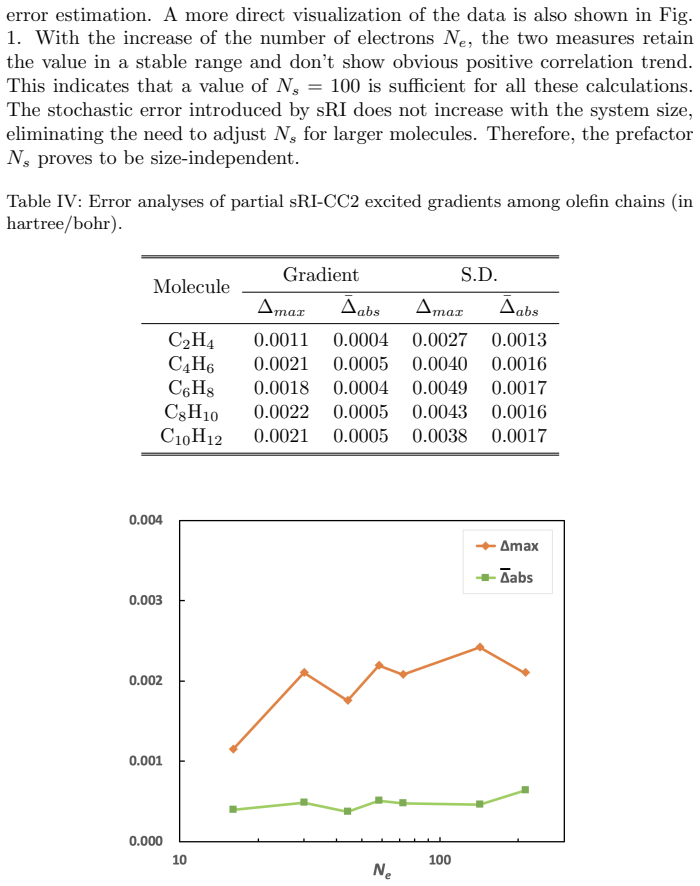
The central claim is that the partial sRI-CC2 method computes excited-state analytical gradients and derivative couplings at O(N^4) scaling, down from the O(N^5) of conventional RI-CC2, by applying stochastic resolution of identity only to exchange terms in the double-amplitude contractions while keeping Coulomb terms deterministic. Empirical timings on (all-E)-olefin chains give scaling exponents of 3.94 for gradients and 3.63 for derivative couplings, versus 4.78 and 4.41 for RI-CC2, with the crossover near 400 electrons. With Ns=100 stochastic orbitals, maximum gradient errors against RI-CC2 are below 0.008 hartree/bohr and the statistical error does not grow with system size, so a fixed
Load-bearing premise
The derivative-coupling reference itself is not validated against an independent CC2 code, so the sRI-CC2 comparisons inherit any error in the RI-CC2 derivative-coupling implementation.
Editorial extensions
If this is right
- CC2 excited-state gradients and derivative couplings become affordable for molecules with hundreds of electrons, with the empirical crossover from RI-CC2 occurring around 400 electrons.
- A fixed number of stochastic orbitals (Ns=100) suffices regardless of system size, so the stochastic error does not grow with molecular size.
- The complete-sRI variant, though cubic in scaling, remains impractical in the tested size range because it demands roughly 50,000 stochastic orbitals to control noise.
- The sRI-CC2 machinery is positioned as a step toward large-scale nonadiabatic dynamics, with the stated next step being similarity-constrained CC2 for conical intersections.
Reading between the lines
- The selective-sRI design principle—stochasticity only in exchange contractions—could transfer to other correlated methods such as CCSD or ADC gradients, which have similarly exchange-dominated bottlenecks.
- The cubic complete-sRI route might overtake the quartic partial route only for systems substantially larger than the tested ~200-electron range; the paper's error data does not establish where that crossover lies.
- A direct testable extension is to apply the partial-sRI derivative-coupling code at a near-degenerate pair of states, since conical intersections are the stated target and the noise behavior there is not yet benchmarked.
Editorial analysis
A structured set of objections, weighed in public.
Referee Report
Summary. The manuscript presents two stochastic resolution-of-identity (sRI) variants for computing CC2 excited-state analytical gradients and derivative couplings: a 'complete sRI' approach that stochastically samples both Coulomb and exchange terms (formal O(N^3) scaling) and a 'partial sRI' approach that applies sRI only to exchange terms (formal O(N^4) scaling). The theory section adapts the standard CC2 Lagrangian formalism, introduces the Laplace-transform/sRI contraction machinery, and gives explicit working equations and scaling tables. Numerical benchmarks for gradients on H2, H2O, HF, LiH, LiF, NH3, benzene, furan, pyrrole, pyridine, and a series of olefin chains show that partial sRI-CC2 with Ns=100 reproduces the authors' deterministic RI-CC2 gradients within about 0.008 hartree/bohr maximum error, with measured scaling close to O(N^4). Derivative couplings are tested on H2O and several small molecules; partial sRI-CC2 again matches the in-house RI-CC2 reference within stochastic deviation, but the RI-CC2 derivative-coupling implementation itself is validated only against CIS/CCS, not against an independent CC2 code. The paper concludes that partial sRI-CC2 is a practical alternative for systems with hundreds or even thousands of electrons.
Significance. If the derivative-coupling implementation were independently validated, this paper would be a worthwhile contribution to the stochastic quantum-chemistry literature: the partial sRI scheme offers a plausible route to CC2 excited-state gradients and derivative couplings at reduced scaling, and the gradient accuracy data are encouraging. The strengths are the careful comparison of the complete and partial sRI variants, the size-dependence study on olefin chains, and the explicit scaling analysis. The weak point is the derivative-coupling validation: the only reference for the new sRI derivative couplings is the authors' own RI-CC2 code, and that code is not cross-checked against an independent CC2 derivative-coupling implementation. The practical-scale claim in the abstract also goes beyond what is demonstrated, since the largest systems in the manuscript are C10H12 (72 electrons).
major comments (3)
- [Sec. III.B, Tables V-VIII; Eq. (38)-(41)] The derivative-coupling reference is not independent. Sec. III.B states that the CCSD and CC2 implementations in CFOUR/eT are 'in developmental versions and inaccessible', so the RI-CC2 derivative-coupling implementation is benchmarked only against CIS/CCS. For H2O F21, RI-CC2 deviates from CIS by Delta_bar_abs = 0.1912 (Table VI); the 'CCS->CC2' hybrid recovers CIS but still uses the same CC2 derivative-coupling equations (Eqs. 38-41) and does not exercise the CC2-specific amplitude response. Tables VII-VIII therefore validate the sRI algorithm against the authors' own deterministic code, not against an external CC2 reference. Any systematic error in the RI-CC2 derivative-coupling code is inherited by the reported sRI-CC2 derivative couplings. This is load-bearing for the derivative-coupling claim. Please provide an independent CC2 benchmark when feasible, or at least a numerical finite
- [Abstract and Sec. IV; Figs. 2, 4] The practical-scale claim overreaches the data. The largest systems computed in this manuscript are C10H12 (72 electrons) for both gradients and derivative couplings. The crossover with RI-CC2 is predicted by fitting at about 400 electrons, and CPU-time data stop near x=200. No calculation in this paper reaches 'hundreds or even thousands of electrons.' The quartic-scaling fits (O(N^3.94) and O(N^3.63)) support the asymptotic advantage, but the abstract's claim that partial sRI-CC2 'can handle' such systems needs either a demonstration on a system beyond the crossover or qualification as a projected capability.
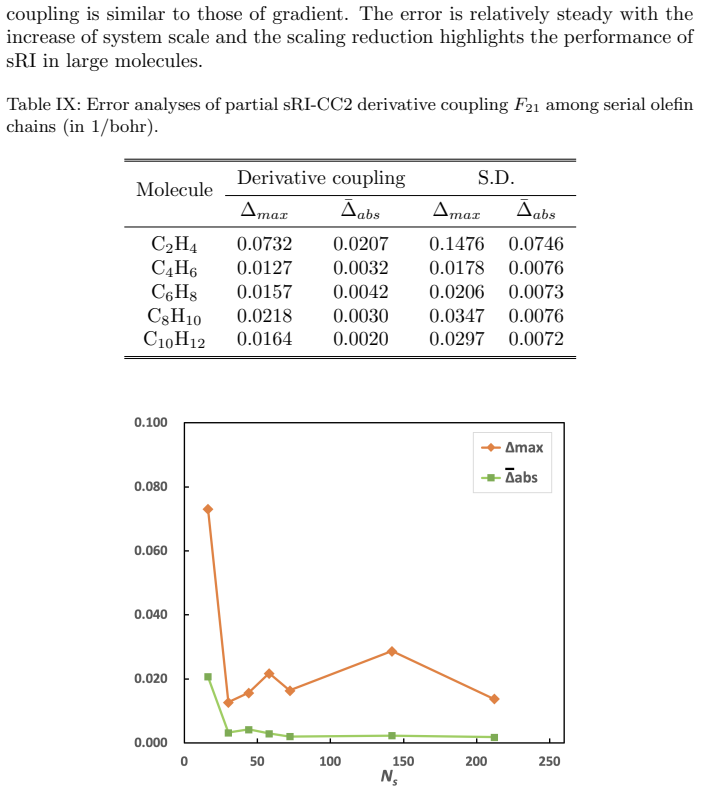
- [Sec. III.A and III.C; Tables III, VIII] The conclusion that Ns=100 is sufficient and that stochastic error does not increase with system size is drawn from olefin chains (Table IV, Fig. 1), but the broader benchmark tables show substantial system-to-system variation at fixed Ns. For derivative couplings, pyrrole and pyridine have S.D. Delta_max of 0.2995 and 0.2984 (Table VIII), compared to 0.0777 for LiH or 0.0283 for benzene. The H2O-based Ns selection (Figs. 5-6) therefore does not imply that Ns=100 is universally sufficient. Either report Ns-dependent results for the problematic cases or qualify the size-independence claim to the tested molecule classes.
minor comments (7)
- [Table III caption] Typo: 'hatree/bohr' should be 'hartree/bohr'.
- [Sec. III.A] The sentence 'The sRI-CC2 variant is deemed accurate if the standard deviation ... exceeds the systematic error' appears to express the opposite of the intended accuracy criterion. Clarify: presumably the deterministic RI-CC2 result should lie within the stochastic error bar rather than being exceeded by it.
- [Figs. 2 and 4] Define the horizontal axis (presumably the number of electrons) and the meaning of the crossover coordinate x=400 in the captions or text.
- [Eq. (61)] Clarify whether the averaged quantity \bar F_mn = (F_mn - F_nm)/2 is used consistently in Tables V and VII, and how phase conventions are handled for the non-Hermitian CC2 coupling.
- [Eqs. (27) and (33)] The symbol \bar\gamma is used both for the reduced density matrix in Eq. (27) and for the Lagrange multiplier in Eq. (33); rename one to avoid confusion.
- [Sec. III.B] The row labeled 'CCS->CC2' in Tables V and VI is not a standard method; specify precisely which amplitudes and which equations are used in that hybrid calculation.
- [References] Reference [88] appears unrelated to the body of the paper and may be a typographical artifact; please check its relevance or remove it.
Circularity Check
No circular derivation: sRI-CC2 is a stochastic approximation of RI-CC2, and the accuracy tests are convergence checks rather than fitted predictions.
full rationale
The derivation is self-contained. The excited-state gradient and derivative-coupling Lagrangians (Eqs. 18 and 33) are standard CC2 expressions, and the sRI/Laplace reformulations (Eqs. 51-58) are algebraic replacements of four-index ERIs by stochastic tensors. Since the stochastic approximation reduces to deterministic RI-CC2 as Ns→∞, comparing sRI-CC2 to RI-CC2 is a Monte Carlo convergence test, not a prediction fitted from the reference. The RI-CC2 gradient is independently benchmarked against TURBOMOLE, giving the gradient chain an external anchor. The derivative-coupling chain is weaker: the authors state that independent CC2 implementations in CFOUR/eT are "in developmental versions and inaccessible," so the RI-CC2 derivative couplings are checked only against CIS and the authors' own CCS, and the sRI-CC2 comparison inherits that reference. This is a genuine validation gap and the paper explicitly calls for additional tests, but it is not a circular reduction: the stochastic calculation is not defined in terms of the RI-CC2 result, and the comparison is a convergence check, not an identity. Prior sRI-CC2 papers are cited as extensions, not as load-bearing justifications for the present claims. The choice of Ns is calibrated on H2O and then applied to other systems, not refit per prediction. No fitted parameter is renamed as a prediction. Therefore there is no significant circularity.
Assumptions & free parameters
free parameters (3)
- Number of stochastic orbitals Ns (partial = 100, complete = 50000) =
100 / 50000
- Laplace quadrature points Nz =
7
- Number of independent stochastic runs averaged =
10
assumptions (4)
- domain assumption RI approximation with auxiliary basis is accurate enough to serve as the deterministic reference
- domain assumption Laplace transform with Nz=7 integrates orbital-energy denominators accurately
- domain assumption CC2 derivative-coupling formalism is valid for the nondegenerate states considered
- standard math Stochastic trace estimator converges and its error decreases with Ns
Cite this review
Pith. "Pith review of Stochastic resolution of identity to CC2 for large systems: Excited-state gradients and derivative couplings." pith.science (2026). https://pith.science/paper/2MRXIBBS
@misc{pith2026250906460,
  author       = {Pith},
  title        = {Pith review of: Stochastic resolution of identity to CC2 for large systems: Excited-state gradients and derivative couplings},
  year         = {2026},
  howpublished = {\url{https://pith.science/paper/2MRXIBBS}},
  note         = {Machine review of arXiv:2509.06460}
}
read the original abstract
Excited-state gradients and derivative couplings are critical for simulating excited-state dynamics. However, their calculations are very expensive within the coupled-cluster framework due to the steep scaling. In this work, we present two implementations of stochastic resolution of identity to CC2 (sRI-CC2) for excited-state analytical gradients and derivative couplings. The first method employs sRI for both Coulomb and exchange terms, reducing the formal scaling to cubic. However, this method has a significant stochastic noise. Consequently, we introduce a substitute, termed partial sRI-CC2, which applies sRI selectively to the exchange terms only. The partial sRI-CC2 shows a quartic scaling with a modest prefactor, rendering it a practical alternative. Compared to conventional RI-CC2, the partial sRI-CC2 can handle systems with hundreds or even thousands of electrons. This work is an extension to our previous implementation of sRI-CC2 method and provides essential ingredients for large-scale nonadiabatic dynamics.
Figures

Figures from the paper (3 more)


Reference graph
Works this paper leans on
-
[1]
Ahlrichs and W
R. Ahlrichs and W. Kutzelnigg, “Direct calculation of approximate natural orbitals and natural expansion coefficients of atomic and molecular elec- tronic wavefunctions. ii. decoupling of the pair equations and calculation of the pair correlation energies for the be and lih ground states,” The Journal of Chemical Physics , vol. 48, no. 4, pp. 1819–1832, 1...
1968
-
[2]
Efficient and accurate approxima- tions to the local coupled cluster singles doubles method using a truncated pair natural orbital basis,
F. Neese, A. Hansen, and D. G. Liakos, “Efficient and accurate approxima- tions to the local coupled cluster singles doubles method using a truncated pair natural orbital basis,” The Journal of chemical physics , vol. 131, no. 6, 2009
2009
-
[3]
Local pair natural orbitals for excited states,
B. Helmich and C. H¨ attig, “Local pair natural orbitals for excited states,” The Journal of chemical physics , vol. 135, no. 21, 2011
2011
-
[4]
A pair natural orbital implementation of the coupled cluster model cc2 for excitation energies,
B. Helmich and C. Haettig, “A pair natural orbital implementation of the coupled cluster model cc2 for excitation energies,” The Journal of Chemical Physics, vol. 139, no. 8, 2013
2013
-
[5]
Explicitly correlated pno-mp2 and pno-ccsd and their application to the s66 set and large molecular systems,
G. Schmitz, C. H¨ attig, and D. P. Tew, “Explicitly correlated pno-mp2 and pno-ccsd and their application to the s66 set and large molecular systems,” Physical Chemistry Chemical Physics , vol. 16, no. 40, pp. 22 167–22 178, 2014
2014
-
[6]
Localizability of dynamic electron correlation,
P. Pulay, “Localizability of dynamic electron correlation,” Chemical physics letters, vol. 100, no. 2, pp. 151–154, 1983
1983
-
[7]
Local treatment of electron correlation in coupled cluster theory,
C. Hampel and H.-J. Werner, “Local treatment of electron correlation in coupled cluster theory,” The Journal of chemical physics , vol. 104, no. 16, pp. 6286–6297, 1996
1996
-
[8]
Low-order scaling local electron correlation methods. iv. linear scaling local coupled-cluster (lccsd),
M. Sch¨ utz and H.-J. Werner, “Low-order scaling local electron correlation methods. iv. linear scaling local coupled-cluster (lccsd),” The Journal of Chemical Physics, vol. 114, no. 2, pp. 661–681, 2001
2001
Show all 88 references
-
[9]
Local cc2 electronic excitation en- ergies for large molecules with density fitting,
D. Kats, T. Korona, and M. Sch¨ utz, “Local cc2 electronic excitation en- ergies for large molecules with density fitting,” The Journal of chemical physics, vol. 125, no. 10, 2006
2006
-
[10]
Hyper-optimized tensor network contraction,
J. Gray and S. Kourtis, “Hyper-optimized tensor network contraction,” Quantum, vol. 5, p. 410, 2021. 22
2021
-
[11]
Tensor hypercontrac- tion density fitting. i. quartic scaling second-and third-order møller-plesset perturbation theory,
E. G. Hohenstein, R. M. Parrish, and T. J. Mart ´ ınez, “Tensor hypercontrac- tion density fitting. i. quartic scaling second-and third-order møller-plesset perturbation theory,” The Journal of chemical physics, vol. 137, no. 4, 2012
2012
-
[12]
Quartic scaling second-order approximate coupled cluster singles and doubles via tensor hypercontraction: Thc-cc2,
E. G. Hohenstein, S. I. Kokkila, R. M. Parrish, and T. J. Mart ´ ınez, “Quartic scaling second-order approximate coupled cluster singles and doubles via tensor hypercontraction: Thc-cc2,” The Journal of chemical physics , vol. 138, no. 12, 2013
2013
-
[13]
Ten- sor hypercontraction equation-of-motion second-order approximate coupled cluster: Electronic excitation energies in o (n 4) time,
E. G. Hohenstein, S. I. Kokkila, R. M. Parrish, and T. J. Mart ´ ınez, “Ten- sor hypercontraction equation-of-motion second-order approximate coupled cluster: Electronic excitation energies in o (n 4) time,” The Journal of Physical Chemistry B , vol. 117, no. 42, pp. 12 972–12...
2013
-
[14]
Efficient low- scaling calculation of thc-sos-lr-cc2 and thc-sos-adc (2) excitation energies through density-based integral-direct tensor hypercontraction,
F. Sacchetta, F. H. Bangerter, H. Laqua, and C. Ochsenfeld, “Efficient low- scaling calculation of thc-sos-lr-cc2 and thc-sos-adc (2) excitation energies through density-based integral-direct tensor hypercontraction,” Journal of Chemical Theory and Computation , vol. 21, no. 1...
2025
-
[15]
Even more efficient quantum computations of chemistry through tensor hypercontraction,
J. Lee, D. W. Berry, C. Gidney, W. J. Huggins, J. R. McClean, N. Wiebe, and R. Babbush, “Even more efficient quantum computations of chemistry through tensor hypercontraction,” PRX Quantum, vol. 2, no. 3, p. 030305, 2021
2021
-
[16]
Improved second-order møller–plesset perturbation theory by separate scaling of parallel-and antiparallel-spin pair correlation energies,
S. Grimme, “Improved second-order møller–plesset perturbation theory by separate scaling of parallel-and antiparallel-spin pair correlation energies,” The Journal of chemical physics , vol. 118, no. 20, pp. 9095–9102, 2003
2003
-
[17]
Benchmarking the performance of spin-component scaled cc2 in ground and electronically excited states,
A. Hellweg, S. A. Gr¨ un, and C. H¨ attig, “Benchmarking the performance of spin-component scaled cc2 in ground and electronically excited states,” Physical Chemistry Chemical Physics, vol. 10, no. 28, pp. 4119–4127, 2008
2008
-
[18]
Accuracy of spin-component-scaled cc2 excita- tion energies and potential energy surfaces,
A. Tajti and P. G. Szalay, “Accuracy of spin-component-scaled cc2 excita- tion energies and potential energy surfaces,” Journal of Chemical Theory and Computation , vol. 15, no. 10, pp. 5523–5531, 2019
2019
-
[19]
Scaled opposite-spin second order møller–plesset correlation energy: An economi- cal electronic structure method,
Y. Jung, R. C. Lochan, A. D. Dutoi, and M. Head-Gordon, “Scaled opposite-spin second order møller–plesset correlation energy: An economi- cal electronic structure method,” The Journal of chemical physics, vol. 121, no. 20, pp. 9793–9802, 2004
2004
-
[20]
Scaled opposite-spin cc2 for ground and excited states with fourth order scaling computational costs,
N. O. Winter and C. H¨ attig, “Scaled opposite-spin cc2 for ground and excited states with fourth order scaling computational costs,” The Journal of chemical physics , vol. 134, no. 18, 2011
2011
-
[21]
Use of approximate integrals in ab initio theory. an application in mp2 energy calculations,
M. Feyereisen, G. Fitzgerald, and A. Komornicki, “Use of approximate integrals in ab initio theory. an application in mp2 energy calculations,” Chemical physics letters , vol. 208, no. 5-6, pp. 359–363, 1993. 23
1993
-
[22]
Auxiliary basis sets to approximate coulomb potentials,
K. Eichkorn, O. Treutler, H. ¨Ohm, M. H¨ aser, and R. Ahlrichs, “Auxiliary basis sets to approximate coulomb potentials,” Chemical physics letters , vol. 240, no. 4, pp. 283–290, 1995
1995
-
[23]
Large-scale correlated electronic structure calculations: the ri-mp2 method on parallel computers,
D. E. Bernholdt and R. J. Harrison, “Large-scale correlated electronic structure calculations: the ri-mp2 method on parallel computers,” Chemi- cal Physics Letters , vol. 250, no. 5-6, pp. 477–484, 1996
1996
-
[24]
Elimination of energy denominators in møller—plesset pertur- bation theory by a laplace transform approach,
J. Alml¨ of, “Elimination of energy denominators in møller—plesset pertur- bation theory by a laplace transform approach,” Chemical physics letters , vol. 181, no. 4, pp. 319–320, 1991
1991
-
[25]
Laplace transform techniques in mo/ller–plesset perturbation theory,
M. H¨ aser and J. Alml¨ of, “Laplace transform techniques in mo/ller–plesset perturbation theory,” The Journal of chemical physics , vol. 96, no. 1, pp. 489–494, 1992
1992
-
[26]
Møller-plesset (mp2) perturbation theory for large molecules,
M. H¨ aser, “Møller-plesset (mp2) perturbation theory for large molecules,” Theoretica chimica acta, vol. 87, pp. 147–173, 1993
1993
-
[27]
Self-averaging stochastic kohn- sham density-functional theory,
R. Baer, D. Neuhauser, and E. Rabani, “Self-averaging stochastic kohn- sham density-functional theory,” Physical review letters , vol. 111, no. 10, p. 106402, 2013
2013
-
[28]
Communication: Embedded fragment stochastic density functional theory,
D. Neuhauser, R. Baer, and E. Rabani, “Communication: Embedded fragment stochastic density functional theory,” The Journal of chemical physics, vol. 141, no. 4, 2014
2014
-
[29]
Sublinear scaling for time- dependent stochastic density functional theory,
Y. Gao, D. Neuhauser, R. Baer, and E. Rabani, “Sublinear scaling for time- dependent stochastic density functional theory,” The Journal of chemical physics, vol. 142, no. 3, 2015
2015
-
[30]
Stochastic optimally tuned range-separated hybrid density functional theory,
D. Neuhauser, E. Rabani, Y. Cytter, and R. Baer, “Stochastic optimally tuned range-separated hybrid density functional theory,” The Journal of Physical Chemistry A , vol. 120, no. 19, pp. 3071–3078, 2016
2016
-
[31]
Deterministic/fragmented-stochastic exchange for large-scale hybrid dft calculations,
N. C. Bradbury, T. Allen, M. Nguyen, and D. Neuhauser, “Deterministic/fragmented-stochastic exchange for large-scale hybrid dft calculations,” Journal of Chemical Theory and Computation , vol. 19, no. 24, pp. 9239–9247, 2023
2023
-
[32]
Expeditious stochastic approach for mp2 energies in large electronic systems,
D. Neuhauser, E. Rabani, and R. Baer, “Expeditious stochastic approach for mp2 energies in large electronic systems,” Journal of Chemical theory and Computation , vol. 9, no. 1, pp. 24–27, 2013
2013
-
[33]
A guided stochastic energy-domain formulation of the second order møller–plesset perturbation theory,
Q. Ge, Y. Gao, R. Baer, E. Rabani, and D. Neuhauser, “A guided stochastic energy-domain formulation of the second order møller–plesset perturbation theory,” The Journal of Physical Chemistry Letters , vol. 5, no. 1, pp. 185– 189, 2014. 24
2014
-
[34]
Stochastic formulation of the resolution of identity: Application to second order møller–plesset perturbation theory,
T. Y. Takeshita, W. A. de Jong, D. Neuhauser, R. Baer, and E. Rabani, “Stochastic formulation of the resolution of identity: Application to second order møller–plesset perturbation theory,” Journal of Chemical Theory and Computation, vol. 13, no. 10, pp. 4605–4610, 2017
2017
-
[35]
Stochastic self-consistent second- order green’s function method for correlation energies of large electronic systems,
D. Neuhauser, R. Baer, and D. Zgid, “Stochastic self-consistent second- order green’s function method for correlation energies of large electronic systems,” Journal of chemical theory and computation , vol. 13, no. 11, pp. 5396–5403, 2017
2017
-
[36]
Stochastic resolution of identity second- order matsubara green’s function theory,
T. Y. Takeshita, W. Dou, D. G. Smith, W. A. de Jong, R. Baer, D. Neuhauser, and E. Rabani, “Stochastic resolution of identity second- order matsubara green’s function theory,” The Journal of chemical physics , vol. 151, no. 4, 2019
2019
-
[37]
Stochastic resolution of identity for real-time second-order green’s func- tion: ionization potential and quasi-particle spectrum,
W. Dou, T. Y. Takeshita, M. Chen, R. Baer, D. Neuhauser, and E. Rabani, “Stochastic resolution of identity for real-time second-order green’s func- tion: ionization potential and quasi-particle spectrum,” Journal of chemical theory and computation , vol. 15, no. 12, pp. 6703–6...
2019
-
[38]
Range-separated stochastic resolution of identity: Formulation and appli- cation to second-order green’s function theory,
W. Dou, M. Chen, T. Y. Takeshita, R. Baer, D. Neuhauser, and E. Rabani, “Range-separated stochastic resolution of identity: Formulation and appli- cation to second-order green’s function theory,” The Journal of chemical physics, vol. 153, no. 7, 2020
2020
-
[39]
Convergence analysis of the stochastic resolution of identity: Comparing hutchinson to hutch++ for the second-order green’s function,
L. Mej ´ ıa, S. Sharma, R. Baer, G. K.-L. Chan, and E. Rabani, “Convergence analysis of the stochastic resolution of identity: Comparing hutchinson to hutch++ for the second-order green’s function,” Journal of Chemical Theory and Computation , vol. 20, no. 17, pp. 7494–7502, 2024
2024
-
[40]
Time-dependent stochastic bethe- salpeter approach,
E. Rabani, R. Baer, and D. Neuhauser, “Time-dependent stochastic bethe- salpeter approach,” Physical Review B , vol. 91, no. 23, p. 235302, 2015
2015
-
[41]
Stochastic resolution-of-the-identity auxiliary- field quantum monte carlo: Scaling reduction without overhead,
J. Lee and D. R. Reichman, “Stochastic resolution-of-the-identity auxiliary- field quantum monte carlo: Scaling reduction without overhead,”The Jour- nal of Chemical Physics , vol. 153, no. 4, 2020
2020
-
[42]
Stochastic resolution of identity to cc2 for large systems: Ground state and triplet excitation energy calculations,
C. Zhao, J. Lee, and W. Dou, “Stochastic resolution of identity to cc2 for large systems: Ground state and triplet excitation energy calculations,” The Journal of Physical Chemistry A , vol. 128, no. 42, pp. 9302–9310, 2024
2024
-
[43]
Stochastic resolution of identity to cc2 for large systems: excited state properties,
C. Zhao, Q. Ou, J. Lee, and W. Dou, “Stochastic resolution of identity to cc2 for large systems: excited state properties,” Journal of Chemical Theory and Computation , vol. 20, no. 12, pp. 5188–5195, 2024
2024
-
[44]
Stochastic resolution of identity to cc2 for large systems: Oscillator strength and ground state gradient calculations,
C. Zhao, Q. Ou, C. Li, and W. Dou, “Stochastic resolution of identity to cc2 for large systems: Oscillator strength and ground state gradient calculations,” The Journal of Chemical Physics , vol. 163, no. 2, p. 024102, 2025. 25
2025
-
[45]
Analytic gradients for excited states in the coupled-cluster model cc2 employing the resolution-of-the-identity approx- imation,
A. K¨ ohn and C. H¨ attig, “Analytic gradients for excited states in the coupled-cluster model cc2 employing the resolution-of-the-identity approx- imation,” The Journal of chemical physics , vol. 119, no. 10, pp. 5021–5036, 2003
2003
-
[46]
Quartic scaling analytical gradients of scaled opposite-spin cc2,
N. O. Winter and C. H¨ attig, “Quartic scaling analytical gradients of scaled opposite-spin cc2,” Chemical Physics, vol. 401, pp. 217–227, 2012
2012
-
[47]
Local cc2 response method based on the laplace transform: Orbital-relaxed first-order properties for excited states,
K. Lederm¨ uller, D. Kats, and M. Sch¨ utz, “Local cc2 response method based on the laplace transform: Orbital-relaxed first-order properties for excited states,” The Journal of Chemical Physics , vol. 139, no. 8, p. 084111, 2013
2013
-
[48]
Local cc2 response method based on the laplace transform: analytic energy gradients for ground and excited states,
K. Lederm¨ uller and M. Sch¨ utz, “Local cc2 response method based on the laplace transform: analytic energy gradients for ground and excited states,” The Journal of Chemical Physics , vol. 140, no. 16, p. 164113, 2014
2014
-
[49]
Analytical nuclear excited-state gradients for the second-order approximate coupled-cluster singles and doubles (cc2) method employing uncoupled frozen-density embedding,
J. Heuser and S. H¨ ofener, “Analytical nuclear excited-state gradients for the second-order approximate coupled-cluster singles and doubles (cc2) method employing uncoupled frozen-density embedding,” Journal of Chemical The- ory and Computation , vol. 14, no. 9, pp. 4616–4628, 2018
2018
-
[50]
Structure optimizations for excited states with correlated second-order methods: Cc2 and adc(2),
C. H¨ attig, “Structure optimizations for excited states with correlated second-order methods: Cc2 and adc(2),” Advances in Quantum Chemistry, vol. 50, pp. 37–60, 2005
2005
-
[51]
Can coupled-cluster theory treat conical intersec- tions?
A. K¨ ohn and A. Tajti, “Can coupled-cluster theory treat conical intersec- tions?” The Journal of chemical physics , vol. 127, no. 4, 2007
2007
-
[52]
Communication: Non-adiabatic derivative coupling elements for the coupled cluster singles and doubles model,
E. F. Kjønstad and H. Koch, “Communication: Non-adiabatic derivative coupling elements for the coupled cluster singles and doubles model,” The Journal of Chemical Physics , vol. 158, no. 16, 2023
2023
-
[53]
Coupled cluster theory for nonadiabatic dynamics: nuclear gradients and nonadiabatic couplings in similarity constrained coupled cluster theory,
E. F. Kjønstad, S. Angelico, and H. Koch, “Coupled cluster theory for nonadiabatic dynamics: nuclear gradients and nonadiabatic couplings in similarity constrained coupled cluster theory,” Journal of Chemical Theory and Computation , vol. 20, no. 16, pp. 7080–7092, 2024
2024
-
[54]
Similarity constrained cc2 for efficient coupled cluster nonadiabatic dynamics,
L. Stoll, S. Angelico, E. F. Kjønstad, and H. Koch, “Similarity constrained cc2 for efficient coupled cluster nonadiabatic dynamics,” arXiv preprint arXiv:2504.11157, 2025
2025 arXiv
-
[55]
Resolving the notorious case of conical inter- sections for coupled cluster dynamics,
E. F. Kjønstad and H. Koch, “Resolving the notorious case of conical inter- sections for coupled cluster dynamics,” The Journal of Physical Chemistry Letters, vol. 8, no. 19, pp. 4801–4807, 2017
2017
-
[56]
An orbital invariant similarity constrained coupled cluster model,
E. F. Kjønstad and H. Koch, “An orbital invariant similarity constrained coupled cluster model,” Journal of Chemical Theory and Computation , vol. 15, no. 10, pp. 5386–5397, 2019. 26
2019
-
[57]
Generalized coupled cluster theory for ground and excited state intersections,
F. Rossi, E. F. Kjønstad, S. Angelico, and H. Koch, “Generalized coupled cluster theory for ground and excited state intersections,” The Journal of Physical Chemistry Letters , vol. 16, no. 2, pp. 568–578, 2025
2025
-
[58]
Psi4 1.4: Open-source software for high-throughput quantum chemistry,
D. G. Smith, L. A. Burns, A. C. Simmonett, R. M. Parrish, M. C. Schieber, R. Galvelis, P. Kraus, H. Kruse, R. Di Remigio, A. Alenaizan et al. , “Psi4 1.4: Open-source software for high-throughput quantum chemistry,” The Journal of chemical physics , vol. 152, no. 18, 2020
2020
-
[59]
The generality of the guga mrci approach in columbus for treating complex quantum chemistry,
H. Lischka, R. Shepard, T. M¨ uller, P. G. Szalay, R. M. Pitzer, A. J. Aquino, M. M. Ara´ ujo do Nascimento, M. Barbatti, L. T. Belcher, J.-P. Blaudeau et al. , “The generality of the guga mrci approach in columbus for treating complex quantum chemistry,” The Journal of Chemic...
2020
-
[60]
Recent developments in the pyscf program package,
Q. Sun, X. Zhang, S. Banerjee, P. Bao, M. Barbry, N. S. Blunt, N. A. Bogdanov, G. H. Booth, J. Chen, Z.-H. Cui et al. , “Recent developments in the pyscf program package,” The Journal of chemical physics , vol. 153, no. 2, 2020
2020
-
[61]
Software for the frontiers of quantum chemistry: An overview of developments in the q-chem 5 package,
E. Epifanovsky, A. T. Gilbert, X. Feng, J. Lee, Y. Mao, N. Mardirossian, P. Pokhilko, A. F. White, M. P. Coons, A. L. Dempwolff et al. , “Software for the frontiers of quantum chemistry: An overview of developments in the q-chem 5 package,” The Journal of chemical physics , vo...
2021
-
[62]
A spin-flip variant of the second- order approximate coupled-cluster singles and doubles method,
G. P. Paran, C. Utku, and T.-C. Jagau, “A spin-flip variant of the second- order approximate coupled-cluster singles and doubles method,” Physical Chemistry Chemical Physics , vol. 24, no. 44, pp. 27 146–27 156, 2022
2022
-
[63]
On the performance of second- order approximate coupled-cluster singles and doubles methods for non- valence anions,
G. P. Paran, C. Utku, and T.-C. Jagau, “On the performance of second- order approximate coupled-cluster singles and doubles methods for non- valence anions,” Physical Chemistry Chemical Physics , vol. 26, no. 3, pp. 1809–1818, 2024
2024
-
[64]
Coupled- cluster treatment of complex open-shell systems: the case of single-molecule magnets,
M. Alessio, G. P. Paran, C. Utku, A. Gr¨ uneis, and T.-C. Jagau, “Coupled- cluster treatment of complex open-shell systems: the case of single-molecule magnets,” Physical Chemistry Chemical Physics, vol. 26, no. 24, pp. 17 028– 17 041, 2024
2024
-
[65]
The second-order approx- imate coupled cluster singles and doubles model cc2,
O. Christiansen, H. Koch, and P. Jørgensen, “The second-order approx- imate coupled cluster singles and doubles model cc2,” Chemical Physics Letters, vol. 243, no. 5-6, pp. 409–418, 1995
1995
-
[66]
A linear response, coupled-cluster theory for excitation energy,
H. Sekino and R. J. Bartlett, “A linear response, coupled-cluster theory for excitation energy,” International Journal of Quantum Chemistry , vol. 26, no. S18, pp. 255–265, 1984
1984
-
[67]
Coupled cluster response functions,
H. Koch and P. Jørgensen, “Coupled cluster response functions,” Journal of Chemical Physics , vol. 93, no. 5, pp. 3333–3344, 1990. 27
1990
-
[68]
Linear response cc2 triplet excitation energies,
K. Hald, C. H¨ attig, D. L. Yeager, and P. Jørgensen, “Linear response cc2 triplet excitation energies,” Chemical Physics Letters , vol. 328, no. 3, pp. 291–301, 2000
2000
-
[69]
The equation-of-motion coupled-cluster method: Excitation energies of be and co,
J. Geertsen, M. Rittby, and R. J. Bartlett, “The equation-of-motion coupled-cluster method: Excitation energies of be and co,” Chemical Physics Letters, vol. 164, no. 1, pp. 57–62, 1989
1989
-
[70]
The equation-of-motion coupled-cluster method. applications to open-and closed-shell reference states,
D. C. Comeau and R. J. Bartlett, “The equation-of-motion coupled-cluster method. applications to open-and closed-shell reference states,” Chemical Physics Letters, vol. 207, no. 4-6, pp. 414–423, 1993
1993
-
[71]
The equation of motion coupled-cluster method. a systematic biorthogonal approach to molecular excitation ener- gies, transition probabilities, and excited state properties,
J. F. Stanton and R. J. Bartlett, “The equation of motion coupled-cluster method. a systematic biorthogonal approach to molecular excitation ener- gies, transition probabilities, and excited state properties,” The Journal of chemical physics, vol. 98, no. 9, pp. 7029–7039, 1993
1993
-
[72]
Perturbative treatment of the similarity transformed hamiltonian in equation-of-motion coupled-cluster approxima- tions,
J. F. Stanton and J. Gauss, “Perturbative treatment of the similarity transformed hamiltonian in equation-of-motion coupled-cluster approxima- tions,” The Journal of chemical physics , vol. 103, no. 3, pp. 1064–1076, 1995
1995
-
[73]
Simplified methods for equation-of-motion coupled-cluster excited state calculations,
S. R. Gwaltney, M. Nooijen, and R. J. Bartlett, “Simplified methods for equation-of-motion coupled-cluster excited state calculations,” Chemical physics letters , vol. 248, no. 3-4, pp. 189–198, 1996
1996
-
[74]
A similarity trans- formed second-order approximate coupled cluster method for the excited states: Theory, implementation, and benchmark,
S. Haldar, T. Mukhopadhyay, and A. K. Dutta, “A similarity trans- formed second-order approximate coupled cluster method for the excited states: Theory, implementation, and benchmark,” The Journal of Chemical Physics, vol. 156, no. 1, 2022
2022
-
[75]
Analytical calculation of geometrical deriva- tives in molecular electronic structure theory,
T. Helgaker and P. Jørgensen, “Analytical calculation of geometrical deriva- tives in molecular electronic structure theory,” Advances in quantum chem- istry, vol. 19, pp. 183–245, 1988
1988
-
[76]
Response functions from fourier component variational perturbation theory applied to a time- averaged quasienergy,
O. Christiansen, P. Jørgensen, and C. H¨ attig, “Response functions from fourier component variational perturbation theory applied to a time- averaged quasienergy,” International Journal of Quantum Chemistry , vol. 68, no. 1, pp. 1–52, 1998
1998
-
[77]
Analytic gradients for the spin-conserving and spin-flipping equation-of-motion coupled-cluster mod- els with single and double substitutions,
S. V. Levchenko, T. Wang, and A. I. Krylov, “Analytic gradients for the spin-conserving and spin-flipping equation-of-motion coupled-cluster mod- els with single and double substitutions,” The Journal of chemical physics , vol. 122, no. 22, 2005
2005
-
[78]
Implementation of analytic gradients for ccsd and eom-ccsd using cholesky decomposition of the electron-repulsion integrals and their derivatives: Theory and bench- marks,
X. Feng, E. Epifanovsky, J. Gauss, and A. I. Krylov, “Implementation of analytic gradients for ccsd and eom-ccsd using cholesky decomposition of the electron-repulsion integrals and their derivatives: Theory and bench- marks,” The Journal of chemical physics , vol. 151, no. 1,...
2019
-
[79]
Transition moments and excited-state first-order properties in the coupled-cluster model cc2 using the resolution-of-the- identity approximation,
C. H¨ attig and A. K¨ ohn, “Transition moments and excited-state first-order properties in the coupled-cluster model cc2 using the resolution-of-the- identity approximation,” The Journal of chemical physics , vol. 117, no. 15, pp. 6939–6951, 2002
2002
-
[80]
Force constants and dipole-moment derivatives of molecules from perturbed hartree–fock calculations. i,
J. Gerratt and I. M. Mills, “Force constants and dipole-moment derivatives of molecules from perturbed hartree–fock calculations. i,” The Journal of Chemical Physics, vol. 49, no. 4, pp. 1719–1729, 1968
1968
-
[81]
On the evaluation of analytic energy derivatives for correlated wave functions,
N. C. Handy and H. F. Schaefer III, “On the evaluation of analytic energy derivatives for correlated wave functions,”The Journal of chemical physics, vol. 81, no. 11, pp. 5031–5033, 1984
1984
-
[82]
Integral-direct coupled cluster calculations of frequency-dependent polar- izabilities, transition probabilities and excited-state properties,
O. Christiansen, A. Halkier, H. Koch, P. Jo/rgensen, and T. Helgaker, “Integral-direct coupled cluster calculations of frequency-dependent polar- izabilities, transition probabilities and excited-state properties,” The Jour- nal of chemical physics , vol. 108, no. 7, pp. 2801–...
1998
-
[83]
Turbomole: Modular program suite for ab initio quantum-chemical and condensed-matter simulations,
S. G. Balasubramani, G. P. Chen, S. Coriani, M. Diedenhofen, M. S. Frank, Y. J. Franzke, F. Furche, R. Grotjahn, M. E. Harding, C. H¨ attig et al. , “Turbomole: Modular program suite for ab initio quantum-chemical and condensed-matter simulations,” The Journal of chemical phys...
2020
-
[84]
Analytic evaluation of the nonadiabatic coupling vector between excited states using equation-of-motion coupled-cluster the- ory,
A. Tajti and P. G. Szalay, “Analytic evaluation of the nonadiabatic coupling vector between excited states using equation-of-motion coupled-cluster the- ory,” The Journal of chemical physics , vol. 131, no. 12, 2009
2009
-
[85]
Coupled-cluster techniques for computational chemistry: The cfour program package,
D. A. Matthews, L. Cheng, M. E. Harding, F. Lipparini, S. Stopkowicz, T.-C. Jagau, P. G. Szalay, J. Gauss, and J. F. Stanton, “Coupled-cluster techniques for computational chemistry: The cfour program package,” The Journal of Chemical Physics , vol. 152, no. 21, 2020
2020
-
[86]
et 1.0: An open source electronic structure program with emphasis on coupled cluster and multilevel methods,
S. D. Folkestad, E. F. Kjønstad, R. H. Myhre, J. H. Andersen, A. Balbi, S. Coriani, T. Giovannini, L. Goletto, T. S. Haugland, A. Hutcheson et al., “et 1.0: An open source electronic structure program with emphasis on coupled cluster and multilevel methods,” The Journal of Che...
2020
-
[87]
Analytic deriva- tive couplings between configuration-interaction-singles states with built- in electron-translation factors for translational invariance,
S. Fatehi, E. Alguire, Y. Shao, and J. E. Subotnik, “Analytic deriva- tive couplings between configuration-interaction-singles states with built- in electron-translation factors for translational invariance,” The Journal of chemical physics, vol. 135, no. 23, 2011
2011
-
[88]
Scalable neural quantum state based kernel polynomial method for optical properties from the first principle,
W. Liu, R.-H. Bi, and W. Dou, “Scalable neural quantum state based kernel polynomial method for optical properties from the first principle,” arXiv preprint arXiv:2506.07430, 2025. 29
2025 arXiv
Reviewed August 4, 2026 · model on record in the stance chip above.
Discussion (0). Sign in to comment.