REVIEW 3 major objections 6 minor 57 references
FSG-Net: Frequency-Spatial Synergistic Gated Network for High-Resolution Remote Sensing Change Detection
T0 review · 3 major / 6 minor · reviewed 2026-08-04 · deepseek-v4-flash
Pith's one-line read Frequency-spatial synergistic gated network (FSG-Net) reports top F1 scores of 94.16%, 89.51%, and 91.27% on three remote-sensing change-detection benchmarks.
desk verdict Competent incremental architecture paper with a load-bearing mismatch: DAWIM's residual formula cannot attenuate low-frequency subbands, so the central pseudo-change suppression story doesn't follow from the math. read the letter →
The pith
A machine-rendered reading of the paper's core claim, the machinery that carries it, and where it could break.
The reading
What carries the argument
DAWIM applies a 2D Haar discrete wavelet transform to bi-temporal features, processes LL and LH/HL subbands with 3D convolutions along the temporal dimension, processes HH by element-wise difference, reweights channels via a squeeze-and-excitation style adaptive mask, and reconstructs via inverse DWT; STSAM couples cross-attention with temporal embeddings and coordinate attention; LGFU creates a single-channel pixel-level gate from concatenated upsampled deep and shallow features, multiplies the gate into the shallow features, and adds them residually. The wavelet subband mask carries the pseudo-change suppression argument, the attention pair carries genuine-change enhancement, and the gate
What would settle it
Construct or select image pairs where the only genuine change is a large, smooth, low-frequency region with no new edges, while strong seasonal or illumination shifts appear elsewhere; if FSG-Net's DAWIM attenuates the genuine low-frequency change more than a spatial-only baseline, the spectral-separation premise is not supported.
Extended reading notes
Core claim
The central claim is that performing frequency-domain interaction before spatial-domain attention, followed by semantics-guided gated fusion, gives a better change-detection model than spatial-only or simple fusion approaches. The paper argues that nuisance variations concentrate in low-frequency wavelet subbands while genuine changes leave high-frequency structural evidence, so DAWIM can reweight subbands differently to suppress false alarms without removing true changes. STSAM then uses temporally embedded cross-attention plus coordinate attention to make genuine change regions salient, and LGFU uses deep features to gate shallow details so that boundaries stay sharp. The ablation table su
Load-bearing premise
The load-bearing premise is that nuisance variations like illumination and seasonal shifts live mainly in low-frequency wavelet subbands while genuine structural changes live mainly in high-frequency subbands, so reweighting subbands can suppress false alarms without removing real changes.
Editorial extensions
If this is right
- If correct, frequency-domain pre-filtering of pseudo-changes can be inserted before spatial attention modules in other change-detection pipelines.
- The single-channel gating fusion offers a low-overhead way to sharpen boundaries in dense prediction tasks beyond change detection.
- Improved robustness to seasonal and illumination shifts would make change detection more usable for disaster response, urban monitoring, and land-cover tracking.
- The claimed accuracy-to-efficiency trade-off makes the architecture suitable for deployment on limited hardware while retaining high F1.
- The reported reciprocal amplification between modules suggests that frequency cleaning and spatial attention are not redundant but synergistic.
Reading between the lines
- The central assumption that real changes are high-frequency and nuisances are low-frequency likely fails for broad, slow-onset changes such as gradual land degradation or large-scale floods; a testable extension would adapt the subband reweighting to change type.
- One could isolate the DAWIM behavior by measuring F1 on synthetic image pairs with known illumination shifts and known low-frequency structural changes; this would directly probe the spectral-separation premise.
- The paper's 'greater than sum of parts' ablation observation suggests a co-adaptation between modules that could be studied by training the full model and then stripping modules without fine-tuning.
- The gating unit's single-channel spatial gate could be extended to multi-class change detection, where different change categories may need different shallow-feature detail budgets.
Signed reviews
Editorial analysis
A structured set of objections, weighed in public.
Referee Report
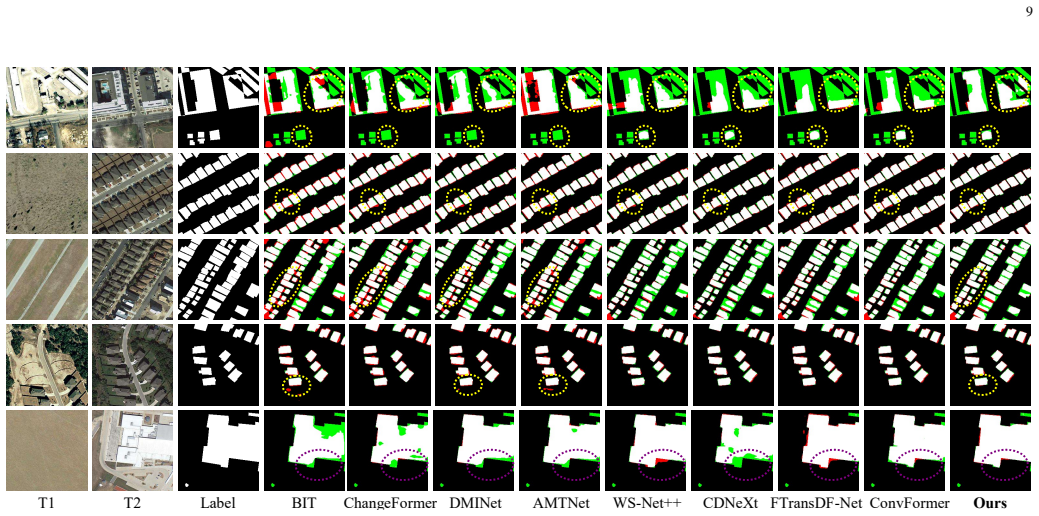
Summary. The paper proposes FSG-Net, a change-detection network for high-resolution remote sensing images, built from three modules: DAWIM (a wavelet-domain interaction module), STSAM (a synergistic temporal-spatial attention module), and LGFU (a lightweight gated fusion unit). DAWIM decomposes features with a Haar DWT and processes low-, mid-, and high-frequency subbands with different strategies; STSAM couples cross-attention with coordinate attention; LGFU gates shallow features with deep semantics. The paper reports state-of-the-art F1 scores of 94.16% on CDD, 89.51% on GZ-CD, and 91.27% on LEVIR-CD, supported by ablations, visualizations, and an efficiency comparison. The central claimed mechanism is that DAWIM suppresses pseudo-changes by attenuating low-frequency radiometric shifts while preserving high-frequency structural evidence.
Significance. The paper's strengths are its extensive comparisons on three public benchmarks, consistent ablation tables (Tables II–IV), qualitative visualizations, and a clear three-module design with a favorable parameter/FLOP trade-off. If the frequency-domain suppression mechanism were actually realized, the paper would make a useful contribution to change detection. However, the core mechanistic claim is contradicted by the module equations: DAWIM cannot attenuate low-frequency subbands as written. In addition, the SOTA margins are small on two of the three datasets and are reported without error bars, and the code is not released. As it stands, the paper does not establish that the proposed modules work in the way claimed; the contribution is currently an architecture with an unverified explanation.
major comments (3)
- [III-B, Eq. (10)] Eq. (10) defines LL'_i = W_fLL ⊙ LL_i + LL_i, with W_fLL = σ(·) ∈ [0,1]. Thus every low-frequency coefficient is multiplied by (1 + W_fLL), which lies in [1,2]; the subband can only be amplified or left unchanged, never attenuated. This directly contradicts the paper's central claim (Abstract, Sec. I, Sec. III-B, Sec. IV-E1) that DAWIM 'attenuates low-frequency radiometric shifts' and suppresses pseudo-changes. Unless a different operation is used for the other subbands, the same issue applies throughout Fig. 2. The ablation gains in Table II therefore cannot be attributed to low-frequency suppression; they may arise from the 3D convolutions, the SE weighting, or the residual path. Notably, Table III shows that removing the residual connection (which would permit attenuation) degrades performance, creating a tension with the paper's stated rationale.
- [Table I, Sec. IV-D] The 'superior results on nearly every metric' claim rests on single-run comparisons with no error bars. On LEVIR-CD the F1 advantage over WS-Net++ is 0.20 points (91.27 vs. 91.07), and on CDD the advantage over FTransDF-Net is 0.60 points (94.16 vs. 93.56). These margins are small relative to typical seed-to-seed variance in change-detection training. Because the code is not released, the central SOTA claim is not verifiable. Please report mean ± std over at least three runs (or release code and exact training protocols) to support the claimed improvements.
- [Sec. I, Sec. III-B] The spectral-separation assumption—that low-frequency components are dominated by illumination/seasonal variations and high-frequency components by true structural changes—is stated but not validated. No experiment quantifies the frequency content of genuine versus nuisance changes. Large-area or slow-onset changes (e.g., land-cover conversion) are low-frequency and could be suppressed by any actual low-frequency attenuation, risking true positives. If the module is revised to genuinely attenuate low-frequency content, the authors should test this premise, e.g., with synthetic radiometric-shift experiments or by ablating the frequency assignment.
minor comments (6)
- [IV-A, GZ-CD description] The phrase 'after filtering out those containing changed pixels' is likely a typo; it should presumably be 'unchanged pixels' or 'no changed pixels', otherwise it contradicts the use of 1073 clips for training.
- [Table I] The header uses 'IOU'; please change to 'IoU' for consistency with the text and equations.
- [III-C, Eq. (12)] The notation 'Linear' in Eq. (12) is not defined. If it denotes the shared 1×1 convolution, please state this explicitly.
- [References] Several references contain duplicated text 'in in Proc.' (e.g., [10], [12], [15], [24], [30], [36], [37]). Please clean these up.
- [Table V] WS-Net++ parameters and FLOPs are shown as '–' with no explanation; add a note clarifying that these values are not reported in the original paper or are unavailable.
- [IV-B] Implementation details do not state the random seed or the number of runs. Please add this information, especially given the small performance margins.
Circularity Check
No circular derivation; FSG-Net is an empirical architecture paper validated on external benchmarks.
full rationale
FSG-Net's central claims are empirical: its SOTA F1 scores are measured on the held-out test splits of CDD, GZ-CD, and LEVIR-CD against publicly available implementations, and the module contributions are supported by ablations on those same benchmarks. No parameter is fitted to a subset and then renamed as a prediction; no derived quantity is defined in terms of the evaluation metric; and no uniqueness theorem or first-principles result is imported from the authors' prior work. The single self-citation, [19] (Yao and Ghamisi), appears only in a related-work list of frequency-domain methods and is not load-bearing. The paper even acknowledges a limitation (failure on minute isolated building changes, Sec. IV-D/F), which is consistent with an honest empirical report. The most substantive concern is a mechanism/narrative mismatch, not circularity: Eq. (10), LL'_i = W_fLL ⊙ LL_i + LL_i with W_fLL = σ(...) ∈ [0,1], implies low-frequency subbands are scaled by (1+W) ∈ [1,2], so DAWIM's residual reweighting cannot literally attenuate low-frequency components as claimed in Sec. I and III-B. That is a correctness/interpretation issue that would need to be resolved by inspecting learned weights or changing the formulation; it does not make the benchmark results circular, because the results do not depend on that narrative being true. Hence no circular step meets the evidentiary bar.
Assumptions & free parameters
free parameters (8)
- Initial learning rate (decoder/head) =
1e-3
- Initial learning rate (pretrained backbone) =
1e-4
- Weight decay =
0.01
- Batch size =
32
- Number of epochs =
100
- Cross-attention Q/K compression ratio =
1/8 of channel dimension
- Temporal embeddings T_i =
learned, Cx1x1 per time index
- STSAM scaling parameter omega =
learned, initialized to 0
assumptions (5)
- standard math 2D Haar DWT followed by IDWT reconstructs the original signal (perfect reconstruction property).
- domain assumption Pseudo-changes from illumination/seasonal shifts are predominantly low-frequency while genuine structural changes are predominantly high-frequency.
- domain assumption The pretrained ResNet18 backbone features are suitable for all three datasets and provide a fair common basis for comparison.
- domain assumption Baseline methods were correctly run with their official implementations and default parameters.
- domain assumption The composite loss L_BCE + L_Dice is appropriate and the weights are implicitly equal (coefficient 1 each).
Cite this review
Pith. "Pith review of FSG-Net: Frequency-Spatial Synergistic Gated Network for High-Resolution Remote Sensing Change Detection." pith.science (2026). https://pith.science/paper/QKNZVRG5
@misc{pith2026250906482,
  author       = {Pith},
  title        = {Pith review of: FSG-Net: Frequency-Spatial Synergistic Gated Network for High-Resolution Remote Sensing Change Detection},
  year         = {2026},
  howpublished = {\url{https://pith.science/paper/QKNZVRG5}},
  note         = {Machine review of arXiv:2509.06482}
}
read the original abstract
Change detection from high-resolution remote sensing images lies as a cornerstone of Earth observation applications, yet its efficacy is often compromised by two critical challenges. First, false alarms are prevalent as models misinterpret radiometric variations from temporal shifts (e.g., illumination, season) as genuine changes. Second, a non-negligible semantic gap between deep abstract features and shallow detail-rich features tends to obstruct their effective fusion, culminating in poorly delineated boundaries. To step further in addressing these issues, we propose the Frequency-Spatial Synergistic Gated Network (FSG-Net), a novel paradigm that aims to systematically disentangle semantic changes from nuisance variations. Specifically, FSG-Net first operates in the frequency domain, where a Discrepancy-Aware Wavelet Interaction Module (DAWIM) adaptively mitigates pseudo-changes by discerningly processing different frequency components. Subsequently, the refined features are enhanced in the spatial domain by a Synergistic Temporal-Spatial Attention Module (STSAM), which amplifies the saliency of genuine change regions. To finally bridge the semantic gap, a Lightweight Gated Fusion Unit (LGFU) leverages high-level semantics to selectively gate and integrate crucial details from shallow layers. Comprehensive experiments on the CDD, GZ-CD, and LEVIR-CD benchmarks validate the superiority of FSG-Net, establishing a new state-of-the-art with F1-scores of 94.16%, 89.51%, and 91.27%, respectively. The code will be made available at https://github.com/zxXie-Air/FSG-Net after a possible publication.
Figures


Figures from the paper (5 more)




Reference graph
Works this paper leans on
-
[1]
D. Peng, X. Liu, Y . Zhang, H. Guan, Y . Li, and L. Bruzzone, “Deep learning change detection techniques for optical remote sensing imagery: Status, perspectives and challenges,”Int. J. Appl. Earth Observ. Geoinf., vol. 136, p. 104282, 2025
work page 2025
-
[2]
Hyperspectral simultaneous anomaly detection and denoising: Insights from integrative perspective,
M. Wang, L. Gao, L. Ren, X. Sun, and J. Chanussot, “Hyperspectral simultaneous anomaly detection and denoising: Insights from integrative perspective,”IEEE J. Sel. Top. Appl. Earth Observ. Remote Sens., 2024
work page 2024
-
[3]
X. Wen, H. Xie, H. Liu, and L. Yan, “Accurate reconstruction of the LoD3 building model by integrating multi-source point clouds and oblique remote sensing imagery,”ISPRS Int. J. Geo-Inf., vol. 8, no. 3, p. 135, 2019
work page 2019
-
[4]
SPECIAL: Zero-shot Hyperspectral Image Classification With CLIP,
L. Pang, J. Yao, K. Li, and X. Cao, “SPECIAL: Zero-shot Hyperspectral Image Classification With CLIP,”arXiv preprint arXiv:2501.16222, 2025
arXiv 2025
-
[5]
Landslide detection, monitoring and prediction with remote-sensing techniques,
N. Casagli, E. Intrieri, V . Tofani, G. Gigli, and F. Raspini, “Landslide detection, monitoring and prediction with remote-sensing techniques,” Nat. Rev. Earth Environ., vol. 4, no. 1, pp. 51–64, 2023
work page 2023
-
[6]
F. Bovolo and L. Bruzzone, “A theoretical framework for unsupervised change detection based on change vector analysis in the polar domain,” IEEE Trans. Geosci. Remote Sens., vol. 45, no. 1, pp. 218–236, 2006
work page 2006
-
[7]
T. Bai, K. Sun, S. Deng, D. Li, W. Li, and Y . Chen, “Multi-scale hierarchical sampling change detection using Random Forest for high- resolution satellite imagery,”Int. J. Remote Sens., vol. 39, no. 21, pp. 7523–7546, 2018
work page 2018
-
[8]
J. Lin, G. Wang, D. Peng, and H. Guan, “Edge-guided multi-scale foreground attention network for change detection in high resolution remote sensing images,”Int. J. Appl. Earth Observ. Geoinf., vol. 133, p. 104070, 2024
work page 2024
Show all 57 references
-
[9]
A review of multi-class change detection for satellite remote sensing imagery,
Q. Zhu, X. Guo, Z. Li, and D. Li, “A review of multi-class change detection for satellite remote sensing imagery,”Geo-Spat. Inf. Sci., vol. 27, no. 1, pp. 1–15, 2024
2024
-
[10]
Scaling up your kernels to 31x31: Revisiting large kernel design in cnns,
X. Ding, X. Zhang, J. Han, and G. Ding, “Scaling up your kernels to 31x31: Revisiting large kernel design in cnns,” inin Proc. IEEE/CVF Conf. Comput. Vis. Pattern Recognit. (CVPR), 2022, pp. 11 963–11 975
2022
-
[11]
Multi-scale context aggregation by dilated convolutions,
F. Yu and V . Koltun, “Multi-scale context aggregation by dilated convolutions,”arXiv preprint arXiv:1511.07122, 2015
2015 arXiv
-
[12]
Poly kernel inception network for remote sensing detection,
X. Cai, Q. Lai, Y . Wang, W. Wang, Z. Sun, and Y . Yao, “Poly kernel inception network for remote sensing detection,” inin Proc. IEEE/CVF Conf. Comput. Vis. Pattern Recognit. (CVPR), 2024, pp. 27 706–27 716
2024
-
[13]
GlobalMind: Global multi-head inter- active self-attention network for hyperspectral change detection,
M. Hu, C. Wu, and L. Zhang, “GlobalMind: Global multi-head inter- active self-attention network for hyperspectral change detection,”ISPRS J. Photogramm. Remote Sens., vol. 211, pp. 465–483, 2024
2024
-
[14]
Asymmetric cross-attention hierarchical network based on CNN and transformer for bitemporal remote sensing images change detection,
X. Zhang, S. Cheng, L. Wang, and H. Li, “Asymmetric cross-attention hierarchical network based on CNN and transformer for bitemporal remote sensing images change detection,”IEEE Trans. Geosci. Remote Sens., vol. 61, pp. 1–15, 2023. 13
2023
-
[15]
Coordinate attention for efficient mobile network design,
Q. Hou, D. Zhou, and J. Feng, “Coordinate attention for efficient mobile network design,” inin Proc. IEEE/CVF Conf. Comput. Vis. Pattern Recognit. (CVPR), 2021, pp. 13 713–13 722
2021
-
[16]
An attention-based multiscale transformer network for remote sensing image change detection,
W. Liu, Y . Lin, W. Liu, Y . Yu, and J. Li, “An attention-based multiscale transformer network for remote sensing image change detection,”ISPRS J. Photogramm. Remote Sens., vol. 202, pp. 599–609, 2023
2023
-
[17]
Change detection on remote sensing images using dual-branch multilevel intertemporal network,
Y . Feng, J. Jiang, H. Xu, and J. Zheng, “Change detection on remote sensing images using dual-branch multilevel intertemporal network,” IEEE Trans. Geosci. Remote Sens., vol. 61, pp. 1–15, 2023
2023
-
[18]
Changer: Feature interaction is what you need for change detection,
S. Fang, K. Li, and Z. Li, “Changer: Feature interaction is what you need for change detection,”IEEE Trans. Geosci. Remote Sens., vol. 61, pp. 1–11, 2023
2023
-
[19]
Mask Approximation Net: A Novel Diffusion Model Approach for Remote Sensing Change Captioning,
D. Sun, J. Yao, W. Xue, C. Zhou, P. Ghamisi, and X. Cao, “Mask Approximation Net: A Novel Diffusion Model Approach for Remote Sensing Change Captioning,”IEEE Trans. Geosci. Remote Sens., 2025
2025
-
[20]
Dual Fine-Grained network with frequency Transformer for change detection on remote sensing images,
Z. Li, Z. Zhang, M. Li, L. Zhang, X. Peng, R. He, and L. Shi, “Dual Fine-Grained network with frequency Transformer for change detection on remote sensing images,”Int. J. Appl. Earth Observ. Geoinf., vol. 136, p. 104393, 2025
2025
-
[21]
An object fine-grained change detection method based on frequency decoupling interaction for high-resolution remote sensing images,
Y . Tang, S. Feng, C. Zhao, Y . Fan, Q. Shi, W. Li, and R. Tao, “An object fine-grained change detection method based on frequency decoupling interaction for high-resolution remote sensing images,”IEEE Trans. Geosci. Remote Sens., vol. 62, pp. 1–13, 2023
2023
-
[22]
Decompose, adjust, compose: Effective normalization by playing with frequency for domain generalization,
S. Lee, J. Bae, and H. Y . Kim, “Decompose, adjust, compose: Effective normalization by playing with frequency for domain generalization,” in in Proc. IEEE/CVF Conf. Comput. Vis. Pattern Recognit. (CVPR), 2023, pp. 11 776–11 785
2023
-
[23]
Multi- view knowledge ensemble with frequency consistency for cross-domain face translation,
B. Cao, Q. Wang, P. Zhu, Q. Hu, D. Ren, W. Zuo, and X. Gao, “Multi- view knowledge ensemble with frequency consistency for cross-domain face translation,”IEEE Trans. Neural Netw. Learn. Syst., vol. 35, no. 7, pp. 9728–9742, 2023
2023
-
[24]
Fsdr: Frequency space domain randomization for domain generalization,
J. Huang, D. Guan, A. Xiao, and S. Lu, “Fsdr: Frequency space domain randomization for domain generalization,” inin Proc. IEEE/CVF Conf. Comput. Vis. Pattern Recognit. (CVPR), 2021, pp. 6891–6902
2021
-
[25]
Triple change detection network via joint multifrequency and full-scale swin- transformer for remote sensing images,
D. Xue, T. Lei, S. Yang, Z. Lv, T. Liu, Y . Jin, and A. K. Nandi, “Triple change detection network via joint multifrequency and full-scale swin- transformer for remote sensing images,”IEEE Trans. Geosci. Remote Sens., vol. 61, pp. 1–15, 2023
2023
-
[26]
Wavelet siamese network with semi-supervised domain adaptation for remote sensing image change detection,
F. Xiong, T. Li, Y . Yang, J. Zhou, J. Lu, and Y . Qian, “Wavelet siamese network with semi-supervised domain adaptation for remote sensing image change detection,”IEEE Trans. Geosci. Remote Sens., 2024
2024
-
[27]
High- resolution remote sensing image change detection based on Fourier feature interaction and multi-scale perception,
Y . Chen, S. Feng, C. Zhao, N. Su, W. Li, R. Tao, and J. Ren, “High- resolution remote sensing image change detection based on Fourier feature interaction and multi-scale perception,”IEEE Trans. Geosci. Remote Sens., 2024
2024
-
[28]
Extended vision transformer (ExViT) for land use and land cover classification: A multimodal deep learning framework,
J. Yao, B. Zhang, C. Li, D. Hong, and J. Chanussot, “Extended vision transformer (ExViT) for land use and land cover classification: A multimodal deep learning framework,”IEEE Trans. Geosci. Remote Sens., vol. 61, pp. 1–15, 2023
2023
-
[29]
Hybrid attention-aware transformer network collaborative multiscale feature alignment for building change detection,
C. Xu, Z. Ye, L. Mei, H. Yu, J. Liu, Y . Yalikun, S. Jin, S. Liu, W. Yang, and C. Lei, “Hybrid attention-aware transformer network collaborative multiscale feature alignment for building change detection,”IEEE Trans. Instrum. Meas., vol. 73, pp. 1–14, 2024
2024
-
[30]
Deformable convnets v2: More deformable, better results,
X. Zhu, H. Hu, S. Lin, and J. Dai, “Deformable convnets v2: More deformable, better results,” inin Proc. IEEE/CVF Conf. Comput. Vis. Pattern Recognit. (CVPR), 2019, pp. 9308–9316
2019
-
[31]
Alignseg: Feature-aligned segmentation networks,
Z. Huang, Y . Wei, X. Wang, W. Liu, T. S. Huang, and H. Shi, “Alignseg: Feature-aligned segmentation networks,”IEEE Trans. Pattern Anal. Mach. Intell., vol. 44, no. 1, pp. 550–557, 2021
2021
-
[32]
Change detection from very-high-spatial-resolution op- tical remote sensing images: Methods, applications, and future direc- tions,
D. Wen, X. Huang, F. Bovolo, J. Li, X. Ke, A. Zhang, and J. A. Benediktsson, “Change detection from very-high-spatial-resolution op- tical remote sensing images: Methods, applications, and future direc- tions,”IEEE Geosci. Remote Sens. Mag., vol. 9, no. 4, pp. 68–101, 2021
2021
-
[33]
Deep residual learning for image recognition,
K. He, X. Zhang, S. Ren, and J. Sun, “Deep residual learning for image recognition,” inin Proc. IEEE Conf. Comput. Vis. Pattern Recognit. (CVPR), 2016, pp. 770–778
2016
-
[34]
Change detection based on image standardization and improved residual network for single-polarization SAR images,
M. Wang, J. Zhang, G. Huang, L. Lu, and F. Hua, “Change detection based on image standardization and improved residual network for single-polarization SAR images,”IEEE J. Sel. Top. Appl. Earth Observ. Remote Sens., 2025
2025
-
[35]
UNet- Like Remote Sensing Change Detection: A review of current models and research directions,
C. Wu, L. Zhang, B. Du, H. Chen, J. Wang, and H. Zhong, “UNet- Like Remote Sensing Change Detection: A review of current models and research directions,”IEEE Geosci. Remote Sens. Mag., 2024
2024
-
[36]
A CNN-transformer network with multiscale context aggregation for fine-grained cropland change detection,
M. Liu, Z. Chai, H. Deng, and R. Liu, “A CNN-transformer network with multiscale context aggregation for fine-grained cropland change detection,”IEEE J. Sel. Top. Appl. Earth Observ. Remote Sens., vol. 15, pp. 4297–4306, 2022
2022
-
[37]
Fully convolutional siamese networks for change detection,
R. C. Daudt, B. Le Saux, and A. Boulch, “Fully convolutional siamese networks for change detection,” inin Proc. IEEE Int. Conf. Image Process. (ICIP). IEEE, 2018, pp. 4063–4067
2018
-
[38]
Building change detection for remote sensing images using a dual-task constrained deep siamese convolutional network model,
Y . Liu, C. Pang, Z. Zhan, X. Zhang, and X. Yang, “Building change detection for remote sensing images using a dual-task constrained deep siamese convolutional network model,”IEEE Geosci. Remote Sens. Lett., vol. 18, no. 5, pp. 811–815, 2020
2020
-
[39]
SNUNet-CD: A densely connected Siamese network for change detection of VHR images,
S. Fang, K. Li, J. Shao, and Z. Li, “SNUNet-CD: A densely connected Siamese network for change detection of VHR images,”IEEE Geosci. Remote Sens. Lett., vol. 19, pp. 1–5, 2021
2021
-
[40]
Deep learning for change detection in remote sensing: a review,
T. Bai, L. Wang, D. Yin, K. Sun, Y . Chen, W. Li, and D. Li, “Deep learning for change detection in remote sensing: a review,”Geo-Spat. Inf. Sci., vol. 26, no. 3, pp. 262–288, 2022
2022
-
[41]
Attention is all you need,
A. Vaswani, N. Shazeer, N. Parmar, J. Uszkoreit, L. Jones, A. N. Gomez, Ł. Kaiser, and I. Polosukhin, “Attention is all you need,”Adv. Neural Inf. Process. Syst., vol. 30, 2017
2017
-
[42]
An image is worth 16x16 words: Transformers for image recognition at scale,
A. Dosovitskiy, L. Beyer, A. Kolesnikov, D. Weissenborn, X. Zhai, T. Unterthiner, M. Dehghani, M. Minderer, G. Heigold, S. Gellyet al., “An image is worth 16x16 words: Transformers for image recognition at scale,”arXiv preprint arXiv:2010.11929, 2020
2010 arXiv
-
[43]
A transformer-based siamese network for change detection,
W. G. C. Bandara and V . M. Patel, “A transformer-based siamese network for change detection,” inin Proc. IEEE Int. Geosci. Remote Sens. Symp. (IGARSS). IEEE, 2022, pp. 207–210
2022
-
[44]
SwinSUNet: Pure transformer network for remote sensing image change detection,
C. Zhang, L. Wang, S. Cheng, and Y . Li, “SwinSUNet: Pure transformer network for remote sensing image change detection,”IEEE Trans. Geosci. Remote Sens., vol. 60, pp. 1–13, 2022
2022
-
[45]
Remote sensing image change detection with transformers,
H. Chen, Z. Qi, and Z. Shi, “Remote sensing image change detection with transformers,”IEEE Trans. Geosci. Remote Sens., vol. 60, pp. 1–14, 2021
2021
-
[46]
ConvFormer-CD: Hybrid CNN-Transformer with Temporal Attention for Detecting Changes in Remote Sensing Imagery,
F. Yang, M. Li, W. Shu, A. Qin, T. Song, C. Gao, and G.-S. Xia, “ConvFormer-CD: Hybrid CNN-Transformer with Temporal Attention for Detecting Changes in Remote Sensing Imagery,”IEEE Trans. Geosci. Remote Sens., 2025
2025
-
[47]
Robust change detection for remote sensing images based on temporospatial interactive attention module,
J. Wei, K. Sun, W. Li, W. Li, S. Gao, S. Miao, Q. Zhou, and J. Liu, “Robust change detection for remote sensing images based on temporospatial interactive attention module,”Int. J. Appl. Earth Observ. Geoinf., vol. 128, p. 103767, 2024
2024
-
[48]
GCFormer: Global context-aware trans- former for remote sensing image change detection,
W. Yu, L. Zhuo, and J. Li, “GCFormer: Global context-aware trans- former for remote sensing image change detection,”IEEE Trans. Geosci. Remote Sens., vol. 62, pp. 1–12, 2024
2024
-
[49]
Deep multimodal fusion by channel exchanging,
Y . Wang, W. Huang, F. Sun, T. Xu, Y . Rong, and J. Huang, “Deep multimodal fusion by channel exchanging,”Adv. Neural Inf. Process. Syst., vol. 33, pp. 4835–4845, 2020
2020
-
[50]
High- resolution remote sensing bitemporal image change detection based on feature interaction and multitask learning,
C. Zhao, Y . Tang, S. Feng, Y . Fan, W. Li, R. Tao, and L. Zhang, “High- resolution remote sensing bitemporal image change detection based on feature interaction and multitask learning,”IEEE Trans. Geosci. Remote Sens., vol. 61, pp. 1–14, 2023
2023
-
[51]
Fda: Fourier domain adaptation for semantic segmentation,
Y . Yang and S. Soatto, “Fda: Fourier domain adaptation for semantic segmentation,” inin Proc. IEEE/CVF Conf. Comput. Vis. Pattern Recog- nit. (CVPR), 2020, pp. 4085–4095
2020
-
[52]
Efficient and robust: A cross-modal registration deep wavelet learning method for remote sensing images,
D. Quan, H. Wei, S. Wang, Y . Li, J. Chanussot, Y . Guo, B. Hou, and L. Jiao, “Efficient and robust: A cross-modal registration deep wavelet learning method for remote sensing images,”IEEE J. Sel. Top. Appl. Earth Observ. Remote Sens., vol. 16, pp. 4739–4754, 2023
2023
-
[53]
Squeeze-and-excitation networks,
J. Hu, L. Shen, and G. Sun, “Squeeze-and-excitation networks,” inin Proc. IEEE Conf. Comput. Vis. Pattern Recognit. (CVPR), 2018, pp. 7132–7141
2018
-
[54]
Change detection in remote sensing images using conditional adversarial networks,
M. A. Lebedev, Y . V . Vizilter, O. V . Vygolov, V . A. Knyaz, and A. Y . Rubis, “Change detection in remote sensing images using conditional adversarial networks,”Int. Arch. Photogramm. Remote Sens. Spat. Inf. Sci., vol. 42, pp. 565–571, 2018
2018
-
[55]
Enhancing cloud-removed regions in multispectral optical images using sar edge features,
M. Wang, X. Zhao, and L. Ren, “Enhancing cloud-removed regions in multispectral optical images using sar edge features,”IEEE Geosci. Remote Sens. Lett., 2025
2025
-
[56]
SemiCDNet: A semisupervised convolutional neural network for change detection in high resolution remote-sensing images,
D. Peng, L. Bruzzone, Y . Zhang, H. Guan, H. Ding, and X. Huang, “SemiCDNet: A semisupervised convolutional neural network for change detection in high resolution remote-sensing images,”IEEE Trans. Geosci. Remote Sens., vol. 59, no. 7, pp. 5891–5906, 2020
2020
-
[57]
A spatial-temporal attention-based method and a new dataset for remote sensing image change detection,
H. Chen and Z. Shi, “A spatial-temporal attention-based method and a new dataset for remote sensing image change detection,”Remote Sens., vol. 12, no. 10, p. 1662, 2020
2020
Reviewed August 4, 2026 · model on record in the stance chip above.
Discussion (0). Continue with ORCID to comment.