REVIEW 2 major objections 6 minor 45 references
Robust Competitive Ratio for Deterministic Monopoly Pricing
T0 review · 2 major / 6 minor · reviewed 2026-08-15 · deepseek-v4-flash
Pith's one-line read A monopolist who knows only mean, variance, and maximum value has an optimal robust price: charge low below a dispersion threshold, high above it.
desk verdict The paper solves a meaningful max-min pricing problem with an elegant decomposition, but the load-bearing monotonicity lemma has a long unverified proof and a contradictory summary statement that must be fixed before I'd trust it as a theorem. read the letter →
The pith
A machine-rendered reading of the paper's core claim, the machinery that carries it, and where it could break.
The reading
What carries the argument
The workhorse is the ratio decomposition in Theorem 3.1, which expresses the worst-case competitive ratio as the minimum of a tail-probability ratio and a price-to-conditional-expectation ratio. The proof identifies two- and three-point extremal distributions, parameterized by the price $p$, that attain tight bounds for each of the three quantities in the decomposition, and it certifies those bounds with dual solutions from semi-infinite linear programming. A second load-bearing object is the best-case revenue function $g(p)=p\,\sup_{P\in\mathcal{P}}\mathbb{P}(X\ge p)$; Lemma 4.3 proves this function is non-decreasing on $(0,\tau_2]$, which is what turns the $p^*\le p$ case into the tail-ratio lower bound. The threshold $\tau_2$ is the right support point of the two-point distribution on $\{0,\tau_2\}$ and separates the regime where the adversarial distribution is two-point from the regime where it is three-point.
What would settle it
Choose a strictly convex $\varphi$ such as $\varphi(x)=x^q$ with parameters for which $\mathcal{P}$ is nonempty and compute $g(p)$ on $(0,\tau_2]$; if $g$ decreases on any interval, evaluate $\inf_{P\in\mathcal{P}}\mathrm{CR}(p,P)$ directly at a price in that interval and compare it with the right-hand side of the decomposition, since any gap would refute Theorem 3.1. In the variance case, evaluate $R(p_l^*,\sigma)$ and $R(p_h^*,\sigma)$ around the claimed threshold $\sigma^*$; if either is beaten by a third candidate price, Theorem 5.1 fails.
Extended reading notes
Core claim
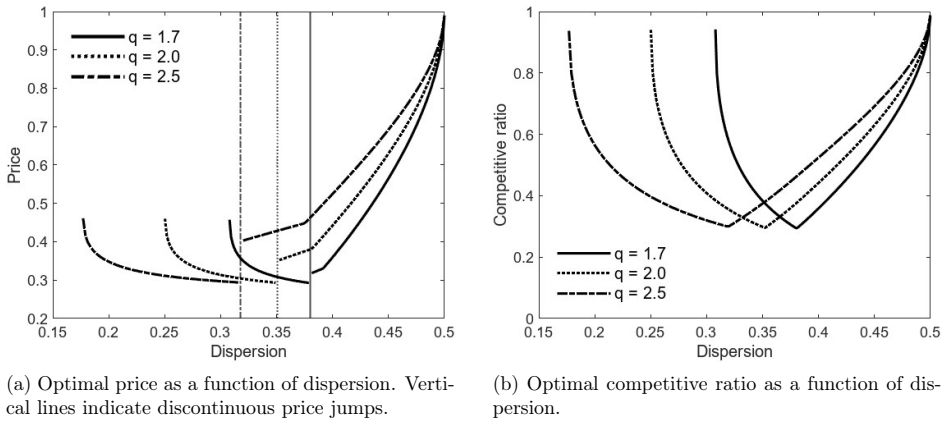
The central discovery is a complete solution of the maximin competitive-ratio problem for the ambiguity set $\mathcal{P}(\mu,s,\beta,\varphi)$, the distributions on $[0,\beta]$ with mean $\mu$ and dispersion $\mathbb{E}_P[\varphi(X)]=s$. Theorem 3.1 states that for any fixed price $p$ the tight worst-case ratio equals $\min\left(\frac{\inf_{P\in\mathcal{P}}\mathbb{P}(X\ge p)}{\sup_{P\in\mathcal{P}}\mathbb{P}(X\ge p)}, \frac{p}{\sup_{P\in\mathcal{P}}\mathbb{E}(X\mid X\ge p)}\right)$, so the fractional ratio problem decouples into three one-sided moment problems. Theorem 3.2 adds that the same limiting extremal distribution realizes both the worst-case ratio and the worst-case expected revenue. With $\varphi(x)=x^2$, Theorem 5.1 gives the maximin price explicitly: $p_l^*$ for $\sigma\le\sigma^*$ and $p_h^*$ for $\sigma\ge\sigma^*$, a discontinuous shift from a low-price, high-conversion strategy to a high-price, selective strategy. With $\varphi(x)=x^q$ for $q>1$, the optimal price is one of four candidate prices, and introducing a unit cost only shifts the ambiguity set.
Load-bearing premise
The whole derivation hinges on the assumption that the best-case revenue function $g(p)=p\,\sup_{P\in\mathcal{P}}\mathbb{P}(X\ge p)$ never decreases while $p$ is at most $\tau_2$; if a permitted dispersion measure made it dip, the tight competitive-ratio formula and the prices derived from it would not follow.
Editorial extensions
If this is right
- In the mean-variance-cap model, the optimal robust price is $p_l^*$ for $\sigma\le\sigma^*$ and $p_h^*$ for $\sigma\ge\sigma^*$, so a seller switches abruptly from a low-price mass-market strategy to a high-price niche strategy as dispersion crosses $\sigma^*$.
- Without the cap $\beta$, the high-price regime vanishes and the same low-price formula $p_l^*$ remains optimal, with the worst-case ratio decaying to zero as variance grows; knowing the cap is therefore valuable.
- The competitive-ratio optimal prices are systematically more moderate than expected-revenue optimal prices: $\pi_l^*<p_l^*$ in the low regime and $\pi_h^*>p_h^*$ in the high regime.
- For fractional moments $\varphi(x)=x^q$ with $q>1$, the optimal price is one of four candidate prices, and larger $q$ widens the range of dispersions over which the strategy applies and enlarges the price jump.
- A positive unit cost $c$ can be absorbed by shifting the valuation variable, so the same pricing structure applies to a seller with a production cost.
Reading between the lines
- One practical consequence not developed in the paper: $\sigma^*$ is a dataable market-risk threshold, so estimating $\mu$, $\sigma$, and $\beta$ from transaction data would tell a seller directly whether to price low or high.
- Because the same adversarial distribution governs expected revenue and competitive ratio, robust expected-revenue algorithms for other moment sets may be reusable for ratio objectives; the paper demonstrates this only for the current ambiguity set.
- For $1<q<2$, fractional moments permit heavier tails, and the four-candidate price set suggests a monotone relationship between the tail exponent $q$ and the robust price; this is a testable extension, not a claim of the paper.
- The paper's limiting-distribution caveat implies that exact attainment of the worst-case ratio may require an approximating sequence, and the paper does not estimate how quickly such a sequence converges; in practice a seller approaches the bound rather than hitting it.
Signed reviews
Editorial analysis
A structured set of objections, weighed in public.
Referee Report
Summary. The paper studies deterministic monopoly pricing when the seller knows only the mean mu, a dispersion value s = E phi(X), and an upper bound beta on the support of the valuation X, and must choose a deterministic price maximizing the worst-case competitive ratio CR(p,P) = p P(X >= p) / sup_{t>0} t P(X >= t). The main result, Theorem 3.1, expresses inf_{P in P(mu,s,beta,phi)} CR(p,P) as the minimum of the worst-to-best tail-probability ratio and the ratio p / sup_P E(X | X >= p). Propositions 4.1-4.3 give explicit formulas for the three ingredients using two- and three-point extremal distributions; Theorem 3.2 claims that the same limiting distribution is worst-case for expected revenue. Section 5 specializes to variance, with a closed-form optimal price switching between a low price and a high price at an implicit dispersion threshold sigma*, and to fractional moments, with the optimum restricted to four candidates. Proofs use semi-infinite LP duality and a novel monotonicity lemma for the best-case revenue function.
Significance. If the proofs are correct, this is a substantial contribution to distributionally robust pricing. It generalizes the mean-variance competitive-ratio analysis of Giannakopoulos et al. and Chen et al. to general convex dispersion measures and to a known maximum valuation, provides explicit extremal distributions with LP-duality certificates, and yields a closed-form pricing policy for the variance case. The observation that the worst-case distribution for the competitive ratio coincides with the worst-case distribution for expected revenue is a clean and non-obvious structural result. The paper also demonstrates a practical discontinuity in the optimal price as a function of dispersion, contrasting with the unbounded-support benchmark.
major comments (2)
- [Section 4.3 (proof of Theorem 3.1)] The upper-bound step evaluates the competitive ratio at P* = P*(p-) and states 'consider P* in P'. Since p- is a left-limit symbol rather than an actual support point, P*(p-) is not a distribution in P, and for any fixed distribution in P the displayed equalities REV(p,P*) = p * inf_P P(X >= p) and OPT(P*) = max{p * sup_P P(X >= p), y(p) * inf_P P(X >= p)} do not hold: the mass at p contributes to P(X >= p) in the limit. The proof needs an explicit limiting argument with a sequence P_n in P, for instance P_n = P*(p_n) with p_n increasing to p. The footnote in Section 3.2 defines asymptotic attainment, but the body proof does not use it; as written, the upper bound in (5) is not established.
- [Section 6 and Lemma 4.3 / Appendix E] The Conclusions state: 'This function must be non-increasing up to a certain value for the proof of Theorem 3.1 to work.' This is the opposite of what the proof in Section 4.3 requires: the case p* <= p needs sup_{t in (0,p]} g(t) = g(p), i.e., g non-decreasing, and Appendix E is written to prove non-decreasing. Because Lemma 4.3 is the only place where the maximum-valuation bound beta enters the lower-bound branch, this contradiction is not merely cosmetic. The manuscript must correct the Conclusions statement and should present the proof of Lemma 4.3 in a more verifiable form (for example, by listing the sign of each factor in (59)-(62)); as it stands, a reader cannot tell which direction is intended.
minor comments (6)
- [Section 5.2, Theorem 5.3(iii)] The defining equation for pbar_h uses the symbol pbar_l on the left-hand side; it should presumably be an equation in the variable that is supposed to be pbar_h. Please correct the displayed formula.
- [Section 4.2 (upper-bound dispersion paragraph)] This paragraph states several claims 'without proof' and says the full derivation is left to the interested reader. Since the variant with an upper bound on dispersion is not used in the main theorems, it should be marked as a remark; if it is intended as a result, the proof should be supplied.
- [Equations (33) and (49)] The systems displayed in (33) and (49) are missing a plus sign in the second equation ('lambda0 lambda1 alpha(p)'); please fix these typos.
- [Equation (8) and Section 3.1] The two-point distribution P2 in (8) uses the left-limit notation p- before it is defined, and the text does not explain that (8) is a limiting construction; please define the notation at first use.
- [Theorem 5.3 proof] The inference 'g1a(0+) > g1b(0) implies g1a(tau1) > g1b(tau1)' is only valid together with the already assumed inequality tau1 < pbar_l; please spell out this dependence.
- [Table 2] The '-' entries for beta = 1 and mu = 1 correspond to an empty ambiguity set by Lemma 4.1 (tau2 > beta); the table caption should state this.
Circularity Check
No circular derivation found: Theorem 3.1 is proved from independent moment-tail bounds and Lemma 4.3 rather than assumed; same-author citations are independent support.
full rationale
Walking the paper's derivation chain, I find no step in which a claimed result is equivalent to its own input by construction. Theorem 3.1 is derived, not assumed: Propositions 4.1–4.3 solve independent extremal problems for sup/inf tail probabilities and the conditional expectation, and the proof of Theorem 3.1 in Section 4.3 combines these with the explicit distribution P*(p-) for the upper bound and a case split p*≤p / p*>p for the lower bound. The p*≤p case uses Lemma 4.3, whose proof in Appendix E is a direct monotonicity argument from strict convexity of phi and the dispersion relation (22); it is not a restatement of Theorem 3.1. The pricing results in Section 5 then maximize the resulting closed-form competitive ratio, with no fitted parameter being renamed as a prediction. The same-author citations (Kleer et al., 2024; van Eck et al., 2024) supply two-point-distribution parametrization, conditional-expectation bounds, and a standard continuity fact; these are parameter-free moment results whose stated assumptions do not include the target competitive-ratio formula, so under the review rules they count as independent evidence rather than circularity. I do flag one manuscript inconsistency: Section 6 states that the best-case revenue function 'must be non-increasing up to a certain value for the proof of Theorem 3.1 to work,' while Lemma 4.3 and Appendix E prove it is non-decreasing. This is a correctness/typo issue, not a circularity. I also note the paper leaves an upper-bound-dispersion variant 'Without proof' and treats P*(p-) as a limiting left-limit object; these are rigor gaps, not circular reductions. Overall, the central derivation is self-contained against the standard moment-bound benchmarks, so the circularity score is 0.
Assumptions & free parameters
assumptions (5)
- domain assumption φ is strictly convex, differentiable and nonnegative on [0,β]; dispersion constraint is exact equality E φ(X)=s.
- domain assumption Ambiguity set is non-empty with μ≤τ2≤β and β>τ2.
- standard math Semi-infinite linear programming strong duality and existence of extremal three-point distributions.
- domain assumption For every p in the relevant ranges, a unique two-point distribution solving (19) exists, and sup E(X|X≥p)=α(p) for p∈(0,τ1].
- domain assumption Worst-case distributions may be attained only asymptotically as left-limits p-.
Cite this review
Pith. "Pith review of Robust Competitive Ratio for Deterministic Monopoly Pricing." pith.science (2026). https://pith.science/paper/VWCLQRPT
@misc{pith2026250906619,
  author       = {Pith},
  title        = {Pith review of: Robust Competitive Ratio for Deterministic Monopoly Pricing},
  year         = {2026},
  howpublished = {\url{https://pith.science/paper/VWCLQRPT}},
  note         = {Machine review of arXiv:2509.06619}
}
read the original abstract
We study deterministic monopoly pricing under partial knowledge of the market, where the seller has access only to summary statistics of the valuation distribution, such as the mean, dispersion, and maximum value. Using tools from distributionally robust optimization and max-min analysis, we evaluate pricing strategies based on their competitive ratio (CR). We characterize the worst-case market scenario consistent with the available information and provide a complete solution for minimizing the CR. Our analysis also covers optimal pricing under various measures of dispersion, including variance and fractional moments. Interestingly, we find that the worst-case market for CR coincides with that for expected revenue. Using proof techniques tailored to the CR framework, we further examine how dispersion and maximum valuation influence optimal deterministic pricing. These results offer practical guidance for setting robust prices when market information is limited.
Figures


Reference graph
Works this paper leans on
-
[1]
, " * write output.state after.block = add.period write newline
ENTRY address author booktitle chapter doi edition editor eid howpublished institution isbn issn journal key month note number organization pages publisher school series title type url volume year label extra.label sort.label short.list INTEGERS output.state before.all mid.sentence after.sentence after.block FUNCTION init.state.consts #0 'before.all := #1...
-
[2]
write newline
" write newline "" before.all 'output.state := FUNCTION n.dashify 't := "" t empty not t #1 #1 substring "-" = t #1 #2 substring "--" = not "--" * t #2 global.max substring 't := t #1 #1 substring "-" = "-" * t #2 global.max substring 't := while if t #1 #1 substring * t #2 global.max substring 't := if while FUNCTION word.in "" FUNCTION format.date year ...
-
[3]
Allouah, A., Bahamou, A., and Besbes, O. (2023). Optimal pricing with a single point. Management Science , 69(10):5866--5882
work page 2023
-
[4]
Averbakh, I. and Baysan, M. (2012). Semi-online two-level supply chain scheduling problems. Journal of Scheduling , 15(3):381--390
work page 2012
-
[5]
Azar, P. and Micali, S. (2012). Optimal parametric auctions. Technical report, MIT-CSAIL-TR-2012-015, MIT CSAIL
work page 2012
-
[6]
Azar, P. D. and Micali, S. (2013). Parametric digital auctions. In Proceedings of the 4th conference on Innovations in Theoretical Computer Science , pages 231--232
work page 2013
-
[7]
Babaioff, M. and Walsh, W. E. (2005). Incentive-compatible, budget-balanced, yet highly efficient auctions for supply chain formation. Decision Support Systems , 39(1):123--149
work page 2005
-
[8]
Bahamou, A., Besbes, O., and Mouchtaki, O. (2024). Fast revenue maximization. arXiv preprint arXiv:2407.07316
work page Pith review arXiv 2024
Show all 45 references
-
[9]
and Schlag, K
Bergemann, D. and Schlag, K. H. (2008). Pricing without priors. Journal of the European Economic Association , 6(2-3):560--569
2008
-
[10]
and Schlag, K
Bergemann, D. and Schlag, K. H. (2011). Robust monopoly pricing. Journal of Economic Theory , 146(6):2527--2543
2011
-
[11]
and Elmachtoub, A
Bergquist, J. and Elmachtoub, A. N. (2023). Static pricing guarantees for queueing systems. arXiv preprint arXiv:2305.09168
2023
-
[12]
and El-Yaniv, R
Borodin, A. and El-Yaniv, R. (2005). Online computation and competitive analysis . Cambridge University Press
2005
-
[13]
F., Kos, N., Messner, M., Monteiro, P., and Moreira, H
Carrasco, V., Luz, V. F., Kos, N., Messner, M., Monteiro, P., and Moreira, H. (2018). Optimal selling mechanisms under moment conditions. Journal of Economic Theory , 177:245--279
2018
-
[14]
Carroll, G. (2019). Robustness in mechanism design and contracting. Annual Review of Economics , 11:139--166
2019
-
[15]
Chen, H., Hu, M., and Perakis, G. (2022). Distribution-free pricing. Manufacturing & Service Operations Management , 24(4):1939--1958
2022
-
[16]
Chen, Z., Yu, P., and Haskell, W. B. (2019). Distributionally robust optimization for sequential decision-making. Optimization , 68(12):2397--2426
2019
-
[17]
Das, B., Dhara, A., and Natarajan, K. (2021). On the heavy-tail behavior of the distributionally robust newsvendor. Operations Research , 69(4):1077--1099
2021
-
[18]
and Heijnen, B
De Schepper, A. and Heijnen, B. (1995). General restrictions on tail probabilities. Journal of Computational and Applied Mathematics , 64(1-2):177--188
1995
-
[19]
Elmachtoub, A. N. and Levi, R. (2016). Supply chain management with online customer selection. Operations Research , 64(2):458--473
2016
-
[20]
N., Sheth, H., and Zhou, Y
Elmachtoub, A. N., Sheth, H., and Zhou, Y. (2023). Simple policies for joint pricing and inventory management. Available at SSRN 4470538
2023
-
[21]
Elmachtoub, A. N. and Shi, J. (2023). The power of static pricing for reusable resources. arXiv preprint arXiv:2302.11723
2023 arXiv
-
[22]
Eren, S. S. and Maglaras, C. (2010). Monopoly pricing with limited demand information. Journal of Revenue and Pricing Management , 9(1):23--48
2010
-
[23]
Giannakopoulos, Y., Po c as, D., and Tsigonias-Dimitriadis, A. (2023). Robust revenue maximization under minimal statistical information. ACM Transactions on Economics and Computation , 10(3):1--34
2023
-
[24]
and Wagner, M
Jaillet, P. and Wagner, M. R. (2008). Generalized online routing: New competitive ratios, resource augmentation, and asymptotic analyses. Operations Research , 56(3):745--757
2008
-
[25]
S., and Verseveldt, B
Kleer, P., van Leeuwaarden, J. S., and Verseveldt, B. (2024). Distribution-free expectation operators for robust pricing and stocking with heavy-tailed demand. arXiv preprint arXiv:2409.17962
2024 arXiv
-
[26]
and Messner, M
Kos, N. and Messner, M. (2015). Selling to the mean. Available at SSRN 2632014
2015
-
[27]
and Muir, E
Loertscher, S. and Muir, E. V. (2022). Monopoly pricing, optimal randomization, and resale. Journal of Political Economy , 130(3):566--635
2022
-
[28]
and Muir, E
Loertscher, S. and Muir, E. V. (2024). Market power, randomization and regulation. International Journal of Industrial Organization , 96:103081
2024
-
[29]
Lucier, B. (2017). An economic view of prophet inequalities. ACM SIGecom Exchanges , 16(1):24--47
2017
-
[30]
Myerson, R. B. (1981). Optimal auction design. Mathematics of Operations Research , 6(1):58--73
1981
-
[31]
Popescu, I. (2005). A semidefinite programming approach to optimal-moment bounds for convex classes of distributions. Mathematics of Operations Research , 30(3):632--657
2005
-
[32]
and Mehrotra, S
Rahimian, H. and Mehrotra, S. (2019). Distributionally robust optimization: A review. arXiv preprint arXiv:1908.05659
2019 arXiv
-
[33]
and Zeckhauser, R
Riley, J. and Zeckhauser, R. (1983). Optimal selling strategies: When to haggle, when to hold firm. The Quarterly Journal of Economics , 98(2):267--289
1983
-
[34]
Rogosinski, W. W. (1958). Moments of non-negative mass. Proceedings of the Royal Society of London. Series A. Mathematical and Physical Sciences , 245(1240):1--27
1958
-
[35]
Roos, E., Brekelmans, R., Van Eekelen, W., Den Hertog, D., and Van Leeuwaarden, J. S. (2022). Tight tail probability bounds for distribution-free decision making. European Journal of Operational Research , 299(3):931--944
2022
-
[36]
Scarf, H. E. (1958). A min-max solution of an inventory problem. In Arrow, K. J., Karlin, S., and Scarf, H. E., editors, Studies in the Mathematical Theory of Inventory and Production . Stanford University Press, Palo Alto, CA
1958
-
[37]
Shapiro, A. (2001). On duality theory of conic linear problems. In Goberna, M. A. and Lopez, M. A., editors, Semi-Infinite Programming: Recent Advances , pages 135--165. Kluwer Academic Publishers, Dordrecht, The Netherlands
2001
-
[38]
Suzdaltsev, A. (2018). Distributionally robust pricing in auctions. Available at SSRN 3119305
2018
-
[39]
Terlizzese, D. (2008). Relative minimax
2008
-
[40]
S., Kleer, P., and van Leeuwaarden, J
van Eck, T. S., Kleer, P., and van Leeuwaarden, J. S. (2024). Distributionally robust monopoly pricing: Switching from low to high prices in volatile markets. arXiv preprint arXiv:2403.19486
2024
-
[41]
van Eekelen, W. J. (2023). A generalized moment approach to sharp bounds for conditional expectations. arXiv preprint arXiv:2401.00090
2023 arXiv
-
[42]
Wang, S. (2024). The power of simple menus in robust selling mechanisms. Management Science
2024
-
[43]
Wang, S., Liu, S., and Zhang, J. (2024). Minimax regret robust screening with moment information. Manufacturing & Service Operations Management
2024
-
[44]
Weber, T. A. (2024). Monopoly pricing with unknown demand. The Scandinavian Journal of Economics
2024
-
[45]
Wilson, R. (1989). Game theoretic analysis of trading. In Advances in Economic Theory: Fifth World Congress , number 12, page 33. CUP Archive
1989
Reviewed August 15, 2026 · model on record in the stance chip above.
Discussion (0). Continue with ORCID to comment.