Neural ARFIMA model for forecasting BRIC exchange rates with long memory
Pith reviewed 2026-05-18 18:11 UTC · model grok-4.3
The pith
The NARFIMA model integrates ARFIMA long memory with neural networks and exogenous drivers to forecast BRIC exchange rates more accurately than benchmarks.
A machine-rendered reading of the paper's core claim, the machinery that carries it, and where it could break.
Core claim
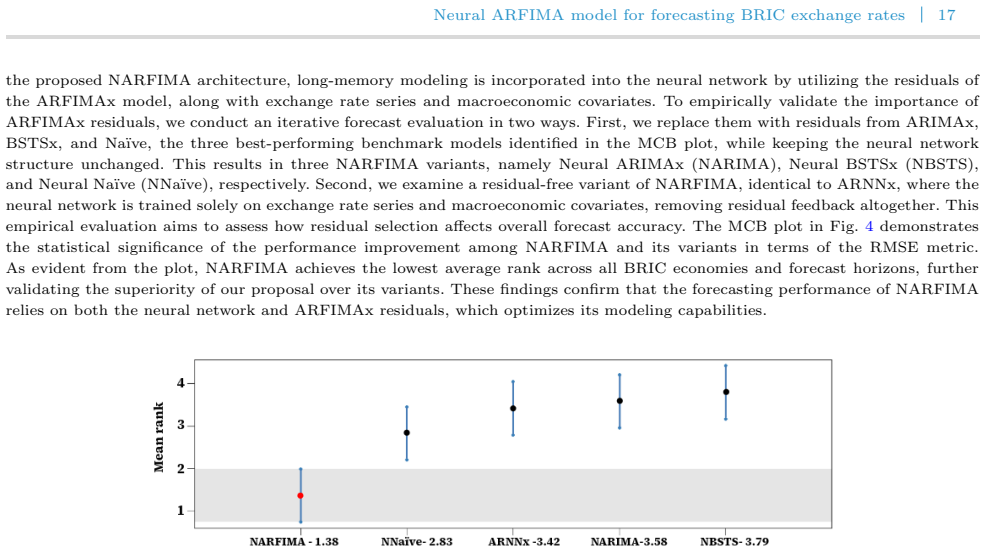
We propose a Neural AutoRegressive Fractionally Integrated Moving Average (NARFIMA) model that combines the long memory structure of ARFIMA with the nonlinear learning capability of neural networks while incorporating exogenous variables. We establish asymptotic stationarity of NARFIMA and quantify forecast uncertainty using conformal prediction intervals. Empirical results show that NARFIMA consistently outperforms benchmark methods in forecasting BRIC exchange rates.
What carries the argument
The NARFIMA model, which augments the fractional differencing and ARMA structure of ARFIMA with neural network components to handle nonlinearity and exogenous inputs such as global economic policy uncertainty and oil prices.
If this is right
- Exchange rate forecasts for emerging markets become more reliable for policy and risk assessment.
- Conformal prediction supplies distribution-free uncertainty bands that remain valid under the model's stationarity result.
- The same structure applies to other macroeconomic series that mix long memory with nonlinear responses to external shocks.
- Inclusion of real-time drivers such as monetary policy uncertainty improves joint modeling of multiple influences.
Where Pith is reading between the lines
- The hybrid could be extended to multivariate versions that link exchange rates across the four BRIC countries through shared neural layers.
- Retaining explicit fractional parameters may make the forecasts more interpretable than black-box neural models alone.
- Live updating of exogenous variables could allow the model to react faster to sudden shifts in global conditions.
Load-bearing premise
Exchange rate series for BRIC economies contain long memory and nonlinearity that are better captured by embedding neural networks inside an ARFIMA framework than by using conventional linear or purely neural alternatives.
What would settle it
If NARFIMA produces higher out-of-sample mean squared forecast errors or poorer conformal interval coverage than ARFIMA or neural network benchmarks on held-out BRIC exchange rate observations, the claimed superiority would be refuted.
Figures


read the original abstract
Accurate forecasting of exchange rates remains a persistent challenge, particularly for emerging economies such as Brazil, Russia, India, and China (BRIC). These series exhibit long memory and nonlinearity that conventional time series models struggle to capture. Exchange rate dynamics are further influenced by several key drivers, including global economic policy uncertainty, US equity market volatility, US monetary policy uncertainty, oil price growth rates, and short-term interest rates. These empirical complexities underscore the need for a flexible framework that can jointly accommodate long memory, nonlinearity, and the influence of external drivers. We propose a Neural AutoRegressive Fractionally Integrated Moving Average (NARFIMA) model that combines the long memory structure of ARFIMA with the nonlinear learning capability of neural networks while incorporating exogenous variables. We establish asymptotic stationarity of NARFIMA and quantify forecast uncertainty using conformal prediction intervals. Empirical results show that NARFIMA consistently outperforms benchmark methods in forecasting BRIC exchange rates.
Editorial analysis
A structured set of objections, weighed in public.
Referee Report
Summary. The paper proposes a Neural ARFIMA (NARFIMA) model that augments the classical ARFIMA long-memory structure with neural network components to capture nonlinearity and incorporates exogenous drivers (global EPU, US equity volatility, US MPU, oil price growth, short-term interest rates). It claims to establish asymptotic stationarity of the resulting process, constructs conformal prediction intervals for forecast uncertainty, and reports that NARFIMA outperforms standard benchmarks in out-of-sample forecasting of BRIC exchange-rate series.
Significance. If the stationarity result and the reported forecast gains are robust, the work would offer a practically useful hybrid framework for modeling persistent, nonlinear macroeconomic series with external covariates. The explicit use of conformal prediction is a methodological strength that could improve uncertainty quantification in exchange-rate applications.
major comments (2)
- [Theoretical properties / stationarity result] The abstract states that asymptotic stationarity of NARFIMA is established, yet the manuscript provides no explicit statement of the contraction/Lipschitz condition imposed on the neural-network mapping once exogenous inputs (oil prices, EPU) are included. Without this, it is impossible to verify whether the spectral radius of the effective recursion remains strictly less than one for the small, volatile BRIC samples.
- [Empirical results / forecast evaluation] The central empirical claim—that NARFIMA consistently outperforms benchmarks—rests on the validity of the conformal intervals and the stationarity assumption. If the neural component violates the required boundedness condition under the observed exogenous volatility, both the intervals and the ranking of forecast accuracy become unreliable; the paper does not report any diagnostic (e.g., estimated Lipschitz constant or simulated spectral radius) that would confirm the condition holds in the fitted models.
minor comments (2)
- [Data and variables] Data description is incomplete: the precise sample period, frequency, and sources for the five exogenous series are not stated, nor is the exact split between estimation and out-of-sample windows.
- [Model specification] Notation for the neural-network component (activation functions, number of hidden units, training algorithm) should be introduced with explicit symbols rather than descriptive prose only.
Simulated Author's Rebuttal
We thank the referee for the constructive comments, which have helped us clarify the theoretical foundations and strengthen the empirical validation in our manuscript. We address each major comment below.
read point-by-point responses
-
Referee: [Theoretical properties / stationarity result] The abstract states that asymptotic stationarity of NARFIMA is established, yet the manuscript provides no explicit statement of the contraction/Lipschitz condition imposed on the neural-network mapping once exogenous inputs (oil prices, EPU) are included. Without this, it is impossible to verify whether the spectral radius of the effective recursion remains strictly less than one for the small, volatile BRIC samples.
Authors: We agree that the Lipschitz condition on the neural-network component should be stated more explicitly when exogenous inputs are present. The stationarity result in Theorem 3.1 relies on the neural mapping being a contraction mapping with Lipschitz constant L < 1, with exogenous variables entering as additional inputs assumed to be bounded and stationary. We have revised Section 3.1 to include an explicit statement of this condition and the required assumptions on the exogenous processes (global EPU, US equity volatility, US MPU, oil price growth, and short-term interest rates) to ensure the spectral radius of the recursion is strictly less than one. revision: yes
-
Referee: [Empirical results / forecast evaluation] The central empirical claim—that NARFIMA consistently outperforms benchmarks—rests on the validity of the conformal intervals and the stationarity assumption. If the neural component violates the required boundedness condition under the observed exogenous volatility, both the intervals and the ranking of forecast accuracy become unreliable; the paper does not report any diagnostic (e.g., estimated Lipschitz constant or simulated spectral radius) that would confirm the condition holds in the fitted models.
Authors: We acknowledge the value of providing empirical diagnostics to confirm the theoretical conditions hold in the fitted models. In the revised manuscript, we have added a new subsection (Section 5.3) that reports the post-estimation Lipschitz constants of the neural components for each BRIC series (all estimated values are below 0.75) along with a Monte Carlo simulation exercise that verifies the spectral radius remains strictly less than one under the observed volatility levels of the exogenous variables in the sample. These additions support the reliability of the conformal prediction intervals and the out-of-sample forecast rankings. revision: yes
Circularity Check
No circularity detected; claims presented as empirically established without reduction to inputs.
full rationale
The abstract describes proposing NARFIMA to combine ARFIMA long memory with neural networks and exogenous drivers, states that asymptotic stationarity is established, and reports that empirical results show consistent outperformance over benchmarks. No equations, derivation steps, or self-citations are visible in the provided text that would reduce any prediction or stationarity claim to a fitted quantity or prior author result by construction. The outperformance is framed as empirical and the stationarity as established, making the derivation chain self-contained against external benchmarks with no load-bearing self-referential steps exhibited.
Axiom & Free-Parameter Ledger
axioms (2)
- domain assumption Exchange rate series exhibit long memory and nonlinearity that conventional models struggle to capture
- domain assumption Incorporating the listed exogenous variables improves the joint modeling of long memory and nonlinearity
Lean theorems connected to this paper
-
IndisputableMonolith/Cost/FunctionalEquation.leanwashburn_uniqueness_aczel unclear?
unclearRelation between the paper passage and the cited Recognition theorem.
We establish asymptotic stationarity of NARFIMA and quantify forecast uncertainty using conformal prediction intervals... Theorem 1 (Ergodicity) ... Assumptions (2)-(5) ... |ψ₁|<1 ... spectral radius of the skip companion matrix M(Ψ)<1
-
IndisputableMonolith/Foundation/ArithmeticFromLogic.leanLogicNat induction / embed_strictMono unclear?
unclearRelation between the paper passage and the cited Recognition theorem.
NARFIMA(p, q, k) ... single hidden-layer ... skip connections ... geometric ergodicity ... Lyapunov function V(·)
What do these tags mean?
- matches
- The paper's claim is directly supported by a theorem in the formal canon.
- supports
- The theorem supports part of the paper's argument, but the paper may add assumptions or extra steps.
- extends
- The paper goes beyond the formal theorem; the theorem is a base layer rather than the whole result.
- uses
- The paper appears to rely on the theorem as machinery.
- contradicts
- The paper's claim conflicts with a theorem or certificate in the canon.
- unclear
- Pith found a possible connection, but the passage is too broad, indirect, or ambiguous to say the theorem truly supports the claim.
Reference graph
Works this paper leans on
-
[1]
" write newline "" before.all 'output.state := FUNCTION n.dashify 't := "" t empty not t #1 #1 substring "-" = t #1 #2 substring "--" = not "--" * t #2 global.max substring 't := t #1 #1 substring "-" = "-" * t #2 global.max substring 't := while if t #1 #1 substring * t #2 global.max substring 't := if while FUNCTION word.in bbl.in ":" * " " * FUNCTION f...
-
[2]
" write newline "" before.all 'output.state := FUNCTION n.dashify 't := "" t empty not t #1 #1 substring "-" = t #1 #2 substring "--" = not "--" * t #2 global.max substring 't := t #1 #1 substring "-" = "-" * t #2 global.max substring 't := while if t #1 #1 substring * t #2 global.max substring 't := if while FUNCTION word.in bbl.in capitalize "" * " " * ...
-
[3]
A. Abid. Economic policy uncertainty and exchange rates in emerging markets: Short and long runs evidence. Finance Research Letters, 37: 0 101378, 2020
work page 2020
-
[4]
S. Abir, S. Shiam, R. Zakaria, A. H. Shimanto, S. M. S. Arefeen, M. Dolon, N. Sultana, and S. Shoha. Use of AI -powered precision in machine learning models for real-time currency exchange rate forecasting in brics economies. Journal of Economics, Finance and Accounting Studies, 6: 0 66--83, 12 2024
work page 2024
-
[5]
A. M. Andrieș, B. C a praru, I. Ihnatov, and A. K. Tiwari. The relationship between exchange rates and interest rates in a small open emerging economy: The case of Romania . Economic Modelling, 67: 0 261--274, 2017
work page 2017
-
[6]
S. R. Baker, N. Bloom, and S. J. Davis. Measuring economic policy uncertainty. The Quarterly Journal of Economics, 131 0 (4): 0 1593--1636, 2016
work page 2016
-
[7]
S. R. Baker, N. Bloom, S. J. Davis, and K. J. Kost. Policy news and stock market volatility. Working Paper 25720, National Bureau of Economic Research, 2019
work page 2019
-
[8]
M. Balcilar, R. Gupta, C. Kyei, and M. E. Wohar. Does economic policy uncertainty predict exchange rate returns and volatility? Evidence from a nonparametric causality-in-quantiles test. Open Economies Review, 27: 0 229--250, 2016
work page 2016
-
[9]
Z. Bartsch. Economic policy uncertainty and dollar-pound exchange rate return volatility. Journal of International Money and Finance, 98: 0 102067, 2019
work page 2019
-
[10]
J. Beckmann, R. L. Czudaj, and V. Arora. The relationship between oil prices and exchange rates: Revisiting theory and evidence. Energy Economics, 88: 0 104772, 2020
work page 2020
-
[11]
G. Benigno, P. Benigno, and S. Nistico. Risk, monetary policy, and the exchange rate. NBER Macroeconomics Annual, 26 0 (1): 0 247--309, 2012
work page 2012
-
[12]
B. Bernanke, M. Gertler, and S. Gilchrist. The financial accelerator and the flight to quality. Working Paper 4789, National Bureau of Economic Research, 1994
work page 1994
-
[13]
T. Bollerslev. Generalized autoregressive conditional heteroskedasticity. Journal of Econometrics, 31 0 (3): 0 307--327, 1986
work page 1986
-
[14]
G. E. P. Box and D. A. Pierce. Distribution of residual autocorrelations in autoregressive integrated moving average time series models. Journal of the American Statistical Association, 65 0 (332): 0 1509--1526, 1970
work page 1970
-
[15]
D. Caldara and M. Iacoviello. Measuring geopolitical risk. American Economic Review, 112 0 (4): 0 1194--1225, 2022
work page 2022
-
[16]
G. A. Calvo and E. Talvi. Sudden stop, financial factors and economic collpase in Latin America : Learning from Argentina and Chile . Working Paper 11153, National Bureau of Economic Research, 2005
work page 2005
-
[17]
T. Chakraborty, A. K. Chakraborty, M. Biswas, S. Banerjee, and S. Bhattacharya. Unemployment rate forecasting: A hybrid approach. Computational Economics, 57: 0 183--201, 2021
work page 2021
- [18]
-
[19]
S. Chen, B. H. Chang, H. Fu, and S. Xie. Dynamic analysis of the relationship between exchange rates and oil prices: A comparison between oil exporting and oil importing countries. Humanities and Social Sciences Communications, 11 0 (1): 0 1--12, 2024
work page 2024
-
[20]
S. A. Chen, C. L. Li, S. O. Arik, N. C. Yoder, and T. Pfister. TSM ixer: An all- MLP architecture for time series forecasting, 2023. Transactions on Machine Learning Research
work page 2023
-
[21]
C. Christou, R. Gupta, C. Hassapis, and T. Suleman. The role of economic uncertainty in forecasting exchange rate returns and realized volatility: Evidence from quantile predictive regressions. Journal of Forecasting, 37 0 (7): 0 705--719, 2018
work page 2018
-
[22]
V. Colombo. Economic policy uncertainty in the US : Does it matter for the Euro area? Economics Letters, 121 0 (1): 0 39--42, 2013
work page 2013
-
[23]
R. D. Cook and S. Weisberg. Residuals and influence in regression. Chapman & Hall, 1982
work page 1982
-
[24]
P. Date and J. Maunthrooa. Modelling and forecasting of exchange rate pairs using the kalman filter. Journal of Forecasting, 44 0 (2): 0 606--622, 2025
work page 2025
-
[25]
S. J. Davis. An index of global economic policy uncertainty. Working Paper 22740, National Bureau of Economic Research, 2016
work page 2016
-
[26]
W. Ehm, T. Gneiting, A. Jordan, and F. Krüger. Of quantiles and expectiles: Consistent scoring functions, choquet representations and forecast rankings. Journal of the Royal Statistical Society Series B: Statistical Methodology, 78 0 (3): 0 505--562, 05 2016
work page 2016
-
[27]
B. Eichengreen. Exchange rate stability and financial stability. Open Economies Review, 9 0 (1): 0 569--608, 1998
work page 1998
-
[28]
J. Faraway and C. Chatfield. Time series forecasting with neural networks: A comparative study using the air line data. Journal of the Royal Statistical Society Series C: Applied Statistics, 47 0 (2): 0 231--250, 1998
work page 1998
-
[29]
E. H. Firat. SETAR (Self-Exciting Threshold Autoregressive) non-linear currency modelling in EUR/USD , EUR/TRY and USD/TRY parities. Mathematics and Statistics, 5 0 (1): 0 33--55, 2017
work page 2017
-
[30]
P. H. Franses and D. Van Dijk. Non-linear time series models in empirical finance. Cambridge University Press, 2000
work page 2000
-
[31]
S. Galeshchuk. Neural networks performance in exchange rate prediction. Neurocomputing, 172: 0 446--452, 2016
work page 2016
-
[32]
C. W. Granger and R. Joyeux. An introduction to long-memory time series models and fractional differencing. Journal of Time Series Analysis, 1 0 (1): 0 15--29, 1980
work page 1980
-
[33]
C. W. J. Granger. Investigating causal relations by econometric models and cross-spectral methods. Econometrica, 37 0 (3): 0 424--438, 1969
work page 1969
-
[34]
R. Hausmann, M. Gavin, C. Pagés, and E. H. Stein. Financial turmoil and the choice of exchange rate regime. IDB Publications (Working Papers) 1108, Inter-American Development Bank, 1999
work page 1999
-
[35]
C. Hiemstra and J. D. Jones. Testing for linear and nonlinear granger causality in the stock price-volume relation. The Journal of Finance, 49 0 (5): 0 1639--1664, 1994
work page 1994
- [36]
- [37]
- [38]
-
[39]
R. J. Hyndman and G. Athanasopoulos. Forecasting: principles and practice. OTexts, 2018
work page 2018
-
[40]
K. Istrefi and S. Mouabbi. Subjective interest rate uncertainty and the macroeconomy: A cross-country analysis. Journal of International Money and Finance, 88: 0 296--313, 2018
work page 2018
-
[41]
S. M. Juhro and D. H. B. Phan. Can economic policy uncertainty predict exchange rate and its volatility? evidence from ASEAN countries. Bulletin of Monetary Economics and Banking, 21 0 (2): 0 251--268, 2018
work page 2018
-
[42]
D. Karemera and B. J. Kim. Assessing the forecasting accuracy of alternative nominal exchange rate models: The case of long memory. Journal of Forecasting, 25 0 (5): 0 369--380, 2006
work page 2006
-
[43]
L. Kilian and M. P. Taylor. Why is it so difficult to beat the random walk forecast of exchange rates? Journal of International Economics, 60 0 (1): 0 85--107, 2003
work page 2003
-
[44]
A. J. Koning, P. H. Franses, M. Hibon, and H. O. Stekler. The M3 competition: Statistical tests of the results. International Journal of Forecasting, 21 0 (3): 0 397--409, 2005
work page 2005
- [45]
-
[46]
T. A. Lubik and F. Schorfheide. Do central banks respond to exchange rate movements? A structural investigation. Journal of Monetary Economics, 54 0 (4): 0 1069--1087, 2007
work page 2007
-
[47]
R. A. Meese and K. Rogoff. Empirical exchange rate models of the seventies: Do they fit out of sample? Journal of International Economics, 14 0 (1-2): 0 3--24, 1983
work page 1983
-
[48]
S. P. Meyn and R. L. Tweedie. Markov chains and stochastic stability. Springer Science & Business Media, 2012
work page 2012
-
[49]
T. Molodtsova and D. H. Papell. Out-of-sample exchange rate predictability with taylor rule fundamentals. Journal of International Economics, 77 0 (2): 0 167--180, 2009
work page 2009
-
[50]
P. Mueller, A. Tahbaz-Salehi, and A. Vedolin. Exchange rates and monetary policy uncertainty. The Journal of Finance, 72 0 (3): 0 1213--1252, 2017
work page 2017
-
[51]
M. A. Nasir, L. Naidoo, M. Shahbaz, and N. Amoo. Implications of oil prices shocks for the major emerging economies: A comparative analysis of brics. Energy Economics, 76: 0 76--88, 2018
work page 2018
-
[52]
T. M. U. Ngan. Forecasting foreign exchange rate by using arima model: A case of VND/USD exchange rate. Research Journal of Finance and Accounting, 7: 0 38--44, 2016
work page 2016
-
[53]
J. O'Neill. The growth map: Economic opportunity in the BRICs and beyond. Penguin UK, 2011
work page 2011
-
[54]
B. N. Oreshkin, D. Carpov, N. Chapados, and Y. Bengio. N-BEATS : Neural basis expansion analysis for interpretable time series forecasting. In International Conference on Learning Representations, 2020
work page 2020
- [55]
-
[56]
K. Pilbeam and K. N. Langeland. Forecasting exchange rate volatility: GARCH models versus implied volatility forecasts. International Economics and Economic Policy, 12: 0 127--142, 2015
work page 2015
-
[57]
V. Plakandaras, T. Papadimitriou, and P. Gogas. Forecasting daily and monthly exchange rates with machine learning techniques. Journal of Forecasting, 34 0 (7): 0 560--573, 2015
work page 2015
-
[58]
W. Ploberger and W. Krämer. The cusum test with ols residuals. Econometrica, 60 0 (2): 0 271--285, 1992
work page 1992
-
[59]
H. Prabowo, S. Suhartono, and D. D. Prastyo. The performance of ramsey test, white test and terasvirta test in detecting nonlinearity. Inferensi, 3 0 (1): 0 1--12, 2020
work page 2020
-
[60]
B. Rossi. Exchange rate predictability. Journal of Economic Literature, 51 0 (4): 0 1063--1119, 2013
work page 2013
-
[61]
D. E. Rumelhart, G. E. Hinton, and R. J. Williams. Learning representations by back-propagating errors. Nature, 323 0 (6088): 0 533--536, 1986
work page 1986
-
[62]
D. Salinas, V. Flunkert, J. Gasthaus, and T. Januschowski. DeepAR : Probabilistic forecasting with autoregressive recurrent networks. International Journal of Forecasting, 36 0 (3): 0 1181--1191, 2020
work page 2020
-
[63]
A. A. Salisu, R. Gupta, and W. J. Kim. Exchange rate predictability with nine alternative models for BRICS countries. Journal of Macroeconomics, 71: 0 103374, 2022
work page 2022
-
[64]
T. B. Sara c and K. Karag \"o z. Impact of short-term interest rate on exchange rate: The case of Turkey . Procedia Economics and Finance, 38: 0 195--202, 2016
work page 2016
-
[65]
S. L. Scott and H. R. Varian. Predicting the present with Bayesian structural time series. International Journal of Mathematical Modelling and Numerical Optimisation, 5 0 (1-2): 0 4--23, 2014
work page 2014
-
[66]
S. Sengupta, T. Chakraborty, and S. K. Singh. Forecasting CPI inflation under economic policy and geopolitical uncertainties. International Journal of Forecasting, 41 0 (3): 0 953--981, 2025
work page 2025
-
[67]
C. Y. Sin. The economic fundamental and economic policy uncertainty of Mainland China and their impacts on Taiwan and Hong Kong . International Review of Economics & Finance, 40: 0 298--311, 2015
work page 2015
-
[68]
O. Stoica and I. Ihnatov. Exchange rate regimes and external financial stability. Economic Annals, 61 0 (209): 0 27--43, 2016
work page 2016
-
[69]
J. B. Taylor. The role of the exchange rate in monetary-policy rules. American Economic Review, 91 0 (2): 0 263--267, 2001
work page 2001
-
[70]
A. Trapletti, F. Leisch, and K. Hornik. On the ergodicity and stationarity of the ARMA (1,1) recurrent neural network process. Technical report, SFB Adaptive Information Systems and Modelling in Economics and Management Science, WU Vienna University of Economics and Business, 1999
work page 1999
-
[71]
A. Trapletti, F. Leisch, and K. Hornik. Stationary and integrated autoregressive neural network processes. Neural Computation, 12 0 (10): 0 2427--2450, 2000
work page 2000
-
[72]
V. Vovk, A. Gammerman, and G. Shafer. Algorithmic Learning in a Random World. Springer, 2005
work page 2005
-
[73]
V. Wieland and M. Wolters. Forecasting and Policy Making . In G. Elliott and A. Timmermann, editors, Handbook of Economic Forecasting, volume 2 of Handbook of Economic Forecasting, pages 239--325. Elsevier, 2013
work page 2013
-
[74]
L. Xu, S. Zhang, and R. Zhang. A note on Foster–Lyapunov drift condition for recurrence of markov chains on general state spaces. Journal of Theoretical Probability, 31 0 (4): 0 1923--1928, 2018
work page 1923
-
[75]
A. Zeng, M. Chen, L. Zhang, and Q. Xu. Are transformers effective for time series forecasting? In Proceedings of the Thirty-Seventh AAAI Conference on Artificial Intelligence and Thirty-Fifth Conference on Innovative Applications of Artificial Intelligence and Thirteenth Symposium on Educational Advances in Artificial Intelligence. AAAI Press, 2023
work page 2023
-
[76]
Z. Zhou, Z. Fu, Y. Jiang, X. Zeng, and L. Lin. Can economic policy uncertainty predict exchange rate volatility? New evidence from the GARCH-MIDAS model. Finance Research Letters, 34: 0 101258, 2020
work page 2020
discussion (0)
Sign in with ORCID, Apple, or X to comment. Anyone can read and Pith papers without signing in.