Entanglement Structure Certification Based on Energy-Restricted State Discrimination
Pith reviewed 2026-05-18 18:10 UTC · model grok-4.3
The pith
A state discrimination game certifies the structure of multipartite entanglement in energy-restricted ensembles.
A machine-rendered reading of the paper's core claim, the machinery that carries it, and where it could break.
Core claim
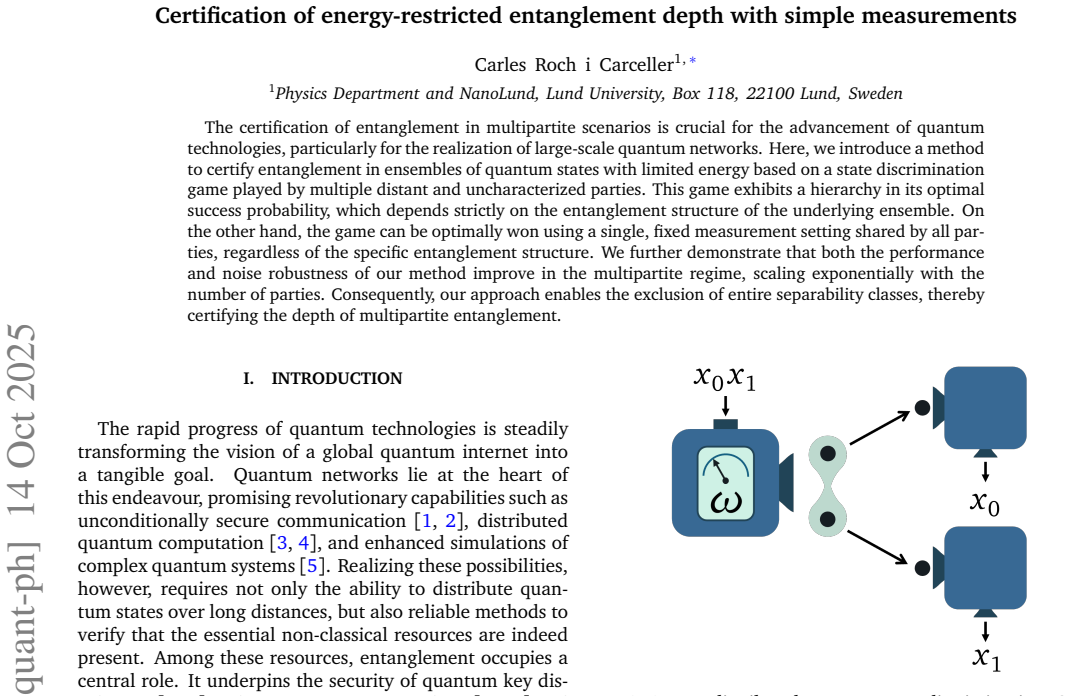
The optimal success probability of this game forms a strict hierarchy, determined by the number of bipartitions and the size of the entangled subsets in each state of the underlying ensemble. The game can be optimally won using a single, fixed measurement setting shared by all parties, regardless of the specific entanglement structure. Both the performance and noise robustness of the method improve in the multipartite regime, scaling exponentially with the number of parties.
What carries the argument
The energy-restricted state discrimination game played by multiple uncharacterized parties, whose optimal success probability encodes the number and size of bipartitions in the entanglement structure.
If this is right
- Success probabilities strictly order states according to their bipartition count and entangled subset sizes.
- One shared measurement setting suffices for optimal performance across all possible entanglement structures.
- Both discrimination performance and noise tolerance scale exponentially with the number of parties.
- Observed success rates allow entire structural classes of multipartite entanglement to be excluded.
Where Pith is reading between the lines
- The fixed-measurement feature could simplify certification protocols in distributed quantum networks where adaptive measurements are costly to coordinate.
- Similar discrimination games might be constructed for other restricted resources, such as bounded coherence or bounded purity, to certify additional quantum features.
- Numerical checks on concrete low-energy ensembles, for example ground states of local Hamiltonians, would provide direct tests of the exponential scaling.
Load-bearing premise
The states come from an ensemble with a well-defined energy restriction, and the parties can carry out the discrimination task using only local uncharacterized measurements.
What would settle it
An energy-restricted ensemble in which the optimal success probabilities fail to form a strict hierarchy across different bipartition numbers or subset sizes, or in which optimal play requires different measurement settings for different structures, would falsify the claim.
Figures


read the original abstract
The certification of entanglement in multipartite scenarios is crucial for the advancement of quantum technologies, particularly for the realization of large-scale quantum networks. Here, we introduce a method to certify the structure of the entanglement in ensembles of quantum states with limited energy based on a state discrimination game played by multiple distant and uncharacterized parties. The optimal success probability of this game forms a strict hierarchy, determined by the number of bipartitions and the size of the entangled subsets in each state of the underlying ensemble. The game can be optimally won using a single, fixed measurement setting shared by all parties, regardless of the specific entanglement structure. We further demonstrate that both the performance and noise robustness of our method improve in the multipartite regime, scaling exponentially with the number of parties. Consequently, our approach enables the exclusion of entire structural classes, thereby certifying the structure of multipartite entanglement.
Editorial analysis
A structured set of objections, weighed in public.
Referee Report
Summary. The manuscript introduces a state discrimination game for certifying the entanglement structure of ensembles of multipartite quantum states subject to an energy restriction. The central claim is that the optimal success probability of this game, played by distant uncharacterized parties, forms a strict hierarchy determined by the number of bipartitions and the sizes of the entangled subsets in the ensemble states. A single fixed measurement setting is asserted to be optimal regardless of the specific entanglement structure, with both performance and noise robustness improving exponentially with the number of parties, enabling exclusion of entire structural classes.
Significance. If the hierarchy and single-measurement optimality hold under the stated energy restriction, the method offers a practical, scalable tool for multipartite entanglement certification in quantum networks without requiring full state tomography or characterized measurements. The exponential scaling with party number is a notable potential strength for large-scale systems.
major comments (2)
- [Energy restriction and ensemble definition] The strict hierarchy of optimal success probabilities (abstract and main claim) is derived under an energy restriction on the ensemble. If this restriction is only a global bound on total energy rather than a per-state support or projector constraint, states with different entanglement structures can be selected inside the same energy ball to equalize or invert success probabilities, violating strictness. The manuscript should explicitly define the energy restriction (e.g., in the section introducing the ensemble and game) and prove that the ordering remains strict inside the restricted set, including showing that no equalizing states exist.
- [Optimal measurement and success probability derivation] The optimality of a single fixed measurement for all entanglement structures is asserted but requires explicit verification. The derivation of this optimality (likely in the section on the discrimination game and optimal strategy) should include a proof that the same measurement achieves the optimal probability across the hierarchy, and that this holds only inside the energy-restricted set.
minor comments (2)
- [Abstract] The abstract states the hierarchy and exponential scaling but supplies no explicit derivations, proofs, or numerical checks; adding a brief pointer to the relevant theorem or section would improve readability.
- [Main text] Notation for bipartitions and entangled subset sizes should be defined consistently when first introduced to avoid ambiguity in the hierarchy description.
Simulated Author's Rebuttal
We thank the referee for the careful reading of our manuscript and the constructive comments. We address each major comment below. Where appropriate, we have revised the manuscript to incorporate clarifications and additional proofs.
read point-by-point responses
-
Referee: [Energy restriction and ensemble definition] The strict hierarchy of optimal success probabilities (abstract and main claim) is derived under an energy restriction on the ensemble. If this restriction is only a global bound on total energy rather than a per-state support or projector constraint, states with different entanglement structures can be selected inside the same energy ball to equalize or invert success probabilities, violating strictness. The manuscript should explicitly define the energy restriction (e.g., in the section introducing the ensemble and game) and prove that the ordering remains strict inside the restricted set, including showing that no equalizing states exist.
Authors: We agree that explicit definition and a proof of strictness are important for clarity. In the manuscript, the energy restriction is introduced as a per-state constraint: each state ρ_i in the ensemble satisfies Tr(ρ_i H) ≤ E, where H is a fixed local energy operator (e.g., the number operator on each mode). This appears in the section defining the ensemble and game. To strengthen the presentation, the revised manuscript adds an explicit statement of this per-state bound together with a proof that the hierarchy of optimal success probabilities remains strict inside the restricted set. The proof proceeds by contradiction: suppose a state with fewer bipartitions achieves the success probability of one with more bipartitions; the energy bound then forces an overlap that violates the optimality condition derived from the discrimination game, showing no equalizing states exist within the ball. This establishes the claimed ordering. revision: yes
-
Referee: [Optimal measurement and success probability derivation] The optimality of a single fixed measurement for all entanglement structures is asserted but requires explicit verification. The derivation of this optimality (likely in the section on the discrimination game and optimal strategy) should include a proof that the same measurement achieves the optimal probability across the hierarchy, and that this holds only inside the energy-restricted set.
Authors: We acknowledge that the optimality claim benefits from a self-contained proof. The original derivation in the discrimination-game section shows that a single fixed measurement (the energy-restricted Helstrom measurement on the effective states) attains the optimal success probability for every structure in the hierarchy. In the revision we expand this section with a formal proof: we first derive the optimal success probability under the per-state energy constraint, then demonstrate that the same measurement operator is optimal for all structures because the energy ball projects the states onto a common effective subspace where the distinguishing measurement is independent of the precise bipartition count. We further prove that this single-measurement optimality fails to hold without the energy restriction, as unrestricted states with different structures can require distinct measurements. The revised text includes these steps explicitly. revision: yes
Circularity Check
No circularity: hierarchy emerges directly from game definition and energy constraint
full rationale
The paper defines a multipartite state discrimination game under an energy restriction on the ensemble and derives that optimal success probability forms a strict hierarchy ordered by number of bipartitions and entangled subset sizes. This ordering is presented as a direct consequence of the game rules and the support constraint on states, with a single fixed measurement shown to be optimal inside that set. No equations reduce a claimed prediction to a fitted parameter by construction, no self-citation is invoked as the sole justification for a uniqueness or optimality result, and no ansatz is smuggled via prior work. The exponential scaling with party number and the ability to exclude structural classes follow from the same game performance metric without tautological redefinition. The derivation is therefore self-contained against the stated assumptions.
Axiom & Free-Parameter Ledger
axioms (2)
- standard math Quantum states obey the standard rules of quantum mechanics including the Born rule for measurement probabilities.
- domain assumption Energy restriction defines a valid convex set of allowed states for the ensemble.
Reference graph
Works this paper leans on
-
[1]
author author C. H. \ Bennett ,\ title title Quantum cryptography using any two nonorthogonal states ,\ https://doi.org/10.1103/PhysRevLett.68.3121 journal journal Phys. Rev. Lett. \ volume 68 ,\ pages 3121 ( year 1992 ) NoStop
-
[2]
author author A. K. \ Ekert ,\ title title Quantum cryptography based on bell's theorem ,\ https://doi.org/10.1103/PhysRevLett.67.661 journal journal Phys. Rev. Lett. \ volume 67 ,\ pages 661 ( year 1991 ) NoStop
-
[3]
author author J. I. \ Cirac , author A. K. \ Ekert , author S. F. \ Huelga ,\ and\ author C. Macchiavello ,\ title title Distributed quantum computation over noisy channels ,\ https://doi.org/10.1103/PhysRevA.59.4249 journal journal Phys. Rev. A \ volume 59 ,\ pages 4249 ( year 1999 ) NoStop
-
[4]
author author H. J. \ Kimble ,\ title title The quantum internet ,\ https://doi.org/10.1038/nature07127 journal journal Nature \ volume 453 ,\ pages 1023 ( year 2008 ) NoStop
-
[5]
author author I. M. \ Georgescu , author S. Ashhab ,\ and\ author F. Nori ,\ title title Quantum simulation ,\ https://doi.org/10.1103/RevModPhys.86.153 journal journal Rev. Mod. Phys. \ volume 86 ,\ pages 153 ( year 2014 ) NoStop
work page internal anchor Pith review doi:10.1103/revmodphys.86.153 2014
-
[6]
author author N. Gisin , author G. Ribordy , author W. Tittel ,\ and\ author H. Zbinden ,\ title title Quantum cryptography ,\ https://doi.org/10.1103/RevModPhys.74.145 journal journal Rev. Mod. Phys. \ volume 74 ,\ pages 145 ( year 2002 ) NoStop
-
[7]
author author V. Scarani , author H. Bechmann-Pasquinucci , author N. J. \ Cerf , author M. Du s s ek , author N. L\"utkenhaus ,\ and\ author M. Peev ,\ title title The security of practical quantum key distribution ,\ https://doi.org/10.1103/RevModPhys.81.1301 journal journal Rev. Mod. Phys. \ volume 81 ,\ pages 1301 ( year 2009 ) NoStop
-
[8]
author author V. Giovannetti , author S. Lloyd ,\ and\ author L. Maccone ,\ title title Quantum metrology ,\ https://doi.org/10.1103/PhysRevLett.96.010401 journal journal Phys. Rev. Lett. \ volume 96 ,\ pages 010401 ( year 2006 ) NoStop
-
[9]
author author S. Dooley , author S. Pappalardi ,\ and\ author J. Goold ,\ title title Entanglement enhanced metrology with quantum many-body scars ,\ https://doi.org/10.1103/PhysRevB.107.035123 journal journal Phys. Rev. B \ volume 107 ,\ pages 035123 ( year 2023 ) NoStop
-
[10]
author author J. Huang , author M. Zhuang ,\ and\ author C. Lee ,\ title title Entanglement-enhanced quantum metrology: From standard quantum limit to heisenberg limit ,\ https://doi.org/10.1063/5.0204102 journal journal Applied Physics Reviews \ volume 11 ,\ pages 031302 ( year 2024 ) NoStop
-
[11]
author author S. Kuriyattil , author P. M. \ Poggi , author J. D. \ Pritchard , author J. Kombe ,\ and\ author A. J. \ Daley ,\ title title Entangled states from sparsely coupled spins for metrology with neutral atoms ,\ https://doi.org/10.1103/h6sr-yxgw journal journal Phys. Rev. Lett. \ volume 134 ,\ pages 240801 ( year 2025 ) NoStop
-
[12]
author author R. Cleve , author W. van Dam , author M. Nielsen ,\ and\ author A. Tapp ,\ title title Quantum entanglement and the communication complexity of the inner product function ,\ in\ @noop booktitle Quantum Computing and Quantum Communications ,\ editor edited by\ editor C. P. \ Williams \ ( publisher Springer Berlin Heidelberg ,\ address Berlin,...
work page 1999
-
[13]
author author H. Buhrman , author R. Cleve ,\ and\ author W. van Dam ,\ title title Quantum entanglement and communication complexity ,\ https://doi.org/10.1137/S0097539797324886 journal journal SIAM Journal on Computing \ volume 30 ,\ pages 1829 ( year 2001 ) ,\ https://arxiv.org/abs/https://doi.org/10.1137/S0097539797324886 https://doi.org/10.1137/S0097...
-
[14]
author author G. Brassard ,\ title title Quantum communication complexity ,\ https://doi.org/10.1023/A:1026009100467 journal journal Foundations of Physics \ volume 33 ,\ pages 1593 ( year 2003 ) NoStop
-
[15]
author author i. c. v. \ Brukner , author M. Z \. Z ukowski ,\ and\ author A. Zeilinger ,\ title title Quantum communication complexity protocol with two entangled qutrits ,\ https://doi.org/10.1103/PhysRevLett.89.197901 journal journal Phys. Rev. Lett. \ volume 89 ,\ pages 197901 ( year 2002 ) NoStop
-
[16]
author author A. S. \ S rensen \ and\ author K. M lmer ,\ title title Entanglement and extreme spin squeezing ,\ https://doi.org/10.1103/PhysRevLett.86.4431 journal journal Phys. Rev. Lett. \ volume 86 ,\ pages 4431 ( year 2001 ) NoStop
-
[17]
author author O. Gühne , author G. Tóth ,\ and\ author H. J. \ Briegel ,\ title title Multipartite entanglement in spin chains ,\ https://doi.org/10.1088/1367-2630/7/1/229 journal journal New Journal of Physics \ volume 7 ,\ pages 229 ( year 2005 ) NoStop
-
[18]
author author B. L\"ucke , author J. Peise , author G. Vitagliano , author J. Arlt , author L. Santos , author G. T\'oth ,\ and\ author C. Klempt ,\ title title Detecting multiparticle entanglement of dicke states ,\ https://doi.org/10.1103/PhysRevLett.112.155304 journal journal Phys. Rev. Lett. \ volume 112 ,\ pages 155304 ( year 2014 ) NoStop
-
[19]
author author M. Seevinck \ and\ author J. Uffink ,\ title title Sufficient conditions for three-particle entanglement and their tests in recent experiments ,\ https://doi.org/10.1103/PhysRevA.65.012107 journal journal Phys. Rev. A \ volume 65 ,\ pages 012107 ( year 2001 ) NoStop
-
[20]
author author O. Gühne \ and\ author G. Tóth ,\ title title Entanglement detection ,\ https://doi.org/https://doi.org/10.1016/j.physrep.2009.02.004 journal journal Physics Reports \ volume 474 ,\ pages 1 ( year 2009 ) NoStop
-
[21]
author author O. Gühne \ and\ author M. Seevinck ,\ title title Separability criteria for genuine multiparticle entanglement ,\ https://doi.org/10.1088/1367-2630/12/5/053002 journal journal New Journal of Physics \ volume 12 ,\ pages 053002 ( year 2010 ) NoStop
-
[22]
author author M. Huber , author F. Mintert , author A. Gabriel ,\ and\ author B. C. \ Hiesmayr ,\ title title Detection of high-dimensional genuine multipartite entanglement of mixed states ,\ https://doi.org/10.1103/PhysRevLett.104.210501 journal journal Phys. Rev. Lett. \ volume 104 ,\ pages 210501 ( year 2010 ) NoStop
-
[23]
author author B. Jungnitsch , author T. Moroder ,\ and\ author O. G\"uhne ,\ title title Taming multiparticle entanglement ,\ https://doi.org/10.1103/PhysRevLett.106.190502 journal journal Phys. Rev. Lett. \ volume 106 ,\ pages 190502 ( year 2011 ) NoStop
-
[24]
author author M. Huber , author P. Erker , author H. Schimpf , author A. Gabriel ,\ and\ author B. Hiesmayr ,\ title title Experimentally feasible set of criteria detecting genuine multipartite entanglement in n -qubit dicke states and in higher-dimensional systems ,\ https://doi.org/10.1103/PhysRevA.83.040301 journal journal Phys. Rev. A \ volume 83 ,\ p...
-
[25]
author author J.-D. \ Bancal , author N. Gisin , author Y.-C. \ Liang ,\ and\ author S. Pironio ,\ title title Device-independent witnesses of genuine multipartite entanglement ,\ https://doi.org/10.1103/PhysRevLett.106.250404 journal journal Phys. Rev. Lett. \ volume 106 ,\ pages 250404 ( year 2011 ) NoStop
-
[26]
author author T. Moroder , author J.-D. \ Bancal , author Y.-C. \ Liang , author M. Hofmann ,\ and\ author O. G\"uhne ,\ title title Device-independent entanglement quantification and related applications ,\ https://doi.org/10.1103/PhysRevLett.111.030501 journal journal Phys. Rev. Lett. \ volume 111 ,\ pages 030501 ( year 2013 ) NoStop
-
[27]
author author Y.-C. \ Liang , author D. Rosset , author J.-D. \ Bancal , author G. P\"utz , author T. J. \ Barnea ,\ and\ author N. Gisin ,\ title title Family of bell-like inequalities as device-independent witnesses for entanglement depth ,\ https://doi.org/10.1103/PhysRevLett.114.190401 journal journal Phys. Rev. Lett. \ volume 114 ,\ pages 190401 ( ye...
-
[28]
author author A. Aloy , author J. Tura , author F. Baccari , author A. Ac\' n , author M. Lewenstein ,\ and\ author R. Augusiak ,\ title title Device-independent witnesses of entanglement depth from two-body correlators ,\ https://doi.org/10.1103/PhysRevLett.123.100507 journal journal Phys. Rev. Lett. \ volume 123 ,\ pages 100507 ( year 2019 ) NoStop
-
[29]
author author A. Tavakoli , author A. A. \ Abbott , author M.-O. \ Renou , author N. Gisin ,\ and\ author N. Brunner ,\ title title Semi-device-independent characterization of multipartite entanglement of states and measurements ,\ https://doi.org/10.1103/PhysRevA.98.052333 journal journal Phys. Rev. A \ volume 98 ,\ pages 052333 ( year 2018 ) NoStop
-
[30]
author author G. Moreno , author R. Nery , author C. de Gois , author R. Rabelo ,\ and\ author R. Chaves ,\ title title Semi-device-independent certification of entanglement in superdense coding ,\ https://doi.org/10.1103/PhysRevA.103.022426 journal journal Phys. Rev. A \ volume 103 ,\ pages 022426 ( year 2021 ) NoStop
-
[31]
author author C. Reimer , author L. Caspani , author M. Clerici , author M. Ferrera , author M. Kues , author M. Peccianti , author A. Pasquazi , author L. Razzari , author B. E. \ Little , author S. T. \ Chu , author D. J. \ Moss ,\ and\ author R. Morandotti ,\ title title Integrated frequency comb source of heralded single photons ,\ https://doi.org/10....
-
[32]
author author F. Mazeas , author M. Traetta , author M. Bentivegna , author F. Kaiser , author D. Aktas , author W. Zhang , author C. A. \ Ramos , author L. A. \ Ngah , author T. Lunghi , author E. Picholle , author N. Belabas-Plougonven , author X. L. \ Roux , author E. Cassan , author D. Marris-Morini , author L. Vivien , author G. Sauder , author L. La...
-
[33]
author author A. Martin , author T. Guerreiro , author A. Tiranov , author S. Designolle , author F. Fr\"owis , author N. Brunner , author M. Huber ,\ and\ author N. Gisin ,\ title title Quantifying photonic high-dimensional entanglement ,\ https://doi.org/10.1103/PhysRevLett.118.110501 journal journal Phys. Rev. Lett. \ volume 118 ,\ pages 110501 ( year ...
-
[34]
author author W. Wen , author Z. Chen , author L. Lu , author W. Yan , author W. Xue , author P. Zhang , author Y. Lu , author S. Zhu ,\ and\ author X.-s. \ Ma ,\ title title Realizing an entanglement-based multiuser quantum network with integrated photonics ,\ https://doi.org/10.1103/PhysRevApplied.18.024059 journal journal Phys. Rev. Appl. \ volume 18 ,...
-
[35]
author author W.-T. \ Kao , author C.-Y. \ Huang , author T.-J. \ Tsai , author S.-H. \ Chen , author S.-Y. \ Sun , author Y.-C. \ Li , author T.-L. \ Liao , author C.-S. \ Chuu , author H. Lu ,\ and\ author C.-M. \ Li ,\ title title Scalable determination of multipartite entanglement in quantum networks ,\ https://doi.org/10.1038/s41534-024-00867-0 journ...
-
[36]
author author T. Van Himbeeck , author E. Woodhead , author N. J. \ Cerf , author R. Garc \' i a-Patr \' o n ,\ and\ author S. Pironio ,\ title title Semi-device-independent framework based on natural physical assumptions ,\ https://doi.org/10.22331/q-2017-11-18-33 journal journal Quantum \ volume 1 ,\ pages 33 ( year 2017 ) NoStop
-
[37]
author author J. Pauwels , author S. Pironio ,\ and\ author A. Tavakoli ,\ title title Information capacity of quantum communication under natural physical assumptions ,\ https://doi.org/10.22331/q-2025-02-18-1637 journal journal Quantum \ volume 9 ,\ pages 1637 ( year 2025 ) NoStop
-
[38]
Roch i Carceller \ and\ author A
author author C. Roch i Carceller \ and\ author A. Bernal ,\ title title Global restrictions under local state discrimination ,\ https://doi.org/10.1103/PhysRevA.111.042422 journal journal Phys. Rev. A \ volume 111 ,\ pages 042422 ( year 2025 ) NoStop
-
[39]
author author K. Chen \ and\ author L.-A. \ Wu ,\ title title A matrix realignment method for recognizing entanglement ,\ @noop journal journal Quantum Info. Comput. \ volume 3 ,\ pages 193–202 ( year 2003 ) NoStop
work page 2003
-
[40]
author author O. Rudolph ,\ title title Further results on the cross norm criterion for separability ,\ https://doi.org/10.1007/s11128-005-5664-1 journal journal Quantum Information Processing \ volume 4 ,\ pages 219 ( year 2005 ) NoStop
-
[41]
author author M. D. \ Krein , M. ,\ title title On extreme points of regular convex sets ,\ http://eudml.org/doc/219061 journal journal Studia Mathematica \ volume 9 ,\ pages 133 ( year 1940 ) NoStop
work page 1940
-
[42]
author author R. T. \ Rockafellar ,\ @noop title Convex Analysis \ ( publisher Princeton University Press ,\ address Princeton, NJ ,\ year 1970 ) NoStop
work page 1970
-
[43]
author author M. A. \ Nielsen \ and\ author I. L. \ Chuang ,\ @noop title Quantum Computation and Quantum Information \ ( publisher Cambridge University Press ,\ address Cambridge, UK ,\ year 2000 ) NoStop
work page 2000
-
[44]
author author G. Cobucci \ and\ author A. Tavakoli ,\ title title Detecting the dimensionality of genuine multiparticle entanglement ,\ https://doi.org/10.1126/sciadv.adq4467 journal journal Science Advances \ volume 10 ,\ pages eadq4467 ( year 2024 ) ,\ https://arxiv.org/abs/https://www.science.org/doi/pdf/10.1126/sciadv.adq4467 https://www.science.org/d...
discussion (0)
Sign in with ORCID, Apple, or X to comment. Anyone can read and Pith papers without signing in.