REVIEW 3 major objections 4 minor 19 references
Multimode Photon-Photon Coupling
T0 review · 3 major / 4 minor · reviewed 2026-08-04 · deepseek-v4-flash
Pith's one-line read Three photon modes in a planar CSRR-microstrip system exhibit strong coupling, with level repulsion in one size range and level attraction in another, according to the paper's simulations and coupled-mode fits.
desk verdict Three-mode CSRR simulations with a fitted coupled-oscillator model, but the 'experimental validation' in the abstract and conclusion doesn't exist—only CST simulations. read the letter →
The pith
A machine-rendered reading of the paper's core claim, the machinery that carries it, and where it could break.
The reading
What carries the argument
Complementary split-ring resonators (CSRRs): slots etched into a ground plane that act as LC resonators for microwave photons; here three CSRRs—one fixed and two tunable—couple to each other and to a microstrip feed line. The argument runs through a coupled-mode Lagrangian whose Euler–Lagrange equations produce a 3×3 characteristic matrix; replacing each mode frequency with a complex value (ω_i − i(damping + shared extrinsic damping)) yields an eigenvalue equation that reproduces level repulsion when couplings are coherent and level attraction when dissipation dominates.
What would settle it
Fabricate the CSRR-microstrip board with L near 7.6 mm and another with L near 14.4 mm, measure |S21| with a vector network analyzer, and look for the predicted avoided crossing in the first case and the merged absorption dip in the second; absence of either feature would falsify the central claim.
Extended reading notes
Core claim
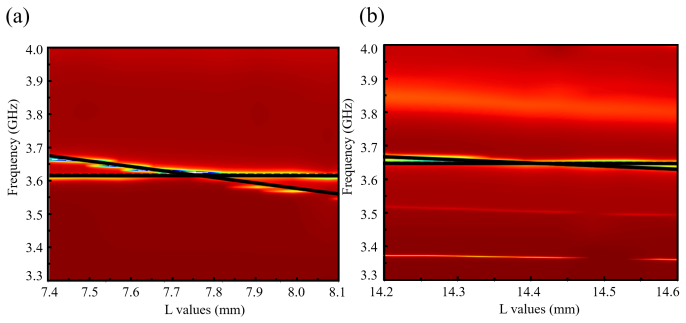
The central claim is that three photon modes in a CSRR-microstrip system do not merely coexist; they exchange energy coherently or dissipatively depending on geometry. As the outer side length L of the two concentric rings is varied, the transmission spectra show anti-crossing: in the range L = 6–9 mm, the CSRR-A resonance repels the approaching ring resonance (coupling-induced transparency); in the range L = 13–16 mm, the two resonances attract and merge into an absorption dip (coupling-induced absorption). The paper's theoretical framework—a 3×3 characteristic matrix from the Euler–Lagrange equations of three inductively coupled LC oscillators, with each mode assigned a complex frequency—q
Load-bearing premise
The paper assumes that its CST full-wave simulations count as experimental validation, but the manuscript reports no fabricated sample, no vector-network-analyzer measurement, and no error analysis.
Editorial extensions
If this is right
- If the model is correct, coupling strengths can be extracted from planar geometry alone, giving design rules for choosing L to reach either transparency or absorption.
- The platform operates at room temperature in a planar format, suggesting it can be integrated into on-chip magnonic and hybrid photonic circuits without cryogenic hardware.
- Changing one geometric parameter switches between coupling-induced transparency and coupling-induced absorption, so a single device could serve as a reconfigurable CIT/CIA element.
- The complex-frequency Lagrangian model, with fixed intrinsic dampings and an extrinsic damping parameter, should generalize to other three-resonator planar systems and predict their hybrid modes.
- The extracted coupling constants for the two L regions provide concrete targets for future experimental tuning of coherent versus dissipative photon-photon coupling.
Reading between the lines
- A direct check not performed in the paper is to fabricate the board and measure |S21| with a vector network analyzer: clear anti-crossing near L = 7–8 mm and a merged absorption dip near L = 14–15 mm would confirm the claimed dual regime.
- The model's distinction between coherent and dissipative coupling suggests that increasing extrinsic damping alone—without changing L—might flip a given device from level repulsion to level attraction; this is a testable extension.
- Since the paper reports only one fixed geometry for CSRR-A, varying the dimensions and positions of all three rings could reveal whether the mutual-inductance signs, rather than just frequency detuning, determine which regime appears.
- The absence of error bars or measurement uncertainty means the reported coupling strengths should be treated as simulation-derived estimates until a fabricated device provides independent values.
Editorial analysis
A structured set of objections, weighed in public.
Referee Report
Summary. The manuscript reports a CST Microwave Studio simulation study of a planar microstrip line coupled to three complementary split-ring resonators (CSRRs), labeled A, B, and C. The authors observe avoided crossings in simulated |S21| spectra as the outer dimension L of CSRR-B/C is varied, and they interpret two regions—L = 6–9 mm and L = 13–16 mm—as coupling-induced transparency (CIT, level repulsion) and coupling-induced absorption (CIA, level attraction), respectively. A Lagrangian coupled-oscillator model with complex eigenfrequencies and inter-resonator couplings is introduced, and the authors state that fitting this model to simulated transmission data yields coupling strengths that are 'further validated experimentally.' The paper concludes that the system demonstrates tunable multimode photon-photon coupling at room temperature in a planar architecture.
Significance. If the claims were supported, a planar, room-temperature, three-mode photon-photon coupling platform with both level repulsion and level attraction would be a useful addition to the hybrid microwave-photonics literature, particularly for reconfigurable transparency/absorption devices. The manuscript also attempts to supply a compact Lagrangian coupled-mode description of three mutually coupled resonators, which could be a helpful modeling framework. However, the claimed significance is heavily tied to two unsupported premises: that the simulations are confirmed by experiment, and that the fitted coupled-mode model provides an independent validation of the three-mode interaction. Neither premise is substantiated in the text, and the fitted coupling strengths are not reported, so the central quantitative claims cannot be checked. The paper contains no machine-checked derivations, no code/data release, and no experimental dataset; its evidentiary basis is a small set of simulated transmission spectra and a fit to those same spectra.
major comments (3)
- [Abstract and Section 4 (Conclusion)] The paper repeatedly states that the coupling strengths and the observed phenomena are 'validated experimentally' (Abstract) and that 'Our experimental results confirm strong coupling' (Conclusion). The manuscript contains no experiment: Section 2 describes only CST Microwave Studio simulations, Figs. 2–4 are simulated |S21| colormaps, and Fig. 5 compares the theoretical fit to simulation data. No fabricated sample, VNA measurement, error analysis, or measured dataset is presented. This is a load-bearing gap because the claimed room-temperature experimental demonstration is part of the paper's contribution and is used to elevate the work beyond a purely numerical study.
- [Section 3.2, Fig. 5] The theoretical model is validated only by fitting the exported simulated |S21| data: 'the exported |S21| data were fitted using the eigenvalue equation.' The fitted inter-resonator couplings Δ_AB, Δ_BC, and Δ_CA are never reported, and the eigenvalue equation is not written out explicitly after the substitution of complex frequencies. As a result, the central quantitative claim—that the model 'yields the coupling strengths'—is not independently checkable. A fit to the same simulation data that produced the observed anti-crossings cannot by itself confirm the three-mode interaction; it is a parameter extraction, not a prediction. The absence of the fitted parameter values also prevents the reader from assessing whether the couplings are indeed 'comparable strength' and whether the two coupling regimes are physically distinct.
- [Section 3.2, Eq. (8) and following text] The derivation from the Lagrangian to the eigenvalue equation contains an unstated step: after introducing complex eigenfrequencies, the paper says the matrix 'simplifies to yield the eigenvalue equations for the two coupling regions,' but those equations are not displayed. The model parameters are also described inconsistently—intrinsic dampings are held fixed at κ = 0.03290, α = 0.02387, β = 0.03579, while extrinsic damping γ and couplings Δ_AB, Δ_BC, Δ_CA are adjusted. This is a multiparameter fit to a qualitative feature (anti-crossing), and without the fitted equations, parameter values, and goodness-of-fit metrics, the claim of 'close agreement' is not verifiable.
minor comments (4)
- [Section 3.1, Fig. 3 caption] The caption states that green, blue, and red markers denote CSRR-A, CSRR-B, and CSRR-C, while the main text says the green arrow corresponds to CSRR-A and the red/blue arrows correspond to CSRR-B/C. The color assignment in the caption conflicts with the text; please align the notation.
- [Section 3.1] The sentence 'The red arrows (CSRR- B) indicate the outer ring resonance, given by ωB = 1/√LBCB' is followed by the blue arrows (CSRR C) description, but Fig. 3 is not shown in the text; the reader cannot connect the arrows to the actual plot. Please clarify in the figure itself or caption which arrow color is which resonance.
- [Section 2, Figure 1 caption] The caption describes ports connected to a VNA for characterization, but the paper only reports simulations. The notation 'VNA' is potentially misleading unless the figure is explicitly labeled as a simulation schematic.
- [General] Several references are cited loosely in the introduction (e.g., 'quantum sensing,' 'quantum information') without a clear connection to the specific claims; please tighten the citation use to the relevant statements.
Circularity Check
The inter-resonator couplings are fitted to the same simulated |S21| data that are then said to 'validate' the three-mode model, and the claimed experimental validation is absent from the manuscript.
-
fitted input called prediction
[Section 3.2, 'Theoretical model and fitting', after Eq. (9); Fig. 5]
"To quantitatively validate the coupling dynamics observed in the CST simulations, the exported |S21| data were fitted using the eigenvalue equation to analyze the interactions of CSRR-A with CSRR-B and CSRR-C, shown in Fig.5. The model incorporated the intrinsic resonance frequencies, with intrinsic dampings held fixed atκ= 0.03290,α= 0.02387, andβ= 0.03579, together with the extrinsic dampingγand the inter-resonator couplings ∆ AB, ∆BC , and ∆CA confirming that all three oscillators participate with comparable strength and validating the three-mode interaction picture."
The model's inter-resonator couplings ΔAB, ΔBC, ΔCA and extrinsic damping γ are free parameters adjusted so that the eigenvalue equation reproduces the exported CST |S21| spectra. The same spectra are then described as 'confirming' comparable oscillator strengths and 'validating the three-mode interaction picture.' The level repulsion (CIT) and level attraction (CIA) are not independent outputs of the theory; they are the features used to fix the couplings. Moreover, the fitted coupling values are not reported, so the central quantitative claim (the Δ estimates) cannot be checked apart from the fit.
-
other
[Abstract and Section 4 (Conclusion)]
"provides estimates of the coupling strength (∆), which are further validated experimentally. ... Our experimental results confirm strong coupling between CSRR-A and the concentrically arranged CSRR-B and CSRR-C modes, as evidenced by clear anticrossing behavior..."
The manuscript's only data source is CST full-wave simulation (Section 2); no fabricated sample, VNA trace, or measured S-parameter is presented. Calling this 'validated experimentally' and 'experimental results confirm strong coupling' asserts a load-bearing premise without evidence. This is not a circular reduction of the equations, but it is an unsupported claim that the paper treats as the final confirmation of the fitted model.
full rationale
The central derivation chain is: CST simulation yields |S21| spectra; observed anticrossings motivate a three-oscillator Lagrangian; the eigenvalue equation is fitted to the same |S21| by varying the inter-resonator couplings and extrinsic damping; the fitted model is then presented as confirming strong photon-photon coupling and as experimentally validated. This is a fit-called-validation rather than an independent prediction: the level-repulsion/level-attraction features are the input used to determine the coupling constants, and the fitted coupling values are never reported, so the quantitative claim is not independently checkable. The self-citations ([13], [14]) are background context and are not load-bearing in the derivation; no uniqueness theorem is imported. The additional assertion of experimental validation is unsupported—the body contains only CST simulations, no VNA measurement—which further weakens the claimed confirmation but is not itself a circularity. Overall, the paper's quantitative claim reduces to a three-mode fit of the simulation data presented as validation, giving partial but genuine circularity.
Assumptions & free parameters
free parameters (7)
- intrinsic damping alpha =
0.02387
- intrinsic damping beta =
0.03579
- intrinsic damping kappa =
0.03290
- extrinsic damping gamma
- inter-resonator coupling Delta_AB
- inter-resonator coupling Delta_BC
- inter-resonator coupling Delta_CA
assumptions (5)
- standard math The coupled oscillators obey the Euler-Lagrange equations with the given Lagrangian (kinetic and potential energies in Eqs. 1-2).
- domain assumption Each CSRR can be represented as a single-mode lumped LC resonator with inductance L_i and capacitance C_i.
- domain assumption Dissipation can be incorporated by replacing each resonance frequency with a complex frequency omega_i - i(damping) using the given dampings alpha, beta, kappa, gamma.
- ad hoc to paper Level repulsion and attraction in the simulated transmission is sufficient evidence of strong photon-photon coupling.
- domain assumption CST Microwave Studio simulations accurately represent the physical device and no hardware experiment is needed.
Cite this review
Pith. "Pith review of Multimode Photon-Photon Coupling." pith.science (2026). https://pith.science/paper/WG4ZPYHN
@misc{pith2026250906778,
  author       = {Pith},
  title        = {Pith review of: Multimode Photon-Photon Coupling},
  year         = {2026},
  howpublished = {\url{https://pith.science/paper/WG4ZPYHN}},
  note         = {Machine review of arXiv:2509.06778}
}
read the original abstract
This study investigates a planar hybrid system consisting of three complementary splitring resonators (CSRRs), designed to examine interactions among multiple photon modes at room temperature. The system was modeled and simulated using the full-wave electromagnetic solver CST Microwave Studio. Analysis of the transmission spectra (|S21|) as a function of frequency for different CSRR dimensions revealed distinct anti-crossing behavior, indicative of strong photon-photon coupling (PPC). To explain this phenomenon, we present theoretical framework that quantitatively captures the observed mode hybridization and provides estimates of the coupling strength, which are further validated experimentally. This work not only elucidates the fundamental dynamics of PPC in planar systems but also offers practical guidance for designing hybrid platforms with tunable photon interactions, paving the way for future advancements in planar magnonic and hybrid photonic technologies.
Figures


Figures from the paper (2 more)

Reference graph
Works this paper leans on
-
[1]
C. L. Degen, F. Reinhard, and P. Cappellaro. Quantum sensing.Reviews of Modern Physics, 89:035002, 2017
2017
- [2]
-
[3]
B. Bhoi, B. Kim, H.-C. Jeon, and S.-K. Kim. Coupling-induced transparency and absorption in a magnon–multiphoton hybrid system.Journal of Applied Physics, 132:243901, 2022
work page 2022
- [4]
-
[5]
J. W. Rao, Y. T. Zhao, Y. S. Gui, X. L. Fan, D. S. Xue, and C.-M. Hu. Controlling microwaves in non-hermitian metamaterials.Physical Review Applied, 15:L021003, 2021
work page 2021
-
[6]
N. R. Bernier, L. D. T´ oth, A. K. Feofanov, and T. J. Kippenberg. Level attraction in a microwave optomechanical circuit.Phys. Rev. A, 98:023841, 2018
work page 2018
- [7]
-
[8]
A. Metelmann and A. A. Clerk. Quantum-limited amplification via reservoir engi- neering.Phys. Rev. Lett., 112:133904, 2014
work page 2014
Show all 19 references
-
[9]
M. O. Scully and M. S. Zubairy.Quantum Optics. Cambridge University Press, 1997
1997
-
[10]
Tiwari, K
T. Tiwari, K. K. Shrivastava, D. Roy, and R. Singh. A modified quasi-classical analysis to capture the effects of strong interaction in open qed lattices.Ann. Phys., Lpz., 536:2300402, 2023
2023
-
[11]
H. Liu, D. Sun, C. Zhang, M. Groesbeck, R. McLaughlin, and Z. V. Vardeny. Obser- vation of exceptional points in magnonic parity-time symmetry devices.Sci. Adv., 5:eaax9144, 2019
2019
-
[12]
Li et al
Y. Li et al. Coherent coupling of two remote magnonic resonators mediated by superconducting circuits.Phys. Rev. Lett., 128:047701, 2022. 9
2022
-
[13]
Dielectric-tuned photon-photon coupling in a planar hybrid system.Chemical Physics Impact, page 100890, 2025
Rakesh Kumar Nayak, Meghana Mishra, Kuldeep Kumar Shrivastava, Biswanath Bhoi, and Rajeev Singh. Dielectric-tuned photon-photon coupling in a planar hybrid system.Chemical Physics Impact, page 100890, 2025. Article No. 100890
2025
-
[14]
Emergence of coupling induced transparency by tuning purely dissipa- tive couplings.arXiv preprint arXiv:2409.12577, 2024
Kuldeep Kumar Shrivastava, Moulik Deviprasad Ketkar, Biswanath Bhoi, and Ra- jeev Singh. Emergence of coupling induced transparency by tuning purely dissipa- tive couplings.arXiv preprint arXiv:2409.12577, 2024. Submitted to arXiv on 19 September 2024
2024 arXiv
-
[15]
Castel, A
V. Castel, A. Manchec, and J. B. Youssef. Control of magnon-photon coupling strength in a planar resonator/yttrium-iron-garnet thin-film configuration.IEEE Mag. Lett., 8:1–5, 2017
2017
-
[16]
Zhang, C
X. Zhang, C. L. Zou, L. Jiang, and H. X. Tang. Cavity magnomechanics.Sci. Adv., 2:e1501286, 2016
2016
-
[17]
Zheng, P
T. Zheng, P. Wang, B. Wei, B. Lu, B. Cao, and F. Lei. Three-pathway electromag- netically induced transparency and absorption based on coupled superconducting resonators.Phys. Rev. A, 108:053105, 2023
2023
-
[18]
D. F. Walls and G. J. Milburn.Quantum Optics. Springer, 1997
1997
-
[19]
B. Bhoi, T. Cliff, I. S. Maksymov, M. Kostylev, R. Aiyar, N. Venkataramani, S. Prasad, and R. L. Stamps. Study of photon–magnon coupling in a yig-film split- ring resonant system.J. Appl. Phys., 116, 2014. 10
2014
Reviewed August 4, 2026 · model on record in the stance chip above.
Discussion (0). Continue with ORCID to comment.