REVIEW 4 major objections 4 minor 44 references
A New Hybrid Model of Generative Adversarial Network and You Only Look Once Algorithm for Automatic License-Plate Recognition
T0 review · 4 major / 4 minor · reviewed 2026-08-04 · deepseek-v4-flash
Pith's one-line read A selective GAN deblurring step before YOLOv5 detection raises end-to-end license-plate recognition accuracy from 45.80% to 87.26% on blurred images.
desk verdict Useful engineering report with two released datasets and a gated deblurrer, but the headline 40% gain is measured on in-distribution synthetic blur and should not be trusted for real captures. read the letter →
The pith
A machine-rendered reading of the paper's core claim, the machinery that carries it, and where it could break.
The reading
What carries the argument
The load-bearing mechanism is the selective-deblur module: a Laplacian kernel computes edge intensity, a variance threshold decides whether the image is blurred, and only blurred images pass through the Deblur-GAN, a multi-scale Deep Multi-scale CNN generator (three resolution scales, residual blocks, up-convolution concatenation) with a discriminator. The two YOLOv5 heads then carry localization (one class: license plate) and character recognition (44 classes for Iranian plates), with anchor boxes and output head sizes 18 and 147 respectively.
What would settle it
Take real blurred license-plate images from dashcam or handheld video, run the pipeline with and without the Deblur-GAN, and compare end-to-end accuracy; if the gap is much below the reported 41.46 percentage points, the claim is specific to synthetic blur.
Extended reading notes
Core claim
The central claim is that a selective deblurring pre-processor based on a multi-scale GAN, gated by a Laplacian-variance blur check, is the difference between a failing and a working ALPR system on blurred captures. Without the deblurrer, the YOLOv5 pipeline recognizes 45.80% of plates in a heavily blurred test set; with it, accuracy rises to 87.26%. The paper further claims that YOLOv5 is a good backbone choice for both license-plate detection and character segmentation+recognition because it detects small objects well and runs in 0.026 s per stage, and that the generated public datasets, including augmented weather conditions and synthetic uniform blur kernels, are representative enough to
Load-bearing premise
The deblurring gain is measured on test images from the same synthetic uniform-blur pipeline used for training, so the assumption that this blur represents real camera motion is what carries the 40% improvement claim.
Editorial extensions
If this is right
- End-to-end recognition on heavily blurred plates jumps from 45.80% to 87.26% when the selective GAN deblurrer is active.
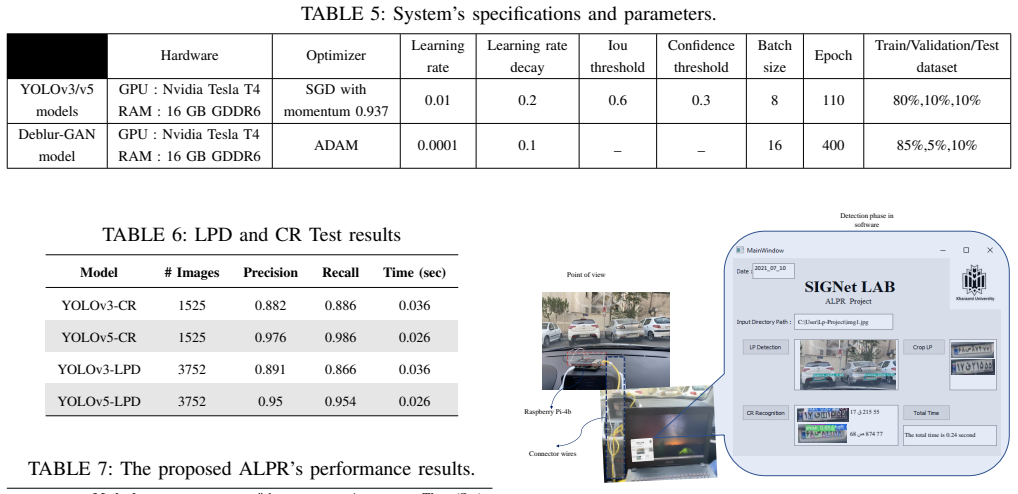
- YOLOv5 LPD and CR each detect in 0.026 seconds on a Tesla T4, making the non-blurred path near real-time.
- The same pipeline reaches 0.24 seconds total on a Raspberry Pi-4B, suggesting portability to dashcam-like devices.
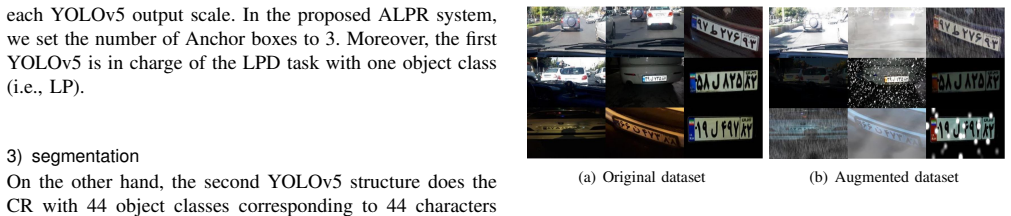
- Publicly released ALPR and deblur datasets enable others to retrain and benchmark Iranian-plate ALPR systems under varied weather and blur.
- Against prior Iranian ALPR systems, the reported per-image runtime of 0.052 s is lower than the compared baselines (0.120-0.356 s).
Reading between the lines
- Because the deblurring benefit is measured entirely on images blurred with synthetic uniform kernels, deploying on real camera-shake blur—often non-uniform and multi-source—could yield a smaller gain; a real-blur benchmark would settle this.
- The 2.052 s deblurring cost suggests the selective gate matters: on mostly-sharp video streams, skipping the GAN keeps the pipeline at 0.052 s, so the threshold could be tuned per camera.
- The same selective pre-processing pattern—a cheap blur detector followed by an expensive restoration network—could generalize to other small-object recognition tasks such as traffic-sign or pedestrian detection.
- A cheaper or distilled deblur network might retain most of the accuracy gain while reducing the 2-second penalty on blurred frames, making the selective module usable in closer to real-time.
Signed reviews
Editorial analysis
A structured set of objections, weighed in public.
Referee Report
Summary. The paper proposes an ALPR pipeline consisting of a selective Deblur-GAN preprocessing module, a YOLOv5 detector for license-plate localization (LPD), and a second YOLOv5 detector for character segmentation/recognition (CR). The selection mechanism uses a Laplacian-variance blur check to decide whether deblurring is applied. The authors introduce new Iranian ALPR and deblur datasets, train the components on augmented data, and report YOLOv5 LPD precision of 0.95 and CR precision of 0.976 with 0.026 s per detection stage on a Tesla T4. The central end-to-end claim is that adding the Deblur-GAN raises accuracy from 45.80% to 87.26% on a 300-image test set described as 75% blurred. A Raspberry Pi implementation is also reported.
Significance. The selective-deblur design is sensible and the public release of Iranian ALPR data is a useful community contribution. If the 40% improvement were validated on realistic blurred captures, the paper would demonstrate a practically valuable preprocessing strategy for ALPR. The YOLOv5 speed numbers are attractive for embedded use. However, the headline gain is measured only on synthetic uniform-kernel blur of the same type used for training, on a small test set without uncertainty quantification, and the real-time claim is based on the non-deblurred path. These gaps currently prevent the central claims from being accepted as stated.
major comments (4)
- [Table 7 / Section V.A] The 40% improvement from 45.80% to 87.26% is measured on 300 images described only as '75% blurred'. The provenance of these images is not stated, but the only blur-generation procedure in the paper is Section IV: convolving sharp images with uniform OpenCV kernels of size 7x7 to 19x19. The Deblur-GAN was trained on exactly this synthetic degradation. Section III.A.1 itself concedes, citing [22], that such synthetic blur is 'not sufficiently representative, specifically in a multi-source blur or blur kernel with complex patterns'. Therefore the reported gain is an in-distribution result for the trained blur model and does not establish performance on real camera-shake or motion blur. Please evaluate on real blurred captures or at least on non-uniform/spatially-varying blur, and report per-blur-kernel and per-blur-level results.
- [Table 7 / Abstract] The central quantitative claim rests on 300 end-to-end images (225 blurred), with no confidence intervals, no repeated runs, and no per-condition breakdown. The difference 45.80% vs 87.26% is an absolute improvement of 41.46 percentage points, which is not 'nearly 40%' in relative terms (relative improvement is ~90%). Please report uncertainties (e.g., Wilson intervals or bootstrap), a significance test, and a breakdown by blur level and by sharp vs blurred subsets. Without this, the headline accuracy gain is not statistically grounded.
- [Table 5 vs Table 6] Table 5 states 80/10/10 train/validation/test splits for the YOLO models, but Table 6 reports 3,752 test images for LPD and 1,525 for CR. These do not match 10% of the stated dataset sizes (39,966 and 28,854). The source and composition of these test sets should be described precisely. In addition, the Abstract's '95% and 97% accuracy' figures correspond to the Precision column of Table 6 (0.95 and 0.976), not to an accuracy metric. Please clarify which metric is being reported and, if plate-level accuracy is intended, compute it explicitly.
- [Table 7 / Table 8 / Abstract] The real-time claim is based on the non-deblurred path: Table 7 gives 0.052 s end-to-end without deblurring but 2.052 s with Deblur-GAN. Table 8 compares only the 0.052 s figure against prior work, omitting the 2.052 s selective-deblur pipeline that would be invoked for blurred inputs. The paper should report the end-to-end latency of the full selective pipeline, including the blur check and deblurring when triggered, and discuss whether the system remains real-time under the stated 75%-blur test condition.
minor comments (4)
- [Section III.B.1] The blur-check threshold is described as a 'carefully selected user-set threshold', but no value, selection procedure, or sensitivity analysis is given. Since the selective behavior depends on it, at least a brief description of its calibration should be added.
- [Table 3] Typographical errors and formatting issues: 'Sumsung' should be 'Samsung'; several cells contain 'NA' repeated as 'NANANP'; superscript footnote markers are unexplained. Also, the table reports 'Blur filter size 7×7,9×9,...,19×9' but the text says '7×7 up to 19×19'.
- [References] The dataset link is given only as a GitHub URL [36] with no version or DOI; if the data is publicly released, please provide a stable identifier and clarify the licensing.
- [Figure 10] The figure caption says 'without/with Deblur-GAN (left/right)', but the ordering is ambiguous from the text. Please make the caption explicit and ensure all subfigures are labeled consistently.
Circularity Check
No definitional circularity; the central claims are empirical. The main caveat is that the headline deblur gain is demonstrated on synthetic uniform-kernel blur of the same type used for training, which is an external-validity concern rather than a circularity.
full rationale
The paper contains no analytic derivation chain whose conclusions reduce to their own assumptions by construction. The YOLOv5 LPD/CR accuracy and timing figures are measured on held-out test splits (Table 6), and the end-to-end comparison in Table 7 directly compares the same system with and without the Deblur-GAN preprocessor on a 300-image test set. The Deblur-GAN is trained on a separately generated Deblur dataset and then evaluated on blurred inputs; unless the test set is secretly drawn from the identical generative pipeline and the evaluation is presented as a prediction on real-world blur, this is a standard train/test protocol. No parameter is fitted to the test set and then renamed a prediction, no uniqueness theorem is imported from the authors, and no ansatz is smuggled in via self-citation. The only self-citation, dataset reference [36], is not load-bearing for the method's validity. The paper itself flags the central limitation in Section III.A.1: 'the synthetic blur datasets so generated are not sufficiently representative, specifically in a multi-source blur or blur kernel with complex patterns scenarios [22].' This directly undermines generalization of the 'nearly 40%' improvement to real non-uniform camera shake and moving-object blur, but that is an external-validity / correctness risk, not a circularity. Accordingly, no circular step is identified.
Assumptions & free parameters
free parameters (2)
- Laplacian variance blur threshold =
not reported
- Blur kernel sizes for synthetic blur =
7x7, 9x9, ..., 19x19
assumptions (4)
- domain assumption Convolving sharp images with uniform blur kernels of sizes up to 19x19 produces blur representative of real camera shake and motion blur in ALPR.
- domain assumption Laplacian variance below a threshold reliably identifies images where GAN deblurring will help rather than hurt.
- domain assumption YOLOv5 and the Deep Multi-scale CNN (Nah et al., [35]) behave as published, and the authors' training reproduces that behavior.
- domain assumption Iranian license plates are fully covered by 44 character classes.
Cite this review
Pith. "Pith review of A New Hybrid Model of Generative Adversarial Network and You Only Look Once Algorithm for Automatic License-Plate Recognition." pith.science (2026). https://pith.science/paper/XICCMSOE
@misc{pith2026250906868,
  author       = {Pith},
  title        = {Pith review of: A New Hybrid Model of Generative Adversarial Network and You Only Look Once Algorithm for Automatic License-Plate Recognition},
  year         = {2026},
  howpublished = {\url{https://pith.science/paper/XICCMSOE}},
  note         = {Machine review of arXiv:2509.06868}
}
read the original abstract
Automatic License-Plate Recognition (ALPR) plays a pivotal role in Intelligent Transportation Systems (ITS) as a fundamental element of Smart Cities. However, due to its high variability, ALPR faces challenging issues more efficiently addressed by deep learning techniques. In this paper, a selective Generative Adversarial Network (GAN) is proposed for deblurring in the preprocessing step, coupled with the state-of-the-art You-Only-Look-Once (YOLO)v5 object detection architectures for License-Plate Detection (LPD), and the integrated Character Segmentation (CS) and Character Recognition (CR) steps. The selective preprocessing bypasses unnecessary and sometimes counter-productive input manipulations, while YOLOv5 LPD/CS+CR delivers high accuracy and low computing cost. As a result, YOLOv5 achieves a detection time of 0.026 seconds for both LP and CR detection stages, facilitating real-time applications with exceptionally rapid responsiveness. Moreover, the proposed model achieves accuracy rates of 95\% and 97\% in the LPD and CR detection phases, respectively. Furthermore, the inclusion of the Deblur-GAN pre-processor significantly improves detection accuracy by nearly 40\%, especially when encountering blurred License Plates (LPs).To train and test the learning components, we generated and publicly released our blur and ALPR datasets (using Iranian license plates as a use-case), which are more representative of close-to-real-life ad-hoc situations. The findings demonstrate that employing the state-of-the-art YOLO model results in excellent overall precision and detection time, making it well-suited for portable applications. Additionally, integrating the Deblur-GAN model as a preliminary processing step enhances the overall effectiveness of our comprehensive model, particularly when confronted with blurred scenes captured by the camera as input.
Figures


Figures from the paper (8 more)





Reference graph
Works this paper leans on
-
[22]
C. J. Schuler, M. Hirsch, S. Harmeling, and B. Scholkopf, “Learning to deblur,”IEEE Transactions on Pattern Analysis and Machine Intelligence, vol. 38, no. 7, pp. 1439–1451, 2016
work page 2016
-
[1]
A hybrid KNN-SVM model for Iranian li- cense plate recognition,
S. S.Tabrizi and N. Cavus, “A hybrid KNN-SVM model for Iranian li- cense plate recognition,”12th International Conference on Application of Fuzzy Systems and Soft Computing, ICAFS, vol. 102, pp. 588–594, 2016
work page 2016
-
[2]
A new and robust method for character segmentation and recognition in license plate images,
A. Sedighi and M. Vafadust, “A new and robust method for character segmentation and recognition in license plate images,”Expert Systems with Applications, vol. 38, pp. 13 497 – 13 504, 2011
work page 2011
-
[3]
Representation learning in a deep network for license plate recognition,
S. Rakhshani, E. Rashedi, and H. Nezamabadi-pour, “Representation learning in a deep network for license plate recognition,”Multimedia Tools and Applications, vol. 79, pp. 13 267 – 13 289, 2020
work page 2020
-
[4]
An edge-based color-aided method for license plate detection,
V . Abolghasemi and A. Ahmadyfard, “An edge-based color-aided method for license plate detection,”Image and Vision Computing, vol. 27, pp. 1134 – 1142, 2009
work page 2009
-
[5]
A License Plate Detection Algorithm Using Edge Fea- tures,
M. A. Mobarhan, A. Shahbahrami, S. Parva, M. N. Asadi, and A. A. Khajekini, “A License Plate Detection Algorithm Using Edge Fea- tures,”Advances in Computer Science, Engineering and Applications, vol. 166, pp. 413 – 421, 2012
work page 2012
-
[6]
A vehicle license plate detection method using region and edge based methods,
M. A. Lalimi, S. Ghofrani, and D. McLernon, “A vehicle license plate detection method using region and edge based methods,”Computers and Electrical Engineering, vol. 39, pp. 834 – 845, 2013
work page 2013
-
[7]
A hierarchical algorithm for vehicle license plate localization,
E. Rashedi and H. Nezamabadi-pour, “A hierarchical algorithm for vehicle license plate localization,”Multimed Tools Appl, vol. 77, pp. 2771 – 2790, 2018
work page 2018
Show all 44 references
-
[8]
An Iranian License Plate Recognition System Based on Color Features,
A. H. Ashtari, M. J. Nordin, and M. Fathy, “An Iranian License Plate Recognition System Based on Color Features,”INTELLIGENT TRANSPORTATION SYSTEMS, vol. 15, pp. 1690 – 1705, 2014
2014
-
[9]
Accurate Detection and Recognition of Dirty Vehicle Plate Numbers for High-Speed Appli- cations,
R. Panahi, Member, and I. Gholampour, “Accurate Detection and Recognition of Dirty Vehicle Plate Numbers for High-Speed Appli- cations,”INTELLIGENT TRANSPORTATION SYSTEMS, vol. 18, pp. 767 – 779, 2017
2017
-
[10]
Adaptive enhance- ment and binarization techniques for degraded plate images,
S. Kashef, H. Nezamabadi-pour, and E. Rashedi, “Adaptive enhance- ment and binarization techniques for degraded plate images,”Multimed Tools Appl, vol. 77, pp. 16 579 – 16 595, 2018
2018
-
[11]
Towards end-to-end license plate detection and recognition: A large dataset and baseline,
Z. Xu, W. Yang, A. Meng, N. Lu, H. Huang, C. Ying, and L. Huang, “Towards end-to-end license plate detection and recognition: A large dataset and baseline,” inComputer Vision – ECCV 2018, 2018, pp. 261–277
2018
-
[12]
Automatic License Plate Recognition via sliding-window darknet-YOLO deep learning,
Hendry and R.-C. Chen, “Automatic License Plate Recognition via sliding-window darknet-YOLO deep learning,”Image and Vision Com- puting, vol. 87, 2019
2019
-
[13]
A Real-Time License Plate Detection Method Using a Deep Learning Approach,
S. Khazaee, A. Tourani, S. Soroori, A. Shahbahrami, and C. Y . Suen, “A Real-Time License Plate Detection Method Using a Deep Learning Approach,”International Conference on Pattern Recognition and Artificial Intelligence, vol. 12068, pp. 425 – 438, 2020
2020
-
[14]
A Robust Deep Learning Approach for Automatic Iranian Vehicle License Plate Detection and Recognition for Surveillance Systems,
A. TOURANI1, A. S. 1, S. SOROORI1, S. KHAZAEE2, and C. Y . SUEN, “A Robust Deep Learning Approach for Automatic Iranian Vehicle License Plate Detection and Recognition for Surveillance Systems,”IEEE Access, vol. 8, pp. 201 317 – 201 330, 2020
2020
-
[15]
Real-time license plate detection and recognition using deep convolutional neural networks,
S. M. Silva and C. R. Jung, “Real-time license plate detection and recognition using deep convolutional neural networks,”J. Vis. Commun. Image R, vol. 71, p. 102773, 2020
2020
-
[16]
Multinational License Plate Recognition Using Generalized Character Sequence Detection,
C. Henry, S. Y . Ahn, and S.-W. Lee, “Multinational License Plate Recognition Using Generalized Character Sequence Detection,”IEEE Access, vol. 8, pp. 35 185 – 35 199, 2020
2020
-
[17]
An embedded automatic license plate recognition system using deep learning,
D. M. F. Izidio, A. P. A. Ferreira, H. R. Medeiros, and E. N. da S. Bar- ros, “An embedded automatic license plate recognition system using deep learning,”Design Automation for Embedded Systems, vol. 24, pp. 23 – 43
-
[18]
Deblurring images using a wiener filter,
P. Biswas, A. Sarkar, and M. Mynuddin, “Deblurring images using a wiener filter,”International Journal of Computer Applications, vol. 109, pp. 36–38, 01 2015
2015
-
[19]
Single-image deblurring with neural networks: A comparative survey,
J. Koh, J. Lee, and S. Yoon, “Single-image deblurring with neural networks: A comparative survey,”Computer Vision and Image Understanding, vol. 203, p. 103134, 2021. [Online]. Available: https://www.sciencedirect.com/science/article/pii/S1077314220301533
2021
-
[20]
A new image enhancement and super resolution technique for license plate recognition,
A. Hamdi, Y . K. Chan, and V . C. Koo, “A new image enhancement and super resolution technique for license plate recognition,” Heliyon, vol. 7, no. 11, p. e08341, 2021. [Online]. Available: https://www.sciencedirect.com/science/article/pii/S2405844021024440
2021
-
[21]
Generative adversarial nets,
I. Goodfellow, J. Pouget-Abadie, M. Mirza, B. Xu, D. Warde-Farley, S. Ozair, A. Courville, and Y . Bengio, “Generative adversarial nets,” inAdvances in Neural Information Processing Systems, Z. Ghahramani, M. Welling, C. Cortes, N. Lawrence, and K. Q. Weinberger, Eds., vol. 27...
2014
-
[23]
Rich feature hierarchies for accurate object detection and semantic segmentation,
R. B. Girshick, J. Donahue, T. Darrell, and J. Malik, “Rich feature hierarchies for accurate object detection and semantic segmentation,”CoRR, vol. abs/1311.2524, 2013. [Online]. Available: http://arxiv.org/abs/1311.2524
2013 arXiv
-
[24]
Fast r-cnn,
R. Girshick, “Fast r-cnn,” in2015 IEEE International Conference on Computer Vision (ICCV), 2015, pp. 1440–1448
2015
-
[25]
Faster r-cnn: Towards real- time object detection with region proposal networks,
S. Ren, K. He, R. Girshick, and J. Sun, “Faster r-cnn: Towards real- time object detection with region proposal networks,”IEEE Transac- tions on Pattern Analysis and Machine Intelligence, vol. 39, 06 2015
2015
-
[26]
Cspnet: A new backbone that can enhance learning capability of cnn,
C.-Y . Wang, H.-y. Liao, Y .-H. Wu, P.-Y . Chen, J.-W. Hsieh, and I.-H. Yeh, “Cspnet: A new backbone that can enhance learning capability of cnn,” in2020 IEEE/CVF Conference on Computer Vision and Pattern Recognition Workshops (CVPRW), 06 2020, pp. 1571–1580
2020
-
[27]
You only look once: Unified, real-time object detection,
J. Redmon, S. Divvala, R. Girshick, and A. Farhadi, “You only look once: Unified, real-time object detection,” in2016 IEEE Conference on Computer Vision and Pattern Recognition (CVPR), 2016, pp. 779– 788
2016
-
[28]
Yolo9000: Better, faster, stronger,
J. Redmon and A. Farhadi, “Yolo9000: Better, faster, stronger,” in 2017 IEEE Conference on Computer Vision and Pattern Recognition (CVPR), 07 2017, pp. 6517–6525
2017
-
[29]
Yolov3: An incremental improvement,
——, “Yolov3: An incremental improvement,”CoRR, vol. abs/1804.02767, 2018. [Online]. Available: http://arxiv.org/abs/1804.02767
2018 arXiv
-
[30]
Yolov4: Optimal speed and accuracy of object detection,
A. Bochkovskiy, C.-Y . Wang, and H.-Y . M. Liao, “Yolov4: Optimal speed and accuracy of object detection,” 2020
2020
-
[31]
Jocheret al., “Yolov5.” [Online]
G. Jocheret al., “Yolov5.” [Online]. Available: https://github.com/ultralytics/yolov5
-
[32]
Feature pyramid networks for object detection,
T.-Y . Lin, P. Dollar, R. Girshick, K. He, B. Hariharan, and S. Belongie, “Feature pyramid networks for object detection,” inProceedings of the IEEE Conference on Computer Vision and Pattern Recognition (CVPR), July 2017
2017
-
[33]
Spatial pyramid pooling in deep convolutional networks for visual recognition,
K. He, X. Zhang, S. Ren, and J. Sun, “Spatial pyramid pooling in deep convolutional networks for visual recognition,”IEEE Transactions on Pattern Analysis and Machine Intelligence, vol. 37, 06 2014
2014
-
[34]
Path aggregation network for instance segmentation,
S. Liu, L. Qi, H. Qin, J. Shi, and J. Jia, “Path aggregation network for instance segmentation,” inProceedings of the IEEE Conference on Computer Vision and Pattern Recognition (CVPR), June 2018
2018
-
[35]
Deep multi-scale convolutional neural network for dynamic scene deblurring,
S. Nah, T. Kim, and K. M. Lee, “Deep multi-scale convolutional neural network for dynamic scene deblurring,” 07 2017, pp. 257–265
2017
-
[36]
Dataset,
B. Shafizadeh, N. Pourhadi, M. Kelarestaghi, and F. Eshghi, “Dataset,” https://github.com/behnoudshafizadeh/, 2022
2022
-
[37]
A. B. Jung, K. Wada, J. Crall, S. Tanaka, J. Graving, C. Reinders, S. Yadav, J. Banerjee, G. Vecsei, A. Kraft, Z. Rui, J. Borovec, C. Vallentin, S. Zhydenko, K. Pfeiffer, B. Cook, I. Fernandez, F.-M. De Rainville, C.-H. Weng, A. Ayala-Acevedo, R. Meudec, M. La- porteet al., “i...
2020
-
[38]
Make Sense,
P. Skalski, “Make Sense,” https://github.com/SkalskiP/make-sense/, 2019
2019
-
[39]
A robust real-time automatic license plate recognition based on the yolo detector,
R. Laroca, E. Severo, L. Zanlorensi, L. Soares de Oliveira, G. Goncalves, W. Schwartz, and D. Menotti, “A robust real-time automatic license plate recognition based on the yolo detector,” 07 2018, pp. 1–10
2018
-
[40]
Automatic license plate detection in hazardous condition,
S. Azam and M. M. Islam, “Automatic license plate detection in hazardous condition,”J. Vis. Commun. Image Represent., vol. 36, pp. 172–186, 2016
2016
-
[41]
Zemris License Plate Dataset,
Zemris, “Zemris License Plate Dataset,” http://www.zemris.fer.hr/projects/LicensePlates/
-
[42]
Holistic recognition of low quality license plates by cnn using track annotated data,
J. Spanhel, J. Sochor, R. Juranek, A. Herout, L. Marsik, and P. Zemcik, “Holistic recognition of low quality license plates by cnn using track annotated data,” in2017 14th IEEE International Conference on Advanced Video and Signal Based Surveillance (AVSS), 2017, pp. 1–6
2017
-
[43]
Robust license plate detection in the wild,
G.-S. Hsu, A. Ambikapathi, S.-L. Chung, and C.-P. Su, “Robust license plate detection in the wild,” in2017 14th IEEE International Conference on Advanced Video and Signal Based Surveillance (AVSS), 2017, pp. 1–6
2017
-
[44]
Benchmark for license plate character segmentation,
G. R. Gonçalves, S. P. G. da Silva, D. Menotti, and W. R. Schwartz, “Benchmark for license plate character segmentation,”Journal of Electronic Imaging, vol. 25, no. 5, p. 053034, 2016. [Online]. Available: https://doi.org/10.1117/1.JEI.25.5.053034
2016 doi
Reviewed August 4, 2026 · model on record in the stance chip above.
Discussion (0). Continue with ORCID to comment.