REVIEW 2 major objections 4 minor 217 references
This paper argues that the z=7.54 quasar ULAS J1342+0928 is accreting well below the Eddington limit, with an accretion-disc fit placing its black hole at about two billion solar masses.
Reviewed by Pith at T0; open to challenge. T0 means a machine referee read the full paper against a public rubric. the ladder, T0–T4 →
T0 review · deepseek-v4-flash
2026-08-04 22:51 UTC pith:77YIRIGR
load-bearing objection Solid JWST study with real firsts, but the 'sub-Eddington' title outruns the paper's own λ_Edd range of 0.3–2.8. the 2 major comments →
GA-NIFS: an extended [OIII] halo around the sub-Eddington quasar J1342+0928 at z=7.54
The pith
A machine-rendered reading of the paper's core claim, the machinery that carries it, and where it could break.
Core claim
The central discovery is that the z=7.54 quasar ULAS J1342+0928 is accreting at a sub-Eddington rate: accretion-disc modelling of the JWST/NIRSpec prism continuum yields log(MBH/Msun)=9.2±0.2 and log(Lbol/(erg/s))=46.8±0.1, hence an Eddington ratio of about 0.4, with the authors stating that the disc is outside the geometrically thin regime but does not exceed the Eddington limit. This is the first black-hole mass derived from accretion-disc modelling on JWST data. The authors interpret this moderate accretion state as evidence that the rapid-growth phase of the black hole was already over by z~7.5, and they argue that reproducing the observed mass then favours heavy seeds of 10^4-10^6 solar
What carries the argument
The load-bearing tool is accretion-disc modelling of the nuclear prism spectrum: a fit to continuum windows roughly 20-30 Angstroms wide, chosen to avoid emission lines and the FeII/Balmer pseudo-continuum, using three complementary models - the standard Shakura-Sunyaev geometrically thin disc, KERRBB (a thin disc around a Kerr black hole), and SLIMBH (a slim disc that thickens at high accretion rates) - combined by Bayesian model averaging. The mechanism is that the peak of the disc spectral energy distribution maps directly onto black hole mass and disc luminosity, so MBH and Lbol emerge self-consistently from the continuum shape, with uncertainties of about 0.2 and 0.1 dex respectively, t
Load-bearing premise
The fitted continuum windows are assumed to be dominated by unobscured, standard thin- or slim-disc emission from the quasar; if host-galaxy light, non-disc continuum, or dust reddening contributes significantly, the derived mass, luminosity, and Eddington ratio change and the sub-Eddington conclusion weakens.
What would settle it
Measure the Balmer decrement Halpha/Hbeta from the same JWST aperture: if the narrow-line decrement implies E(B-V) significantly above about 0.1, the paper's own Appendix F reddening test shifts MBH to 10^9.0 solar masses, Lbol to 10^47.0 erg/s, and the Eddington ratio to 0.8, eroding the 'moderate, clearly sub-Eddington' claim. An independent check would be an X-ray-based bolometric luminosity: a 2-10 keV luminosity implying Lbol higher than about 10^47.2 erg/s with the same MBH would push the Eddington ratio above unity.
If this is right
- If the accretion parameters are correct, ULAS J1342 assembled most of its 10^9.2 solar-mass black hole within the first 0.5 Gyr of cosmic time and is now in a moderate-accretion state, not an Eddington-supercritical growth phase at z=7.5.
- The measured Eddington ratio of about 0.4 implies that heavy seeds of 10^4-10^6 solar masses are preferred over light stellar-remnant seeds that would require sustained Eddington-limited accretion to reach the observed mass.
- The ionised outflow rate of 50-300 solar masses per year overlaps part of the host star-formation rate range of 85-545 solar masses per year, so the outflow could plausibly quench star formation during reionisation.
- The detection of a 7 kpc [OIII] halo and a nuclear outflow on sub-kpc scales indicates outflow events acting on both galactic and nuclear scales, consistent with AGN feedback that can escape the ~1 kpc host.
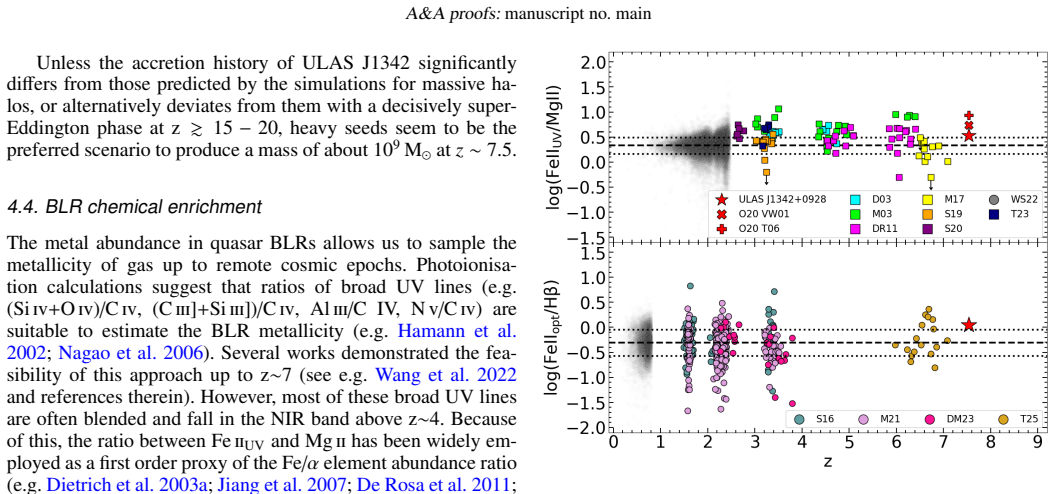
- Broad-line FeII/MgII and FeII/Hbeta ratios at z=7.54 matching lower-redshift values imply early chemical enrichment of the broad-line region, if these ratios are reliable metallicity proxies.
Where Pith is reading between the lines
- The sub-Eddington conclusion is method-dependent: the paper's own single-epoch calibrations span Eddington ratios from about 0.3 to 2.8, so if the community weights virial calibrations more heavily than the disc-model fit, the 'challenge' to widespread super-Eddington accretion weakens.
- A natural testable extension is to apply the same continuum-window accretion-disc fitting to the growing JWST sample of z>6 quasars; if most also land below Eddington, the super-Eddington paradigm fails broadly, while a mix of sub- and super-Eddington objects would suggest that accretion state correlates with X-ray weakness, outflow power, or host properties.
- The paper's own Appendix F shows that allowing SMC-like reddening shifts MBH to 10^9.0 solar masses, Lbol to 10^47.0 erg/s, and the Eddington ratio to 0.8; a direct Balmer-decrement measurement could decide whether the quasar is truly in a moderate, geometrically thick but sub-Eddington state or closer to the Eddington boundary.
- Because the measured outflow rate is an ionised-phase lower limit, the sub-Eddington accretion state is fully compatible with very strong feedback: neutral and molecular phases could push the total mass outflow rate above the star-formation rate even if the quasar is accreting at only 40 percent of Eddington.
Editorial analysis
A structured set of objections, weighed in public.
Referee Report
Summary. This paper presents new JWST/NIRSpec IFS observations of the z=7.54 quasar ULAS J1342+0928, combining PRISM and G395H data to study the nuclear and extended emission. The authors detect a ~7 kpc [OIII] halo, a nuclear ionised outflow, and two companion [OIII] emitters. They measure broad-line FeII/MgII and FeII/Hβ ratios, and use accretion-disc SED fitting to derive log M_BH = 9.2 ± 0.2, log L_bol = 46.8 ± 0.1, and λ_Edd ~ 0.4, which they interpret as a sub-Eddington accretion state. The paper also estimates ionised outflow rates of 50–300 M_sun/yr and discusses implications for early black-hole growth, feedback, and BLR chemical enrichment.
Significance. If the accretion-disc modelling is accepted, this is one of the first sub-Eddington quasars at z>7 and the first AD-based black-hole mass estimate on JWST data. The data itself are valuable: the extended [OIII] halo, spatial PSF subtraction, and nuclear outflow characterisation are careful pieces of work, with Monte Carlo uncertainties, Bayesian model averaging over three disc models, and an independent BADFit cross-check. The FeII/Hβ measurement at z>7 is also a useful first. The paper's broader significance, however, rests on the robustness of the λ_Edd~0.4 claim, and that claim is not as secure as the abstract and title suggest.
major comments (2)
- [Abstract, Sect. 4.2, Table 2, Appendix F] The headline 'sub-Eddington' claim is not robust across the estimators the paper itself presents. Table 2 combines SE virial masses (VP06, S11, P25) with bolometric corrections (R06, R12, N19) to yield λ_Edd in the range ~0.3–2.8. Appendix F further shows that including an SMC-extinction prior in the AD fit shifts the result to log M_BH = 9.0, log L_bol = 47.0, and λ_Edd = 0.8. The abstract and title nevertheless assert a sub-Eddington state and use it to 'challenge the paradigm of widespread super-Eddington accretion'. The fiducial λ_Edd~0.4 should be presented as a model-dependent estimate, and the estimator spread and extinction-shifted value should be reflected in the abstract and conclusions, not only in the body.
- [§3.3, Fig. 3] The AD-based M_BH and L_bol, and hence λ_Edd, rest on the assumption that the selected continuum windows are dominated by unobscured, non-host, standard/slim disc emission with a type-1 inclination prior. The paper argues against extinction using the steep continuum slopes and X-ray photon index, but this is circumstantial; Appendix F demonstrates that the fit has a genuine reddening degeneracy and that the reddening-prior choice moves λ_Edd by a factor of two. The quoted ±0.2/±0.1 dex uncertainties are internal to the assumed model and do not include this prior choice or possible host-galaxy contamination. The central claim would be considerably strengthened by a quantitative host-contamination test or by explicitly reporting the model-dependent range in all summary statements.
minor comments (4)
- [Abstract / §2.1] The abstract quotes R~2700 for the grating, while §2.1 gives R~1900–3600 for G395H/F290LP. Please harmonise.
- [Fig. 4 caption] The caption refers to 'R2770 spectra' in the inset panel description; this appears to be a typo for R2700.
- [Table 2] The table gives SE uncertainties as ±0.5 dex and bolometric-correction uncertainties as ±0.1–0.2 dex, but the text states these are representative systematics. It would help to label these explicitly as systematic uncertainties rather than statistical errors.
- [§4.1.3] Eq. (1) includes the clumping factor K in the normalisation, but the text defines K only in words. A brief explanation after the equation would improve clarity.
Circularity Check
No circularity: the black-hole mass, bolometric luminosity, and Eddington ratio are fitted outputs of accretion-disc SED modelling, cross-checked with an independent fitting routine; the paper's self-citations are methodological and not load-bearing.
full rationale
The central derivation chain is: (i) the prism continuum is measured in line-free windows; (ii) three accretion-disc models (Shakura-Sunyaev, KERRBB, SLIMBH) are fitted, with MBH, Lbol, spin/inclination as free parameters; (iii) the joint posteriors are combined by Bayesian model averaging, giving log(MBH/Msun)=9.2±0.2 and log(Lbol/(erg/s))=46.8±0.1; (iv) lambda_Edd is then the ratio Lbol/L_Edd(MBH). No step in this chain defines a fitted parameter as a prediction, and no quoted equation is equivalent to its own input by construction. The wide spread of single-epoch estimates (lambda_Edd=0.3-2.8, Sect. 4.2) and the Appendix F reddening test (lambda_Edd=0.8 with SMC extinction priors) are acknowledged estimator-dependence and systematic-uncertainty caveats, not circularity: the AD value is one fitted choice, and the title may overstate robustness, but the result is not forced by construction. Self-citations to Carniani et al. (2015), Perna et al. (2023), D'Eugenio et al. (2024), and other GA-NIFS papers are data-reduction recipes and outflow-mass formalisms that are externally published and calibrated; they are not used to forbid alternatives or to import an unverified uniqueness theorem. The accretion-disc fit is additionally checked with the independent BADFit routine (Lai et al. 2023), so the central sub-Eddington claim does not rest on a self-citation chain or on a fitted input being renamed a prediction.
Axiom & Free-Parameter Ledger
free parameters (9)
- Black hole mass MBH (AD fit) =
log(MBH/Msun)=9.2±0.2
- Bolometric luminosity Lbol (AD fit) =
log(Lbol/(erg/s))=46.8±0.1
- Disc inclination =
free, prior 0-70 deg
- Disc spin / ISCO radius =
free, loosely constrained
- Outflow electron density ne =
180-1000 cm^-3 (range)
- Outflow metallicity Z =
1.3 Z_sun
- Outflow history factor C =
1 or 3
- E(B-V) extinction prior (Appendix F) =
half-Gaussian from Krawczyk et al. (2015) sample
- Clumping factor K =
~1
axioms (5)
- domain assumption The nuclear continuum of ULAS J1342 is dominated by emission from an optically thick accretion disc (Shakura-Sunyaev, KERRBB, or SLIMBH), with SED shape set by MBH and accretion rate.
- domain assumption Empirical R-L relation and single-epoch virial calibrations (VP06, S11, P25) hold at z=7.54.
- domain assumption Carniani et al. (2015) outflow mass formula (Eq. 1) with K~1 and a factor-3 correction for [OIII]-vs-Hbeta applies.
- domain assumption The NLR systemic redshift z=7.535 (and [CII] z=7.540) defines the rest frame for outflow velocities.
- domain assumption Line-of-sight dust extinction toward the quasar is negligible (steep continuum, X-ray photon index).
Cite this review
Pith. "Pith review of GA-NIFS: an extended [OIII] halo around the sub-Eddington quasar J1342+0928 at z=7.54." pith.science (2026). https://pith.science/paper/77YIRIGR
@misc{pith2026250907064,
  author       = {Pith},
  title        = {Pith review of: GA-NIFS: an extended [OIII] halo around the sub-Eddington quasar J1342+0928 at z=7.54},
  year         = {2026},
  howpublished = {\url{https://pith.science/paper/77YIRIGR}},
  note         = {Machine review of arXiv:2509.07064}
}
read the original abstract
The James Webb Space Telescope (\textit{JWST}) opened a new observational window on the primordial Universe. Here we present new JWST NIRSpec integral field spectroscopy (IFS) observations of the $z=7.54$ quasar ULAS J1342+0928 obtained as part of the Galaxy Assembly with NIRSpec IFS (GA-NIFS) GTO programme. The new data-set obtained with both the prism ($R\sim100$) and the high-resolution grating ($R\sim2700$) allow for a complete description of the quasar emission from the rest-frame UV to optical bands. The low-resolution data reveal the presence of [\ion{O}{iii}] emission on $\sim$7 kpc scales, well above the typical galaxy size at this redshift, likely associated with a past outflow event. Additionally, the high-resolution observations show a more energetic ionised outflow on nuclear scales ($\lesssim 0.6$ kpc). The total ionised mass outflow rate ranges between 50 and 300 $\rm M_{\odot} \, yr^{-1}$ where the significant spread is mostly due to the lack of tight constraints on the electron density. This range overlaps in part with the star formation rate range (85--545 $\rm M_{\odot} \, yr^{-1}$), implying that the nuclear outflow could ultimately lead to an early star formation quenching. By employing an accretion disc modelling, for the first time on \textit{JWST} data, we manage to robustly estimate the black hole mass and the bolometric luminosity, $\rm \log(M_{BH}/(M_{\odot}))=9.2\pm 0.2$ and $\rm \log(L_{bol}/(erg \, s^{-1}))=46.8\pm 0.1$, respectively. We derive an Eddington ratio of $\rm \lambda_{Edd}\sim 0.4$, challenging the paradigm of widespread super-Eddington accretion in quasars at the epoch of reionisation.
Figures


Reference graph
Works this paper leans on
-
[1]
, " * write output.state after.block = add.period write newline
ENTRY address archiveprefix author booktitle chapter edition editor howpublished institution eprint journal key month note number organization pages publisher school series title type volume year label extra.label sort.label short.list INTEGERS output.state before.all mid.sentence after.sentence after.block FUNCTION init.state.consts #0 'before.all := #1 ...
-
[2]
write newline
" write newline "" before.all 'output.state := FUNCTION n.dashify 't := "" t empty not t #1 #1 substring "-" = t #1 #2 substring "--" = not "--" * t #2 global.max substring 't := t #1 #1 substring "-" = "-" * t #2 global.max substring 't := while if t #1 #1 substring * t #2 global.max substring 't := if while FUNCTION word.in bbl.in " " * FUNCTION format....
-
[3]
Abramowicz, M. A. & Fragile, P. C. 2013, Living Reviews in Relativity, 16, 1
2013
-
[4]
A., Jaroszy \'n ski, M., Kato, S., et al
Abramowicz, M. A., Jaroszy \'n ski, M., Kato, S., et al. 2010, , 521, A15
2010
-
[5]
2024, Nature, 627, 281
Abuter, R., Allouche, F., Amorim, A., et al. 2024, Nature, 627, 281
2024
-
[6]
G., Groves, B
Allen, M. G., Groves, B. A., Dopita, M. A., Sutherland, R. S., & Kewley, L. J. 2008, , 178, 20
2008
-
[7]
2020, , 643, A154
Amorim, A., Baub \"o ck, M., Brandner, W., et al. 2020, , 643, A154
2020
-
[8]
1996, in ASP Conf., Vol
Arnaud, K. 1996, in ASP Conf., Vol. 17
1996
-
[9]
P., Mazzucchelli , C., et al
Ba \ n ados , E., Venemans , B. P., Mazzucchelli , C., et al. 2018, , 553, 473
2018
-
[10]
2017, , 606, A23
Balmaverde, B., Gilli, R., Mignoli, M., et al. 2017, , 606, A23
2017
-
[11]
2018, , 856, L25
Ba \ n ados, E., Connor, T., Stern, D., et al. 2018, , 856, L25
2018
-
[12]
2019, , 881, L23
Ba \ n ados, E., Novak, M., Neeleman, M., et al. 2019, , 881, L23
2019
-
[13]
& Netzer, H
Baron, D. & Netzer, H. 2019, , 486, 4290
2019
-
[14]
& Magueijo, J
Bean, R. & Magueijo, J. 2002, Physical Review D, 66, 063505
2002
-
[15]
S., Sijacki, D., Costa, T., Laporte, N., & Witten, C
Bennett, J. S., Sijacki, D., Costa, T., Laporte, N., & Witten, C. 2024, , 527, 1033
2024
-
[16]
C., Peterson, B
Bentz, M. C., Peterson, B. M., Netzer, H., Pogge, R. W., & Vestergaard, M. 2009, , 697, 160
2009
-
[17]
L., Raccanelli, A., Verde, L., & Silk, J
Bernal, J. L., Raccanelli, A., Verde, L., & Silk, J. 2018, Journal of Cosmology and Astroparticle Physics, 2018, 017
2018
-
[18]
S., et al
Bertemes, C., Wylezalek, D., Rupke, D. S., et al. 2025, , 693, A176
2025
-
[19]
2024, , 691, A178
Bertola , E., Circosta , C., Ginolfi , M., et al. 2024, , 691, A178
2024
-
[20]
GA-NIFS: Mapping $z\simeq3.5$ AGN-driven ionized outflows in the COSMOS field
Bertola, E., Cresci, G., Venturi, G., et al. 2025, arXiv preprint arXiv:2505.08867
work page internal anchor Pith review Pith/arXiv arXiv 2025
-
[21]
2022, Nature, 605, 244
Bischetti, M., Feruglio, C., D’Odorico, V., et al. 2022, Nature, 605, 244
2022
-
[22]
2023, , 952, 44
Bischetti, M., Fiore, F., Feruglio, C., et al. 2023, , 952, 44
2023
-
[23]
2019 a , , 630, A59
Bischetti, M., Maiolino, R., Carniani, S., et al. 2019 a , , 630, A59
2019
-
[24]
2019 b , , 628, A118
Bischetti, M., Piconcelli, E., Feruglio, C., et al. 2019 b , , 628, A118
2019
-
[25]
& McKee, C
Blandford, R. & McKee, C. F. 1982, ApJ, Part 1, vol. 255, Apr. 15, 1982, p. 419-439. Research supported by the Alfred P. Sloan Foundation, 255, 419
1982
-
[26]
D., Burleigh, K., Dey, A., et al
Blum, R. D., Burleigh, K., Dey, A., et al. 2016, in American astronomical society meeting abstracts\# 228, Vol. 228, 317--01
2016
-
[27]
o ker, T., Arribas, S., L \
B \"o ker, T., Arribas, S., L \"u tzgendorf, N., et al. 2022, , 661, A82
2022
-
[28]
2023, PASP, 135, 038001
B \"o ker, T., Beck, T., Birkmann, S., et al. 2023, PASP, 135, 038001
2023
-
[29]
2019, , 625, A23
Campitiello, S., Celotti, A., Ghisellini, G., & Sbarrato, T. 2019, , 625, A23
2019
-
[30]
2020, , 640, A39
Campitiello, S., Celotti, A., Ghisellini, G., & Sbarrato, T. 2020, , 640, A39
2020
-
[31]
2012, , 537, L8
Cano-D \' az, M., Maiolino, R., Marconi, A., et al. 2012, , 537, L8
2012
-
[32]
X., Hennawi , J
Cantalupo , S., Arrigoni-Battaia , F., Prochaska , J. X., Hennawi , J. F., & Madau , P. 2014, , 506, 63
2014
-
[33]
M., Netzer, H., Lira, P., Trakhtenbrot, B., & Mej \' a-Restrepo, J
Capellupo, D. M., Netzer, H., Lira, P., Trakhtenbrot, B., & Mej \' a-Restrepo, J. 2015, , 446, 3427
2015
-
[34]
C., McLure, R
Carnall, A. C., McLure, R. J., Dunlop, J. S., et al. 2023, Nature, 619, 716
2023
-
[35]
2015, , 580, A102
Carniani, S., Marconi, A., Maiolino, R., et al. 2015, , 580, A102
2015
-
[36]
Carr, B. J. & Hawking, S. W. 1974, , 168, 399
1974
-
[37]
2023, , 680, A82
Christensen, L., Jakobsen, P., Willott, C., et al. 2023, , 680, A82
2023
-
[38]
2021, , 646, A96
Circosta, C., Mainieri, V., Lamperti, I., et al. 2021, , 646, A96
2021
-
[39]
P., et al
Costa, T., Arrigoni Battaia, F., Farina, E. P., et al. 2022, , 517, 1767
2022
-
[40]
Costa, T., Rosdahl, J., Sijacki, D., & Haehnelt, M. G. 2018, , 473, 4197
2018
-
[41]
Costa, T., Sijacki, D., Trenti, M., & Haehnelt, M. G. 2014, , 439, 2146
2014
-
[42]
2023, , 672, A128
Cresci, G., Tozzi, G., Perna, M., et al. 2023, , 672, A128
2023
-
[43]
2002, , 337, 275
Croom, S., Rhook, K., Corbett, E., et al. 2002, , 337, 275
2002
-
[44]
2013, Explanatory Supplement to the AllWISE Data Release Products, 1
Cutri, R., Wright, E., Conrow, T., et al. 2013, Explanatory Supplement to the AllWISE Data Release Products, 1
2013
-
[45]
M., Bentz , M
Dalla Bont \`a , E., Peterson , B. M., Bentz , M. C., et al. 2020, , 903, 112
2020
-
[46]
Davies , R. I. 2007, , 375, 1099
2007
-
[47]
L., Belli, S., Park, M., et al
Davies, R. L., Belli, S., Park, M., et al. 2024, , 528, 4976
2024
-
[48]
2011, , 739, 56
De Rosa, G., Decarli, R., Walter, F., et al. 2011, , 739, 56
2011
-
[49]
2023, , 669, A83
Deconto-Machado, A., del Olmo Orozco, A., Marziani, P., Perea, J., & Stirpe, G. 2023, , 669, A83
2023
-
[50]
& Volonteri, M
Devecchi, B. & Volonteri, M. 2009, , 694, 302
2009
-
[51]
2008, , 676, 33
Di Matteo, T., Colberg, J., Springel, V., Hernquist, L., & Sijacki, D. 2008, , 676, 33
2008
-
[52]
2003 a , , 596, 817
Dietrich, M., Hamann, F., Appenzeller, I., & Vestergaard, M. 2003 a , , 596, 817
2003
-
[53]
2003 b , , 589, 722
Dietrich, M., Hamann, F., Shields, J., et al. 2003 b , , 589, 722
2003
-
[54]
2018, International Journal of Modern Physics A, 33, 1844029
Dolgov, A. 2018, International Journal of Modern Physics A, 33, 1844029
2018
-
[55]
& Wang, J.-M
Du, P. & Wang, J.-M. 2019, , 886, 42
2019
-
[56]
J., Scholtz, J., et al
D’Eugenio, F., Cameron, A. J., Scholtz, J., et al. 2025, , 277, 4
2025
-
[57]
G., Maiolino, R., et al
D’Eugenio, F., P \'e rez-Gonz \'a lez, P. G., Maiolino, R., et al. 2024, Nature Astronomy, 8, 1443
2024
-
[58]
Eisenstein, D. J. & Loeb, A. 1994, arXiv preprint astro-ph/9401016
Pith/arXiv arXiv 1994
-
[59]
Fan, X., Ba \ n ados, E., & Simcoe, R. A. 2023, ARA&A, 61, 373
2023
-
[60]
P., Arrigoni-Battaia, F., Costa, T., et al
Farina, E. P., Arrigoni-Battaia, F., Costa, T., et al. 2019, , 887, 196
2019
-
[61]
P., Schindler, J.-T., Walter, F., et al
Farina, E. P., Schindler, J.-T., Walter, F., et al. 2022, , 941, 106
2022
-
[62]
P., Venemans, B
Farina, E. P., Venemans, B. P., Decarli, R., et al. 2017, , 848, 78
2017
-
[63]
D., Barth, A
Fausnaugh, M., Denney, K. D., Barth, A. J., et al. 2016, , 821, 56
2016
-
[64]
J., Porter, R., Van Hoof, P., et al
Ferland, G. J., Porter, R., Van Hoof, P., et al. 2013, Revista mexicana de astronom \' a y astrof \' sica, 49, 137
2013
-
[65]
2014, , 443, 2410
Ferrara, A., Salvadori, S., Yue, B., & Schleicher, D. 2014, , 443, 2410
2014
-
[66]
2017, , 601, A143
Fiore, F., Feruglio, C., Shankar, F., et al. 2017, , 601, A143
2017
-
[67]
2021, , 505, 5753
Fluetsch, A., Maiolino, R., Carniani, S., et al. 2021, , 505, 5753
2021
-
[68]
2019, , 483, 4586
Fluetsch, A., Maiolino, R., Carniani, S., et al. 2019, , 483, 4586
2019
-
[69]
W., Lang , D., & Goodman , J
Foreman-Mackey , D., Hogg , D. W., Lang , D., & Goodman , J. 2013, PASP, 125, 306
2013
-
[70]
B., Trump, J
Fries, L. B., Trump, J. R., Horne, K., et al. 2024, , 975, 239
2024
-
[71]
C., Allen , G
Fruscione , A., McDowell , J. C., Allen , G. E., et al. 2006, in Society of Photo-Optical Instrumentation Engineers (SPIE) Conference Series, Vol. 6270, Observatory Operations: Strategies, Processes, and Systems, ed. D. R. Silva & R. E. Doxsey , 62701V
2006
-
[72]
2017, , 470, 2578
Garc \' a-Gonz \'a lez, J., Alonso-Herrero, A., H \"o nig, S., et al. 2017, , 470, 2578
2017
-
[73]
P., Mather, J
Gardner, J. P., Mather, J. C., Abbott, R., et al. 2023, PASP, 135, 068001
2023
-
[74]
P., Mather, J
Gardner, J. P., Mather, J. C., Clampin, M., et al. 2006, Space Science Reviews, 123, 485
2006
-
[75]
2018, Technical Report JWST-STScI-001007, 1007
Gordon, K., Boyer, M., Sloan, G., Muzerolle, J., & Volk, K. 2018, Technical Report JWST-STScI-001007, 1007
2018
-
[76]
Gordon, K. D. 2024, Journal of Open Source Software, 9, 7023
2024
-
[77]
D., Fitzpatrick, E., Massa, D., et al
Gordon, K. D., Fitzpatrick, E., Massa, D., et al. 2024, ApJ, 970, 51
2024
-
[78]
Grandi, S. A. 1982, ApJ, Part 1, vol. 255, Apr. 1, 1982, p. 25-38., 255, 25
1982
-
[79]
2018, Nature, 563, 657
Gravity Collaboration . 2018, Nature, 563, 657
2018
-
[80]
& Ferland, G
Hamann, F. & Ferland, G. 1993, ApJ v. 418, p. 11, 418, 11
1993
discussion (0)
Sign in with ORCID, Apple, or X to comment. Anyone can read and Pith papers without signing in.