REVIEW 2 major objections 5 minor 1 cited by
Compressing Syndrome Measurement Sequences
T0 review · 2 major / 5 minor · reviewed 2026-08-04 · deepseek-v4-flash
Pith's one-line read This paper claims that combining stabilizer generators according to a classical parity-check matrix compresses the syndrome, so LDPC codes can be fault-tolerantly corrected with O(d log r) measurements and concatenated codes with O(d log d
desk verdict Genuinely new and constructive syndrome-compression framework with solid weak-fault-tolerance bounds, but the single-shot Corollary 8.2 rests on an unproven gauge-fixing step. read the letter →
The pith
A machine-rendered reading of the paper's core claim, the machinery that carries it, and where it could break.
The reading
What carries the argument
The key object is the compressed measurement matrix H_m = P H, where H is the r×n parity-check matrix of the quantum code and P is the r'×r parity-check matrix of a classical code of distance w+1, with w the maximum syndrome weight of the quantum code. Measuring the rows of H_m instead of H shortens the schedule from r to r' checks; P's distance guarantees that any nonzero syndrome surviving compression has weight at least d, so the compressed schedule preserves the detection distance. The BCH code supplies P with r' = O(w log r) rows, and the syndrome-weight bound for LDPC (w = O(d)) or concatenated (w = O(d log d)) codes delivers the stated scaling.
What would settle it
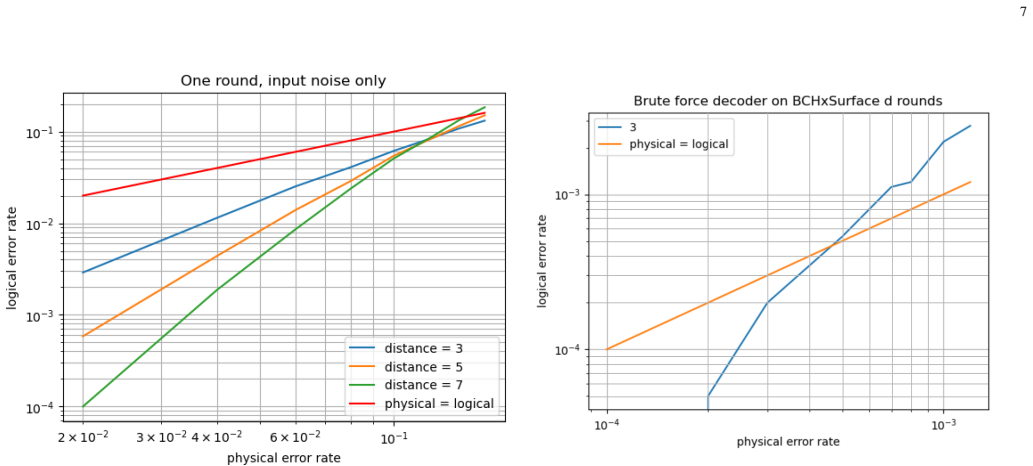
Test the compressed schedule on a concrete LDPC code family with a brute-force decoder and check whether the logical error rate decays as p^d (weak fault tolerance) or degrades to p^{d/2}; alternatively, attempt to construct a low-weight error that, under the Corollary 8.2 schedule, is corrected to a different logical state or gauge of the original code.
Extended reading notes
Core claim
The central claim is that a quantum stabilizer code's syndrome, viewed as a classical bitstring of bounded weight, can be compressed by a classical parity-check matrix without losing the ability to detect errors up to the code's distance. Measuring the rows of P·H—parity checks of a classical code applied to the original stabilizer matrix—produces a shorter measurement sequence; if P has distance exceeding the maximum syndrome weight, any error that escapes all these combined measurements must be a logical operator of weight at least d. Choosing P as a BCH code of distance Θ(d) gives O(d log r) measurements, and repeating the schedule d times, or applying a known single-shot construction, gi
Load-bearing premise
The single-shot version rests on the assumption that the code defined by the compressed measurements, a subgroup of the original stabilizer group, can be gauge-fixed back to the original code: that its decoder, after correcting errors, returns the state to the original codespace up to stabilizers of the original code—a step the paper sketches but does not prove.
Editorial extensions
If this is right
- Syndrome extraction cost can be decoupled from the number of stabilizer generators: for LDPC and concatenated codes, O(d log r) or O(d log d log r) measurements suffice, asymptotically below r.
- The construction is explicit: the schedules are written down as products of the original stabilizer generators selected by a classical parity-check matrix, giving a constructive counterpart to earlier existence results.
- For the surface code, d rounds of the compressed schedule yield exponential error suppression with O(d^2 log d) total measurements, versus O(d^3) for the standard generator-by-generator approach.
- Applying the known single-shot construction to the compressed code gives a single-shot fault-tolerant schedule of the same asymptotic length (Corollary 8.2).
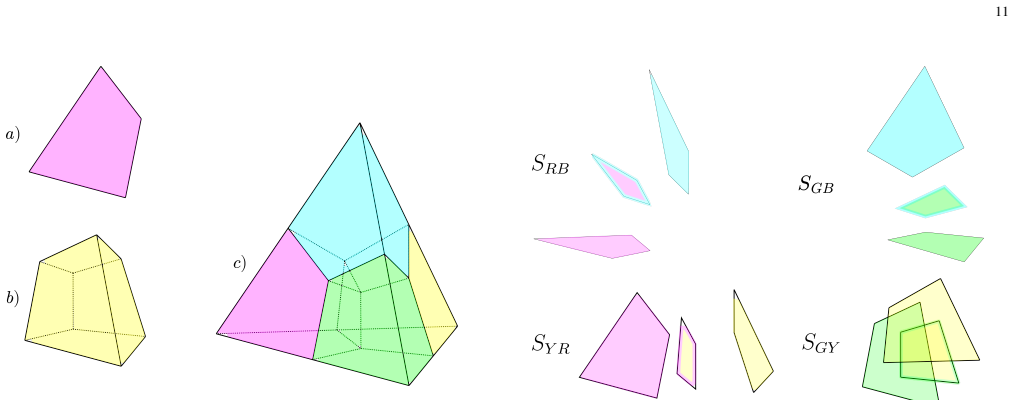
- The same compression viewpoint explains existing measurement redundancies, such as the tetrahedral code admitting only four Z-checks while preserving distance 3.
Reading between the lines
- The compression recipe should transfer to any code family with a syndrome-weight bound, including subsystem codes or codes with spatially local checks, potentially yielding sub-generator schedules beyond LDPC and concatenated families.
- The trade-off between measurement count and stabilizer weight is tunable through the choice of classical code; low-weight variants such as repetition-code compression in Section VI are likely more practical than the asymptotic BCH-optimal schedules for near-term hardware.
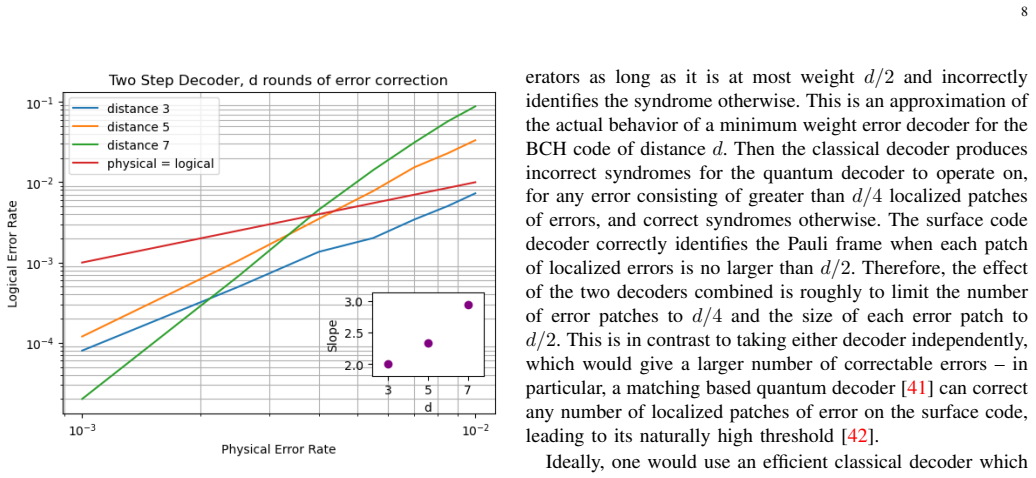
- An efficient decoder that respects the classical code's noise model rather than raw Hamming weight could alter the threshold behavior seen in Figures 4–5 and make the two-step decoder competitive with brute force.
- Combining the compressed schedule with data-syndrome codes (Section VIII) gives robustness to measurement errors but not to mid-circuit errors; closing that gap would yield O(d log r) schedules that are both short and robust.
Editorial analysis
A structured set of objections, weighed in public.
Referee Report
Summary. The paper proposes a framework for reducing the number of syndrome measurements needed for fault-tolerant error correction of stabilizer codes. The central construction multiplies the stabilizer parity-check matrix H by the parity-check matrix P of a classical code; Theorem 3 shows that if all low-weight errors have syndrome weight at most w, then choosing P with distance w+1 ensures that any undetectable error has weight at least d. For LDPC codes w = O(d), yielding a compressed round with O(d log r) measurements, and for concatenated codes a similar bound is claimed. Repeating the compressed round d times gives a weakly fault-tolerant schedule with O(d^2 log r) measurements. The paper further claims, via Campbell's single-shot fault-tolerance theorem, that the compressed round can be made single-shot with only O(d log r) measurements. Numerical surface-code experiments and a two-step decoder analysis are also presented.
Significance. The framework is constructive and the central reduction in Theorem 3 is clean. The paper uses no fitted parameters, relies on standard BCH code parameters, and the LDPC and concatenated bounds follow from the stated syndrome-weight lemmas. The surface-code simulations are concrete, and the authors state that the simulation code is available. If the single-shot transition in Section VII can be rigorously justified, the paper would establish a significant asymptotic reduction in syndrome-measurement count. As it stands, however, that transition is the main missing piece, and the abstract's strongest claim is not yet supported by the proofs in the manuscript.
major comments (2)
- [Section VII, Corollary 8.2] The transition from the compressed code Q' back to the original code Q is not proved. Q' is defined by the compressed checks P H, so its stabilizer group G' is a proper subgroup of the original stabilizer group S. Consequently the logical operators of Q' include the original stabilizer generators in S \ G'; these have the weight of the original stabilizers (e.g., O(1) for the surface code), so d(Q') can be far smaller than d. Corollary 8.1 applied to Q' therefore limits only errors with 2|u|+|E| < d(Q')/2, not d/2. The sentence 'The errors which are not caught ... either harmless stabilizers or guaranteed to be high-weight by Theorem 3' concerns only errors with zero measured syndrome; it does not control the recovery applied by the Q' decoder when the syndrome has weight between d(Q')/2 and d/2. What is needed is a subsystem-code version of Campbell's theorem for Q' with gauge group S a
- [Abstract and Section VII] The abstract's claim of fault-tolerant error correction with O(d log r) measurements (and O(d log d log r) for concatenated codes) is not the result proved by the weak-fault-tolerance machinery. The repetition argument in Section III gives a weakly fault-tolerant schedule only after d rounds, i.e., O(d^2 log r) measurements. The O(d log r) and O(d log d log r) statements are exactly Corollary 8.2, which rests on the missing subsystem-code proof discussed above. Please qualify the abstract and introduction, or supply the missing argument, so that the claimed asymptotic is not presented as a proven standalone theorem.
minor comments (5)
- [Theorem 3 proof] The proof writes 0 < |He| ≤ w+1; since w = max_{|e|<d} |He|, a nonzero syndrome has weight at most w. With P of distance w+1 this already gives the contradiction; the w+1 is harmless but confusing.
- [Lemma 4] 'By the triangle equality' should read 'by the triangle inequality'.
- [Corollary 5.1] The bound w ≤ cD log_d D conflicts with Lemma 5 and with the sentence following the corollary ('distance only c log_d D times the desired distance'). The factor D appears spurious; please correct the statement.
- [Theorem 6 proof] In the proof, 'Since s+e_m is at most weight w' should refer to s+e'_m; otherwise the statement is not the one justified by the preceding argument.
- [Lemma 7] In the greedy assignment, 'assign the candidate stabilizer a to subset A1 if ... for all a_j ∈ A_i' should clearly refer to A_1. Also specify that the stabilizers removed from consideration are exactly those sharing support with the newly added stabilizer.
Circularity Check
No significant circularity: the construction is self-contained and no fitted parameter is relabeled as a prediction; the Sec. VII concern is an unproven transition, not a circular reduction.
full rationale
The paper's central derivation is a direct algebraic construction: it combines stabilizer generators according to a classical parity-check matrix P, with Theorem 3 proving that any error with PHe = 0 must have weight at least d given the bounded-syndrome-weight assumption w. This is a genuine lemma, not an input disguised as an output. The quantity w is an assumed property of the original code, not a fitted parameter, and the BCH-code parameters are standard external facts. Campbell's single-shot theorem is cited from outside the author group, so it is not a self-citation chain. The numerical results compare logical error rates under stated noise models; they are observations, not predictions forced from fitted values. The reviewer's flagged concern about Corollary 8.2 is a correctness gap: Q' may have distance smaller than d because the original stabilizers become low-weight logical operators of Q', so Campbell's guarantee for Q' does not automatically transfer to Q, and a subsystem-code argument is missing. That is an unproven step, but it is not circular in the sense of deriving a result from its own conclusion or renaming a fit as a prediction. Therefore the circularity score is 0.
Assumptions & free parameters
assumptions (3)
- domain assumption The quantum code's syndrome has bounded weight w: any error of weight < d produces a syndrome of weight at most w.
- standard math BCH codes with length r ~ n-k, distance w+1, and O(w log r) parity checks exist for the parameters at hand.
- ad hoc to paper Campbell's single-shot fault-tolerance theorem applies to the compressed code Q' and, after gauge fixing, protects the original code Q.
Cite this review
Pith. "Pith review of Compressing Syndrome Measurement Sequences." pith.science (2026). https://pith.science/paper/GVE2QJLO
@misc{pith2026250907288,
  author       = {Pith},
  title        = {Pith review of: Compressing Syndrome Measurement Sequences},
  year         = {2026},
  howpublished = {\url{https://pith.science/paper/GVE2QJLO}},
  note         = {Machine review of arXiv:2509.07288}
}
abstract
In this work, we analyze a framework for constructing fault-tolerant measurement schedules of varying lengths by combining stabilizer generators, and prove results about the distance of such schedules by combining according to classical codes. Using this framework, we produce explicit measurement schedules sufficient for fault-tolerant error correction of quantum codes of distance $d$ with $r$ independent stabilizer generators using only $O(d \log{r})$ measurements if the code is LDPC, and $O(d \log d \log r)$ measurements if the code is produced via concatenating a smaller code with itself $O(\log d)$ times. In both of these cases the number of measurements can be asymptotically fewer than the number of stabilizer generators which define the code. Although optimizing our construction to use the fewest measurements produces high-weight stabilizers, we also show that we can reduce the number of measurements used for specific examples while maintaining low-weight stabilizer measurements. We numerically examine the performance of our construction on the surface code under several noise models and demonstrate the exponential error suppression with increasing distance which is characteristic of weak fault tolerance.
Figures

Figures from the paper (6 more)



Forward citations
Cited by 1 Pith paper
-
When to Skip Syndrome Extraction in Surface-GKP Codes
Adaptive skipping of surface-code stabilizer measurements in surface-GKP codes, guided by GKP analog data, reduces measurement count while preserving or improving logical error rates in circuit-level simulations under...
Reference graph
Works this paper leans on
-
[1]
P. W. Shor, Fault-tolerant quantum computation, Pro- ceedings of 37th conference on foundations of computer science (1996)
work page 1996
-
[2]
T. J. Yoder, R. Takagi, and I. L. Chuang, Phys. Rev. X 6, 031039 (2016)
work page 2016
-
[3]
Lidar,Quantum Error Correction(Cambridge Uni- versity Press, 2013)
D. Lidar,Quantum Error Correction(Cambridge Uni- versity Press, 2013)
work page 2013
- [4]
-
[5]
A. G. Fowler, M. Mariantoni, J. M. Martinis, and A. N. Cleland, Phys. Rev. A86, 032324 (2012)
2012
-
[6]
Gottesman, Stabilizer codes and quantum error cor- rection (1997), arXiv:quant-ph/9705052
D. Gottesman, Stabilizer codes and quantum error cor- rection (1997), arXiv:quant-ph/9705052
arXiv 1997
-
[7]
Google Quantum AI, Nature614, 676 (2023)
2023
-
[8]
L. Egan, D. M. Debroy, C. Noel, A. Risinger, D. Zhu, D. Biswas, M. Newman, M. Li, K. R. Brown, M. Cetina, and C. Monroe, Nature598, 281 (2021)
2021
Show all 46 references
-
[9]
Foxen et
B. Foxen et. al (Google AI Quantum), Phys. Rev. Lett. 125, 120504 (2020)
2020
-
[10]
Bomb ´ın, Phys
H. Bomb ´ın, Phys. Rev. X5, 031043 (2015)
2015
-
[11]
E. T. Campbell, Quantum Science and Technology4, 025006 (2019)
2019
-
[12]
Stahl, Physical Review B110, 075143 (2024)
C. Stahl, Physical Review B110, 075143 (2024)
2024
-
[13]
Y . Lin, S. Huang, and K. R. Brown, Phys. Rev. A109, 052438 (2024)
2024
-
[14]
Kubica and M
A. Kubica and M. Vasmer, Nature Communications13, 10.1038/s41467-022-33923-4 (2022)
2022 doi
-
[15]
A. O. Quintavalle, M. Vasmer, J. Roffe, and E. T. Camp- bell, PRX Quantum2, 10.1103/prxquantum.2.020340 (2021)
2021 doi
-
[16]
S. Gu, E. Tang, L. Caha, S. H. Choe, Z. He, and A. Kubica, Communications in Mathematical Physics 405, 10.1007/s00220-024-04951-6 (2024)
2024 doi
-
[17]
Hillmann, G
T. Hillmann, G. Dauphinais, I. Tzitrin, and M. Vasmer, Single-shot and measurement-based quantum error cor- rection via fault complexes, arXiv:2410.12963
-
[18]
Berthusen, S
N. Berthusen, S. J. S. Tan, E. Huang, and D. Gottesman, PRX Quantum6, 030307 (2025)
2025
-
[19]
Berthusen and D
N. Berthusen and D. Gottesman, Quantum8, 1345 (2024)
2024
-
[20]
Tansuwannont, B
T. Tansuwannont, B. Pato, and K. R. Brown, Quantum 7, 1075 (2023)
2023
-
[21]
Delfosse and B
N. Delfosse and B. W. Reichardt, Short shor-style syn- drome sequences (2020), arXiv:2008.05051
2020 arXiv
-
[22]
Mohseninia, J
R. Mohseninia, J. Yang, I. Siddiqi, A. N. Jordan, and J. Dressel, Quantum4, 358 (2020)
2020
-
[23]
Kumar and A
P. Kumar and A. Patel, Quantum Information Processing 18, 10.1007/s11128-018-2166-5 (2019)
2019 doi
-
[24]
Gottesman, Opportunities and challenges in fault- tolerant quantum computation (2022), arXiv:2210.15844
D. Gottesman, Opportunities and challenges in fault- tolerant quantum computation (2022), arXiv:2210.15844
2022 arXiv
-
[25]
Nemec and T
A. Nemec and T. Tansuwannont, A hamming-like bound for degenerate stabilizer codes (2023), arXiv:2306.00048
2023 arXiv
-
[26]
S. A. Aly, A note on quantum hamming bound (2007), arXiv:0711.4603
2007 arXiv
-
[27]
Dallas, F
E. Dallas, F. Andreadakis, and D. Lidar, IEEE BITS the Information Theory Magazine2, 33 (2023). 15
2023
-
[28]
Delfosse, B
N. Delfosse, B. W. Reichardt, and K. M. Svore, IEEE Transactions on Information Theory68, 287–301 (2022)
2022
-
[29]
Ashikhmin, C.-Y
A. Ashikhmin, C.-Y . Lai, and T. A. Brun, in2014 IEEE International Symposium on Information Theory(IEEE,
-
[30]
Guttentag, A
E. Guttentag, A. Nemec, and K. R. Brown, in2024 IEEE International Symposium on Information Theory (ISIT) (IEEE, 2024) pp. 2281–2286
2024
-
[31]
Fujiwara, Physical Review A90, 062304 (2014)
Y . Fujiwara, Physical Review A90, 062304 (2014)
2014
-
[32]
V . N. Premakumar, H. Sha, D. Crow, E. Bach, and R. Joynt, Quantum Information Processing20, 84 (2021)
2021
-
[33]
A. R. Calderbank and P. W. Shor, Phys. Rev. A54, 1098 (1996)
1996
-
[34]
Steane, Proceedings of the Royal Society of London
A. Steane, Proceedings of the Royal Society of London. Series A: Mathematical, Physical and Engineering Sci- ences452, 2551 (1996)
1996
-
[35]
R. C. Bose and D. K. Ray-Chaudhuri, Information and Control3, 68 (1960)
1960
-
[36]
Hocquenghem, Chiffers2, 147 (1959)
A. Hocquenghem, Chiffers2, 147 (1959)
1959
-
[37]
Chao and B
R. Chao and B. W. Reichardt, Phys. Rev. Lett.121, 050502 (2018)
2018
-
[38]
Chamberland, P
C. Chamberland, P. Iyer, and D. Poulin, Quantum2, 43 (2018)
2018
-
[39]
Knill, Nature434, 39–44 (2005)
E. Knill, Nature434, 39–44 (2005)
2005
-
[40]
Gidney, Quantum5, 497 (2021)
C. Gidney, Quantum5, 497 (2021)
2021
-
[41]
Higgott and C
O. Higgott and C. Gidney, Quantum9, 1600 (2025)
2025
-
[42]
Dennis, A
E. Dennis, A. Kitaev, A. Landahl, and J. Preskill, Journal of Mathematical Physics43, 4452–4505 (2002)
2002
-
[43]
A. G. Manes and J. Claes, Quantum9, 1618 (2025)
2025
-
[44]
Bombin and M
H. Bombin and M. Martin-Delgado, Physical Review B—Condensed Matter and Materials Physics75, 075103 (2007)
2007
-
[45]
Bomb ´ın, New Journal of Physics17, 083002 (2015)
H. Bomb ´ın, New Journal of Physics17, 083002 (2015)
2015
-
[46]
J. T. Anderson, G. Duclos-Cianci, and D. Poulin, Physi- cal Review Letters113, 080501 (2014)
2014
Reviewed August 4, 2026 · model on record in the stance chip above.
Discussion (0). Sign in to comment.