REVIEW 3 major objections 6 minor 93 references
An $ab\;initio$ answer to long-debated questions about superconducting Nb$_3$Sn
T0 review · 3 major / 6 minor · reviewed 2026-08-04 · deepseek-v4-flash
Pith's one-line read This paper presents the first fully ab initio microscopic description of superconducting Nb3Sn and shows that the measured drop of the upper critical field across the martensitic transition is caused by a redistribution of Fermi velocities
desk verdict The anharmonic phonons and gap anisotropy are real progress; the Hc2 and first-order claims are built on a tetragonal phase that the calculation itself refuses to stabilize. read the letter →
The pith
A machine-rendered reading of the paper's core claim, the machinery that carries it, and where it could break.
The reading
What carries the argument
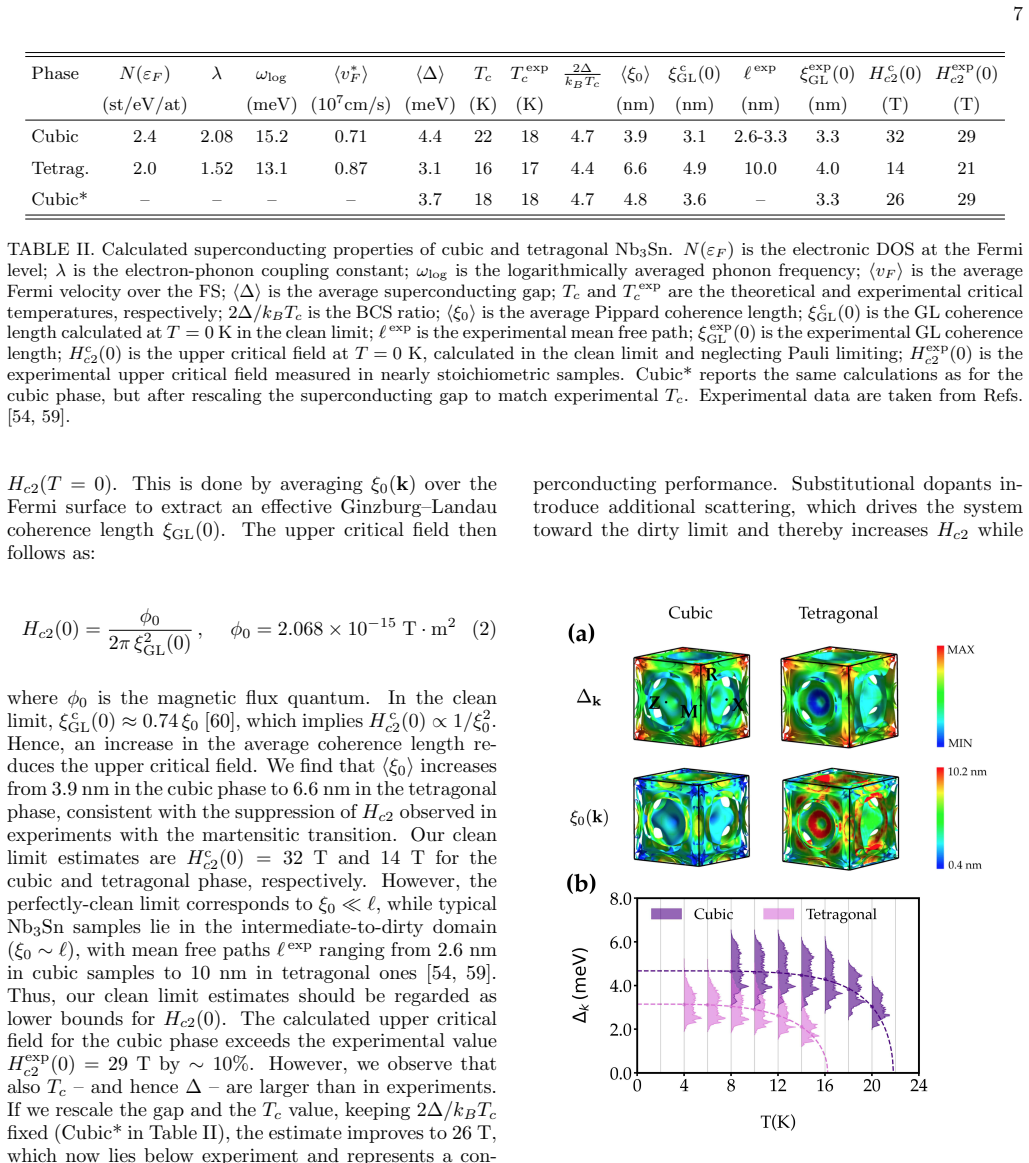
The load-bearing machinery is the combination of (i) the SSCHA treatment of anharmonicity, which removes the imaginary phonons that make harmonic theory unstable and reproduces neutron-scattering spectra, and (ii) the momentum-resolved Pippard coherence length ξ0(k) = ħvF(k)/(πZ_kΔ_k), with Z_k = 1 + λ_k, evaluated from the full-bandwidth anisotropic Migdal–Eliashberg solution. The coherence length distribution—controlled mainly by the renormalized Fermi velocity v*_F = v_F/Z rather than by the gap—is what converts the Fermi-surface reshaping into a numerically specific Hc2 value via Hc2(0) = φ0/(2π ξ_GL(0)^2).
What would settle it
Compute the tetragonal electronic structure at a genuinely relaxed tetragonal minimum (e.g., using the PBE0 functional that the paper's footnote 43 says gives a larger tetragonal energy gain) and recalculate ξ0 and Hc2; or measure the Fermi-velocity redistribution in tetragonal Nb3Sn directly via quantum oscillations. If the measured clean-limit Hc2 of tetragonal Nb3Sn does not fall near the predicted ~14 T lower bound, the coherence-length mechanism is wrong or the fixed experimental structure is the wrong reference.
Extended reading notes
Core claim
The paper's core claim is that the suppression of Hc2 in tetragonal Nb3Sn is a Fermi-surface effect. Solving the full-bandwidth anisotropic Migdal–Eliashberg equations on anharmonic phonons, the authors compute the momentum-resolved Pippard coherence length ξ0(k) = ħvF(k)/(π Z_k Δ_k) and find that the tetragonal distortion reshapes the Fermi surface so that the Γ-centered electron pockets, short-coherence regions in the cubic phase, become long-coherence regions. The average coherence length increases from 3.9 to 6.6 nm, lowering the clean-limit Hc2(0) from 32 T to 14 T, bracketing the experimental change from 29 T to 21 T. The same calculation yields a strongly anisotropic but nodeless supe
Load-bearing premise
All tetragonal results are computed for the experimental tetragonal geometry even though the calculation's own anharmonic relaxation finds no tetragonal minimum and relaxes every tetragonal starting point back to cubic; if the physically relaxed tetragonal structure differs, the computed Fermi velocities, coherence lengths, and the Hc2 reduction could change substantially.
Editorial extensions
If this is right
- If correct, the martensitic transition in Nb3Sn is a weakly first-order transition between two anharmonically stabilized structures, not a soft-mode Peierls transition; the tetragonal phase may be stabilized in real samples by internal stress.
- The superconducting gap is single-valued and fully open, so two-gap scenarios from early specific-heat and point-contact data are not supported; pairing involves transverse Nb d orbitals and is three-dimensional.
- The Hc2 drop across the martensitic transition is intrinsic and Fermi-surface driven: suppressing the transition (e.g., by epitaxial growth or stress-free synthesis) would preserve the higher Hc2.
- Sn-site doping (e.g., Al) should raise both Tc and Hc2 by strengthening transverse-state coupling and isotropizing the gap; Nb-site doping (Ti, Ta, Hf) reinforces Hc2 through scattering but lowers Tc by weakening the strongly coupled chain states.
- The ab initio clean-limit Hc2(0) of 32 T for cubic Nb3Sn is a lower bound; real samples in the intermediate-to-dirty limit should have slightly higher values, consistent with experiment.
Reading between the lines
- The same coherence-length-redistribution mechanism could be tested in other A15 compounds with martensitic transitions (e.g., V3Si), where a similar Hc2 drop is debated; the paper's machinery is transferable.
- The claim that the tetragonal phase is stabilized by internal stress suggests that controlled stress engineering (e.g., strain from substrates) could be a cleaner alternative to chemical doping for preserving cubic-phase Hc2.
- The paper's clean-limit Hc2 formula neglects Pauli limiting and orbital pair-breaking in the dirty/intermediate regime; a full Hc2(T) curve from the same Fermi-surface data could sharpen the comparison and expose how much of the 14 T underestimate is due to the fixed experimental tetragonal structure.
- The predicted doping trade-off between Tc and Hc2 for Nb-site vs Sn-site doping can be tested by measuring the gap anisotropy (e.g., point-contact spectroscopy) in Al-doped vs Ti-doped samples.
Editorial analysis
A structured set of objections, weighed in public.
Referee Report
Summary. The paper combines SSCHA anharmonic lattice dynamics (accelerated by machine-learned potentials) with full-bandwidth anisotropic Migdal-Eliashberg calculations (EPW) to describe cubic and tetragonal Nb3Sn. It claims to resolve three long-standing issues: (i) the martensitic transition is weakly first-order and anharmonicity stabilizes both phases; (ii) the superconducting gap is strongly anisotropic but fully open, with pairing contributions from both longitudinal and transverse Nb d-orbitals; and (iii) the experimentally observed Hc2 drop across the transition is explained by a combination of weaker electron-phonon coupling and a redistribution of Fermi velocities that increases the average Pippard coherence length from 3.9 nm (cubic) to 6.6 nm (tetragonal). The paper additionally proposes that Sn-site doping could enhance transverse-state coupling and raise Tc and Hc2, while Nb-site doping reinforces Hc2 at the cost of Tc.
Significance. If confirmed, this would be the first fully ab initio microscopic account of the superconducting properties of the two phases of Nb3Sn, a technologically central superconductor. The state-of-the-art methodology is a genuine strength: SSCHA-MLIP reproduces the neutron-scattering phonon spectra, including the temperature renormalization of the Gamma_12^+ mode, and the full-bandwidth solution of the Migdal-Eliashberg equations avoids the numerical smearing artifacts that plague earlier DFT studies. The paper also provides a concrete, falsifiable microscopic mechanism for the Hc2 reduction across the martensitic transition, which is a long-standing puzzle in the A15 community. However, the validity of the central Hc2 claim rests on the tetragonal-phase treatment, which the authors themselves report is not a stable minimum of the SSCHA free energy.
major comments (3)
- [Sec. II and V.B] The central Hc2 mechanism is computed for a tetragonal structure that the authors' own SSCHA calculation does not stabilize. Sec. II states that 'within SSCHA all tetragonal configurations... relax back to the cubic structure' and that the experimental structure is adopted 'as a reference.' The tetragonal Fermi-surface redistribution, the average coherence length 6.6 nm, and the resulting Hc2 estimate of 14 T in Table II and Eq. (2) are all derived from this non-stationary point. The PBE0 test in footnote [43] indicates that the energy surface is functional-dependent, so the correct relaxed tetragonal geometry is not established. Since a small change in the tetragonal distortion could alter the Gamma-centered FS pockets that are identified as the origin of the long-ξ0 regions, the central claim (iii) is conditional. The authors should either compute the tetragonal superconducting propert
- [Sec. IV and Conclusions, Fig. 2(b)] The paper claims that the martensitic transition is 'weakly first-order between two nearly-degenerate minima, both stabilized by anharmonic effects' (Sec. IV and Conclusions). This is internally inconsistent with the SSCHA free-energy landscape of Fig. 2(b), which shows a single cubic minimum and no tetragonal stationary point; Sec. II explicitly states that all tetragonal configurations relax back to cubic. A transition between a minimum and a non-stationary point is not a first-order transition. To support conclusion (i), the authors need either a second minimum in the anharmonic free energy (e.g., under finite stress or with a different functional), or they should clearly state that their calculation does not reproduce the martensitic transition and lower the strength of the claim accordingly.
- [Sec. V.A and Table S2] The tetragonal Coulomb pseudopotential μ* is obtained by rescaling the cubic μ* by the DOS ratio (Table S2) rather than from a separate first-principles RPA/KO calculation, unlike the cubic μ*. This choice directly affects the tetragonal gap Δ_k, and through Eq. (1) the coherence length ξ0(k) = ħ v_F / (π Z_k Δ_k), and therefore the predicted Hc2. The qualitative conclusion may survive, but the quantitative estimate (14 T vs 21 T experimental) and even the extent of the coherence-length redistribution depend on this ad hoc rescaling. The authors should report a sensitivity analysis, e.g., using the same μ* for both phases or computing a fully first-principles tetragonal μ*, to demonstrate that the Hc2 mechanism is robust.
minor comments (6)
- [SM Section I vs main text] The main text (Sec. VII) states that PBEsol was used, while the Supplemental Material Section I refers to the 'Perdew-Burke-Ernzerhof (PBE) exchange-correlation functional.' Please clarify which functional was used for the final calculations and, if different, whether results change.
- [Sec. VII] The sentence 'The structures were pre-relaxed using and then relaxed within SSCHA' is incomplete; please fix.
- [Table II] The notation for the Ginzburg-Landau coherence length is inconsistent: ξ^c_GL(0) in the table header versus ξ_c^GL(0) in the text and the footnote. Please unify. Also define all symbols in the caption consistently.
- [Fig. 4 caption] The figure caption describes panels (a-d), (b-e), and (c-f), but the text refers to '(a) and (d)', '(b) and (e)', '(c) and (f)'. The panel labeling appears inconsistent; please check.
- [Footnote [61]] The sentence 'may justify why the experimentally observed Tc reduction...' is a fragment and reads awkwardly. Integrate it into the main text.
- [SM Fig. 7 caption] Typo: 'coherence lenght' should be 'coherence length'.
Circularity Check
No circularity: Hc2 prediction is computed from calculated phonons, coupling, and Fermi velocities; experimental quantities are comparisons, not fitted inputs.
full rationale
The derivation chain is self-contained. Phonons are computed with anharmonic SSCHA (Sec. IV), electron-phonon matrix elements with DFPT/EPW, and superconducting gaps by solving the full-bandwidth anisotropic Migdal-Eliashberg equations (Sec. V.A, Methods); these give xi0(k) = hbar vF(k)/(pi Zk Delta_k) (Eq. 1) and Hc2(0) = phi0/(2 pi xi_GL^2) (Eq. 2). Experimental Tc, gap, and Hc2 values in Table II are used for comparison, not as constraints. The only deliberately rescaled entry, Cubic*, is explicitly labeled 'after rescaling the superconducting gap to match experimental Tc', so it is a transparent consistency check, not a prediction. The tetragonal mu* is an input approximation obtained by rescaling the cubic mu* by the DOS ratio (Table S2); this influences the tetragonal Tc and hence xi0, but it is not fitted to the experimental Hc2, Tc, or gap, so it introduces uncertainty without being circular. The paper's main caveat is structural, not circular: Sec. II states 'When tetragonal structures are relaxed within SSCHA, they always relax back to the cubic structure' and that 'we adopt the experimental tetragonal structure as a reference'; footnote [43] also reports a PBE0 energy gain that could stabilize a tetragonal phase. This means the tetragonal results are conditional on an external experimental structure, which weakens the 'fully ab initio' label, but it is not a reduction of the predicted Hc2 to the target Hc2. Self-citations are methodological and non-load-bearing. No equation is shown to equal its input by construction, and no fitted parameter is renamed as a prediction. Therefore no circular step can be exhibited.
Assumptions & free parameters
free parameters (2)
- Tetragonal Coulomb pseudopotential µ* =
0.19 (KO), 0.15 (RPA)
- Electronic smearing (Methfessel-Paxton width) =
0.005 Ry production; 0.02 Ry in tests
assumptions (6)
- domain assumption DFT with the PBEsol exchange-correlation functional gives an accurate electronic structure and Born-Oppenheimer surface for Nb3Sn.
- domain assumption The Moment Tensor Potential trained on 280 DFT configurations (RMSE 0.3 meV/atom) is accurate enough to resolve inter-structure energy differences of roughly 0.5-3 meV/atom.
- ad hoc to paper The experimental tetragonal lattice geometry can stand in for the tetragonal phase, even though the SSCHA calculation finds no tetragonal minimum.
- domain assumption The Morel-Anderson pseudopotential with µ* from prior RPA and Kukkonen-Overhauser calculations (cubic) and a DOS-rescaled µ* (tetragonal) correctly captures Coulomb repulsion in the Migdal-Eliashberg equations.
- domain assumption Migdal-Eliashberg theory with phonon-mediated pairing applies to Nb3Sn.
- domain assumption The clean-limit Helfand-Werthamer relations (ξGL(0) = 0.74 ξ0, Hc2 = Φ0/2πξ^2) and neglect of Pauli limiting and impurity scattering give a meaningful comparison of Hc2 between the two phases.
Cite this review
Pith. "Pith review of An $ab\;initio$ answer to long-debated questions about superconducting Nb$_3$Sn." pith.science (2026). https://pith.science/paper/KAQQX6P4
@misc{pith2026250907307,
  author       = {Pith},
  title        = {Pith review of: An $ab\;initio$ answer to long-debated questions about superconducting Nb$_3$Sn},
  year         = {2026},
  howpublished = {\url{https://pith.science/paper/KAQQX6P4}},
  note         = {Machine review of arXiv:2509.07307}
}
abstract
We present the first fully $ab\;initio$ microscopic description of cubic and tetragonal Nb$_3$Sn. We compute the anharmonic free energy surface, phonon spectra, and solve the full-bandwidth anisotropic Migdal-Eliashberg equations for the superconducting gap of the two phases. Our results show that anharmonic effects are crucial to stabilize both the cubic and tetragonal structures, yielding phonon spectra in excellent agreement with neutron scattering data. We find that the martensitic transition is weakly first-order and that the superconducting gap is strongly anisotropic yet fully-open, with contributions from both longitudinal and transverse Nb $d$-orbitals, revealing an unexpected three-dimensional pairing mechanism. We also find that the experimentally observed reduction of the upper critical field $H_{c2}$ across the transition is explained by a combination of overall weaker electron-phonon coupling and a redistribution of Fermi velocities, which shifts parts of the Fermi surface to longer coherence lengths and limits $H_{c2}$. Based on these insights, we propose that Sn-site doping could enhance transverse-state coupling and gap isotropy, potentially improving both $T_c$ and $H_{c2}$, while Nb-site doping reinforce $H_{c2}$ at the cost of lowering $T_c$.
Figures


Figures from the paper (3 more)


Reference graph
Works this paper leans on
-
[43]
P. Jin, L. Li, X. Li, Q. Wang, and J. Cheng, IEEE Transactions on Applied Superconductivity 27, 1 (2017)
work page 2017
-
[1]
The color scale indicates the total energy per atom relative to the cubic configuration ( ε = 0 , δ = 0), with red and blue indicating higher and lower energies, re- spectively, and thus representing the depth of the energy landscape. Fig. 2 (a) reveals a double-well profile, with two slightly asymmetric minima (blue stars) separated 3 Phase Space Group Lat...
-
[2]
Godeke, Superconductor Science and Technology 19, R68 (2006)
A. Godeke, Superconductor Science and Technology 19, R68 (2006)
2006
-
[3]
Larbalestier, A
D. Larbalestier, A. Gurevich, D. M. Feldmann, and A. Polyanskii, Nature 414, 368 (2001)
2001
-
[4]
Stewart, Physica C: Superconductivity and its Appli- cations 514, 28 (2015), superconducting Materials: Con- ventional, Unconventional and Undetermined
G. Stewart, Physica C: Superconductivity and its Appli- cations 514, 28 (2015), superconducting Materials: Con- ventional, Unconventional and Undetermined
2015
-
[5]
Yao and Y
C. Yao and Y. Ma, iScience 24, 102541 (2021)
2021
-
[6]
Shirane and J
G. Shirane and J. D. Axe, Phys. Rev. B 4, 2957 (1971)
1971
-
[7]
Dew-Hughes, Cryogenics 15, 435 (1975)
D. Dew-Hughes, Cryogenics 15, 435 (1975)
1975
Show all 93 references
-
[8]
Fujii, J
Y. Fujii, J. B. Hastings, M. Kaplan, G. Shirane, Y. Inada, and N. Kitamura, Phys. Rev. B 25, 364 (1982)
1982
-
[9]
R. N. Bhatt and W. L. McMillan, Phys. Rev. B 14, 1007 (1976)
1976
-
[10]
Tachikawa, H
K. Tachikawa, H. Sekine, and Y. Iijima, Journal of Applied Physics 53, 5354 (1982), https://pubs.aip.org/aip/jap/article- pdf/53/7/5354/18397822/5354 1 online.pdf
1982
-
[11]
L. R. Testardi, Rev. Mod. Phys. 47, 637 (1975)
1975
-
[12]
S. M. Heald, C. Tarantini, P. J. Lee, M. D. Brown, Z. Sung, A. K. Ghosh, and D. C. Larbalestier, Scien- tific Reports 8, 4798 (2018)
2018
-
[13]
Fl¨ ukiger, C
R. Fl¨ ukiger, C. Senatore, M. Cesaretti, F. Buta, D. Ugli- etti, and B. Seeber, Superconductor Science and Tech- nology 21, 054015 (2008)
2008
-
[14]
Sanna, C
A. Sanna, C. Pellegrini, and E. K. U. Gross, Phys. Rev. Lett. 125, 057001 (2020)
2020
-
[15]
Tarantini, F
C. Tarantini, F. Kametani, S. Balachandran, S. M. Heald, L. Wheatley, C. R. M. Grovenor, M. P. Moody, Y.-F. Su, P. J. Lee, and D. C. Larbalestier, Scientific Reports 11, 17845 (2021)
2021
-
[16]
Sadigh and V
B. Sadigh and V. Ozoli¸ nˇ s, Phys. Rev. B57, 2793 (1998)
1998
-
[17]
Cucciari, D
A. Cucciari, D. Naddeo, S. Di Cataldo, and L. Boeri, Phys. Rev. B 110, L140502 (2024)
2024
-
[18]
H. M. T¨ ut¨ unc¨ u, G. P. Srivastava, S. Ba˘ gc ı, and S. Du- man, Phys. Rev. B 74, 212506 (2006)
2006
-
[19]
B. M. Klein and Z. Lu, Physica B: Condensed Matter 296, 120 (2001), proceedings of the Symposium on Wave Propagation and Electronic Structure in Disordered Sys- tems
2001
-
[20]
Zhang, P
R. Zhang, P. Gao, X. Wang, and Y. Zhou, AIP Advances 5, 107233 (2015), https://pubs.aip.org/aip/adv/article- pdf/doi/10.1063/1.4935099/12990541/107233 1 online.pdf
2015 doi
-
[21]
De Marzi, L
G. De Marzi, L. Morici, L. Muzzi, A. della Corte, and M. Buongiorno Nardelli, Journal of Physics: Condensed Matter 25, 135702 (2013)
2013
-
[22]
X. Yang, Q. Du, L. Qiao, G. Xiao, Z. Li, and L. Yang, Journal of Alloys and Compounds 941, 168891 (2023)
2023
-
[23]
F. Gala, G. De Marzi, L. Muzzi, and G. Zollo, Phys. Chem. Chem. Phys. 18, 32840 (2016)
2016
-
[24]
W. Chen, X. Chen, Y. Gao, Y. Zhou, S. Cai, J. Zhao, K. Yang, A. Li, S. Jiang, Q. Wu, D. Duan, J. Guo, and L. Sun, Superconductivity 13, 100153 (2025)
2025
-
[25]
Wu, S.-T
L.-N. Wu, S.-T. Yang, J.-K. Shen, J.-S. Zhang, and F.-H. Liu, Phys. Chem. Chem. Phys. 25, 32452 (2023)
2023
-
[27]
Monacelli, R
L. Monacelli, R. Bianco, M. Cherubini, M. Calandra, I. Errea, and F. Mauri, J. Phys. Condens. Matter 33, 363001 (2021). 10
2021
-
[28]
P. W. Anderson and E. I. Blount, Phys. Rev. Lett. 14, 217 (1965)
1965
-
[29]
Ferreira, R
P. Ferreira, R. Lucrezi, I. Guilhon, M. Marques, L. Teles, C. Heil, and L. Eleno, Materials Today Physics 48, 101547 (2024)
2024
-
[30]
Vieland and A
L. Vieland and A. Wicklund, Solid State Communica- tions 7, 37 (1969)
1969
-
[31]
B. W. Batterman and C. S. Barrett, Phys. Rev. Lett. 13, 390 (1964)
1964
-
[32]
Escudero, F
R. Escudero, F. Morales, and S. Bern` es, Journal of Physics: Condensed Matter 21, 325701 (2009)
2009
-
[33]
Mailfert, B
R. Mailfert, B. Batterman, and J. Hanak, Physics Let- ters A 24, 315 (1967)
1967
-
[34]
Guritanu, W
V. Guritanu, W. Goldacker, F. Bouquet, Y. Wang, R. Lortz, G. Goll, and A. Junod, Phys. Rev. B 70, 184526 (2004)
2004
-
[35]
Acosta-Alejandro, J
M. Acosta-Alejandro, J. Lezama-Pacheco, R. Falconi, R. Escudero, and J. Mustre de Le´ on, Journal of Su- perconductivity and Novel Magnetism 24, 1219 (2011)
2011
-
[36]
Y. J. Jo, J. Zhou, Z. H. Sung, P. J. Lee, and D. C. Larbalestier, APL Materials 2, 106101 (2014)
2014
-
[37]
M. Marz, G. Goll, W. Goldacker, and R. Lortz, Phys. Rev. B 82, 024507 (2010)
2010
-
[38]
J. P. Perdew, A. Ruzsinszky, G. I. Csonka, O. A. Vydrov, G. E. Scuseria, L. A. Constantin, X. Zhou, and K. Burke, Phys. Rev. Lett. 100, 136406 (2008)
2008
-
[39]
J. Zhou, Y. Jo, Z. Hawn Sung, H. Zhou, P. J. Lee, and D. C. Larbalestier, Applied Physics Letters 99, 122507 (2011)
2011
-
[40]
Schicktanz, R
S. Schicktanz, R. Kaiser, E. Schneider, and W. Gl¨ aser, Phys. Rev. B 22, 2386 (1980)
1980
-
[41]
See Supplemental Material at URL_will_be_inserted_ by_publisher for further computational details on the ab initio calculations, as well as additional figures for convergence tests, electronic structure and Fermi-surface analysis, SSCHA convergence and MLIP training
-
[42]
J. Lee, S. Posen, Z. Mao, Y. Trenikhina, K. He, D. L. Hall, M. Liepe, and D. N. Seidman, Superconductor Sci- ence and Technology 32, 024001 (2018)
2018
-
[44]
Boeri, G
L. Boeri, G. Bachelet, E. Cappelluti, and L. Pietronero, Phys. Rev. B 65, 214501 (2002)
2002
-
[45]
It is worth noting that the energy differences involved are so small that we cannot exclude other effects could reshape the BO surface and stabilize a tetragonal phase. Indeed, test calculations using the PBE0 hybrid func- tional [79] predict a larger energy gain ( ∼5 meV/atom) ...
-
[46]
Pintschovius, H
L. Pintschovius, H. G. Smith, N. Wakabayashi, W. Re- ichardt, W. Weber, G. W. Webb, and Z. Fisk, Phys. Rev. B 28, 5866 (1983)
1983
-
[49]
Pintschovius, H
L. Pintschovius, H. Takei, and N. Toyota, Phys. Rev. Lett. 54, 1260 (1985)
1985
-
[50]
J. K. Freericks, A. Y. Liu, A. Quandt, and J. Geerk, Phys. Rev. B 65, 224510 (2002)
2002
-
[53]
Kieselmann and H
G. Kieselmann and H. Rietschel, Journal of Low Tem- perature Physics 46, 27 (1982)
1982
-
[54]
Mentink, M
M. Mentink, M. Dhalle, D. Dietderich, A. Godeke, F. Hellman, and H. t. Kate, Superconductor Science and Technology 30, 025006 (2016)
2016
-
[56]
Morel and P
P. Morel and P. W. Anderson, Physical Review 125, 1263 (1962)
1962
-
[57]
H. Lee, S. Ponc´ e, K. Bushick, S. Hajinazar, J. Lafuente- Bartolome, J. Leveillee, C. Lian, J.-M. Lihm, F. Macheda, H. Mori, et al. , npj Computational Materi- als 9, 156 (2023)
2023
-
[58]
J. P. Charlesworth, I. Macphail, and P. E. Madsen, Jour- nal of Materials Science 5, 580 (1970)
1970
-
[60]
Helfand and N
E. Helfand and N. R. Werthamer, Phys. Rev. 147, 288 (1966)
1966
-
[61]
T. P. Orlando, E. J. McNiff, S. Foner, and M. R. Beasley, Phys. Rev. B 19, 4545 (1979)
1979
-
[62]
L. J. Vieland and R. W. Cohen, Study of Transition Tem- perature in Superconductors , Final Report NAS 8-21384 (RCA Laboratories, Princeton, New Jersey 08540, 1970) prepared for NASA under Contract No. NAS 8-21384, reporting period: 11 March 1968 to 10 March 1970
1970
-
[63]
Our calculations refer to ideal stoichiometric crystals an d do not include extrinsic effects such as inhomogeneity or residual cubic domains, which may justify why the experimentally observed Tc reduction (typically 1 K) is much smaller than the correspondent Hc2 reduction
-
[64]
Tresca, G
C. Tresca, G. Profeta, G. Marini, et al. , Phys. Rev. B 106, L180501 (2022)
2022
-
[65]
Vacancy-free cubic superconduct- ing nbn enabled by quantum anharmonicity,
E. Kogler, M. R. Sahoo, C.-N. Tsai, F. J¨ obstl, R. Lu- crezi, P. I. C. Cooke, B. Kunert, R. Resel, C. J. Pickard, M. N. Julian, R. P. Prasankumar, M. I. Hus- sein, and C. Heil, “Vacancy-free cubic superconduct- ing nbn enabled by quantum anharmonicity,” (2025), arXiv:2507.034...
2025 arXiv
-
[66]
Di Cataldo, W
S. Di Cataldo, W. Cursio, and L. Boeri, arXiv preprint arXiv:2506.07768 (2025)
2025 arXiv
-
[67]
N. S. Sitaraman, Z. Sun, B. L. Francis, A. C. Hire, T. Os- eroff, Z. Baraissov, T. A. Arias, R. G. Hennig, M. U. Liepe, D. A. Muller, and M. K. Transtrum (Center for Bright Beams), Phys. Rev. Appl. 20, 014064 (2023)
2023
-
[68]
Weber and L
W. Weber and L. F. Mattheiss, Phys. Rev. B 25, 2270 (1982)
1982
-
[69]
Jones, A
D. Jones, A. ¨Ostlin, A. Chmeruk, F. Beiu¸ seanu, U. Eck- ern, L. Vitos, and L. Chioncel, Phys. Rev. B 111, 165152 (2025)
2025
-
[70]
Giannozzi, S
P. Giannozzi, S. Baroni, N. Bonini, M. Calandra, R. Car, C. Cavazzoni, D. Ceresoli, G. L. Chiarotti, M. Cococ- cioni, and I. Dabo, J. Phys.: Condens. Matter 21, 395502 (2009)
2009
-
[71]
Net- work 4 Energy Sustainable Transition - NEST
were used in conjunction with the PBEsol exchange- correlation functional [38] for a better agreement with ex- perimental data. The structures were pre-relaxed using and then relaxed within SSCHA. Structural relaxations were carried out until the residual atomic forces were sm...
2019
-
[72]
Baroni, S
S. Baroni, S. de Gironcoli, A. D. Corso, and P. Gian- nozzi, Rev. Mod. Phys 73, 515 (2001)
2001
-
[74]
H. J. Monkhorst and J. D. Pack, Phys. Rev. B 13, 5188 (1976). 11
1976
-
[77]
Novoselov, A
I. Novoselov, A. Yanilkin, A. Shapeev, and E. Podryabinkin, Computational Materials Science 164, 46 (2019)
2019
-
[79]
I. S. Novikov, K. Gubaev, E. V. Podryabinkin, and A. V. Shapeev, Machine Learning: Science and Technology 2, 025002 (2020)
2020
-
[81]
This work
J. P. Perdew, M. Ernzerhof, and K. Burke, J. Chem. Phys. 105, 9982 (1996). Supplementary Material for: An ab initio answer to long-standing questions about superconducting Nb 3Sn Alessio Cucciari 1, † and Lilia Boeri 1, ∗ 1Dipartimento di Fisica, Sapienza - Universit` a di Rom...
1996
-
[82]
Baroni, S
S. Baroni, S. de Gironcoli, A. D. Corso, and P. Giannozzi, Rev. Mod. Phys 73, 515 (2001)
2001
-
[83]
Giannozzi, S
P. Giannozzi, S. Baroni, N. Bonini, M. Calandra, R. Car, C. Ca vazzoni, D. Ceresoli, G. L. Chiarotti, M. Cococcioni, and I. Dabo, J. Phys.: Condens. Matter 21, 395502 (2009)
2009
-
[84]
D. R. Hamann, Phys. Rev. B 88, 085117 (2017)
2017
-
[85]
J. P. Perdew, K. Burke, and M. Ernzerhof, Phys. Rev. Lett. 77, 3865 (1996)
1996
-
[86]
H. J. Monkhorst and J. D. Pack, Phys. Rev. B 13, 5188 (1976)
1976
-
[87]
Methfessel and A
M. Methfessel and A. T. Paxton, Phys. Rev. B 40, 3616 (1989)
1989
-
[88]
Pintschovius, H
L. Pintschovius, H. G. Smith, N. Wakabayashi, W. Reichard t, W. Weber, G. W. Webb, and Z. Fisk, Phys. Rev. B 28, 5866 (1983)
1983
-
[89]
Pintschovius, H
L. Pintschovius, H. Takei, and N. Toyota, Phys. Rev. Lett . 54, 1260 (1985)
1985
-
[90]
J. D. Axe and G. Shirane, Phys. Rev. B 28, 4829 (1983)
1983
-
[91]
Errea, M
I. Errea, M. Calandra, and F. Mauri, Phys. Rev. B 89, 064302 (2014)
2014
-
[92]
Monacelli, R
L. Monacelli, R. Bianco, M. Cherubini, M. Calandra, I. Errea , and F. Mauri, J. Phys. Condens. Matter 33, 363001 (2021)
2021
-
[93]
Novoselov, A
I. Novoselov, A. Yanilkin, A. Shapeev, and E. Podryabink in, Computational Materials Science 164, 46 (2019)
2019
-
[95]
I. S. Novikov, K. Gubaev, E. V. Podryabinkin, and A. V. Sha peev, Machine Learning: Science and Technology 2, 025002 (2020)
2020
-
[96]
V. L. Deringer, M. A. Caro, and G. Cs´ anyi, Advanced Materials 31, 1902765 (2019)
2019
-
[97]
Ponc´ e, E
S. Ponc´ e, E. R. Margine, C. Verdi, and F. Giustino, Comp. P hys. Communications 209, 116 (2016)
2016
-
[98]
Giustino, M
F. Giustino, M. L. Cohen, and S. G. Louie, Phys. Rev. B 76, 165108 (2007)
2007
-
[99]
Lucrezi, P
R. Lucrezi, P. P. Ferreira, S. Hajinazar, et al. , Communications Physics 7 (2024), 10.1038/s42005-024-01528-6
2024 doi
-
[100]
L. Y. L. Shen, Phys. Rev. Lett. 29, 1082 (1972)
1972
-
[101]
D. A. Rudman and M. R. Beasley, Phys. Rev. B 30, 2590 (1984)
1984
-
[102]
J. K. Freericks, A. Y. Liu, A. Quandt, and J. Geerk, Phys. Rev . B 65, 224510 (2002)
2002
-
[103]
Kieselmann and H
G. Kieselmann and H. Rietschel, Journal of Low Temperature Physics 46, 27 (1982)
1982
-
[104]
E. L. Wolf, Principles of Electron Tunneling Spectroscopy (Oxford University Press, 2011)
2011
-
[105]
Geerk, U
J. Geerk, U. Schneider, W. Bangert, H. Rietschell, F. Gompf, M. Gurvitch, J. Remeika, and J. Rowell, Physica B+C 135, 187 (1985)
1985
-
[106]
Pellegrini, C
C. Pellegrini, C. Kukkonen, and A. Sanna, Phys. Rev. B 108, 064511 (2023)
2023
Reviewed August 4, 2026 · model on record in the stance chip above.
Discussion (0). Sign in to comment.