REVIEW 4 major objections 5 minor 61 references
Neural Cone Radiosity for Interactive Global Illumination with Glossy Materials
T0 review · 4 major / 5 minor · reviewed 2026-08-04 · deepseek-v4-flash
Pith's one-line read The paper claims that cone-encoded, prefiltered queries let neural radiosity render glossy global illumination at interactive rates with higher fidelity than the point-based baseline.
desk verdict Glossy reflections in neural radiosity get a real boost from cone encoding, but the clustering approximation needs stronger validation before I'd trust it beyond the paper's five scenes. read the letter →
The pith
A machine-rendered reading of the paper's core claim, the machinery that carries it, and where it could break.
The reading
What carries the argument
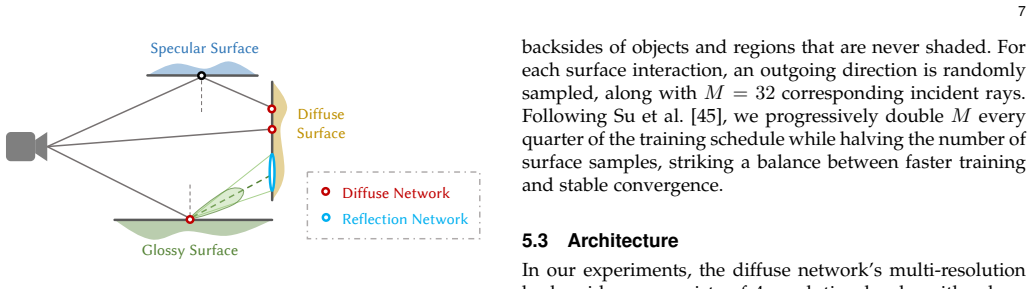
Ray cone encoding into a pre-filtered multi-resolution hash grid: the glossiness-dependent BSDF lobe defines a cone; its projected footprint on the scene is decomposed by 1D K-Means on ray marching distances into clusters, each queried as a scale-aware feature vector interpolated between the two grid resolutions closest to the cone radius, replacing single-point radiance evaluation.
What would settle it
Render a glossy sphere reflecting a high-frequency checkerboard at grazing angle and compare NCR to a high-sample path-traced reference. If the distance-only clusters smear or shift the reflected checkerboard where the projected cone footprint is elongated (the circular-disk approximation breaks down), the 1D K-Means summary is the load-bearing failure point; if the error matches a much higher-quality reference, the summary holds.
Extended reading notes
Core claim
Neural Cone Radiosity (NCR) replaces the pointwise radiance queries of neural radiosity with a cone encoding. For each glossy surface interaction it traces a cone whose aperture comes from the microfacet normal distribution, then projects that cone onto the scene. Because the projected footprint is irregular and may span multiple depths, it traces reflected rays, groups their distances with 1D K-Means into clusters, and queries each cluster in a prefiltered multi-resolution hash grid at the two scales bracketing the footprint, using the mean distance as center and the distance standard deviation as axial scale. The paper's claim is that this scale-aware, prefiltered query captures high-frequ
Load-bearing premise
The cluster approximation assumes that reflected radiance over a glossy lobe can be summarized by a few one-dimensional K-Means groups, each replaced by a single query at the mean marching distance with a standard-deviation scale; if radiance changes quickly within a cluster (such as a sharp reflected edge inside the cone), this summary biases the prefiltered radiance and glossy rendering degrades.
Editorial extensions
If this is right
- Produces noise-free glossy global illumination at interactive frame rates (roughly 37–131 ms per frame across test scenes), comparable to vanilla Neural Radiosity.
- Handles a continuous range of roughness on a single object — spatially varying roughness across a wall is reconstructed with low error.
- Yields better temporal stability than equal-time path tracing with denoising, which flickers in interactive use.
- Reduces the MLP size of the radiance network because the prefiltered cone module offloads the hard view-dependent fitting.
- Extends beyond reflections to glossy refraction, where it reconstructs refracted and reflected content more accurately than the baseline.
Reading between the lines
- The distance-only 1D clustering is the obvious simplification; clustering on the actual 3D hit points or on (distance, direction) pairs would test whether accounting for angular structure improves grazing-angle reflections, which the current circular-footprint model likely struggles with.
- The cone encoding could be transplanted into other learned radiance representations, e.g., radiance caching or generalizable scene-agnostic models, since it is orthogonal to the underlying network architecture.
- The prefiltered hash grid with scale-based interpolation effectively acts as a learned mipmap of radiance; the same trick could reduce the cost of path guiding or serve as a control variate in Monte Carlo renderers.
- Because the method must retrain per scene, coupling cone encoding with a dynamic or generalizable front end is a natural next step; a test would be whether the prefiltered features generalize across similar materials.
Editorial analysis
A structured set of objections, weighed in public.
Referee Report
Summary. The paper proposes Neural Cone Radiosity (NCR), an extension of Neural Radiosity (NR) for interactive global illumination with glossy materials. The central idea is to replace point queries of a neural radiance/radiosity field with cone queries: at a glossy surface, a cone is formed around the specular reflection direction, multiple reflected rays are traced, and their intersection depths are clustered via 1D K-means. Each cluster is represented by a center placed on the specular ray at the mean marching distance and by an axial radius equal to the standard deviation of distances. A pre-filtered multi-resolution hash grid is then queried at these cluster centers with the computed footprint radius, embedding view-dependent reflectance information directly into the encoding. A dual-branch network separates diffuse and glossy components and blends them with a modulation network. The paper reports MAPE improvements over vanilla NR on five scenes, comparable or better results than a 4-spp path tracer with Oidn denoising, and interactive frame rates (37--116 ms per frame with 32 reflected rays). Ablations on a Cornell-box scene support the inclusion of the diffuse branch, glossy branch, layer interpolation, and cone encoding.
Significance. If the central approximation is sound, NCR is a meaningful step toward real-time neural global illumination for glossy materials. The method is architecturally compact, physically motivated by pre-filtering over the BSDF lobe, and its reported quantitative results consistently beat vanilla NR on five scenes. The authors also provide ablations for the main components and a visualization of intra-cluster variance. The main strength is the integration of cone tracing and clustered spatial aggregation into a neural radiosity framework, which is a plausible and promising direction. However, the load-bearing cluster approximation is not directly validated, and the performance claims are overstated relative to the reported timings. The paper would be substantially strengthened by a direct test of the cluster-summary approximation and a more complete comparison with existing neural GI methods for glossy effects.
major comments (4)
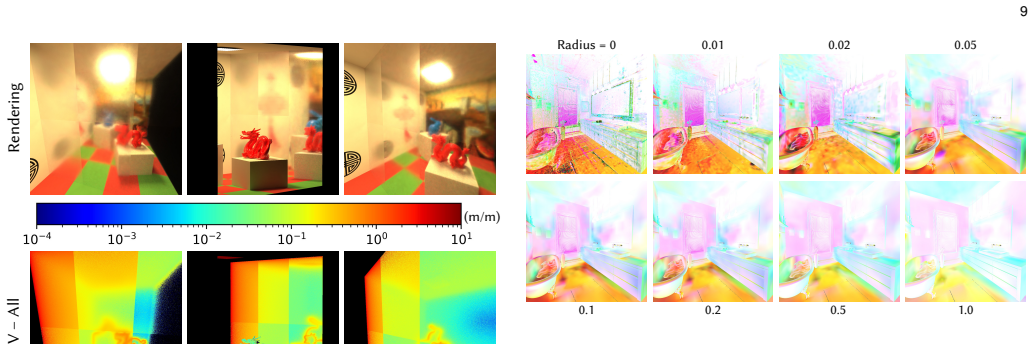
- [Sec. 4.2, Eqs. (11)--(13)] The cluster approximation is load-bearing but not validated. The method reduces each cluster to a center x'_k = x + t_k \omega_r and an axial radius r_{C\parallel,k} = stddev of forward distances, discarding the transverse positions of the traced ray hits. This is a critical simplification: for non-planar geometry or high-frequency incident radiance, the actual 2D footprint can be poorly represented by a point on the specular ray. The paper's evidence is indirect: Fig. 6 visualizes the coefficient of variation of marching distances, which is not a radiance-error metric, and the w/o-Cone ablation in Fig. 11 removes the entire cone encoding, not the clustering approximation. I request a direct validation: compare the clustered query against (a) querying at the actual ray hit positions, (b) full 3D K-means on hit positions, and (c) sensitivity to the number of clusters K, using a radiance-e
- [Abstract and Table 1] The abstract claims 'real time' rendering, but Table 1 reports per-frame times of 37--116 ms for Ours-32 and 49--131 ms for Ours-128 across the five scenes. Even the fastest scene is only about 27 fps, and the kitchen scene runs at about 8.6 fps. This is interactive but not real time by standard usage. The text frequently says 'interactive', which is fair, but the abstract and contribution statements should be qualified. If the authors intend 'real time' in a weaker sense, they should define the term explicitly.
- [Sec. 6.1 (Comparison)] The comparison set is too narrow for the stated claims. The paper compares only with vanilla NR, equal-time path tracing, and Oidn denoising. It explicitly declines to compare with recent neural GI methods that handle glossy effects, such as Neural Radiance Caching [36], LightFormer [41], or NeLT [58], arguing that these do not query at primary intersections or target glossy effects. This justification is not fully convincing: NRC is a widely used real-time neural GI method, and LightFormer/NeLT explicitly model light-dependent highlights. At minimum, the authors should include an NRC comparison or provide a more precise argument why such a comparison would be unfair. Additionally, many MAPE differences in Table 1 are small (e.g., 0.057 vs. 0.059 on cornell-box), and the paper reports no repeated runs or confidence intervals, so the statistical significance of the improvement is unclear.
- [Sec. 4.3, Eq. (16)] The glossy MLP does not take surface normal or material reflectance as input, relying instead on the pre-filtered feature grid to represent smooth radiance. This is a strong assumption: the radiance at a secondary hit depends on the local normal and the BSDF at that point, especially for curved glossy surfaces. The paper does not provide any analysis of how the feature grid is able to encode this orientation-dependent information, nor does it test a variant that includes the normal or a local coordinate frame. If the pre-filtering assumption fails, the glossy branch may blur or alias on curved high-gloss geometry. I recommend adding an ablation or a controlled test on a curved glossy object to justify this design choice.
minor comments (5)
- [Sec. 4.1, Eq. (8)] The notation \omega_\tau in the definition of \theta_C is not defined. The cone angle is first described as determined by roughness and the NDF, then Eq. (8) introduces a threshold integral. Please clarify the relationship and define all symbols.
- [Sec. 4.1, Eq. (9)] The formula uses s \cdot r_C as the queried scale, but the role of the sampling ratio s is only described in prose. Please make explicit how s interacts with the grid resolutions and how the default value s=1 is chosen.
- [Sec. 5.3] The activation description is confusing: 'We use ReLU as the activation function between hidden layers. For the output layer, instead of using the absolute value activation as in Neural Radiosity, we adopt SquarePlus.' If SquarePlus is used only on the output, describe whether the diffuse and glossy branches share this choice, and why ReLU is used internally.
- [Sec. 6.1, Table 1] The table header says 'Per-frame time cost (in milliseconds)' but the rows list MAPE first. Please separate the metrics visually or in the caption to avoid ambiguity. Also, the caption for Fig. 12 says 'MAPE is reported with respect to the reference' but some values in the figure differ from Table 1; ensure consistency.
- [Sec. 6.1 (Oidn comparison)] The Oidn column reports a time of 41--109 ms for 4-spp path tracing plus denoising, but the paper does not state whether this is equal-time in the sense of including the denoiser overhead or only the path-tracing time. Please clarify the timing methodology.
Circularity Check
No significant circularity: NCR's glossy module is validated against external path-traced references and trained with the radiosity residual, not with the reference or with its own output by construction.
full rationale
The paper's central derivation is not circular. NCR extends Neural Radiosity with a cone/cone-cluster encoding; the training loss (Eq. 7) is the relative mean-squared radiosity residual between the LHS and RHS of the rendering equation, and evaluation (Figs. 1, 5, 8–12) is against 100,000-spp path-traced references. The glossy prediction L_glo (Eq. 11) is a weighted sum of network queries at cluster centers; those queries are learned to satisfy the radiosity equation, not fitted to the reference images, so the comparison is an independent check. The approximation in Sec. 4.2 (placing cluster centers on the specular ray, Eq. 12, and using axial stddev as r_{C||}, Eq. 13) is a heuristic with potential bias, but that is a correctness/robustness concern, not circularity; the paper discloses it is an approximation and validates it indirectly via CV visualization (Fig. 6) and ablations (Fig. 11). The only same-author citations ([14,15,44,45]) are used for training scheduling, related work, and a suggested future extension; none is load-bearing for the core claim. Per-scene training is explicitly disclosed as a limitation, and the paper does not claim cross-scene generalization. No load-bearing step reduces to its own input by construction.
Assumptions & free parameters
free parameters (5)
- Cone threshold tau =
0.99
- Sampling ratio s =
1
- Cluster count K and reflected rays T =
K=4, T=128 train, T=32 render
- Roughness split =
0.5
- Network hyperparameters =
diffuse: 4 levels, base 32; glossy: 8 levels, base 4; MLP sizes
assumptions (5)
- standard math The rendering equation (Eq. 1) is the ground-truth transport model.
- domain assumption A glossy BSDF lobe can be bounded by a cone aperture theta_C defined by the NDF level set integral threshold tau=0.99 (Eq. 8).
- domain assumption Reflected radiance over the cone footprint can be represented by a multi-resolution hash grid queried with scale r_C (Eqs. 9-10).
- ad hoc to paper 1D K-Means on marching distances plus cluster centers along the specular direction approximates the cone-surface integral (Eqs. 11-13).
- domain assumption Roughness threshold 0.5 separates diffuse and glossy regimes, with specular rays traced recursively (Eq. 17, Fig. 4).
Cite this review
Pith. "Pith review of Neural Cone Radiosity for Interactive Global Illumination with Glossy Materials." pith.science (2026). https://pith.science/paper/GPNICXPN
@misc{pith2026250907522,
  author       = {Pith},
  title        = {Pith review of: Neural Cone Radiosity for Interactive Global Illumination with Glossy Materials},
  year         = {2026},
  howpublished = {\url{https://pith.science/paper/GPNICXPN}},
  note         = {Machine review of arXiv:2509.07522}
}
read the original abstract
Modeling of high-frequency outgoing radiance distributions has long been a key challenge in rendering, particularly for glossy material. Such distributions concentrate radiative energy within a narrow lobe and are highly sensitive to changes in view direction. However, existing neural radiosity methods, which primarily rely on positional feature encoding, exhibit notable limitations in capturing these high-frequency, strongly view-dependent radiance distributions. To address this, we propose a highly-efficient approach by reflectance-aware ray cone encoding based on the neural radiosity framework, named neural cone radiosity. The core idea is to employ a pre-filtered multi-resolution hash grid to accurately approximate the glossy BSDF lobe, embedding view-dependent reflectance characteristics directly into the encoding process through continuous spatial aggregation. Our design not only significantly improves the network's ability to model high-frequency reflection distributions but also effectively handles surfaces with a wide range of glossiness levels, from highly glossy to low-gloss finishes. Meanwhile, our method reduces the network's burden in fitting complex radiance distributions, allowing the overall architecture to remain compact and efficient. Comprehensive experimental results demonstrate that our method consistently produces high-quality, noise-free renderings in real time under various glossiness conditions, and delivers superior fidelity and realism compared to baseline approaches.
Figures


Figures from the paper (6 more)



Reference graph
Works this paper leans on
-
[36]
T. M ¨uller, F. Rousselle, J. Nov ´ak, and A. Keller. Real- time neural radiance caching for path tracing.ACM T rans. Graph., 40(4), July 2021. doi: 10.1145/3450626. 3459812 13
doi:10.1145/3450626 2021
-
[41]
H. Ren, Y. Huo, Y. Peng, H. Sheng, H. Huang, W. Xue, J. Lan, R. Wang, and H. Bao. Lightformer: Light- oriented global neural rendering in dynamic scene. ACM T ransactions on Graphics, 43(4):1–14, 2024
work page 2024
- [58]
-
[1]
A. T. ´Afra. Intel ® Open Image Denoise, 2025. https: //www.openimagedenoise.org
work page 2025
- [2]
-
[3]
S. Bako, T. Vogels, B. McWilliams, M. Meyer, J. Nov ´ak, A. Harvill, P . Sen, T. Derose, and F. Rousselle. Kernel- predicting convolutional networks for denoising monte carlo renderings.ACM T ransactions on Graphics (TOG), 36(4), 2017. doi: 10.1145/3072959.3073708 11 bathroom 0.053 0.055 0.224 0.081 0.662 0.187 0.187 0.235 0.238 0.637 Reference Ours-128 O...
-
[4]
J. T. Barron. Squareplus: A softplus-like algebraic rectifier.arXiv preprint arXiv:2112.11687, 2021
arXiv 2021
-
[5]
J. T. Barron, B. Mildenhall, M. Tancik, P . Hedman, R. Martin-Brualla, and P . P . Srinivasan. Mip-nerf: A multiscale representation for anti-aliasing neural radi- ance fields. InProceedings of the IEEE/CVF international conference on computer vision, pp. 5855–5864, 2021
work page 2021
Show all 61 references
-
[6]
J. T. Barron, B. Mildenhall, D. Verbin, P . P . Srinivasan, and P . Hedman. Zip-nerf: Anti-aliased grid-based neural radiance fields. InProceedings of the IEEE/CVF International Conference on Computer Vision, pp. 19697– 19705, 2023
2023
-
[7]
Bitterli
B. Bitterli. Rendering resources, 2016. https://benedikt-bitterli.me/resources/
2016
-
[8]
Bitterli, F
B. Bitterli, F. Rousselle, B. Moon, D. Adler, K. Mitchell, and W. Jarosz. Nonlinearly weighted first-order regres- sion for denoising monte carlo renderings.Computer Graphics Forum (EGSR), 37(4):107–118, 2018. doi: 10. 1111/cgf.13423
2018
-
[9]
Chaitanya, A
C. Chaitanya, A. Kaplanyan, C. Schied, M. Salvi, A. Lefohn, D. Nowrouzezahrai, and T. Aila. Interactive reconstruction of monte carlo image sequences using a recurrent denoising autoencoder.ACM T ransactions on Graphics (TOG), 36(4), 2017. doi: 10.1145/3072959. 3073601
2017 doi
-
[10]
A. Chen, Z. Xu, A. Geiger, J. Yu, and H. Su. Tensorf: Tensorial radiance fields. InEuropean conference on computer vision, pp. 333–350. Springer, 2022
2022
-
[11]
Coomans, E
A. Coomans, E. A. Dominci, C. D ¨oring, J. H. Mueller, J. Hladky, and M. Steinberger. Real-time neural render- ing of dynamic light fields.Computer Graphics Forum, 43(2):e15014, 2024
2024
-
[12]
DesLauriers
M. DesLauriers. glsl-fxaa. https://github.com/ mattdesl/glsl-fxaa, Apr. 2021. Version 1.7, BSD-3- Clause License
2021
-
[13]
Diolatzis, J
S. Diolatzis, J. Philip, and G. Drettakis. Active explo- ration for neural global illumination of variable scenes. ACM T ransactions on Graphics (TOG), 41(5):1–18, 2022
2022
-
[14]
H. Dong, R. Su, G. Wang, and S. Li. Efficient neural path guiding with 4d modeling. InSIGGRAPH Asia 2024 Conference Papers, pp. 1–11, 2024
2024
-
[15]
H. Dong, G. Wang, and S. Li. Neural parametric mixtures for path guiding. InACM SIGGRAPH 2023 Conference Proceedings, pp. 1–10, 2023
2023
-
[16]
Fridovich-Keil, G
S. Fridovich-Keil, G. Meanti, F. R. Warburg, B. Recht, and A. Kanazawa. K-planes: Explicit radiance fields in space, time, and appearance. InProceedings of the IEEE/CVF Conference on Computer Vision and Pattern Recognition, pp. 12479–12488, 2023
2023
-
[17]
Fridovich-Keil, A
S. Fridovich-Keil, A. Yu, M. Tancik, Q. Chen, B. Recht, and A. Kanazawa. Plenoxels: Radiance fields without neural networks. InProceedings of the IEEE/CVF confer- ence on computer vision and pattern recognition, pp. 5501– 5510, 2022
2022
-
[18]
C. M. Goral, K. E. Torrance, D. P . Greenberg, and B. Battaile. Modeling the interaction of light between diffuse surfaces.ACM SIGGRAPH computer graphics, 18(3):213–222, 1984
1984
-
[19]
Granskog, F
J. Granskog, F. Rousselle, M. Papas, and J. Nov ´ak. Compositional neural scene representations for shad- ing inference.ACM T ransactions on Graphics (TOG), 39(4):135–1, 2020
2020
-
[20]
J. Guo, Z. Zong, Y. Song, X. Fu, C. Tao, Y. Guo, and L.-Q. Yan. Efficient light probes for real-time global illumination.ACM T ransactions on Graphics (TOG), 41(6):1–14, 2022
2022
-
[21]
Y.-C. Guo, D. Kang, L. Bao, Y. He, and S.-H. Zhang. Nerfren: Neural radiance fields with reflections. InPro- ceedings of the IEEE/CVF Conference on Computer Vision and Pattern Recognition, pp. 18409–18418, 2022
2022
-
[22]
Hadadan, S
S. Hadadan, S. Chen, and M. Zwicker. Neural radiosity. ACM T ransactions on Graphics (TOG), 40(6):1–11, 2021
2021
-
[23]
Heidrich et al
W. Heidrich et al. Efficient representation of specular reflection.ACM T ransactions on Graphics (TOG), 2009
2009
-
[24]
W. Hu, Y. Wang, L. Ma, B. Yang, L. Gao, X. Liu, and Y. Ma. Tri-miprf: Tri-mip representation for efficient anti-aliasing neural radiance fields. InProceedings of the IEEE/CVF International Conference on Computer Vision, pp. 19774–19783, 2023
2023
-
[25]
Huo and S.-e
Y. Huo and S.-e. Yoon. A survey on deep learning- based monte carlo denoising.Computational visual media, 7(2):169–185, 2021
2021
-
[26]
Is ¸ık, K
M. Is ¸ık, K. Mullia, M. Fisher, J. Eisenmann, and M. Gharbi. Interactive monte carlo denoising using affinity of neural features.ACM T ransactions on Graphics (TOG), 40(4):1–13, 2021
2021
-
[27]
Isola, J.-Y
P . Isola, J.-Y. Zhu, T. Zhou, and A. A. Efros. Image- to-image translation with conditional adversarial net- works. InProceedings of the IEEE conference on computer vision and pattern recognition, pp. 1125–1134, 2017
2017
-
[28]
Jakob, S
W. Jakob, S. Speierer, N. Roussel, M. Nimier-David, D. Vicini, T. Zeltner, B. Nicolet, M. Crespo, V . Leroy, and Z. Zhang. Mitsuba 3 renderer. https:// mitsuba-renderer.org, 2022. Version 3.5.2
2022
-
[29]
J. T. Kajiya. The rendering equation. InProceedings of the 13th Annual Conference on Computer Graphics and Interactive T echniques (SIGGRAPH), pp. 143–150. ACM, New York, NY, USA, 1986. doi: 10.1145/15922.15902
1986
-
[30]
L. Liu, J. Gu, K. Zaw Lin, T.-S. Chua, and C. Theobalt. Neural sparse voxel fields.Advances in Neural Informa- tion Processing Systems, 33:15651–15663, 2020
2020
-
[31]
Mildenhall, P
B. Mildenhall, P . P . Srinivasan, M. Tancik, J. T. Barron, R. Ramamoorthi, and R. Ng. Nerf: Representing scenes as neural radiance fields for view synthesis.Communi- cations of the ACM, 65(1):99–106, 2021
2021
-
[32]
M ¨uller
T. M ¨uller. tiny-cuda-nn. https://github.com/NVlabs/ tiny-cuda-nn, Apr. 2021. Version 1.7, BSD-3-Clause License
2021
-
[33]
M ¨uller, A
T. M ¨uller, A. Evans, C. Schied, and A. Keller. Instant neural graphics primitives with a multiresolution hash encoding.ACM transactions on graphics (TOG), 41(4):1– 15, 2022
2022
-
[34]
M ¨uller, B
T. M ¨uller, B. McWilliams, F. Rousselle, M. Gross, and J. Nov ´ak. Neural importance sampling.ACM T ransac- tions on Graphics (T oG), 38(5):1–19, 2019
2019
-
[35]
M ¨uller, F
T. M ¨uller, F. Rousselle, A. Keller, and J. Nov´ak. Neural control variates.ACM T ransactions on Graphics (TOG), 39(6):1–19, 2020
2020
-
[37]
Nalbach, E
O. Nalbach, E. Arabadzhiyska, D. Mehta, H.-P . Seidel, and T. Ritschel. Deep shading: Convolutional neural networks for screen space shading.Computer Graphics Forum, 36(4):65–78, 2017
2017
-
[38]
A. Paszke. Pytorch: An imperative style, high- performance deep learning library.arXiv preprint arXiv:1912.01703, 2019
1912 arXiv
-
[39]
Rahaman, A
N. Rahaman, A. Baratin, D. Arpit, F. Draxler, M. Lin, F. Hamprecht, Y. Bengio, and A. Courville. On the spec- tral bias of neural networks. InInternational conference on machine learning, pp. 5301–5310. PMLR, 2019
2019
-
[40]
Reiser, S
C. Reiser, S. Peng, Y. Liao, and A. Geiger. Kilonerf: Speeding up neural radiance fields with thousands of tiny mlps. InProceedings of the IEEE/CVF international conference on computer vision, pp. 14335–14345, 2021
2021
-
[42]
Schied, A
C. Schied, A. Kaplanyan, C. Wyman, A. Patney, C. R. A. Chaitanya, J. Burgess, S. Liu, C. Dachsbacher, A. Lefohn, and M. Salvi. Spatiotemporal variance- guided filtering: Real-time reconstruction for path- traced global illumination. InProceedings of High Per- formance Graphics...
2017
-
[43]
Sloan, J
P .-P . Sloan, J. Kautz, and J. Snyder. Precomputed radi- ance transfer for real-time rendering in dynamic, low- frequency lighting environments.ACM T rans. Graph., 21(3):527–536, July 2002. doi: 10.1145/566654.566612
2002
-
[44]
F. Su, B. Li, Q. Yin, Y. Zhang, and S. Li. Proxy tracing: Unbiased reciprocal estimation for optimized sampling in bdpt.ACM T rans. Graph., 43(4), July 2024. doi: 10. 1145/3658216
2024
-
[45]
R. Su, H. Dong, J. Ren, H. Jin, Y. Chen, G. Wang, and S. Li. Dynamic neural radiosity with multi-grid decomposition. InSIGGRAPH Asia 2024 Conference Papers, pp. 1–12, 2024
2024
-
[46]
C. Sun, M. Sun, and H.-T. Chen. Direct voxel grid op- timization: Super-fast convergence for radiance fields reconstruction. InProceedings of the IEEE/CVF conference on computer vision and pattern recognition, pp. 5459–5469, 2022
2022
-
[47]
Tancik, P
M. Tancik, P . Srinivasan, B. Mildenhall, S. Fridovich- Keil, N. Raghavan, U. Singhal, R. Ramamoorthi, J. Bar- ron, and R. Ng. Fourier features let networks learn high frequency functions in low dimensional domains.Ad- vances in neural information processing systems, 33:7537– ...
2020
-
[48]
J. Tang, X. Chen, J. Wang, and G. Zeng. Compressible- composable nerf via rank-residual decomposition. Advances in Neural Information Processing Systems, 35:14798–14809, 2022
2022
-
[49]
Verbin, P
D. Verbin, P . Hedman, B. Mildenhall, T. Zickler, J. T. Barron, and P . P . Srinivasan. Ref-nerf: Structured view- dependent appearance for neural radiance fields. In 2022 IEEE/CVF Conference on Computer Vision and Pat- tern Recognition (CVPR), pp. 5481–5490. IEEE, 2022
2022
-
[50]
Vogels, F
T. Vogels, F. Rousselle, B. McWilliams, G. R ¨othlin, A. Harvill, D. Adler, M. Meyer, and J. Nov ´ak. De- noising with kernel prediction and asymmetric loss functions.ACM T ransactions on Graphics (TOG), 37(4):1– 15, 2018
2018
-
[51]
S. Wu, S. Kim, Z. Zeng, D. Vembar, S. Jha, A. Ka- planyan, and L.-Q. Yan. Extrass: A framework for joint spatial super sampling and frame extrapolation. In SIGGRAPH Asia 2023 Conference Papers, pp. 1–11, 2023
2023
-
[52]
H. Xin, S. Zheng, K. Xu, and L.-Q. Yan. Lightweight bilateral convolutional neural networks for interactive single-bounce diffuse indirect illumination.IEEE T rans- actions on Visualization and Computer Graphics, 2021
2021
-
[53]
Xu, Y.-P
K. Xu, Y.-P . Cao, L.-Q. Ma, Z. Dong, R. Wang, and S.-M. Hu. A practical algorithm for rendering interreflections with all-frequency brdfs.ACM T ransactions on Graphics (TOG), 33(1):1–16, 2014
2014
-
[54]
A. Yu, R. Li, M. Tancik, H. Li, R. Ng, and A. Kanazawa. Plenoctrees for real-time rendering of neural radiance fields. InProceedings of the IEEE/CVF international con- ference on computer vision, pp. 5752–5761, 2021
2021
-
[55]
C. Zeng, Y. Dong, P . Peers, H. Wu, and X. Tong. Render- former: Transformer-based neural rendering of triangle meshes with global illumination. InACM SIGGRAPH 2025 Conference Papers, 2025
2025
-
[56]
Zhang, C
K. Zhang, C. Liu, X. Wang, X. Tong, and K. Zhang. Deep illumination: Approximating dynamic global il- lumination with convolutional neural networks. In SIGGRAPH Asia 2020 T echnical Communications, 2020. doi: 10.1145/3415255.3422888
2020
-
[57]
Zheng, Y
C. Zheng, Y. Huo, H. Huang, H. Sheng, J. Huang, R. Tang, H. Zhu, R. Wang, and H. Bao. Neural global illumination via superposed deformable feature fields. InSIGGRAPH Asia 2024 Conference Papers, pp. 1–11, 2024
2024
-
[59]
Zhong, J
Z. Zhong, J. Zhu, Y. Dai, C. Zheng, G. Chen, Y. Huo, H. Bao, and R. Wang. Fusesr: Super resolution for real-time rendering through efficient multi-resolution fusion. InSIGGRAPH Asia 2023 Conference Papers, pp. 1–10, 2023
2023
-
[60]
˚Akerlund et al
O. ˚Akerlund et al. Real-time glossy reflections. In SIGGRAPH Asia 2023 T echnical Communications, 2023
2023
-
[128]
The metric shown below each row indicates the overall MAPE, while the value in the bottom-right corner of each region shows its local error
and 32 reflected rays (Ours-32), in comparison with vanilla Neural Radiosity (NR), an equal-time Monte Carlo path tracer with 4 spp and Oidn denoising (Oidn), and a 16 spp path tracer (PT).MAPEis reported with respect to the reference (path traced with 100,000 spp). The metric...
Reviewed August 4, 2026 · model on record in the stance chip above.
Discussion (0). Continue with ORCID to comment.