REVIEW 3 major objections 5 minor 160 references
Optical plateaus in GRB afterglows point to millisecond magnetar engines.
Reviewed by Pith at T0; open to challenge. T0 means a machine referee read the full paper against a public rubric. the ladder, T0–T4 →
T0 review · deepseek-v4-flash
2026-08-04 21:56 UTC pith:ONQLABMW
load-bearing objection A careful 200-GRB UVOT+XRT census with a genuinely new optical plateau L–t_b relation; the magnetar conclusion needs a measured-z-only refit before it is load-bearing. the 3 major comments →
Investigating Temporal Features in Swift GRB Afterglows: A Comparative Study of UVOT and XRT Data
The pith
A machine-rendered reading of the paper's core claim, the machinery that carries it, and where it could break.
Core claim
The paper's central claim is an optical plateau relation: log L_v,b,iso,47 = (1.57±0.80) + (-0.97±0.23) log t_b,z, with Spearman r=0.70 and p∼1e-3. This anti-correlation between the isotropic optical luminosity at the plateau break and the rest-frame break time is the optical counterpart of the X-ray luminosity–time relation, and the paper reads it as magnetar spin-down: a millisecond magnetar with a roughly fixed energy reservoir produces a brighter plateau that ends sooner. Four plateaus followed by steep decay are tested against the relation; two satisfy it (GRB 111209A, GRB 180618A), and two do not (GRB 060526A, GRB 060614A), which the paper attributes to black-hole central engines. Arou
What carries the argument
The engine of the argument is the luminosity–break-time relation itself: fitting optical plateaus with a broken power law yields a break time t_b and a break luminosity L_v,b,iso; in the rest frame these follow log L_v,b,iso,47 = (1.57±0.80) + (-0.97±0.23) log t_b,z. The near-unity slope is the fingerprint of a magnetar with an approximately fixed rotational energy reservoir—the same physics used to explain X-ray plateaus—while outliers flag a different engine. Supporting machinery includes the smoothly joined broken power law used to fit bumps, the F-test criteria for adding breaks, and the comparison of optical decay indices with reverse- and internal-shock predictions.
Load-bearing premise
The load-bearing premise is that the 21 very early flares were sampled densely enough for their decay indices and their correlation with X-ray and BAT flares to be judged; the paper itself says 2–3 data points are too few for two of the reverse-shock candidates, so if the sparse sampling is unrepresentative, the early-flare classification loses its support.
What would settle it
A dedicated campaign would obtain densely sampled optical light curves of roughly thirty plateau GRBs with known redshifts and re-fit the break time and luminosity; if the Spearman correlation drops below about 2 sigma or the slope deviates substantially from -1, the magnetar relation fails. Separately, sub-minute-cadence early optical observations would show whether the 21 steep decays have complete flares and whether the reverse-shock decay indices are real rather than artifacts of sparse sampling.
If this is right
- Optical plateaus can be used alongside X-ray plateaus as a central-engine diagnostic, roughly doubling the number of bursts in which magnetar versus black-hole engines can be tested.
- Because two internal-plateau bursts violate the relation while two satisfy it, internal plateaus do not uniquely imply magnetars; some are better explained by black-hole engines.
- Chromatic breaks between optical and X-ray plateaus in about eighteen bursts require structured or two-component jets, showing that energy injection alone cannot explain every plateau.
- Early optical flares that are uncorrelated with X-ray and BAT flares form a clean reverse-shock sample: twelve bursts show decay indices between 2 and 3 consistent with reverse shock in ISM or wind media.
- The plateau relation gives a quantitative way to test whether a newly observed optical plateau is powered by continued central-engine energy injection or by a different mechanism.
Where Pith is reading between the lines
- If the near-unity slope holds in a larger sample, the optical plateau relation could become a redshift-independent distance indicator for GRBs, in the same spirit as the X-ray Dainotti relation—though the paper does not make this claim.
- The early-flare census is the fragile part: because several reverse-shock candidates rest on only two or three optical points, future sub-minute-cadence observations could reclassify a fraction of them as prompt-optical flares; that would not damage the plateau relation but would weaken the claimed 21-GRB decomposition.
- The two black-hole outliers suggest a concrete next step: if internal plateaus from accreting black holes have systematically different spectral indices or prompt-to-afterglow efficiencies than magnetar plateaus, the relation could be used to separate engine classes in larger samples.
Editorial analysis
A structured set of objections, weighed in public.
Referee Report
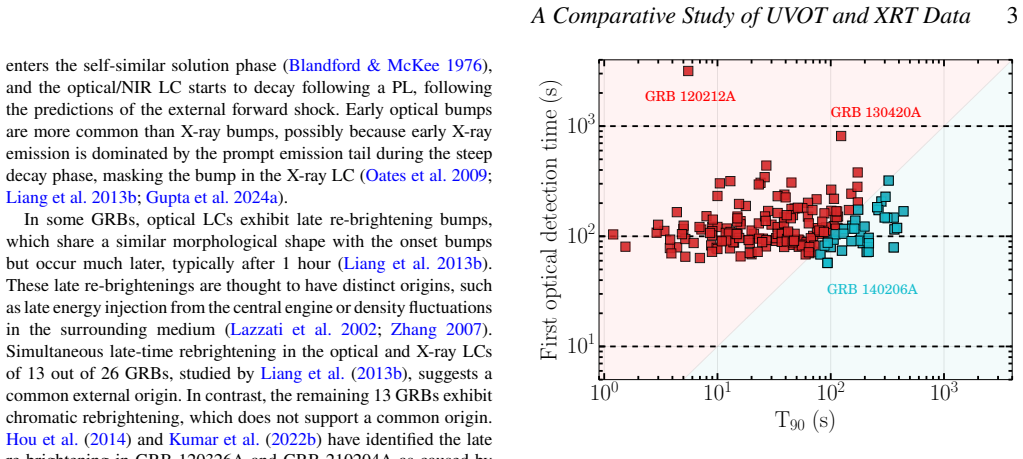
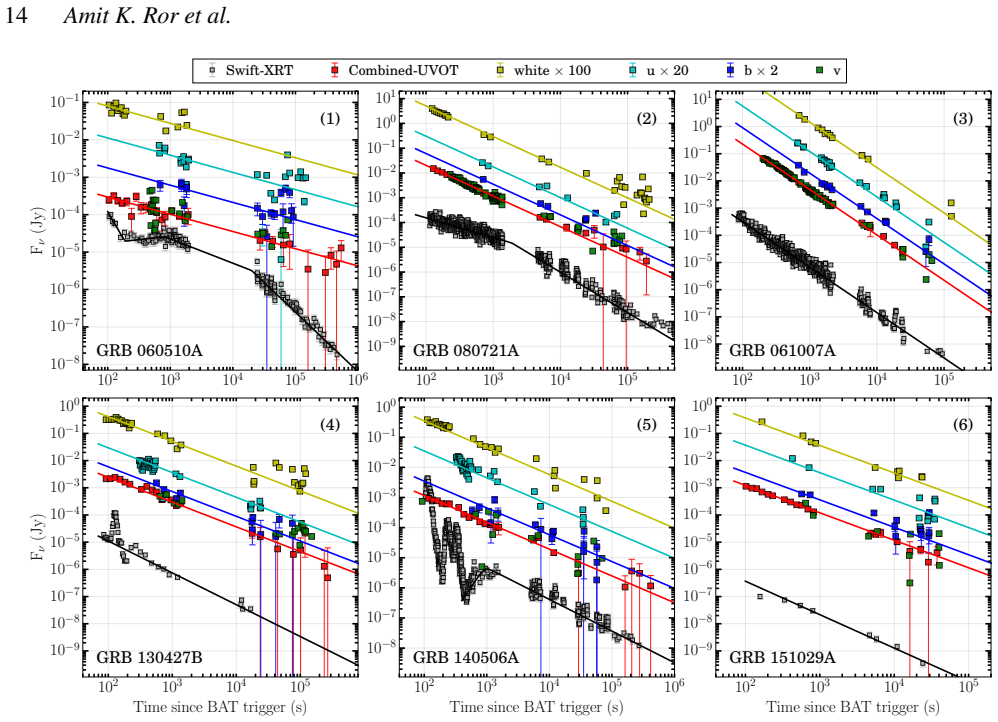
Summary. The paper presents a statistical, morphological study of 200 Swift-UVOT GRB afterglow light curves from 2005–2018, jointly analysed with Swift-XRT and BAT data. Light curves are fitted with power-law and smoothly-broken-power-law models using F-test model selection; the resulting features are classified into early flares, bumps, plateaus, breaks, and late re-brightenings. The main claims are: (i) 21 GRBs show very early optical flares/steep decays attributable to reverse or internal shocks; (ii) optical plateaus mostly require energy injection, with four cases of internal plateau origin; (iii) Eq. (1) shows a tight anti-correlation between plateau optical luminosity and rest-frame break time, interpreted as magnetar spin-down; and (iv) early bump correlations are consistent with the afterglow onset interpretation of Liang et al. (2010).
Significance. If the central claims hold, this is a valuable large-sample, uniformly processed comparison of UVOT and XRT afterglow morphology, providing one of the most extensive optical-plateau catalogues and a direct optical analogue of the X-ray Dainotti relation. Strengths include the homogeneous Swift data processing, use of standard F-test model selection, detailed tabulation of fit parameters in the appendices, and explicit cross-checks against earlier catalogues. However, the most load-bearing quantitative claim, Eq. (1), is potentially sensitive to the adopted z=2 assumption for redshift-unknown GRBs, and the early-flare taxonomy is built partly on very sparse photometry. These issues must be fixed before the magnetar conclusion can be regarded as robust.
major comments (3)
- [§4.1, Tables 1-2, Appendix C1] The L_v,b,iso–t_b,z correlation is fitted using GRBs with at least an optical plateau, but for redshift-unknown GRBs §2.3.2 adopts z=2 for all distance-dependent quantities. Tables B2 and B4 list several plateau GRBs with z∼2 (e.g., GRB 060111B, 110319A, 130725B, 110715A), and the text says only GRB 110420A was excluded for unknown redshift, implying other z=2-assumed bursts remain in the fit. Under that assumption, a burst at true z>2 is placed at larger t_b,z and lower L, while a burst at true z<2 is placed at smaller t_b,z and higher L—exactly along the claimed L∝t_b^-1 anti-correlation. The reported slope −0.97±0.23, r=0.70, p∼1e-3 may therefore be inflated. Please refit Eq. (1) using only the 145 GRBs with measured redshifts, and/or marginalize over the plausible redshift distribution; report the known-z-only slope, correlation, and sample size. This is load-bearing for the magnetar
- [§4.3.1] The early-flare classification (21 GRBs; Tables 1 and 2) is based on decay indices 'approximately obtained from fitting a few early data points; therefore, errors are not given'. Appendix C1 explicitly concedes for GRB 060729A and GRB 151027A that 'it is hard to draw any conclusion with only 2-3 data points,' yet both are counted among the 12 reverse-shock candidates in Table 1. Because this census directly supports the abstract's statement about early flares and reverse/internal shock origins, the lack of uncertainties is not merely a presentation issue. Please provide error estimates where possible, or exclude/flag cases with fewer than a minimum number of points, and state how many of the 21 classifications survive a stricter sampling requirement.
- [§4.3] After fitting Eq. (1) to the same plateau sample, the paper uses residuals to classify individual bursts: GRB 060526A and GRB 060614A are said to favour a black-hole engine because they are outliers, while GRB 111209A and GRB 180618A are called magnetar-driven because they lie on the relation. This is partly circular, since outliers to a fitted relation do not independently test that relation or the engine model. I ask the authors to reframe this as an interpretive classification rather than a test, and to demonstrate that the fit is not driven by the very points used to define 'magnetar' cases (e.g., jackknife or outlier-removal sensitivity). A quantitative treatment of the suggested overlapping-flare contamination would also strengthen the outlier discussion.
minor comments (5)
- [Abstract and §4.2] The abstract says optical PL decay indices are shallower than X-ray ones, but §4.2 reports 3/27 GRBs with α_x ≲ α_o; please qualify the statement accordingly.
- [Table B4 caption] The caption says 'p-value<0.0027 indicates that the 2 break PL is preferred over the 2 break PL.' This is a typo and should read 'over the 1 break PL.'
- [§4.4, Table 4] The definitions of W, t_r, and t_d appear after the table is referenced; consider stating them in the table caption or before the table for readability.
- [Fig. 10] The figure would be much clearer with the redshift-known and redshift-assumed points marked with different symbols, and with the known-z-only fit overplotted in a distinct line style.
- [General] The appendix tables are dense but useful; a machine-readable version (e.g., FITS or CSV) of Tables B1–B8 would improve reproducibility and ease of use by the community.
Circularity Check
No significant circularity: the plateau L–t_b correlation is an empirical fit anchored to an external magnetar prediction; z=2 and sparse-flare issues are data-quality, not definitional, reductions.
full rationale
The paper's central quantitative result (Eq. 1, §4.3) is an empirical correlation between the optical plateau luminosity and rest-frame break time, fitted to plateau GRBs. The magnetar interpretation is an external theoretical consistency check: the paper cites Stratta et al. (2018) and Tang et al. (2019) for the expectation L ∝ t_b^-1, then measures −0.97±0.23. This is not circular because the theoretical prediction does not come from the fit. The z=2 assumption for redshift-unknown GRBs (§2.3.2) is an external prior based on the Swift-UVOT redshift distribution (Oates 2023; Tang et al. 2019; Gupta et al. 2022a); it can bias distance-dependent quantities and the correlation if true redshifts deviate, but it is not an input that defines the correlation, so it is a robustness/correctness concern rather than circularity. The paper explicitly concedes in App. C1 that for GRB 060729A and GRB 151027A 'it is hard to draw any conclusion with only 2-3 data points,' and Tables 1–2 state the early-flare decay indices have no quoted errors; this is a data-quality limitation in the early-flare census, not a circular reduction. Finally, using Eq. 1 to classify individual internal-plateau bursts that entered the fit is an in-sample consistency statement; outliers are explicitly identified, and the same relation is anchored to an external magnetar model, so the derivation chain does not collapse to its inputs.
Axiom & Free-Parameter Ledger
free parameters (5)
- SBPL smoothness parameter s =
1 or 3, chosen by hand per GRB
- Assumed redshift z=2 for 55 GRBs without measured redshift =
2
- F-test inclusion threshold p =
0.0027
- Onset-bump peak-time threshold =
3600 s (1 hour)
- Eq. 1 fitted slope and intercept =
slope -0.97±0.23, intercept 1.57±0.80
axioms (6)
- domain assumption External forward-shock synchrotron closure relations (Sari et al. 1998) map (alpha, beta) to electron index p and medium type
- domain assumption No colour evolution during the afterglow, so UVOT filter LCs can be normalized to v-band
- domain assumption Host-galaxy extinction is negligible
- domain assumption z=2 is representative for redshift-unknown GRBs
- domain assumption UVOT LCs reach sensitivity limits within 1-5 days, so late bumps cannot be supernovae
- ad hoc to paper Overlapping flares contaminate the plateau luminosity and explain outliers to Eq. 1
Cite this review
Pith. "Pith review of Investigating Temporal Features in Swift GRB Afterglows: A Comparative Study of UVOT and XRT Data." pith.science (2026). https://pith.science/paper/ONQLABMW
@misc{pith2026250907560,
  author       = {Pith},
  title        = {Pith review of: Investigating Temporal Features in Swift GRB Afterglows: A Comparative Study of UVOT and XRT Data},
  year         = {2026},
  howpublished = {\url{https://pith.science/paper/ONQLABMW}},
  note         = {Machine review of arXiv:2509.07560}
}
read the original abstract
This study presents a statistical analysis of optical light curves (LCs) of 200 UVOT-detected GRBs from 2005 to 2018. We have categorised these LCs based on their distinct morphological features, including early flares, bumps, breaks, plateaus, etc. Additionally, to compare features across different wavelengths, we have also included XRT LCs in our sample. The early observation capability of UVOT has allowed us to identify very early flares in 21 GRBs preceding the normal decay or bump, consistent with predictions of external reverse or internal shock. The decay indices of optical LCs following a simple power-law (PL) are shallower than corresponding X-ray LCs, indicative of a spectral break between two wavelengths. Not all LCs with PL decay align with the forward shock model and require additional components such as energy injection or a structured jet. Further, plateaus in the optical LCs are primarily consistent with energy injection from the central engine to the external medium. However, in four cases, plateaus followed by steep decay may have an internal origin. The optical luminosity observed during the plateau is tightly correlated with the break time, indicative of a magnetar as their possible central engine. For LCs with early bumps, the peak position, correlations between the parameters, and observed achromaticity allowed us to constrain their origin as the onset of afterglow, off-axis jet, late re-brightening, etc. In conclusion, the ensemble of observed features is explained through diverse physical mechanisms or emissions observed from different outflow locations and, in turn, diversity among possible progenitors.
Figures




Reference graph
Works this paper leans on
-
[1]
Akerlof C., et al., 1999, @doi [ ] 10.1038/18837 , https://ui.adsabs.harvard.edu/abs/1999Natur.398..400A 398, 400
doi:10.1038/18837 1999
-
[2]
Antonelli L. A., et al., 2009, @doi [ ] 10.1051/0004-6361/200913062 , https://ui.adsabs.harvard.edu/abs/2009A&A...507L..45A 507, L45
-
[3]
A., 1996, in Jacoby G
Arnaud K. A., 1996, in Jacoby G. H., Barnes J., eds, Astronomical Society of the Pacific Conference Series Vol. 101, Astronomical Data Analysis Software and Systems V. p. 17
1996
-
[4]
Arnaud K., Dorman B., Gordon C., 1999, XSPEC: An X-ray spectral fitting package , Astrophysics Source Code Library, record ascl:9910.005
1999
-
[5]
Barthelmy S. D., et al., 2005, @doi [ ] 10.1007/s11214-005-5096-3 , https://ui.adsabs.harvard.edu/abs/2005SSRv..120..143B 120, 143
-
[6]
Becerra R. L., et al., 2023, @doi [ ] 10.1093/mnras/stad2513 , https://ui.adsabs.harvard.edu/abs/2023MNRAS.525.3262B 525, 3262
-
[7]
Beniamini P., Duque R., Daigne F., Mochkovitch R., 2020, @doi [ ] 10.1093/mnras/staa070 , https://ui.adsabs.harvard.edu/abs/2020MNRAS.492.2847B 492, 2847
-
[8]
Berger E., et al., 2000, @doi [The Astrophysical Journal] 10.1086/317814 , 545, 56
doi:10.1086/317814 2000
-
[9]
Blandford R. D., McKee C. F., 1976, @doi [Physics of Fluids] 10.1063/1.861619 , https://ui.adsabs.harvard.edu/abs/1976PhFl...19.1130B 19, 1130
doi:10.1063/1.861619 1976
-
[10]
Bo \"e r M., Atteia J. L., Damerdji Y., Gendre B., Klotz A., Stratta G., 2006, @doi [ ] 10.1086/501048 , https://ui.adsabs.harvard.edu/abs/2006ApJ...638L..71B 638, L71
-
[12]
Burrows D. N., et al., 2005a, @doi [ ] 10.1007/s11214-005-5097-2 , https://ui.adsabs.harvard.edu/abs/2005SSRv..120..165B 120, 165
-
[13]
Burrows D. N., et al., 2005b, @doi [Science] 10.1126/science.1116168 , https://ui.adsabs.harvard.edu/abs/2005Sci...309.1833B 309, 1833
-
[14]
N., et al., 2007, in Siegmund O
Burrows D. N., et al., 2007, in Siegmund O. H., ed., Society of Photo-Optical Instrumentation Engineers (SPIE) Conference Series Vol. 6686, UV, X-Ray, and Gamma-Ray Space Instrumentation for Astronomy XV. p. 668607 ( @eprint arXiv 0803.1844 ), @doi 10.1117/12.735130
Pith/arXiv arXiv 2007
-
[15]
Butler N., et al., 2012, in McLean I. S., Ramsay S. K., Takami H., eds, Society of Photo-Optical Instrumentation Engineers (SPIE) Conference Series Vol. 8446, Ground-based and Airborne Instrumentation for Astronomy IV. p. 844610, @doi 10.1117/12.926471
-
[16]
Caballero-Garc \' a M. D., et al., 2023, @doi [ ] 10.1093/mnras/stac3629 , https://ui.adsabs.harvard.edu/abs/2023MNRAS.519.3201C 519, 3201
-
[17]
Caballero-Garc \' a M. D., et al., 2025, @doi [ ] 10.1093/mnrasl/slaf016 , https://ui.adsabs.harvard.edu/abs/2025MNRAS.538L.100C 538, L100
-
[18]
Cano Z., et al., 2014, @doi [ ] 10.1051/0004-6361/201423920 , https://ui.adsabs.harvard.edu/abs/2014A&A...568A..19C 568, A19
-
[19]
Castro-Tirado, A. J. et al., 1999, @doi [Astron. Astrophys. Suppl. Ser.] 10.1051/aas:1999362 , 138, 583
-
[20]
J., Hudec R., Soldán J., 1996, @doi [AIP Conference Proceedings] 10.1063/1.51596 , 384, 814
Castro-Tirado A. J., Hudec R., Soldán J., 1996, @doi [AIP Conference Proceedings] 10.1063/1.51596 , 384, 814
-
[21]
Castro-Tirado A. J., et al., 1999, @doi [Science] 10.1126/science.283.5410.2069 , https://ui.adsabs.harvard.edu/abs/1999Sci...283.2069C 283, 2069
arXiv 1999
-
[22]
J., Jel \' nek M., Mateo Sanguino T
Castro-Tirado A. J., Jel \' nek M., Mateo Sanguino T. J., de Ugarte Postigo A., BOOTES Team 2004, @doi [Astronomische Nachrichten] 10.1002/asna.200410333 , https://ui.adsabs.harvard.edu/abs/2004AN....325..679C 325, 679
-
[23]
Castro-Tirado A. J., et al., 2024, @doi [ ] 10.1051/0004-6361/202346042 , https://ui.adsabs.harvard.edu/abs/2024A&A...683A..55C 683, A55
-
[24]
Chen H.-W., et al., 2010, @doi [ ] 10.1088/2041-8205/723/2/L218 , https://ui.adsabs.harvard.edu/abs/2010ApJ...723L.218C 723, L218
-
[25]
Chevalier R. A., Li Z.-Y., 2000, @doi [ ] 10.1086/308914 , https://ui.adsabs.harvard.edu/abs/2000ApJ...536..195C 536, 195
doi:10.1086/308914 2000
-
[26]
Cucchiara A., et al., 2011a, @doi [ ] 10.1088/0004-637X/736/1/7 , https://ui.adsabs.harvard.edu/abs/2011ApJ...736....7C 736, 7
-
[27]
Cucchiara A., et al., 2011b, @doi [ ] 10.1088/0004-637X/743/2/154 , https://ui.adsabs.harvard.edu/abs/2011ApJ...743..154C 743, 154
-
[28]
A., Menci N., Brocato E., eds, American Institute of Physics Conference Series Vol
Dado S., Dar A., 2009, in Giobbi G., Tornambe A., Raimondo G., Limongi M., Antonelli L. A., Menci N., Brocato E., eds, American Institute of Physics Conference Series Vol. 1111, Probing Stellar Populations Out to the Distant Universe: Cefalu 2008, Proceedings of the International Conference. AIP, pp 333--343 ( @eprint arXiv 0901.4260 ), @doi 10.1063/1.3141570
Pith/arXiv arXiv 2009
-
[29]
Dainotti M. G., Cardone V. F., Capozziello S., 2008, @doi [ ] 10.1111/j.1745-3933.2008.00560.x , https://ui.adsabs.harvard.edu/abs/2008MNRAS.391L..79D 391, L79
arXiv 2008
-
[30]
Dainotti M. G., Willingale R., Capozziello S., Fabrizio Cardone V., Ostrowski M., 2010, @doi [ ] 10.1088/2041-8205/722/2/L215 , https://ui.adsabs.harvard.edu/abs/2010ApJ...722L.215D 722, L215
-
[31]
Dainotti M. G., et al., 2022a, @doi [The Astrophysical Journal Supplement Series] 10.3847/1538-4365/ac7c64 , 261, 25
-
[32]
Dainotti M. G., Levine D., Fraija N., Warren D., Sourav S., 2022b, @doi [ ] 10.3847/1538-4357/ac9b11 , https://ui.adsabs.harvard.edu/abs/2022ApJ...940..169D 940, 169
-
[33]
Dainotti M. G., et al., 2024, @doi [ ] 10.1093/mnras/stae1484 , https://ui.adsabs.harvard.edu/abs/2024MNRAS.tmp.1527D
-
[34]
De Pasquale M., et al., 2010, @doi [ ] 10.1088/2041-8205/709/2/L146 , https://ui.adsabs.harvard.edu/abs/2010ApJ...709L.146D 709, L146
-
[35]
Evans P. A., et al., 2007, @doi [ ] 10.1051/0004-6361:20077530 , https://ui.adsabs.harvard.edu/abs/2007A&A...469..379E 469, 379
-
[37]
Filgas R., et al., 2011, @doi [ ] 10.1051/0004-6361/201015320 , https://ui.adsabs.harvard.edu/abs/2011A&A...526A.113F 526, A113
-
[38]
Foreman-Mackey D., Hogg D. W., Lang D., Goodman J., 2013, @doi [ ] 10.1086/670067 , https://ui.adsabs.harvard.edu/abs/2013PASP..125..306F 125, 306
doi:10.1086/670067 2013
-
[39]
Gao H., M \'e sz \'a ros P., 2015, @doi [Advances in Astronomy] 10.1155/2015/192383 , https://ui.adsabs.harvard.edu/abs/2015AdAst2015E..13G 2015, 192383
-
[40]
Gao H., Lei W.-H., Zou Y.-C., Wu X.-F., Zhang B., 2013, @doi [ ] 10.1016/j.newar.2013.10.001 , https://ui.adsabs.harvard.edu/abs/2013NewAR..57..141G 57, 141
-
[41]
Gao H., Wang X.-G., M \'e sz \'a ros P., Zhang B., 2015, @doi [ ] 10.1088/0004-637X/810/2/160 , https://ui.adsabs.harvard.edu/abs/2015ApJ...810..160G 810, 160
-
[42]
Gehrels N., et al., 2004, @doi [The Astrophysical Journal] 10.1086/422091 , 611, 1005
doi:10.1086/422091 2004
-
[43]
Gehrels N., et al., 2008, @doi [The Astrophysical Journal] 10.1086/592766 , 689, 1161
-
[44]
Gendre B., et al., 2013, @doi [ ] 10.1088/0004-637X/766/1/30 , https://ui.adsabs.harvard.edu/abs/2013ApJ...766...30G 766, 30
-
[45]
Geng J. J., Wu X. F., Li L., Huang Y. F., Dai Z. G., 2014, @doi [The Astrophysical Journal] 10.1088/0004-637X/792/1/31 , 792, 31
-
[46]
Ghirlanda G., et al., 2018, @doi [ ] 10.1051/0004-6361/201731598 , https://ui.adsabs.harvard.edu/abs/2018A&A...609A.112G 609, A112
-
[47]
Ghisellini G., Ghirlanda G., Nava L., Firmani C., 2007, @doi [ ] 10.1086/515570 , https://ui.adsabs.harvard.edu/abs/2007ApJ...658L..75G 658, L75
doi:10.1086/515570 2007
-
[48]
Granot J., Miller M., Piran T., Suen W. M., Hughes P. A., 2001, in Costa E., Frontera F., Hjorth J., eds, Gamma-ray Bursts in the Afterglow Era. p. 312 ( @eprint arXiv astro-ph/0103038 ), @doi 10.1007/10853853_82
Pith/arXiv arXiv 2001
-
[49]
E., 2002, @doi [The Astrophysical Journal] 10.1086/340991 , 570, L61
Granot J., Panaitescu A., Kumar P., Woosley S. E., 2002, @doi [The Astrophysical Journal] 10.1086/340991 , 570, L61
doi:10.1086/340991 2002
-
[50]
Greiner J., et al., 2013, @doi [ ] 10.1051/0004-6361/201321284 , https://ui.adsabs.harvard.edu/abs/2013A&A...560A..70G 560, A70
-
[51]
Multiwavelength Observations of Gamma Ray Bursts
Gupta R., 2023, @doi [arXiv e-prints] 10.48550/arXiv.2312.16265 , https://ui.adsabs.harvard.edu/abs/2023arXiv231216265G p. arXiv:2312.16265
work page internal anchor Pith review Pith/arXiv arXiv doi:10.48550/arxiv.2312.16265 2023
-
[52]
Gupta R., et al., 2021, @doi [ ] 10.1093/mnras/stab1573 , https://ui.adsabs.harvard.edu/abs/2021MNRAS.505.4086G 505, 4086
-
[53]
Gupta R., et al., 2022a, @doi [Journal of Astrophysics and Astronomy] 10.1007/s12036-022-09865-0 , https://ui.adsabs.harvard.edu/abs/2022JApA...43...82G 43, 82
-
[54]
Gupta R., et al., 2022b, @doi [ ] 10.1093/mnras/stac015 , https://ui.adsabs.harvard.edu/abs/2022MNRAS.511.1694G 511, 1694
-
[55]
An Intermediate Luminosity GRB 210210A: The early onset of the external forward shock in the X-ray?
Gupta R., Ror A. K., Pandey S. B., Racusin J., Moss M., Aryan A., Klingler N., Castro-Tirado A. J., 2024a, @doi [arXiv e-prints] 10.48550/arXiv.2409.04871 , https://ui.adsabs.harvard.edu/abs/2024arXiv240904871G p. arXiv:2409.04871
work page internal anchor Pith review Pith/arXiv arXiv doi:10.48550/arxiv.2409.04871
-
[56]
Gupta R., et al., 2024b, @doi [The Astrophysical Journal] 10.3847/1538-4357/ad5a92 , 972, 166
-
[57]
Hou S. J., Geng J. J., Wang K., Wu X. F., Huang Y. F., Dai Z. G., Lu J. F., 2014, @doi [ ] 10.1088/0004-637X/785/2/113 , https://ui.adsabs.harvard.edu/abs/2014ApJ...785..113H 785, 113
-
[58]
Japelj J., et al., 2014, @doi [ ] 10.1088/0004-637X/785/2/84 , https://ui.adsabs.harvard.edu/abs/2014ApJ...785...84J 785, 84
-
[59]
Kann D. A., et al., 2010, @doi [ ] 10.1088/0004-637X/720/2/1513 , https://ui.adsabs.harvard.edu/abs/2010ApJ...720.1513K 720, 1513
-
[60]
Kann D. A., et al., 2024, @doi [ ] 10.1051/0004-6361/202142344 , https://ui.adsabs.harvard.edu/abs/2024A&A...684A.164K 684, A164
-
[61]
Klotz A., Bo \"e r M., Atteia J. L., Gendre B., 2009a, @doi [ ] 10.1088/0004-6256/137/5/4100 , https://ui.adsabs.harvard.edu/abs/2009AJ....137.4100K 137, 4100
-
[62]
Klotz A., Gendre B., Atteia J. L., Bo \"e r M., Coward D. M., Imerito A. C., 2009b, @doi [ ] 10.1088/0004-637X/697/1/L18 , https://ui.adsabs.harvard.edu/abs/2009ApJ...697L..18K 697, L18
-
[63]
Kobayashi S., 2000, @doi [ ] 10.1086/317869 , https://ui.adsabs.harvard.edu/abs/2000ApJ...545..807K 545, 807
doi:10.1086/317869 2000
-
[64]
Kobayashi S., Zhang B., 2003, @doi [ ] 10.1086/367691 , https://ui.adsabs.harvard.edu/abs/2003ApJ...582L..75K 582, L75
doi:10.1086/367691 2003
-
[65]
Kobayashi S., Zhang B., 2007, @doi [ ] 10.1086/510203 , https://ui.adsabs.harvard.edu/abs/2007ApJ...655..973K 655, 973
doi:10.1086/510203 2007
-
[66]
Kobayashi S., Piran T., Sari R., 1997, @doi [ ] 10.1086/512791 , https://ui.adsabs.harvard.edu/abs/1997ApJ...490...92K 490, 92
doi:10.1086/512791 1997
-
[67]
Kobayashi S., Piran T., Sari R., 1999, @doi [ ] 10.1086/306868 , https://ui.adsabs.harvard.edu/abs/1999ApJ...513..669K 513, 669
doi:10.1086/306868 1999
-
[68]
Kobayashi S., Zhang B., M \'e sz \'a ros P., Burrows D., 2007, @doi [ ] 10.1086/510198 , https://ui.adsabs.harvard.edu/abs/2007ApJ...655..391K 655, 391
doi:10.1086/510198 2007
-
[69]
Kouveliotou C., Meegan C. A., Fishman G. J., Bhat N. P., Briggs M. S., Koshut T. M., Paciesas W. S., Pendleton G. N., 1993, @doi [ ] 10.1086/186969 , https://ui.adsabs.harvard.edu/abs/1993ApJ...413L.101K 413, L101
doi:10.1086/186969 1993
-
[70]
Kulkarni S. R., et al., 1999, @doi [ ] 10.1038/18821 , https://ui.adsabs.harvard.edu/abs/1999Natur.398..389K 398, 389
-
[71]
Kumar P., Granot J., 2003, @doi [ ] 10.1086/375186 , https://ui.adsabs.harvard.edu/abs/2003ApJ...591.1075K 591, 1075
doi:10.1086/375186 2003
-
[72]
Kumar P., Panaitescu A., 2000, @doi [ ] 10.1086/312905 , https://ui.adsabs.harvard.edu/abs/2000ApJ...541L..51K 541, L51
doi:10.1086/312905 2000
-
[73]
Kumar P., Zhang B., 2015, @doi [ ] 10.1016/j.physrep.2014.09.008 , https://ui.adsabs.harvard.edu/abs/2015PhR...561....1K 561, 1
-
[74]
Kumar A., Pandey S. B., Gupta R., Aryan A., Ror A. K., Sharma S., Brahme N., 2022a, @doi [ ] 10.1016/j.newast.2022.101889 , https://ui.adsabs.harvard.edu/abs/2022NewA...9701889K 97, 101889
arXiv 2022
-
[75]
Kumar H., et al., 2022b, @doi [ ] 10.1093/mnras/stac1061 , https://ui.adsabs.harvard.edu/abs/2022MNRAS.513.2777K 513, 2777
-
[76]
Lamb D. Q., Reichart D. E., 2000, @doi [ ] 10.1086/308918 , https://ui.adsabs.harvard.edu/abs/2000ApJ...536....1L 536, 1
doi:10.1086/308918 2000
-
[77]
A., Sari R., Fong W.-f., 2015, @doi [The Astrophysical Journal] 10.1088/0004-637X/814/1/1 , 814, 1
Laskar T., Berger E., Margutti R., Perley D., Zauderer B. A., Sari R., Fong W.-f., 2015, @doi [The Astrophysical Journal] 10.1088/0004-637X/814/1/1 , 814, 1
-
[78]
Laskar T., et al., 2018, @doi [ ] 10.3847/1538-4357/aacbcc , https://ui.adsabs.harvard.edu/abs/2018ApJ...862...94L 862, 94
-
[79]
Lazzati D., Rossi E., Covino S., Ghisellini G., Malesani D., 2002, @doi [ ] 10.1051/0004-6361:20021618 , https://ui.adsabs.harvard.edu/abs/2002A&A...396L...5L 396, L5
-
[80]
Li L., et al., 2012, @doi [ ] 10.1088/0004-637X/758/1/27 , https://ui.adsabs.harvard.edu/abs/2012ApJ...758...27L 758, 27
-
[81]
Liang E. W., et al., 2006, @doi [ ] 10.1086/504684 , https://ui.adsabs.harvard.edu/abs/2006ApJ...646..351L 646, 351
doi:10.1086/504684 2006
-
[82]
Liang E.-W., Zhang B.-B., Zhang B., 2007, @doi [ ] 10.1086/521870 , https://ui.adsabs.harvard.edu/abs/2007ApJ...670..565L 670, 565
doi:10.1086/521870 2007
discussion (0)
Sign in with ORCID, Apple, or X to comment. Anyone can read and Pith papers without signing in.