Path Integral Approach to Input-Output Theory
Pith reviewed 2026-05-18 17:57 UTC · model grok-4.3
The pith
A Schwinger-Keldysh path integral approach to input-output theory directly accesses the full output field statistics including coherence functions.
A machine-rendered reading of the paper's core claim, the machinery that carries it, and where it could break.
Core claim
We present an approach to input-output theory using the Schwinger-Keldysh path integral formalism that gives us direct access to the full output field statistics such as the first and second order coherence functions. By making the rich toolbox of non-equilibrium quantum field theory accessible, our formalism greatly simplifies the treatment of nonlinear systems and provides a uniform way of obtaining perturbative results. We showcase this particular strength by computing the output field statistics of a Kerr nonlinear oscillator at finite temperatures through the use of diagrams and diagram summation techniques. We find a reduction in reflection that is not due to photon leakage but rather
What carries the argument
The Schwinger-Keldysh path integral formalism applied to input-output relations, which provides a diagrammatic perturbative expansion for the output field statistics.
If this is right
- Direct access to first and second order coherence functions of the output field without additional approximations.
- Uniform perturbative treatment of nonlinear open quantum systems using standard diagram techniques.
- Application to finite-temperature calculations for systems like the Kerr nonlinear oscillator.
- Identification of squeezing as the cause of reduced reflection in the output light.
Where Pith is reading between the lines
- Similar path integral methods could be applied to other nonlinear quantum optical systems or multi-mode setups.
- This formalism might connect input-output theory more closely to full counting statistics in quantum transport.
- Experimental verification could involve measuring g^(2) correlations in circuit QED devices at varying temperatures.
- Extensions may allow for non-perturbative resummations in strongly nonlinear regimes.
Load-bearing premise
The Schwinger-Keldysh path integral formalism applies directly to the input-output relations for open quantum systems including nonlinear cases without requiring additional unstated approximations.
What would settle it
Experimental measurement of the second-order coherence function for the output light from a driven Kerr resonator at finite temperature, compared against the diagram-summation prediction for the squeezing-induced reflection reduction.
Figures


read the original abstract
Input-output theory is a well-known tool in quantum optics and ubiquitous in the description of quantum systems probed by light. Owing to the generality of the setup it describes, the theory finds application in a wide variety of experiments in circuit and cavity QED. We present an approach to input-output theory using the Schwinger-Keldysh path integral formalism that gives us direct access to the full output field statistics such as the first and second order coherence functions. By making the rich toolbox of non-equilibrium quantum field theory accessible, our formalism greatly simplifies the treatment of nonlinear systems and provides a uniform way of obtaining perturbative results. We showcase this particular strength by computing the output field statistics of a Kerr nonlinear oscillator at finite temperatures through the use of diagrams and diagram summation techniques. We find a reduction in reflection that is not due to photon leakage but rather associated to the squeezing of the output light.
Editorial analysis
A structured set of objections, weighed in public.
Referee Report
Summary. The manuscript introduces a Schwinger-Keldysh path integral formalism for input-output theory in open quantum systems. It claims to provide direct access to the full output field statistics, including first- and second-order coherence functions, by leveraging non-equilibrium quantum field theory tools. The approach is demonstrated on a Kerr nonlinear oscillator at finite temperatures, where diagrammatic perturbation theory and diagram summation yield output statistics showing a reduction in reflection attributed to squeezing of the output light rather than photon leakage.
Significance. If the central formalism is validated, the work would offer a uniform perturbative framework for nonlinear open quantum systems, extending established Schwinger-Keldysh techniques to input-output relations and simplifying calculations of coherence functions via diagrams. This could be particularly useful for cavity and circuit QED experiments involving nonlinearities, providing a systematic alternative to master-equation or Heisenberg-Langevin approaches.
major comments (1)
- [Kerr nonlinear oscillator application and diagrammatic treatment] The manuscript does not demonstrate that the proposed formalism recovers the standard linear input-output relations, such as b_out(t) = b_in(t) - sqrt(kappa) a(t) and the associated first-order coherence function, prior to the nonlinear extension. This benchmark is load-bearing for the central claim, as errors in contour choice, output operator identification, or bath integration could propagate into the reported Kerr results (e.g., the reflection reduction).
minor comments (1)
- [Formalism introduction] Notation for the input and output fields and the precise definition of the Schwinger-Keldysh contour in the presence of the system-bath coupling could be clarified with an explicit equation or diagram in the formalism section.
Simulated Author's Rebuttal
We thank the referee for their careful reading of the manuscript and for the constructive comments. We appreciate the positive assessment of the potential utility of the Schwinger-Keldysh approach for nonlinear open quantum systems. We address the major comment below.
read point-by-point responses
-
Referee: [Kerr nonlinear oscillator application and diagrammatic treatment] The manuscript does not demonstrate that the proposed formalism recovers the standard linear input-output relations, such as b_out(t) = b_in(t) - sqrt(kappa) a(t) and the associated first-order coherence function, prior to the nonlinear extension. This benchmark is load-bearing for the central claim, as errors in contour choice, output operator identification, or bath integration could propagate into the reported Kerr results (e.g., the reflection reduction).
Authors: We agree that an explicit demonstration of the linear limit is a valuable benchmark for validating the formalism. The derivation in the manuscript begins from the standard input-output boundary condition and applies the Schwinger-Keldysh path integral to the system-bath dynamics, with the output field identified via the usual relation after integrating out the bath modes. In the absence of nonlinearity, this construction is designed to recover the linear input-output theory. To address the concern directly, we will add a dedicated subsection in the revised manuscript that specializes the general expressions to the linear cavity (Kerr coefficient set to zero). We will explicitly compute the output operator correlators and show that the first-order coherence function matches the known result obtained from the Heisenberg-Langevin equations, thereby confirming the contour ordering, output identification, and bath integration steps before presenting the nonlinear Kerr results. revision: yes
Circularity Check
Schwinger-Keldysh path integral applied to input-output theory without definitional or fitted reduction
full rationale
The derivation starts from the established Schwinger-Keldysh contour formalism and constructs the input-output mapping for the output field operators and their correlation functions. No equation is shown to equal its own input by construction, no parameter is fitted to a subset and then relabeled as a prediction, and no load-bearing uniqueness or ansatz is imported solely via self-citation. The linear input-output relations appear as the appropriate limit of the contour integrals, while the Kerr-oscillator results follow from standard diagrammatic perturbation theory on that contour. The approach is therefore self-contained against external benchmarks and receives the default non-circularity finding.
Axiom & Free-Parameter Ledger
axioms (1)
- domain assumption The Schwinger-Keldysh contour formalism can be adapted to describe input-output relations in quantum optical systems.
Lean theorems connected to this paper
-
IndisputableMonolith/Cost/FunctionalEquation.leanwashburn_uniqueness_aczel unclear?
unclearRelation between the paper passage and the cited Recognition theorem.
We present an approach to input-output theory using the Schwinger-Keldysh path integral formalism that gives us direct access to the full output field statistics such as the first and second order coherence functions.
-
IndisputableMonolith/Foundation/BranchSelection.leanbranch_selection unclear?
unclearRelation between the paper passage and the cited Recognition theorem.
We showcase this particular strength by computing the output field statistics of a Kerr nonlinear oscillator at finite temperatures through the use of diagrams and diagram summation techniques.
What do these tags mean?
- matches
- The paper's claim is directly supported by a theorem in the formal canon.
- supports
- The theorem supports part of the paper's argument, but the paper may add assumptions or extra steps.
- extends
- The paper goes beyond the formal theorem; the theorem is a base layer rather than the whole result.
- uses
- The paper appears to rely on the theorem as machinery.
- contradicts
- The paper's claim conflicts with a theorem or certificate in the canon.
- unclear
- Pith found a possible connection, but the passage is too broad, indirect, or ambiguous to say the theorem truly supports the claim.
Reference graph
Works this paper leans on
-
[1]
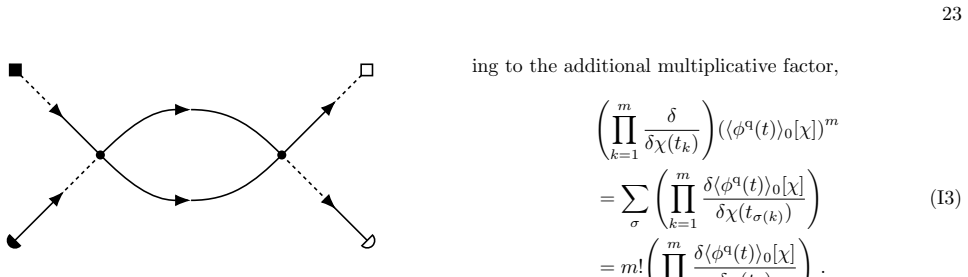
Every vertex connects to two ingoing and to two outgoing lines. ✓ × The left diagram is valid but the right diagram not since it contains three ingoing lines at the same vertex. 7
-
[2]
Every vertex connects to either one or three dashed lines. ✓ ✓ × The left and center diagram show the two possible ways that lines can attach to a vertex - either one full line or three full lines. The rightmost diagram is not valid since the vertex connects to two full lines and two dotted lines
-
[3]
✓ × × Loops of dotted lines or mixed loops cannot exist
The only loops that exist are those of the Keldysh Green function. ✓ × × Loops of dotted lines or mixed loops cannot exist. These three rules are sufficient to find all contributing diagrams for a specific cumulant. However, taking into account the application of Wicks theorem and the causal- ity structure of the Green functions yields additional con- str...
-
[4]
Whenever two vertices are connected by multiple Green functions, the connecting Green functions have to be arranged in such a way that all dotted lines connect to the same vertex. ✓ × . The right diagram will invariably equal zero be- cause the dotted lines of the connecting Green func- tions connect to opposite vertices
-
[5]
a) Any diagram that contains exactly two detec- tor symbols at the same vertex, one filled and one unfilled, where exactly one connects to the vertex through a dashed line invariably vanishes. × × . b) Any diagram that contains exactly three detec- tor legs at one vertex, whereof two are identical, and one or two connect to the vertex through a dashed lin...
-
[6]
At zero temperature, two vertices cannot be con- nected by three lines. 0 nB →0 . The terms contributing, e.g., to the second order cor- rection of the average output field can now be determined by finding all diagrams that (i) contain two vertices, (ii) one empty half-circle and are (iii) consistent with the di- agrammatic rules outlined above. Some of t...
-
[7]
Each vertex contributes a multiplicity factor of two if and only if all four legs connecting to the ver- tex are different, i.e. each building block in Fig. 2 8 a) b) c) d) e) f) g) h) FIG. 4. Second order diagrams for⟨ ˆbout⟩. a)-e) Diagrams that can be obtained by concatenating first order diagrams and can thus be obtained from a finite-temperature mean...
-
[8]
Each diagram is multiplied by the factorial of the number of empty half–circles and the factorial of the number of filled half–circles, (# )!×(# )!
-
[9]
#l " #p , =F e i(∆+4nB U)(t−t ′)e−κ/2|t−t′| , (49) iGR U(t−t ′) = ∞X n=0
Lastly we multiply by the number of ways connec- tions between vertices can be realigned. This factor is found by cutting up each propagator that starts and ends at a vertex and counting all possible ways of reconnecting the arrows such that one recovers the original diagram. After cutting the propagator lines, there are two ways of reconnecting the dangl...
work page 2020
-
[10]
This highlights the fact that the contin- uum notation should always be considered as a nota- tional shorthand for the exact, discrete path integral. Since any diagram that allows for a quantum-quantum loop (a fully dashed circle) also fulfills all the diagram rules with a classical-classical loop in its stead we fix the following convention: We only allo...
-
[11]
A. A. Clerk, M. H. Devoret, S. M. Girvin, F. Marquardt, and R. J. Schoelkopf, Introduction to quantum noise, measurement, and amplification, Rev. Mod. Phys.82, 1155 (2010)
work page 2010
-
[12]
H. H¨ ubener, U. De Giovannini, C. Sch¨ afer, J. And- berger, M. Ruggenthaler, J. Faist, and A. Rubio, En- gineering quantum materials with chiral optical cavities, Nat. Mater.20, 438 (2021)
work page 2021
- [13]
-
[14]
A. Reiserer and G. Rempe, Cavity-based quantum net- works with single atoms and optical photons, Rev. Mod. Phys.87, 1379 (2015)
work page 2015
-
[15]
M. Aspelmeyer, T. J. Kippenberg, and F. Marquardt, Cavity optomechanics, Rev. Mod. Phys.86, 1391 (2014)
work page 2014
-
[16]
I.-T. Lu, D. Shin, M. K. Svendsen, S. Latini, H. H¨ ubener, M. Ruggenthaler, and A. Rubio, Cavity engineering of solid-state materials without external driving, Adv. Opt. Photon.17, 441 (2025)
work page 2025
-
[17]
F. Mivehvar, F. Piazza, T. Donner, and H. R. and, Cavity qed with quantum gases: new paradigms in many-body physics, Adv. Phys.70, 1 (2021)
work page 2021
-
[18]
H.-P. Breuer and F. Petruccione, The theory of open quantum systems, 1st ed. (Ox- ford University Press, Oxford, 2007)
work page 2007
-
[19]
Kamenev, Field Theory of Non-Equilibrium Systems (Cambridge University Press, 2011)
A. Kamenev, Field Theory of Non-Equilibrium Systems (Cambridge University Press, 2011)
work page 2011
-
[20]
A. Strathearn, P. Kirton, D. Kilda, J. Keeling, and B. W. Lovett, Efficient non-markovian quantum dynamics using time-evolving matrix product operators, Nat. Commun. 9, 3322 (2018)
work page 2018
-
[21]
D. F. Walls and G. J. Milburn, Quantum optics, 3rd ed. (Springer Nature Switzerland AG, 2025)
work page 2025
-
[22]
M. J. Collett and C. W. Gardiner, Squeezing of intracav- ity and traveling-wave light fields produced in parametric amplification, Phys. Rev. A30, 1386 (1984)
work page 1984
-
[23]
C. W. Gardiner and M. J. Collett, Input and output in damped quantum systems: Quantum stochastic differen- tial equations and the master equation, Phys. Rev. A31, 3761 (1985)
work page 1985
-
[24]
Yurke, Input-output theory, in Quantum Squeezing, edited by P
B. Yurke, Input-output theory, in Quantum Squeezing, edited by P. D. Drummond and Z. Ficek (Springer Berlin Heidelberg, Berlin, Heidelberg, 2004) pp. 53–96
work page 2004
-
[25]
I. Strandberg, G. Johansson, and F. Quijandr´ ıa, Wigner negativity in the steady-state output of a kerr parametric oscillator, Phys. Rev. Research3, 023041 (2021)
work page 2021
-
[26]
Yurke, Use of cavities in squeezed-state generation, Phys
B. Yurke, Use of cavities in squeezed-state generation, Phys. Rev. A29, 408 (1984)
work page 1984
-
[27]
A. H. Kiilerich and K. Mølmer, Quantum interactions with pulses of radiation, Phys. Rev. A102, 023717 (2020)
work page 2020
-
[28]
A. H. Kiilerich and K. Mølmer, Input-output theory with quantum pulses, Phys. Rev. Lett.123, 123604 (2019)
work page 2019
-
[29]
P. Z. Crispin Gardiner, Quantum Noise, 3rd ed., Springer Series in Synergetics (Springer Berlin, Heidelberg, 2004)
work page 2004
-
[30]
L. M. Sieberer, M. Buchhold, and S. Diehl, Keldysh field theory for driven open quantum systems, Reports on Progress in Physics79, 096001 (2016)
work page 2016
-
[31]
F. Thompson and A. Kamenev, Field theory of many- body lindbladian dynamics, Annals of Physics455, 169385 (2023)
work page 2023
-
[32]
R. J. Glauber, The quantum theory of optical coherence, Phys. Rev.130, 2529 (1963)
work page 1963
-
[33]
R. J. Glauber, Coherent and incoherent states of the ra- diation field, Phys. Rev.131, 2766 (1963)
work page 1963
-
[34]
E. C. G. Sudarshan, Equivalence of semiclassical and quantum mechanical descriptions of statistical light beams, Phys. Rev. Lett.10, 277 (1963)
work page 1963
-
[35]
Vogel, Nonclassical correlation properties of radiation fields, Phys
W. Vogel, Nonclassical correlation properties of radiation fields, Phys. Rev. Lett.100, 013605 (2008)
work page 2008
- [36]
-
[37]
R. Kubo, Generalized cumulant expansion method, Jour- nal of the Physical Society of Japan17, 1100 (1962)
work page 1962
-
[38]
A. Altland and B. D. Simons, Condensed Matter Field Theory, 2nd ed. (Cambridge University Press, 2010)
work page 2010
-
[39]
A. McDonald and A. A. Clerk, Third quantization of open quantum systems: Dissipative symmetries and con- nections to phase-space and keldysh field-theory formu- lations, Phys. Rev. Res.5, 033107 (2023)
work page 2023
-
[40]
N. Bartolo, F. Minganti, W. Casteels, and C. Ciuti, Exact steady state of a kerr resonator with one- and two-photon driving and dissipation: Controllable wigner- function multimodality and dissipative phase transitions, Phys. Rev. A94, 033841 (2016)
work page 2016
-
[41]
M. E. Peskin and D. V. Schroeder, An Introduction to quantum field theory (Addison- Wesley, Reading, USA, 1995)
work page 1995
-
[42]
S. Kr¨ amer, D. Plankensteiner, L. Ostermann, and H. Ritsch, QuantumOptics. jl: A Julia framework for simulating open quantum systems, Comput. Phys. Com- mun.227, 109 (2018)
work page 2018
-
[43]
G. Peccati and M. S. Taqqu, Wiener Chaos: Moments, Cumulants and Diagrams (Springer Milan, 2011)
work page 2011
-
[44]
C. Gerry and P. Knight, Introductory Quantum Optics (Cambridge University Press, 2004)
work page 2004
-
[45]
G. J. M. D.F. Walls, Quantum Optics, 2nd ed. (Springer- Verlag, 2008)
work page 2008
- [46]
discussion (0)
Sign in with ORCID, Apple, or X to comment. Anyone can read and Pith papers without signing in.