REVIEW 4 major objections 5 minor 62 references
What's in the Box: Ergonomic and Expressive Capture Tracking over Generic Data Structures (Extended Version)
T0 review · 4 major / 5 minor · reviewed 2026-08-04 · deepseek-v4-flash
Pith's one-line read The paper introduces reach capabilities, a mechanism that names the capabilities hidden inside boxed generic data structures, and shows they make capture checking practical enough to compile Scala's standard collections library with minimal
desk verdict A serious, well-engineered paper that makes capture checking practical for generic data structures; the main open risk is that the surface calculus's soundness rests on an unmechanized translation and an intuitive deep-capture-set definition. read the letter →
The pith
A machine-rendered reading of the paper's core claim, the machinery that carries it, and where it could break.
The reading
What carries the argument
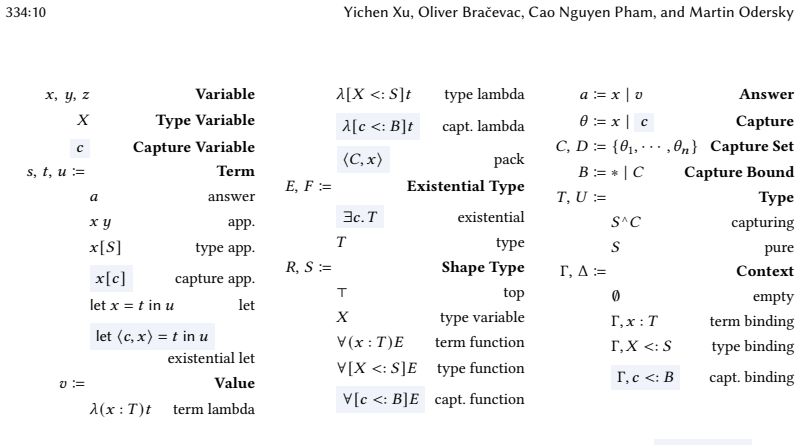
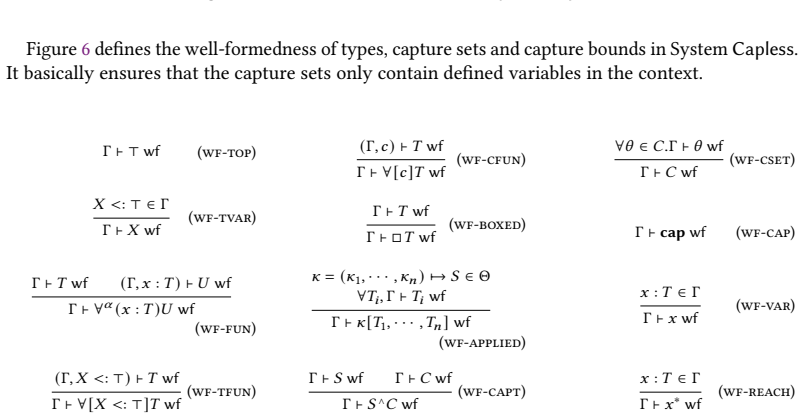
The central object is the reach capability x* — a name for what is inside the box. When x is used, reach refinement replaces covariant occurrences of the universal capability cap in x's type with x*, making a generic collection's hidden captures addressable. The deep capture set dcs(Γ,T) collects the capabilities occurring covariantly in T and is the concrete witness when a reach capability is instantiated at a call site; the @use annotation tells the checker to add the argument's deep capture set to the caller's capture set. System Capless grounds this by translating hidden caps into explicit existential or universal capture quantifiers, making the naming sound.
What would settle it
Give a @use parameter a boxed value whose type mentions a capability only contravariantly (e.g., a stored function File^ => Unit), then invoke that function with a file inside the body. If the resulting capture set omits the file effect, dcs is unsound; if the checker rejects the program, dcs over-approximates. Either outcome would settle whether dcs correctly characterizes what's in the box.
Extended reading notes
Core claim
Reach capabilities make effect polymorphism over generic data structures expressive yet lightweight. A reach capability x* names the existential capture set hidden in the boxes of x's type: reach refinement replaces covariant occurrences of cap in x's type with x*; the deep capture set dcs(Γ,T) collects the capabilities that can escape through a value of type T and instantiates x* at @use call sites; @use adds dcs to the caller's capture set. System Capless replaces cap with explicit universal/existential capture quantification; System Reacap translates to it type-preservingly. A Scala 3 reimplementation compiles the collections library with under 5% of lines changed.
Load-bearing premise
The whole mechanism rests on the assumption that the deep capture set — which collects only covariant capability occurrences in a type — captures every capability that can actually escape through a use of a value of that type, with no misses in contravariant or hidden positions and no harmful over-approximation.
Editorial extensions
If this is right
- Functions such as mkIterator and collect get precise types like Iterator[T]^{ops*}; a pure input yields a pure result instead of an arbitrary top capture.
- Scala's standard collections library compiles under capture checking with under 5% of lines changed and almost 90% of function signatures unmodified.
- Explicit capture-set polymorphism becomes optional; the collections library required none, and recursive or mutable patterns can fall back to explicit capture parameters.
- Capture checking can be adopted per module since checked and unchecked code can be mixed, and the mostly box-inferred syntax keeps most signatures untouched.
- Lean-mechanized type soundness and scope safety provide a foundation for extending the system toward freshness, capability categories, and path-dependent capture tracking.
Reading between the lines
- If the deep-capture-set characterization is complete, the same recipe — removing the top capability, adding explicit capture quantifiers, and offering a surface-level reach name — should transplant to other box-based capability or effect systems.
- Generalizing reach capabilities from whole variables to paths, as the paper's p._1* discussion suggests, would give element-level precision and directly address the coarse-grained fst/snd limitation the paper acknowledges.
- A testable extension: applying the same migration recipe to other mainstream libraries (e.g., futures/IO ecosystems beyond the case study) would show whether the under-5%-changes figure is a property of the mechanism or of the collections library.
- Because dcs is defined covariantly and no completeness theorem is given, the soundness boundary in contravariant or hidden positions remains the open question most likely to delimit the approach.
Editorial analysis
A structured set of objections, weighed in public.
Referee Report
Summary. The paper develops System Capless, a capture calculus with explicit universal and existential capture-set quantification, and System Reacap, a surface calculus with reach capabilities (x*) and @use annotations. Reach capabilities are intended to name the contents of boxes in generic data structures without obliging users to write capture quantifiers. The authors report a Lean 4 mechanization of Capless type soundness and scope safety, a pen-and-paper type-preserving translation from Reacap to Capless, and a reimplementation of Scala 3's capture checker used to port the standard collections library with, they claim, minimal changes. The central claim is that reach capabilities make capture checking ergonomic and expressive enough for generic collections.
Significance. If the results hold, this is a substantial step toward practical effect/capture tracking in a mainstream language: it directly addresses a known limitation of prior capture-checking systems (CC<:□), provides a new foundational calculus with both existential and universal capture-set quantification, and validates the design on a large code base. The machine-checked metatheory for Capless and the artifact (Lean development, compiler, migrated collections) are genuine strengths. However, the surface language's soundness depends on a paper-and-pencil translation whose key cases are sketched, and on the deep-capture-set function dcs, which lacks a formal characterization tying it to the existential witnesses introduced by the translation. These gaps are load-bearing because the @use application rule and reach-capability semantics rely on dcs being exactly the set of escaping capabilities.
major comments (4)
- [Definition 4.1 / Figure 4 (app)] The soundness of reach capabilities rests on the claim that dcs(Γ,T) collects exactly the capabilities that can escape through a value of type T. Definition 4.1 is purely covariant: it discards z and z* from function results, ignores contravariant argument types, and for applied types sums only over covariant parameters. The paper provides examples but no theorem stating, for every type T and appropriate translation context, that dcs(Γ,T) matches the existential witness produced by the translation J T K. Without such a characterization, the (app) rule's use of dcs(Γ,S) both as a subcapturing obligation and as the substitution for z* is not justified. A reach capability hidden in a nested negative position (e.g., inside a box in a contravariant function argument of a result type) could be missed, reintroducing exactly the leaks that the earlier failures (#19571, #20503, #21442) exhibited.
- [Theorem 5.3 / Appendix D.3] Theorem 5.3 is the only bridge between Reacap's surface semantics and the mechanized Capless metatheory, yet its proof is not mechanized and several cases are only sketched. In the (app) case the proof constructs a term using D1 but does not show that D1 equals the translation of dcs(Γ,S_y); the closing note that 'the use set when typing t' will include D1' is not a derivation. In the (abs) case the two subcases (existential vs. non-existential result type) are handled differently, but the well-formedness of the extended contexts is not verified. Because subtyping in Reacap induces term transformations in Capless (Theorem D.10), these are not routine details. The central claim that Reacap is 'certified' by the translation is therefore not fully supported.
- [Theorem D.10 (Translation Preserves Subtyping)] This theorem is load-bearing because every use of (sub) in a Reacap derivation must be translated into a term transformation in Capless. The proof's (fun) case constructs a long eta-expansion with several let-bound intermediates but does not present the full typing derivation of that term. The (applied-p) and (applied-m) cases are dispatched with 'By induction ... we can construct a way adapt the term' and a note about decreasing the size of Θ. This is a proof sketch, not a proof. Since this theorem is outside the Lean development, the gap is not caught by the mechanization. Please provide complete proofs or extend the mechanization to cover the translation.
- [Table 2 / §7.2] The headline quantitative claims are difficult to verify from Table 2. The row 'Capture sets on definitions' reports 691 functions and 91 classes changed, while its two subcategories ('Only universal captures' = 351 and 'Only capture set on returns' = 379) sum to 730, exceeding 691. It is unclear whether the 691 counts only functions or also includes classes, and whether the subcategories are disjoint. The 25 'Unsafe capture set removal' and 5 'Unsafe casts' are escape hatches, but their locations and necessity are not discussed, which weakens the claim of a sound capture-checked library. Finally, the abstract's '<5% LoC changed' and 'almost 90% function signatures stay the same' are not reproduced by the table: 2825 changed lines / 52,160 total lines = 5.4%, and 691 changed functions / 6189 functions = 11.2% changed (88.8% unchanged). Please clarify the denominators and make the change
minor comments (5)
- [Section 5, first sentence] Typo: 'scope safey' should be 'scope safety'.
- [Section 7.1, Table 1] The text says capture checking takes 'approximately half the time compared to the previous typing phase'; Table 1 shows 3896 ms vs. 10436 ms, which is about 37%, not half. Please adjust the wording.
- [References [43, 44, 23]] The cited GitHub issues are labeled '2015' but issue numbers 19571, 20503, and 21442 correspond to a much later period. Please correct the years.
- [Data Availability] The artifact DOI is given, but the paper does not include a commit hash, Lean version, or verification instructions. Adding these would materially improve reproducibility.
- [Definition 4.1] In dcs(Γ,∀α(z:T)U) = dcs(Γ,U)\ {z,z*}, the removal of z from the capture set of U is intuitive but should be justified explicitly: a function result mentioning z refers to the parameter, not to an escaping capability. A short explanation would prevent confusion.
Circularity Check
No circularity: the rcaps mechanism is assigned meaning by a type-preserving translation into a separately mechanized calculus, and no fitted parameter is renamed as a prediction.
full rationale
The paper's central construction is System Reacap, whose reach capabilities are not assumed sound but are assigned meaning by the type-preserving translation (Theorem 5.3) into System Capless, whose type soundness and scope safety are independently mechanized in Lean 4. The deep capture set dcs (Definition 4.1) is a syntactic definition used in the @use application rule; the paper does not prove a completeness theorem connecting dcs to the exact escaping capabilities, but that is a soundness/expressiveness gap rather than a circular reduction: nothing in the paper defines dcs in terms of the typing conclusion it is used to derive. The motivating examples are counterexamples to an earlier design, not fitted inputs. Prior work on CC<:□ [5] and the earlier rcaps extended abstract [55] are cited as building blocks and as evidence of previous soundness bugs, but the present derivation does not reduce to those citations: System Capless is new and has mechanized metatheory, and the library migration is an empirical existence proof rather than a prediction forced by construction. The pen-and-paper status of the translation theorem and the absence of a dcs characterization theorem are correctness risks, not circularity.
Assumptions & free parameters
assumptions (6)
- domain assumption Capabilities are represented as ordinary program variables, and a capturing type over-approximates the variables a value may capture (object-capability model).
- domain assumption Generic type arguments are boxed by default; box inference is complete and boxes have no runtime cost.
- domain assumption Deep capture sets dcs(Γ,T), collecting only covariant capture occurrences, characterize exactly the capabilities accessible by unboxing or using a value of type T.
- domain assumption Reach refinement can safely replace covariant occurrences of cap by x*, excluding function domains and codomains, with type definitions recovering lost expressiveness.
- ad hoc to paper The type-preserving translation from Reacap to Capless (Theorem 5.3) is correct as a paper-and-pencil proof.
- standard math Standard syntactic type-soundness machinery (progress, preservation, store typing) applies.
invented entities (2)
-
Reach capability x*
independent evidence
-
System Capless bounded capture quantification (universal and existential capture variables)
Cite this review
Pith. "Pith review of What's in the Box: Ergonomic and Expressive Capture Tracking over Generic Data Structures (Extended Version)." pith.science (2026). https://pith.science/paper/TXLDVK3R
@misc{pith2026250907609,
  author       = {Pith},
  title        = {Pith review of: What's in the Box: Ergonomic and Expressive Capture Tracking over Generic Data Structures (Extended Version)},
  year         = {2026},
  howpublished = {\url{https://pith.science/paper/TXLDVK3R}},
  note         = {Machine review of arXiv:2509.07609}
}
read the original abstract
Capturing types in Scala unify static effect and resource tracking with object capabilities, enabling lightweight effect polymorphism with minimal notational overhead. However, their expressiveness has been insufficient for tracking capabilities embedded in generic data structures, preventing them from scaling to the standard collections library -- an essential prerequisite for broader adoption. This limitation stems from the inability to name capabilities within the system's notion of box types. This paper develops System Capless, a new foundation for capturing types that provides the theoretical basis for reach capabilities (rcaps), a novel mechanism for naming "what's in the box." The calculus refines the universal capability notion into a new scheme with existential and universal capture set quantification. Intuitively, rcaps witness existentially quantified capture sets inside the boxes of generic types in a way that does not require exposing existential capture types in the surface language. We have fully mechanized the formal metatheory of System Capless in Lean, including proofs of type soundness and scope safety. System Capless supports the same lightweight notation of capturing types plus rcaps, as certified by a type-preserving translation, and also enables fully optional explicit capture-set quantification to increase expressiveness. Finally, we present a full reimplementation of capture checking in Scala 3 based on System Capless and migrate the entire Scala collections library and an asynchronous programming library to evaluate its practicality and ergonomics. Our results demonstrate that reach capabilities enable the adoption of capture checking in production code with minimal changes and minimal-to-zero notational overhead in a vast majority of cases.
Figures


Figures from the paper (9 more)




Reference graph
Works this paper leans on
-
[1]
Parkinson, and Tobias Wrigstad
Ellen Arvidsson, Elias Castegren, Sylvan Clebsch, Sophia Drossopoulou, James Noble, Matthew J. Parkinson, and Tobias Wrigstad. 2023. Reference capabilities for flexible memory management. Proc. ACM Program. Lang. , 7, OOPSLA2, 1363–1393 (cit. on p. 25)
work page 2023
-
[2]
Thibaut Balabonski, François Pottier, and Jonathan Protzenko. 2016. The design and formalization of Mezzo, a permission-based programming language. ACM Trans. Program. Lang. Syst. , 38, 4, 14:1–14:94 (cit. on p. 24)
work page 2016
-
[3]
Yuyan Bao, Guannan Wei, Oliver Bračevac, Yuxuan Jiang, Qiyang He, and Tiark Rompf. 2021. Reachability types: Tracking aliasing and separation in higher-order functional programs. Proc. ACM Program. Lang., 5, OOPSLA, 1–32 (cit. on p. 23)
work page 2021
-
[4]
Erik Barendsen and Sjaak Smetsers. 1996. Uniqueness typing for functional languages with graph rewriting semantics. Math. Struct. Comput. Sci. , 6, 6, 579–612 (cit. on p. 24)
work page 1996
-
[5]
Aleksander Boruch-Gruszecki, Martin Odersky, Edward Lee, Ondrej Lhoták, and Jonathan Immanuel Brachthäuser
-
[6]
Chandrasekhar Boyapati, Barbara Liskov, and Liuba Shrira. 2003. Ownership types for object encapsulation. In POPL. ACM, 213–223 (cit. on p. 24)
work page 2003
-
[7]
Oliver Bračevac, Guannan Wei, Songlin Jia, Supun Abeysinghe, Yuxuan Jiang, Yuyan Bao, and Tiark Rompf. 2023. Graph IRs for impure higher-order languages (technical report). CoRR, abs/2309.08118 (cit. on p. 23)
work page Pith review arXiv 2023
-
[8]
Oliver Bračevac, Guannan Wei, Songlin Jia, Supun Abeysinghe, Yuxuan Jiang, Yuyan Bao, and Tiark Rompf. 2023. Graph IRs for impure higher-order languages: Making aggressive optimizations affordable with precise effect dependencies. Proc. ACM Program. Lang., 7, OOPSLA2, 400–430 (cit. on p. 23)
work page 2023
Show all 62 references
-
[9]
Jonathan Immanuel Brachthäuser, Philipp Schuster, Edward Lee, and Aleksander Boruch-Gruszecki. 2022. Effects, capabilities, and boxes: From scope-based reasoning to type-based reasoning and back. Proc. ACM Program. Lang., 6, OOPSLA, 1–30 (cit. on pp. 1, 2, 24)
2022
-
[10]
Jonathan Immanuel Brachthäuser, Philipp Schuster, and Klaus Ostermann. 2020. Effects as capabilities: Effect handlers and lightweight effect polymorphism. Proc. ACM Program. Lang., 4, OOPSLA, 126:1–126:30 (cit. on pp. 1, 2)
2020
-
[11]
Canthrow capabilities
2021. Canthrow capabilities. Accessed: 2025-07-28. https://docs.scala-lang.org/scala3/reference/experimental/canthr ow.html (cit. on p. 24)
2021
-
[12]
Dave Clarke, Johan Östlund, Ilya Sergey, and Tobias Wrigstad. 2013. Ownership types: A survey. In Aliasing in Object-Oriented Programming. Lecture Notes in Computer Science. Vol. 7850. Springer, 15–58 (cit. on p. 24)
2013
-
[13]
Sylvan Clebsch, Sophia Drossopoulou, Sebastian Blessing, and Andy McNeil. 2015. Deny capabilities for safe, fast actors. In AGERE!@SPLASH. ACM, 1–12 (cit. on p. 24)
2015
-
[14]
Sylvan Clebsch, Juliana Franco, Sophia Drossopoulou, Albert Mingkun Yang, Tobias Wrigstad, and Jan Vitek. 2017. Orca: GC and type system co-design for actor languages. Proc. ACM Program. Lang., 1, OOPSLA, 72:1–72:28 (cit. on p. 24)
2017
-
[15]
Lukas Convent, Sam Lindley, Conor McBride, and Craig McLaughlin. 2020. Doo bee doo bee doo. J. Funct. Program., 30, e9 (cit. on pp. 1, 2, 25)
2020
-
[16]
Werner Dietl, Sophia Drossopoulou, and Peter Müller. 2007. Generic universe types. In ECOOP (Lecture Notes in Computer Science). Vol. 4609. Springer, 28–53 (cit. on p. 24)
2007
-
[17]
Fish, Darya Melicher, and Jonathan Aldrich
Jennifer A. Fish, Darya Melicher, and Jonathan Aldrich. 2020. A case study in language-based security: Building an I/O library for Wyvern. In Onward! ACM, 34–47 (cit. on p. 25)
2020
-
[18]
Foster, Manuel Fähndrich, and Alexander Aiken
Jeffrey S. Foster, Manuel Fähndrich, and Alexander Aiken. 1999. A theory of type qualifiers. In PLDI. ACM, 192–203 (cit. on p. 25). What’s in the Box 334:27
1999
-
[19]
Colin S. Gordon. 2020. Designing with Static Capabilities and Effects: Use, Mention, and Invariants. In 34th European Conference on Object-Oriented Programming (ECOOP 2020) (Leibniz International Proceedings in Informatics (LIPIcs)). Robert Hirschfeld and Tobias Pape, (Eds.) V...
2020 doi
-
[20]
Gregory Morrisett, Trevor Jim, Michael W
Dan Grossman, J. Gregory Morrisett, Trevor Jim, Michael W. Hicks, Yanling Wang, and James Cheney. 2002. Region- based memory management in Cyclone. In PLDI. ACM, 282–293 (cit. on p. 24)
2002
-
[21]
John Hatcliff and Olivier Danvy. 1994. A generic account of continuation-passing styles. InPOPL. ACM Press, 458–471 (cit. on pp. 10, 13)
1994
-
[22]
Mark P. Jones. 1994. A theory of qualified types. Sci. Comput. Program., 22, 3, 231–256 (cit. on p. 25)
1994
-
[23]
Leaking local reach capability
2015. Leaking local reach capability. Accessed: 2025-03-23. https://github.com/scala/scala3/issues/21442 (cit. on pp. 3, 8)
2015
-
[24]
Edward Lee, Yaoyu Zhao, Ondrej Lhoták, James You, Kavin Satheeskumar, and Jonathan Immanuel Brachthäuser
-
[25]
Sam Lindley, Conor McBride, and Craig McLaughlin. 2017. Do be do be do. In POPL. ACM, 500–514 (cit. on pp. 1, 2, 25)
2017
-
[26]
Eisenberg, and Sam Lindley
Anton Lorenzen, Leo White, Stephen Dolan, Richard A. Eisenberg, and Sam Lindley. 2024. Oxidizing OCaml with modal memory management. Proc. ACM Program. Lang., 8, ICFP, Article 253, (Aug. 2024), 30 pages (cit. on p. 25)
2024
-
[27]
Lucassen and David K
John M. Lucassen and David K. Gifford. 1988. Polymorphic effect systems. In POPL. ACM Press, 47–57 (cit. on p. 24)
1988
-
[28]
Matthew Lutze and Magnus Madsen. 2024. Associated effects: Flexible abstractions for effectful programming. Proc. ACM Program. Lang., 8, PLDI, 394–416 (cit. on p. 25)
2024
-
[29]
Danielle Marshall, Michael Vollmer, and Dominic Orchard. 2022. Linearity and uniqueness: An entente cordiale. In ESOP (Lecture Notes in Computer Science). Vol. 13240. Springer, 346–375 (cit. on p. 24)
2022
-
[30]
Matsakis and Felix S
Nicholas D. Matsakis and Felix S. Klock II. 2014. The Rust language. In HILT. ACM, 103–104 (cit. on p. 24)
2014
-
[31]
Darya Melicher, Yangqingwei Shi, Alex Potanin, and Jonathan Aldrich. 2017. A capability-based module system for authority control. In ECOOP (LIPIcs). Vol. 74. Schloss Dagstuhl - Leibniz-Zentrum für Informatik, 20:1–20:27 (cit. on p. 25)
2017
-
[32]
Darya Melicher, Anlun Xu, Valerie Zhao, Alex Potanin, and Jonathan Aldrich. 2022. Bounded abstract effects. ACM Trans. Program. Lang. Syst., 44, 1, 5:1–5:48 (cit. on p. 25)
2022
-
[33]
Mark S. Miller. 2006. Robust Composition: Towards a Unified Approach to Access Control and Concurrency Control . Ph.D. Dissertation. John Hopkins University (cit. on pp. 1, 25)
2006
-
[34]
Aleksandar Nanevski, Frank Pfenning, and Brigitte Pientka. 2008. Contextual modal type theory.ACM Trans. Comput. Log., 9, 3, 23:1–23:49 (cit. on p. 24)
2008
-
[35]
James Noble, Jan Vitek, and John Potter. 1998. Flexible alias protection. In ECOOP (Lecture Notes in Computer Science). Vol. 1445. Springer, 158–185 (cit. on p. 24)
1998
-
[36]
Robert Nystrom. 2015. What colour is your function? Accessed: 2024-09-09. https://web.archive.org/web/2024100915 2925/https://journal.stuffwithstuff.com/2015/02/01/what-color-is-your-function/ (cit. on p. 23)
2015
-
[37]
Martin Odersky, Olivier Blanvillain, Fengyun Liu, Aggelos Biboudis, Heather Miller, and Sandro Stucki. 2018. Simplicitly: Foundations and applications of implicit function types. Proc. ACM Program. Lang., 2, POPL, 42:1–42:29 (cit. on p. 18)
2018
-
[38]
Martin Odersky, Aleksander Boruch-Gruszecki, Jonathan Immanuel Brachthäuser, Edward Lee, and Ondrej Lhoták
-
[39]
Essertel, Xilun Wu, Lilliam I
Leo Osvald, Grégory M. Essertel, Xilun Wu, Lilliam I. González Alayón, and Tiark Rompf. 2016. Gentrification gone too far? Affordable 2nd-class values for fun and (co-)effect. In OOPSLA. ACM, 234–251 (cit. on p. 25)
2016
-
[40]
Cao Nguyen Pham and Martin Odersky. 2024. Stack-copying delimited continuations for Scala Native. In ICOOOLPS @ ECOOP. ACM, 2–13. doi: 10.1145/3679005.3685979 (cit. on p. 24)
2024
-
[41]
url: https://web.archive.org/web/20 241007175842/https://www.ponylang.io/, vcs: https://github.com/ponylang/ponyc (cit
[SW Mod.] Pony, Pony Programming Language 2024 Pony Development Team. url: https://web.archive.org/web/20 241007175842/https://www.ponylang.io/, vcs: https://github.com/ponylang/ponyc (cit. on p. 24)
2024
-
[42]
Alex Potanin, James Noble, Dave Clarke, and Robert Biddle. 2006. Generic ownership for generic Java. In OOPSLA. ACM, 311–324 (cit. on p. 24)
2006
-
[43]
Reach capabilities get dropped in cv
2015. Reach capabilities get dropped in cv. Accessed: 2025-03-23. https://github.com/scala/scala3/issues/19571 (cit. on pp. 3, 8)
2015
-
[44]
Reach capabilities of function arguments get ignored
2015. Reach capabilities of function arguments get ignored. Accessed: 2025-03-23. https://github.com/scala/scala3/iss ues/20503 (cit. on pp. 3, 8)
2015
-
[45]
Tiark Rompf and Nada Amin. 2016. Type soundness for dependent object types (DOT). In OOPSLA. ACM, 624–641 (cit. on pp. 22, 25). 334:28 Yichen Xu, Oliver Bračevac, Cao Nguyen Pham, and Martin Odersky
2016
-
[46]
Jean-Pierre Talpin and Pierre Jouvelot. 1994. The type and effect discipline. Inf. Comput., 111, 2, 245–296 (cit. on p. 24)
1994
-
[47]
Wenhao Tang, Leo White, Stephen Dolan, Daniel Hillerström, Sam Lindley, and Anton Lorenzen. 2025. Modal effect types. Proc. ACM Program. Lang., 9, OOPSLA1, Article 120, (Apr. 2025), 28 pages. doi: 10.1145/3720476 (cit. on pp. 1, 2, 25)
2025 doi
-
[48]
Mads Tofte and Jean-Pierre Talpin. 1997. Region-based memory management. Inf. Comput., 132, 2, 109–176 (cit. on p. 24)
1997
-
[49]
Philip Wadler. 1990. Linear types can change the world! In Programming Concepts and Methods . North-Holland, 561 (cit. on p. 24)
1990
-
[50]
Philip Wadler. 1989. Theorems for free! InProceedings of the Fourth International Conference on Functional Programming Languages and Computer Architecture (FPCA ’89). Association for Computing Machinery, Imperial College, London, United Kingdom, 347–359. isbn: 0897913280. doi:...
1989
-
[51]
Guannan Wei, Oliver Bračevac, Songlin Jia, Yuyan Bao, and Tiark Rompf. 2024. Polymorphic reachability types: Tracking freshness, aliasing, and separation in higher-order generic programs. Proc. ACM Program. Lang., 8, POPL, 393–424 (cit. on p. 23)
2024
-
[52]
Anxhelo Xhebraj, Oliver Bračevac, Guannan Wei, and Tiark Rompf. 2022. What if we don’t pop the stack? The return of 2nd-class values. In ECOOP (LIPIcs). Vol. 222. Schloss Dagstuhl - Leibniz-Zentrum für Informatik, 15:1–15:29 (cit. on p. 25)
2022
-
[53]
Yichen Xu, Aleksander Boruch-Gruszecki, and Martin Odersky. 2024. Degrees of separation: A flexible type system for safe concurrency. Proc. ACM Program. Lang., 8, OOPSLA1, 1181–1207. doi: 10.1145/3649853 (cit. on p. 23)
2024 doi
-
[54]
What’s in the Box: Ergonomic and Expressive Capture Tracking over Generic Data Structures
[SW] Yichen Xu, Oliver Bračevac, Cao Nguyen Pham, and Martin Odersky, Artifact for "What’s in the Box: Ergonomic and Expressive Capture Tracking over Generic Data Structures" Aug. 2025. doi: 10.5281/zenodo.16922930 (cit. on pp. 4, 26)
2025 doi
-
[55]
Yichen Xu and Martin Odersky. 2024. A formal foundation of reach capabilities (extended abstract). In Companion Proceedings of the International Conference on the Art, Science, and Engineering of Programming (VIMPL’24) . ACM. doi: 10.1145/3660829.3660851 (cit. on p. 3)
2024
-
[56]
test.txt
Yichen Xu and Martin Odersky. 2023. Formalizing box inference for capture calculus. ArXiv, abs/2306.06496 (cit. on p. 6). What’s in the Box 334:29 A Additional Definitions A.1 Well-formedness Γ⊢⊤ wf (wf-top) 𝑋 <:𝑆∈ Γ Γ⊢𝑋 wf (wf-tvar) Γ⊢𝑇 wf (Γ,𝑥 :𝑇)⊢ 𝐸 wf Γ⊢∀( 𝑥 :𝑇)𝐸 wf (wf-fu...
2023 arXiv
-
[60]
Case (box)
We then conclude this case by Theorem D.10 and Theorem D.2. Case (box). Then the typing derivation is of the form{}; Γ⊢ □𝑥0 : □(𝑆0∧𝐶0) where we have 𝐶0; Γ⊢𝑥0 :𝑆0∧𝐶0. By the IH, we can show that J𝐶0K𝐷0; Δ⊢𝑎′ 0 : J𝑆0∧𝐶0K𝐷0 for some𝐷0 and𝑎′
-
[61]
We conclude this case by repeated application of the (tabs) rule
We let𝐷′ =𝐷0 and construct the following𝑡′: 𝜆[𝑋 <:⊤]𝜆[𝑋 <:⊤]𝑎′ 0, which is also an answer. We conclude this case by repeated application of the (tabs) rule. Case (unbox). Then the typing derivation is of the form 𝐶0; Γ⊢𝐶 𝑥0 :𝑆0∧𝐶0 and we have 𝐶0; Γ⊢𝑥0 : □𝑆0∧𝐶0. By analyzing th...
-
[62]
We construct the following𝑡′: let𝑧1 =𝑡′ 1 in 𝑡′ 2 and conclude this case by the (let) rule. If the second case holds, we invoke the IH on the second typing derivation to show that J𝐶K𝐷2; Δ,𝑐𝑧 : CapSet,𝑧 : J𝑇1K𝑐𝑧⊢𝑡′ 2 : J𝑇2K𝐷2 for some𝐷2 and𝑡′ 2, and construct the following𝑡′: ...
2025
-
[2021]
In SCALA/SPLASH
Safer exceptions for Scala. In SCALA/SPLASH. ACM, 1–11 (cit. on pp. 4, 24)
-
[2023]
ACM Trans
Capturing types. ACM Trans. Program. Lang. Syst. , 45, 4, 21:1–21:52 (cit. on pp. 1, 2, 4, 6, 7, 10, 12–14, 17, 25, 30, 32)
-
[2024]
Qualifying system F<: Some terms and conditions may apply. Proc. ACM Program. Lang., 8, OOPSLA1, 583–612 (cit. on p. 25)
Reviewed August 4, 2026 · model on record in the stance chip above.
Discussion (0). Sign in to comment.