REVIEW 3 major objections 8 minor 31 references
Kinematics-informed training injects exact forward kinematics as a differentiable loss, making configuration-space sampling converge up to 74.29× faster than DDPG while reaching 99.25% sampling accuracy.
Reviewed by Pith at T0; open to challenge. T0 means a machine referee read the full paper against a public rubric. the ladder, T0–T4 →
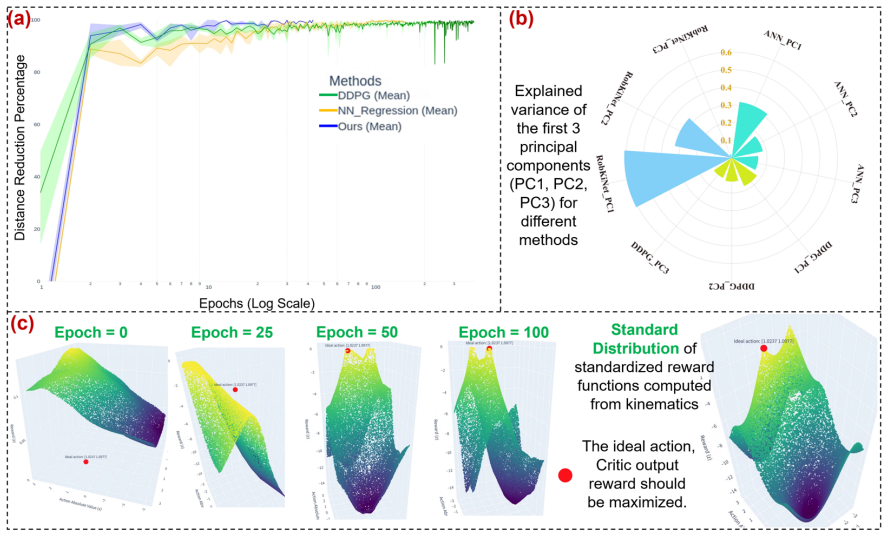
RobKiNet uses exact forward kinematics in its training loss, reaching 98% distance reduction in about 4 epochs versus 322 for DDPG, with 99.25% sampling accuracy on a 9-DOF robot.
T0 review reviewed 2026-08-04 challenge →
load-bearing objection Follow-up analysis of the authors' own RobKiNet: the 9-DOF deployment is real, but the headline 74.29x training-speed claim compares epochs, not wall-clock time, and so does not support the paper's central efficiency argument. the 3 major comments →
Decoding RobKiNet: Insights into Efficient Training of Robotic Kinematics Informed Neural Network
The pith
A machine-rendered reading of the paper's core claim, the machinery that carries it, and where it could break.
The reading
Core claim
The central claim is that RobKiNet's efficiency comes from its kinematic knowledge infusion: the network outputs joint angles, those angles pass through the differentiable forward-kinematics engine, and the training loss compares the resulting end-effector pose with the desired pose. Because the kinematics define a clear target, the optimization does not depend on dataset labels or on a learned reward; the gradient direction is stable across epochs and points accurately at the feasible set. The paper captures this as an Optimization Expectation Model where each method minimizes an expected error over its own sampling distribution—random sampling over the whole space, supervised ANN over a fi
What carries the argument
The load-bearing mechanism is the differentiable forward-kinematics layer, built with differential programming and inserted into the neural network's forward computation graph so that motion-level kinematics participate in backpropagation. It expands the computational graph of a conventional ANN and makes the loss a kinematic consistency check rather than a label comparison. The paper also introduces the Optimization Expectation Model to formalize the comparison, and two diagnostics—Distance Reduction Percentage (DRP) and principal-component explained variance of gradient vectors—to operationalize 'stable direction.' 'Accurate direction' is operationalized by showing DDPG's learned reward di
Load-bearing premise
The whole efficiency story assumes the robot's forward kinematics can be embedded as an exactly differentiable, numerically stable layer; if the kinematic model is inaccurate or its gradients are ill-conditioned, the claimed stable and accurate optimization direction no longer follows.
What would settle it
Retrain RobKiNet with a learned approximate forward-kinematics layer in place of the exact one, keeping architecture, data, and loss identical. If the 74× epoch advantage over DDPG persists, exact kinematic knowledge is not the driver; if it collapses, the paper's stable-gradient explanation is confirmed.
If this is right
- Configuration sampling under multi-level TAMP constraints no longer requires large labeled datasets: RobKiNet reaches 98% distance reduction in 4.33 epochs in 2-DOF, 123.2 epochs in 9-DOF decoupled control, and 976.33 epochs in 9-DOF whole-body control.
- Training speedup over DDPG is 74.29× in 2-DOF, 48.74× in 9-DOF decoupled control, and 29.82× in 9-DOF whole-body control.
- Deployment accuracy after training exceeds alternatives in all tested dimensions: 99.25% in 2-DOF, 96.67% in 9-DOF decoupled control, and 98.40% in 9-DOF whole-body control, all within 1 mm pose error.
- The same network supports both whole-body control (outputting all 9 joints at once) and decoupled control (outputting the mobile base so that the arm has a DH analytic solution).
- Real-world battery-disassembly tasks reach a 97.33% average completion rate across single-movement, continuous-motion, and scheduling scenarios.
Where Pith is reading between the lines
- The stable-gradient explanation is testable as a general design rule: a candidate constraint layer should be evaluated by the explained variance of gradient principal components and by Jacobian conditioning before committing to training.
- If the exact forward kinematics are replaced by an approximate learned model, the 74× speed advantage should shrink in proportion to the model's error; measuring that degradation would isolate how much of the gain is due to exactness versus mere constraint regularization.
- The same differentiable-constraint principle might extend to inequality constraints such as collision avoidance and torque limits if those functions can be made differentiable, which the paper lists as future work.
Editorial analysis
A structured set of objections, weighed in public.
Referee Report
Summary. This paper presents and analyzes RobKiNet, a kinematics-informed neural network that embeds differentiable forward/inverse kinematics into the training loss to sample robot configurations inside a constrained feasible set (CFS). The authors introduce a probabilistic 'Optimization Expectation Model' that compares random sampling, supervised ANN, DDPG, and RobKiNet, and use a 2-DOF planar arm to argue that kinematic infusion produces 'stable' and 'accurate' gradient directions. They then report experiments on a 9-DOF autonomous mobile manipulator in battery disassembly, claiming a 74.29x training-speed improvement over DDPG, sampling accuracy up to 99.25%, and a 97.33% real-world task completion rate.
Significance. The core idea—using differentiable forward kinematics as a training signal rather than relying on labels or reward shaping—is practically appealing and the real-world deployment on a 9-DOF AMMR is a useful demonstration. The quantitative metrics (DRP, sampling accuracy, task completion) are in principle falsifiable and the limitation for soft-bodied robots is openly acknowledged. However, the paper's central quantitative claim of '74.29 times faster training' is based on epoch counts that are not commensurable across DDPG and RobKiNet, and the theoretical model is largely descriptive rather than derivational. If the speed claim is replaced by a properly matched compute or environment-interaction comparison, and the statistical reporting is improved, the paper would make a solid empirical contribution. As it stands, the explanatory contribution exceeds what the evidence supports.
major comments (3)
- [§IV-A, Table I; Abstract and Conclusions] The headline '74.29x training speed' is the ratio of epochs to reach 98% DRP. Epochs are not a comparable unit across DDPG and RobKiNet: a DDPG epoch here includes 512 newly resampled environment transitions, replay-buffer sampling, critic updates, and actor updates, whereas a RobKiNet epoch is one supervised-style gradient step on an analytic FK loss. No wall-clock time, environment steps, FLOPs, or hardware details are reported. This conflation is load-bearing because the abstract and conclusions advertise the 74.29x factor as the primary evidence of efficiency. Please report comparable metrics (e.g., wall-clock to 98% DRP, total environment interactions, or FLOPs) or explicitly restrict the claim to 'fewer epochs to convergence'.
- [§III-A/B, Eqs. (3)–(9), (8), (14)] The 'Optimization Expectation Model' is presented as a theoretical explanation, but Eqs. (3)–(9) are definitions and analogies, not a derivation. σ in Eq. (3) is never specified; Eq. (5) contains a dimensional typo ('dθ2' should be 'dθ_n'); Eq. (9) has an unbalanced parenthesis; and Eq. (8) is not the standard DDPG actor update—it differentiates Q with respect to the action variables rather than the policy parameters. The 'stable direction' evidence in Figure 5(b) is PCA on a single 2-DOF run, and 'accurate direction' is supported by one illustrative reward plot. Thus the central causal claim that kinematic infusion ensures stable and accurate gradient optimization is not established either formally or as a statistically validated effect. Please either supply a genuine derivation with explicit assumptions or present multi-seed quantitative evidence and soften the theoretical claims accor
- [§IV-B, Table II; Figure 6] The reported sampling accuracies (99.25%, 96.67%, 98.40%) and the 97.33% task completion rate are point estimates with no confidence intervals, no number of independent runs, and no random-seed information. DDPG is stochastic and Table I shows large epoch counts, so a single realization is insufficient to support the comparative accuracy claims. The 1 mm positive-sample threshold is also arbitrary, though usable if justified. Please provide error bars, multiple seeds, number of trials per cell, and the DDPG reward function and hyperparameters so that the comparisons are reproducible and statistically meaningful.
minor comments (8)
- [Eq. (5)] The integration measure 'dθ1 · · · dθ2' should presumably be 'dθ1 · · · dθn'; as written the dimension count is inconsistent with the n-DOF setting.
- [Eq. (3)] The parameter σ in the Gaussian-like distribution is never defined. State whether it is a fixed temperature, learned, or a hyperparameter.
- [Eq. (9)] There is an unbalanced parenthesis after 'pose target'; the norm expression should be cleaned up.
- [§III-C, Eq. (14) and Fig. 5(b)] Clarify what matrix is fed into PCA: is it epochs × flattened gradients, or per-layer gradients? Also clarify whether 'gradient magnitudes' means raw gradients or their norms; the two support different interpretations of 'stable direction'.
- [Eq. (11)] The text refers to d_target^(epoch) and d_target^(0), but the equation uses f(θ^(epoch)) and f(θ^(0)); align the notation.
- [Table I] 'Training epoch optimization factor' is a misleading label. Use 'epoch reduction factor' or report actual compute, since the factor is not a speed factor.
- [§IV-A] DDPG details are incomplete: the reward function, network architecture, replay buffer size, and Ray-tune search ranges are not reported. This is needed for reproducibility.
- [Conclusion] The soft-body limitation is welcome and should be stated earlier in the paper, because the abstract's broad wording implies applicability beyond precisely modeled kinematics.
Circularity Check
The headline 74.29x training-speed comparison reduces to comparing RobKiNet's training loss with DDPG's off-objective metric; deployment results remain non-circular.
specific steps
-
self definitional
[Section III-B Eq. (9) and Section III-C Eq. (11), used in Table I]
"The training guidance is provided by the FK and IK calculations incorporated into the network via differential programming... E(θ1,···,θ n)∼P(θ1,···,θ n|posetarget) h ∥f(θ 1,· · ·, θn)−pose target)∥2 i. (9) ... DRP(%) = (1 − ∥f(θ (epoch) 1 ,· · ·, θ(epoch) n )−pose target∥ / ∥f(θ (0) 1 ,· · ·, θ(0) n )−pose target∥) × 100 (11)"
RobKiNet's training loss (Eq. 9) is literally the expected squared forward-kinematics error. DRP (Eq. 11) is a normalized version of that same forward-kinematics error. Thus the 'number of epochs required at 98% DRP' for RobKiNet is exactly the number of epochs for gradient descent to reduce its own training objective by 98%. For DDPG, DRP is not the objective (Eq. 8/15); it is an external evaluation metric. The 74.29× 'training epoch optimization factor' therefore compares RobKiNet's own loss convergence with DDPG's progress on a metric DDPG does not directly optimize. The speed advantage is forced by the choice of evaluation metric, not independently established.
full rationale
The paper's central efficiency claim is the 74.29× training epoch optimization factor over DDPG (Table I). This factor is computed from epochs needed to reach 98% DRP. DRP (Eq. 11) is exactly the normalized forward-kinematics error ∥f(θ)−pose∥, while RobKiNet's training loss (Eq. 9) is the expected value of the same quantity. Consequently, for RobKiNet the epochs-to-98%-DRP is just the time for gradient descent to reduce its own objective; for DDPG, DRP is not optimized (reward is learned per Eq. 8/15). The comparison is therefore a self-definitional artifact: RobKiNet is fast on DRP by construction, not by a demonstrated independent speed advantage. The paper does not report wall-clock time, environment steps, or compute, so the epoch-count ratio is the only support for the speed claim. The Optimization Expectation Model and the 'stable and accurate gradients' discussion are qualitative restatements of this same loss design. The deployment sampling accuracies (99.25%, 96.67%, 98.40%) and real-world task completion (97.33%) are actual measurements and are not circular. Self-citations [11], [31] are normal references to the authors' prior architecture and robot hardware; they are not load-bearing for the derivation. No uniqueness theorem is imported. Hence partial circularity: score 5.
Axiom & Free-Parameter Ledger
free parameters (2)
- 98% DRP convergence threshold =
98%
- 1 mm positive-sample tolerance =
1 mm
axioms (4)
- domain assumption Forward kinematics of the robot is exactly known and differentiable in the training engine
- domain assumption The configuration space CFS is a differentiable manifold locally homeomorphic to Euclidean space
- domain assumption The Gaussian-like conditional distribution in Eq (3) models the true sampling likelihood
- domain assumption The baseline methods (ANN, DDPG) are implemented competitively
Cite this review
Pith. "Pith review of Decoding RobKiNet: Insights into Efficient Training of Robotic Kinematics Informed Neural Network." pith.science (2026). https://pith.science/paper/LPE5NX6N
@misc{pith2026250907646,
  author       = {Pith},
  title        = {Pith review of: Decoding RobKiNet: Insights into Efficient Training of Robotic Kinematics Informed Neural Network},
  year         = {2026},
  howpublished = {\url{https://pith.science/paper/LPE5NX6N}},
  note         = {Machine review of arXiv:2509.07646}
}
read the original abstract
In robots task and motion planning (TAMP), it is crucial to sample within the robot's configuration space to meet task-level global constraints and enhance the efficiency of subsequent motion planning. Due to the complexity of joint configuration sampling under multi-level constraints, traditional methods often lack efficiency. This paper introduces the principle of RobKiNet, a kinematics-informed neural network, for end-to-end sampling within the Continuous Feasible Set (CFS) under multiple constraints in configuration space, establishing its Optimization Expectation Model. Comparisons with traditional sampling and learning-based approaches reveal that RobKiNet's kinematic knowledge infusion enhances training efficiency by ensuring stable and accurate gradient optimization.Visualizations and quantitative analyses in a 2-DOF space validate its theoretical efficiency, while its application on a 9-DOF autonomous mobile manipulator robot(AMMR) demonstrates superior whole-body and decoupled control, excelling in battery disassembly tasks. RobKiNet outperforms deep reinforcement learning with a training speed 74.29 times faster and a sampling accuracy of up to 99.25%, achieving a 97.33% task completion rate in real-world scenarios.
Figures



Reference graph
Works this paper leans on
-
[1]
Recent trends in task and motion planning for robotics: A survey
Huihui Guo, Fan Wu, Yunchuan Qin, Ruihui Li, Keqin Li, and Kenli Li. Recent trends in task and motion planning for robotics: A survey. ACM Computing Surveys, 55(13s):1–36, 2023
work page 2023
-
[2]
Asim Munawar, Giovanni De Magistris, Tu-Hoa Pham, Daiki Kimura, Michiaki Tatsubori, Takao Moriyama, Ryuki Tachibana, and Grady Booch. Maestrob: A robotics framework for integrated orchestration of low-level control and high-level reasoning. In 2018 IEEE International Conference on Robotics and Automation (ICRA), pages 527–534. IEEE, 2018
work page 2018
-
[3]
Integrated task and motion planning
Caelan Reed Garrett, Rohan Chitnis, Rachel Holladay, Beomjoon Kim, Tom Silver, Leslie Pack Kaelbling, and Tom ´as Lozano-P ´erez. Integrated task and motion planning. Annual review of control, robotics, and autonomous systems, 4(1):265–293, 2021
work page 2021
-
[4]
Learning to predict action feasibility for task and motion planning in 3d environments
Smail Ait Bouhsain, Rachid Alami, and Thierry Simeon. Learning to predict action feasibility for task and motion planning in 3d environments. In 2023 IEEE International Conference on Robotics and Automation (ICRA), pages 3736–3742. IEEE, 2023
work page 2023
-
[5]
Learning reachable manifold and inverse mapping for a redundant robot manipulator
Seungsu Kim and Julien Perez. Learning reachable manifold and inverse mapping for a redundant robot manipulator. In 2021 IEEE International Conference on Robotics and Automation (ICRA), pages 4731–4737. IEEE, 2021
work page 2021
-
[6]
Neural manipulation planning on constraint manifolds
Ahmed H Qureshi, Jiangeng Dong, Austin Choe, and Michael C Yip. Neural manipulation planning on constraint manifolds. IEEE Robotics and Automation Letters, 5(4):6089–6096, 2020
work page 2020
-
[7]
Sampling-based methods for motion planning with constraints
Zachary Kingston, Mark Moll, and Lydia E Kavraki. Sampling-based methods for motion planning with constraints. Annual review of control, robotics, and autonomous systems, 1(1):159–185, 2018
work page 2018
-
[8]
The convex feasible set algorithm for real time optimization in motion planning
Changliu Liu, Chung-Yen Lin, and Masayoshi Tomizuka. The convex feasible set algorithm for real time optimization in motion planning. SIAM Journal on Control and optimization, 56(4):2712–2733, 2018
work page 2018
-
[9]
Hierarchical task and motion planning through deep reinforcement learning
Abdullah Al Redwan Newaz and Tauhidul Alam. Hierarchical task and motion planning through deep reinforcement learning. In 2021 Fifth IEEE International Conference on Robotic Computing (IRC), pages 100–105, 2021
work page 2021
-
[10]
A survey on vision-language-action models for embodied ai
Yueen Ma, Zixing Song, Yuzheng Zhuang, Jianye Hao, and Irwin King. A survey on vision-language-action models for embodied ai. arXiv preprint arXiv:2405.14093, 2024
Pith/arXiv arXiv 2024
-
[11]
RobKiNet: Robotic Kinematics Informed Neural Network for Optimal Robot Configuration Prediction
Yanlong Peng, Zhigang Wang, Yisheng Zhang, Pengxu Chang, Ziwen He, Kai Gu, Hongshen Zhang, and Ming Chen. RobKiNet: Robotic Kinematics Informed Neural Network for Optimal Robot Configu- ration Prediction. arXiv e-prints, page arXiv:2402.16281, February 2024
work page internal anchor Pith review Pith/arXiv arXiv 2024
-
[12]
A configuration manifold embedding model for dynamic control of redundant robots
Edward YL Gu. A configuration manifold embedding model for dynamic control of redundant robots. The International Journal of Robotics Research, 19(3):289–304, 2000
work page 2000
-
[13]
Learning feasibility for task and motion planning in tabletop environments
Andrew M Wells, Neil T Dantam, Anshumali Shrivastava, and Lydia E Kavraki. Learning feasibility for task and motion planning in tabletop environments. IEEE robotics and automation letters, 4(2):1255–1262, 2019
work page 2019
-
[14]
Robot task planning and explanation in open and uncertain worlds
Marc Hanheide, Moritz G ¨obelbecker, Graham S Horn, Andrzej Prono- bis, Kristoffer Sj ¨o¨o, Alper Aydemir, Patric Jensfelt, Charles Gretton, Richard Dearden, Miroslav Janicek, et al. Robot task planning and explanation in open and uncertain worlds. Artificial Intelligence, 247:119–150, 2017
work page 2017
-
[15]
A method for robot placement optimization based on two-dimensional manifold in joint space
Guanhua Li, Weidong Zhu, Huiyue Dong, and Yinglin Ke. A method for robot placement optimization based on two-dimensional manifold in joint space. Robotics and Computer-Integrated Manufacturing, 67:102002, 2021
work page 2021
-
[16]
Global manipulation planning in robot joint space with task constraints
Mike Stilman. Global manipulation planning in robot joint space with task constraints. IEEE Transactions on Robotics, 26(3):576–584, 2010
work page 2010
-
[17]
Pddlstream: Integrating symbolic planners and blackbox samplers via optimistic adaptive planning
Caelan Reed Garrett, Tom ´as Lozano-P´erez, and Leslie Pack Kaelbling. Pddlstream: Integrating symbolic planners and blackbox samplers via optimistic adaptive planning. In Proceedings of the International Conference on Automated Planning and Scheduling, volume 30, pages 440–448, 2020
work page 2020
-
[18]
Efficient configuration space construc- tion and optimization for motion planning
Jia Pan and Dinesh Manocha. Efficient configuration space construc- tion and optimization for motion planning. Engineering, 1(1):046–057, 2015
work page 2015
-
[19]
Timothy P. Lillicrap, Jonathan J. Hunt, Alexander Pritzel, Nicolas Heess, Tom Erez, Yuval Tassa, David Silver, and Daan Wierstra. Continuous control with deep reinforcement learning. 2016. Publisher Copyright: © ICLR 2016: San Juan, Puerto Rico. All Rights Reserved.; 4th International Conference on Learning Representations, ICLR 2016 ; Conference date: 02...
work page 2016
-
[20]
Learning agile soccer skills for a bipedal robot with deep reinforcement learning
Tuomas Haarnoja, Ben Moran, Guy Lever, Sandy H Huang, Dhruva Tirumala, Jan Humplik, Markus Wulfmeier, Saran Tunyasuvunakool, Noah Y Siegel, Roland Hafner, et al. Learning agile soccer skills for a bipedal robot with deep reinforcement learning. Science Robotics, 9(89):eadi8022, 2024
work page 2024
-
[21]
Dynamically conservative self-driving planner for long- tail cases
Weitao Zhou, Zhong Cao, Nanshan Deng, Xiaoyu Liu, Kun Jiang, and Diange Yang. Dynamically conservative self-driving planner for long- tail cases. IEEE Transactions on Intelligent Transportation Systems, 24(3):3476–3488, 2022
work page 2022
-
[22]
Deep super-class learning for long-tail distributed image classification
Yucan Zhou, Qinghua Hu, and Yu Wang. Deep super-class learning for long-tail distributed image classification. Pattern Recognition, 80:118– 128, 2018
work page 2018
-
[23]
Quar-vla: Vision-language-action model for quadruped robots
Pengxiang Ding, Han Zhao, Wenjie Zhang, Wenxuan Song, Min Zhang, Siteng Huang, Ningxi Yang, and Donglin Wang. Quar-vla: Vision-language-action model for quadruped robots. In European Conference on Computer Vision, pages 352–367. Springer, 2024
2024
-
[24]
Deer-vla: Dynamic inference of multimodal large language models for efficient robot execution
Yang Yue, Yulin Wang, Bingyi Kang, Yizeng Han, Shenzhi Wang, Shiji Song, Jiashi Feng, and Gao Huang. Deer-vla: Dynamic inference of multimodal large language models for efficient robot execution. Advances in Neural Information Processing Systems, 37:56619– 56643, 2025
work page 2025
-
[25]
Bi- vla: Vision-language-action model-based system for bimanual robotic dexterous manipulations
Koffivi Fid `ele Gbagbe, Miguel Altamirano Cabrera, Ali Alabbas, Oussama Alyunes, Artem Lykov, and Dzmitry Tsetserukou. Bi- vla: Vision-language-action model-based system for bimanual robotic dexterous manipulations. In 2024 IEEE International Conference on Systems, Man, and Cybernetics (SMC), pages 2864–2869. IEEE, 2024
work page 2024
-
[26]
Pacheco and Eduardo Camponogara
Bruno M. Pacheco and Eduardo Camponogara. Solving differential equations using physics-informed deep equilibrium models. In 2024 IEEE 20th International Conference on Automation Science and Engineering (CASE), pages 1883–1888, 2024
work page 2024
-
[27]
A high-efficient hybrid physics-informed neural net- works based on convolutional neural network
Zhiwei Fang. A high-efficient hybrid physics-informed neural net- works based on convolutional neural network. IEEE Transactions on Neural Networks and Learning Systems, 33(10):5514–5526, 2022
work page 2022
-
[28]
Differentiable programming tensor networks
Hai-Jun Liao, Jin-Guo Liu, Lei Wang, and Tao Xiang. Differentiable programming tensor networks. Physical Review X, 9(3):031041, 2019
work page 2019
-
[29]
CR Rocha, CP Tonetto, and Altamir Dias. A comparison between the denavit–hartenberg and the screw-based methods used in kinematic modeling of robot manipulators. Robotics and Computer-Integrated Manufacturing, 27(4):723–728, 2011
work page 2011
-
[30]
Tune: A research platform for distributed model selection and training
Richard Liaw, Eric Liang, Robert Nishihara, Philipp Moritz, Joseph E Gonzalez, and Ion Stoica. Tune: A research platform for distributed model selection and training. arXiv preprint arXiv:1807.05118, 2018
Pith/arXiv arXiv 2018
-
[31]
Yanlong Peng, Zhigang Wang, Yisheng Zhang, Shengmin Zhang, Nan Cai, Fan Wu, and Ming Chen. Revolutionizing battery disassembly: The design and implementation of a battery disassembly autonomous mobile manipulator robot (beam-1). arXiv preprint arXiv:2407.06590, 2024
work page internal anchor Pith review Pith/arXiv arXiv 2024
This paper was first reviewed by deepseek-v4-flash on August 4, 2026.
discussion (0)
Sign in with ORCID, Apple, or X to comment. Anyone can read and Pith papers without signing in.