REVIEW 5 major objections 5 minor 105 references
Gravitational Lensing and Topological Photon Sphere of Holonomy Corrected Schwarzschild Black Hole with a Cloud of Strings
T0 review · 5 major / 5 minor · reviewed 2026-08-15 · deepseek-v4-flash
Pith's one-line read The paper claims that in a holonomy-corrected Schwarzschild spacetime with a cloud of strings, both the string-cloud parameter and the holonomy parameter increase the gravitational deflection of light, with explicit weak-field expressions…
desk verdict The central deflection formula is internally inconsistent; the paper needs a major recalculation, but the topic is worth a referee's time. read the letter →
The pith
A machine-rendered reading of the paper's core claim, the machinery that carries it, and where it could break.
The reading
What carries the argument
The load-bearing object is the line element $$$ds^{2}$ = -F(r)\,$dt^{2}$ + \frac{$dr^{2}$}{F(r)(1-\ell/r)} + $r^{2}$\,d\$\Omega$^2, \qquad F(r)=1-\$\alpha$-\frac{2M}{r},$$ formed by putting the holonomy-corrected Schwarzschild radial factor $1/(1-\ell/r)$ together with the string-cloud metric function $F(r)$. This metric controls the radial null-geodesic equation, whose quartic polynomial is reduced to elliptic integrals to give the exact deflection angle and then expanded to produce the weak-field formula. The same metric supplies the effective potential for photon orbits, the normalized vector field whose zero locates the photon sphere, and the circular-orbit quantities that feed the thin-disk flux calculation.
What would settle it
Compute the field equations for the metric and see whether any physically acceptable stress-energy tensor reproduces it; if the geometry is not a true solution of a consistent theory, the deflection, magnification, topological, and disk predictions describe a spacetime that need not exist. A weaker check is to compare Eq. (28) term-by-term with precise light-deflection measurements; a coefficient structure differing from the predicted $\alpha$ and $\ell$ dependence would falsify this specific model.
Extended reading notes
Core claim
The paper's central claim is that a Schwarzschild-like spacetime modified by both a holonomy factor $\ell$ and a cloud of strings $\alpha$ produces a weak-field deflection angle of the form $$\delta\phi_{\rm weak} \simeq \left(\frac{1}{\sqrt{1-\$\alpha$}}-1\right)\pi + \frac{4M}{\$\beta$(1-\$\alpha$)^{3/2}} + \frac{\ell}{\$\beta$\sqrt{1-\$\alpha$}} + \frac{3\pi\$ell^{2}$\$\alpha$}{16\$beta^{2}$\sqrt{1-\$\alpha$}} + \frac{\ell M(3\pi-4)}{4\$beta^{2}$(1-\$\alpha$)^{3/2}}$$ (Eq. 28). Every term added beyond the standard Schwarzschild leading term is positive, so the combined geometry bends light more than the classical case. The same parameters enhance the total magnification of lensed images, move the photon-sphere radius to $r_{\rm ph}=3M/(1-\alpha)$, change the winding structure of the normalized vector field around the photon sphere, and lower the peak flux, temperature, and luminosity of a thin accretion disk.
Load-bearing premise
The line element is assumed to be a genuine spacetime, obtained by splicing the holonomy-corrected radial factor with the string-cloud metric; the paper does not derive it from an action or check that it solves any stated field equations.
Editorial extensions
If this is right
- Any weak-field light-deflection measurement that exceeds the Schwarzschild prediction by the specific $\alpha$ and $\ell$ terms in Eq. (28) would support the existence of one or both modifications.
- Because the photon-sphere radius $r_{\rm ph}=3M/(1-\alpha)$ depends on $\alpha$ but not on $\ell$, shadow-size observations can constrain the string-cloud density independently of the holonomy parameter.
- The total magnification of lensed images grows with both parameters and is largest for small source angles, so closely aligned background sources provide the most sensitive lensing tests.
- Accretion-disk spectra become cooler and fainter as $\alpha$ or $\ell$ grows, so broad-band X-ray observations of black hole disks can serve as a complementary discriminator.
Reading between the lines
- Beyond the paper's own claims, the constant, impact-parameter-independent term $(\pi/\sqrt{1-\alpha}-\pi)$ in Eq. (28) resembles a global deficit-angle signature; if real, it would affect not only compact-object lensing but also cosmic-shear calibrations at fixed $\alpha$.
- The photon-sphere radius contains no $\ell$ while the deflection angle does, which suggests a consistency test the paper does not perform: combining shadow-size and deflection measurements on the same source would separate $\alpha$ from $\ell$.
- Since the holonomy factor enters only through the radial metric component, the same $1/(1-\ell/r)$ correction may give a linear-in-$\ell$ deflection contribution in charged or rotating string-cloud spacetimes; this is a speculative extension, not a result of the paper.
Signed reviews
Editorial analysis
A structured set of objections, weighed in public.
Referee Report
Summary. The paper studies gravitational lensing, photon-sphere topology, and thin accretion-disk emission for a spacetime obtained by combining a holonomy-corrected Schwarzschild metric with a Letelier cloud of strings. It derives null geodesic equations, an exact deflection angle expressed through elliptic integrals, a weak-field expansion of the deflection angle, lens equations and magnifications, a topological photon-sphere analysis based on a normalized vector field, and accretion-disk radiation properties. The central quantitative claim is that both the string-cloud parameter alpha and the holonomy parameter ell increase the weak-field deflection angle (Eq. 28) and thereby leave observable imprints in lensing, magnification, photon-sphere topology, and accretion-disk spectra.
Significance. If correct, the weak-field deflection formula would provide a falsifiable prediction for a quantum-gravity-inspired modification of Schwarzschild lensing and would connect LQG-type corrections to observables. The paper lays out a complete chain from a metric to several classes of observables and correctly recovers the ell=0 (Letelier) limit in Eq. (30). However, several load-bearing expressions are internally inconsistent or underived, so the present version cannot serve as a reliable source of quantitative predictions. The qualitative tendency for alpha to increase deflection is supported by a direct expansion, but the printed formulas and figures need substantial correction before the claims can be assessed.
major comments (5)
- [§3, Eqs. (26)–(27)] The exact deflection-angle expressions have inconsistent prefactors. Substituting the elliptic integral result (24) into Eq. (21) gives a factor 2/sqrt((u+ - u1)(u3 - u2)) multiplying the bracket, so Eq. (26) is missing a factor of 2. Equation (27), which should be the corresponding deflection angle, uses the reciprocal prefactor 4 sqrt(2 M ell (u+ - u1)(u3 - u2)) instead of a multiple of the prefactor in Eq. (26); it is not twice Eq. (26) nor otherwise consistent with it. Because Fig. 4 is generated from these expressions, the exact deflection-angle comparison is unreliable and must be recomputed.
- [§3, Eq. (28)] The weak-field deflection formula (28) is inconsistent with its own alpha=0 limit (29) and with a direct expansion of the orbit equation (16). Setting M=0 and q=1-alpha in Eq. (16), the turning point is u0=1/(beta sqrt(q)); substituting u=u0 sin(theta) gives delta = pi(1/sqrt(q) - 1) + ell/(beta q) + 3 pi ell^2/(16 beta^2 q^{3/2}) + O(ell^3). This disagrees with Eq. (28), which has ell/(beta sqrt(1-alpha)) and 3 pi ell^2 alpha/(16 beta^2 sqrt(1-alpha)); the latter term vanishes at alpha=0, so Eq. (28) cannot reduce to Eq. (29) with its 3 pi ell^2/(16 beta^2) term. Since Figs. 5–6 and the lensing-observable discussion in Section 4 are built on Eq. (28), the quantitative lensing results do not follow from the metric as written.
- [§4, Eqs. (31)–(37)] The magnification section never defines how the dimensionless parameter chi depends on alpha, ell, beta, zeta, or the distance ratios; chi=zeta/theta0 is introduced without defining theta0, and Eqs. (35)–(37) are the standard point-mass lens magnifications with no explicit alpha or ell dependence. Consequently, the claimed dependence of mu_tot on alpha and ell in Figs. 7–8 is not derived from the spacetime metric or from the deflection angle. The authors need to provide the explicit map from delta(beta; alpha, ell) to chi and then to mu_tot, or revise the claims accordingly.
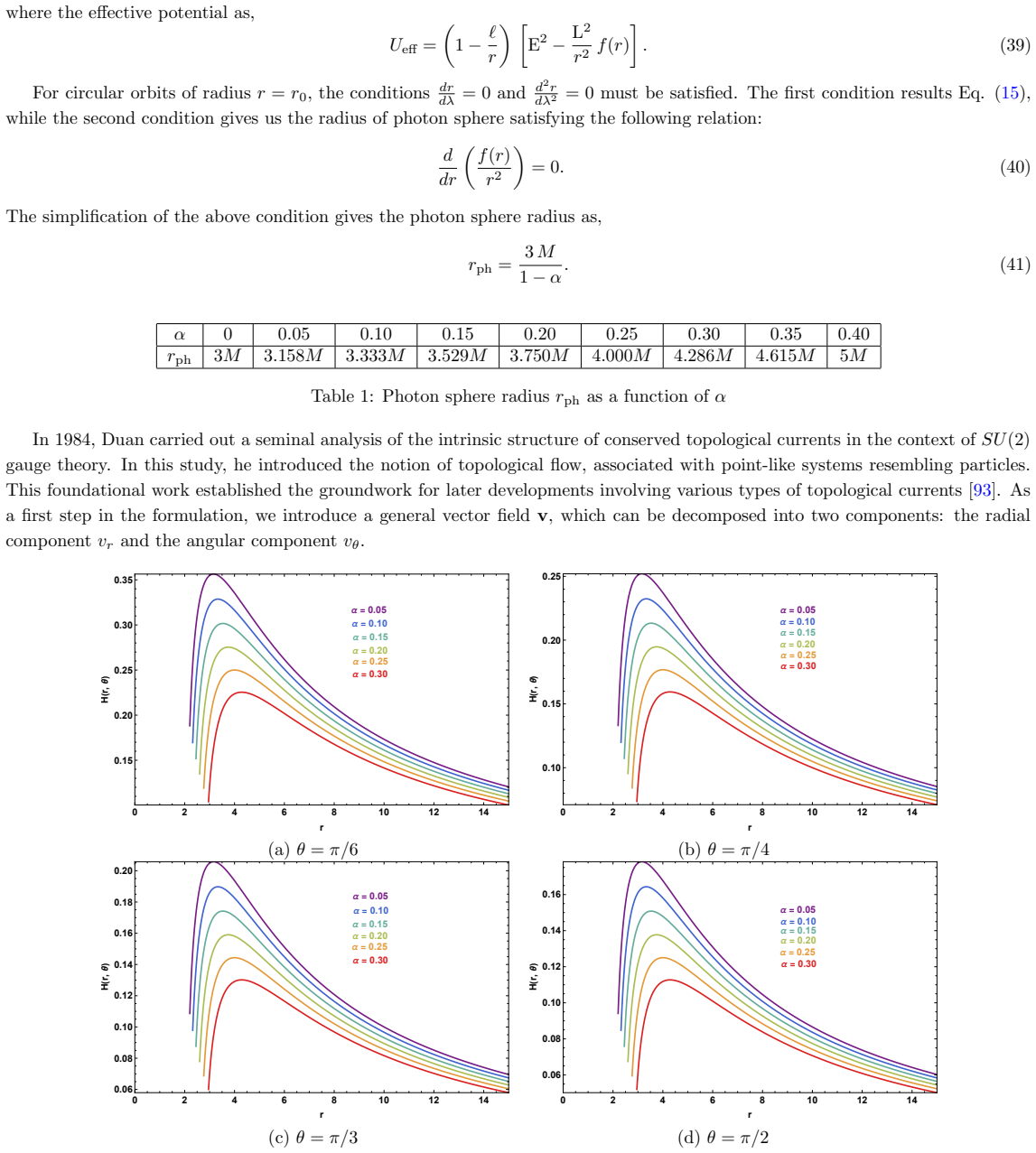
- [§5, Eqs. (42)–(47), Figs. 10–11] The zero of the vector field v occurs at (r, theta) = (3M/(1-alpha), pi/2) regardless of ell, because v_r contains the factor (1-alpha - 3M/r) and v_theta vanishes at theta=pi/2; the factor sqrt(1-ell/r) does not shift this zero. Thus the photon-sphere location and its winding number are independent of the holonomy parameter. The text's assertion that holonomy corrections deform the vanishing of n is internally inconsistent, since n=v/|v| is undefined at the zero, and the plotted 'standard points' at r_ph +/- b use an unspecified b. The abstract's claim that the topological structure is affected by holonomy corrections is therefore not supported.
- [§2, Eq. (4)] The line element (4) is introduced as a combination of the holonomy-corrected Schwarzschild metric (1) and the Letelier string-cloud metric (3) without a derivation from an action, field equations, or an explicit energy-momentum source. It is not a solution of Einstein's equations with the string-cloud stress tensor (2): already for alpha=0 the Ricci scalar (8) is 3M ell/r^4, so the geometry is not vacuum and is not the original Letelier solution. The paper should either derive Eq. (4) from a consistent gravitational theory or clearly state and justify that it is a phenomenological effective metric; all subsequent observable predictions inherit this assumption.
minor comments (5)
- [§2 and Introduction] There are typographical errors: 'Krestchmann' should be 'Kretschmann', 'Schwrazschild' appears in the mention of reference [44], and 'demonstarte' and 'differences' appear in the Introduction; these should be corrected.
- [§3, near Eq. (16)] The sentence 'Therefore, in terms of u, (16) becomes' refers to the preceding unnumbered equation; the equation number should be (15), not (16).
- [§3, Eq. (28)] The remainder term O(M^2, ell^2) in Eq. (28) is inconsistent with the retained ell M term; the authors should specify the ordering used, for example O(M^3, ell^3, M ell^2).
- [§4, Eq. (33)] Equation (33) defines the Einstein angle theta_E in terms of R_s, but the relation of R_s to the deflection angle (28) or to the impact parameter beta is never given; the definition should be completed.
- [§5, Fig. 10 caption] The shift b in r0 = r_ph +/- b is never defined or computed; the caption and text should specify how b is chosen and why the plotted point differs from r_ph = 3M/(1-alpha).
Circularity Check
No significant circularity: Eq. (28) and all derived observables are forward computations from the assumed metric (4), with α and ℓ as fixed inputs never fitted to outputs; the self-citations [64] and [68] are displayed, parameter-free, and externally checkable, so the central claim does not reduce to its inputs.
full rationale
The derivation chain in this paper is a forward calculation and is not circular. The spacetime is introduced as an explicit ansatz — 'we consider a class of static and spherically symmetric BH incorporating holonomy corrections and surrounded by a cloud of strings' — giving Eq. (4), ds2 = −F dt2 + dr2/[F(1−ℓ/r)] + r2 dΩ2 with F = 1−α−2M/r. The string-cloud parameter α and the holonomy parameter ℓ are fixed inputs of the metric; they are never fitted to any output observable, and no data subset is used to generate the predicted deflection, magnification, topological charge, or disk spectra. The deflection angle is derived from the paper's own orbit equation (16) by the standard Iyer–Hansen elliptic-integral reduction (Eqs. 21–27), and the weak-field expansion (28) is attributed to the perturbative method of [64], a paper co-authored by Kala but whose content is parameter-free with stated assumptions (M≪1, ℓ≪1), reproduced in the present text, and externally falsifiable against Eq. (16); indeed, a direct M=0 expansion of Eq. (16) gives ℓ/[β(1−α)] for the first-order holonomy term, disagreeing with the printed coefficient ℓ/[β√(1−α)] in Eq. (28). That disagreement is an internal-consistency defect, not a circular reduction. The factored roots u1, u2, u3 in Eq. (20), credited to [68] (co-authored by Kala and Ahmed), are displayed in full and are routine algebra from the cubic B(u)=0, so the citation is not an unverified black box. The photon-sphere radius r_ph = 3M/(1−α) follows from the stated condition d/dr(f(r)/r2)=0 (Eq. 40); the topological charge Q = +1 follows from the standard Duan–Wei vector-field construction of Section 5; and the accretion-disk results in Section 6 are numerical Novikov–Thorne integrations over metric (4). None of these outputs is used to define the metric or the parameters, so no self-definitional step and no fitted-input-called-prediction step exists. The metric itself is assumed, not derived from a stated action or field equations, and Eq. (28) does not reduce to Eq. (29) at α=0; these are missing-derivation and correctness concerns, not circularity. Verdict: no significant circularity; the score of 2 reflects only the minor, non-load-bearing self-citations at method points ([64], [68]).
Assumptions & free parameters
free parameters (3)
- α (string cloud parameter)
- ℓ (LQG holonomy scale)
- b (photon-sphere shift) =
not specified
assumptions (5)
- ad hoc to paper The line element (4) is a valid effective spacetime for a holonomy-corrected Schwarzschild BH surrounded by a cloud of strings.
- domain assumption The cloud-of-strings source has T^t_t = T^r_r = α/r² (Eq. 2) and remains the matter content once holonomy corrections are added.
- standard math The Iyer-Hansen method and the elliptic reduction apply to the quartic (1-ℓu)(1/β² - u²(1-α-2Mu)) with roots ordered u3 > u2 > u1 and u+ > u3.
- domain assumption The Duan topological current formalism and the vector-field construction of Wei [74] correctly characterize photon-sphere topology for this spacetime.
- domain assumption The Novikov-Thorne thin-disk model applies with M_dot0 = 1 and the usual circular-orbit assumptions in this non-asymptotically-flat spacetime.
Cite this review
Pith. "Pith review of Gravitational Lensing and Topological Photon Sphere of Holonomy Corrected Schwarzschild Black Hole with a Cloud of Strings." pith.science (2026). https://pith.science/paper/MNP2TVND
@misc{pith2026250907686,
  author       = {Pith},
  title        = {Pith review of: Gravitational Lensing and Topological Photon Sphere of Holonomy Corrected Schwarzschild Black Hole with a Cloud of Strings},
  year         = {2026},
  howpublished = {\url{https://pith.science/paper/MNP2TVND}},
  note         = {Machine review of arXiv:2509.07686}
}
read the original abstract
In this paper, we theoretically investigate the deflection of light, lensing equations, topological properties of photon rings, and accretion disk characteristics in the spacetime of a holonomy-corrected Schwarzschild black hole surrounded by a cloud of strings. The analysis is carried out in the weak-field limit, where we analytically derive expressions for the deflection angle and extract the corresponding lensing observables. These results reveal the dependence of light deflection on the string cloud parameter and the holonomy correction parameter, offering potential observational signatures of underlying quantum gravity effects. We model possible gravitational scenarios to explore the distinguishing features of this modified BH geometry and assess its deviation from classical solutions through gravitational lensing behavior. Furthermore, we analyze the topological structure of the photon sphere by constructing a normalized vector field and demonstrate how it is affected by the presence of string clouds and holonomy corrections. Finally, we examine the properties of a thin accretion disk in this BH background, showing that both the string cloud and holonomy parameters significantly influence the disk's radiation profile, temperature distribution, and spectral characteristics. Our results suggest that these modifications leave measurable imprints, providing viable avenues for observational constraints in the strong-gravity regime.
Figures


Figures from the paper (12 more)




Reference graph
Works this paper leans on
-
[1]
Bertiet al., Class
E. Bertiet al., Class. Quantum Grav.32, 243001 (2015)
2015
-
[2]
Gravitational collapse and space-time singularities, Phys. Rev. Lett.14, 57 (1965)
1965
-
[3]
S. W. Hawking, and R. Penrose, Proc. R Soc. Lond. Ser A.314, 529 (1970)
1970
-
[4]
A. G. Riesset al.[Supernova Search Team Collaboration], Astron. J.116, 1009 (1998)
1998
-
[5]
Perlmutteret al.[Supernova Cosmology Project Collaboration], Astrophys
S. Perlmutteret al.[Supernova Cosmology Project Collaboration], Astrophys. J.517, 565 (1999)
1999
-
[6]
R. A. Knoplayet al., Astrophys. J.598, 102 (2003)
2003
-
[7]
C. B. Netterfieldet al.[Boomerang Collaboration], Astrophys. J.571, 604 (2002)
2002
-
[8]
D. La, P. J. Steinhardt, Phys. Rev. Lett.62, 376 (1989)
1989
Show all 105 references
-
[9]
N. W. Halverson, E. M. Leitch, C. Pryke, J. Kovac, J. E. Carlstrom, W. L. Holzapfel, M. Dragovan, J. K. Cartwright, B. S. Mason, S. Padin, T. J. Pearson, A. C. S. Readhead, and M. C. Shepherd, ApJ568, 38 (2002)
2002
-
[10]
Rovelli,Zakopane lectures on loop gravity, Proc
C. Rovelli,Zakopane lectures on loop gravity, Proc. Sci. QGQGS2011 (2011) 003 [arXiv:1102.3660]
2011 arXiv
-
[11]
Ashtekar and E
A. Ashtekar and E. Bianchi, Rep. Prog. Phys.84, 042001 (2021)
2021
-
[12]
Perez, Rep
A. Perez, Rep. Prog. Phys.80, 126901 (2017)
2017
-
[13]
Alonso-Bardaj´ ı, Phys
A. Alonso-Bardaj´ ı, Phys. Lett. B829, 137075 (2022)
2022
-
[14]
Alonso-Bardaj´ ı, D
A. Alonso-Bardaj´ ı, D. Brizuela, and R. Vera, Phys. Rev. D106, 024035 (2022)
2022
-
[15]
Fernando, Phys
S. Fernando, Phys. Rev. D85, 024033 (2012)
2012
-
[16]
K. S. Virbhadra and G. F. R. Ellis, Phys. Rev. D62, 084003 (2000)
2000
-
[17]
Bozza, Phys
V. Bozza, Phys. Rev. D66, 103001 (2002)
2002
-
[18]
Tsukamoto, Phys
N. Tsukamoto, Phys. Rev. D95, 064035 (2017)
2017
-
[19]
Eiroa, and C
A. Eiroa, and C. Sendra, Phys. Rev. D86, 083009 (2012). 19
2012
-
[20]
Gyulchev, and S
K. Gyulchev, and S. Yazadjiev, Phys. Rev. D75, 023006 (2007)
2007
-
[21]
Virbhadra, and G
K. Virbhadra, and G. Ellis, Phys. Rev. D65, 103004 (2002)
2002
-
[23]
Nedkova, V
P. Nedkova, V. Tinchev, S. Yazadjiev, Phys. Rev. D88, 124019 (2013)
2013
-
[24]
Ahmed, Adv
F. Ahmed, Adv. High Energy Phys.2017, 3587018 (2017)
2017
-
[25]
Ahmed, Prog
F. Ahmed, Prog. Theor. Exp. Phys.2017, 083E03 (2017)
2017
-
[26]
Ahmed and F
F. Ahmed and F. Rahaman, Adv. High Energy Phys.2018, 7839619 (2018)
2018
-
[27]
Ahmed and F
F. Ahmed and F. Rahaman, Eur. Phys. J. A54, 52 (2018)
2018
-
[28]
Werner, Gen
M. Werner, Gen. Relativ. Gravit.44, 3047–3057 (2012)
2012
-
[29]
Shaikh, and S
R. Shaikh, and S. Kar, Phys. Rev. D96, 044037 (2017)
2017
-
[30]
Shaikh, Phys
R. Shaikh, Phys. Rev. D98, 064033 (2018)
2018
-
[31]
Ahmed, Int
F. Ahmed, Int. J Geom. Meths. Mod. Phys.21, 2450187 (2024)
2024
-
[32]
Ovgun, Phys
S. Ovgun, Phys. Rev. D98, 024033 (2018)
2018
-
[33]
Simpson, and M
A. Simpson, and M. Visser, JCAP02, 042 (2019)
2019
-
[34]
Jusufi and A
K. Jusufi and A. ¨Ovgun, Phys. Rev. D97, 024042 (2018)
2018
-
[35]
Ali, and K
H. Ali, and K. Bamba, Eur. Phys. J. C81, 1018 (2021)
2021
-
[36]
Sakalli and A
I. Sakalli and A. ¨Ovg¨ un, EPL118, 60006 (2017)
2017
-
[37]
Bambi, K
C. Bambi, K. Freese, Class. Quantum Grav.30, 065003 (2013)
2013
-
[38]
Abe, Astrophys
F. Abe, Astrophys. J.725, 787 (2010)
2010
-
[39]
Tsukamoto, Phys
N. Tsukamoto, Phys. Rev. D94, 124001 (2016)
2016
-
[40]
Ahmed, EPL142, 39002 (2023)
F. Ahmed, EPL142, 39002 (2023)
2023
-
[41]
E. L. B. Junior, F. S. N. Lobo, M. E. Rodrigues and H. A. Vieira, Phys. Rev.D 109, 024004 (2024)
2024
-
[42]
A. R. Soares, C. F. S. Pereira, R. L. L. Vit´oria and E. M. Rocha, Phys. Rev.D 108, 124024 (2023)
2023
-
[43]
A. R. Soares, R. L. L. Vit´ oria and C. F. S. Pereira, Phys. Rev.D 110, 084004 (2024)
2024
-
[44]
Ahmed, Int
F. Ahmed, Int. J Geom. Meths. Mod. Phys.22, 2450336 (2025)
2025
-
[45]
Sharif and S
M. Sharif and S. Iftikhar, Adv. High Energy Phys.2015, 635625 (2015)
2015
-
[46]
Li, and T
Z. Li, and T. Zhou, Phys. Rev.D 104, 104044 (2021)
2021
-
[47]
Mustafa, F
G. Mustafa, F. Atamurotov, I. Hussain, S. Shaymatov, and A. ¨Ovg¨ un, Chinese Phys. C46, 125107 (2022)
2022
-
[48]
Atamurotov, H
F. Atamurotov, H. Alibekov, A. Abdujabbarov, G. Mustafa and M. M. Aripov, Symmetry2023, 15(4), 848
-
[49]
Dong, Nucl
Y. Dong, Nucl. Phys.B 1005, 116612 (2024)
2024
-
[50]
L. Zhao, M. Tang and Z. Xu, Eur. Phys. J. C84, 971 (2024)
2024
-
[51]
N. U. Molla, H. Chaudhary, G. Mustafa, F. Atamurotov, U. Debnath and D. Arora, Eur. Phys. J. C84, 574 (2024)
2024
-
[52]
Atamurotov, I
F. Atamurotov, I. Hussain, G. Mustafa, and A. ¨Ovg¨ un, Chin. Phys. C47, 025102 (2023)
2023
-
[53]
Atamurotov, U
F. Atamurotov, U. Papnoi, and K. Jusufi, Class. Quantum Gravity39, 025014 (2022)
2022
-
[54]
Atamurotov, A
F. Atamurotov, A. Abdujabbarov, and W. B. Han, Phys. Rev.D 104, 084015 (2021)
2021
-
[55]
Atamurotov, A
F. Atamurotov, A. Abdujabbarov, J. Rayimbaev, Eur. Phys. J. C81, 118 (2021). 20
2021
-
[56]
Abdujabbarov, B
A. Abdujabbarov, B. Toshmatov, J. Schee, Z. Stuchl´ ık, and B. Ahmedov, Int. J. Mod. Phys. D26, 1741011 (2017)
2017
-
[57]
Atamurotov, M
F. Atamurotov, M. Jamil, K. Jusufi, Chin. Phys. C47, 035106 (2023)
2023
-
[58]
Atamurotov, A
F. Atamurotov, A. Abdujabbarov, W.-B. Han, Phys. Rev.D 104, 084015 (2021)
2021
-
[59]
Kala, Saurabh, H
S. Kala, Saurabh, H. Nandan, and P. Sharma, Int. J. Mod. Phys. A35, 2050177 (2020)
2020
-
[60]
S. Kala, H. Nandan, and P. Sharma, Mod. Phys. Lett. A35, 2050323 (2020)
2020
-
[61]
S. Kala, H. Nandan, P. Sharma, and M. Elmardi, Mod. Phys. Lett. A36, 2150224 (2021)
2021
-
[62]
S. Kala, H. Nandan, and P. Sharma, Eur. Phys. J. Plus137, 457 (2022)
2022
-
[63]
B. K. Vishvakarma, S. Kala, and S. Siwach, Ann. Phys. (NY)475, 169957 (2025)
2025
-
[64]
R. C. Pantig, S. Kala, A. ¨Ovg¨ un, and N. J. L. S. Lobos, IJGMMP (2025)https://doi.org/10.1142/S0219887825502408
2025 doi
-
[65]
S. Kala, H. Nandan, A. Abebe, and S. Roy, Eur. Phys. J. C84, 1089 (2024)
2024
-
[66]
S. Kala, H. Nandan, K. Maithani, S. Roy, and A. Abebe, arXiv:2503.19571 [gr-qc]
-
[67]
S. Roy, S. Kala, A. Singha, H. Nandan, and A. K. Sen, Eur. Phys. J. C85, 772 (2025)
2025
- [68]
- [69]
-
[70]
Cardoso, L
V. Cardoso, L. C. B. Crispino, C. F. B. Macedo, H. Okawa, P. Pani, Phys. Rev. D90, 044069 (2014)
2014
-
[71]
P. V. P. Cunha, C. A. R. Herdeiro, and E. Radu, Phys. Rev. D96, 024039 (2017)
2017
-
[72]
P. V. P. Cunha, E. Berti, and C. A. R. Herdeiro, Phys. Rev. Lett.119, 251102 (2017)
2017
-
[73]
P. V. P. Cunha, and C. A. R. Herdeiro, Phys. Rev. Lett.124, 181101 (2020)
2020
-
[74]
Wei, Phys
S.-W. Wei, Phys. Rev. D102, 064039 (2020)
2020
-
[75]
Ghosh, and S
R. Ghosh, and S. Sarkar, Phys. Rev. D104, 044019 (2021)
2021
-
[76]
Sadeghi, andM
J. Sadeghi, andM. Ali S. Afshar, Astropart. Physics162, 102994 (2024)
2024
-
[77]
Sadeghi, M
J. Sadeghi, M. Ali S. Afshar, S. N. Gashti, and M. Reza Alipour, Astropart. Phys.156, 102920 (2024)
2024
-
[78]
W. Liu, D. Wu, and J. Wang, Phys. Lett.B 858, 139052 (2024)
2024
-
[79]
A.-Bardaji, D
A. A.-Bardaji, D. Brizuela and R. Vera, Phys. Lett.B 829, 137075 (2022)
2022
-
[80]
A.-Bardaji, D
A. A.-Bardaji, D. Brizuela and R. Vera, Phys. Rev.D 106, 024035 (2022)
2022
-
[81]
P. S. Letelier, Phys. Rev.D 20, 1294 (1979)
1979
-
[82]
F. W. Dyson, A. S. Eddington, and C. Davidson, Phil. Trans. R. Soc. Lond. A220, 291 (1920)
1920
-
[83]
Bartelmann and P
M. Bartelmann and P. Schneider, Phys. Rep.340, 291 (2001)
2001
-
[84]
Kaiser and G
N. Kaiser and G. Squires, Astrophys. J.404, 441 (1993)
1993
-
[85]
Darwin, Proc
C. Darwin, Proc. R. Soc. Lond. A249, 180 (1959)
1959
-
[86]
Chandrasekhar,The Mathematical Theory of Black Holes, Oxford University Press (1983)
S. Chandrasekhar,The Mathematical Theory of Black Holes, Oxford University Press (1983)
1983
-
[87]
S. V. Iyer and E. C. Hansen, Phys. Rev. D80, 124023 (2009)
2009
-
[88]
P. F. Byrd and M. D. Friedman,Handbook of Elliptic Integrals for Engineers and Scientists, Grundlehren der mathematischen Wis- senschaften,V ol. 67(Springer, 1971)
1971
-
[89]
Bozza, Phys
V. Bozza, Phys. Rev. D78, 103005 (2008)
2008
-
[90]
Schneider, J
P. Schneider, J. Ehlers and E. E. Falco,Gravitational Lenses, (Springer, Astronomy and Astrophysics Library, 1992)
1992
-
[91]
Bozza, Gen
V. Bozza, Gen. Relativ. Gravit.42, 2269 (2010). 21
2010
-
[92]
Al-Badawi, M
A. Al-Badawi, M. Alloqulov, S. Shaymatov and B. Ahmedov, Chin. Phys. C48, 095105 (2024)
2024
-
[93]
Y. S. Duan,The structure of the topological current, SLACPUB-3301, (1984)
1984
-
[94]
I. D. Novikov and K. S. Thorne,Black Holes (Les Astres Occlus), C. DeWittet al.(Eds.), Gordon and Breach, New York (1973), pp. 343–450
1973
-
[95]
K. S. Thorne, Astrophys. J.191, 507 (1974)
1974
-
[96]
Boshkayev, T
K. Boshkayev, T. Konysbayev, Y. Kurmanov, O. Luongo, M. Muccino, A. Taukenova and A. Urazalina, Eur. Phys. J. C84, 230 (2024)
2024
-
[97]
Boshkayev, A
K. Boshkayev, A. Idrissov, O. Luongo and D. Malafarina, Mon. Not. Roy. Astron. Soc.496, 1115 (2020)
2020
-
[98]
D. F. Torres, Nucl. Phys. B626, 377 (2002)
2002
-
[99]
F. S. Guzm´ an, Phys. Rev. D73, 021501 (2006)
2006
-
[100]
Javed, D
F. Javed, D. Arora, M. Yasir, H. Chaudhary, G. Mustafa, X. Tiecheng and F. Atamurotov, Phys. Dark Univ.46, 101654 (2024)
2024
-
[101]
Fatima, F
G. Fatima, F. Javed, A. Waseem, B. Almutairi, G. Mustafa, F. Atamurotov and E. G¨ udekli, Phys. Dark Univ.47, 101820 (2025)
2025
-
[102]
Javed, A
F. Javed, A. Waseem, P. Channuie, G. Mustafa, T. Muhammad and E. G¨ udekli, Phys. Dark Univ.47, 101766 (2025)
2025
-
[103]
Mustafa, F
G. Mustafa, F. Javed, S. K. Maurya, S. Alkarni, O. Donmez, A. Cilli and E. G¨ udekli, J. High Energy Astrophys.44, 437 (2024)
2024
-
[104]
Ditta, F
A. Ditta, F. Javed, A. Bouzenada, G. Mustafa, A. Mahmood, F. Atamurotov and V. Khamidov, J. High Energy Astrophys.45, 62 (2025)
2025
-
[105]
Wei and Y.-X
S.-W. Wei and Y.-X. Liu, Phys. Rev.D 105, 104003 (2022)
2022
-
[106]
Wei, Y.-X
S.-W. Wei, Y.-X. Liu, and R. B. Mann, Phys. Rev. Lett.129, 191101 (2022). 22
2022
Reviewed August 15, 2026 · model on record in the stance chip above.
Discussion (0). Continue with ORCID to comment.