SciNLP: A Domain-Specific Benchmark for Full-Text Scientific Entity and Relation Extraction in NLP
Pith reviewed 2026-05-18 17:43 UTC · model grok-4.3
The pith
SciNLP is the first full-text benchmark for extracting entities and relations from complete NLP research papers.
A machine-rendered reading of the paper's core claim, the machinery that carries it, and where it could break.
Core claim
SciNLP comprises 60 manually annotated full-text NLP publications that contain 6,409 entities and 1,648 relations. It is the first dataset to provide full-text annotations of entities and their relationships in the NLP domain. Comparative experiments with existing datasets and state-of-the-art supervised models reveal varying extraction performance across academic texts of different lengths, with SciNLP-trained models achieving significant improvements on certain baselines. Models trained on the dataset enable automatic construction of a fine-grained knowledge graph for the NLP domain that has an average node degree of 3.3.
What carries the argument
The SciNLP dataset of full-text entity and relation annotations across 60 NLP publications, used both for model evaluation and for building a domain knowledge graph.
If this is right
- Extraction models can now be trained and tested on complete documents instead of isolated sections.
- Knowledge graphs built from the extractions contain richer connectivity (average degree 3.3) for downstream tasks.
- Varying model performance on short versus long texts becomes measurable for scientific literature.
- Core concepts and emerging trends can be tracked more completely across full papers.
Where Pith is reading between the lines
- The same full-text annotation approach could be repeated for other scientific fields where section-limited datasets currently dominate.
- Relations that cross section boundaries, such as method-to-result links, become visible only with full-text coverage.
- The resulting knowledge graph could support automated literature mapping or trend forecasting tools.
Load-bearing premise
The 60 chosen NLP publications represent the broader domain and the manual annotations correctly identify entities and relations without major bias or inconsistency.
What would settle it
New full-text NLP papers on which models trained on SciNLP extract entities and relations no more accurately than models trained only on section-limited datasets.
Figures


read the original abstract
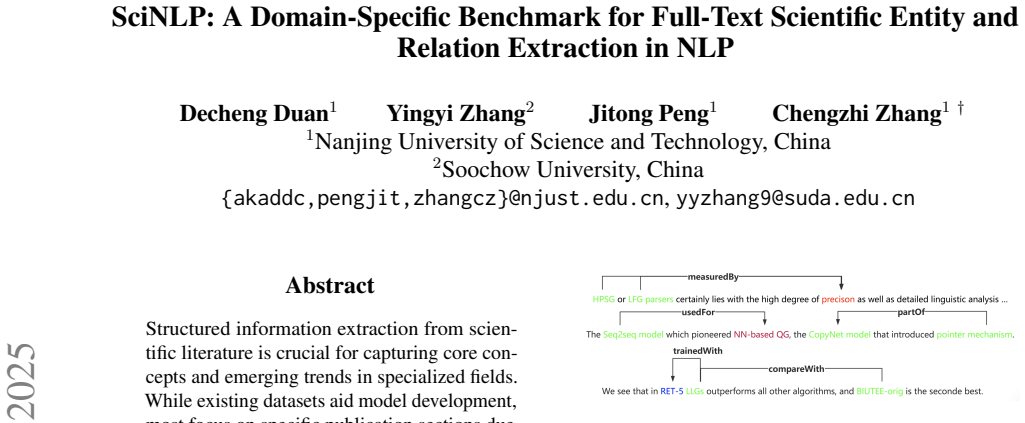
Structured information extraction from scientific literature is crucial for capturing core concepts and emerging trends in specialized fields. While existing datasets aid model development, most focus on specific publication sections due to domain complexity and the high cost of annotating scientific texts. To address this limitation, we introduce SciNLP - a specialized benchmark for full-text entity and relation extraction in the Natural Language Processing (NLP) domain. The dataset comprises 60 manually annotated full-text NLP publications, covering 6,409 entities and 1,648 relations. Compared to existing research, SciNLP is the first dataset providing full-text annotations of entities and their relationships in the NLP domain. To validate the effectiveness of SciNLP, we conducted comparative experiments with similar datasets and evaluated the performance of state-of-the-art supervised models on this dataset. Results reveal varying extraction capabilities of existing models across academic texts of different lengths. Cross-comparisons with existing datasets show that SciNLP achieves significant performance improvements on certain baseline models. Using models trained on SciNLP, we implemented automatic construction of a fine-grained knowledge graph for the NLP domain. Our KG has an average node degree of 3.3 per entity, indicating rich semantic topological information that enhances downstream applications. The dataset is publicly available at: https://github.com/AKADDC/SciNLP.
Editorial analysis
A structured set of objections, weighed in public.
Referee Report
Summary. The paper introduces SciNLP, a benchmark dataset of 60 manually annotated full-text NLP publications containing 6,409 entities and 1,648 relations for entity and relation extraction. It claims to be the first full-text dataset of this kind in the NLP domain, reports experiments with state-of-the-art supervised models showing performance variation across text lengths, notes improvements on certain baselines relative to existing datasets, and demonstrates construction of a fine-grained NLP-domain knowledge graph with average node degree 3.3. The dataset is released publicly.
Significance. A high-quality full-text entity-relation dataset for the NLP literature would address a genuine gap, as most existing scientific IE resources are limited to abstracts or specific sections. If the annotations are reliable and the 60 papers representative, the resource could support improved models for scientific information extraction and downstream KG applications. The public release and the reported KG construction are concrete strengths that would aid reproducibility and further work.
major comments (2)
- [Dataset creation / annotation section] The manuscript provides no details on the annotation process, including the number of annotators, inter-annotator agreement scores, adjudication procedure, or annotation guidelines used to label the 6,409 entities and 1,648 relations across the 60 full-text papers. Without these, it is impossible to assess the consistency or potential systematic biases in the core data resource that underpins all subsequent claims and experiments.
- [Introduction and Dataset sections] The selection criteria and sampling strategy for the 60 NLP publications are not described. This omission makes it difficult to evaluate whether the corpus is representative of the NLP domain or whether domain-specific ambiguities (e.g., nested concepts or cross-section relations) were handled consistently.
minor comments (2)
- [Abstract] The abstract states that SciNLP 'achieves significant performance improvements on certain baseline models' but does not quantify the improvements or identify the models; adding these specifics would improve clarity.
- [Experiments] The experimental protocol (train/test splits, hyperparameter settings, evaluation metrics, and handling of long documents) is only summarized at a high level; a more detailed description or reference to supplementary material would aid reproducibility.
Simulated Author's Rebuttal
We thank the referee for the constructive comments, which highlight important aspects of dataset documentation that will improve the manuscript. We address each major comment below and will revise the paper to incorporate the requested details.
read point-by-point responses
-
Referee: [Dataset creation / annotation section] The manuscript provides no details on the annotation process, including the number of annotators, inter-annotator agreement scores, adjudication procedure, or annotation guidelines used to label the 6,409 entities and 1,648 relations across the 60 full-text papers. Without these, it is impossible to assess the consistency or potential systematic biases in the core data resource that underpins all subsequent claims and experiments.
Authors: We agree that a detailed description of the annotation process is necessary to allow readers to evaluate annotation quality and potential biases. In the revised manuscript we will add a new subsection in the Dataset section that specifies the number of annotators, their expertise, the inter-annotator agreement scores obtained, the adjudication procedure used to resolve disagreements, and the annotation guidelines developed for the entity and relation types. These additions will directly address the concern and strengthen the reproducibility of the resource. revision: yes
-
Referee: [Introduction and Dataset sections] The selection criteria and sampling strategy for the 60 NLP publications are not described. This omission makes it difficult to evaluate whether the corpus is representative of the NLP domain or whether domain-specific ambiguities (e.g., nested concepts or cross-section relations) were handled consistently.
Authors: We acknowledge the omission of explicit selection criteria and sampling details. The revised manuscript will expand the Introduction and Dataset sections to describe the sources from which the papers were drawn, the filtering and sampling strategy employed to achieve coverage across NLP sub-areas and publication years, and the specific procedures used to handle domain-specific phenomena such as nested entities and relations spanning multiple sections. This information will clarify the representativeness of the corpus and the consistency of annotation decisions. revision: yes
Circularity Check
No circularity in SciNLP dataset creation paper
full rationale
The paper's central contribution is the manual creation and public release of the SciNLP benchmark: 60 full-text NLP papers annotated with 6,409 entities and 1,648 relations. No mathematical derivations, equations, fitted parameters, or predictions appear in the abstract or described content. Claims about being the first full-text dataset and downstream KG construction rest on the new annotations themselves rather than any self-referential reduction or load-bearing self-citation chain. Comparative experiments with other datasets and model evaluations are external validations, not circular steps. The work is self-contained empirical dataset construction with no derivational loop.
Axiom & Free-Parameter Ledger
axioms (2)
- domain assumption The 60 selected NLP publications are representative of the broader NLP research literature.
- domain assumption Manual annotations by experts provide reliable ground truth for entities and relations.
Lean theorems connected to this paper
-
IndisputableMonolith/Foundation/RealityFromDistinction.leanreality_from_one_distinction unclear?
unclearRelation between the paper passage and the cited Recognition theorem.
A hierarchical ontology framework is developed to reflect NLP’s knowledge structure, defining 4 core entity types (Tasks, Methods, Datasets, Metrics) and 11 relation types.
What do these tags mean?
- matches
- The paper's claim is directly supported by a theorem in the formal canon.
- supports
- The theorem supports part of the paper's argument, but the paper may add assumptions or extra steps.
- extends
- The paper goes beyond the formal theorem; the theorem is a base layer rather than the whole result.
- uses
- The paper appears to rely on the theorem as machinery.
- contradicts
- The paper's claim conflicts with a theorem or certificate in the canon.
- unclear
- Pith found a possible connection, but the passage is too broad, indirect, or ambiguous to say the theorem truly supports the claim.
Reference graph
Works this paper leans on
-
[1]
ENTRY address author booktitle chapter edition editor howpublished institution journal key month note number organization pages publisher school series title type volume year eprint doi pubmed url lastchecked label extra.label sort.label short.list INTEGERS output.state before.all mid.sentence after.sentence after.block STRINGS urlintro eprinturl eprintpr...
-
[2]
" write newline "" before.all 'output.state := FUNCTION n.dashify 't := "" t empty not t #1 #1 substring "-" = t #1 #2 substring "--" = not "--" * t #2 global.max substring 't := t #1 #1 substring "-" = "-" * t #2 global.max substring 't := while if t #1 #1 substring * t #2 global.max substring 't := if while FUNCTION word.in bbl.in capitalize " " * FUNCT...
-
[3]
Isabelle Augenstein, Mrinal Das, Sebastian Riedel, Lakshmi Vikraman, and Andrew McCallum. 2017. https://doi.org/10.18653/v1/S17-2091 S em E val 2017 task 10: S cience IE - extracting keyphrases and relations from scientific publications . In Proceedings of the 11th International Workshop on Semantic Evaluation ( S em E val-2017) , pages 546--555, Vancouve...
-
[4]
Iz Beltagy, Kyle Lo, and Arman Cohan. 2019. https://doi.org/10.18653/v1/D19-1371 S ci BERT : A pretrained language model for scientific text . In Proceedings of the 2019 Conference on Empirical Methods in Natural Language Processing and the 9th International Joint Conference on Natural Language Processing (EMNLP-IJCNLP), pages 3615--3620, Hong Kong, China...
-
[5]
Xianshuai Cao, Yuliang Shi, Han Yu, Jihu Wang, Xinjun Wang, Zhongmin Yan, and Zhiyong Chen. 2021. https://doi.org/10.1145/3404835.3462900 Dekr: Description enhanced knowledge graph for machine learning method recommendation . In Proceedings of the 44th International ACM SIGIR Conference on Research and Development in Information Retrieval, SIGIR '21, page...
-
[6]
Yanguang Chen, Yuanyuan Sun, Zhihao Yang, and Hongfei Lin. 2020. https://doi.org/10.18653/v1/2020.coling-main.137 Joint entity and relation extraction for legal documents with legal feature enhancement . In Proceedings of the 28th International Conference on Computational Linguistics, pages 1561--1571, Barcelona, Spain (Online). International Committee on...
-
[7]
Kata G \'a bor, Davide Buscaldi, Anne-Kathrin Schumann, Behrang QasemiZadeh, Ha \"i fa Zargayouna, and Thierry Charnois. 2018. https://doi.org/10.18653/v1/S18-1111 S em E val-2018 task 7: Semantic relation extraction and classification in scientific papers . In Proceedings of the 12th International Workshop on Semantic Evaluation, pages 679--688, New Orle...
-
[8]
Sarthak Jain, Madeleine van Zuylen, Hannaneh Hajishirzi, and Iz Beltagy. 2020. https://doi.org/10.18653/v1/2020.acl-main.670 S ci REX : A challenge dataset for document-level information extraction . In Proceedings of the 58th Annual Meeting of the Association for Computational Linguistics, pages 7506--7516, Online. Association for Computational Linguistics
-
[9]
Yuna Jeong and Eunhui Kim. 2022. https://doi.org/10.1109/ACCESS.2022.3180830 Scideberta: Learning deberta for science technology documents and fine-tuning information extraction tasks . IEEE Access, 10:60805--60813
-
[10]
Bin Ji, Jie Yu, Shasha Li, Jun Ma, Qingbo Wu, Yusong Tan, and Huijun Liu. 2020. https://doi.org/10.18653/v1/2020.coling-main.8 Span-based joint entity and relation extraction with attention-based span-specific and contextual semantic representations . In Proceedings of the 28th International Conference on Computational Linguistics, pages 88--99, Barcelona...
-
[11]
Akhil Kedia, Sai Chetan Chinthakindi, and Wonho Ryu. 2021. https://doi.org/10.18653/v1/2021.findings-emnlp.37 Beyond reptile: Meta-learned dot-product maximization between gradients for improved single-task regularization . In Findings of the Association for Computational Linguistics: EMNLP 2021, pages 407--420, Punta Cana, Dominican Republic. Association...
-
[12]
Jiao Li, Yueping Sun, Robin J Johnson, Daniela Sciaky, Chih-Hsuan Wei, Robert Leaman, Allan Peter Davis, Carolyn J Mattingly, Thomas C Wiegers, and Zhiyong Lu. 2016. Biocreative v cdr task corpus: a resource for chemical disease relation extraction. Database, 2016
work page 2016
-
[13]
Jing Li, Aixin Sun, Jianglei Han, and Chenliang Li. 2020. A survey on deep learning for named entity recognition. IEEE transactions on knowledge and data engineering, 34(1):50--70
work page 2020
-
[14]
Yi Luan, Luheng He, Mari Ostendorf, and Hannaneh Hajishirzi. 2018. https://doi.org/10.18653/v1/D18-1360 Multi-task identification of entities, relations, and coreference for scientific knowledge graph construction . In Proceedings of the 2018 Conference on Empirical Methods in Natural Language Processing, pages 3219--3232, Brussels, Belgium. Association f...
-
[15]
Tomoko Ohta, Yuka Tateisi, and Jin-Dong Kim. 2002. The genia corpus: an annotated research abstract corpus in molecular biology domain. In Proceedings of the Second International Conference on Human Language Technology Research, HLT '02, page 82–86, San Francisco, CA, USA. Morgan Kaufmann Publishers Inc
work page 2002
-
[16]
Wolfgang Otto, Matth \"a us Zloch, Lu Gan, Saurav Karmakar, and Stefan Dietze. 2023. https://doi.org/10.18653/v1/2023.findings-emnlp.548 GSAP - NER : A novel task, corpus, and baseline for scholarly entity extraction focused on machine learning models and datasets . In Findings of the Association for Computational Linguistics: EMNLP 2023, pages 8166--8176...
-
[17]
Huitong Pan, Qi Zhang, Cornelia Caragea, Eduard Dragut, and Longin Jan Latecki. 2024. https://aclanthology.org/2024.lrec-main.1256/ S ci DMT : A large-scale corpus for detecting scientific mentions . In Proceedings of the 2024 Joint International Conference on Computational Linguistics, Language Resources and Evaluation (LREC-COLING 2024), pages 14407--14...
work page 2024
-
[18]
Huitong Pan, Qi Zhang, Eduard Dragut, Cornelia Caragea, and Longin Jan Latecki. 2023. https://doi.org/10.1162/tacl_a_00592 DMDD : A large-scale dataset for dataset mentions detection . Transactions of the Association for Computational Linguistics, 11:1132--1146
-
[19]
Behrang QasemiZadeh and Anne-Kathrin Schumann. 2016. https://aclanthology.org/L16-1294/ The ACL RD - TEC 2.0: A language resource for evaluating term extraction and entity recognition methods . In Proceedings of the Tenth International Conference on Language Resources and Evaluation ( LREC `16) , pages 1862--1868, Portoro z , Slovenia. European Language R...
work page 2016
-
[20]
David Wadden, Ulme Wennberg, Yi Luan, and Hannaneh Hajishirzi. 2019. https://doi.org/10.18653/v1/D19-1585 Entity, relation, and event extraction with contextualized span representations . In Proceedings of the 2019 Conference on Empirical Methods in Natural Language Processing and the 9th International Joint Conference on Natural Language Processing (EMNL...
-
[21]
Qingyun Wang, Doug Downey, Heng Ji, and Tom Hope. 2024. https://doi.org/10.18653/v1/2024.acl-long.18 S ci MON : Scientific inspiration machines optimized for novelty . In Proceedings of the 62nd Annual Meeting of the Association for Computational Linguistics (Volume 1: Long Papers), pages 279--299, Bangkok, Thailand. Association for Computational Linguistics
-
[22]
Zhaohui Yan, Songlin Yang, Wei Liu, and Kewei Tu. 2023. https://doi.org/10.18653/v1/2023.emnlp-main.467 Joint entity and relation extraction with span pruning and hypergraph neural networks . In Proceedings of the 2023 Conference on Empirical Methods in Natural Language Processing, pages 7512--7526, Singapore. Association for Computational Linguistics
-
[23]
Zhiheng Yan, Chong Zhang, Jinlan Fu, Qi Zhang, and Zhongyu Wei. 2021. https://doi.org/10.18653/v1/2021.emnlp-main.17 A partition filter network for joint entity and relation extraction . In Proceedings of the 2021 Conference on Empirical Methods in Natural Language Processing, pages 185--197, Online and Punta Cana, Dominican Republic. Association for Comp...
-
[24]
Deming Ye, Yankai Lin, Peng Li, and Maosong Sun. 2022. https://doi.org/10.18653/v1/2022.acl-long.337 Packed levitated marker for entity and relation extraction . In Proceedings of the 60th Annual Meeting of the Association for Computational Linguistics (Volume 1: Long Papers), pages 4904--4917, Dublin, Ireland. Association for Computational Linguistics
-
[25]
Heng Zhang, Chengzhi Zhang, and Yuzhuo Wang. 2024 a . https://doi.org/10.1016/j.ipm.2023.103574 Revealing the technology development of natural language processing: A scientific entity-centric perspective . Inf. Process. Manage., 61(1)
-
[26]
Qi Zhang, Zhijia Chen, Huitong Pan, Cornelia Caragea, Longin Jan Latecki, and Eduard Dragut. 2024 b . https://doi.org/10.18653/v1/2024.emnlp-main.726 S ci ER : An entity and relation extraction dataset for datasets, methods, and tasks in scientific documents . In Proceedings of the 2024 Conference on Empirical Methods in Natural Language Processing, pages...
-
[27]
Tao Zhang, Congying Xia, Philip S. Yu, Zhiwei Liu, and Shu Zhao. 2021. https://doi.org/10.18653/v1/2021.emnlp-main.442 PDALN : Progressive domain adaptation over a pre-trained model for low-resource cross-domain named entity recognition . In Proceedings of the 2021 Conference on Empirical Methods in Natural Language Processing, pages 5441--5451, Online an...
-
[29]
Zexuan Zhong and Danqi Chen. 2021 b . https://doi.org/10.18653/v1/2021.naacl-main.5 A frustratingly easy approach for entity and relation extraction . In Proceedings of the 2021 Conference of the North American Chapter of the Association for Computational Linguistics: Human Language Technologies, pages 50--61, Online. Association for Computational Linguistics
discussion (0)
Sign in with ORCID, Apple, or X to comment. Anyone can read and Pith papers without signing in.