Residence-time theory applied to circulating-fuel reactors: zero-power analysis
Pith reviewed 2026-05-18 22:38 UTC · model grok-4.3
The pith
Residence-time theory supplies closed-form expressions for reactivity loss and zero-power dynamics in circulating-fuel reactors.
A machine-rendered reading of the paper's core claim, the machinery that carries it, and where it could break.
Core claim
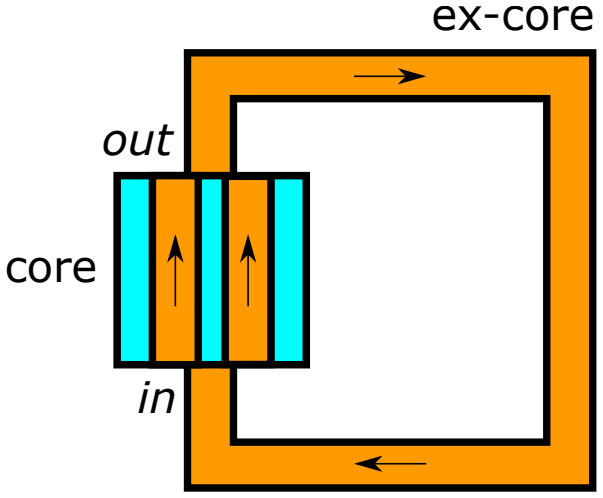
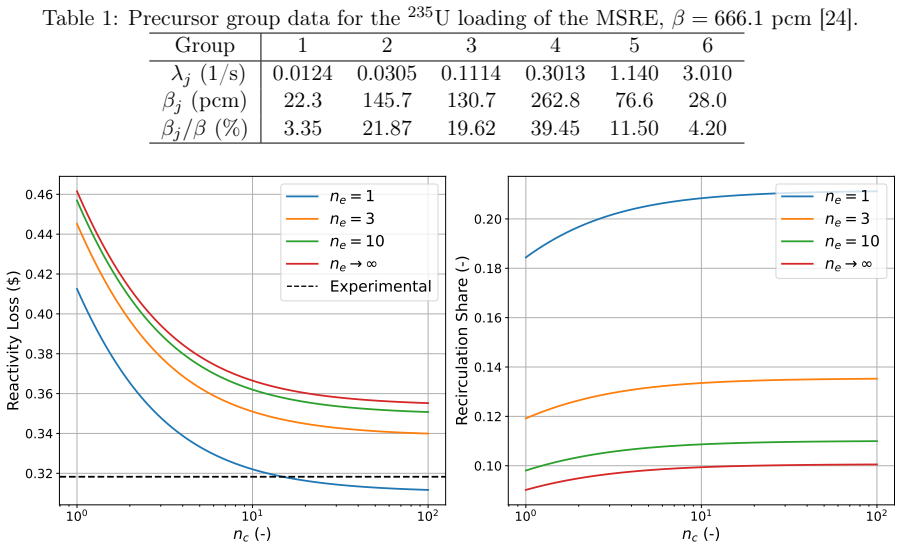
Treating the core and ex-core regions as two mixing volumes in series and adopting gamma residence-time distributions yields closed-form expressions for the static reactivity loss due to precursor drift and for the zero-power transfer function. The framework reduces to the plug-flow and Continuous-Stirred-Tank-Reactor limits as special cases and generalizes to intermediate mixing regimes through a single degree-of-mixing parameter. Parameter studies show that DNP recirculation has the largest effect when core and ex-core residence times are comparable and when the product of the decay constant and in-core residence time is small. Benchmarks reproduce the MSRE static loss of approximately 0.3
What carries the argument
Gamma residence-time distributions applied to two mixing volumes in series, with a single degree-of-mixing parameter that interpolates between plug flow and perfect mixing.
If this is right
- DNP recirculation contributes about 20 percent of the steady-state precursor worth under MSRE conditions.
- The model remains accurate for the EVOL reference molten-salt fast reactor when compared with Serpent-2 coupled to CFD.
- Sensitivity studies become straightforward because only one mixing parameter needs to be varied.
- The same residence-time structure supplies the foundation for later importance-weighted and time-domain extensions.
Where Pith is reading between the lines
- The same single-parameter description could be used to explore how loop geometry choices affect stability margins at low flow rates.
- Designers might deliberately tune the degree of mixing to reduce or control the fraction of precursor worth that is lost to recirculation.
- The approach offers a lightweight alternative to full CFD for rapid scoping of fuel-salt loop configurations before committing to high-fidelity runs.
Load-bearing premise
The core and ex-core regions can be represented as two well-mixed volumes connected in series whose residence times follow gamma distributions controlled by one mixing parameter.
What would settle it
A measured frequency response of a circulating-fuel reactor at zero power that deviates from the predicted transfer function by more than the reported 20 percent recirculation contribution when core and ex-core residence times are comparable.
Figures




read the original abstract
Circulating-fuel reactors (CFRs) lose reactivity when delayed-neutron precursors (DNPs) drift out of the core and may regain part of it when the fuel re-enters the core. This paper formulates a physics-based description of both effects by combining DNP transport with residence-time theory. Then, treating the core and ex-core regions as two mixing volumes in series, closed-form expressions for (i) the static reactivity loss due to precursor drift and (ii) the zero-power transfer function that governs linearised dynamics are derived. When the gamma residence-time distributions are used, the new framework is shown to reduce to the plug-flow and Continuous-Stirred-Tank-Reactor limits as special cases, while generalising to intermediate mixing regimes via a single parameter: the degree of mixing. Performed parameter studies show that DNP recirculation has the highest impact when core and ex-core residence times are comparable and the product of the DNP decay constant and the in-core residence time is small. Benchmarks against the Molten-Salt Reactor Experiment are able to reproduce the measured static loss ($k_0 \approx 0.32$ \$) and its frequency response, with $\approx$20% of the steady-state DNP worth arising from recirculation. Additionally, for the EVOL reference Molten-Salt Fast Reactor the model is shown to agree well with the results of high-fidelity Serpent-2 calculations coupled with Computational Fluid Dynamics. Overall, the residence-time approach offers a computationally light yet versatile tool for sensitivity studies and generation of physical intuition for the behaviour of CFRs. Foundation for extensions to importance weighting of DNPs and application of the framework to time-domain analysis is also briefly sketched.
Editorial analysis
A structured set of objections, weighed in public.
Referee Report
Summary. The manuscript develops a residence-time theory framework for analyzing delayed-neutron precursor (DNP) effects in circulating-fuel reactors at zero power. By modeling the core and ex-core regions as two mixing volumes in series and employing gamma residence-time distributions with a single degree-of-mixing parameter, closed-form expressions are derived for the static reactivity loss due to precursor drift and the zero-power transfer function. The approach recovers the plug-flow and continuous-stirred-tank-reactor limits as special cases. Parameter studies are performed, and the model is benchmarked against Molten-Salt Reactor Experiment (MSRE) measurements, reproducing the static loss of approximately 0.32 $ with about 20% attributed to recirculation, as well as showing good agreement with Serpent-2 coupled with CFD for the EVOL molten-salt fast reactor.
Significance. If the central results hold, the paper offers a computationally light yet versatile tool for sensitivity studies and generating physical intuition regarding DNP recirculation in circulating-fuel reactors. Strengths include the derivation of closed-form expressions that generalize known limits and the provision of benchmarks against both experimental data from the MSRE and independent high-fidelity Serpent-2/CFD calculations. This contributes to the field by providing an analytic framework that can serve as a foundation for extensions to importance weighting and time-domain analysis.
major comments (2)
- [§3] §3 (residence-time model and derivation of closed-form expressions): The static reactivity loss and transfer function are obtained only after collapsing the system into two mixing volumes in series with gamma residence-time distributions controlled by a single degree-of-mixing parameter. This modeling choice is load-bearing for the headline MSRE benchmark claim that ≈20% of the steady-state DNP worth arises from recirculation; the manuscript does not demonstrate that the assumed pdf matches the actual MSRE loop geometry (piping, pump, heat-exchanger paths), so deviations could alter both the loss decomposition and the frequency-response agreement.
- [§4.1] §4.1 (MSRE benchmark): The reported reproduction of k0 ≈ 0.32 $ and the frequency-response match are presented as validation, yet the degree-of-mixing parameter appears to be selected to achieve agreement rather than fixed by independent geometric or flow measurements. An explicit sensitivity study showing how the recirculation fraction and transfer-function shape vary with this parameter (and with alternative residence-time forms) is needed to establish that the 20% recirculation contribution is robust rather than an artifact of the chosen distribution.
minor comments (2)
- [Figure 3] Figure 3 (frequency-response comparison): Adding the experimental uncertainty bands or the range of model predictions for nearby values of the mixing parameter would clarify the quality of the match.
- [Notation] Notation section: The symbol denoting the degree of mixing should be introduced once with a clear physical definition and then used uniformly in all subsequent equations and text.
Simulated Author's Rebuttal
We thank the referee for the constructive and detailed comments. We address each major point below, indicating where revisions will be made to improve the manuscript's clarity and robustness regarding modeling assumptions and parameter sensitivity.
read point-by-point responses
-
Referee: [§3] §3 (residence-time model and derivation of closed-form expressions): The static reactivity loss and transfer function are obtained only after collapsing the system into two mixing volumes in series with gamma residence-time distributions controlled by a single degree-of-mixing parameter. This modeling choice is load-bearing for the headline MSRE benchmark claim that ≈20% of the steady-state DNP worth arises from recirculation; the manuscript does not demonstrate that the assumed pdf matches the actual MSRE loop geometry (piping, pump, heat-exchanger paths), so deviations could alter both the loss decomposition and the frequency-response agreement.
Authors: We agree that the two-volume model with gamma residence-time distributions is a deliberate simplification chosen to yield closed-form expressions while interpolating between the plug-flow and CSTR limits via a single mixing parameter. The manuscript does not claim that this specific pdf exactly reproduces the detailed residence-time distribution of the MSRE's complex loop (piping, pump, and heat exchanger). The framework is presented as a computationally efficient tool for sensitivity studies and physical insight rather than a high-fidelity geometric model. In the revised manuscript we will add a dedicated paragraph in §3 explicitly stating this limitation, justifying the gamma choice on analytical grounds, and noting that the reported 20% recirculation contribution is tied to the chosen parameterization. revision: yes
-
Referee: [§4.1] §4.1 (MSRE benchmark): The reported reproduction of k0 ≈ 0.32 $ and the frequency-response match are presented as validation, yet the degree-of-mixing parameter appears to be selected to achieve agreement rather than fixed by independent geometric or flow measurements. An explicit sensitivity study showing how the recirculation fraction and transfer-function shape vary with this parameter (and with alternative residence-time forms) is needed to establish that the 20% recirculation contribution is robust rather than an artifact of the chosen distribution.
Authors: The degree-of-mixing parameter was selected to lie within a physically plausible intermediate-mixing range while reproducing the measured static loss; it was not derived from independent MSRE geometric data. We acknowledge that an explicit sensitivity analysis is required to demonstrate robustness. The revised manuscript will include a new figure and accompanying text in §4.1 showing the recirculation fraction and transfer-function shape as functions of the mixing parameter over a representative range, together with a brief comparison using an alternative (exponential) residence-time distribution. This will clarify that the qualitative finding of a non-negligible recirculation contribution remains consistent across reasonable parameter choices. revision: yes
Circularity Check
Derivation from residence-time transport assumptions is self-contained with external benchmarks
full rationale
The paper explicitly adopts a two-volume mixing model with gamma residence-time distributions to obtain closed-form expressions for static reactivity loss and the zero-power transfer function. This is presented as a modeling choice required for analytic tractability that generalizes known plug-flow and CSTR limits via a single mixing parameter. The resulting expressions are then compared to independent MSRE measurements (reproducing k0 ≈ 0.32 $) and to Serpent-2/CFD results for the EVOL MSFR; no step in the provided derivation chain reduces the target quantities to fitted inputs or self-citations by construction. The central claims therefore rest on first-principles transport assumptions plus external validation rather than tautological re-expression of the inputs.
Axiom & Free-Parameter Ledger
free parameters (1)
- degree of mixing
axioms (1)
- domain assumption Core and ex-core regions modeled as two mixing volumes in series
Reference graph
Works this paper leans on
-
[1]
Z. Akcasu, G. S. Lellouche, and L. M. Shotkin.Mathematical Methods in Nuclear Reactor Dynamics. Academic Press, 1971.doi: 10.1016/B978-0-12-047150-8.50007-5
-
[2]
M. Aufiero et al. “Calculating the effective delayed neutron fraction in the Molten Salt Fast Reactor: Analytical, deterministic and Monte Carlo approaches”. In:Annals of Nuclear Energy 65 (2014), pp. 78–90.doi: 10.1016/j.anucene.2013.10.015
-
[3]
Transfer function modeling of zero-power dynamics of circulating fuel reactors
A. Cammi et al. “Transfer function modeling of zero-power dynamics of circulating fuel reactors”. In:Journal of Engineering for Gas Turbines and Power133.5 (Dec. 2010).doi: 10.1115/1.4002880
-
[4]
Kinetics, dynamics, and neutron noise in stationary MSRs
I. Pázsit and V. Dykin. “Kinetics, dynamics, and neutron noise in stationary MSRs”. In: Molten Salt Reactors and Thorium Energy. Ed. by T. J. Dolan. Woodhead Publishing, 2017, pp. 111–166.doi: 10.1016/B978-0-08-101126-3.00005-1
-
[6]
Comparison of analytical models for frequency response and linear stability of molten salt reactors
L. Bureš. “Comparison of analytical models for frequency response and linear stability of molten salt reactors”. In:Nuclear Engineering and Design0.0 (2025), pp. 1–24.doi: 10.1080/00295639.2025.2460318
-
[7]
M. Ponce Tovar, L. Fischer, and L. Bureš. “On the impact of fuel velocity profile on the loss of delayed neutron precursors in the Molten Salt Reactor Experiment”. In:Proceedings of PHYSOR 2024 - The International Conference on Physics of Reactors. San Francisco, California, USA, Apr. 2024.doi: 10.13182/PHYSOR24-43458
-
[8]
Theoretical dynamics analysis of the Molten Salt Reactor Experiment
T. W. Kerlin, S. J. Ball, and R. C. Steffy. “Theoretical dynamics analysis of the Molten Salt Reactor Experiment”. In:Nuclear Technology10.2 (1971), pp. 118–132.doi: 10.13182/ NT71-A30920
work page 1971
-
[9]
G.Morgan.“Phenomenologicalmodellingofmoltensaltreactorswithcoupledpointnuclear reactor kinetics and thermal hydraulic feedback models”. PhD thesis. Imperial College London, 2018. doi: 10.25560/80719
-
[10]
P. N. Haubenreich. Prediction of effective yields of delayed neutrons in MSRE. Tech. rep. ORNL-TM-380. Oak Ridge National Laboratory, Oct. 1962.doi: 10.2172/4754943
-
[11]
J. Shi and M. Fratoni. “GeN-Foam model and benchmark of delayed neutron precursor drift in the Molten Salt Reactor Experiment”. In:EPJ Web of Conferences247 (2021), p. 06040. doi: 10.1051/epjconf/202124706040
-
[12]
A. Abou-Jaoude et al. “A workflow leveraging MOOSE transient multiphysics simulations to evaluate the impact of thermophysical property uncertainties on molten-salt reactors”. In: Annals of Nuclear Energy163 (2021), p. 108546. doi: 10 . 1016 / j . anucene . 2021 . 108546
work page 2021
-
[13]
Roleofrecirculationinreactivitylossincirculating-fuelreactors
L.Bureš.“Roleofrecirculationinreactivitylossincirculating-fuelreactors”.In: Proceedings of M&C 2025 - The International Conference on Mathematics and Computational Methods Applied to Nuclear Science and Engineering. Denver, Colorado, Apr. 2025.doi: 10.13182/ MC25-47000
work page 2025
-
[14]
Continuous flow systems: Distribution of residence times
P. V. Danckwerts. “Continuous flow systems: Distribution of residence times”. In:Chemical Engineering Science2.1 (1953), pp. 1–13.doi: 10.1016/0009-2509(53)80001-1
-
[15]
Residence time distribution (RTD) revisited
A. E. Rodrigues. “Residence time distribution (RTD) revisited”. In:Chemical Engineering Science 230 (2021), p. 116188.doi: 10.1016/j.ces.2020.116188. 24
-
[16]
S. E. Schwartz. “Residence times in reservoirs under non-steady-state conditions: appli- cation to atmospheric SO2 and aerosol sulfate”. In:Tellus 31.6 (1979), pp. 530–547.doi: 10.1111/j.2153-3490.1979.tb00935.x
-
[17]
A note on the concepts of age distribution and transit time in natural reservoirs
B. Bolin and H. Rodhe. “A note on the concepts of age distribution and transit time in natural reservoirs”. In:Tellus 25.1 (1973), pp. 58–62.doi: 10.1111/j.2153-3490.1973. tb01594.x
-
[18]
R. B. MacMullin. “The theory of short circuiting in continuous-flow mixing vessels in series and the kinetics of chemical reactions in such systems”. In:Transactions of the American Institute of Chemical Engineers31 (1935), pp. 409–458
work page 1935
-
[19]
P. Toson, P. Doshi, and D. Jajcevic. “Explicit residence time distribution of a generalised cascade of continuous stirred tank reactors for a description of short recirculation time (bypassing)”. In:Processes 7.9 (2019). doi: 10.3390/pr7090615
-
[20]
CFD simulations of the Molten Salt Fast Reactor
F. Martin et al. “CFD simulations of the Molten Salt Fast Reactor”. In:Nuclear Technology (2024), pp. 1–11.doi: 10.1080/00295450.2024.2408967
-
[21]
M. Fratoni et al. Molten Salt Reactor Experiment benchmark evaluation. Tech. rep. DOE- UCB-8542. University of California, Berkeley and Oak Ridge National Laboratory, May
-
[22]
doi: 10.2172/1617123
-
[23]
J. R. Engel et al.Conceptual design characteristics of a denatured molten-salt reactor with once-through fueling. Tech. rep. ORNL/TM-7207. Oak Ridge National Laboratory, July
-
[24]
doi: 10.2172/5352526
-
[25]
M. Brovchenko et al. “Neutronic benchmark of the molten salt fast reactor in the frame of the EVOL and MARS collaborative projects”. In:EPJ N – Nuclear Sciences & Technologies 5.2 (2019). doi: 10.1051/epjn/2018052
-
[26]
B. E. Prince et al. Zero-power physics experiments on the molten-salt reactor experiment. Tech. rep. ORNL-4233. Oak Ridge National Laboratory, Jan. 1968.doi: 10.2172/4558029
-
[27]
J. R. Engel and P. N. Haubenreich.Temperatures in the MSRE core during steady-state power operation. Tech. rep. ORNL-TM-378. Oak Ridge National Laboratory, Nov. 1962. doi: 10.2172/4749259
-
[28]
E. L. Compere et al.Fission product behavior in the Molten Salt Reactor Experiment. Tech. rep. ORNL-4865. Oak Ridge National Laboratory, Oct. 1975.doi: 10.2172/4077644
-
[29]
Application of Modelica/TRANSFORM to system modeling of the molten salt reactor experiment
L. Fischer and L. Bureš. “Application of Modelica/TRANSFORM to system modeling of the molten salt reactor experiment”. In:Nuclear Engineering and Design416 (2024), p. 112768. doi: 10.1016/j.nucengdes.2023.112768
-
[30]
R. C. Steffy.Experimental dynamic analysis of the MSRE with233U fuel. Tech. rep. ORNL- TM-2997. ORNL, 1970.doi: 10.2172/4132458
-
[31]
Abilene Christian University Molten Salt Research Reactor preliminary safety analysis re- port. Tech. rep. Abilene, Texas: Abilene Christian University, 2022
work page 2022
-
[32]
M. S. Walls and K. D. Yancey Spencer.Molten Chloride Reactor Experiment. Tech. rep. INL/MIS-23-73611-Rev000. Idaho National Laboratory, July 2023
work page 2023
-
[33]
Pfahl et al.Multi-physics benchmark for a thermal molten salt reactor
P. Pfahl et al.Multi-physics benchmark for a thermal molten salt reactor. Manuscript under review
-
[34]
H. Federer. Geometric Measure Theory. Die Grundlehren der mathematischen Wissenscha- ften in Einzeldarstellungen. Springer, 1969.doi: 10.1007/978-3-642-62010-2. 25
-
[35]
D. R. Cox and D. Oakes.Analysis of Survival Data. Chapman & Hall/CRC Monographs on Statistics & Applied Probability. Taylor & Francis, 1984.doi: 10.1201/9781315137438. 26
discussion (0)
Sign in with ORCID, Apple, or X to comment. Anyone can read and Pith papers without signing in.