REVIEW 2 major objections 4 minor 1 cited by
Cloning Quantum Channels
T0 review · 2 major / 4 minor · reviewed 2026-08-15 · deepseek-v4-flash
Pith's one-line read A Kraus-derivative obstruction decides which quantum channel families can super-replicate; noisy phase gates are the first non-unitary examples, while classical noise, amplitude damping, and noisy unitaries stay linear.
desk verdict A serious, well-written paper with genuinely new positive results, but the no-go claims for non-unitary channels rest on a causal-only bound that is silently applied to arbitrary processes. read the letter →
The pith
A machine-rendered reading of the paper's core claim, the machinery that carries it, and where it could break.
The reading
What carries the argument
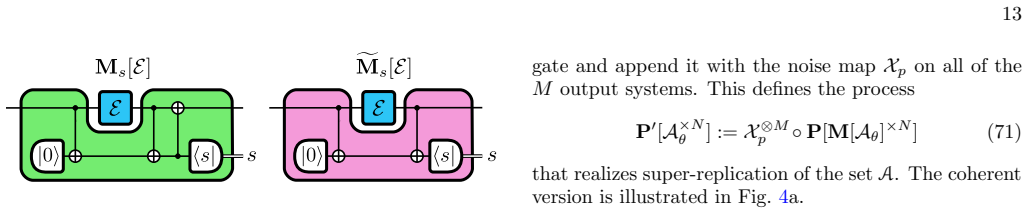
The central objects are the Kraus-derivative operators $\alpha(x)=\sum_n \dot K_n^\dagger(x)\dot K_n(x)$ and $\beta(x)=\sum_n \dot K_n^\dagger(x)K_n(x)$, together with the channel-estimation bound $f_N(E_x)=\min_{\text{Kraus}}\sqrt{\|\alpha(x)\|}\big[(N-1)\|\beta(x)\|+\sqrt{\|\alpha(x)\|}\big]$. The paper's upper bounds follow a triangle-inequality strategy: compare the $M$-copy Bures angle between the ideal channels' Choi states with the optimal $N$-copy channel-discrimination distance, and bound the latter by an integral of $f_N$ along the curve. A function $A(z)$ defined through the Lambert $W$ function converts the resulting ratios of quantum Fisher informations into explicit lower bounds on cloning distance. For the constructive side, the workhorse is the error-mitigation quantum instrument $\{M_s\}$ of Fig. 3, which labels the branches of a channel by parity; applied to noisy phase gates it either recovers the clean phase gate or produces known effective phase gates whose estimation error decays as $1/N^2$.
What would settle it
Run a search over causally nonseparable processes, for example using the process-matrix SDP form, for N-copy to M=$N^{{2-\delta}}$-copy cloning of amplitude-damping or Pauli-noise channels with Choi-Jamiolkowski fidelity tending to 1; one success would overturn Corollaries 4.1 and 4.2 as stated.
Extended reading notes
Core claim
The load-bearing claim is Proposition 4. For a smoothly parametrized channel curve $E_x$ with Kraus decomposition $E_x[\cdot]=\sum_n K_n(x)\,\cdot\,K_n^\dagger(x)$, define $\alpha(x)=\sum_n \dot K_n^\dagger(x)\dot K_n(x)$ and $\beta(x)=\sum_n \dot K_n^\dagger(x)K_n(x)$. If some Kraus representation gives $\beta(x)=0$, the optimal replication rate is linear for small error thresholds, and the Choi-Jamiolkowski cloning distance is bounded below by the Lambert-W-based function $A$ evaluated at a ratio of $\|\alpha(x)\|$ to the quantum Fisher information of the Choi state. If $\beta(x)$ cannot be made zero, the same bound leaves room for the quadratic rate $M\sim N^2$. The paper constructs super-replicating processes for the noisy phase-gate families $A=\{X_p\circ U_\theta\}$ and $B=\{U_\theta\circ X_p\}$, using an error-mitigation instrument that detects bit flips and then either recovers the clean phase gate or estimates $\theta$ from the effective phase gates that survive; these are the first non-unitary channels shown to super-replicate. In the opposite direction, it proves that classical-noise channels, amplitude-damping channels, and all noisy unitary gates satisfy the $\beta(x)=0$ condition and hence cannot be super-replicated.
Load-bearing premise
The blanket no-super-replication claims assume that an upper bound proved only for estimation processes with definite causal order also bounds arbitrary cloning processes with indefinite causal order; the paper asserts this without proof.
Editorial extensions
If this is right
- State cloning is subsumed by channel cloning: any $N\to M$ state cloner is equivalent to cloning $N$ trash-and-replace channels, so a strong converse for states (at most linear rate, fidelity $\le 1/\sqrt{2}$ for $M=N^{1+\delta}$) follows from the same framework.
- Super-replication of the full unitary group has zero noise robustness: composing every gate with any fixed non-unitary noise $N$ yields a family $\{N\circ U\}$ with at most linear rate, even if the desired target is the noiseless gate.
- Classical-noise channels and amplitude-damping channels are confined to linear replication; in the linear regime $M=(1+\lambda)N$ the paper gives explicit distance bounds $A(1/(1+\lambda))$ and $A(2/(1+\lambda))$.
- Noisy phase gates with bit-flip noise before or after the gate are the first non-unitary channels shown to super-replicate; for noise before the gate the explicit rate-2 process excludes only $p=1/2$.
- Measure-and-prepare processes already super-replicate $SU(2)$ and $U(1)$ gates, so quadratic replication is a signature of Heisenberg-limited estimation, not of coherent processing alone.
Reading between the lines
- Indefinite causal order is the natural loophole: the no-super-replication results are proved through a bound on causally ordered estimation processes, so a causally nonseparable cloning process that super-replicates amplitude damping or Pauli noise would refute the blanket claims.
- The $\beta(x)=0$ condition has a geometric reading: it means the Kraus frame can be chosen parallel along the curve, so the dividing line may be a curvature or parallel-transport property of the channel manifold, not merely an algebraic accident.
- The same error-mitigation-plus-estimation recipe used for noisy phase gates might extend to open-system dynamics, for example simulating a Liouvillian evolution for time $t'>t$ from access to time $t$; the paper leaves this as an open direction but provides all ingredients.
- The SDP results hint at a finite-$N$ frontier where coherence helps (1-to-2 amplitude damping) and where it provably never helps (Pauli noise); scanning other channel families could map where coherent processes pay off.
Signed reviews
Editorial analysis
A structured set of objections, weighed in public.
Referee Report
Summary. The paper develops a framework for deterministic cloning and replication of quantum channels using higher-order quantum processes, including causally ordered and non-causally ordered operations. It proves an equivalence between state cloning and cloning of trash-and-replace channels, derives upper bounds on cloning fidelities from channel-discrimination and channel-estimation arguments, and gives a necessary condition for super-replication based on the operators alpha(x) and beta(x) of a Kraus decomposition. The positive results include explicit super-replicating processes for two families of noisy phase gates, measure-and-prepare super-replication of qubit unitaries and qubit phase gates, and an SDP-based numerical method for searching optimal cloning processes. The negative results claim linear replication rates for classical-noise channels, the full set of noisy unitaries, and amplitude-damping channels.
Significance. If the central claims hold, this is the first demonstration of super-replication for non-unitary channels, and the framework unifying state, gate, and channel cloning is conceptually valuable. The explicit constructions in Secs. IV B and V B are concrete and checkable, and the connection between measure-and-prepare cloning and Bayesian channel estimation is a useful contribution. The SDP formulation in Sec. IV A and App. H is also a practical asset. However, the negative results currently rest on a causal-order restriction that is not carried through the propositions, so the no-super-replication statements are not yet established for the full class of processes the paper considers. The paper is well written and the derivations use external benchmarks rather than circular reasoning, but the scope gap must be fixed before the negative claims can be accepted.
major comments (2)
- [Sec. III B, Eqs. (24)-(27), Prop. 3/4, Cor. 4.1/4.2, Sec. V D 1] The no-super-replication statements for classical noise channels, noisy unitary gates, and amplitude-damping channels are not proven for non-causally ordered cloning processes. Proposition 3 bounds the N-copy discrimination distance only "for all causally ordered state-producing processes S", whereas Eq. (12) defines D^(N) as a supremum over all state-producing processes. Eq. (27) is explicitly derived "for all causally ordered processes", and Proposition 4 then drops this qualifier without justification. Since the framework explicitly includes non-causally ordered processes (Sec. II B and Lemma 6), the necessary condition beta(x)=0 for linear replication, and hence Corollaries 4.1 and 4.2 and the amplitude-damping claim in Sec. V D 1, remain open for non-causal cloners. The authors should either extend Proposition 3 to arbitrary state-producing processes, prove directly that non-causal processes cannot improve the relevant bound, or explicitly restrict the no-go theorems to causally ordered cloning processes.
- [App. B, Eq. (B2)-(B4), Corollary 2.1] The proof of the superlinear no-go for state cloning chooses F(rho0,rho1)=1-1/N^{1+delta} and then sets M=N^{1+delta}. For this choice, F(rho0,rho1)^M tends to e^{-1}, not to 0, so D(rho0^{otimes M},rho1^{otimes M}) does not tend to pi/2 and the claimed bound D^S >= pi/4 does not follow. The exponent algebra in Eq. (B4) appears inconsistent. The result itself is known from Ref. [21] and is likely repairable by choosing F=1-N^{-r} with 1<r<1+delta, but the proof as written needs correction.
minor comments (4)
- [Eq. (23)] The definition of \dot K_n(x) writes dK^\dagger_n(x)/dx, but the subsequent expressions for beta(x) use \dot K^\dagger_n(x)K_n(x); the derivative should be taken of K_n(x), not of K_n^\dagger(x).
- [Appendix A, Eqs. (A7) and (A10)] The notation F^S_{1/2} appears with a stray subscript 1/2 that is not defined; it should presumably be F^S throughout.
- [Sec. V D 4 and Fig. 5 caption] There are typographical errors: "tfull lines" should be "full lines" in the Fig. 5 caption, and "assymptotic error" should be "asymptotic error" in Sec. V C.
- [Sec. IV B 1 heading] The heading "Measure-and-prepare super-replication of all qubit unitries" contains a typo: "unitries" should be "unitaries".
Circularity Check
No circularity: the derivation chain rests on external estimation bounds and published super-replication circuits, not on fitted inputs or self-defined quantities.
full rationale
I examined the load-bearing steps in the paper and found no circular reduction. Proposition 1, the equivalence between cloning states and cloning trash-and-replace channels, is proved from the definitions of processes and the data-processing inequality rather than assumed. The upper bounds in Propositions 2-4 follow from the triangle inequality for the Bures angle, the external channel-estimation bound of Ref. [47] (Eq. (24)), and a closed-form optimization involving the Lambert W function; no parameter is fitted to the no-super-replication statements. Corollaries 4.1 and 4.2 are derived by direct algebraic computation of beta(x)=0 from explicit Kraus decompositions, so they are not restatements of the necessary condition. The positive super-replication constructions for noisy phase gates use either the published coherent circuits of Refs. [1,2] or the paper's own measure-and-prepare protocols, whose asymptotic fidelities are computed from the independent estimation results of Refs. [55,57]; even though Refs. [1] and [10] share authors with this paper, the central construction does not reduce to those citations because an independent measure-and-prepare route is provided. The only substantive concern, that Proposition 3's QFI bound is stated for causally ordered processes while Proposition 4 and its corollaries are applied to arbitrary cloning processes, is a possible scope/validity gap and not a circularity by the criteria of this analysis, since it does not make the claimed result equivalent to its inputs by construction. Overall, the derivation is self-contained against external benchmarks and contains no fitted constants disguised as predictions.
Assumptions & free parameters
free parameters (1)
- q (bit-flip 1→2 preparation probability) =
≈0.0778
assumptions (5)
- domain assumption Superchannel (quantum process) formalism: any cloning strategy is represented by a process matrix with positive semidefinite and trace constraints.
- domain assumption Quantum Fisher information bound of [47] for N-copy channel estimation, f_N(E_x), upper bounds the discrimination distance for causal state-producing processes.
- domain assumption Optimal Bayesian estimation fidelities for SU(2) and U(1) channels from [55-58] (e.g., 1-π²/N²) are correct.
- standard math Fidelity of tensor products is multiplicative and Choi-Jamiolkowski states faithfully represent channels.
- domain assumption Smoothness and regularity conditions on channel curves, such as bounded derivatives of α(x) and β(x), hold for the considered sets.
Cite this review
Pith. "Pith review of Cloning Quantum Channels." pith.science (2026). https://pith.science/paper/42YRU7MM
@misc{pith2026250908059,
  author       = {Pith},
  title        = {Pith review of: Cloning Quantum Channels},
  year         = {2026},
  howpublished = {\url{https://pith.science/paper/42YRU7MM}},
  note         = {Machine review of arXiv:2509.08059}
}
read the original abstract
We consider the problem of deterministically cloning quantum channels with respect to the best attainable rate and the highest quality, so-called optimal cloning. We demonstrate that cloning quantum states is, in-fact, equivalent to cloning the trash-and-replace channel and therefore the former is a special case of the more general problem. By appealing to higher-order quantum operations (quantum processes) we construct a unified framework to deal with the most general cloning tasks and establish necessary conditions for a family of channels to exhibit super-replication -- a quadratic cloning rate with vanishing error. We find that noisy phase-gate channels satisfy these conditions, and we construct the explicit super-replicating process for the task. Conversely, we find that the criteria are not met by the full set of noisy unitary gates; classical noise channels; or amplitude damping channels, whose respective cloning rates are at most linear. In this paradigm, we not only derive new results, but also refigure known ones. We derive a strong converse for state cloning, and for unitary channels we construct an alternative super-replication process to that of D\"ur et al. [PRL 114, 120503 (2015)] and Chiribella et al. [PRL 114, 120504 (2015)] based on a measure-and-prepare process, which allows us to establish a direct connection between optimal channel cloning and Bayesian channel estimation. Finally we give an SDP algorithm to search for optimal cloning processes and study the advantage of coherent vs measure-and-prepare protocols on concrete examples.
Figures


Figures from the paper (6 more)


Forward citations
Cited by 1 Pith paper
-
Optimal complex conjugation of unknown isometry channels
The optimal n-use fidelity for complex conjugating an unknown isometry C^d→C^D is derived in closed form, with parallel protocols proven optimal among all general quantum superchannels.
Reference graph
Works this paper leans on
-
[21]
Example of process constraints As concrete examples, we give the projectors for the parallel (par), sequential (seq), and general (non-causal, nc) processes (represented in Fig. 8) when the number of input channels isN= 2, i.e., for P: (L(H 11→H 21)⊗L(H 12→H 22))−→L(H in→H out),(H14) in terms of thetrace-and-replaceoperator AX:= tr AX⊗ 1 dA , which is ide...
-
[1]
(88)) as well as the bit-flip channelX p (Eq
Numerical results for 1 to 2 In Table I we present the numerics for 1→2 cloning for the amplitude-damping channelE γ (Eq. (88)) as well as the bit-flip channelX p (Eq. (68)) performed in Matlabusing theSeDuMisolver. The exact formula- tion of the programs can be found in App. H, as well as plots of the interesting cases. Note that for 1→2 cloning the line...
-
[2]
By going up toH= 21, we find the approximation FD CJ(1,2)≈0.932 for the optimal cloning fidelity of AD channels
This is exactly as expected, as the identity (id) and the trash-and-replace (T|0⟩⟨0|) channels can be perfectly distinguished by probing them with the state|1⟩. By going up toH= 21, we find the approximation FD CJ(1,2)≈0.932 for the optimal cloning fidelity of AD channels. This value is computed by fixing the optimal processP∗ found by the feasibility pro...
-
[3]
The task of estimating an unknown qubit unitary U2 ={U[·] :=U·U †|U∈SU(2)}(57) has been studied extensively [55, 56]
Measure-and-prepare super-replication of all qubit unitries. The task of estimating an unknown qubit unitary U2 ={U[·] :=U·U †|U∈SU(2)}(57) has been studied extensively [55, 56]. The optimal strat- egy probesNcopies of the gateUin parallel usingN spin-1/2 systems prepared in the state |ψ⟩=β N 2 N 2 ,N 2 + N 2−1X j=0(1/2) βj√2j+ 1 jX m=−j |j,m⟩⊗|j,α(m)⟩(58...
-
[4]
Measure-and-prepare super-replication of all qubit phase gates. We now consider an estimate and prepare strategy for cloning the set P2 := Uθ|θ∈[0,2π) (62) Uθ[·] =U θ[·]U † θ :=e iθσz·e−iθσz.(63) The optimal estimation strategy has been determined in [57], although here we closely follow the notation es- tablished in [58]. The optimal estimation strategy ...
-
[5]
(69) that the error mitigation process corrects the bit flips
Bit-flip noise after the phase gate For the family of channelsAit is trivial to see from Eq. (69) that the error mitigation process corrects the bit flips. After discarding the outputswe find M[Aθ] :=M 0[Aθ] +M 1[Aθ] =U θ.(70) Upon recovering the phase gateU θ we can now use the coherent process of [1] (Sec. V A), or the measure-and- prepare process (Sec....
-
[6]
classical
Bit-flip noise before the phase gate Here the situation is more involved, since depending on the value ofsone finds M0[Bθ] = (1−p)U θ orM 1[Bθ] =pU −θ.(72) We will restrict our attention to measure-and-prepare cloning processes. For a bit strings= (s 1...s N) with Hamming weight|s|= PN i=1si consider the CP map Ms[B×N] := NO i=1 Msi[Bθ] =p|s|(1−p) N−|s| N...
-
[7]
AD channels can not be super-replicated With the help of Proposition 4 it is immediate to see that AD channels can not be super-replicated. Indeed, with the derivatives of the natural Kraus operators ˙K† 0(γ) =− 1 2√1−γ |1⟩⟨1|, ˙K† 1(ζ) = 1 2√γ|1⟩⟨0|(90) we find thatβ(γ) = ˙K† 0(γ)K0(γ) + ˙K† 1(γ)K1(γ) = 0 which rules out the possibility of super-linear r...
Show all 87 references
-
[8]
(91), see also [61])
This comes from the fact that probing AD channels in parallel through their Choi-Jamio lkowski states is in 16 fact suboptimal by a factor of two from the QFI per- spective (it is not difficult to see 5 that probing the AD channels with the state|1⟩⊗N saturates the upper-bound...
-
[9]
ForNcopies of the channel, the sum of the out- comest:=|s|= PN i=1si follows the binomial distribu- tion Pr Bin(t|N,γ)
Estimate-and-prepare cloning of AD channels A simple estimation process for the AD channels, max- imizing the Fisher information for allγ, consists of prob- ing each copyE γ with the state|1⟩, and measuring the output system in the computation basis{|s⊕1⟩} s=0,1, such that the...
-
[10]
the CP maps Ks|γ[·] :=K s(γ)·K † s(γ) withs= 0,1,(94) have a different parity and can be detected with the pro- cess{fMs}with fM0 =M 0 andfM1 =X 1◦M1, illustrated in Fig
Coherent cloning of AD channels Just like for the bit-flip noise the two branches of the AD channel, i.e. the CP maps Ks|γ[·] :=K s(γ)·K † s(γ) withs= 0,1,(94) have a different parity and can be detected with the pro- cess{fMs}with fM0 =M 0 andfM1 =X 1◦M1, illustrated in Fig. ...
-
[11]
classical
Performance of the estimate-and-prepare and coherent processes To evaluate the fidelities F D|• CJ acheived by the estimate-and-prepare (•= E&P) and the coherent (•= coh) processes, notice that the expressions in Eqs. (93,96) are very similar. Using Jensen’s inequality Eq. (52...
2021
-
[12]
A preliminary lemma We start by proving the following lemma which is of independent interest from cloning. Lemma 6.For any processPtakingNchannels, the CPTP mapP[T ⊗N ρ ]resulting from using the process withN trash-and-replace channelsT ρ is of the form P[Tρ ×N][·] = tr S′EP[·...
-
[13]
Proof.We readily know thatF C CJ≥F C ⋄ , since by construction the CJ fidelity for two channels is greater or equal than the diamond fidelity
The main proof Next we use Lemma 6 to prove Proposition 1 in the main text. Proof.We readily know thatF C CJ≥F C ⋄ , since by construction the CJ fidelity for two channels is greater or equal than the diamond fidelity. First, we show that the optimal state cloning machineP:L(H...
-
[14]
Regularity conditions Let us now come back to the assumptions used to derive the bounds in Eq. (C4). For anyδ >0 andR<∞, there is a big enoughM 0 such that q R M < δforM≤M 0. Hence, if (i)β(x) = 0 for allx∈[a,a+δ) we can write for M= (1 +λ)N Z a+ √ R M a p fN(Ex)dx= √ N Z a+ √...
-
[15]
Note that the functiong(ζ;Z) assumes the values−∞and 0 on the boundaries of the domain (ζ= 0,1 respectively), and is smooth on the open interval (0,1)
Optimization of the bound In this section for all 0<x,y <∞we solve the following optimization f(x,y) := max R≥0 arccos (exp[−Rx])− p 2Ry .(C17) Define a new variableζ:= exp [−Rx]∈[0,1] which allows us to rewrite the maximization as f(x,y) = g(y/x) := max ζ∈[0,1] g(ζ;Z) g(ζ;Z) ...
-
[16]
Derivation of Eq.(85) In this section we make explicit the computation of the fidelityF CJ(P[N×N p ],N⊗M p ) for the measure-and-prepare cloning process of the Pauli-noise channels,P[N ×N p ] =P j Ej[N×N p ] bN (M) j , with bN (M) j = NO i=1 Pji ! ⊗ bN (M−N) j ,(F1) Pj[·] =σ j...
-
[17]
To do so we will lower bound the final fidelity for all values of the parameterp, using two approaches
Computing the asymptotic cloning fidelity of the coherent process In this section we lower bound the cloning fidelity of the Pauli-noise channels (Section V C) FC|M&P CJ = min p X t PrMult(t|N,p)F CJ(N ˆp(t),Np)M−N (F7) for the specific choice of the estimator ˆpk(t) = tk N . ...
-
[18]
Square root of a binomial random variable For completeness, in this section we summarize the demonstration of the bound E[ √ X]≥ p pN 1− 1−p 2pN (F16) for a binomial random variabelX∼Bin(N,p), given in the discussion [63] on Mathoverflow. First, forx≥0 consider the inequality ...
-
[19]
The dummy process for amplitude-damping channels Recall that the Kraus operators of the amplitude-damping channelsE γ, γ∈[0,1] are given by K0(γ) = 1 0 0 √1−γ , K 1(γ) = 0 √γ 0 0 (G1) in the computational basis. In order to derive the best dummy cloning process we need to find...
-
[20]
Computing the fidelity of the coherent process for cloning AD channels Here we compute the cloning fidelityF CJ(P[E×N γ ],EM γ ) for the coherent AD cloning process discussed in Sec. V D 3. In the main text we have established that the process returns theM-qubit CPTP map P[E×N...
-
[22]
7) of the Choi-Jamio lkowski stateCJ[S] representing a processP
Constraining measure-and-prepare processes Consider the physical realization (Fig. 7) of the Choi-Jamio lkowski stateCJ[S] representing a processP. It is obvious that for a measure-and-prepare process, the representing Choi-Jamio lkowski state is separable across the bi- parti...
-
[23]
In other words, the extremal points are a unitary map and the trash-and-replacemap
Cloning1→2copies of the amplitude-damping map Numerically we tested the qubit amplitude-damping channelE γ[·] :=K 0(γ)·K † 0(γ) +K 1(γ)·K † 1(γ) with Kraus operators given by K0 = 1 0 0 √1−γ , K 1 = 0 √γ 0 0 .(H19) Note the natural asymmetry of the problem at the end points: γ...
-
[24]
D¨ ur, P
W. D¨ ur, P. Sekatski, and M. Skotiniotis, Deterministic Superreplication of One-Parameter Unitary Transformations, Phys. Rev. Lett.114, 120503 (2015)
2015
-
[25]
Chiribella, Y
G. Chiribella, Y. Yang, and C. Huang, Universal Superreplication of Unitary Gates, Phys. Rev. Lett.114, 120504 (2015)
2015
-
[26]
J. L. Park, The concept of transition in quantum mechanics, Found. Phys.1, 23 (1970)
1970
-
[27]
W. K. Wootters and W. H. Zurek, A single quantum cannot be cloned, Nature299, 802 (1982)
1982
-
[28]
Dieks, Communication by EPR devices, Physics Letters A92, 271 (1982)
D. Dieks, Communication by EPR devices, Physics Letters A92, 271 (1982)
1982
-
[29]
Herbert, FLASH—a superluminal communicator based upon a new kind of quantum measurement, Found
N. Herbert, FLASH—a superluminal communicator based upon a new kind of quantum measurement, Found. Phys.12, 1171 (1982)
1982
-
[30]
Gisin, Quantum cloning without signaling, Phys
N. Gisin, Quantum cloning without signaling, Phys. Lett. A242, 1 (1998)
1998
-
[31]
Ghosh, G
S. Ghosh, G. Kar, and A. Roy, Optimal cloning and no signaling, Phys. Lett. A261, 17 (1999)
1999
-
[32]
Gedik and B
Z. Gedik and B. C ¸ akmak, Application of the no-signaling principle to obtain quantum cloners for any allowed value of fidelity, Phys. Rev. A87, 42314 (2013)
2013
-
[33]
Sekatski, M
P. Sekatski, M. Skotiniotis, and W. D¨ ur, No-signaling bounds for quantum cloning and metrology, Phys. Rev. A92, 022355 (2015)
2015
-
[34]
N. J. Cerf, M. Bourennane, A. Karlsson, and N. Gisin, Security of quantum key distribution using$\mathit{d}$-level systems, Phys. Rev. Lett.88, 127902 (2002)
2002
-
[35]
Duan and G.-C
L.-M. Duan and G.-C. Guo, Probabilistic Cloning and Identification of Linearly Independent Quantum States, Phys. Rev. Lett.80, 4999 (1998)
1998
-
[36]
Buzek and M
V. Buzek and M. Hillery, Quantum Copying: Beyond the No-Cloning Theorem, Phys. Rev. A54, 1844 (1996), arXiv:quant- ph/9607018
1996
-
[37]
Gisin and S
N. Gisin and S. Massar, Optimal quantum cloning machines, Phys. Rev. Lett.79, 2153 (1997)
1997
-
[38]
R. F. Werner, Optimal cloning of pure states, Phys. Rev. A58, 1827 (1998)
1998
-
[39]
Bruss, A
D. Bruss, A. Ekert, and C. Macchiavello, Optimal universal quantum cloning and state estimation, Phys. Rev. Lett.81, 2598 (1998), arXiv:quant-ph/9712019
1998 arXiv
-
[40]
A. K. Pati, Quantum superposition of multiple clones and the novel cloning machine, Phys. Rev. Lett.83, 2849 (1999)
1999
-
[41]
Chefles and S
A. Chefles and S. M. Barnett, Strategies and networks for state-dependent quantum cloning, Phys. Rev. A60, 136 (1999)
1999
-
[42]
D. Bruß, M. Cinchetti, G. Mauro D’Ariano, and C. Macchiavello, Phase-covariant quantum cloning, Phys. Rev. A62, 12302 (2000)
2000
-
[43]
G. M. D’Ariano and C. Macchiavello, Optimal phase-covariant cloning for qubits and qutrits, Phys. Rev. A67, 42306 (2003)
2003
-
[44]
Chiribella, Y
G. Chiribella, Y. Yang, and A. C.-C. Yao, Quantum replication at the Heisenberg limit, Nat Commun4, 2915 (2013)
2013
-
[45]
Chiribella, G
G. Chiribella, G. M. D’Ariano, and P. Perinotti, Optimal Cloning of Unitary Transformation, Phys. Rev. Lett.101, 180504 (2008)
2008
-
[46]
Chiribella, G
G. Chiribella, G. M. D’Ariano, and P. Perinotti, Quantum Circuits Architecture, Phys. Rev. Lett.101, 060401 (2008), arXiv:0712.1325 [quant-ph]
2008 arXiv
-
[47]
Chiribella, G
G. Chiribella, G. M. D’Ariano, and P. Perinotti, Transforming quantum operations: Quantum supermaps, EPL83, 30004 (2008)
2008
-
[48]
Chiribella, G
G. Chiribella, G. M. D’Ariano, and P. Perinotti, Theoretical framework for quantum networks, Phys. Rev. A80, 022339 (2009), arXiv:0904.4483 [quant-ph]
2009 arXiv
-
[49]
Gour and A
G. Gour and A. Winter, How to quantify a dynamical quantum resource, Phys. Rev. Lett.123, 150401 (2019), arXiv:1906.03517 [math-ph, physics:quant-ph]
2019 arXiv
-
[50]
Oreshkov, F
O. Oreshkov, F. Costa, and ˇCaslav Brukner, Quantum correlations with no causal order, Nature Communications3, 1 (2012)
2012
-
[51]
Chiribella, G
G. Chiribella, G. M. D’Ariano, P. Perinotti, and B. Valiron, Quantum computations without definite causal structure, Phys. Rev. A88, 22318 (2013)
2013
-
[52]
Milz and M
S. Milz and M. T. Quintino, Characterising transformations between quantum objects, ’completeness’ of quantum proper- ties, and transformations without a fixed causal order, Quantum8, 1415 (2024)
2024
-
[53]
Chen and E
S. Chen and E. Chitambar, Entanglement-breaking superchannels, Quantum4, 299 (2020)
2020
-
[54]
Nielsen and I
M. Nielsen and I. L. Chuang,Quantum Computation and Quantum Information(Cambirdge University Press, New York, 2000)
2000
-
[55]
Barnum, C
H. Barnum, C. M. Caves, C. A. Fuchs, R. Jozsa, and B. Schumacher, Noncommuting Mixed States Cannot Be Broadcast, Phys. Rev. Lett.76, 2818 (1996)
1996
-
[56]
G. M. D’Ariano, C. Macchiavello, and P. Perinotti, Superbroadcasting of Mixed States, Phys. Rev. Lett.95, 060503 (2005)
2005
-
[57]
Chiribella, G
G. Chiribella, G. M. D’Ariano, C. Macchiavello, P. Perinotti, and F. Buscemi, Superbroadcasting and classical information, Phys. Rev. A75, 012315 (2007), arXiv:quant-ph/0608153
2007 arXiv
-
[58]
Scarani, S
V. Scarani, S. Iblisdir, N. Gisin, and A. Acin, Quantum cloning, Rev. Mod. Phys.77, 1225 (2005), arXiv:quant-ph/0511088
2005 arXiv
-
[59]
Luo, On Quantum No-Broadcasting, Lett Math Phys92, 143 (2010)
S. Luo, On Quantum No-Broadcasting, Lett Math Phys92, 143 (2010)
2010
-
[60]
Fan, Y.-N
H. Fan, Y.-N. Wang, L. Jing, J.-D. Yue, H.-D. Shi, Y.-L. Zhang, and L.-Z. Mu, Quantum cloning machines and the applications, Physics Reports Quantum Cloning Machines and the Applications,544, 241 (2014)
2014
-
[61]
Raginsky, A fidelity measure for quantum channels, Phys
M. Raginsky, A fidelity measure for quantum channels, Phys. Lett. A290, 11 (2001)
2001
-
[62]
Schumacher, Sending entanglement through noisy quantum channels, Phys
B. Schumacher, Sending entanglement through noisy quantum channels, Phys. Rev. A54, 2614 (1996). 35
1996
-
[63]
I. L. Chuang and M. A. and Nielsen, Prescription for experimental determination of the dynamics of a quantum black box, J. Mod. Opt.44, 2455 (1997)
1997
-
[64]
Horodecki, P
M. Horodecki, P. Horodecki, and R. Horodecki, General teleportation channel, singlet fraction, and quasidistillation, Phys. Rev. A60, 1888 (1999)
1999
-
[65]
M. A. Nielsen, A simple formula for the average gate fidelity of a quantum dynamical operation, Physics Letters A303, 249 (2002)
2002
-
[66]
D. Bures, An extension of kakutani’s theorem on infinite product measures to the tensor product of semifinite w*-algebras, Transactions of the American Mathematical Society135, 199 (1969)
1969
-
[67]
transition probability
A. Uhlmann, The “transition probability” in the state space ofa∗-algebra, Reports on Mathematical Physics9, 273 (1976)
1976
-
[68]
Fuchs and J
C. Fuchs and J. van de Graaf, Cryptographic distinguishability measures for quantum-mechanical states, IEEE Trans. Inf. Theory45, 1216 (1999)
1999
-
[69]
G. M. D’Ariano, P. Lo Presti, and M. G. A. Paris, Using entanglement improves the precision of quantum measurements, Phys. Rev. Lett.87, 270404 (2001)
2001
-
[70]
Kurdzia lek, W
S. Kurdzia lek, W. G´ orecki, F. Albarelli, and R. Demkowicz-Dobrza´ nski, Using adaptiveness and causal superpositions against noise in quantum metrology, Phys. Rev. Lett.131, 90801 (2023)
2023
-
[71]
S. L. Braunstein and C. M. Caves, Statistical distance and the geometry of quantum states, Phys. Rev. Lett.72, 3439 (1994)
1994
-
[72]
Demkowicz-Dobrza´ nski and L
R. Demkowicz-Dobrza´ nski and L. Maccone, Using entanglement against noise in quantum metrology, Phys. Rev. Lett. 113, 250801 (2014)
2014
-
[73]
Zhou and L
S. Zhou and L. Jiang, Asymptotic theory of quantum channel estimation, PRX Quantum2, 010343 (2021)
2021
-
[74]
Uhlmann, The metric of bures and the geometric phase, Quantum groups and related topics , 267 (1992)
A. Uhlmann, The metric of bures and the geometric phase, Quantum groups and related topics , 267 (1992)
1992
-
[75]
M. M. Taddei, B. M. Escher, L. Davidovich, and R. L. de Matos Filho, Quantum speed limit for physical processes, Physical review letters110, 050402 (2013)
2013
-
[76]
Albarelli and R
F. Albarelli and R. Demkowicz-Dobrza´ nski, Probe incompatibility in multiparameter noisy quantum metrology, Physical Review X12, 011039 (2022)
2022
-
[77]
Skrzypczyk and D
P. Skrzypczyk and D. Cavalcanti,Semidefinite Programming in Quantum Information Science, 2053-2563 (IOP Publishing, 2023)
2023
-
[78]
Hayashi, Parallel treatment of estimation of su (2) and phase estimation, Physics Letters A354, 183 (2006)
M. Hayashi, Parallel treatment of estimation of su (2) and phase estimation, Physics Letters A354, 183 (2006)
2006
-
[79]
Chiribella, G
G. Chiribella, G. M. D’Ariano, and M. F. Sacchi, Optimal estimation of group transformations using entanglement, Phys. Rev. A72, 042338 (2005)
2005
-
[80]
D. W. Berry and H. M. Wiseman, Optimal states and almost optimal adaptive measurements for quantum interferometry, Physical review letters85, 5098 (2000)
2000
-
[81]
S. D. Bartlett, T. Rudolph, and R. W. Spekkens, Reference frames, superselection rules, and quantum information, Reviews of Modern Physics79, 555 (2007)
2007
-
[82]
R. H. Dicke, Coherence in spontaneous radiation processes, Phys. Rev.93, 99 (1954)
1954
-
[83]
Bacon, I
D. Bacon, I. L. Chuang, and A. W. Harrow, Efficient quantum circuits for schur and clebsch-gordan transforms, Phys. Rev. Lett.97, 170502 (2006)
2006
-
[84]
Fujiwara, Estimation of a generalized amplitude-damping channel, Phys
A. Fujiwara, Estimation of a generalized amplitude-damping channel, Phys. Rev. A70, 012317 (2004)
2004
-
[85]
Odake, H
T. Odake, H. Kristj´ ansson, P. Taranto, and M. Murao, Universal algorithm for transforming hamiltonian eigenvalues, Physical Review Research7, 013331 (2025)
2025
-
[86]
Gurel-Gurevich, Answer to: ”expectation of square root of binomial r.v.” (2012), mathOverflow, accessed August 19, 2025
O. Gurel-Gurevich, Answer to: ”expectation of square root of binomial r.v.” (2012), mathOverflow, accessed August 19, 2025
2012
-
[87]
Taranto, S
P. Taranto, S. Milz, M. Murao, M. T. Quintino, and K. Modi, Higher-order quantum operations, arXiv preprint arXiv:2503.09693 (2025)
2025 arXiv
Reviewed August 15, 2026 · model on record in the stance chip above.
Discussion (0). Continue with ORCID to comment.