REVIEW 4 major objections 4 minor 1 cited by
The paper argues that the geometrical-optics singularity at reflection points is an artifact of the (x, k) representation: in ray-time coordinates the envelope equation stays finite, and mapping back reproduces the standard Airy patterns.
Reviewed by Pith at T0; open to challenge. T0 means a machine referee read the full paper against a public rubric. the ladder, T0–T4 →
T0 review · deepseek-v4-flash
2026-08-04 21:16 UTC pith:MAR3FLXQ
load-bearing objection The core result is real and clean: a continuous (tau,h) MGO formulation with a derived Airy-transform symbol map explains the cutoff singularity, but the claim that MGO can replace GO for any practical purposes runs ahead of the evidence. the 4 major comments →
Geometrical optics in phase space
The pith
A machine-rendered reading of the paper's core claim, the machinery that carries it, and where it could break.
Core claim
The central claim is that the singularity of GO at reflection points is an artifact of representation, not of the wave physics. Introducing canonical coordinates (τ, h) aligned with the ray, where τ is the ray time and h is the ray energy, the authors construct the Weyl symbol calculus on this space and prove that the symbol H_r of the wave Hamiltonian in the ray-aligned representation is related to the physical symbol H_z by an Airy transform, with leading-order mapping H_r(r) ≈ H_z(z(r)) + O(ε²), where ε = (Δx Δk)⁻¹ is the inverse product of the dispersion scales. The resulting envelope equation in τ-space is ∂_τ ψ_τ = Γ_r(τ) ψ_τ, whose solution never blows up, unlike the GO amplitude law
What carries the argument
The load-bearing object is the metaplectic transform: a unitary change of field representation induced by a canonical transformation of the position and momentum operators. The authors combine metaplectic transforms with Weyl symbol calculus on the ray-aligned space (τ, h), and the key identity is the pseudo-measure µ ≈ Ai_ε(H_z(z) − h) δ(τ(z) − τ) relating symbols in the two representations, where Ai_ε is the rescaled Airy function Ai_ε(z) = (1/2π)∫dt e^{izt + iγt³/24}. This kernel turns symbol remapping into an Airy transform O_z(z) ≈ ∫ Ai_ε(H_z(z) − h̃) O_r(τ(z), h̃) dh̃, which yields the nonsingular envelope equation and the Wigner-function map W_z(z) = W_0 Ai_ε(H_z(z)).
Load-bearing premise
The load-bearing premise is that the dispersion symbol H_z varies slowly compared with the symplectic radius R of the ray orbit, so the Hayes representation is accurate to second order; if the medium changes on scales comparable to R, or if ε = (Δx Δk)⁻¹ is not small, the Airy-transform relation and the nonsingular envelope equation lose their justification.
What would settle it
Compute the exact Wigner function of the full wave equation in a medium whose dispersion symbol varies on scales comparable to the symplectic radius (a sharp density ramp at cutoff, so ε ≳ 1) and compare against the MGO predictions W_z(z) = W_0 Ai_ε(H_z(z)) and the mapped intensity of Eq. (6.25); disagreement in the near-cutoff fringe pattern would mark the boundary of the claimed validity.
If this is right
- The MGO envelope equation ∂_τ ψ_τ = Γ_r(τ) ψ_τ can be integrated with coefficients computed from the known dispersion symbol H_z, with no amplitude singularity at cutoffs.
- Quadratic observables, such as energy density and dissipation power, follow from the mapped Wigner function W_z(z) = W_0 Ai_ε(H_z(z)) without ever constructing the field in physical space.
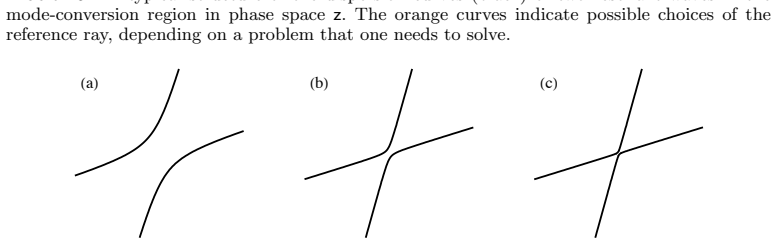
- Mode conversion, including O–X conversion near the critical density, is captured by a vector version of the same equations with a freely chosen reference-ray Hamiltonian.
- Because the field itself is needed only for initialization and diagnostics, MGO can serve as a drop-in replacement for GO in ray-tracing and quasilinear codes.
- A generalized resonance condition ω = ∂_τ θ extends the Cherenkov resonance to waves that are quasimonochromatic in τ-space but not in x-space, unifying Cherenkov and Fermi acceleration.
Where Pith is reading between the lines
- The Airy-transform kernel suggests a hierarchy: linear canonical changes map symbols exactly, while the first nonlinear correction to a ray-aligned change is always an Airy transform; the paper's own asymptotics point toward higher-order corrections organizing as folded catastrophe integrals.
- A testable extension is the explicit construction of a multi-chart merger that joins several local (τ, h) charts along a full ray orbit, testing whether global MGO retains its claimed O(ε²) accuracy.
- The metaplectic resonance condition could support Landau-type damping calculations in reflection regions, where the usual ω = kv condition is ill defined; the paper leaves the quantitative heating theory open.
- The same symbol-mapping machinery should carry over to quasioptical beams with transverse diffraction, a direction the paper identifies as future work.
Editorial analysis
A structured set of objections, weighed in public.
Referee Report
Summary. The paper develops a phase-space formulation of geometrical optics, called MGO, in which the wave equation is solved in ray-time/ray-energy variables (τ,h) rather than physical (x,k). The central technical results are: a Weyl-symbol calculus on (τ,h); an Airy-transform relation between symbols in the two representations (Eq. 5.65), with the symbol mapping H_r(r) ≈ H_z(z(r)) + O(ε²) (Eq. 5.66); a nonsingular envelope equation ∂_τ ψ = Γ ψ (Eq. 6.3); a Wigner-function map W_z(z) ≈ W_0 Ai_ε(H_z(z)) (Eqs. 6.11, 6.16); and explicit Airy profiles for reflected fields (Eq. 6.25). An extension to vector waves and mode conversion is given in Sec. 7, and a generalized Cherenkov resonance is introduced in Sec. 8. The paper argues that MGO removes the spurious GO singularity at cutoffs while remaining similar to GO in computational cost.
Significance. If the central derivation is correct, MGO is a substantial contribution to reduced modeling of waves in plasmas: it offers a concrete, apparently parameter-free scheme for propagating wave envelopes through reflection and conversion regions where conventional GO fails. The paper contains many explicit analytical formulas, derives the Airy transform rather than postulating it, and checks the results against exact quantum-harmonic-oscillator eigenstates and Wigner functions (Figs. 4 and 5) as well as known WKB and Airy asymptotics. These checks are genuinely useful. However, the derivation is not yet fully secured in the regimes that motivate it, so the practical significance is conditional on additional convergence estimates and benchmark tests.
major comments (4)
- [Sec. 5.4.2, Eq. (5.56)] The pseudo-measure (5.62) and, through it, the symbol mapping (5.66) rely on a Taylor expansion of delta functions in Eq. (5.56). The authors themselves call this 'questionable' and justify it only as a shorthand for integrals. Because the claimed O(ε²) accuracy of H_r ≈ H_z(z(r)) is load-bearing for the entire MGO envelope equation, this step needs a rigorous justification or an explicit error bound. Without it, the central symbol-mapping theorem is not established to the stated order.
- [Secs. 5.4.1, 5.4.3 and 7.3] The small parameter ε = R^{-2} is introduced via a single symplectic scale R, and the Hayes representation H_y ≈ V(q)(p−p(q)) (Eq. 5.44) is assumed accurate. Near the very cutoffs and mode-conversion regions that motivate MGO, this is not demonstrated: in the O–X problem the small eigenvalues Λ of H_r vary on the mode-conversion scale, and Sec. 7.3 states that dispersion curves become non-smooth near exact resonance and defers the details to a later publication. Thus the central claim that MGO can replace GO through cutoffs and conversion regions is plausible but not secured by the present derivation.
- [Sec. 6.2.2, Eqs. (6.16), (6.25)] The reproduction of Airy patterns in Figs. 3–5 is partly by construction, because the Airy function Ai_ε is the mapping kernel itself (Eq. 5.62). The comparisons with exact QHO states are useful consistency checks, but they are smooth-symbol illustrations, not independent full-wave benchmarks for cutoff or mode-conversion scenarios. The paper should either add such benchmarks (e.g., a solvable turning-point model or a model O–X conversion case) or explicitly scope the claims to internal consistency rather than external validation.
- [Sec. 5.4.3, Eq. (5.64)] The global extrapolation of ε via Eq. (5.64) is a heuristic step. The authors note that the calculation is valid only for small q, and Eq. (5.64) is introduced as an extrapolation that is 'expected to be applicable' near the ray. Since the global form of the Airy transform (5.65) and the Wigner maps (6.11), (6.16) depend on this extrapolation, its error control should be quantified or its status as an approximation should be stated more carefully.
minor comments (4)
- [Author list] The name 'V alerian' in the author block has a stray space; should be 'Valerian'.
- [Appendix C.1] In the first displayed equation of Appendix C.1, the integration variable in 1/(2π) ∫ dz ... e^{izt} should be dt, not dz.
- [Appendix F] In the notation table, 'u ≐ v∧u/v' is described as 'sections 5.7 and 5.2'; the correct cross-reference is Sec. 5.1.2 (and Sec. 5.2).
- [Throughout] The symbols ε (symplectic curvature) and ϵ (MGO parameter) are used interchangeably in places, e.g., in the sentence following Eq. (5.66) 'O(ϵ²)' vs. 'εB_h³O_r'. Clarifying the distinction would improve readability.
Circularity Check
Minor by-construction Airy reproduction; central MGO derivation independent.
specific steps
-
self definitional
[Section 6.2.2, Eqs. (6.10), (6.16), using the mapping (5.62)/(5.65)]
"Wr(τ,h)≈W0(τ)δ(h)... Wz(z)=∫ dτdh Wr(τ,h)µ(r,z). This leads to ... Wz(z)=W0(τ(z))Aiε(Hz(z))."
The claimed reproduction of the standard Airy patterns follows by substituting a delta-function Wigner function into the Airy-transform mapping (5.62)-(5.65). The output is thus the same Airy function Aiε that constitutes the mapping kernel, so the pattern is in the transform by construction. The kernel itself is derived from the M-wave equation under the Hayes/parabolic approximation rather than fitted, so this is only a mild, partial circularity: it makes the Airy-profile comparison a consistency check rather than an independent confirmation of the framework.
full rationale
The central derivation is self-contained. The paper builds the Weyl calculus on (τ,h), derives the M-wave kernel from explicit approximations (Hayes representation (5.44) and the parabolic model (5.29)), and obtains the Airy-transform mapping (5.65) and the symbol relation (5.66) rather than postulating them. The MGO envelope equation (6.3) and the nonsingular solution (6.4) are direct consequences. The only notable by-construction element is the reproduction of Airy profiles in (6.16): because the mapping kernel is Aiε and W_r is taken as a delta function in h, the Wigner pattern in z-space is essentially the kernel evaluated at H_z. This is a valid consistency check but not an independent prediction. The paper does, however, provide external anchors: comparisons with exact QHO eigenstates (Figs. 4 and 5) and with a sinusoidal-potential example (Fig. 3b), which do not rely on the fitted values of the theory. Self-citations to prior MGO work by the same authors are contextual and are not load-bearing for the new derivation. Overall, the claimed MGO extension through cutoffs is supported by the derivation as far as its stated small-ε assumptions hold, and no significant circularity is present beyond the mild by-construction character of the Airy-pattern demonstration.
Axiom & Free-Parameter Ledger
axioms (5)
- domain assumption The wave equation is linear with a Hermitian dispersion operator plus a small anti-Hermitian part (Sec. 1.3, Sec. 4.1).
- domain assumption The medium is smooth enough that the Weyl symbol H_z has characteristic scales Δx and Δk with ε = (ΔxΔk)^{-1} ≪ 1 (Sec. 5.4.1).
- domain assumption The reference ray is curved, with v and u = ẑ linearly independent so that ε = ż∧ẑ ≠ 0 (Sec. 5.1.2).
- domain assumption The Hayes representation Hy(y) ≈ V(q)(p − p(q)) is accurate to the required order (Sec. 5.4.1, Eq. 5.44).
- standard math The underlying symplectic geometry and Weyl calculus results, including the metaplectic transform formalism, are taken as standard background (Sections 2 and 3).
read the original abstract
Geometrical optics (GO) is widely used for reduced modeling of waves in plasmas but fails near reflection points, where it predicts a spurious singularity of the wave amplitude. We show how to avoid this singularity by adopting a different representation of the wave equation. Instead of the physical space $x$ and the wavevector $k$, we use the ray time $\tau$ as the new canonical coordinate and the ray energy $h$ as the associated canonical momentum. To derive the envelope equation in the $\tau$-representation, we construct the Weyl symbol calculus on the $(\tau, h)$ space and show that the corresponding Weyl symbols are related to their $(x, k)$ counterparts by the Airy transform. This allows us to express the coefficients in the envelope equation through the known properties of the original dispersion operator. When necessary, solutions of this equation can be mapped to the $x$-space using a generalised metaplectic transform. But the field per se might not even be needed in practice. Instead, knowing the corresponding Wigner function usually suffices for linear and quasilinear calculations. As a Weyl symbol itself, the Wigner function can be mapped analytically, using the aforementioned Airy transform. We show that the standard Airy patterns that form in regions where conventional GO fails are successfully reproduced within MGO simply by remapping the field from the $\tau$-space to the $x$-space. An extension to mode-converting waves is also presented. This formulation, which we call generalised metaplectic GO (MGO) offers a promising tool, for example, for reduced modeling of the O--X conversion in inhomogeneous plasma near the critical density, an effect that is important for fusion applications and also occurs in the ionosphere. Aside from better handling reflection, MGO is similar to GO and can replace it for any practical purposes.
Figures




Forward citations
Cited by 1 Pith paper
-
A Doppler backscattering diagnostic for the EXL-50U spherical tokamak: plasma considerations and preliminary quasioptical design
Conceptual DBS diagnostic design for EXL-50U enables turbulence measurements at 0.15 < ρ < 1 with k_perp between 2.47 and 9.49 cm^{-1} via U-band quasioptics and toroidal steering matched to the high magnetic pitch angle.
Reference graph
Works this paper leans on
-
[1]
Alonso, M. A. & Forbes, G. W.1997 Uniform asymptotic expansions for wave propagators via fractional transformations.J. Opt. Soc. Am. A14,
work page 1997
-
[23]
A geometric theory of waves and its applications to plasma physics
Ruiz, D. E.2017 Geometric theory of waves and its applications to plasma physics. PhD thesis, Princeton University, arXiv: 1708.05423. Ruiz, D. E. & Dodin, I. Y.2015 First-principles variational formulation of polarization effects in geometrical optics.Phys. Rev. A92, 043805. Ruiz, D. E. & Dodin, I. Y.2017aExtending geometrical optics: a Lagrangian theory...
work page internal anchor Pith review Pith/arXiv arXiv 2017
-
[35]
Dodin, I. Y. & Fisch, N. J.2014 Ponderomotive forcesonwaves in modulated media.Phys. Rev. Lett.112, 205002, arXiv:1402.5900. Dodin, I. Y., Ruiz, D. E., Yanagihara, K., Zhou, Y. & Kubo, S.2019 Quasioptical modeling of wave beams with and without mode conversion. I. Basic theory.Phys. Plasmas26, 072110, arXiv:1901.00268. Dodin, I. Y. & Startsev, E. A.2021 O...
work page internal anchor Pith review Pith/arXiv arXiv 2014
-
[36]
Preinhaelter, J. & Kopeck ´y, V.1973 Penetration of high-frequency waves into a weakly inhomogeneous magnetized plasma at oblique incidence and their transformation to Bernstein modes.J. Plasma Phys.10,
work page 1973
-
[37]
& Glogower, J.1964 Quantum mechanical phase and time operator.Physics 1,
Susskind, L. & Glogower, J.1964 Quantum mechanical phase and time operator.Physics 1,
work page 1964
-
[49]
’t Hooft, G.2024 The hidden ontological variable in quantum harmonic oscillators, arXiv:2407.18153. Thomson, C. J. & Chapman, C. H.1985 An introduction to Maslov’s asymptotic method. Geophys. J. Intl.83,
Pith/arXiv arXiv 2024
-
[143]
Tracy, E. R., Brizard, A. J., Richardson, A. S. & Kaufman, A. N.2014Ray Tracing and Beyond: Phase Space Methods in Plasma Wave Theory. New York: Cambridge University Press. Tracy, E. R., Kaufman, A. N. & Brizard, A. J.2003 Ray-based methods in multidimensional linear wave conversion.Phys. Plasmas10,
work page 2003
-
[156]
Weinbub, J. & Ferry, D. K.2018 Recent advances in Wigner function approaches.Appl. Phys. Rev.5. Widder, D. V.1979 The Airy transform.Amer. Math. Monthly86,
work page 2018
-
[193]
G.1985 Symplectically invariant WKB wave functions.Phys
Littlejohn, R. G.1985 Symplectically invariant WKB wave functions.Phys. Rev. Lett.54,
work page 1985
-
[199]
Højlund Marholt, R., Senstius, M. G. & Nielsen, S. K.2024 Demonstration of metaplectic geometrical optics for reduced modeling of plasma waves.Phys. Rev. E110, 025208. Kamran, N., Olver, P. & Tenenblat, K.2009 Local symplectic invariants for curves. Commun. Contemp. Math.11,
work page 2024
-
[271]
Yanagihara, K., Dodin, I. Y. & Kubo, S.2019aQuasioptical modeling of wave beams with and without mode conversion. II. Numerical simulations of single-mode beams.Phys. Plasmas26, 072111, arXiv:1903.01357. Yanagihara, K., Dodin, I. Y. & Kubo, S.2019bQuasioptical modeling of wave beams with and without mode conversion. III. Numerical simulations of mode-conv...
work page internal anchor Pith review Pith/arXiv arXiv 1903
-
[337]
Mello, P. A. & Moshinsky, M.1975 Nonlinear canonical transformations and their representations in quantum mechanics.J. Math. Phys.16,
work page 1975
-
[517]
& Ursell, F.1957 An extension of the method of steepest descents.Math
Chester, C., Friedman, B. & Ursell, F.1957 An extension of the method of steepest descents.Math. Proc. Camb. Philos. Soc.53,
work page 1957
-
[599]
Quasilinear theory for inhomogeneous plasma
Dodin, I. Y.2022 Quasilinear theory for inhomogeneous plasma.J. Plasma Phys.88, 905880407, arXiv:2201.08562. Dodin, I. Y.2024 Quasilinear theory: the lost ponderomotive effects and why they matter.Rev. Mod. Plasma Phys.8,
work page internal anchor Pith review Pith/arXiv arXiv 2022
- [669]
- [1001]
-
[1077]
D.1973 Group velocity and nonlinear dispersive wave propagation.Proc
Hayes, W. D.1973 Group velocity and nonlinear dispersive wave propagation.Proc. R. Soc. Lond. A Math. Phys. Sci.332,
work page 1973
-
[1139]
Novikau, I., Dodin, I. Y. & Startsev, E. A.2023 Simulation of linear non-Hermitian boundary-value problems with quantum singular-value transformation.Phys. Rev. Appl. 19, 054012, arXiv:2212.09113. Novikau, I., Startsev, E. A. & Dodin, I. Y.2022 Quantum signal processing for simulating cold plasma waves.Phys. Rev. A105, 062444, arXiv:2112.06086. Pereverzev...
work page internal anchor Pith review Pith/arXiv arXiv 2023
-
[1279]
Alonso, M. A. & Forbes, G. W.1999 New approach to semiclassical analysis in mechanics. J. Math. Phys.40,
work page 1999
-
[1321]
Wigner Function for Harmonic Oscillator and The Classical Limit
62 Mostowski, J. & Pietraszewicz, J.2021 Wigner function for harmonic oscillator and the classical limit, arXiv:2104.06638. Nicacio, F.2021 Williamson theorem in classical, quantum, and statistical physics.Am. J. Phys.89,
work page internal anchor Pith review Pith/arXiv arXiv 2021
-
[1699]
Balakin, A. A., Balakina, M. A., Permitin, G. V. & Smirnov, A. I.2007 Quasi-optical description of wave beams in smoothly inhomogeneous anisotropic media.J. Phys. D: Appl. Phys.40,
work page 2007
-
[1742]
Littlejohn, R. G. & Flynn, W. G.1991 Geometric phases in the asymptotic theory of coupled wave equations.Phys. Rev. A44,
work page 1991
-
[2017]
H.1974 Classical-limit quantum mechanics and the theory of molecular collisions
Miller, W. H.1974 Classical-limit quantum mechanics and the theory of molecular collisions. InAdvances in Chemical Physics(edited by I. Prigogine and S. A. Rice). Mjølhus, E.1990 On linear conversion in a magnetized plasma.Radio Sci.25,
work page 1974
-
[2147]
& de Izarra, C.1997 An integral representation for the product of Airy functions.Z
V all´ee, O., Soares, M. & de Izarra, C.1997 An integral representation for the product of Airy functions.Z. angew. Math. Phys.48,
work page 1997
-
[2644]
Maslov, V. P. & Fedoriuk, M. V.1981Semi-Classical Approximation in Quantum Mechanics. Dordrecht, Netherlands: Reidel. McDonald, S. W.1988 Phase-space representations of wave equations with applications to the eikonal approximation for short-wavelength waves.Phys. Rep.158,
work page 1988
-
[2727]
61 Fu, Y., Dodin, I. Y. & Qin, H.2023 Spin Hall effect of radiofrequency waves in magnetized plasmas.Phys. Rev. E107, 055210, arXiv:2211.11705. Galindo, A. & Pascual, P.1990Quantum Mechanics I. Berlin: Springer. Goldstein, H., Poole, C. P. & Safko, J. L.2011Classical Mechanics, 3rd edn. Upper Saddle River, NJ: Pearson. de Gosson, M.2006Symplectic Geometry...
work page internal anchor Pith review Pith/arXiv arXiv 2023
-
[3529]
D., F arina, D., Felici, F., Figini, L., Fischer, R., Galperti, C., Happel, T., Lin-Liu, Y
Poli, E., Bock, A., Lochbrunner, M., Maj, O., Reich, M., Snicker, A., Stegmeir, A., Volpe, F., Bertelli, N., Bilato, R., Conway, G. D., F arina, D., Felici, F., Figini, L., Fischer, R., Galperti, C., Happel, T., Lin-Liu, Y. R., Marushchenko, N. B., Mszanowski, U., Poli, F. M., Stober, J., Westerhof, E., Zille, R., Peeters, A. G. & Pereverzev, G. V.2018 TO...
work page 2018
-
[4285]
Blair, M. D.2022 The Van Vleck formula on Ehrenfest time scales and stationary phase asymptotics for frequency-dependent phases.Commun. Math. Phys.392,
work page 2022
-
[4432]
Kravtsov, Y. A. & Orlov, Y. I.1990Geometrical optics of inhomogeneous media. New York: Springer-Verlag. Langer, R. E.1937 On the connection formulas and the solutions of the wave equation.Phys. Rev.51,
work page 1937
-
[5239]
Lopez, N. A.2024 Exact boundary-value solution for an electromagnetic wave propagating in a linearly varying index of refraction.J. Plasma Phys.90, 995900602. Lopez, N. A. & Dodin, I. Y.2019 Pseudo-differential representation of the metaplectic transform and its application to fast algorithms.J. Opt. Soc. Am. A36, 1846, arXiv:1905.11943. Lopez, N. A. & Do...
work page internal anchor Pith review Pith/arXiv arXiv 2024
discussion (0)
Sign in with ORCID, Apple, or X to comment. Anyone can read and Pith papers without signing in.