REVIEW 5 minor 28 references
BabyIAXO's Micromegas prototype reaches ~100 µm X-ray spatial resolution at 6 keV, beating the 1 mm requirement.
Reviewed by Pith at T0; open to challenge. T0 means a machine referee read the full paper against a public rubric. the ladder, T0–T4 →
T0 review · deepseek-v4-flash
2026-08-04 21:11 UTC pith:MWQF3CBJ
load-bearing objection Solid engineering characterization that backs the BabyIAXO 1-mm requirement by a wide margin; just don't quote the headline 100 µm as deconvolved intrinsic resolution.
Spatial resolution studies with the BabyIAXO Micromegas prototype
The pith
A machine-rendered reading of the paper's core claim, the machinery that carries it, and where it could break.
Core claim
On its own terms, the paper's central measured claim is that the standard deviation of the reconstructed mean position of single-track X-ray events, the operational definition of spatial resolution used here, is just under 100 µm at 6 keV and grows to roughly 260 µm at 10 keV, with symmetric X and Y behavior at the detector center. The resolution is best near a drift field of 100 V/cm; it degrades rapidly at lower fields because gas impurities reduce collection efficiency, and more gradually at higher fields because transverse diffusion grows. Away from the center, within the 1 cm fiducial radius, the resolution worsens by a factor of 3–4 when the field shaper is not powered, an effect attri
What carries the argument
The central object is the IAXO-D1 detector: a small time-projection chamber with a 3 cm argon–5% isobutane conversion volume and a 6×6 cm² microbulk Micromegas readout plane patterned into 120 X-strips and 120 Y-strips at 500 µm pitch. The 2D strip readout disperses each point-like X-ray absorption over neighboring strips, so the centroid of the charge distribution can be located more finely than the strip pitch; the paper's spatial-resolution figure is the standard deviation of that reconstructed centroid over repeated single-track events. The supporting argument is a simulation chain that transports X-rays through the chamber, models electron drift and diffusion in the gas, adds realistic
Load-bearing premise
The load-bearing premise is that the width of the reconstructed position distribution, measured with a 90×90 µm beam, can be reported as the detector's spatial resolution without subtracting the beam's finite size; the paper states this makes the quoted values upper bounds, so even if the premise is wrong in detail the 1 mm conclusion only gets stronger.
What would settle it
Measure the same detector with a beam smaller than the strip pitch, such as a 20-µm pinhole or knife-edge scan at 6 keV and 100 V/cm, and deconvolve the beam profile from the centroid histogram; if the deconvolved sigma comes out above the quoted 100 µm, the headline resolution claim would be called into question, while a value well below 100 µm would confirm the paper's conservative reading.
If this is right
- The detector meets BabyIAXO's 1 mm spatial-resolution requirement with roughly an order of magnitude margin, enabling tight fiducial cuts for background rejection.
- Operationally, the drift field should be kept near 100 V/cm: lower fields risk attachment to gas impurities and higher fields degrade resolution through transverse diffusion.
- Higher X-ray energies worsen resolution because longer photoelectron tracks spread the charge, so the best measured value is a lower bound on the detector's intrinsic capability.
- A powered field shaper is necessary in the final detector: with it disconnected, resolution degrades by a factor of 3–4 only a few millimeters off center, although it still stays below 1 mm.
- The same thin, radiopure 2D microbulk readout, with sub-100-µm position capability, is a candidate for neutron imaging applications.
Where Pith is reading between the lines
- Because the beam width only broadens the measured distribution, deconvolving a measured 90×90 µm beam profile would likely push the quoted 6 keV resolution below 100 µm; the authors did not perform that deconvolution.
- A testable extension is to repeat the scan with a much smaller beam or a knife-edge mask to separate beam size from intrinsic resolution, and compare against the existing simulation that already models the square beam profile.
- The low-field discrepancy between data and simulation points to gas impurities; a closed-loop gas system with purified argon/isobutane could test whether the resolution minimum shifts to lower drift fields, improving the operational margin.
- The reported position dependence suggests the final BabyIAXO detector should both power the field shaper and route high-voltage connections symmetrically away from the readout plane; the paper notes the asymmetry but does not study it further.
Editorial analysis
A structured set of objections, weighed in public.
Referee Report
Summary. The manuscript reports an experimental characterization of the spatial resolution of the IAXO-D1 2D Microbulk Micromegas prototype, performed with a focused X-ray beam at the SOLEIL Metrology beamline. The detector was scanned in beam energy (5–10 keV), drift field (50–400 V/cm), and readout position, using the measured standard deviation of the reconstructed mean-position observable as the resolution estimator. The results are compared with Geant4/Garfield++ simulations that include independently measured noise and threshold conditions. At the detector center, the measured sigma ranges from about 100 µm at 6 keV to about 300 µm at 10 keV for drift fields of at least 100 V/cm. The paper concludes that the detector meets and exceeds the BabyIAXO requirement of 1 mm spatial resolution. The authors explicitly state in Sec. 7 that the extracted values include contributions from both the intrinsic detector resolution and the finite beam width, so the quoted values are conservative upper bounds. They also note in Sec. 3 that the field shaper was intentionally disconnected and that the noise and threshold at SOLEIL were higher than in the final BabyIAXO configuration, and in Sec. 6.2 that the low-drift-field data disagree with simulation.
Significance. If the measurement is correct, it provides the first dedicated demonstration that the 2D Microbulk Micromegas readout satisfies the BabyIAXO spatial-resolution specification with a wide margin. The result is robust to the main caveat: because the measured sigma includes the finite beam width, the intrinsic resolution is at least as good as the quoted values, so the conclusion that the resolution is well below 1 mm does not depend on any deconvolution. The paper is transparent about experimental deviations from final conditions (disconnected field shaper, higher threshold) and about the low-field simulation mismatch. The main weakness is presentation: the abstract's 'approximately 100 µm at 6 keV' should be labeled as a measured, beam-convolved upper bound rather than a deconvolved intrinsic resolution. This does not affect the central requirement claim.
minor comments (5)
- [Abstract and Sec. 7] The headline value of approximately 100 µm at 6 keV is an upper bound, not the deconvolved intrinsic resolution. Please add 'beam-convolved' or 'upper bound' in the abstract and in the opening of Sec. 7 to align with the caveat already stated later in Sec. 7.
- [Sec. 4] The sentence 'no significant differences were observed ... suggesting that the detector resolution is of the order of the beam size' is ambiguous. Please clarify whether the alternative fit served as a cross-check and how this statement relates to the Sec. 7 statement that the extracted values include the beam contribution.
- [Sec. 6.2] The low-drift-field discrepancy is attributed to gas impurities such as O2 or H2O. Please provide a quantitative estimate or reference for the impurity levels, or state explicitly that this is a qualitative explanation; this would strengthen the comparison between data and simulation.
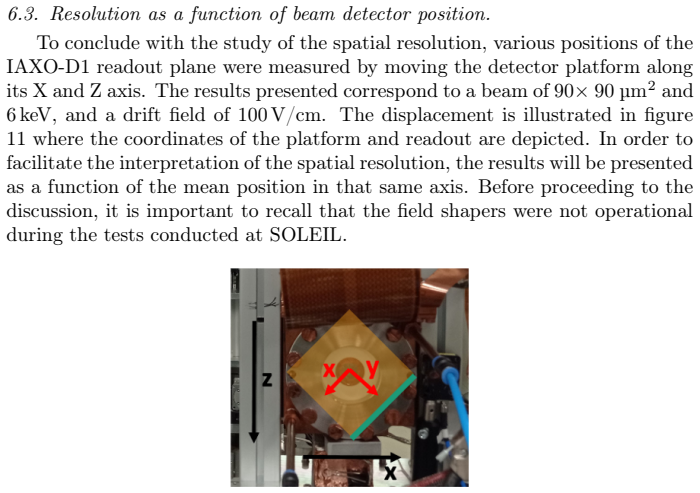
- [Sec. 6.3] Figure 12 uses X and Y axes while the text says the detector platform was moved along X and Z. Please clarify the correspondence between readout coordinates (X,Y) and platform coordinates to avoid confusion.
- [Sec. 3] The statement that the field shaper was 'intentionally left disconnected' is important. Consider adding a sentence in Sec. 7 that the final BabyIAXO configuration with the field shaper operational should improve field uniformity and reduce position-dependent degradation.
Circularity Check
No circularity: the spatial-resolution claim is a direct measurement; the beam-convolved sigma is a conservative upper bound, so no prediction reduces to an input.
full rationale
The paper's central claim—spatial resolution of approximately 100 µm at 6 keV and 100–300 µm over 5–10 keV, satisfying the BabyIAXO 1 mm requirement—rests on a direct measurement, not on a derived or fitted quantity. The resolution is extracted as the standard deviation of the per-event mean-position observable from a Gaussian fit to calibrated detector data (Sec. 4, Figs. 6–7). The load-bearing inputs are independently set or measured: beam size by collimating slits and the reference camera, noise as the measured baseline sigma, thresholds from acquisition conditions, and drift velocity from the Garfield++ simulation. None of these is fitted to the measured resolution and then recycled as a prediction. The Geant4/REST-for-Physics simulations of Sec. 5 use these same empirically measured parameters and serve only as a comparison/validation, not as the source of the headline value. The finite beam width (90×90 µm²) is comparable to the measured sigma, but the paper explicitly states in Sec. 7 that the extracted values 'include contributions from both the intrinsic detector resolution and the finite beam width' and labels them 'conservative estimates'; Sec. 6.1 further notes the intrinsic resolution is 'at least as good as the lowest value measured.' Thus the caveat works in favor of the 1 mm requirement and does not constitute circularity. Self-citations (CAST low-background development [12], REST-for-Physics [21], and the spatial-resolution study [24]) provide context, software, and physical interpretation, but the requirement of 1 mm is an external experimental constraint and the measurement is self-contained against it. The only weakness is presentation: the abstract's 'approximately 100 µm at 6 keV' omits the explicit beam-convolved-upper-bound qualifier that the body supplies, which is a clarity issue, not a circularity issue.
Axiom & Free-Parameter Ledger
axioms (4)
- domain assumption X-ray photoelectric events are point-like and mostly reconstruct as single tracks, so the single-track selection (retaining about 96% of calibration events) does not bias the position resolution estimate.
- domain assumption Garfield++ and Geant4 correctly describe drift, diffusion, and signal formation in Ar with 5% isobutane, except for unmodeled impurity effects at low drift field.
- domain assumption The synchrotron beam has a square profile of the size measured by the reference camera, and the beam size enters directly into the resolution estimate.
- domain assumption The reconstruction pipeline maps strip signals linearly to X and Y coordinates, so the spread of reconstructed mean positions equals the detector resolution.
Cite this review
Pith. "Pith review of Spatial resolution studies with the BabyIAXO Micromegas prototype." pith.science (2026). https://pith.science/paper/MWQF3CBJ
@misc{pith2026250908138,
  author       = {Pith},
  title        = {Pith review of: Spatial resolution studies with the BabyIAXO Micromegas prototype},
  year         = {2026},
  howpublished = {\url{https://pith.science/paper/MWQF3CBJ}},
  note         = {Machine review of arXiv:2509.08138}
}
read the original abstract
The spatial resolution of the Micromegas prototype developed for the BabyIAXO experiment was evaluated using a low-energy X-ray beam at the SOLEIL synchrotron facility. BabyIAXO, currently under construction, aims to search for hypothetical solar axions. A key component of the experiment is a low-background X-ray detector with high efficiency in the 1-10 keV energy range and stringent background rejection capabilities. Achieving a spatial resolution on the order of, or better than, 1 mm is critical for accurately reconstructing signal shapes and positions, and for effectively discriminating between signal and background events. Therefore, a precise characterization of the detector's spatial resolution is essential to validate its suitability for the experiment. This study involved scanning the IAXO-D1 Micromegas detector under various beam energies, positions, and drift field configurations to evaluate their influence on spatial resolution. A resolution of approximately 100 $\mu$m at 6 keV was achieved, confirming the strong potential of this technology for application in the final BabyIAXO setup.
Figures



Reference graph
Works this paper leans on
-
[1]
A. Abeln, et al., Conceptual design of BabyIAXO, the intermediate stage towards the International Axion Observatory, JHEP 05 (2021) 137.arXiv: 2010.12076,doi:10.1007/JHEP05(2021)137
Pith/arXiv arXiv 2021
-
[2]
S. Ahyoune, et al., An accurate solar axions ray-tracing response of BabyIAXO, JHEP 02 (2025) 159.arXiv:2411.13915,doi:10.1007/ JHEP02(2025)159
Pith/arXiv arXiv 2025
-
[3]
E. Armengaud, et al., Physics potential of the International Axion Obser- vatory (IAXO), JCAP 06 (2019) 047.arXiv:1904.09155,doi:10.1088/ 1475-7516/2019/06/047
Pith/arXiv arXiv 2019
-
[4]
P. Carenza, M. Giannotti, J. Isern, A. Mirizzi, O. Straniero, Axion as- trophysics, Phys. Rept. 1117 (2025) 1–102.arXiv:2411.02492,doi: 10.1016/j.physrep.2025.02.002
Pith/arXiv arXiv 2025
-
[5]
Y. Giomataris, P. Rebourgeard, J. P. Robert, G. Charpak, MI- CROMEGAS: A High granularity position sensitive gaseous detector for high particle flux environments, Nucl. Instrum. Meth. A376 (1996) 29–35. doi:10.1016/0168-9002(96)00175-1
-
[6]
S. Andriamonje, et al., Development and performance of Microbulk Mi- cromegas detectors, JINST 5 (2010) P02001.doi:10.1088/1748-0221/5/ 02/P02001
-
[7]
Zioutas, et al., First results from the CERN Axion Solar Telescope (CAST), Phys
K. Zioutas, et al., First results from the CERN Axion Solar Telescope (CAST), Phys. Rev. Lett. 94 (2005) 121301.arXiv:hep-ex/0411033,doi: 10.1103/PhysRevLett.94.121301
Pith/arXiv arXiv 2005
-
[8]
Probing eV-scale axions with CAST
E. Arik, et al., Probing eV-scale axions with CAST, JCAP 02 (2009) 008. arXiv:0810.4482,doi:10.1088/1475-7516/2009/02/008
work page internal anchor Pith review Pith/arXiv arXiv 2009
-
[9]
Aune, et al., CAST search for sub-eV mass solar axions with 3He buffer gas, Phys
S. Aune, et al., CAST search for sub-eV mass solar axions with 3He buffer gas, Phys. Rev. Lett. 107 (2011) 261302.arXiv:1106.3919,doi:10.1103/ PhysRevLett.107.261302
Pith/arXiv arXiv 2011
-
[10]
Anastassopoulos, et al., New CAST Limit on the Axion-Photon In- teraction, Nature Phys
V. Anastassopoulos, et al., New CAST Limit on the Axion-Photon In- teraction, Nature Phys. 13 (2017) 584–590.arXiv:1705.02290,doi: 10.1038/nphys4109
Pith/arXiv arXiv 2017
-
[11]
K. Altenmüller, et al., New Upper Limit on the Axion-Photon Cou- pling with an Extended CAST Run with a Xe-Based Micromegas De- tector, Phys. Rev. Lett. 133 (22) (2024) 221005.arXiv:2406.16840, doi:10.1103/PhysRevLett.133.221005
Pith/arXiv arXiv 2024
-
[12]
Background discrimination with a Micromegas detector prototype and veto system for BabyIAXO
K. Altenmüller, et al., Background discrimination with a Micromegas de- tector prototype and veto system for BabyIAXO, Front. in Phys. 12 (2024) 1384415.arXiv:2403.06316,doi:10.3389/fphy.2024.1384415. 14
work page internal anchor Pith review Pith/arXiv arXiv 2024
-
[13]
S. Hoof, J. Jaeckel, L. J. Thormaehlen, Axion helioscopes as solar ther- mometers, JCAP 10 (2023) 024.arXiv:2306.00077,doi:10.1088/ 1475-7516/2023/10/024
work page internal anchor Pith review Pith/arXiv arXiv 2023
-
[14]
F. Aznar, et al., A Micromegas-based low-background x-ray detector cou- pled to a slumped-glass telescope for axion research, JCAP 12 (2015) 008. arXiv:1509.06190,doi:10.1088/1475-7516/2015/12/008
work page internal anchor Pith review Pith/arXiv arXiv 2015
-
[15]
H. Mirallas Sánchez, Desarrollo de grandes planos de lectura Micromegas para experimentos de búsqueda de sucesos poco probables, Ph.D. thesis, U. Zaragoza (main) (2024)
work page 2024
- [16]
-
[17]
E. Ruiz Chóliz, Ultra-low background Micromegas X-ray detectors for Ax- ion searches in IAXO and BabyIAXO, PhD thesis, Universidad de Zaragoza (2019)
work page 2019
-
[18]
M. Idir, P. Mercere, T. Moreno, A. Delmotte, Metrology and Tests Beamline at SOLEIL, AIP Conference Proceedings 879 (1) (2007) 619– 622.arXiv:https://aip.scitation.org/doi/pdf/10.1063/1.2436137, doi:10.1063/1.2436137. URLhttps://aip.scitation.org/doi/abs/10.1063/1.2436137
-
[19]
Y. Ménesguen, M.-C. Lépy, Characterization of the Metrology beamline at the SOLEIL synchrotron and application to the de- termination of mass attenuation coefficients of Ag and Sn in the range 3.5≤E≤28 keV, X-Ray Spectrometry 40 (6) (2011) 411–416. doi:https://doi.org/10.1002/xrs.1366. URLhttps://analyticalsciencejournals.onlinelibrary.wiley. com/doi/abs/...
-
[20]
URLhttp://www.altavision.com.br/Datasheets/Basler_EN/ scA1300-32gm.htmlx
Altavision. URLhttp://www.altavision.com.br/Datasheets/Basler_EN/ scA1300-32gm.htmlx
-
[21]
K. Altenmüller, S. Cebrián, T. Dafni, D. Díez-Ibáñez, J. Galán, J. Galindo, J. A. García, I. G. Irastorza, G. Luzón, C. Margalejo, H. Mirallas, L. Obis, O. Pérez, K. Han, K. Ni, Y. Bedfer, B. Biasuzzi, E. Ferrer-Ribas, D. Neyret, T. Papaevangelou, C. Cogollos, E. Picatoste, REST-for-Physics, a ROOT- based framework for event oriented data analysis and com...
-
[22]
H. Schindler, R. Veenhof, Garfield++ — simulation of ionisation based tracking detectorshttp://garfieldpp.web.cern.ch/garfieldpp, accessed: 2024-04-02 (2024)
work page 2024
-
[23]
Allison, K
J. Allison, K. Amako, J. Apostolakis, P. Arce, M. Asai, T. Aso, E. Bagli, A. Bagulya, S. Banerjee, G. Barrand, B. Beck, A. Bogdanov, D. Brandt, J. Brown, H. Burkhardt, P. Canal, D. Cano-Ott, S. Chauvie, K. Cho, G. Cirrone, G. Cooperman, M. Cortés-Giraldo, G. Cosmo, G. Cuttone, G. Depaola, L. Desorgher, X. Dong, A. Dotti, V. Elvira, G. Folger, Z. Francis, ...
2016
-
[24]
A. Cools, E. Ferrer-Ribas, T. Papaevangelou, E. C. Pollacco, M. Lisowska, F. M. Brunbauer, E. Oliveri, F. J. Iguaz, Spatial resolution studies us- ing point spread function extraction in optically read out Micromegas and GEM detectors, Nucl. Instrum. Meth. A 1069 (2024) 169933.arXiv: 2407.15491,doi:10.1016/j.nima.2024.169933
work page internal anchor Pith review Pith/arXiv arXiv 2024
-
[25]
M. Strobl, R. P. Harti, C. Gruenzweig, R. Woracek, J. Plomp, Small angle scattering in neutron imaging—a review, Journal of Imaging 3 (4) (2017). doi:10.3390/jimaging3040064. URLhttps://www.mdpi.com/2313-433X/3/4/64
-
[26]
I. Anderson, R. McGreevy, H. Bilheux, Neutron Imaging and Applications, 2009.doi:10.1007/978-0-387-78693-3
-
[27]
Pancin, et al., Measurement of the n_TOF beam profile with a mi- cromegas detector, Nucl
J. Pancin, et al., Measurement of the n_TOF beam profile with a mi- cromegas detector, Nucl. Instrum. Meth. A 524 (2004) 102–114.doi: 10.1016/j.nima.2004.01.055
-
[28]
Neutron imaging with a Micromegas detector
F. Jeanneau, et al., Neutron imaging with a Micromegas detector, IEEE Trans. Nucl. Sci. 53 (2006) 595–600.arXiv:physics/0607191,doi:10. 1109/TNS.2006.870175. 16
work page internal anchor Pith review Pith/arXiv arXiv 2006
discussion (0)
Sign in with ORCID, Apple, or X to comment. Anyone can read and Pith papers without signing in.