REVIEW 3 major objections 4 minor 30 references
Selective Induction Heads: How Transformers Select Causal Structures In Context
T0 review · 3 major / 4 minor · reviewed 2026-08-04 · deepseek-v4-flash
Pith's one-line read A three-layer attention-only transformer can select the correct causal lag in context and converge to maximum-likelihood selection.
desk verdict The selective induction head construction and the interleaved-Markov-chain task are real contributions, but the paper's headline proof of asymptotic MLE equivalence rests on an unproved inequality (Claim 1), so the abstract overstates what is established. read the letter →
The pith
A machine-rendered reading of the paper's core claim, the machinery that carries it, and where it could break.
The reading
What carries the argument
The mechanism is the selective induction head, an attention circuit whose copy source is chosen by an evidence score rather than by a fixed token match. The score at position i for lag k is the normalized transition probability p̃ᵢ,ₖ = Xᵢ₋ₖᵀ P* Xᵢ / Σₗ Xᵢ₋ₗᵀ P* Xᵢ; the head watches cumulative sums over i. The construction uses three layers: layer 1 puts log P* and a lag-selective position mask in the attention matrix so each token stores normalized transitions for every lag; layer 2 uses K shifted diagonal attention heads to aggregate non-overlapping chunks of history without mixing lags; layer 3 combines an A matrix that opens only diagonals corresponding to lags with B matrices that select
What would settle it
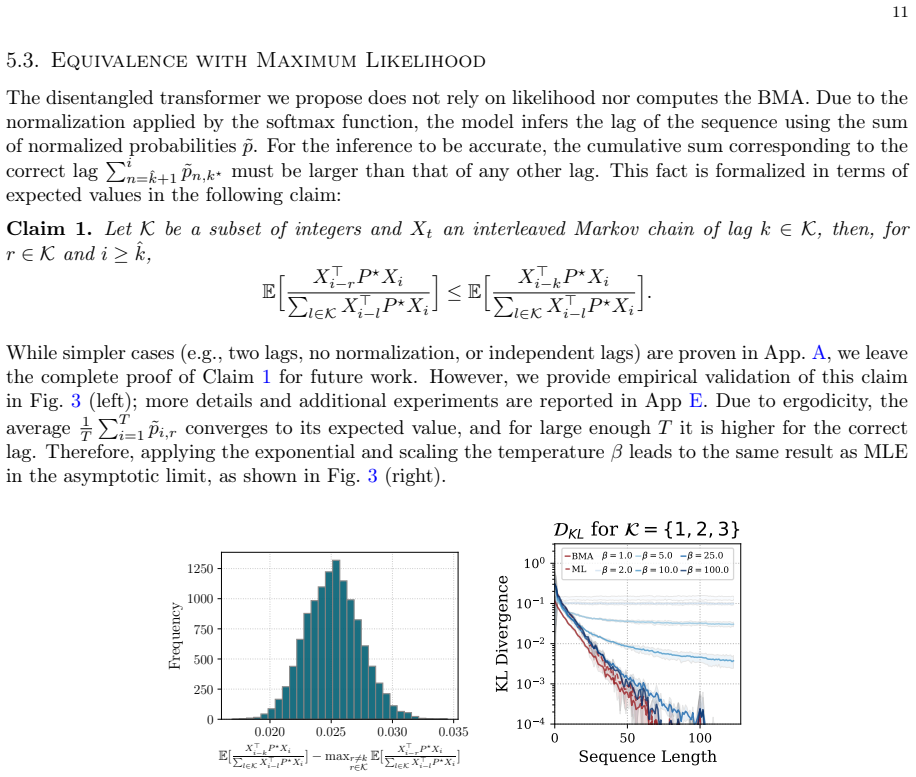
Compute, for randomly sampled transition matrices P* and lag sets K (including lag sets with close or nested lags), the stationary expectation E[ X_{i-k}^T P* X_i / Σ_l X_{i-l}^T P* X_i ] for the true lag k and for each alternative r. If any alternative has a larger expectation, Claim 1 is false; the paper itself reports a histogram of this difference and all values are positive, but that histogram is finite. The cleanest test is to search adversarially for a counterexample and, if found, to check whether trained transformers still select the wrong lag asymptotically.
Extended reading notes
Core claim
The central claim is Proposition 1: for any contiguous set of lags K, there exists a three-layer disentangled attention-only transformer whose final-token prediction is a weighted mixture over lags, with weights proportional to exp(β/(T−k̂) Σᵢ p̃ᵢ,ₖ), where p̃ᵢ,ₖ is the normalized transition probability of lag k at position i. In the large-β limit this becomes a hard selection of the lag with the largest cumulative normalized transition probability, and the final attention copies the corresponding past token—the selective induction head. Section 5.3 then claims this selection coincides with maximum-likelihood selection asymptotically: under Claim 1 the true lag has the largest expected norma
Load-bearing premise
Claim 1: for an interleaved Markov chain generated with true lag k, the expected normalized transition probability of lag k is at least that of every other lag; the paper proves this only for two lags, independent lags, and the unnormalized case, and leaves the general proof to future work.
Editorial extensions
If this is right
- If the construction is what transformers learn, then three attention layers suffice for in-context causal-structure selection, and two layers do not.
- The selection rule is not Bayesian model averaging but a softmax over accumulated normalized transition evidence; as context grows it approaches the maximum-likelihood lag, not the Bayes average.
- Standard trained transformers, not just the interpretable disentangled variant, show attention maps matching the constructed circuit, so the mechanism is a plausible account of actual trained models.
- The same circuit adapts to different lag sets: contiguous lags need K heads, non-contiguous lags need more, and the two-lag case needs only one head while retaining optimal sample complexity.
- A trained single-head transformer can outperform the interpreted construction, implying gradient descent finds other aggregation strategies with comparable or better sample efficiency.
Reading between the lines
- The unproven Claim 1 is the load-bearing inequality for the MLE-convergence result; a single transition matrix and lag set where a wrong lag has higher expected normalized transition probability would refute the asymptotic claim even though the circuit itself still exists.
- The aggregate-then-select pattern is attention's natural computation, so the same circuit may explain selection among other candidate statistical structures, such as n-gram orders or mixture components, whenever each candidate can be scored by a per-position normalized probability.
- The observed performance gap between single-head trained transformers and the interpretable single-head construction suggests that superposition-like compression in the aggregation layer is worth reverse-engineering.
- The setup offers a controlled testbed to measure the transition from Bayesian averaging at short lengths to hard MLE-like selection at long lengths, which could inform when LLMs switch between in-context strategies.
Editorial analysis
A structured set of objections, weighed in public.
Referee Report
Summary. The paper introduces a synthetic framework in which sequences are generated from interleaved Markov chains with a fixed transition matrix P* but an unknown, context-dependent lag k drawn from a set K. The task is to predict the next token by selecting the correct causal structure in-context. The authors define 'selective induction heads', propose a detailed 3-layer disentangled-transformer construction that extracts normalized transition probabilities, aggregates them with multiple attention heads, and selects a past token via a softmax-weighted score, and empirically compare trained transformers with the construction. The theoretical section (Sec. 5.3) claims that the constructed predictor asymptotically converges to the maximum-likelihood solution. The paper also provides special-case proofs in App. A, experiments on several lag sets, and attention-map comparisons.
Significance. If the theoretical claim were fully established, the paper would make a useful contribution: it identifies a concrete mechanism by which transformers can select among causal structures, gives an explicit circuit-level construction, and provides evidence that trained transformers implement the same algorithm. The construction itself is detailed and the experiments are extensive, including head/layer ablations and attention-map alignments. The two-lag proof, the ergodicity argument, and the empirical validation of the score are valuable. However, the headline theoretical contribution — asymptotic convergence to the MLE — is conditional on an explicitly unproved inequality, Claim 1, and the exact statement of Proposition 1 requires the λ→∞ limit. The paper is therefore stronger as an empirical/mechanistic study than as a proof of MLE equivalence.
major comments (3)
- [Sec. 5.3, App. A] The central asymptotic claim — that the cumulative normalized-transition score selects the true lag and hence matches MLE — is exactly Claim 1. The paper explicitly states 'we leave the complete proof of Claim 1 for future work' and provides only the two-lag case, the independent-lag case, and the unnormalized case. For |K|≥3, the denominator couples all lags, so the pairwise Lemma 1 cannot be directly applied. Since Claim 1 is the only bridge between the construction and MLE equivalence, the abstract's phrase 'a theoretical analysis proving that this mechanism asymptotically converges to the maximum likelihood solution' is stronger than what the manuscript establishes. Please either prove Claim 1 under stated conditions or explicitly restate the theoretical conclusion as conditional on Claim 1.
- [Prop. 1, Sec. 5.1, Eq. (3)] Proposition 1 is stated as an exact existence result: 'there exists a three-layer disentangled transformer' whose output equals Eq. (3). However, the construction derives Eq. (3) only in the λ→∞ limit; at finite λ the softmax attention gives a smoothed approximation, not the exact normalized probabilities p̃_{i,k} and exact weights w̃_k. To justify the proposition as stated, either formulate it as a limit statement (λ→∞, possibly β→∞) or provide finite-λ error bounds that vanish as λ grows. This is a load-bearing gap between the statement and the proof.
- [Sec. 5.3, Eq. (3), Sec. 5.2] The claimed convergence to MLE requires specifying the limiting order of T→∞ and β→∞. Eq. (3) already contains the temperature β; for a fixed finite β the softmax weights do not (generically) converge to the hard argmax that defines k*. The manuscript says 'for large β' in Sec. 5.2 and 'high-temperature limit' in App. A, which is inconsistent. Please define precisely the asymptotic regime (e.g., T→∞ then β→∞, or β growing with T) under which Eq. (3) reduces to MLE selection.
minor comments (4)
- [Abstract, Conclusion] The abstract says 'a theoretical analysis proving that this mechanism asymptotically converges to the maximum likelihood solution', while the Conclusion says 'in certain cases, it asymptotically converges to maximum likelihood'. These are materially different. Adjust the abstract to match the actual conditional statement.
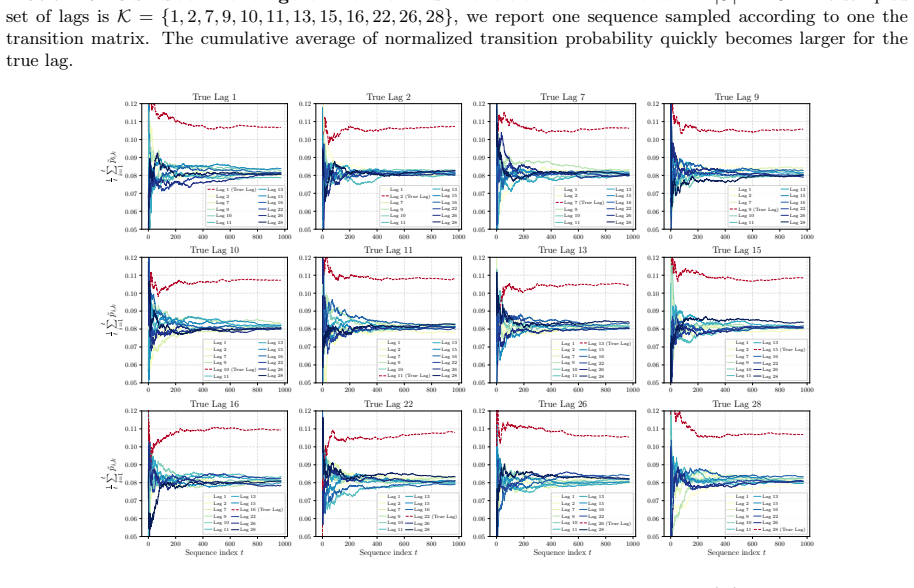
- [Fig. 3, App. E] The empirical validation of Claim 1 reports histograms of a positive difference over sampled matrices. Please include error bars or worst-case gaps over the sampled transition matrices to make the strength of the empirical support clearer.
- [App. A, Lemma 2 proof] The notation in the Cauchy-Schwarz chain in Lemma 2 is difficult to parse (e.g., the lines beginning with square-root sums and the marginalization step). Please restate the proof with explicit sums and a clear statement of the coupling/marginalization argument.
- [Sec. 3, Eq. (3)] The temperature notation is inconsistent: in the softmax definition α>0 is the temperature, while Eq. (3) uses β as an inverse temperature. Clarify the relationship and use consistent terminology for the 'large-β' / 'high-temperature' limits.
Circularity Check
No circularity: the headline derivation rests on an unproved inequality (Claim 1), not on a step that reduces to its own inputs.
full rationale
The derivation chain is constructive and self-contained: explicit attention matrices in Sec. 5.1 produce the estimator in Eq. (3), and the claimed asymptotic agreement with MLE in Sec. 5.3 is conditional on Claim 1, a substantive probabilistic inequality about interleaved Markov chains. Claim 1 is honestly labeled as unproved in general ("we leave the complete proof of Claim 1 for future work") and supported only by special cases and empirical histograms. This is a proof gap or an overstatement of what is proven, but it is not circular: the true lag is not defined as the maximizer of E[\tilde p_{i,k}], and the inequality is not an identity arrived at by construction. Nor is any parameter fitted to the benchmark data and then renamed a prediction. The paper contains no load-bearing self-citations; the cited prior work (Friedman et al., Nichani et al., Olsson et al., Rousseau and Mengersen) supplies background architecture, known consistency of MLE, and induction-head context, none of which smuggles in the paper's own conclusion. The secondary issue that Eq. (3) is formally obtained in the \lambda\to\infty limit while Proposition 1 states finite transformer weights is a rigor gap, not a circular reduction. Overall, the central mechanism has independent constructive content, and the unproved Claim 1 is an assumption, not an input-output equivalence.
Assumptions & free parameters
free parameters (2)
- lambda (attention sharpness) =
500
- beta (selection temperature) =
100
assumptions (4)
- domain assumption Interleaved Markov chain is ergodic with stationary distribution pi; the first k_hat samples of each sequence are drawn i.i.d. from pi.
- domain assumption The transition matrix P* is known to the constructed transformer, which places log P*^T and P*^T into its weights.
- ad hoc to paper Claim 1: the expected normalized transition probability is maximized by the true lag.
- standard math Softmax limits lambda -> infinity and beta -> infinity are taken and are assumed to preserve the finite-behavior mechanism.
invented entities (1)
-
Selective induction head
Cite this review
Pith. "Pith review of Selective Induction Heads: How Transformers Select Causal Structures In Context." pith.science (2026). https://pith.science/paper/KZRV7XD2
@misc{pith2026250908184,
  author       = {Pith},
  title        = {Pith review of: Selective Induction Heads: How Transformers Select Causal Structures In Context},
  year         = {2026},
  howpublished = {\url{https://pith.science/paper/KZRV7XD2}},
  note         = {Machine review of arXiv:2509.08184}
}
read the original abstract
Transformers have exhibited exceptional capabilities in sequence modeling tasks, leveraging self-attention and in-context learning. Critical to this success are induction heads, attention circuits that enable copying tokens based on their previous occurrences. In this work, we introduce a novel framework that showcases transformers' ability to dynamically handle causal structures. Existing works rely on Markov Chains to study the formation of induction heads, revealing how transformers capture causal dependencies and learn transition probabilities in-context. However, they rely on a fixed causal structure that fails to capture the complexity of natural languages, where the relationship between tokens dynamically changes with context. To this end, our framework varies the causal structure through interleaved Markov chains with different lags while keeping the transition probabilities fixed. This setting unveils the formation of Selective Induction Heads, a new circuit that endows transformers with the ability to select the correct causal structure in-context. We empirically demonstrate that transformers learn this mechanism to predict the next token by identifying the correct lag and copying the corresponding token from the past. We provide a detailed construction of a 3-layer transformer to implement the selective induction head, and a theoretical analysis proving that this mechanism asymptotically converges to the maximum likelihood solution. Our findings advance the understanding of how transformers select causal structures, providing new insights into their functioning and interpretability.
Figures


Figures from the paper (15 more)


Reference graph
Works this paper leans on
-
[1]
K. Ahn, X. Cheng, H. Daneshmand, and S. Sra. Transformers learn to implement preconditioned gradient descent for in-context learning. InThirty-seventh Conference on Neural Information Pro- cessing Systems, 2023. URLhttps://openreview.net/forum?id=LziniAXEI9
work page 2023
-
[2]
E. Akyürek, D. Schuurmans, J. Andreas, T. Ma, and D. Zhou. What learning algorithm is in-context learning? investigations with linear models.arXiv preprint arXiv:2211.15661, 2022
arXiv 2022
-
[3]
Y. Bai, F. Chen, H. Wang, C. Xiong, and S. Mei. Transformers as statisticians: Provable in-context learning with in-context algorithm selection. InThirty-seventh Conference on Neural Information Processing Systems, 2023. URLhttps://openreview.net/forum?id=liMSqUuVg9
work page 2023
-
[4]
Y. Bai, F. Chen, H. Wang, C. Xiong, and S. Mei. Transformers as statisticians: Provable in-context learning with in-context algorithm selection.Advances in neural information processing systems, 36, 2023
work page 2023
-
[5]
T. Batu, S. Guha, and S. Kannan. Inferring mixtures of markov chains. InLearning Theory: 17th Annual Conference on Learning Theory, COLT 2004, Banff, Canada, July 1-4, 2004. Proceedings 17, pages 186–199. Springer, 2004
work page 2004
-
[6]
A. Berchtold and A. Raftery. The mixture transition distribution model for high-order markov chains and non-gaussian time series.Statistical Science, 17(3):328–356, 2002
work page 2002
- [7]
-
[8]
T. B. Brown. Language models are few-shot learners.arXiv preprint arXiv:2005.14165, 2020
arXiv 2005
Show all 30 references
-
[9]
S. Chan, A. Santoro, A. Lampinen, J. Wang, A. Singh, P. Richemond, J. McClelland, and F. Hill. Data distributional properties drive emergent in-context learning in transformers.Advances in neural information processing systems, 35:18878–18891, 2022
2022
-
[10]
B. L. Edelman, E. Edelman, S. Goel, E. Malach, and N. Tsilivis. The evolution of statistical induction heads: In-context learning markov chains.arXiv preprint arXiv:2402.11004, 2024
2024 arXiv
-
[11]
Friedman, A
D. Friedman, A. Wettig, and D. Chen. Learning transformer programs. InThirty-seventh Confer- ence on Neural Information Processing Systems, 2023. URLhttps://openreview.net/forum?id= Pe9WxkN8Ff
2023
-
[12]
S. Garg, D. Tsipras, P. S. Liang, and G. Valiant. What can transformers learn in-context? a case study of simple function classes.Advances in Neural Information Processing Systems, 35:30583– 30598, 2022
2022
-
[13]
J. Hu, Q. Liu, and C. Jin. On limitation of transformer for learning hmms.arXiv preprint arXiv:2406.04089, 2024
2024 arXiv
-
[14]
M. E. Ildiz, Y. HUANG, Y. Li, A. S. Rawat, and S. Oymak. From self-attention to markov mod- els: Unveiling the dynamics of generative transformers. InForty-first International Conference on Machine Learning, 2024. URLhttps://openreview.net/forum?id=72oT4mPLUb
2024
-
[15]
A. V. Makkuva, M. Bondaschi, A. Girish, A. Nagle, M. Jaggi, H. Kim, and M. Gastpar. Attention with markov: A framework for principled analysis of transformers via markov chains.arXiv preprint arXiv:2402.04161, 2024
2024 arXiv
-
[16]
Minot and Y
A. Minot and Y. M. Lu. Separation of interleaved markov chains. In2014 48th Asilomar Conference on Signals, Systems and Computers, pages 1757–1761. IEEE, 2014
2014
-
[17]
T. Nguyen. Understanding transformers via n-gram statistics.arXiv preprint arXiv:2407.12034, 2024
2024 arXiv
-
[18]
Howtransformerslearncausalstructurewithgradientdescent
E.Nichani, A.Damian, andJ.D.Lee. Howtransformerslearncausalstructurewithgradientdescent. InForty-first International Conference on Machine Learning, 2024. URLhttps://openreview. net/forum?id=jNM4imlHZv
2024
-
[19]
Olsson, N
C. Olsson, N. Elhage, N. Nanda, N. Joseph, N. DasSarma, T. Henighan, B. Mann, A. Askell, Y. Bai, A. Chen, et al. In-context learning and induction heads.arXiv preprint arXiv:2209.11895, 2022. 15
2022 arXiv
-
[20]
Rajaraman, M
N. Rajaraman, M. Bondaschi, K. Ramchandran, M. Gastpar, and A. V. Makkuva. Transformers on markov data: Constant depth suffices.arXiv preprint arXiv:2407.17686, 2024
2024 arXiv
-
[21]
Raventós, M
A. Raventós, M. Paul, F. Chen, and S. Ganguli. Pretraining task diversity and the emergence of non-bayesian in-context learning for regression.Advances in Neural Information Processing Systems, 36, 2024
2024
-
[22]
Rousseau and K
J. Rousseau and K. Mengersen. Asymptotic behaviour of the posterior distribution in overfitted mixture models.Journal of the Royal Statistical Society Series B: Statistical Methodology, 73(5): 689–710, 2011
2011
-
[23]
M. E. Sander, R. Giryes, T. Suzuki, M. Blondel, and G. Peyré. How do transformers perform in-context autoregressive learning ? InForty-first International Conference on Machine Learning,
-
[24]
Svete and R
A. Svete and R. Cotterell. Transformers can representn-gram language models.arXiv preprint arXiv:2404.14994, 2024
2024 arXiv
-
[25]
Vaswani, N
A. Vaswani, N. Shazeer, N. Parmar, J. Uszkoreit, L. Jones, A. N. Gomez, L. u. Kaiser, and I. Polo- sukhin. Attention is all you need. In I. Guyon, U. V. Luxburg, S. Bengio, H. Wallach, R. Fergus, S. Vishwanathan, and R. Garnett, editors,Advances in Neural Information Processin...
2017
-
[26]
Von Oswald, E
J. Von Oswald, E. Niklasson, E. Randazzo, J. Sacramento, A. Mordvintsev, A. Zhmoginov, and M. Vladymyrov. Transformers learn in-context by gradient descent. InInternational Conference on Machine Learning, pages 35151–35174. PMLR, 2023
2023
-
[27]
Von Oswald, E
J. Von Oswald, E. Niklasson, M. Schlegel, S. Kobayashi, N. Zucchet, N. Scherrer, N. Miller, M. San- dler, M. Vladymyrov, R. Pascanu, et al. Uncovering mesa-optimization algorithms in transformers. arXiv preprint arXiv:2309.05858, 2023
2023 arXiv
-
[28]
S. M. Xie, A. Raghunathan, P. Liang, and T. Ma. An explanation of in-context learning as implicit bayesian inference.arXiv preprint arXiv:2111.02080, 2021
2021 arXiv
-
[29]
Yadlowsky, L
S. Yadlowsky, L. Doshi, and N. Tripuraneni. Pretraining data mixtures enable narrow model selec- tion capabilities in transformer models.arXiv preprint arXiv:2311.00871, 2023. 16 Organization of the Appendix.The Appendix is organized as follows. App. A extends the statistical ...
2023 arXiv
-
[2024]
URLhttps://openreview.net/forum?id=kZbTkpnafR
Reviewed August 4, 2026 · model on record in the stance chip above.
Discussion (0). Sign in to comment.