REVIEW 4 major objections 4 minor 61 references
Ensemble Distribution Distillation for Self-Supervised Human Activity Recognition
T0 review · 4 major / 4 minor · reviewed 2026-08-04 · deepseek-v4-flash
Pith's one-line read A single prior network, trained by ensemble distribution distillation, matches a 10-member ensemble's accuracy and robustness on human activity recognition while running one forward pass.
desk verdict Solid applied paper that transfers EDD to self-supervised HAR; the robustness claim is real but thinner than advertised because it's FGSM-only. read the letter →
The pith
A machine-rendered reading of the paper's core claim, the machinery that carries it, and where it could break.
The reading
What carries the argument
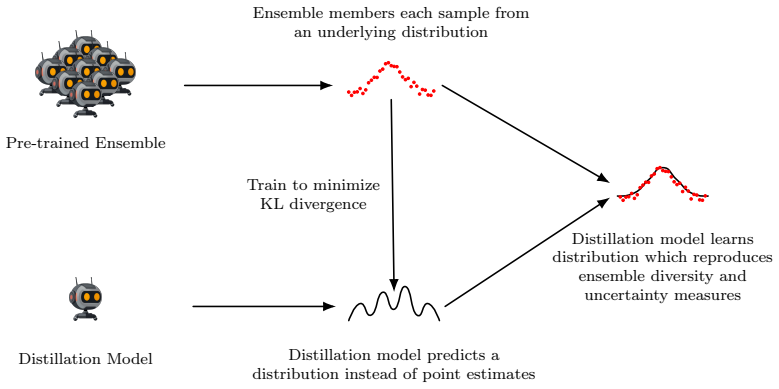
The central mechanism is ensemble distribution distillation into a prior network: rather than a point prediction, the network outputs Dirichlet parameters over activity classes, which define a distribution over class probabilities. Training minimizes the KL divergence between this Dirichlet distribution and the distribution implied by the ensemble's outputs, allowing one forward pass to reproduce the ensemble's mean prediction, total uncertainty, and separable epistemic and aleatoric estimates. Two data-augmentation ingredients carry the argument: the eight self-supervised transforms extend the distillation dataset into invariant directions, and weighted combinations of samples fill the betw
What would settle it
Run the same evaluation under a stronger white-box attack, such as projected gradient descent at epsilon=0.1, or an attack optimized directly against the distilled prior network, and compare the distilled model's accuracy and uncertainty AUC-ROC to those of the 10- and 50-member ensembles. If the distilled model drops to single-model-level accuracy while the ensembles remain robust, the central robustness claim is refuted.
Extended reading notes
Core claim
The paper's central claim is that ensemble diversity, not just ensemble accuracy, is transferable to a single model through ensemble distribution distillation in the self-supervised HAR setting. The authors train each ensemble member with the same architecture and partially supervised procedure used for the baseline single model, differing only in random initialization, batch sampling, and hidden-unit scaling. The distilled prior network, whose outputs parameterize a Dirichlet distribution over activity classes, is trained by minimizing KL divergence to the ensemble's output distribution on an augmented distillation dataset. Their results show that this single network retains close to the pr
Load-bearing premise
The load-bearing assumption is that robustness measured against FGSM at epsilon=0.1 generalizes to adversarial perturbation in general; if a stronger or adaptive attack erases the distilled model's advantage over the single model, the headline robustness claim fails.
Editorial extensions
If this is right
- Single-pass deployment: activity-recognition models on phones and wearables could get ensemble-level accuracy and uncertainty without running multiple models, enabling uncertainty-based gating or fall detection in real time.
- Adversarial robustness without adversarial training: the robustness gain comes from distilling ensemble diversity, not from training on adversarial examples, suggesting a path to robustness that does not require knowing the attack in advance.
- Small-label regime: with only 50 labeled instances per class, distilled ensembles outperform the fully supervised single-model baseline on several datasets, so reliable HAR may be possible where labels are scarce.
- Uncertainty as a quality signal: the distilled model's total uncertainty remains a useful predictor of misclassification under perturbation, supporting its use to trigger human review or alternative sensors.
Reading between the lines
- The paper evaluates robustness only under FGSM at epsilon=0.1; whether the distilled model retains ensemble-level accuracy under stronger or adaptive attacks, such as PGD or attacks designed for the distilled model, is an open extension.
- The weighted-combination augmentation, designed to create between-class sensor samples, could plausibly transfer to other time-series domains with few labels, but that transfer is not shown here.
- The separable epistemic and aleatoric uncertainties the model outputs are measured but not exploited; a natural next step is using epistemic uncertainty for active learning or out-of-distribution detection on wearable data.
- Because the architecture is unchanged from the baseline, the same distillation recipe could be applied to any small HAR model to improve calibration and robustness, though gains may depend on dataset diversity, as the UCI results suggest.
Editorial analysis
A structured set of objections, weighed in public.
Referee Report
Summary. The paper proposes an Ensemble Distribution Distillation (EDD) pipeline for semi-supervised human activity recognition. It first trains an ensemble of CNNs following Saeed et al.'s self-supervised pretext task with a small labeled downstream set, augments unlabeled data with eight transformations and weighted combinations of samples, and distills the ensemble's predictive distribution into a single prior network by minimizing KL divergence. The manuscript reports accuracy, FGSM robustness (epsilon=0.1), and total-uncertainty quality (accuracy-vs-uncertainty curves, AUC-ROC) on HHAR, UCI HAR, MotionSense, and PAMAP2, comparing a single model, 10- and 50-member ensembles, and the distilled model. The central claim is that the distilled model retains ensemble-level accuracy, robustness, and uncertainty at no extra inference cost.
Significance. If the claims hold, the paper addresses an important deployment gap: obtaining ensemble-grade predictive accuracy and uncertainty estimates at single-model inference cost. The evaluation uses four public datasets, matched architectures, 10-run averages, and the method does not appear to fit constants to the test sets. These are genuine strengths. The main weaknesses are the narrow adversarial evaluation protocol and the incomplete reporting of training hyperparameters; both are addressable and do not invalidate the overall direction.
major comments (4)
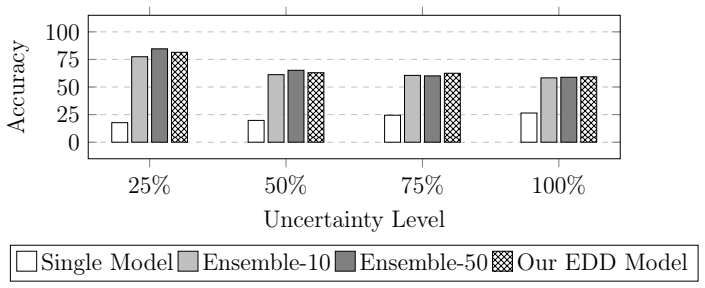
- [§3.2; §4.3.2, Table 2] The robustness claim in the Abstract and Section 4.3.2 is supported only by FGSM with epsilon=0.1. FGSM is a single-step attack and can overstate robustness. More importantly, the manuscript does not state whether perturbations are computed white-box per model or transferred from a single model. If a single perturbation from the baseline model is applied to all models, Table 2 compares white-box single-model accuracy against black-box transfer accuracy for the ensembles and distilled model, invalidating the comparison. Please specify the attack protocol and add an iterative attack (e.g., PGD) or a per-model white-box FGSM baseline. This is load-bearing because 'substantial increases in robustness against adversarial perturbation' is a headline contribution.
- [Algorithm 1; §4.1] Algorithm 1 lists E, t0, t_max, v_t, v_c, N_C, r, and N_F as inputs, but Section 4.1 provides only the architecture, ensemble sizes, and hidden-unit scaling factor r. No values or schedules are given for the temperature annealing, combo-depth schedule, number of epochs, or combo weight distribution. Consequently the experiments cannot be reproduced and the role of the augmentation procedure cannot be isolated. Please report these hyperparameters explicitly, or provide a reproducibility appendix with the values used for each dataset.
- [Tables 3–6; §4.3.3] AUC-ROC scores are reported as point estimates even though the paper states that all results are averaged over 10 runs. The uncertainty-quality comparisons, such as the claim that the distilled model achieves the highest AUC-ROC on PAMAP2, lack error bars or significance tests. Without variance estimates it is unclear whether the observed differences are meaningful. Please report mean±std or confidence intervals for AUC-ROC and, where ranking claims are made, provide a paired statistical test.
- [§4.3.2, final paragraph] The text states that the observed adversarial resilience comes 'solely as a result of the ensemble diversity.' This attribution is not supported by the experiments, because the distilled model also receives self-supervised pretraining, transformed data, weighted-combination augmentation, and temperature annealing. A comparison against the single-model baseline does not isolate ensemble diversity. Please either add ablations that separate these components or soften the attribution claim.
minor comments (4)
- [§2.2, Eq. (2)] Bayes' theorem is written as p(θ|D)=p(D|θ)p(θ); the normalizing constant p(D) is missing. It should be p(θ|D)=p(D|θ)p(θ)/p(D), or the right-hand side should be marked as proportional.
- [Algorithm 1; §4.1] The symbol r is overloaded: in Algorithm 1 and Eq. (7) it denotes the weighted-combination parameter, while in Section 4.1 it denotes the hidden-unit scaling factor. Please use distinct symbols.
- [§2.2] Typo: 'we can be use this approach' should read 'we can use this approach'.
- [§4.1] The relationship between the 50-member ensemble used for distillation and the reported 10-member ensemble is not stated explicitly. Is Ensemble-10 a subset of the 50 members, or a separate group? Please clarify.
Circularity Check
No circularity: the distilled model's accuracy, robustness, and uncertainty are empirical outcomes evaluated on held-out data and perturbations not used in training.
full rationale
The paper's central chain is: (1) train an ensemble of 50 semi-supervised models following Saeed et al. [48]; (2) build a distillation dataset by running the ensemble on augmented inputs; (3) train a prior network to match the ensemble's predictive Dirichlet distribution via KL/NLL (Eq. 5 and Algorithm 1); (4) evaluate accuracy, FGSM robustness, and uncertainty quality on held-out participants (HHAR/UCI/MotionSense/PAMAP2) against single-model and ensemble baselines. No step reduces to its own inputs: the distilled model's outputs are not fitted to the reported test-set accuracies or AUC-ROC values, and the FGSM perturbations (Sections 3.2 and 4.3.2) were not used as training data. The method builds on prior external work [38,39] and an external training pipeline [48], with no author self-citations carrying a load-bearing argument. The only noteworthy caveat—robustness being measured solely with FGSM at epsilon=0.1—is a threat-model limitation, not circularity. The selection of augmentations based on validation performance is a model-selection concern, but the reported metrics are measurements, not predictions implied by construction.
Assumptions & free parameters
free parameters (5)
- combo weight parameter r =
not specified in paper
- temperature schedule (t0, t_max, v_t) =
not specified
- combo depth schedule (v_c, N_C) =
not specified
- number of epochs E =
not specified
- ensemble hidden-unit scaling range =
0.75 to 1.25
assumptions (4)
- domain assumption EDD as formalized by Malinin et al. [39] correctly distills an ensemble's predictive distribution into a Dirichlet prior network.
- domain assumption The self-supervised transform-prediction pretraining of Saeed et al. [48] yields transferable representations for HAR with limited labels.
- ad hoc to paper Weighted combinations of samples (Eq. 7) create points with genuinely high epistemic uncertainty that a trustworthy ensemble labels meaningfully.
- domain assumption FGSM with epsilon=0.1 is representative of adversarial perturbation for the robustness claims.
Cite this review
Pith. "Pith review of Ensemble Distribution Distillation for Self-Supervised Human Activity Recognition." pith.science (2026). https://pith.science/paper/OPNHV5KO
@misc{pith2026250908225,
  author       = {Pith},
  title        = {Pith review of: Ensemble Distribution Distillation for Self-Supervised Human Activity Recognition},
  year         = {2026},
  howpublished = {\url{https://pith.science/paper/OPNHV5KO}},
  note         = {Machine review of arXiv:2509.08225}
}
read the original abstract
Human Activity Recognition (HAR) has seen significant advancements with the adoption of deep learning techniques, yet challenges remain in terms of data requirements, reliability and robustness. This paper explores a novel application of Ensemble Distribution Distillation (EDD) within a self-supervised learning framework for HAR aimed at overcoming these challenges. By leveraging unlabeled data and a partially supervised training strategy, our approach yields an increase in predictive accuracy, robust estimates of uncertainty, and substantial increases in robustness against adversarial perturbation; thereby significantly improving reliability in real-world scenarios without increasing computational complexity at inference. We demonstrate this with an evaluation on several publicly available datasets. The contributions of this work include the development of a self-supervised EDD framework, an innovative data augmentation technique designed for HAR, and empirical validation of the proposed method's effectiveness in increasing robustness and reliability.
Figures


Figures from the paper (7 more)




Reference graph
Works this paper leans on
-
[1]
Rajendra Acharya, Vladimir Makarenkov, and Saeid Nahavandi
Moloud Abdar, Farhad Pourpanah, Sadiq Hussain, Dana Rezazadegan, Li Liu, Mohammad Ghavamzadeh, Paul Fieguth, Xiaochun Cao, Ab- bas Khosravi, U. Rajendra Acharya, Vladimir Makarenkov, and Saeid Nahavandi. A review of uncertainty quantification in deep learning: Techniques, applications and challenges.Information Fusion, 76:243–297, 2021
work page 2021
-
[2]
Large scale distributed neural network training through online distillation
Rohan Anil, Gabriel Pereyra, Alexandre Tachard Passos, Robert Or- mandi, George Dahl, and Geoffrey Hinton. Large scale distributed neural network training through online distillation. InInternational Conference on Learning Representations (ICLR) Workshop Track, 2018
work page 2018
-
[3]
Alexei Baevski, Henry Zhou, Abdel-rahman Mohamed, and Michael Auli. wav2vec 2.0: A framework for self-supervised learning of speech representations.arXiv preprint, abs/2006.11477, 2020
arXiv 2006
-
[4]
Recent advances in adversarial training for adversarial robustness
Tao Bai, Jinqi Luo, Jun Zhao, Bihan Wen, and Qian Wang. Recent advances in adversarial training for adversarial robustness. InProceedings of the Thirtieth International Joint Conference on Artificial Intelligence (IJCAI-21), pages 4312–4321, 2021. Survey Track
work page 2021
-
[5]
Blei, Alp Kucukelbir, and Jon D
David M. Blei, Alp Kucukelbir, and Jon D. McAuliffe. Variational inference: A review for statisticians.Journal of the American Statistical Association, 112(518):859–877, 2017
2017
-
[6]
Michael Blum and Martin Riedmiller. Aleatoric and epistemic uncertainty in machine learning: an introduction to concepts and methods.Machine Learning, 110(5):1309–1354, 2021
work page 2021
-
[7]
Weight uncertainty in neural networks
Charles Blundell, Julien Cornebise, Koray Kavukcuoglu, and Daan Wier- stra. Weight uncertainty in neural networks. InProceedings of the 32nd International Conference on Machine Learning (ICML), pages 1613–1622, 2015
work page 2015
-
[8]
Curse of dimensionality in adversarial examples
Nandish Chattopadhyay, Anupam Chattopadhyay, Sourav Sen Gupta, and Michael Kasper. Curse of dimensionality in adversarial examples. In2019 International Joint Conference on Neural Networks (IJCNN), pages 1–8, 2019. 30
work page 2019
Show all 61 references
-
[9]
Deeplearningensembleforhyperspectralimageclassification
Yushi Chen, Ying Wang, Yanfeng Gu, Xin He, Pedram Ghamisi, and XiupingJia. Deeplearningensembleforhyperspectralimageclassification. IEEE Journal of Selected Topics in Applied Earth Observations and Remote Sensing, 12(6):1882–1897, 2019
2019
-
[10]
An inves- tigation into smartphone based weakly supervised activity recognition systems.Pervasive and Mobile Computing, 56:45–56, 2019
William Duffy, Kevin Curran, Daniel Kelly, and Tom Lunney. An inves- tigation into smartphone based weakly supervised activity recognition systems.Pervasive and Mobile Computing, 56:45–56, 2019
2019
-
[11]
Lipton, Michael Tschannen, Laurent Itti, and Anima Anandkumar
Tommaso Furlanello, Zachary C. Lipton, Michael Tschannen, Laurent Itti, and Anima Anandkumar. Born again neural networks, 2018
2018
-
[12]
Bayesian convolutional neural networks with bernoulli approximate variational inference.arXiv preprint, abs/1506.02158, 2015
Yarin Gal and Zoubin Ghahramani. Bayesian convolutional neural networks with bernoulli approximate variational inference.arXiv preprint, abs/1506.02158, 2015
2015 arXiv
-
[13]
Dropout as a bayesian approximation: Representing model uncertainty in deep learning
Yarin Gal and Zoubin Ghahramani. Dropout as a bayesian approximation: Representing model uncertainty in deep learning. InProceedings of The 33rd International Conference on Machine Learning, pages 1050–1059. PMLR, 2016
2016
-
[14]
Sufficient conditions for robustness to adversarial examples: a theoretical and empirical study with bayesian neural networks, 2019
Yarin Gal and Lewis Smith. Sufficient conditions for robustness to adversarial examples: a theoretical and empirical study with bayesian neural networks, 2019. OpenReview preprint, https://openreview. net/forum?id=B1eZRiC9YX
2019
-
[15]
Daniel Garcia-Gonzalez, Daniel Rivero, Enrique Fernandez-Blanco, and Miguel R. Luaces. A public domain dataset for real-life human activity recognition using smartphone sensors.Sensors, 20(8):2200, 2020
2020
-
[16]
Goodfellow, Jonathon Shlens, and Christian Szegedy
Ian J. Goodfellow, Jonathon Shlens, and Christian Szegedy. Explaining and harnessing adversarial examples.CoRR, abs/1412.6572, 2014
2014 arXiv
-
[17]
Maybank, and Dacheng Tao
Jianping Gou, Baosheng Yu, Stephen J. Maybank, and Dacheng Tao. Knowledge distillation: A survey.International Journal of Computer Vision, 129(6):1789–1819, 2021
2021
-
[18]
Practical variational inference for neural networks
Alex Graves. Practical variational inference for neural networks. In Advances in Neural Information Processing Systems, volume 24, 2011. 31
2011
-
[19]
Hammerla, Shane Halloran, and Thomas Plötz
Nils Y. Hammerla, Shane Halloran, and Thomas Plötz. Deep, con- volutional, and recurrent models for human activity recognition using wearables. InProceedings of the Twenty-Fifth International Joint Con- ference on Artificial Intelligence (IJCAI), pages 1533–1540, 2016
2016
-
[20]
Large language models memorize sensor datasets! implications on human activity recognition research, 2024
Harish Haresamudram, Hrudhai Rajasekhar, Nikhil Murlidhar Shanbhogue, and Thomas Ploetz. Large language models memorize sensor datasets! implications on human activity recognition research, 2024
2024
-
[21]
Using self-supervised learning can improve model robustness and uncer- tainty
Dan Hendrycks, Mantas Mazeika, Saurav Kadavath, and Dawn Song. Using self-supervised learning can improve model robustness and uncer- tainty. InProceedings of the 33rd International Conference on Neural Information Processing Systems, pages 1403–1414, Red Hook, NY, USA,
-
[22]
Hinton, Oriol Vinyals, and Jeffrey Dean
Geoffrey E. Hinton, Oriol Vinyals, and Jeffrey Dean. Distilling the knowledge in a neural network.arXiv preprint, abs/1503.02531, 2015
2015 arXiv
-
[23]
Detecting adversarial examples using data manifolds
Susmit Jha, Uyeong Jang, Somesh Jha, and Brian Jalaian. Detecting adversarial examples using data manifolds. InMILCOM 2018 - 2018 IEEE Military Communications Conference (MILCOM), pages 547–552, 2018
2018
-
[24]
HARGPT: Are LLMs zero-shot human activity recognizers?, 2024
Sijie Ji, Xinzhe Zheng, and Chenshu Wu. HARGPT: Are LLMs zero-shot human activity recognizers?, 2024
2024
-
[25]
Sampling- based self-supervised augmented contrast learning for movie recommen- dation systems
Huixin Jiang, Lingyu Yan, Chunzhi Wang, and Donghua Liu. Sampling- based self-supervised augmented contrast learning for movie recommen- dation systems. In2023 11th International Conference on Information Technology: IoT and Smart City (ITIoTSC), pages 144–148, 2023
2023
-
[26]
Evaluating uncertainty estimation methods on 3d semantic segmentation of point clouds, 2020
Swaroop K, Nico Hochgeschwender, Paul Plöger, Frank Kirchner, and Matias Valdenegro. Evaluating uncertainty estimation methods on 3d semantic segmentation of point clouds, 2020
2020
-
[27]
Distributional actor-critic ensemble for uncertainty-aware continuous control
Takuya Kanazawa, Haiyan Wang, and Chetan Gupta. Distributional actor-critic ensemble for uncertainty-aware continuous control. In2022 International Joint Conference on Neural Networks (IJCNN), pages 1–10, 2022. 32
2022
-
[28]
On the geometry of adversarial examples.arXiv preprint, abs/1811.00525, 2018
Marc Khoury and Dylan Hadfield-Menell. On the geometry of adversarial examples.arXiv preprint, abs/1811.00525, 2018
2018 arXiv
-
[29]
Large language models are zero-shot reasoners.arXiv preprint, abs/2205.11916, 2022
Takeshi Kojima, Shixiang Shane Gu, Machel Reid, Yutaka Matsuo, and Yusuke Iwasawa. Large language models are zero-shot reasoners.arXiv preprint, abs/2205.11916, 2022
2022 arXiv
-
[30]
Goodfellow, and Samy Bengio
Alexey Kurakin, Ian J. Goodfellow, and Samy Bengio. Adversarial machine learning at scale. InInternational Conference on Learning Representations (ICLR), 2017
2017
-
[31]
Towards unsuper- vised image captioning with shared multimodal embeddings
Iro Laina, Christian Rupprecht, and Nassir Navab. Towards unsuper- vised image captioning with shared multimodal embeddings. In2019 IEEE/CVF International Conference on Computer Vision (ICCV), pages 7413–7423, 2019
2019
-
[32]
Sim- ple and scalable predictive uncertainty estimation using deep ensembles
Balaji Lakshminarayanan, Alexander Pritzel, and Charles Blundell. Sim- ple and scalable predictive uncertainty estimation using deep ensembles. InAdvances in Neural Information Processing Systems, 2017
2017
-
[33]
Safe end-to- end imitation learning for model predictive control.arXiv preprint, abs/1803.10231, 2018
Keuntaek Lee, Kamil Saigol, and Evangelos Theodorou. Safe end-to- end imitation learning for model predictive control.arXiv preprint, abs/1803.10231, 2018
2018 arXiv
-
[34]
On norm-agnostic robustness of adversarial training.arXiv preprint, abs/1905.06455, 2019
Bai Li, Changyou Chen, Wenlin Wang, and Lawrence Carin. On norm-agnostic robustness of adversarial training.arXiv preprint, abs/1905.06455, 2019
1905 arXiv
-
[35]
Zechen Li, Shohreh Deldari, Linyao Chen, Hao Xue, and Flora D. Salim. Sensorllm: Aligning large language models with motion sensors for human activity recognition, 2024
2024
-
[36]
A general framework for ensemble distribution distillation.2020 IEEE 30th International Workshop on Machine Learning for Signal Processing (MLSP), pages 1–6, 2020
Jakob Lindqvist, Amanda Olmin, Fredrik Lindsten, and Lennart Svens- son. A general framework for ensemble distribution distillation.2020 IEEE 30th International Workshop on Machine Learning for Signal Processing (MLSP), pages 1–6, 2020
2020
-
[37]
Clegg, Andrea Cavallaro, and Hamed Haddadi
Mohammad Malekzadeh, Richard G. Clegg, Andrea Cavallaro, and Hamed Haddadi. Protecting sensory data against sensitive inferences. InProceedings of the 1st Workshop on Privacy by Design in Distributed Systems, W-P2DS’18, pages 2:1–2:6, New York, NY, USA, 2018. ACM. 33
2018
-
[38]
Predictive uncertainty estimation via prior networks
Andrey Malinin and Mark John Francis Gales. Predictive uncertainty estimation via prior networks. InNeural Information Processing Systems, 2018
2018
-
[39]
Ensemble distribution distillation.arXiv preprint, abs/1905.00076, 2019
Andrey Malinin, Bruno Mlodozeniec, and Mark John Francis Gales. Ensemble distribution distillation.arXiv preprint, abs/1905.00076, 2019
1905 arXiv
-
[40]
Berkay Celik
Patrick McDaniel, Nicolas Papernot, and Z. Berkay Celik. Machine learning in adversarial settings.IEEE Security & Privacy, 14(3):68–72, 2016
2016
-
[41]
On the validity of bayesian neural networks for uncertainty estimation
John Mitros and Brian Mac Namee. On the validity of bayesian neural networks for uncertainty estimation. InIrish Conference on Artificial Intelligence and Cognitive Science (AICS), 2019
2019
-
[42]
Deep convolu- tional feature transfer across mobile activity recognition domains, sensor modalities and locations
Francisco Javier Ordóñez Morales and Daniel Roggen. Deep convolu- tional feature transfer across mobile activity recognition domains, sensor modalities and locations. InProceedings of the 2016 ACM International Symposium on Wearable Computers (ISWC), pages 92–99, 2016
2016
-
[43]
Pong, Glen Berseth, and Sergey Levine
Ashvin Nair, Shikhar Bahl, Alexander Khazatsky, Vitchyr H. Pong, Glen Berseth, and Sergey Levine. Contextual imagined goals for self-supervised robotic learning.arXiv preprint, abs/1910.11670, 2019
1910 arXiv
-
[44]
Henry Friday Nweke, Ying Wah Teh, Mohammed Ali Al-garadi, and Uzoma Rita Alo. Deep learning algorithms for human activity recognition using mobile and wearable sensor networks: State of the art and research challenges.Expert Systems with Applications, 105:233–261, 2018
2018
-
[45]
Sculley, Sebas- tian Nowozin, Joshua V
Yaniv Ovadia, Emily Fertig, Jie Ren, Zachary Nado, D. Sculley, Sebas- tian Nowozin, Joshua V. Dillon, Balaji Lakshminarayanan, and Jasper Snoek. Can you trust your model’s uncertainty? evaluating predictive uncertainty under dataset shift. InAdvances in Neural Information Proc...
2019
-
[46]
Crafting adversarial input sequences for recurrent neural networks
Nicolas Papernot, Patrick McDaniel, Ananthram Swami, and Richard Ha- rang. Crafting adversarial input sequences for recurrent neural networks. InMILCOM 2016 - 2016 IEEE Military Communications Conference, pages 49–54, 2016. 34
2016
-
[47]
PAMAP2 Physical Activity Monitoring
Attila Reiss. PAMAP2 Physical Activity Monitoring. UCI Machine Learning Repository, 2012. DOI: https://doi.org/10.24432/C5NW2H
2012 doi
-
[48]
Multi-task self- supervised learning for human activity detection.Proc
Aaqib Saeed, Tanir Ozcelebi, and Johan Lukkien. Multi-task self- supervised learning for human activity detection.Proc. ACM Interact. Mob. Wearable Ubiquitous Technol., 3(2):61:1–61:30, 2019
2019
-
[49]
A comprehensive guide to bayesian convolutional neural network with variational inference
Kumar Shridhar, Felix Laumann, and Marcus Liwicki. A comprehensive guide to bayesian convolutional neural network with variational inference. arXiv preprint, abs/1901.02731, 2019
1901 arXiv
-
[50]
Improving the generalization of adversarial training with domain adaptation, 2018
Chuanbiao Song, Kun He, Liwei Wang, and John Hopcroft. Improving the generalization of adversarial training with domain adaptation, 2018
2018
-
[51]
Joshua S. Speagle. A conceptual introduction to markov chain monte carlo methods, 2020
2020
-
[52]
Smart devices are different: Assessing and mitigating mobile sensing heterogeneities for activity recognition
Allan Stisen, Henrik Blunck, Sourav Bhattacharya, Thor Siiger Prentow, Mikkel Baun Kjærgaard, Anind Dey, Tobias Sonne, and Mads Møller Jensen. Smart devices are different: Assessing and mitigating mobile sensing heterogeneities for activity recognition. InProceedings of the 13...
2015
-
[53]
Smartphone-based human activity pattern identification using unsupervised learning
Dipanwita Thakur and Suparna Biswas. Smartphone-based human activity pattern identification using unsupervised learning. In Mukesh Saraswat, Sarbani Roy, Chandreyee Chowdhury, and Amir H. Gandomi, editors,Proceedings of International Conference on Data Science and Applications...
2022
-
[54]
J.D. Tygar. Adversarial machine learning.IEEE Internet Computing, 15(5):4–6, 2011
2011
-
[55]
Transferable adversarial robustness using adversarially trained autoen- coders.CoRR, abs/1909.05921, 2019
Pratik Vaishnavi, Kevin Eykholt, Atul Prakash, and Amir Rahmati. Transferable adversarial robustness using adversarially trained autoen- coders.CoRR, abs/1909.05921, 2019
1909 arXiv
-
[56]
Deep sub-ensembles for fast uncertainty esti- mation in image classification.arXiv preprint, abs/1910.08168, 2019
Matias Valdenegro-Toro. Deep sub-ensembles for fast uncertainty esti- mation in image classification.arXiv preprint, abs/1910.08168, 2019. 35
1910 arXiv
-
[57]
Deep learning for sensor-based activity recognition: A survey.Pattern Recognition Letters, 119:3–11, 2019
Jindong Wang, Yiqiang Chen, Shuji Hao, Xiaohui Peng, and Lisha Hu. Deep learning for sensor-based activity recognition: A survey.Pattern Recognition Letters, 119:3–11, 2019
2019
-
[58]
Improving single-step adversarial training by local smoothing
Shaopeng Wang, Yanhong Huang, Jianqi Shi, Yang Yang, and Xin Guo. Improving single-step adversarial training by local smoothing. In2023 International Joint Conference on Neural Networks (IJCNN), pages 1–8, 2023
2023
-
[59]
Deep convolutional neural networks on multi- channel time series for human activity recognition
Jian Bo Yang, Minh Nhut Nguyen, Phyo Phyo San, Xiao Li Li, and Shonali Krishnaswamy. Deep convolutional neural networks on multi- channel time series for human activity recognition. InProceedings of the 24th International Conference on Artificial Intelligence (IJCAI), pages 39...
2015
-
[60]
Strength-adaptive adversarial training
Chaojian Yu, Dawei Zhou, Li Shen, Jun Yu, Bo Han, Mingming Gong, Nannan Wang, and Tongliang Liu. Strength-adaptive adversarial training. arXiv preprint, abs/2210.01288, 2022. 36
2022 arXiv
-
[2019]
Curran Associates Inc
Reviewed August 4, 2026 · model on record in the stance chip above.
Discussion (0). Sign in to comment.